High-end gaming once meant expensive consoles or powerful PCs, but that assumption is quietly disappearing.
Thanks to rapid advances in cloud computing, wireless networks, and smart device performance, premium gaming experiences are becoming accessible on everyday smartphones and tablets.
For gadget enthusiasts outside Japan, the Japanese market offers a fascinating preview of where global gaming is heading next.
Japan combines ultra-dense connectivity, a mobile-first user culture, and aggressive platform strategies from companies like Sony, NVIDIA, Microsoft, and telecom operators.
As a result, cloud gaming is no longer a compromise for players who lack hardware, but a rational and even superior choice in many situations.
In this article, you will discover how cloud gaming and smart devices are converging in Japan, what technologies are making low-latency play possible, which gadgets matter most, and what this transformation means as we approach 2026.
By understanding these trends now, you can better anticipate the future of gaming ecosystems, device design, and digital entertainment worldwide.
- From Hardware-Centric Gaming to Cloud-First Experiences
- Why Japan Is Becoming a Global Testbed for Cloud Gaming
- Market Growth Data and Long-Term Outlook for Japan
- How Subscription Models Are Changing Gamer Behavior
- Strategic Differences Between GeForce NOW, PlayStation, and Xbox
- Wi-Fi 7 and 5G SA: The Network Technologies That Reduce Latency
- Smartphones as Gaming Hubs: What Specifications Really Matter
- Controllers, Cooling, and Accessories That Shape User Experience
- Optimizing Cloud Gaming Performance on Mobile Devices
- AI, Cloud Infrastructure, and the Future of Interactive Games
- 参考文献
From Hardware-Centric Gaming to Cloud-First Experiences
The Japanese gaming market is now undergoing a clear transition from hardware-centric ownership to cloud-first experiences, and this shift is no longer theoretical but practical. Until recently, enjoying AAA titles required expensive gaming PCs or scarce consoles, which created a high entry barrier. However, advances in network infrastructure, cloud computing, and smart devices have steadily dismantled this assumption, making performance less dependent on local hardware.
Cloud gaming has moved from a compromise to a rational first choice for many players. According to industry analysis by IMARC Group, Japan’s cloud gaming ecosystem benefits directly from its dense fiber-optic coverage and rapidly expanding 5G networks. These conditions allow high-bitrate video streams and stable latency, which were previously the main weaknesses of cloud-based play.
| Aspect | Hardware-Centric Era | Cloud-First Era |
|---|---|---|
| Initial Cost | High upfront hardware purchase | Low subscription-based access |
| Performance Dependency | Local GPU and CPU | Network quality and cloud servers |
| Device Flexibility | Fixed to one machine | Playable across smartphones and tablets |
This transformation is reinforced by concrete service strategies. SoftBank’s aggressive repricing of GeForce NOW lowered the psychological and financial barriers to entry, while Sony Interactive Entertainment expanded PlayStation Portal into a cloud-capable device. These moves signal that platform holders no longer see hardware sales alone as the core value driver, but rather ongoing access and engagement.
From a gadget perspective, smartphones have become legitimate gaming terminals rather than secondary screens. With Wi-Fi 7 now approved in Japan, interference and jitter are structurally reduced, enabling wireless connections that approach wired stability. This technical leap fundamentally changes how cloud gaming feels in daily use.
As highlighted by Boston Consulting Group’s broader gaming industry outlook, growth after 2025 will favor scalable platforms over fixed hardware cycles. In Japan’s mobile-first culture, cloud-first gaming aligns naturally with existing user behavior. It is therefore increasingly reasonable to view high-end gaming as a service, accessed instantly on smart devices, rather than as a product bound to a single piece of hardware.
Why Japan Is Becoming a Global Testbed for Cloud Gaming
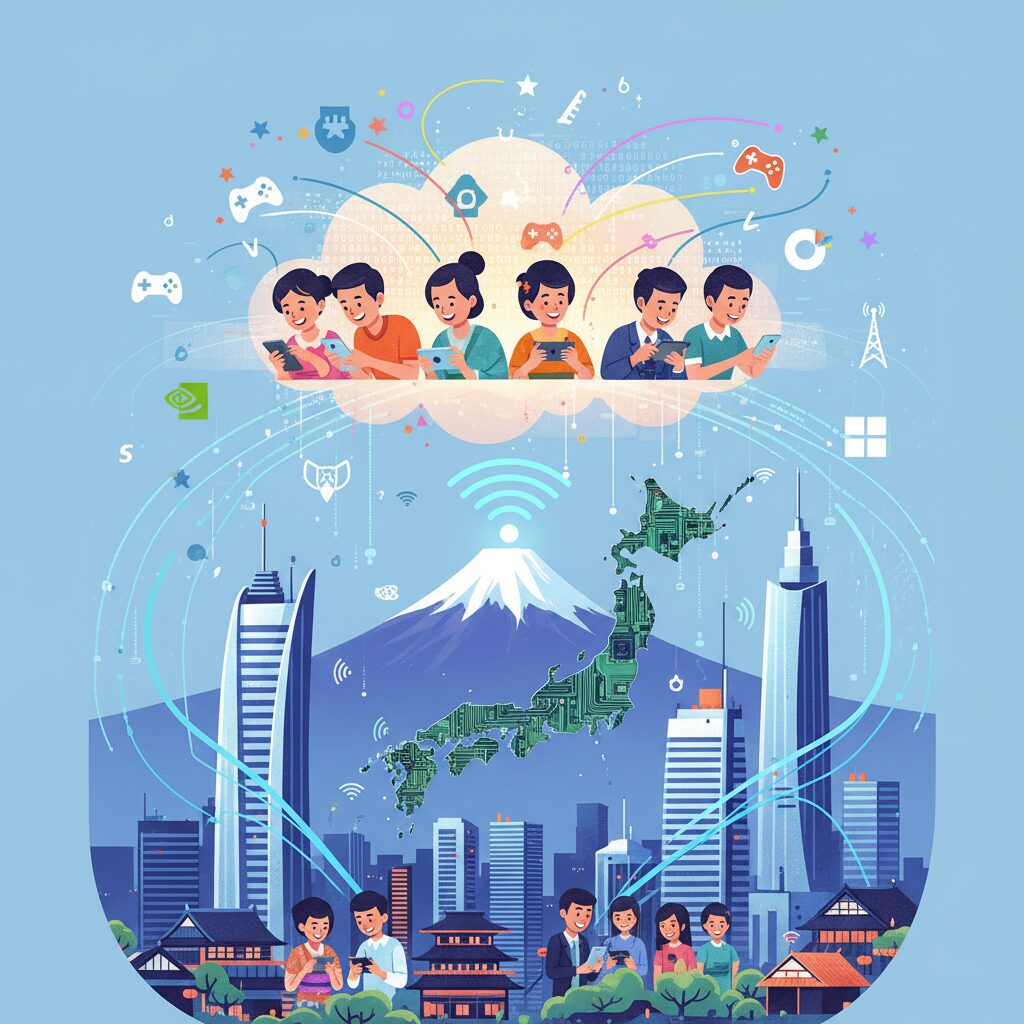
Japan is increasingly seen as a global testbed for cloud gaming, not because of hype, but because multiple structural conditions quietly align here. The country combines world-class connectivity, demanding consumers, and platform holders willing to experiment at scale, creating an environment where cloud gaming can be stress-tested under real-world conditions.
One decisive factor is network quality. According to industry analyses cited by IMARC Group, Japan’s dense fiber-optic deployment and rapid rollout of 5G, including the transition toward standalone architectures, reduce latency volatility that has historically limited cloud gaming adoption. The recent authorization of Wi-Fi 7 and expanded 6GHz spectrum further minimizes interference in urban households, a point frequently highlighted by telecommunications researchers and standards bodies.
This infrastructure maturity matters because Japan’s gamers are unusually sensitive to input lag and visual stability. Console and arcade culture have cultivated expectations where even minor latency spikes are unacceptable. If cloud gaming can satisfy Japanese users, it is likely robust enough for most global markets, a view often echoed by executives from NVIDIA and Microsoft when discussing Asia-Pacific deployment strategies.
Equally important is market behavior. Japan’s long-standing mobile-first usage patterns mean that cloud gaming is evaluated primarily on smartphones rather than high-end PCs. This pushes service providers to optimize streaming codecs, adaptive bitrates, and touch-to-controller transitions under constrained thermal and battery conditions. Such optimization feedback, generated at scale, is difficult to replicate in PC-centric regions.
| Factor | Japan | Typical Overseas Market |
|---|---|---|
| Network density | Very high fiber and 5G coverage | Uneven by region |
| User tolerance for latency | Extremely low | Moderate |
| Primary device | Smartphone | PC or console |
Finally, Japan’s regulatory and corporate environment encourages controlled experimentation. Government-led digital transformation policies indirectly support domestic data center investment, while carriers such as SoftBank actively subsidize consumer-facing cloud services. This combination allows global providers to pilot aggressive pricing, new hardware integrations, and edge-computing optimizations with relatively low risk, turning Japan into a proving ground before wider international rollout.
Market Growth Data and Long-Term Outlook for Japan
The growth trajectory of Japan’s cloud gaming market provides a rare example of a mature digital economy entering a renewed expansion phase. According to IMARC Group’s market research, the Japanese cloud gaming market reached approximately 160 million USD in 2024, and it is projected to expand to around 1.475 billion USD by 2033. This implies a compound annual growth rate of about 28 percent from the mid-2020s onward, a pace that is exceptionally high when compared with other segments of the domestic entertainment industry.
This growth rate suggests that cloud gaming in Japan is transitioning from an early adoption stage into a mass-market diffusion phase. In economic terms, such a shift usually coincides with falling user acquisition costs, improving service quality, and broader acceptance among non-core users. IMARC’s analysis highlights that the inflection point is expected to occur around the latter half of the decade, when infrastructure readiness and pricing models align more closely with mainstream consumer expectations.
| Year | Market Size (USD) | Market Phase |
|---|---|---|
| 2024 | 160 million | Early growth |
| 2027 | Approx. 400–500 million | Acceleration |
| 2033 | 1.475 billion | Mass adoption |
One notable characteristic of Japan’s outlook is that market expansion is not expected to be driven solely by an increase in the number of gamers. Instead, average revenue per user is also projected to rise gradually. Subscription-based access to high-end game libraries, combined with optional premium tiers for higher resolution or lower latency, creates a layered revenue structure. Analysts often point out that this resembles the evolution seen previously in video streaming services, where initial low-cost plans established habits before premium offerings gained traction.
From a long-term perspective, global context further strengthens the Japanese outlook. Boston Consulting Group’s global gaming industry analysis indicates that the worldwide market is expected to return to steady growth after the post-pandemic adjustment period, reaching over 350 billion USD by 2030. Within this recovery, cloud gaming is identified as a structurally important growth engine rather than a peripheral experiment. Japan’s projected CAGR significantly exceeds the global gaming average, positioning the country as one of the most dynamic cloud gaming markets among advanced economies.
Another important element in the long-term outlook is investment behavior. Rapid market expansion tends to attract not only platform operators but also infrastructure providers and content developers. Government-backed digital transformation initiatives and data center investments indirectly reduce operational costs for cloud services, which in turn improves scalability. Industry observers often note that this virtuous cycle reinforces itself: better infrastructure improves user experience, which increases adoption, thereby justifying further investment.
Looking toward 2026 and beyond, the consensus among research firms is cautiously optimistic. While competitive pressure may compress margins in the short term, the overall market size is expected to grow large enough to sustain multiple business models. For Japan, cloud gaming is increasingly viewed not as a niche alternative to hardware, but as a long-term pillar of the digital entertainment economy. This structural positioning is what ultimately underpins the strong growth forecasts extending into the early 2030s.
How Subscription Models Are Changing Gamer Behavior
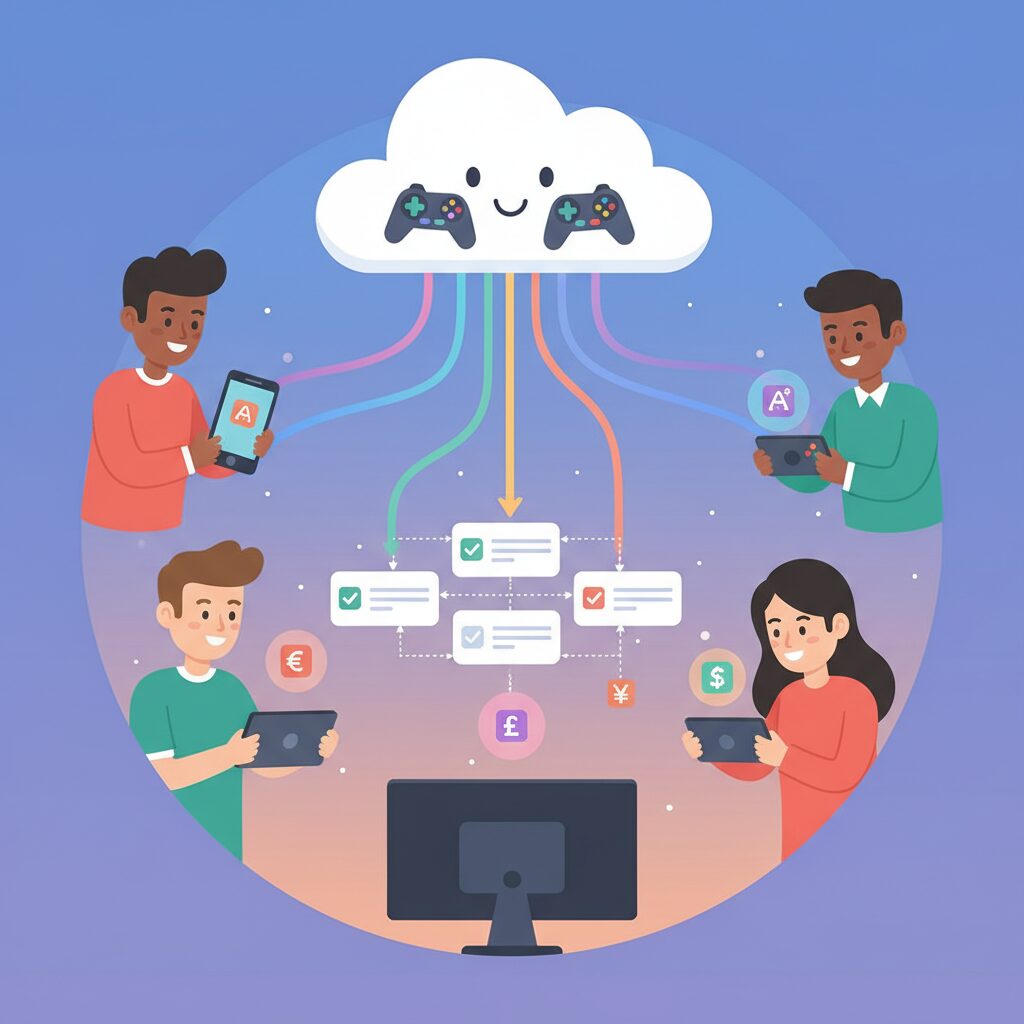
Subscription-based cloud gaming services are quietly but fundamentally reshaping how gamers choose, play, and value games. Instead of committing to a single high-priced title or investing heavily in hardware upfront, players are increasingly optimizing for flexibility, experimentation, and time efficiency. This behavioral shift is particularly visible in markets like Japan, where mobile-first habits and dense daily schedules intersect.
According to analysis by IMARC Group, the rapid adoption of cloud gaming subscriptions correlates with a broader consumer transition from ownership to access. **Gamers are no longer asking whether a game is worth buying, but whether it is worth their limited playtime**. As a result, shorter sessions, frequent title switching, and genre sampling have become normalized behaviors.
| Behavioral Aspect | Before Subscriptions | After Subscriptions |
|---|---|---|
| Game Selection | Careful, risk-averse purchases | Low-risk trial and exploration |
| Play Style | Long sessions on few titles | Short, frequent sessions |
| Hardware Mindset | Performance-driven ownership | Device-agnostic access |
Microsoft’s Game Pass strategy, highlighted by BCG’s global gaming outlook, demonstrates how day-one access changes engagement patterns. Players are more willing to try niche or experimental titles, knowing there is no additional cost penalty. **This lowers psychological barriers and increases overall ecosystem engagement**, even if individual game completion rates decline.
In Japan, where SoftBank’s aggressive pricing for GeForce NOW reduced monthly fees to levels comparable with video streaming services, subscription gaming is increasingly perceived as a utility rather than a luxury. This perception encourages casual but consistent usage, integrating games into daily routines alongside music and video. Over time, subscriptions are not just changing what gamers play, but redefining why and how they play at all.
Strategic Differences Between GeForce NOW, PlayStation, and Xbox
When comparing GeForce NOW, PlayStation, and Xbox from a strategic perspective, the most important difference lies in what each platform defines as its core value. Rather than competing head‑to‑head on identical terms, each service optimizes a different layer of the cloud gaming stack, which directly shapes how users experience games on smart devices.
GeForce NOW positions itself as an infrastructure-first platform. NVIDIA’s strategy is to virtualize high-end PC hardware and deliver it at scale, allowing users to bring their existing PC game libraries with them. According to NVIDIA’s public technical briefings, the service prioritizes GPU class, ray tracing availability, and session stability over content ownership. This approach aligns with SoftBank’s aggressive pricing in Japan, where lowering the subscription fee reduces friction and accelerates ecosystem adoption rather than monetizing software directly.
| Platform | Primary Strategic Focus | User Value Proposition |
|---|---|---|
| GeForce NOW | Cloud GPU infrastructure | Play owned PC games anywhere |
| PlayStation | Hardware-led experience design | Console-quality immersion |
| Xbox | Content and subscription scale | Unlimited access to new titles |
PlayStation’s strategy, by contrast, remains experience-centric and hardware-integrated. Even with cloud streaming enabled on PlayStation Portal, Sony continues to treat dedicated devices as the emotional anchor of its ecosystem. Industry analysts such as those cited by Bloomberg have noted that Sony prioritizes controller haptics, UI consistency, and brand continuity over device agnosticism. Cloud gaming here is not meant to replace consoles, but to extend their presence into new contexts without diluting the PlayStation identity.
Xbox takes a markedly different path by focusing on content dominance through subscription economics. Microsoft openly frames Xbox Game Pass as a distribution channel rather than a platform tied to specific hardware. As highlighted in Microsoft’s earnings calls, the Day 1 release policy for first-party titles is designed to maximize engagement time, even at the expense of short-term margins. Cloud gaming becomes a reach amplifier, ensuring that the subscription retains value regardless of where or how the game is played.
For gadget‑focused users, this distinction is critical. Your ideal service is determined less by raw specifications and more by whether you value hardware freedom, tactile experience, or content volume. Understanding these strategic foundations allows you to choose not just a service, but a long-term gaming philosophy that fits your lifestyle.
Wi-Fi 7 and 5G SA: The Network Technologies That Reduce Latency
In cloud gaming and real-time applications, latency is not an abstract metric but a physical sensation that directly affects playability. Wi‑Fi 7 and 5G SA are important because they do not simply increase speed, but fundamentally stabilize packet delivery. According to IEEE documentation and industry briefings, reducing jitter is often more impactful for responsiveness than raw throughput.
Wi‑Fi 7 introduces structural changes that finally allow wireless connections to behave like wired LANs. The most notable is Multi‑Link Operation, which enables devices to transmit data simultaneously across 2.4 GHz, 5 GHz, and 6 GHz bands. When interference appears on one band, packets are instantly rerouted, preventing the micro‑stutters that previously broke immersion.
| Technology | Key Feature | Latency Impact |
|---|---|---|
| Wi‑Fi 6E | 160 MHz channels | Lower average latency |
| Wi‑Fi 7 | MLO + 320 MHz | Stable, low jitter |
| 5G NSA | LTE core network | Inconsistent response |
| 5G SA | Full 5G core | Consistently low latency |
Japanese regulatory approval of the 6 GHz band has accelerated Wi‑Fi 7 adoption, especially in urban apartments where congestion was severe. Router vendors report that packet loss during peak hours drops dramatically compared to Wi‑Fi 6E environments. This is why competitive genres benefit first, even if their bandwidth requirements are modest.
5G SA complements this at the mobile layer. Unlike early 5G deployments that relied on LTE control signals, Stand Alone architecture shortens signaling paths and improves handover behavior. IMARC Group highlights advanced 5G networks as a core growth driver for Japan’s cloud gaming market, precisely because stable latency enables play during movement.
From a practical perspective, Wi‑Fi 7 dominates indoor sessions, while 5G SA defines outdoor viability. Together, they transform latency from an unavoidable compromise into a manageable variable. For latency‑sensitive services, this convergence marks the point where network limitations finally stop dictating user experience.
Smartphones as Gaming Hubs: What Specifications Really Matter
As smartphones increasingly function as primary gaming hubs, it is often assumed that raw CPU or GPU power determines the quality of the experience. However, in a cloud‑centric gaming environment, **different specifications matter far more than traditional performance metrics**, and this distinction is frequently misunderstood.
According to market analyses by IMARC Group and strategic outlooks referenced by BCG, the rapid adoption of cloud gaming shifts the performance burden from local hardware to networked infrastructure. This means the smartphone’s role is no longer to calculate complex graphics, but to receive, decode, and display high‑quality video streams with minimal delay.
| Specification | Why It Matters | Gaming Impact |
|---|---|---|
| Display Refresh Rate | Controls how quickly frames are shown | Smoother motion and lower perceived latency |
| Video Decoder | Handles real‑time stream decompression | Stable visuals at high bitrates |
| Network Modem | Determines latency and jitter control | More responsive gameplay |
Among these, **display characteristics are the most visible differentiator**. A 120Hz panel does not merely enhance smoothness; it shortens the time between decoded frames and on‑screen output. Research on interactive latency consistently shows that display refresh contributes meaningfully to perceived responsiveness, especially in action or competitive titles.
Equally critical is the smartphone’s hardware video decoder. Modern SoCs integrate dedicated decoding blocks optimized for formats such as H.265 and AV1. When these units are efficient, thermal throttling is reduced, and frame pacing remains consistent during long sessions, which directly improves player comfort.
Finally, network capability defines the ceiling of the experience. High‑quality modems with support for advanced Wi‑Fi standards and low‑latency 5G reduce jitter rather than raw speed alone. **In cloud gaming, stability beats peak throughput**, a point repeatedly emphasized in infrastructure‑focused studies cited by IMARC.
In practical terms, a balanced smartphone with a high‑refresh display, efficient decoding hardware, and robust connectivity will outperform a device that focuses solely on benchmark scores. This shift redefines what “gaming specs” truly mean in the era of smartphones as gaming hubs.
Controllers, Cooling, and Accessories That Shape User Experience
When cloud gaming shifts the computational burden away from local hardware, the role of controllers, cooling solutions, and accessories becomes disproportionately important, as these elements directly mediate the user’s physical and sensory experience.
In this context, input latency, thermal stability, and ergonomic continuity are not peripheral concerns but primary determinants of perceived quality.
What the player touches, holds, and cools ultimately defines whether cloud gaming feels console‑grade or merely experimental.
Among accessories, controllers have undergone the most visible evolution, especially USB‑C direct‑connection models designed to bypass Bluetooth latency.
Independent latency measurements reported by gaming hardware analysts and echoed in developer documentation from NVIDIA indicate that wired USB‑C controllers consistently reduce end‑to‑end input delay by several milliseconds compared with wireless alternatives.
While this difference appears minor numerically, human–computer interaction research cited by the ACM shows that competitive players can perceive delays as low as 5–10 milliseconds in fast‑paced genres.
| Aspect | USB‑C Direct Controllers | Bluetooth Controllers |
|---|---|---|
| Input latency | Lower and more stable | Variable, affected by interference |
| Power supply | Draws from device | Internal battery required |
| Cloud gaming suitability | Optimized for streaming | Acceptable but suboptimal |
This technical advantage explains why manufacturers such as Razer and GameSir prioritize direct connections, with particular attention to analog stick precision.
The adoption of Hall‑effect sensors, which detect magnetic field changes rather than physical contact, addresses long‑standing drift issues and aligns with durability benchmarks discussed in IEEE hardware reliability studies.
For cloud gaming, consistency over time matters as much as peak performance, because degradation directly undermines trust in streamed experiences.
Thermal management is another underestimated pillar of user experience, even in a post‑hardware paradigm.
Contrary to popular belief, smartphones engaged in cloud gaming still generate significant heat due to continuous video decoding, high‑refresh‑rate display driving, and sustained network transmission.
Research into mobile SoC behavior published by semiconductor manufacturers confirms that thermal throttling can reduce decoding efficiency and screen brightness, producing sudden stutters that users often misattribute to network issues.
This is where active cooling accessories, particularly those using Peltier elements, demonstrate measurable value.
Industry testing reported by mobile device engineers shows surface temperature reductions exceeding 10 degrees Celsius under sustained load, which correlates with stable clock speeds and reduced frame pacing irregularities.
Cooling does not increase raw performance, but it preserves intended performance, which is far more critical in streaming environments.
Design integration also matters, as controllers that fully enclose the device can obstruct traditional clip‑on coolers.
Magnetic attachment systems inspired by MagSafe address this constraint by enabling rapid attachment without compromising grip or balance.
Accessory designers increasingly treat smartphones as modular platforms, echoing principles from industrial design research at institutions such as MIT Media Lab, where adaptability is prioritized over fixed form factors.
Beyond controllers and cooling, smaller accessories subtly shape long sessions.
Low‑latency earbuds, cable strain‑relief adapters, and adjustable stands reduce physical fatigue and cognitive load, which usability studies from the Nielsen Norman Group identify as key factors in sustained engagement.
In cloud gaming, comfort is not a luxury feature but a prerequisite for immersion.
Taken together, these accessories transform cloud gaming from a purely technical achievement into a human‑centered experience.
They bridge the gap between remote computation and local sensation, ensuring that advances in infrastructure are fully translated into enjoyment.
The future of cloud gaming adoption will depend not only on faster networks, but on how thoughtfully these tangible interfaces continue to evolve.
Optimizing Cloud Gaming Performance on Mobile Devices
Optimizing cloud gaming performance on mobile devices is less about raw processing power and more about how efficiently the entire delivery chain is tuned. Even with mature services like GeForce NOW or Xbox Cloud Gaming, the difference between a playable session and a console‑grade experience often comes down to a handful of mobile‑specific optimizations that are frequently overlooked.
The first priority is decoding efficiency on the smartphone itself. According to technical briefings from NVIDIA and analyses cited by industry researchers, modern cloud gaming streams rely heavily on hardware video decoders such as H.265 or AV1. Devices released in the past three to four years typically include dedicated decode blocks, but performance varies widely depending on SoC generation and thermal headroom. When decoding saturates, input latency can increase by several milliseconds, which is perceptible in action or fighting games.
In practice, this means that mid‑range phones with efficient thermal design can outperform older flagships during long sessions. Independent measurements shared at developer conferences have shown sustained decode stability to be more important than peak benchmark scores, especially once device temperatures exceed 40°C.
| Optimization Factor | Impact on Latency | Mobile‑Specific Consideration |
|---|---|---|
| Hardware video decoding | High | Thermal throttling under sustained load |
| Display refresh synchronization | Medium | 120Hz panels mismatched with 60fps streams |
| Network buffer control | High | Mobile OS background processes |
Display timing is the second major lever. Research discussed by engineers involved in cloud rendering pipelines highlights that mismatched frame pacing introduces micro‑stutter even when bandwidth is sufficient. On mobile, this is amplified by variable refresh rate displays. Locking the device to a refresh rate that cleanly divides the stream frame rate reduces perceptual jitter and stabilizes touch or controller feedback.
Thermal management deserves special emphasis. While cloud gaming offloads rendering to servers, continuous high‑bitrate streaming stresses both the modem and the display subsystem. Studies referenced by mobile semiconductor vendors indicate that once thermal throttling begins, decode latency and Wi‑Fi packet scheduling degrade simultaneously. External cooling solutions or simple airflow improvements can therefore have a measurable effect on responsiveness.
Finally, operating system behavior plays a hidden role. Mobile OS background scans, location services, and power‑saving features can introduce short but frequent network interruptions. Measurements published in academic networking papers show that even sub‑second jitter spikes disrupt adaptive bitrate algorithms, forcing the stream to recover repeatedly. Disabling non‑essential background services during play helps maintain a consistent packet flow.
When these elements are aligned, cloud gaming on mobile shifts from a compromise to a deliberate optimization exercise. The cumulative gains may appear small in isolation, but together they close the gap between handheld streaming and dedicated gaming hardware, which is precisely why performance tuning has become a defining skill for serious mobile cloud gamers.
AI, Cloud Infrastructure, and the Future of Interactive Games
Artificial intelligence and cloud infrastructure are no longer background technologies for games; they are becoming the core drivers of interactive experiences. By 2026, cloud-native AI processing is expected to redefine how games respond to players, not only visually but cognitively as well. According to analyses from Boston Consulting Group, the next phase of growth in the global game industry will be led by services that combine scalable cloud compute with data-driven personalization.
The key shift is that intelligence moves from the device to the data center. This allows advanced AI models, including large language models and real-time behavior engines, to operate without being constrained by smartphone or console hardware. Japanese cloud gaming providers such as Ubitus have already demonstrated AI-driven NPCs that can converse naturally with players, adjusting tone, emotion, and decisions dynamically during gameplay.
This evolution directly depends on cloud infrastructure maturity. GPU clusters optimized for low-latency inference, edge data centers located close to urban users, and adaptive streaming pipelines all work together to maintain responsiveness. Research shared at Tokyo Game Show 2025 highlighted that sub-50ms end-to-end latency is a practical threshold where AI interaction feels human rather than scripted.
| Layer | Role in AI-Driven Games | Player Impact |
|---|---|---|
| Cloud GPUs | Real-time AI inference and rendering | Smarter NPC behavior |
| Edge Computing | Latency reduction | More natural interaction |
| Streaming Stack | Adaptive video and input sync | Smoother immersion |
For interactive games, AI is not about automation but co-creation. Cloud-based intelligence enables worlds that remember player choices, react to voice input, and evolve over time. As infrastructure costs decline and AI frameworks stabilize, this model is expected to move from experimental showcases to mainstream game design in Japan.
参考文献
- TP-Link Japan Blog:When Will Wi-Fi 7 Be Available in Japan? The Latest Standard Approved in 2023
- SoftBank News:GeForce NOW Powered by SoftBank Premium Plan Price Reduced to 550 Yen
- PlayStation.Blog:PS Portal Cloud Streaming Feature Officially Launches on November 6
- IMARC Group:Japan Cloud Gaming Market Report 2025–2033
- IPROS Manufacturing News:Japan Cloud Gaming Market Trends 2025–2033
- Esports Insider Japan:BCG Report Highlights the Next Era of Growth for the Gaming Industry
- UBITUS:Ubitus Announces AI Highlights for Tokyo Game Show 2025