
Have you ever captured what should have been a perfect moment, only to find it ruined by subtle hand shake or motion blur? In 2026, image stabilization is no longer a minor camera feature but a core visual infrastructure that defines the true value of smartphones, action cameras, and emerging smart glasses.
As sensors surpass 200MP, stacked semiconductor architectures accelerate readout speeds, and AI evolves from generative tools to real-time decision-making agents, the battle between Optical Image Stabilization (OIS) and Electronic Image Stabilization (EIS) is entering a new phase. Physical mechanics and computational intelligence are no longer rivals but deeply intertwined technologies.
In this article, you will discover how next-generation CMOS sensors from Sony and Samsung, AI-powered video systems like Google’s Video Boost, and high-frame-rate 360-degree stabilization are reshaping the gadget landscape. If you care about cutting-edge hardware, computational photography, and the future of visual experience, this deep dive will help you understand where image stabilization is heading—and which devices truly lead the race in 2026.
- Why Image Stabilization Became Core Infrastructure in 2026
- Optical Image Stabilization (OIS): Mechanical Precision and the Physics of Motion Blur
- Electronic Image Stabilization (EIS): From Cropping Algorithms to AI Reconstruction
- OIS vs EIS in 2026: Quantitative Performance Differences and Real-World Trade-Offs
- AI and Computational Stabilization: Predictive Correction with Physical AI
- 360-Degree Stabilization, 5K Recording, and High Frame Rates in Action Cameras
- Sony’s Two-Layer Transistor Pixel CMOS: Expanding Dynamic Range and Reducing Noise
- Samsung’s Three-Layer Hybrid Sensor and the Shift in iPhone Camera Supply Chains
- Flagship Smartphone Case Studies: iPhone 17/18, Pixel 10 Pro, Galaxy S26 Ultra, Xperia Max 7
- Beyond Smartphones: Robotics, Medical Imaging, and Physical AI Applications
- Semiconductor Economics, Memory Prices, and the Impact on Gadget Costs
- Smart Glasses and Wearables: Stabilizing Human Vision in Real Time
- Agent-First Camera Systems: When AI Becomes Your Stabilization Co-Pilot
- 参考文献
Why Image Stabilization Became Core Infrastructure in 2026
In 2026, image stabilization is no longer a premium add-on but a structural requirement for any serious imaging device. Smartphones, action cameras, and emerging smart glasses all rely on stabilization not just to improve footage, but to define the baseline user experience. What used to be a differentiator is now core infrastructure.
The reason is simple. Sensors have become dramatically more capable, and without stabilization, their potential cannot be fully realized. Sony Semiconductor Solutions has demonstrated that its two-layer transistor pixel stacked CMOS technology doubles saturation signal capacity compared to conventional designs, expanding dynamic range and reducing noise. However, even with higher dynamic range and lower noise, motion blur during exposure still degrades detail unless physical or computational stabilization intervenes.
The shift is also computational. According to multiple industry analyses on 2026 AI trends, the transition from generative AI to agentic and physical AI means cameras are no longer passive recorders. They actively interpret motion through gyroscope and acceleration data, predicting shake before it fully manifests. This predictive loop transforms stabilization into a real-time decision system rather than a reactive correction tool.
At the hardware level, optical image stabilization continues to anchor image quality by physically compensating for vibration during exposure. This is especially critical in telephoto shooting, where minor hand movement is magnified. Consumer camera comparisons in 2026 consistently emphasize that optical systems suppress motion blur more effectively than purely electronic methods, particularly in low light and long focal length scenarios.
| Layer | Role in 2026 Devices | Why It Requires Stabilization |
|---|---|---|
| High-Resolution Sensors | 50MP–200MP class capture | Minor shake becomes visible at pixel level |
| Stacked Sensor Architecture | Faster readout, lower noise | Enables AI correction but needs stable input |
| AI Video Processing | Frame-by-frame reconstruction | Relies on accurate motion modeling |
Electronic stabilization has also matured. Cropping-based correction remains fundamental, but 2026 systems increasingly reconstruct lost pixels using AI inference. Google’s evolution of computational video processing illustrates this direction, combining on-device processing with cloud resources to distinguish intentional panning from unwanted shake. Stabilization therefore becomes contextual, not merely mechanical.
Another structural driver is display technology. With 120Hz and higher refresh rate panels now common in flagship smartphones, unstable preview feedback directly impacts usability. A shaky live view undermines framing accuracy and user confidence. As display smoothness improves, camera output must match it.
Economic factors reinforce this transformation. As noted in industry reporting on AI-driven device trends, memory and semiconductor performance are increasingly optimized for high-bandwidth imaging workloads. Electronic stabilization at 4K or 5K resolution demands substantial buffer memory and rapid processing. In other words, the hardware stack itself is being architected around stabilized visual pipelines.
By 2026, stabilization is not about making video look better. It is about enabling high-resolution sensors, AI inference engines, and immersive displays to function coherently as a unified visual system. Without it, advanced optics, stacked semiconductors, and agentic AI would operate on unstable input, limiting their practical value.
This is why image stabilization has evolved into core infrastructure. It is the silent control layer that ensures every photon captured, every frame processed, and every AI decision made is anchored to a stable visual reality.
Optical Image Stabilization (OIS): Mechanical Precision and the Physics of Motion Blur
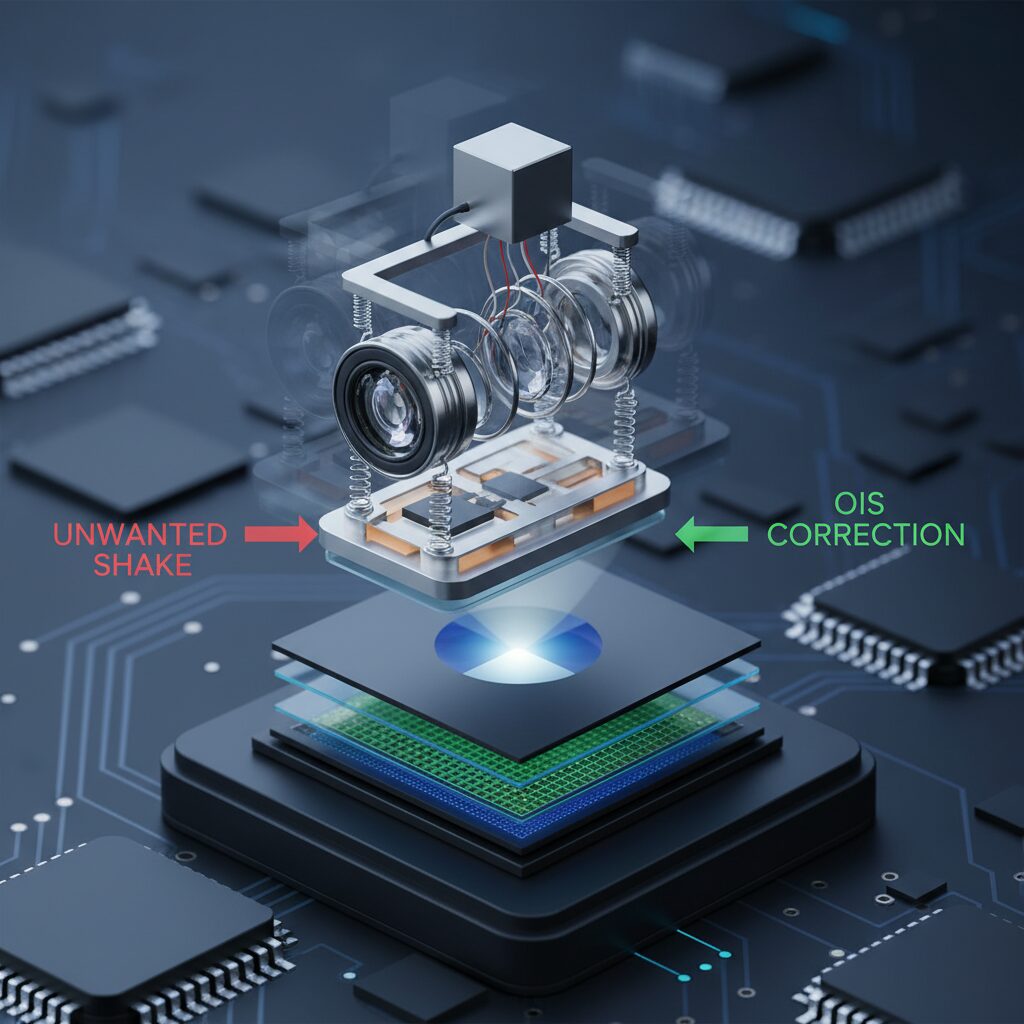
Optical Image Stabilization (OIS) works by physically moving lens elements or the image sensor itself to counteract unintended camera shake. A built-in gyroscope detects angular motion in real time, and electromagnetic actuators such as Voice Coil Motors shift the optical path in the opposite direction. This mechanical feedback loop operates within milliseconds, stabilizing the image before it is even recorded.
The key advantage lies in physics. OIS reduces motion blur at the moment of exposure, not after the fact. Motion blur occurs when the image projected onto the sensor moves during the shutter interval, causing light to trace a streak instead of a point. Because OIS keeps the projected image stationary relative to the sensor, it prevents that streak from forming in the first place.
According to demonstrations comparing Sony’s active stabilization modes, optical systems maintain higher detail retention in low light precisely because they stabilize the optical path itself. This distinction becomes critical when shutter speeds drop and exposure times lengthen.
| Physical Factor | Without OIS | With OIS |
|---|---|---|
| Long Exposure (Low Light) | Light trails and softness | Sharper light points |
| Telephoto Shooting | Magnified handshake | Reduced angular error |
| Still Photography | Detail loss | Preserved micro-contrast |
The physics becomes even more unforgiving at longer focal lengths. As lens magnification increases, tiny angular movements translate into large positional shifts on the sensor plane. In practical terms, a slight hand tremor that is negligible at 24mm can ruin sharpness at 120mm or beyond. This is why telephoto modules in smartphones and interchangeable lenses rely heavily on optical stabilization.
Industry comparisons in 2026 continue to emphasize that mechanical correction remains the most reliable solution for preserving native image quality, particularly in still photography and dark environments. Because OIS does not require cropping or pixel interpolation, it avoids resolution penalties associated with digital correction.
Another often overlooked benefit is exposure flexibility. By physically stabilizing the image, OIS enables slower shutter speeds without introducing blur. This allows more light to reach the sensor, improving signal-to-noise ratio. Sony Semiconductor Solutions has shown that advances in sensor design amplify this benefit, but the foundational enabler remains mechanical stability at the optical level.
In essence, OIS is an elegant application of classical mechanics to modern imaging. It operates in the analog domain, correcting motion before photons are converted into digital data. For gadget enthusiasts who prioritize uncompromised detail and optical authenticity, this mechanical precision continues to define the gold standard of stabilization.
Electronic Image Stabilization (EIS): From Cropping Algorithms to AI Reconstruction
Electronic Image Stabilization (EIS) has evolved far beyond simple frame alignment. In its early form, EIS stabilized footage by cropping a slightly smaller area from the sensor and shifting that window frame by frame. This approach reduced visible shake, but it inevitably narrowed the field of view and could not eliminate motion blur created during exposure.
According to comparative explanations by camera specialists and manufacturers, the fundamental limitation of classic EIS lies in post-processing: once light has streaked across pixels, software cannot truly “undo” that blur. As a result, traditional EIS worked best in bright environments with fast shutter speeds, where blur was minimal to begin with.
In 2026, however, EIS is no longer defined only by cropping. It has become a computational pipeline that integrates sensor data, high frame rates, and AI-driven reconstruction.
| Generation | Core Method | Main Limitation |
|---|---|---|
| Early EIS | Static crop + frame shift | FOV loss, blur remains |
| Advanced EIS | Gyro-assisted alignment | Processor load dependent |
| AI EIS (2026) | Pixel-level reconstruction | Requires high compute & memory |
The first major leap came from deeper integration with gyroscope and accelerometer data. By synchronizing motion vectors with each frame, modern EIS systems predict how the image should be repositioned before rendering. This reduces wobble and rolling artifacts, especially when paired with faster sensor readouts enabled by stacked CMOS architectures, as highlighted in semiconductor technical briefings from Sony and Samsung.
The second leap is more radical: AI-based pixel reconstruction. Instead of merely cropping, neural networks estimate missing edge information and reconstruct detail lost through stabilization. In high-resolution capture—such as 5K recording for 4K output—there is sufficient margin for intelligent reframing. AI models interpolate textures and edges so that the final frame appears wider and sharper than a naive crop would allow.
This marks a conceptual shift from “masking shake” to “rebuilding reality.”
Google’s computational video approach, for example, combines on-device processing with cloud-based enhancement to distinguish intentional camera motion from accidental shake. By understanding subject trajectory and scene context, the algorithm preserves cinematic panning while suppressing chaotic vibration. This context-aware filtering represents a move from geometric correction to semantic stabilization.
High frame rate capture further enhances AI EIS. Recording at 60fps or 120fps reduces inter-frame displacement, giving algorithms finer temporal granularity. Smaller motion gaps mean more accurate motion vector estimation and fewer artifacts when reconstructing edges or textures.
Yet these advances come at a cost. AI-driven EIS demands substantial buffer memory and neural processing throughput. Industry analysts have noted that rising memory prices in 2026 directly impact devices that rely heavily on computational video pipelines. Stabilization is now tied not only to optics, but to semiconductor economics.
For gadget enthusiasts, this transformation means EIS should no longer be dismissed as a compromise solution. When powered by stacked sensors, high frame rates, and AI reconstruction, modern EIS can deliver footage that approaches mechanical stabilization in perceived smoothness—while remaining compact enough for action cameras and wearable devices.
In practical terms, the question is no longer whether EIS crops the image. It is how intelligently the system predicts motion, reallocates pixels, and reconstructs detail in real time. The sophistication of that reconstruction pipeline is what defines cutting-edge electronic stabilization in 2026.
OIS vs EIS in 2026: Quantitative Performance Differences and Real-World Trade-Offs
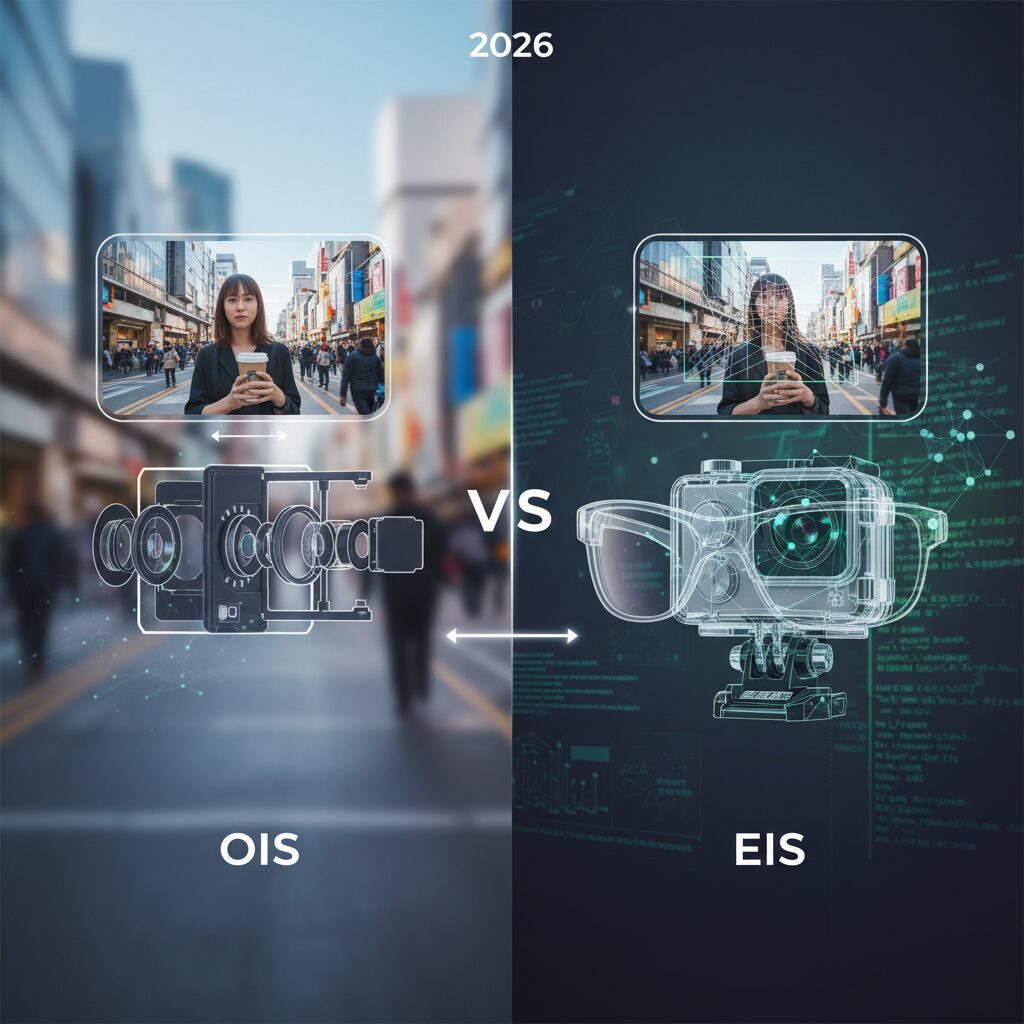
In 2026, the debate between OIS and EIS is no longer ideological but quantitative. The question is not which is “better,” but under what measurable conditions each system delivers superior results. When you compare shutter speed tolerance, crop ratio, latency, and zoom stability, the trade-offs become very clear.
OIS stabilizes light before it hits the sensor, while EIS stabilizes pixels after capture. That single difference defines their performance ceiling. According to Sony’s technical explanations of optical stabilization behavior and industry testing comparisons, OIS directly reduces motion blur during exposure, something pure software correction cannot fully reverse.
| Metric (2026 typical) | OIS | EIS |
|---|---|---|
| Motion blur control | Physically reduced during exposure | Cannot remove exposure blur |
| Field of view impact | No crop | Requires sensor crop |
| Telephoto stability | High effectiveness | Limited by pixel margin |
| Processing load | Hardware actuator driven | Dependent on ISP/AI power |
In low light, the difference becomes measurable. If a scene requires 1/10s shutter speed, hand tremor introduces blur trajectories that software cannot reconstruct with full fidelity. OIS physically shifts the lens or sensor to counteract that motion, allowing sharper frames at slower shutter speeds. This is why optical systems remain dominant for telephoto and night photography, as repeatedly highlighted in camera benchmark reviews and manufacturer technical documentation.
EIS, however, shows quantitative superiority in dynamic motion scenarios. By recording at 60fps or 120fps and cropping from a 5K or higher sensor readout, modern action cameras preserve a stabilized 4K output while using surplus pixels as a motion buffer. Retail evaluations of 2026 action cams confirm that higher base resolution directly increases stabilization headroom.
The real-world trade-off appears in field of view. A 10% crop to enable aggressive EIS may reduce effective wide-angle impact, which matters for vlogging or immersive footage. In contrast, OIS preserves composition but cannot compensate for extreme body movement such as running.
Latency is another overlooked metric. OIS reacts via electromagnetic actuators in milliseconds, largely independent of computational bandwidth. EIS performance scales with ISP and AI throughput. As memory prices and processing demands rise in 2026, high-end EIS systems increasingly rely on advanced chipsets and buffer memory, raising device cost.
OIS maximizes optical integrity and low-light sharpness, while EIS maximizes cinematic smoothness under large-scale motion. The performance gap is not about quality alone, but about physics versus computational margin.
For gadget enthusiasts, the practical takeaway is conditional optimization. If you shoot 10x–100x zoom or night cityscapes, optical stabilization delivers quantifiable sharpness gains. If you record high-frame-rate sports, cycling, or handheld tracking shots, modern AI-driven EIS provides smoother output even if it sacrifices edge pixels.
In 2026, hybrid systems blur the boundary, but the physics remain constant. Light stabilized before capture always retains more raw information, while pixels stabilized after capture rely on predictive reconstruction. Understanding that measurable distinction is what separates spec-sheet reading from true performance literacy.
AI and Computational Stabilization: Predictive Correction with Physical AI
By 2026, image stabilization is no longer limited to reactive correction. AI now predicts motion before it fully manifests, integrating what industry analysts call Physical AI into the camera stack.
This shift transforms stabilization from frame-by-frame alignment into a millisecond-level forecasting problem. The system does not simply fix shake; it anticipates it.
Physical AI combines real-world sensor inputs such as gyroscopes, accelerometers, and lens position data with neural inference engines embedded in modern SoCs. According to 2026 AI trend analyses, the move from generative AI to agentic AI enables devices to make autonomous micro-decisions in real time.
In stabilization, this means the AI agent distinguishes intentional panning from accidental shake. Google’s evolution of Video Boost demonstrates how motion vectors and subject tracking are fused so that creative camera movement is preserved while disruptive vibration is neutralized.
| Layer | Function in Predictive Stabilization | Timing |
|---|---|---|
| Inertial Sensors | Detect angular velocity and acceleration | Sub-millisecond |
| AI Motion Model | Forecast next-frame displacement | 1–5 ms window |
| Actuation & Rendering | Trigger OIS shift and pixel reconstruction | Before frame output |
The critical innovation lies in forecasting within a 1–5 millisecond window. Instead of waiting for blur to occur, the AI model estimates trajectory based on previous motion patterns and contextual cues, such as whether the user is walking, running, or standing still.
This predictive loop directly addresses the long-standing weakness of electronic stabilization: motion blur during exposure. When the system anticipates abrupt vertical oscillation, it can shorten effective exposure time or coordinate with optical actuators to counter-shift the sensor.
Research and industry documentation from semiconductor leaders highlight how stacked sensor architectures enable faster readout speeds. Faster readout reduces rolling distortion and gives AI models cleaner intermediate data for trajectory estimation.
Another breakthrough is intent recognition. Agentic AI models evaluate scene semantics—recognizing a sports subject versus a landscape—and dynamically adjust correction strength. This contextual awareness prevents the “over-stabilized” look that plagued early digital systems.
The result is not merely smoother footage, but perceptually stable reality. Viewers experience reduced visual fatigue because micro-jitters are eliminated without erasing natural motion cues.
Physical AI also enables cross-device sensor fusion. In wearable scenarios, head movement patterns, body acceleration, and camera data can be jointly modeled. The stabilization engine becomes a real-time physics interpreter rather than a post-processing filter.
As AI agents become embedded directly in imaging pipelines, stabilization evolves into a predictive control system. The camera continuously asks: what motion will occur next, and how should optics and pixels respond?
This predictive correction paradigm marks the convergence of mechanics and machine intelligence, redefining stabilization as an anticipatory, physics-aware process rather than a digital afterthought.
360-Degree Stabilization, 5K Recording, and High Frame Rates in Action Cameras
In action cameras, stabilization is no longer just about reducing shake. It is about preserving immersion while the user is skiing down a slope, riding a mountain bike, or diving into rough water. 360-degree stabilization, 5K recording, and high frame rates now work as a tightly integrated system rather than independent features.
According to major Japanese retailers’ 2026 action camera roundups, full 360-degree horizon leveling has become a de facto standard in upper-tier models. By constantly referencing gyro data and spatial orientation, these cameras keep the horizon perfectly level even when the body rotates aggressively.
This is especially critical in POV footage. When the camera rolls 30 or 60 degrees during a turn, viewers can quickly feel discomfort. By locking the horizon digitally across all axes, the footage maintains cinematic stability without sacrificing the intensity of motion.
| Technology | Role in Action Shooting | User Benefit |
|---|---|---|
| 360° Horizon Lock | Multi-axis gyro + full-frame analysis | Stable, immersive POV even during rotation |
| 5K Recording | Oversampling for digital crop margin | High-detail 4K output after stabilization |
| 60–120fps HFR | Reduced frame-to-frame displacement | Smoother motion and precise correction |
The shift to 5K recording plays a decisive role here. When capturing at 5K resolution, the camera retains extra pixel data around the edges. This surplus allows electronic stabilization to crop and realign frames without noticeably degrading the final 4K output.
Higher resolution effectively becomes a buffer zone for aggressive stabilization. Even after rotation correction and vibration compensation, fine textures such as gravel, snow spray, or water droplets remain sharp.
High frame rates further amplify this effect. At 60fps or 120fps, the positional difference between consecutive frames is significantly smaller than at 30fps. This reduces the burden on motion estimation algorithms and enables more accurate vector prediction.
Industry analyses highlighted by Watch Impress note that modern stabilization increasingly depends on tight integration between sensor readout speed and AI-based motion modeling. With faster frame sampling, the system can distinguish intentional pans from chaotic vibrations in milliseconds.
This matters most in action contexts where motion is complex rather than linear. For example, during downhill cycling, the camera experiences vertical shocks, lateral sway, and rotational tilt simultaneously. 360-degree stabilization systems analyze all three axes in parallel and apply rotational correction before spatial cropping.
The result is footage that feels as though it were shot on a miniature gimbal, even when mounted directly on a helmet. Importantly, this stabilization does not eliminate the sense of speed. Instead, it filters out disorienting jitter while preserving forward momentum.
The true breakthrough of 2026 is not a single specification, but the synergy between resolution headroom, high-frequency sampling, and spatial AI correction. For gadget enthusiasts, understanding this relationship explains why modern action cameras deliver dramatically smoother footage without external stabilizers.
In practical terms, when choosing a model, the presence of 5K recording and 60fps or higher modes is not about marketing numbers. It directly determines how much computational freedom the stabilization engine has, and how immersive your final footage will feel.
Sony’s Two-Layer Transistor Pixel CMOS: Expanding Dynamic Range and Reducing Noise
Sony’s Two-Layer Transistor Pixel CMOS technology fundamentally rethinks how image sensors handle light and noise. Instead of placing the photodiode and pixel transistors on the same substrate, Sony separates them onto two distinct layers and stacks them vertically. According to Sony Semiconductor Solutions, this world-first structure enables a dramatic expansion of full-well capacity while simultaneously reducing noise.
The architectural shift may sound subtle, but its impact on real-world imaging is profound. By dedicating more surface area to the photodiode, the sensor can capture significantly more photons before saturation. At the same time, enlarging the amplifier transistor improves signal integrity during readout, especially in low-light environments.
From a technical perspective, the benefits can be understood through three core improvements: higher full-well capacity, lower read noise, and enhanced sensitivity. These elements work together rather than independently, meaning gains in one area reinforce the others.
| Structural Element | Conventional Pixel | Two-Layer Pixel |
|---|---|---|
| Photodiode Area | Shared with transistors | Dedicated, expanded area |
| Saturation Signal | Baseline | Approx. 2× increase |
| Amplifier Size | Physically constrained | Enlarged for lower noise |
The expanded dynamic range means bright highlights are less likely to clip while shadow detail remains intact. In high-contrast scenes such as backlit portraits or cityscapes at dusk, the sensor retains tonal gradation that would otherwise be lost. Sony’s official technical brief emphasizes that this increase in saturation signal directly translates into improved highlight tolerance.
Equally important is noise reduction. Because the amplifier transistor can be made larger on its own layer, read noise is significantly suppressed. In practical terms, this improves signal-to-noise ratio in dim environments, reducing grain and color blotching in night photography or indoor video capture.
What makes this especially compelling for advanced users is the indirect effect on exposure strategy. With higher sensitivity and lower noise, cameras can maintain faster shutter speeds without sacrificing image quality. This reduces reliance on aggressive post-processing and preserves more natural textures straight out of the sensor.
Another often overlooked advantage is design flexibility. By decoupling photodiode and transistor layers, engineers gain more freedom to optimize each independently. This modularity opens pathways for future enhancements in readout circuitry and on-chip processing without compromising light-gathering efficiency.
For gadget enthusiasts evaluating next-generation imaging hardware, this two-layer transistor pixel approach represents more than incremental progress. It is a structural innovation that tackles dynamic range and noise at the physical level, not merely through software compensation. In an era increasingly defined by computational imaging, Sony’s solution demonstrates that breakthroughs in semiconductor architecture remain a decisive foundation for superior image quality.
Samsung’s Three-Layer Hybrid Sensor and the Shift in iPhone Camera Supply Chains
Samsung’s move toward a three-layer hybrid image sensor is not just a technical upgrade. It represents a structural shift in how flagship smartphone cameras are designed and, more importantly, how they are sourced.
According to multiple industry reports in late 2025, Apple is expected to expand its sensor supply chain beyond Sony and adopt Samsung-manufactured CMOS sensors for the iPhone 18 generation. This marks the first serious diversification of Apple’s long-standing reliance on Sony for high-end image sensors.
This transition is strategically significant because the sensor architecture itself changes the balance between hardware physics and computational stabilization.
Three-Layer Hybrid Sensor Architecture
| Layer | Primary Role | Impact on Stabilization |
|---|---|---|
| Top Layer | Photodiodes and rolling shutter control | Improves light capture and distortion handling |
| Middle Layer | Amplifiers and ADC | Faster signal conversion, reduced noise |
| Bottom Layer | Logic circuits, DRAM, AI engine | High-speed readout and on-sensor processing |
By stacking three silicon wafers vertically, Samsung separates light reception, analog processing, and logic computation into optimized layers. As reported by industry analyses covering Apple’s supply chain adjustments, this structure enables significantly faster full-pixel readout speeds.
The practical implication is crucial. Faster readout brings performance closer to a global shutter, dramatically reducing rolling shutter distortion. For electronic image stabilization, which has historically struggled with skewed vertical lines and warped motion, this is a foundational improvement rather than a marginal tweak.
In other words, stabilization quality increasingly depends on sensor architecture, not just software algorithms.
The integration of logic and DRAM directly beneath the photodiode layer also shortens signal pathways. This reduces latency between capture and processing, allowing AI-based stabilization engines to act on cleaner, less distorted data. When computational stabilization relies on frame-to-frame alignment, every microsecond saved in readout matters.
From a supply chain perspective, Apple’s decision to potentially source from Samsung introduces competitive pressure into a market long dominated by Sony’s stacked CMOS technology. Sony’s two-layer transistor pixel architecture, as officially documented by Sony Semiconductor Solutions, doubled saturation signal levels and expanded dynamic range. Samsung’s three-layer approach extends that concept by embedding more computational capability directly into the sensor stack.
This diversification also carries geopolitical and economic weight. Producing sensors in the United States, as some reports suggest for Samsung’s Apple-bound production, could mitigate supply risks amid semiconductor volatility. In an era where memory prices and advanced node capacity are tightly contested, dual sourcing reduces systemic vulnerability.
For camera enthusiasts, the takeaway is clear. The shift is not about brand rivalry. It is about a deeper convergence of optics, silicon engineering, and AI acceleration. When a sensor can read 200MP-class data at high speed while minimizing rolling artifacts, electronic stabilization becomes more natural, less crop-dependent, and more faithful to intentional camera motion.
The supply chain shift therefore signals a new phase where sensor innovation directly reshapes the boundaries of mobile image stabilization.
Flagship Smartphone Case Studies: iPhone 17/18, Pixel 10 Pro, Galaxy S26 Ultra, Xperia Max 7
In 2026, flagship smartphones no longer treat image stabilization as a supporting feature. It has become a defining performance layer that directly shapes video credibility, zoom usability, and even AI-driven shooting workflows.
The competition among iPhone 17/18, Pixel 10 Pro, Galaxy S26 Ultra, and Xperia Max 7 reveals four distinct philosophies. Each brand blends OIS, EIS, and AI differently, and those differences become obvious in real-world shooting scenarios.
Flagship Stabilization Approaches in 2026
| Model | Core Strategy | Signature Strength |
|---|---|---|
| iPhone 17 Pro | Refined sensor-shift OIS + EIS fusion | Natural transition between optical and digital correction |
| iPhone 18 | High-speed stacked sensor + AI pipeline | Reduced rolling distortion, faster readout |
| Pixel 10 Pro | AI-centric computational video | Video Boost with motion-intent recognition |
| Galaxy S26 Ultra | Extreme zoom + hybrid stabilization | Handheld stability at ultra-long focal lengths |
| Xperia Max 7 | Creator-oriented tuning | Controlled “cinematic” motion rendering |
Apple’s iPhone 17 Pro demonstrates how mature sensor-shift OIS can be elevated by tight silicon integration. With the A19 chip orchestrating optical and electronic correction, reviewers note that the handoff between OIS and EIS feels almost invisible. According to benchmark comparisons cited in expert video analyses, its stabilization score reaches the top tier among 2026 devices, reflecting consistency rather than aggressive correction.
The upcoming iPhone 18 takes a more structural leap. Industry reports indicate a transition toward Samsung’s stacked sensor technology, enabling significantly faster readout speeds and mitigating rolling shutter artifacts. By accelerating data extraction at the pixel level, electronic stabilization gains cleaner source frames, which directly improves AI-based correction accuracy.
Google’s Pixel 10 Pro continues to redefine what “electronic” stabilization means. Its evolved Video Boost pipeline integrates gyro data with subject recognition, distinguishing intentional panning from accidental shake. Google explains that cloud-assisted processing refines motion smoothing after capture, resulting in footage that resembles gimbal tracking even during running shots.
Samsung’s Galaxy S26 Ultra focuses on a different battlefield: extreme zoom. At very narrow angles of view, even microscopic hand tremors amplify dramatically. By combining high-resolution sensors with hybrid OIS/EIS tuning, the device maintains handheld usability at long focal lengths. This approach aligns with broader industry observations that optical stabilization remains indispensable for telephoto performance.
Xperia Max 7 takes a creator-first stance. Rather than eliminating all motion, it preserves a controlled sense of movement closer to professional cinema rigs. Experts often emphasize that over-stabilization can produce artificial warping; Sony’s tuning aims to balance realism and smoothness, appealing to videographers who prioritize texture over absolute steadiness.
Across these case studies, the divergence is clear. Apple optimizes integration, Google maximizes AI inference, Samsung empowers zoom dominance, and Sony protects cinematic authenticity. For gadget enthusiasts in 2026, choosing a flagship is less about “does it have stabilization” and more about which philosophy of motion control best matches your shooting identity.
Beyond Smartphones: Robotics, Medical Imaging, and Physical AI Applications
Image stabilization in 2026 no longer belongs only to smartphones. It has become a core visual infrastructure for robotics, medical imaging, and what experts call Physical AI, where intelligent systems act directly in the real world.
As noted in recent analyses of AI trends in Japan, the shift from generative AI to agentic and physical AI means machines must not only understand images but act on them in real time. In such environments, unstable vision is not an inconvenience but a critical failure point.
In robotics and medical systems, image stabilization is directly linked to safety, precision, and economic productivity.
Robotics: Stabilized Vision as Operational Backbone
In manufacturing and logistics, autonomous robots increasingly rely on onboard cameras for navigation, object recognition, and quality inspection. According to industry coverage by Toyo Keizai, collaborations between Japanese manufacturers and AI chipmakers are accelerating the deployment of physical AI in factories.
When a mobile robot moves across uneven factory floors, vibration can distort captured frames. Even small motion artifacts may degrade obstacle detection accuracy or misalign parts during automated assembly.
| Application | Role of Stabilization | Impact |
|---|---|---|
| Autonomous factory robots | Vibration-compensated vision | Improved obstacle detection accuracy |
| Logistics picking systems | Stable object recognition during motion | Higher picking speed and fewer errors |
| Inspection drones | Blur reduction in dynamic environments | More reliable defect detection |
By integrating gyroscopic data with AI-driven computational stabilization, these systems predict motion before it fully manifests in the image stream. This predictive layer reflects the same evolution seen in advanced consumer devices, but here the stakes are operational uptime and safety compliance.
Medical Imaging: Precision Beyond Human Limits
In medical settings, especially endoscopy and microsurgery, even microscopic hand tremors can reduce diagnostic clarity. Research initiatives referenced in AI trend reports highlight how AI-assisted image processing removes subtle shake in real time, enabling clearer visualization of tissue structures.
Unlike post-processed consumer video, medical stabilization must operate with near-zero latency. Surgeons depend on immediate feedback, and any delay could compromise procedural accuracy.
Reducing motion blur at the source shortens effective exposure time and enhances contrast in low-light internal environments, where illumination is limited and sensor noise is a persistent challenge. Advances in stacked CMOS sensors, such as those developed by Sony Semiconductor Solutions, contribute indirectly by improving dynamic range and lowering noise, making downstream stabilization more reliable.
Security and Mobile Surveillance
Body cameras and vehicle-mounted systems operate in unpredictable motion conditions. In these contexts, stabilization ensures that AI-based anomaly detection and facial recognition systems receive clean input data.
As described in broader AI security discussions, real-time threat detection depends on consistent visual streams. Motion-induced distortion can generate false positives or obscure critical evidence.
Stabilization thus becomes a foundational layer for trustworthy AI decision-making, bridging the gap between raw sensor data and actionable intelligence.
Physical AI: From Perception to Action
The defining theme of 2026 is the transition to Physical AI, where systems perceive, decide, and act continuously. In such architectures, image stabilization is not an isolated camera feature but part of a closed-loop control system.
Sensor fusion combines accelerometers, gyroscopes, and visual data streams. AI agents interpret this multimodal input to distinguish intentional movement from disruptive vibration, dynamically adjusting correction strength.
This convergence transforms stabilization into an enabling technology for autonomous mobility, remote surgery assistance, and smart infrastructure monitoring. In every case, the ultimate value lies in one principle: stable vision enables reliable action, and reliable action defines the next stage of intelligent machines.
Semiconductor Economics, Memory Prices, and the Impact on Gadget Costs
Behind every breakthrough in image stabilization lies a far less glamorous driver: semiconductor economics.
In 2026, the cost structure of gadgets is being reshaped not only by innovation, but by memory pricing, fabrication capacity, and geopolitical supply chains.
The price you pay for a flagship smartphone is increasingly tied to DRAM and advanced logic wafer availability.
According to industry analysis cited by Watch Impress, AI deployment across data centers has triggered a surge in demand for high-performance memory.
Servers optimized for AI workloads require vast amounts of high-bandwidth DRAM, tightening global supply.
This ripple effect does not stay in the cloud; it directly impacts consumer devices that rely on similar memory components.
| Component | Why It Matters for Stabilization | Cost Sensitivity |
|---|---|---|
| DRAM | Frame buffering for high-resolution EIS and AI inference | High |
| Advanced CMOS Sensors | Stacked architectures with on-chip processing | Very High |
| Application Processor | Real-time stabilization algorithms | Medium to High |
Electronic stabilization at 4K/60fps or higher requires substantial frame buffers.
When combined with AI-based pixel reconstruction, memory bandwidth becomes critical.
Even a marginal increase in DRAM pricing can cascade into noticeable retail price adjustments.
The situation is further complicated by advanced packaging and stacked sensor designs.
Three-layer hybrid sensors, as reported in coverage of Samsung’s next-generation CMOS developments, integrate logic and sometimes memory directly beneath photodiodes.
These architectures enhance performance but rely on cutting-edge fabrication nodes, where wafer costs are significantly higher.
Geopolitical factors add another layer of uncertainty.
Semiconductor production remains geographically concentrated, and any disruption—from export controls to capacity bottlenecks—can delay product launches.
Reports have suggested that synchronized global launches of major smartphone models could be affected if component supply tightens.
In 2026, stabilization performance is not limited by algorithms alone—it is bounded by memory economics and wafer allocation priorities.
For gadget enthusiasts, this explains why mid-range devices sometimes cap video features despite capable sensors.
Manufacturers strategically allocate premium memory and advanced sensor stacks to flagship tiers where margins can absorb volatility.
This segmentation is economic before it is technological.
National semiconductor strategies also play a role.
Japan’s large-scale public investment framework supporting next-generation fabrication, including initiatives such as Rapidus targeting advanced process nodes, reflects recognition that chip sovereignty influences downstream device competitiveness.
Access to leading-edge logic processes ultimately determines how efficiently AI stabilization can run on-device without excessive power or thermal cost.
The result is a delicate balancing act.
Consumers demand higher resolution, higher frame rates, and smarter AI stabilization.
But every additional computational layer translates into silicon area, memory capacity, and supply chain exposure.
Understanding semiconductor economics therefore gives you an analytical edge.
When flagship prices rise or availability tightens, it is rarely arbitrary.
It is the visible surface of a deeply interconnected system where memory markets, fabrication yields, and AI demand converge to shape the true cost of your next gadget.
Smart Glasses and Wearables: Stabilizing Human Vision in Real Time
In 2026, image stabilization is no longer just a camera feature. In smart glasses and wearables, it becomes a core layer of visual infrastructure that directly affects how humans perceive reality. When a device sits on your head instead of in your hand, every micro-movement of the neck and body translates into constant vibration.
Unlike smartphones, smart glasses must stabilize not only recorded video but also the user’s live field of view. This dual requirement pushes stabilization into true real-time territory, where even a few milliseconds of delay can cause discomfort or motion sickness.
The mission is simple but technically brutal: stabilize human vision itself, not just footage.
Why Head-Mounted Devices Are Different
Human head motion is faster and more frequent than hand tremor. Wearables therefore face a unique blend of rotational shake, forward motion, and natural gaze shifts.
| Factor | Smartphone | Smart Glasses |
|---|---|---|
| Primary Motion Source | Hand tremor | Head & body movement |
| Latency Tolerance | Moderate | Extremely low |
| User Impact | Blurred footage | Visual discomfort or nausea |
Because the display is aligned with the eye, instability is perceived immediately. According to broader AI trend analyses in 2026, the rise of Physical AI emphasizes real-world sensor fusion, and smart glasses are one of its most demanding applications.
They must combine gyroscope data, accelerometers, and increasingly eye-tracking inputs to predict motion before it fully manifests.
Gaze-Linked Stabilization
A breakthrough area is gaze-prioritized correction. With integrated eye tracking, the system identifies where the user is focusing and selectively stabilizes that region with higher precision.
This reduces cognitive load because the brain primarily processes the foveal region. By keeping the attended area steady while allowing peripheral motion to remain natural, devices reduce the sensory mismatch that often causes AR fatigue.
Stabilization becomes perceptual, not merely mechanical.
On-device AI plays a decisive role here. As highlighted in 2026 device forecasts, ultra-low-latency processing is essential for wearable AI systems. Cloud-based correction, effective in smartphones, is often too slow for glasses that overlay digital objects onto real-world scenes.
Every frame must be corrected within milliseconds, synchronizing camera capture, IMU data, and display refresh cycles.
Full-Body Sensor Fusion
Another emerging approach is cross-device integration. Earbuds equipped with motion sensors, such as advanced in-ear wearables, provide additional head orientation data. When fused with glasses-mounted sensors, the system achieves more accurate spatial modeling.
This distributed sensing architecture reflects the broader 2026 shift toward agentic AI systems that coordinate multiple data streams in real time.
The wearable ecosystem acts as a single stabilization organism.
For creators, this means hands-free POV recording that looks as if it were shot on a stabilized rig. For enterprise users in logistics or field service, it ensures that overlaid instructions remain locked to physical objects without jitter.
For everyday users, it quietly removes friction from augmented reality navigation, translation overlays, and contextual notifications.
In wearables, image stabilization is no longer about sharper memories. It is about delivering a stable layer of reality itself, enabling AI systems to align seamlessly with human perception.
Agent-First Camera Systems: When AI Becomes Your Stabilization Co-Pilot
In 2026, stabilization is no longer a passive safety net. It is becoming an active partner. Agent-first camera systems treat AI not as a post-processing filter, but as a real-time co-pilot that anticipates motion before it ruins your shot.
According to multiple 2026 AI trend analyses, the shift from generative AI to agentic AI marks a turning point where systems do not just respond, but act autonomously. In camera systems, this means the stabilization engine continuously interprets sensor data, predicts intent, and executes corrective decisions in milliseconds.
The camera no longer waits for blur to happen. It predicts it.
| Conventional Stabilization | Agent-First Stabilization |
|---|---|
| Reactive correction after motion is detected | Predictive correction based on motion forecasting |
| Uniform stabilization strength | Context-aware, intent-sensitive adjustment |
| Isolated OIS or EIS control | Integrated AI orchestration of sensors and optics |
Modern devices fuse gyroscope data, accelerometer input, image frame analysis, and even subject tracking into a unified decision layer. Google’s evolution of Video Boost demonstrates how AI distinguishes between intentional panning and unwanted shake, preserving cinematic motion while eliminating micro-jitters. This separation of “creative movement” from “noise” is the essence of agentic stabilization.
What makes this possible is tight integration with next-generation image sensors. Sony’s two-layer transistor pixel architecture, which doubles saturation signal capacity according to the company’s technical disclosures, enables shorter exposure times in low light. Shorter exposure directly reduces motion blur at the source, giving the AI cleaner data to work with.
At the same time, emerging three-layer hybrid sensor designs place logic and memory closer to the photodiodes. Faster readout speeds reduce rolling shutter distortion, allowing the AI agent to make corrections on more geometrically accurate frames. In practice, this means stabilization decisions are based on higher-fidelity motion models.
Agent-first systems treat stabilization as a continuous feedback loop, not a one-time correction.
For gadget enthusiasts, this translates into tangible differences. When running with a smartphone, the AI anticipates vertical oscillation patterns typical of human gait. When shooting a skyline, it prioritizes horizon locking. During zoomed telephoto capture, it reallocates computational resources to counter amplified micro-movements. These are not presets you manually select; they are situational judgments made by an embedded agent.
Industry commentary in 2026 increasingly frames this as part of a broader “physical AI” movement, where digital intelligence interacts with real-world dynamics in real time. Stabilization becomes the perceptual backbone of that interaction. Without a stable visual stream, higher-level AI functions—object recognition, scene understanding, spatial mapping—lose reliability.
The result is a subtle but profound shift in authorship. You still compose the frame. You still choose the moment. But an invisible co-pilot constantly negotiates with physics on your behalf, balancing optics, silicon, and algorithms to protect your intent.
In an agent-first camera system, stabilization is no longer about removing shake. It is about safeguarding vision.
参考文献
- Sony Semiconductor Solutions:Development of the World’s First Two-Layer Transistor Pixel Stacked CMOS Image Sensor Technology
- Google Store:Video Boost on Google Pixel
- Gigazine:Samsung to Manufacture Camera Sensors for iPhone 18 Instead of Sony
- BicCamera:Recommended Action Cameras for 2026
- Watch Impress:2026 Will Be the Year of AI and Devices
- K&F Concept:Optical vs Electronic Image Stabilization: Which Is Better?