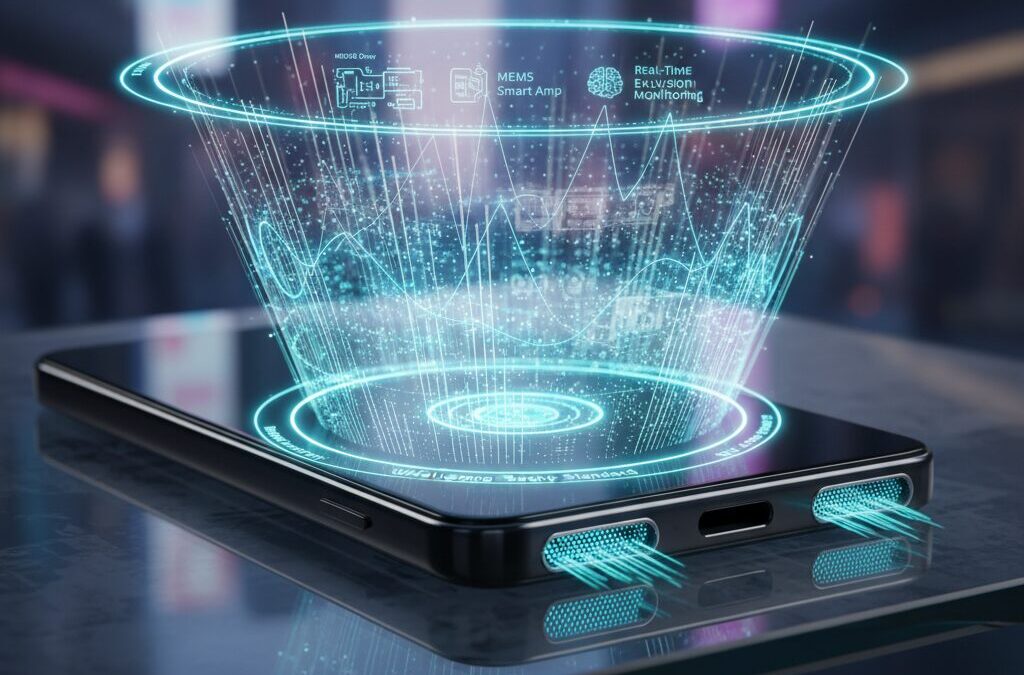
Have you ever turned up your smartphone’s volume only to hear crackling, buzzing, or harsh distortion ruin the experience? As smartphones evolve into primary devices for streaming high-resolution music, immersive gaming, and spatial video, expectations for built-in speakers have never been higher. Yet the physical size of micro-speakers has barely changed.
In 2026, however, the rules are being rewritten. Breakthroughs in MEMS speaker technology from companies like xMEMS and USound, combined with AI-powered smart amplifiers from Cirrus Logic, are transforming distortion from an unavoidable flaw into a controllable variable. Real-time excursion monitoring, thermal prediction models, and psychoacoustic bass enhancement are redefining what tiny speakers can achieve.
At the same time, global hearing-safety standards from organizations such as WHO are shaping how devices manage loudness, balancing performance with long-term auditory health. In this article, you will explore the engineering mechanisms behind speaker distortion, the semiconductor innovations solving them, and how flagship devices in 2026 are setting a new benchmark for mobile audio excellence.
- Why Speaker Distortion Became a Critical Issue in the 2026 Mobile Era
- The Physics of Smartphone Speaker Distortion: Mechanical, Electrical, and Software Factors
- Mechanical Limits of Dynamic Micro-Speakers and Internal Resonance Challenges
- Audio IC Failures, EMI Noise, and the Hidden Electrical Causes of Crackling Sound
- OS-Level DSP Conflicts and Over-EQ: When Software Creates Distortion
- MEMS Speaker Breakthroughs: xMEMS vs. USound Technology Explained
- Hybrid Two-Way Architectures in Flagship Smartphones: Separating Bass and High Frequencies
- Cirrus Logic Smart Amplifiers and Predictive Excursion Protection
- AI-Driven Audio Optimization and Psychoacoustic Bass Without Physical Strain
- Global Hearing Safety Standards: WHO Guidelines and Built-In Volume Governance
- External DACs, Portable Amps, and Amplifier-Integrated Cases in 2026
- Flagship Audio Showdown: iPhone 17 Pro, Xperia 1 VII, and Galaxy S26 Ultra
- The Next Decade of Mobile Audio: Full MEMS, Personalized Sound, and Advanced Materials
- 参考文献
Why Speaker Distortion Became a Critical Issue in the 2026 Mobile Era
In 2026, smartphones are no longer just communication tools but primary hubs for high-resolution video, spatial audio, and immersive digital experiences.
As devices evolve into entertainment and metaverse gateways, user expectations for built-in speakers have risen dramatically.
Speaker distortion is no longer tolerated as a minor flaw; it is perceived as a critical failure of the entire device experience.
The core reason lies in architectural tension. Modern smartphones are thinner, more sealed, and more densely integrated than ever before, yet they are expected to produce louder, clearer, and richer sound.
Traditional dynamic micro-speakers, still widely used, rely on voice coils and diaphragms that must physically move air.
When pushed beyond mechanical limits, distortion emerges through clipping, bottoming out, or structural resonance.
According to Cirrus Logic, modern boosted amplifiers integrate DSP-based protection to prevent excessive excursion and thermal overload.
This reflects a broader industry shift: distortion is now treated as a system-level engineering problem rather than a speaker-only issue.
At the same time, operating systems such as the latest Android and iOS environments rely heavily on complex audio stacks.
Buffer mismatches, aggressive equalization, or improper sampling coordination can introduce digital artifacts that users interpret as speaker failure.
Because these distortions often mimic hardware damage, diagnosing the root cause has become more technically demanding.
| Distortion Source | Primary Trigger | User Perception |
|---|---|---|
| Mechanical | Excessive diaphragm excursion | Buzzing or cracking at high volume |
| Electrical | Amplifier clipping or EMI interference | Harsh, compressed sound |
| Software | DSP overload or buffer mismatch | Popping or unstable audio output |
Another reason distortion became critical is regulatory and health awareness.
The World Health Organization has warned that approximately 1.1 billion young people worldwide are at risk of hearing damage due to unsafe listening habits.
As devices now track exposure levels and enforce safe output thresholds, uncontrolled distortion is no longer acceptable from a compliance standpoint.
Consumers in 2026 are also more discerning.
With access to high-end wireless earbuds, portable DACs, and AI-enhanced audio systems, users can immediately compare built-in speaker quality.
If a flagship device distorts at maximum volume, it directly impacts brand trust and perceived engineering competence.
Ultimately, the mobile era of 2026 transformed speaker distortion from a tolerable side effect into a strategic battleground.
In a world where smartphones define media consumption, even subtle distortion disrupts immersion, credibility, and user safety.
That is why solving distortion has become one of the most urgent challenges in modern mobile audio design.
The Physics of Smartphone Speaker Distortion: Mechanical, Electrical, and Software Factors
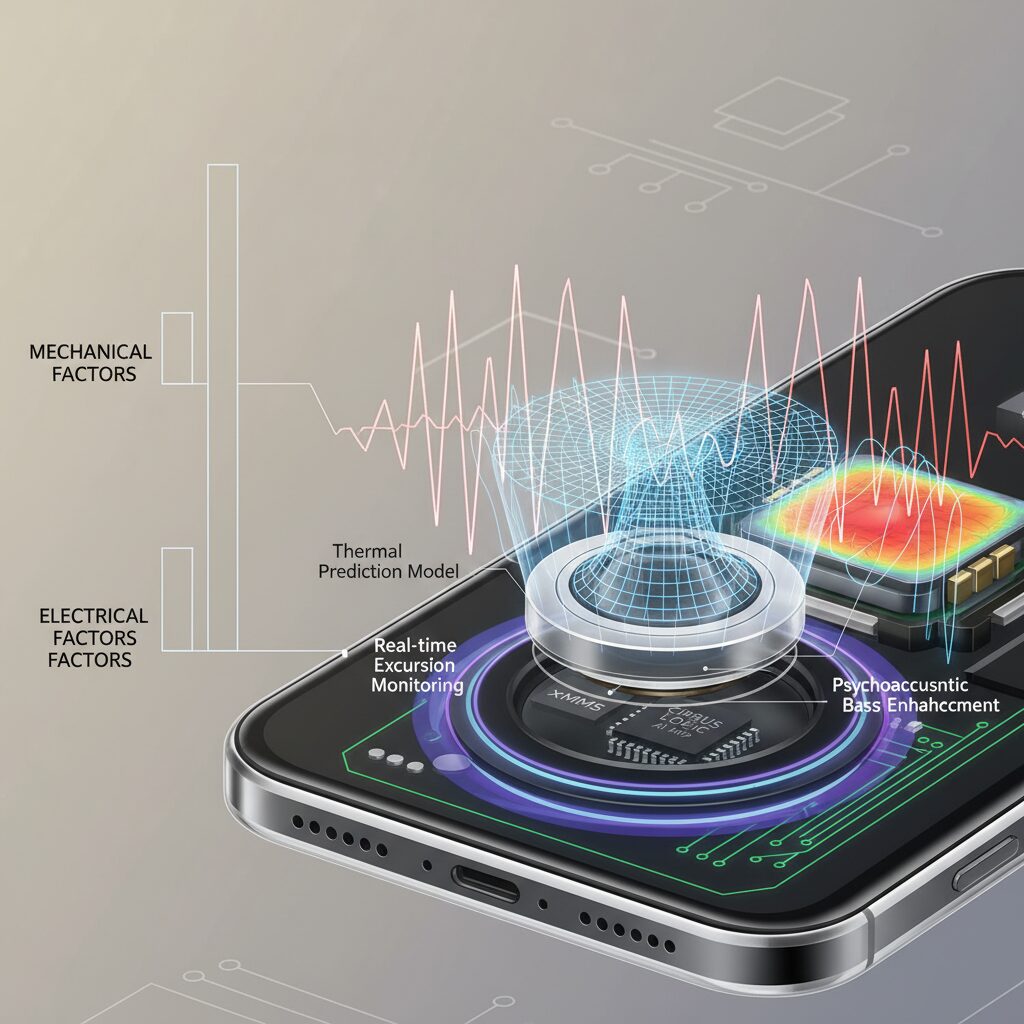
Smartphone speaker distortion does not arise from a single weak component. It emerges from the complex interaction of mechanical limits, electrical behavior, and software control layers. In 2026 devices, where ultra-thin enclosures and boosted amplifiers coexist, even minor imbalance across these domains can become audible as clipping, buzzing, or crackling.
Distortion is therefore not merely “too much volume,” but a system-level failure of control. Understanding each layer helps explain why modern smartphones rarely fail catastrophically, yet can still produce subtle artifacts under stress.
Mechanical Constraints: Excursion, Resonance, and Material Fatigue
At the mechanical level, most smartphones still rely on dynamic micro-speakers with voice coils and ultra-thin diaphragms. When playback demands strong low frequencies, the diaphragm must travel farther. If excursion exceeds its linear range, bottom-out distortion occurs, producing the characteristic rattling sound.
Repeated high-amplitude movement also causes micro-fatigue. Over time, diaphragm compliance changes, leading to uneven vibration modes at specific frequencies. Research discussed by audio engineers and manufacturers such as Cirrus Logic highlights how even slight nonlinear motion can introduce harmonic distortion that becomes perceptible in the 4kHz–10kHz range, where human hearing is most sensitive.
Mechanical distortion is not limited to the speaker unit itself. Internal resonance within sealed smartphone cavities can excite screws, gaskets, or display assemblies. These secondary vibrations are often misdiagnosed as “speaker damage,” when they are in fact enclosure-induced buzz artifacts.
| Mechanical Factor | Primary Cause | Audible Symptom |
|---|---|---|
| Over-excursion | Excessive low-frequency displacement | Rattling / crackling |
| Material fatigue | Repeated high SPL playback | Frequency-specific breakup |
| Enclosure resonance | Internal structural vibration | Buzzing at certain volumes |
Electrical Behavior: Clipping, Thermal Stress, and EMI
Even when the speaker hardware is intact, distortion may originate upstream. Boosted amplifier ICs, such as the CS35L45 and CS35L56/57 series described by Cirrus Logic, increase voltage headroom to deliver louder output from small batteries. However, if the input signal exceeds amplifier limits, waveform clipping occurs.
Clipping converts smooth sine waves into flattened peaks, injecting high-order harmonics that the ear perceives as harsh distortion. This can happen before any mechanical limit is reached.
Thermal accumulation adds another layer. As the voice coil heats, electrical resistance rises, altering impedance and reducing efficiency. Without real-time thermal estimation, the system may push the driver into nonlinear behavior. Modern smart amplifiers continuously estimate temperature and excursion to mitigate this risk.
Electromagnetic interference also contributes. High-frequency communication modules and wireless charging circuits can couple noise into analog paths, creating faint high-pitched artifacts. In compact multilayer boards, shielding quality directly influences audible purity.
Software and DSP: When Algorithms Shape Distortion
Today’s smartphones process nearly all audio through digital signal processing pipelines. Equalization, spatial rendering, and loudness enhancement are applied in real time. If software buffers mismatch sampling rates or apply excessive bass boost, distortion can emerge even at moderate volume.
According to guidance discussed in OS-level audio troubleshooting resources, mismatched buffer sizes may produce digital crackling unrelated to hardware damage. Similarly, aggressive low-frequency EQ forces limiters to activate frequently, causing audible pumping.
In advanced 2026 architectures, smart amplifiers integrate DSP-based “digital twins” of the speaker. These predictive models simulate excursion and thermal states in real time, reducing distortion before it becomes audible. This convergence of physics and computation marks a shift from reactive limitation to proactive control.
Ultimately, smartphone speaker distortion is a multidimensional phenomenon. Mechanical thresholds define the physical boundaries, electrical circuits determine signal integrity, and software algorithms orchestrate behavior within those constraints. Only when all three remain harmonized does truly clean mobile audio become possible.
Mechanical Limits of Dynamic Micro-Speakers and Internal Resonance Challenges
Even in 2026, most smartphones still rely on ultra-thin dynamic micro-speakers built around a voice coil and magnetic motor system. While signal processing and smart amplifiers have evolved dramatically, the core transducer remains bound by mechanical laws. Distortion often begins not in software, but at the physical limits of diaphragm movement.
When a user pushes volume toward maximum, the diaphragm must travel farther—this is called excursion. In a device only a few millimeters thick, excursion tolerance is extremely small. Once the diaphragm approaches its mechanical boundary, non-linear behavior appears. This is perceived as crackling, buzzing, or harsh breakup.
According to Cirrus Logic’s technical documentation on boosted amplifiers, modern smartphones continuously estimate excursion in real time to prevent “bottom-out” events. That protective layer exists precisely because mechanical saturation remains a fundamental constraint.
Primary Mechanical Failure Modes
| Failure Mode | Physical Cause | Audible Symptom |
|---|---|---|
| Excessive Excursion | Diaphragm exceeds linear travel range | Sharp crackling at high volume |
| Material Fatigue | Micro-cracks or softening of suspension | Distortion at specific frequencies |
| Structural Resonance | Vibration coupling with chassis components | Buzzing or rattling noise |
Material fatigue is especially critical in micro-scale designs. The diaphragm—often made of ultra-thin polymer or metal—undergoes thousands of high-amplitude cycles during gaming or video playback. Over time, microscopic deformation alters stiffness. Once stiffness becomes uneven, the diaphragm no longer moves as a single piston. This phenomenon, known as modal breakup, introduces frequency-specific distortion that DSP alone cannot fully eliminate.
Internal resonance presents an equally complex challenge. Smartphones are highly sealed structures designed for water resistance. While this improves durability, it traps acoustic energy inside a compact cavity. When low-frequency energy builds up, it can excite nearby components—camera modules, screws, waterproof gaskets, or even display assemblies.
Repair specialists in Japan frequently report cases where users suspect “speaker damage,” but the actual cause is secondary vibration within the chassis. As documented by registered repair providers, tightening structural elements or replacing degraded gaskets can eliminate buzzing without changing the speaker unit itself.
Another overlooked factor is acoustic duct geometry. Modern narrow-bezel smartphones route sound through curved internal channels before it exits the grille. These ducts can accumulate dust or moisture, subtly altering airflow resistance. When airflow becomes turbulent at high amplitude, additional non-linear noise appears, especially in the mid-bass region.
Thermal expansion further complicates the picture. During prolonged playback, the voice coil heats up. As temperature rises, adhesive materials and suspension elements soften slightly. This shifts mechanical compliance, changing the speaker’s resonant frequency. The result can be a sudden onset of distortion that disappears after cooling.
Academic acoustic research has long shown that small sealed enclosures amplify resonance peaks more aggressively than larger cabinets. In smartphones, enclosure volume is measured in cubic centimeters, not liters. That extreme miniaturization magnifies standing wave effects, particularly around upper bass and lower midrange bands.
The paradox of modern smartphone audio is clear: users demand louder output and deeper bass, yet the physical air volume available for safe acoustic loading continues to shrink. No algorithm can fully override Newtonian mechanics.
Understanding these mechanical and resonance limits is essential for interpreting distortion correctly. What sounds like electronic clipping may actually be structural vibration. What seems like permanent damage may be temporary compliance shift due to heat. For gadget enthusiasts, recognizing these boundaries reveals why hardware engineering remains the ultimate bottleneck in micro-speaker evolution.
Audio IC Failures, EMI Noise, and the Hidden Electrical Causes of Crackling Sound
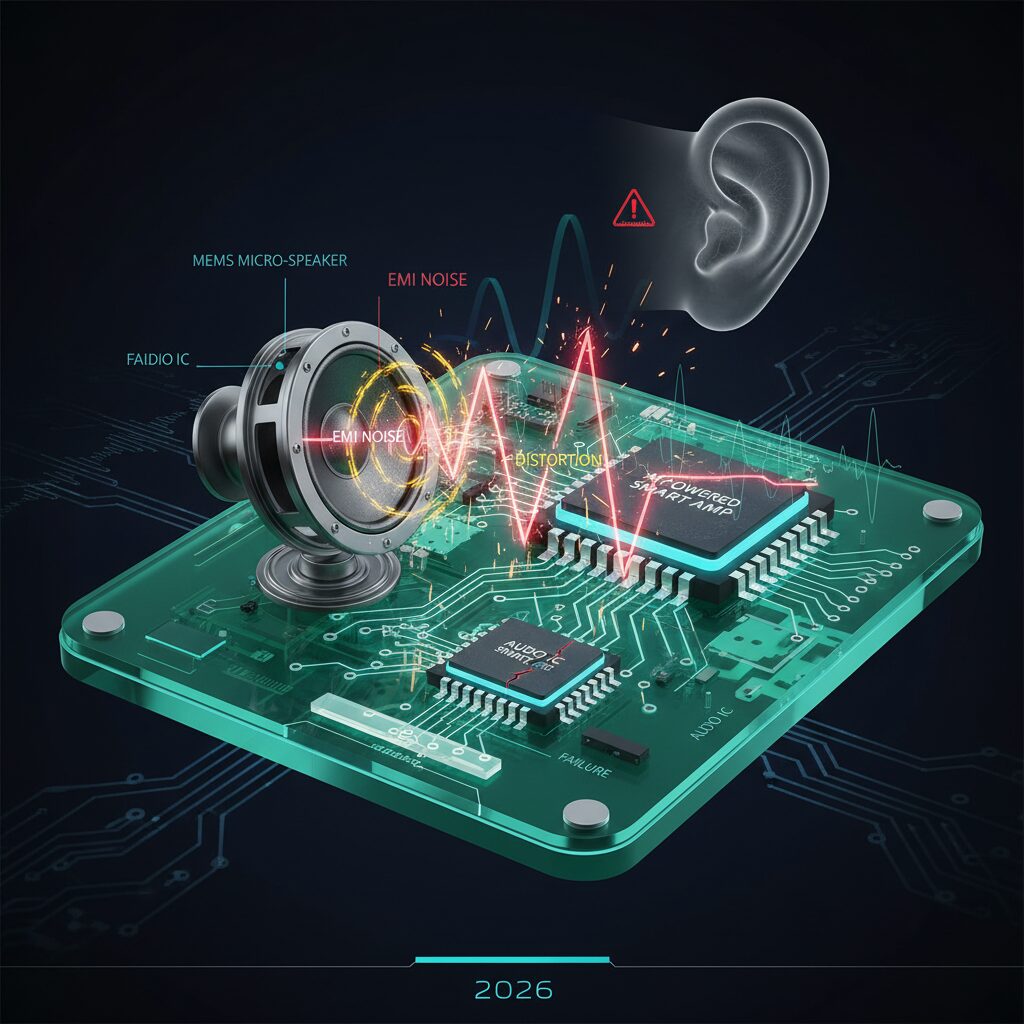
When crackling persists even at moderate volume, the root cause is often electrical rather than mechanical. In 2026 smartphones, audio signals travel through densely integrated multilayer boards where audio ICs, RF modules, and power management circuits sit millimeters apart. In this environment, minute electrical instability can translate directly into audible distortion.
One of the most critical components is the audio codec or smart amplifier IC. As seen in past “audio IC issues” reported in repair ecosystems, microscopic solder cracks caused by thermal cycling or board flex can interrupt signal integrity. Even if the speaker unit is physically intact, clipping or unstable gain inside the amplification stage produces harsh, brittle crackling that resembles a damaged driver.
According to Cirrus Logic’s technical documentation on boosted amplifiers such as the CS35L45 and CS35L56/57 series, modern smart amps constantly monitor voltage, current, and excursion in real time. However, when the IC itself degrades or its feedback loop is disrupted, the protection algorithms cannot compensate correctly, leading to abrupt clipping artifacts rather than smooth limiting.
The electrical causes can be categorized as follows.
| Electrical Factor | Mechanism | Audible Symptom |
|---|---|---|
| Solder micro‑fracture | Intermittent contact in audio IC pins | Random crackle, channel drop |
| Power rail instability | Voltage sag during peak demand | Sharp clipping at bass hits |
| EMI interference | RF coupling into analog traces | Buzzing or high‑pitched noise |
Electromagnetic interference is increasingly relevant in 5G and emerging 6G-era devices. High-frequency transmission modules and fast wireless charging coils emit electromagnetic fields that may couple into poorly shielded analog audio lines. Repair specialists in Japan have noted cases where users hear a faint “zz” noise only during data transmission or while charging, indicating EMI rather than speaker damage.
Research and industry guidance on mixed-signal PCB design consistently emphasize proper grounding, trace separation, and shielding to prevent such coupling. When shielding degrades over time or corrosion affects grounding points, the noise floor rises and subtle interference becomes clearly audible through high-gain amplification.
Another overlooked factor is boost converter ripple. Modern smart amplifiers use internal boost circuits to raise voltage for louder output. If filtering capacitors age or are damaged by heat, ripple noise can leak into the audio path. The result is not constant hiss but dynamic crackling synchronized with volume peaks.
These hidden electrical causes explain why some crackling issues cannot be solved by speaker replacement alone. In advanced 2026 architectures, the true fault often lies upstream in silicon, solder, or shielding—areas invisible to the naked eye yet decisive for pristine sound reproduction.
OS-Level DSP Conflicts and Over-EQ: When Software Creates Distortion
Even when the speaker hardware and smart amplifier are functioning perfectly, distortion can still be created at the software layer. In 2026 smartphones, every sound passes through a complex OS-level audio stack, and subtle mismatches in this digital chain often manifest as crackling, pumping, or harsh clipping.
Modern platforms such as Android 16 and iOS 19 rely on layered DSP pipelines that handle resampling, dynamic range control, spatial rendering, and loudness normalization in real time. If these processes conflict or stack excessively, the result is not louder sound, but digital distortion.
Typical OS-Level DSP Conflict Patterns
| Conflict Type | Technical Cause | Audible Symptom |
|---|---|---|
| Sample Rate Mismatch | App requests different rate than system mixer | Clicks, intermittent crackle |
| Buffer Misalignment | Inconsistent buffer size under CPU load | Popping during playback |
| Over-EQ Boost | Excessive low-frequency gain | Pumping, limiter distortion |
Sample rate mismatches are particularly common in high-resolution streaming apps. When an application requests 96kHz playback but the system mixer operates at 48kHz, real-time resampling occurs. Under heavy multitasking, this conversion may introduce transient artifacts that resemble hardware failure, even though the speaker itself is intact.
Buffer instability is another hidden culprit. If CPU scheduling fluctuates due to gaming, background AI processing, or camera tasks, audio buffers may underrun. This produces the characteristic “pop” or “tick” that users often misinterpret as speaker damage.
More frequently, however, distortion is self-inflicted through aggressive equalization. Boosting low frequencies by 6dB or more effectively doubles the power demand in that band. When combined with OS-level loudness normalization and app-based sound enhancement, the cumulative gain can exceed the headroom defined by the smart amplifier.
Cirrus Logic documentation on boosted amplifiers explains that modern chips include excursion and thermal prediction engines. Yet if upstream DSP pushes the signal into clipping before it reaches the amplifier, protection systems cannot fully restore lost waveform integrity. The distortion is already baked into the digital signal.
Overlapping enhancement layers are especially problematic:
This stacking effect reduces dynamic range and triggers frequent limiter engagement, perceived as volume “breathing” or pumping. What sounds like mechanical strain is often algorithmic congestion.
According to guidance aligned with WHO-informed loudness management frameworks, OS-level volume normalization is designed to reduce harmful peaks. However, users who override these controls with third-party boosters effectively bypass calibrated safety margins. The distortion that follows is not a defect, but a predictable DSP overload condition.
For advanced users, the solution is strategic restraint. Disable redundant EQ layers, maintain moderate low-frequency boosts, and ensure apps match the system sampling configuration whenever possible. In a software-defined audio architecture, clarity depends less on raw power and more on disciplined signal flow management.
MEMS Speaker Breakthroughs: xMEMS vs. USound Technology Explained
MEMS speaker technology is redefining what “small” drivers can achieve inside smartphones. Instead of relying on a traditional voice coil and plastic diaphragm, both xMEMS and USound fabricate their transducers using semiconductor-style processes. This shift from mechanical assembly to silicon-based precision is the core breakthrough that reduces distortion at its source.
According to coverage by specialized audio media such as Phileweb, the two companies lead the current MEMS race, yet their technical philosophies are clearly different. Understanding these differences helps you see why manufacturers choose one over the other depending on tuning goals and power constraints.
| Feature | xMEMS | USound |
|---|---|---|
| Driving principle | Silicon-based actuator driven by voltage/capacitive control | Piezoelectric cantilever structure |
| Key strength | Ultra-fast response, phase consistency | Flexible structure, scalable surface area |
| Design focus | Precision and low high-frequency distortion | Efficiency and broader frequency handling |
xMEMS designs its moving structure directly in silicon, meaning the “valve” that pushes air is etched with semiconductor-level accuracy. Because there is no conventional diaphragm prone to breakup modes, **high-frequency distortion is dramatically reduced**, especially in the 4kHz–10kHz band where human hearing is most sensitive.
This ultra-fast transient response makes xMEMS drivers sound highly transparent and monitor-like. For devices prioritizing clarity in vocals, spatial audio rendering, or immersive media playback, this precision becomes a decisive advantage.
USound, on the other hand, uses a piezoelectric actuator in a cantilever configuration. When voltage is applied, the piezo element flexes and moves a membrane to generate sound. One practical benefit is that the system can operate at relatively lower voltages, which aligns well with the limited power budgets inside smartphones.
Some USound modules integrate dedicated amplification, simplifying system design for OEMs. This lowers development complexity while still delivering MEMS-level benefits such as reduced mechanical fatigue compared to dynamic drivers.
From an architectural perspective, xMEMS often excels in ultra-clean treble reproduction, while USound’s approach allows more structural flexibility for tuning and scaling acoustic output. Neither is universally “better”; the choice depends on target sound signature, enclosure volume, and integration strategy.
As smartphone audio systems move toward hybrid configurations, MEMS tweeters paired with dynamic woofers are becoming increasingly common. In that context, xMEMS and USound are not simply alternatives to legacy speakers. They represent a structural shift toward semiconductor-defined acoustics, where distortion control begins at the material and fabrication level rather than being corrected later by DSP.
For gadget enthusiasts, this marks a fundamental change. The battle between xMEMS and USound is not about marketing claims, but about how silicon physics and piezoelectric mechanics reshape the future of mobile sound.
Hybrid Two-Way Architectures in Flagship Smartphones: Separating Bass and High Frequencies
In 2026 flagship smartphones, hybrid two-way speaker architectures are no longer experimental concepts but practical solutions to long-standing distortion issues. Instead of forcing a single micro-speaker to reproduce the entire frequency spectrum, manufacturers now separate bass and high frequencies into dedicated drivers, dramatically improving clarity at high volumes.
This approach directly addresses a core physical limitation. When a single dynamic driver is pushed to reproduce deep bass, its diaphragm must move with large excursion. That large movement interferes with delicate high-frequency reproduction, leading to intermodulation distortion and the familiar “crackling” or harshness at peak output.
By dividing the workload, each driver operates within its optimal mechanical range. The result is not just louder sound, but cleaner sound under stress.
| Frequency Range | Driver Type | Primary Role |
|---|---|---|
| Low (below ~200–300Hz) | Dynamic driver | Air displacement, bass impact |
| Mid–High (4kHz–10kHz focus) | MEMS tweeter | Clarity, vocal presence, low distortion |
According to industry analyses referenced by Phileweb, MEMS speakers from companies such as xMEMS and USound exhibit significantly reduced diaphragm breakup compared to traditional polymer-based dynamic drivers. Because MEMS structures are fabricated from silicon or piezoelectric elements, their motion remains highly controlled even at high frequencies.
This matters most in the 4kHz to 10kHz region, where human hearing is particularly sensitive to distortion. Psychoacoustic research widely cited in audio engineering shows that artifacts in this band are perceived as sharpness or fatigue. By assigning this region to a low-distortion MEMS tweeter, manufacturers minimize the perception of “digital harshness” even at maximum volume.
Meanwhile, the dynamic woofer continues to handle bass reproduction, where larger air movement is essential. Instead of stretching one driver beyond its limits, the system uses digital crossovers managed by internal DSPs, often integrated within smart amplifier chips such as Cirrus Logic’s boosted amplifier series.
In practical listening scenarios, this architecture changes how flagship phones behave during gaming, movie playback, or speakerphone calls. Explosive low-frequency effects no longer blur dialogue, and high-frequency cues such as footsteps or consonant articulation remain intact.
Another advantage is thermal stability. Because the high-frequency driver does not rely on large excursion, it generates less mechanical stress. The woofer, meanwhile, is monitored by smart amplifier algorithms that predict excursion and temperature in real time, preventing bottom-out distortion before it occurs.
For gadget enthusiasts who care about measurable performance, hybrid two-way systems represent a structural solution rather than a software patch. Instead of relying solely on aggressive limiting or compression, manufacturers redesign the acoustic pathway itself.
As a result, flagship smartphones in 2026 deliver a listening experience that feels closer to compact stereo systems than to traditional monolithic phone speakers. The separation of bass and high frequencies is not merely a specification upgrade; it is a fundamental shift in mobile acoustic engineering.
Cirrus Logic Smart Amplifiers and Predictive Excursion Protection
Cirrus Logic’s smart amplifiers represent one of the most decisive breakthroughs in eliminating speaker distortion at its root. Rather than simply amplifying an incoming signal, modern boosted amplifier ICs such as the CS35L45 and CS35L56/57 integrate real-time DSP and protection algorithms directly into the chip. As Cirrus Logic explains in its technical documentation, these devices are designed specifically for space-constrained smartphones where output power, efficiency, and reliability must coexist.
The key innovation is predictive excursion protection. Traditional amplifiers react after distortion begins. Cirrus Logic’s approach models the speaker’s mechanical behavior in advance, effectively creating a digital twin of the driver inside the amplifier.
| Function | Technical Principle | User Benefit |
|---|---|---|
| Predictive Excursion Protection | Real-time estimation of cone displacement | Prevents bottom-out distortion |
| Thermal Protection | Voice-coil temperature modeling | Avoids overheating and long-term degradation |
| Smart Boost (Class H) | Dynamic voltage scaling up to high boost levels | High SPL without clipping at low battery |
Excursion protection works by continuously calculating how far the speaker diaphragm is moving. If the predicted displacement approaches the mechanical limit, the amplifier reshapes the waveform before physical damage occurs. This is critical in ultra-thin smartphones where micro-speakers operate at the edge of their mechanical envelope.
Thermal protection is equally sophisticated. Instead of relying on a simple temperature sensor, the amplifier estimates voice-coil heat based on electrical input and impedance changes. According to Cirrus Logic’s product briefs, this allows output to be limited gracefully, preserving tonal balance while preventing adhesive failure or coil burn.
This predictive strategy transforms distortion control from reactive limiting to proactive prevention. Users experience fewer harsh artifacts at maximum volume, and manufacturers report significantly lower field failure rates in high-output flagship models.
Another crucial component is Smart Boost technology. By integrating a high-efficiency boost converter, the amplifier maintains stable output even when battery voltage drops. In practical terms, this eliminates the common scenario where low battery leads to clipping or unstable dynamics.
For OEMs, these smart amplifiers also provide fine-grained tuning capability. Engineers can calibrate protection thresholds per device, accounting for enclosure volume, port geometry, and speaker compliance. This device-specific tuning ensures that protection engages only when necessary, maximizing loudness without compromising longevity.
In 2026 smartphones, distortion is no longer merely suppressed; it is anticipated and mathematically controlled. Cirrus Logic’s predictive excursion protection demonstrates how semiconductor intelligence now safeguards both acoustic performance and hardware durability in real time.
AI-Driven Audio Optimization and Psychoacoustic Bass Without Physical Strain
In 2026, smartphone audio is no longer just about driving a tiny speaker harder. It is about making it smarter. AI-driven audio optimization now works alongside smart boosted amplifiers to extract maximum perceived performance while avoiding the physical strain that once caused distortion and long-term damage.
At the center of this shift are advanced amplifier platforms such as Cirrus Logic’s CS35L45 and CS35L56/57. According to Cirrus Logic, these chips integrate DSP blocks that simulate a digital twin of the speaker in real time. Instead of reacting after distortion occurs, the system predicts mechanical excursion and thermal stress before they exceed safe limits.
This predictive protection is critical because distortion is often caused by excessive diaphragm excursion at low frequencies. When a user boosts bass, the diaphragm must travel farther. In traditional systems, that mechanical overreach results in audible cracking or bottoming out. With real-time excursion monitoring, the amplifier subtly reshapes the waveform to maintain impact without crossing physical thresholds.
Thermal modeling works in parallel. The amplifier estimates voice coil temperature based on current flow and resistance changes. If heat approaches a critical level, output is dynamically adjusted in a psychoacoustically optimized way, minimizing perceived loudness loss while protecting hardware integrity.
| Protection Layer | Monitored Parameter | Optimization Goal |
|---|---|---|
| Excursion Control | Diaphragm displacement | Prevent mechanical distortion |
| Thermal Guard | Voice coil temperature | Avoid heat damage and compression |
| Dynamic Boost | Battery voltage | Maintain clean headroom |
Beyond protection, AI now enhances perception itself. Psychoacoustic bass algorithms are particularly transformative. Small smartphone speakers physically struggle to reproduce frequencies below 200Hz. Instead of forcing large excursions, the DSP introduces carefully calculated harmonic overtones above the fundamental frequency.
This technique leverages well-established psychoacoustic principles documented in auditory research and widely applied in broadcast processing. The human brain reconstructs the missing low-frequency fundamental from its harmonics, creating the sensation of deeper bass without requiring extreme mechanical movement.
The result is fuller low-end presence with significantly reduced distortion risk. Because the diaphragm is not pushed beyond safe travel limits, both clarity and durability improve.
AI-driven environmental adaptation adds another dimension. By analyzing ambient noise through built-in microphones, the system selectively enhances midrange clarity rather than blindly increasing overall gain. This reduces the temptation to push volume into unsafe territory while preserving intelligibility in noisy spaces.
Importantly, this optimization aligns with global hearing-safety initiatives. WHO guidelines emphasize limiting prolonged exposure above 80dB. By combining psychoacoustic bass enhancement, dynamic range management, and predictive limiting, smartphones can deliver impactful sound while staying within safer acoustic envelopes.
For gadget enthusiasts, this represents a paradigm shift. The future of mobile audio excellence is not about brute force output. It is about intelligent signal shaping, real-time modeling, and perceptual science working together to achieve powerful sound without physical strain.
Global Hearing Safety Standards: WHO Guidelines and Built-In Volume Governance
As smartphones become more powerful, the responsibility to protect users’ hearing has become just as important as improving sound quality. In 2026, global hearing safety standards are no longer abstract recommendations—they are directly embedded into device architecture.
According to the World Health Organization (WHO), approximately 1.1 billion young people worldwide are at risk of hearing loss due to unsafe listening practices. This statistic has fundamentally reshaped how audio systems are designed and regulated.
Modern smartphones now integrate volume governance at the hardware, firmware, and OS levels, aligning performance with international public health guidelines.
| Listening Level | WHO Guidance | Real-World Example |
|---|---|---|
| 75 dB | Recommended limit for children | Moderate conversation level |
| 80 dB | Up to 40 hours/week (adults) | Inside a subway car |
| 90 dB | Risk zone with prolonged exposure | Loud bus interior |
The WHO and ITU framework encourages manufacturers to implement exposure-based monitoring rather than simple maximum volume caps. This shift means devices now calculate cumulative weekly sound exposure instead of reacting only to peak levels.
Cirrus Logic’s boosted amplifier platforms, widely adopted in flagship smartphones, contribute to this ecosystem by converting output into calibrated decibel estimates in real time. The amplifier communicates with the operating system, allowing exposure tracking dashboards to display measurable data rather than abstract percentage bars.
This is a major architectural change: volume is no longer just a user-controlled slider—it is a regulated variable.
In practical terms, today’s devices include three core governance layers. First, a user-defined volume ceiling can be set—commonly aligned with the 80 dB benchmark for adults. Second, cumulative exposure notifications are triggered when weekly thresholds approach WHO recommendations. Third, dynamic range compression subtly reshapes peaks to prevent sudden acoustic spikes.
Japan’s public health communications, echoing WHO findings, emphasize that sustained listening above 85–90 dB significantly increases long-term hearing risk. This guidance has influenced regional firmware defaults, particularly for youth-oriented devices.
Another critical evolution is the integration of adaptive noise control. By reducing ambient noise through active processing, users can maintain intelligibility at lower playback levels. Lower required volume directly translates into lower cumulative acoustic stress.
For gadget enthusiasts who demand maximum loudness, this governance may feel restrictive. However, from a systems-engineering perspective, it represents a sophisticated balancing act: preserving sonic impact while preventing irreversible biological damage.
In 2026, high-performance mobile audio is defined not only by clarity and distortion control, but by measurable compliance with global hearing safety standards. Volume is now intelligent, contextual, and accountable.
External DACs, Portable Amps, and Amplifier-Integrated Cases in 2026
For enthusiasts who demand more than what even 2026 flagship smartphones can deliver, external DACs, portable amplifiers, and amplifier-integrated cases have become practical, everyday upgrades rather than niche accessories.
Instead of pushing internal speakers to their physical limits and risking distortion, these solutions bypass or reinforce the weakest part of the audio chain. As a result, you gain higher headroom, lower noise, and significantly improved control over demanding headphones.
External audio gear in 2026 is less about volume and more about precision, power stability, and distortion control.
According to specialist retailers such as e-earphone, demand for USB-DAC and portable amp combinations has continued to grow, especially among users streaming high-resolution audio from their smartphones. The key motivation is not only better sound quality but also cleaner amplification with reduced clipping under dynamic peaks.
| Category | Primary Benefit | Typical Use Case |
|---|---|---|
| USB DAC | Bypasses internal audio IC | Hi-res streaming, wired IEMs |
| Portable Amp | Higher output & headroom | High-impedance headphones |
| Amp Case | Integrated power boost | Casual speaker reinforcement |
Devices such as FiiO’s M17 and K11 R2R illustrate how far portable amplification has evolved. By connecting via USB-C, they completely bypass the smartphone’s internal output stage. R2R DAC architectures, highlighted by audio professionals for their smoother transient behavior, are particularly appreciated by listeners who find conventional delta-sigma implementations too clinical.
The technical advantage is measurable. A dedicated DAC/amp typically offers lower output impedance, higher signal-to-noise ratio, and more stable voltage swing than built-in smartphone circuits. This translates into tighter bass control and reduced distortion when musical passages suddenly spike in amplitude.
Another emerging category in 2026 is the amplifier-integrated case. Popular in online marketplaces for Bluetooth-enabled digital amps, these cases embed a boosted amplifier and secondary driver system directly into the chassis. Instead of stressing the phone’s micro-speakers, audio is rerouted to the case’s larger acoustic chamber.
This approach reduces mechanical excursion stress on internal speakers, effectively lowering long-term distortion risk while increasing perceived loudness. Users often describe the experience as carrying a mini Bluetooth speaker without the bulk of a separate device.
Importantly, modern portable amps also integrate protection logic similar to the smart amplifier technologies discussed by Cirrus Logic. Voltage regulation, thermal monitoring, and adaptive gain control prevent clipping even when driving power-hungry over-ear headphones.
For gadget-focused readers, the decision is no longer whether external gear is necessary, but which architecture best matches your listening profile. If you prioritize reference-level clarity with wired in-ear monitors, a compact USB DAC may suffice. If you demand stadium-like dynamics from planar headphones, a high-output portable amplifier becomes essential.
In 2026, external DACs and amplifier solutions are not workarounds for flawed smartphones. They are deliberate performance upgrades that unlock the full potential of high-resolution audio while maintaining cleaner, safer signal integrity.
Flagship Audio Showdown: iPhone 17 Pro, Xperia 1 VII, and Galaxy S26 Ultra
When it comes to flagship audio in 2026, the competition between iPhone 17 Pro, Xperia 1 VII, and Galaxy S26 Ultra is no longer about who gets louder. It is about who controls distortion, protects hardware, and delivers clarity under real-world stress.
All three models integrate advanced smart amplifiers and AI-based signal management, yet their philosophies clearly differ. For audio enthusiasts, those differences are immediately audible.
| Model | Speaker Architecture | Audio Control Focus |
|---|---|---|
| iPhone 17 Pro | Hybrid stereo with advanced DSP | Computational spatial rendering |
| Xperia 1 VII | Front stereo + MEMS tweeter | Low-distortion monitoring accuracy |
| Galaxy S26 Ultra | High-output stereo + smart boost amp | Predictive protection & power efficiency |
The iPhone 17 Pro pushes what Apple calls computational audio to a new level. Spatial rendering feels wider and more immersive, even from internal speakers. According to industry analyses and hands-on reviews, its DSP aggressively prevents clipping at maximum volume.
The result is exceptionally clean output, but some users describe it as slightly conservative in raw impact. Apple prioritizes distortion-free playback over sheer loudness, which becomes evident in bass-heavy tracks.
Xperia 1 VII takes a different route. Sony maintains front-facing stereo speakers and integrates MEMS tweeter technology to handle sensitive high frequencies. As reported by audio-focused media such as Phile Web, MEMS drivers significantly reduce high-frequency breakup distortion.
This means vocals and cymbals remain stable even when volume increases. The sound profile feels closer to studio monitoring than consumer tuning. Internal damping structures also minimize chassis resonance, reducing buzz artifacts under stress.
Galaxy S26 Ultra, meanwhile, emphasizes controlled power. By leveraging Cirrus Logic’s latest boosted amplifier architecture, including predictive excursion and thermal protection, it achieves some of the highest sound pressure levels in its class.
Cirrus Logic explains that real-time excursion monitoring prevents mechanical overdrive before it happens. In practice, this translates into strong output without the harsh “bottoming out” distortion that older smartphones suffered from.
In video calls and speakerphone scenarios, the Galaxy’s vocal projection stands out. The tuning favors intelligibility, especially in noisy environments, where AI-based gain management adapts dynamically.
Where iPhone refines space, Xperia refines texture, and Galaxy refines power control. That distinction defines this flagship showdown.
For users deeply invested in mobile audio, the choice depends on listening priority. If immersive spatial balance matters most, iPhone 17 Pro delivers polished consistency. If tonal accuracy and low high-frequency distortion are critical, Xperia 1 VII offers remarkable stability. If maximum loudness with intelligent protection is essential, Galaxy S26 Ultra leads in controlled output.
In 2026, flagship smartphone audio is no longer limited by size alone. It is shaped by how effectively each brand combines hardware architecture with predictive AI protection, turning distortion management into a defining competitive edge.
The Next Decade of Mobile Audio: Full MEMS, Personalized Sound, and Advanced Materials
The next ten years of mobile audio will be defined by three converging forces: full MEMS integration, AI-driven personalized sound, and breakthroughs in advanced materials.
What began in 2025–2026 as hybrid architectures is steadily moving toward a future where the traditional dynamic micro-speaker becomes optional rather than essential.
The ultimate goal is simple but ambitious: eliminate distortion at its physical root while tailoring sound to each individual listener.
| Innovation Axis | Current State (2026) | Next-Decade Direction |
|---|---|---|
| Speaker Structure | Hybrid dynamic + MEMS | Full-range MEMS arrays |
| Sound Processing | Smart amp protection | AI-driven personal acoustic modeling |
| Materials | Polymer/metal diaphragms | Graphene, nano-carbon composites |
In 2026, MEMS drivers from companies such as xMEMS and USound are primarily used for high-frequency reproduction, where human hearing is most sensitive to distortion between 4kHz and 10kHz.
Over the next decade, improvements in low-frequency displacement and surface area scaling are expected to enable full-range MEMS arrays inside smartphones.
Because MEMS devices are fabricated on silicon wafers, they offer phase consistency and ultra-fast transient response that traditional diaphragm systems struggle to match.
Parallel to hardware evolution, personalization will redefine what “high quality” means.
According to the World Health Organization, over one billion young people are at risk of hearing damage due to unsafe listening habits.
Future smartphones will not only limit unsafe exposure but dynamically adapt frequency balance to each user’s hearing profile.
Using built-in microphones and machine learning models similar to today’s smart amplifier DSP engines, devices will estimate hearing sensitivity, age-related high-frequency roll-off, and even environmental noise patterns.
Instead of globally boosting bass or treble, the system will apply micro-adjustments that maintain clarity without pushing the speaker toward mechanical limits.
This reduces distortion while simultaneously improving perceived loudness at safer sound pressure levels.
Material science will be the third pillar of transformation.
Research into graphene and carbon nanotube composites aims to deliver diaphragms with extreme stiffness-to-weight ratios.
A lighter yet more rigid vibrating surface directly reduces breakup modes, one of the primary physical causes of audible distortion in micro-speakers.
As semiconductor manufacturing continues to shrink and integrate audio, power management, and sensing onto unified platforms, the smartphone speaker becomes less a component and more a computational acoustic system.
Cirrus Logic’s smart amplifier philosophy—predicting excursion and thermal stress before failure—hints at a broader trajectory where physics and AI operate as a closed feedback loop.
In the coming decade, mobile audio will shift from damage control to precision orchestration—where silicon, software, and materials science converge to deliver distortion-free, personalized sound at unprecedented scale.
参考文献
- Cirrus Logic:Boosted Amplifiers
- Cirrus Logic:CS35L45
- Phile Web:What is the Difference Between USound MEMS Speakers and xMEMS?
- Science Portal:WHO Warns 1.1 Billion Young People at Risk of Hearing Loss from Unsafe Listening
- iPhone Quick:Causes and Solutions for Abnormal or High-Frequency Noise from Smartphone Speakers
- e☆イヤホン:FiiO Feature: Recommended Earphones, DAPs, and Portable Amps