Have you ever felt that recording is no longer just about capturing sound, but about extracting meaning from it? In 2025–2026, smartphones and AI-powered devices are transforming audio from a passive record into an intelligent, searchable, and editable asset.
Thanks to advances in MEMS microphones, high-SNR digital interfaces, and multi-microphone beamforming, over 85% of premium smartphones now rely on sophisticated mic arrays to enhance voice clarity and suppress noise. At the same time, AI features such as Google’s Audio Magic Eraser and Apple’s Audio Mix are democratizing professional-grade sound editing directly on mobile devices.
Beyond hardware, AI recording wearables like PLAUD NOTE are reshaping workflows by converting conversations into structured summaries and action items in seconds. Meanwhile, the creator economy—already exceeding 2 trillion yen in Japan alone—proves that audio quality directly impacts engagement and revenue. In this article, you will explore the technologies, market data, creator use cases, and even legal boundaries that define the new era of computational audio.
- From Recording to Cognitive Augmentation: The Paradigm Shift of Sound
- Inside MEMS Microphones: Structure, SNR Race, and the Rise of Digital Interfaces
- Market Growth and Data Trends: Why the MEMS Microphone Industry Is Expanding at 7%+ CAGR
- Multi-Microphone Arrays and Beamforming: How Smartphones Capture Directional Sound
- Google Pixel’s Audio Magic Eraser: AI-Powered Source Separation for Everyone
- iPhone’s Audio Mix and Spatial Audio: Reconstructing the Soundscape
- AI Recording Wearables: PLAUD NOTE, NotePin, and the SaaS-ification of Hardware
- Workflow Disruption: From Listening Back to Instant Summaries and Action Items
- Creator Economy and Audio ROI: Data on Retention, Engagement, and Revenue
- External Microphone Ecosystems: ZOOM Am7, MS Stereo, and the Democratization of ASMR
- Legal and Ethical Boundaries: What the Osaka District Court Ruling Means for Secret Recordings
- The Future of Computational Audio: IoT, Automotive, Hearing Tech, and Ambient Computing
- 参考文献
From Recording to Cognitive Augmentation: The Paradigm Shift of Sound
For more than a century, recording meant fixing air vibrations onto a physical or digital medium. Today, that definition is quietly collapsing. In 2025 and 2026, recording on smartphones is no longer a passive act of preservation but an active process of interpretation. Sound is being transformed from raw data into contextual intelligence in real time.
This shift is powered by what the industry now calls computational audio. Just as computational photography redefined mobile imaging, computational audio uses algorithms and neural networks to reshape what microphones capture. Instead of merely storing waveforms, devices analyze, separate, enhance, and even reconstruct sound based on intent and context.
Recording is evolving from documentation to cognitive augmentation. The device does not simply remember for you; it understands, filters, and prepares meaning on your behalf.
At the hardware level, this transformation begins with MEMS microphones. According to market analyses by Mordor Intelligence and 6Wresearch, the global MEMS microphone market is projected to grow at over 7.5% CAGR through 2031. More importantly, there is a decisive shift toward high-SNR (signal-to-noise ratio) models above 65 dB, reflecting demand for cleaner input signals optimized for AI processing.
The numbers illustrate how foundational this layer has become.
| Technology Trend | 2025 Market Signal | Implication |
|---|---|---|
| High SNR (>65dB) | Fastest growth tier | Improved AI voice recognition accuracy |
| Digital Output Mics | 67.55% market share | Higher noise immunity inside smartphones |
| Multi‑Mic Arrays | 85.1% of premium phones | Beamforming and spatial analysis |
These are not incremental upgrades. They are prerequisites for machines to “understand” sound. High-SNR microphones reduce the noise floor, enabling wake-word detection systems like “Hey Siri” or “OK Google” to operate reliably even in chaotic environments. Digital interfaces minimize electromagnetic interference inside densely packed devices. Multi-mic arrays enable beamforming, allowing smartphones to isolate directional sound and map acoustic space.
On top of this hardware foundation, software redefines the meaning of recording. Google’s Audio Magic Eraser on Pixel devices separates speech, music, noise, and environmental layers within a video file. Apple’s Audio Mix on iPhone 16 reconstructs spatial recordings into modes such as Studio or Cinematic. These tools do not merely clean audio; they reinterpret it according to user intent.
This is where the paradigm shift becomes unmistakable. The value of recording is no longer fidelity alone, but editability and semantic extraction. A conversation can be transformed into structured notes. A noisy clip can become studio-like narration. A chaotic soundscape can be reorganized into layered components.
Wearable AI recorders such as PLAUD NOTE push this further. User reviews report approximately 90% Japanese transcription accuracy in business contexts, indicating that voice capture is now directly linked to large language model processing. The workflow itself changes:
Instead of “record → replay → manually summarize,” the new flow is “record → auto-transcribe → auto-summarize → generate action items.” The middle cognitive labor disappears. The device effectively outsources part of human memory and organizational effort.
In cognitive science terms, this resembles distributed cognition, where tools become extensions of mental processes. The smartphone is no longer a storage device but an active participant in thinking. When audio is instantly searchable, editable, and summarized, it behaves more like structured knowledge than ephemeral sound.
The economic implications reinforce this transformation. Japan’s creator economy surpassed 2 trillion yen in 2024, expanding roughly 1.5 times since 2021, according to industry surveys. In a content-driven market where retention and engagement determine revenue, audio clarity directly affects performance. When sound becomes a measurable KPI rather than a background element, recording technology becomes a strategic asset.
Even in automotive and IoT sectors, microphones are shifting roles. Low-power MEMS microphones consuming under 5µA in active mode enable always-on listening in smart home devices. In vehicles, microphones are used not only for voice commands but also for detecting sirens and monitoring cabin conditions. Sound becomes diagnostic data, not just communication.
All of these developments converge toward one conclusion: recording is evolving into perception engineering. Devices analyze acoustic environments, infer priorities, suppress irrelevance, and amplify meaning. The boundary between sensing and thinking grows thinner.
For gadget enthusiasts and technology-forward users, this shift demands a new evaluation metric. Microphone count, SNR rating, and AI audio features are no longer spec-sheet trivia. They determine how effectively your device augments memory, filters distraction, and converts conversation into structured insight.
We are entering an era in which sound is not merely captured but computationally shaped into knowledge. Recording is becoming an interface between human intention and machine intelligence. The paradigm shift is not about louder or clearer audio. It is about turning sound into cognition-ready data.
Inside MEMS Microphones: Structure, SNR Race, and the Rise of Digital Interfaces

At the heart of every modern smartphone recording system lies a component smaller than a grain of rice: the MEMS microphone. Fabricated on silicon wafers using semiconductor processes, it integrates a vibrating membrane and a fixed backplate to form a capacitive structure. When sound pressure moves the membrane, capacitance changes are converted into electrical signals and processed by an on-package ASIC. This tight integration is what enables both miniaturization and consistency at scale.
Compared with legacy electret condenser microphones, MEMS designs tolerate reflow soldering, resist mechanical shock, and maintain performance stability under heat. These characteristics made them the default choice for smartphones, wearables, and increasingly, automotive systems, as highlighted in industry analyses by Mordor Intelligence.
The competitive frontier, however, is no longer size alone. It is SNR.
The SNR Race: Why Every Decibel Matters
| SNR Tier | 2025 Market Share | Growth Trend |
|---|---|---|
| 60–65 dB | ~45.12% | Stable mainstream |
| Above 65 dB | Smaller share | Fastest growth (CAGR ~7.55%) |
Signal-to-noise ratio defines how clearly a microphone captures intended sound relative to its own internal noise floor. According to market data cited in 2025 industry reports, the 60–65 dB range still dominates shipments, yet microphones exceeding 65 dB SNR are expanding at the fastest pace. Each incremental decibel directly improves wake-word detection and far-field voice recognition accuracy.
In noisy real-world environments—cafés, streets, moving vehicles—AI assistants rely on cleaner input signals to reduce false triggers and missed commands. Higher SNR effectively lowers the computational burden on downstream neural networks, improving both latency and energy efficiency.
Equally transformative is the shift toward digital output interfaces.
The Rise of Digital Interfaces
By 2025, digital MEMS microphones account for roughly 67.55% of the market. Instead of sending fragile analog signals across electrically noisy smartphone boards, these microphones perform analog-to-digital conversion internally and transmit data via PDM or I2S.
This architectural shift dramatically improves immunity to RF interference from 5G modems and high-speed processors. In dense PCB environments, analog traces act like antennas. Digital transmission minimizes signal degradation before reaching the application processor.
The result is not just cleaner audio, but more predictable system design. Engineers can place microphones closer to antennas or SoCs without extensive shielding compromises. For consumers, this translates into more reliable voice capture in ultra-thin devices.
When you combine high-SNR silicon structures with digital interfaces, MEMS microphones cease to be passive sensors. They become precision front-end data acquisition systems—optimized for AI-driven, always-on audio experiences.
Understanding this internal evolution explains why the microphone, once an overlooked component, now defines the competitive edge in smartphones, wearables, and emerging voice-first devices.
Market Growth and Data Trends: Why the MEMS Microphone Industry Is Expanding at 7%+ CAGR
The MEMS microphone industry is entering a structurally strong growth phase, with multiple research firms projecting a compound annual growth rate (CAGR) of over 7% through the early 2030s. According to Mordor Intelligence and 6Wresearch, demand across North America and Asia-Pacific is accelerating, driven by smartphones, wearables, IoT devices, and automotive applications.
This expansion is not speculative. It is rooted in measurable shifts in product architecture, interface standards, and performance requirements that are redefining what “baseline” audio hardware must deliver.
| Metric | Current Status | Growth Signal |
|---|---|---|
| Overall Market CAGR | 7%+ (2025–2031 forecast) | Stable multi-year expansion |
| SNR 60–65dB Segment | 45.12% market share | Largest installed base |
| 65dB+ SNR Tier | Fastest-growing | 7.55% CAGR |
| Digital Output Models | 67.55% share | Analog replacement underway |
One of the clearest indicators of qualitative market expansion is the shift toward higher SNR tiers. While 60–65dB products still dominate shipments, microphones exceeding 65dB SNR are growing the fastest at 7.55% CAGR. This reflects the rising accuracy demands of AI voice assistants and far-field detection systems.
Higher SNR is no longer a premium feature; it is becoming a functional requirement for reliable wake-word detection in noisy, real-world environments.
Another decisive trend is the dominance of digital interfaces. With 67.55% of the market now composed of digital-output MEMS microphones, analog variants are steadily being displaced. As smartphone and IoT boards become increasingly dense with RF components and high-speed processors, digital transmission dramatically improves noise immunity.
This architectural shift reinforces long-term demand stability, because system-level integration increasingly assumes digital audio input by default.
Adoption data further supports the growth thesis. In 2024, 85.1% of premium smartphones and 50% of mid-range devices incorporated two or more MEMS microphones. Multi-mic arrays are now standard infrastructure for beamforming and computational audio.
The market is expanding not only in unit volume, but also in microphones per device.
Beyond smartphones, adjacent sectors are reinforcing CAGR momentum. Ultra-low-power MEMS models designed for always-on IoT applications are lowering active-mode consumption below 5µA, according to recent product disclosures from major semiconductor players. Meanwhile, automotive deployments are projected to grow at 6.62% CAGR as in-cabin voice control and acoustic diagnostics become safety-critical systems.
When viewed holistically, the 7%+ CAGR is not a cyclical rebound but a structural evolution. The industry is scaling because modern digital ecosystems require persistent, intelligent audio sensing. MEMS microphones are transitioning from accessory components to foundational infrastructure in the AI-enabled hardware stack.
Multi-Microphone Arrays and Beamforming: How Smartphones Capture Directional Sound
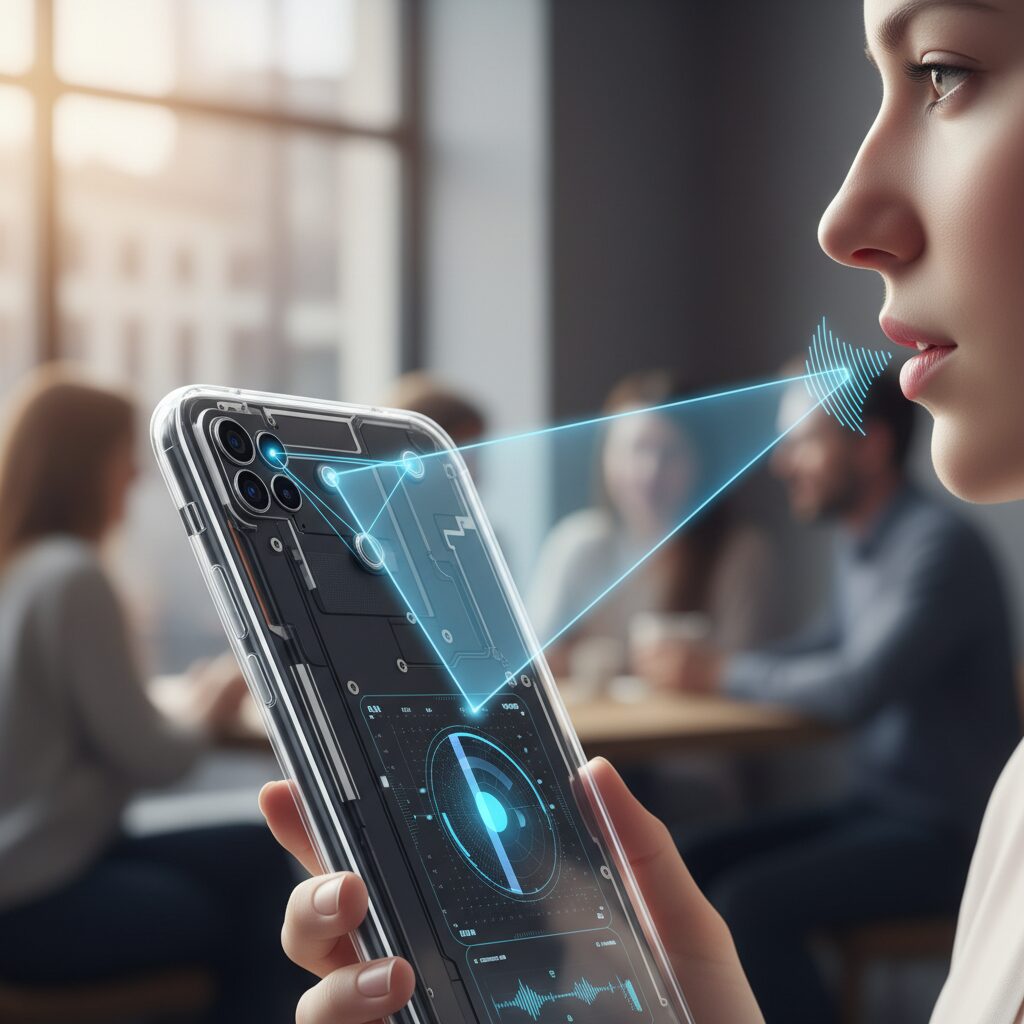
Modern smartphones no longer rely on a single microphone. Instead, they deploy multi-microphone arrays that work together as a coordinated sensing system. According to industry analyses cited by SNS Insider, 85.1% of premium smartphones and 50.0% of mid-range models ship with at least two MEMS microphones. This hardware foundation enables one of the most important technologies in mobile audio today: beamforming.
Beamforming leverages the tiny time differences in which sound waves reach spatially separated microphones. By comparing these arrival times and phase differences, the device estimates the direction of the sound source. The processor then amplifies signals from the desired direction while attenuating others, effectively creating a “virtual directional microphone” through software.
Beamforming transforms multiple omnidirectional MEMS microphones into a software-defined directional system, without changing the physical shape of the phone.
This technique is essential in environments where signal-to-noise ratio (SNR) alone is not enough. Even as the MEMS market shifts toward higher SNR tiers above 65 dB, as reported by Mordor Intelligence, background noise in urban settings or crowded venues remains complex and dynamic. Beamforming adds spatial filtering on top of hardware sensitivity, dramatically improving speech intelligibility.
Core Components of Smartphone Beamforming
| Element | Role | User Impact |
|---|---|---|
| Multiple MEMS Mics | Capture sound from different positions | Enable spatial comparison |
| Time-Difference Analysis | Detect direction of arrival | Focus on speaker’s voice |
| Digital Signal Processor | Apply weighting and filtering | Reduce ambient noise in real time |
In practical terms, this is what makes features like clear voice calls in windy conditions possible. When you hold a phone to your ear, one microphone may primarily capture your voice while others monitor ambient noise. The system continuously recalculates spatial cues, suppressing traffic sounds or chatter behind you while preserving the forward-facing speech signal.
The same principle powers “audio zoom” in video recording. As you zoom the camera toward a distant subject, the beamforming algorithm narrows its virtual pickup pattern in that direction. Rather than digitally increasing volume alone, the system selectively enhances sound energy aligned with the camera’s field of view, creating perceptual coherence between image and audio.
Importantly, this process depends on digital microphones, which now account for 67.55% of the market according to 6Wresearch. Because digital MEMS microphones perform A/D conversion internally, they are less susceptible to electromagnetic interference from 5G antennas and high-speed SoCs. Clean digital input is critical when calculating microsecond-level time differences for accurate beam steering.
For gadget enthusiasts and creators, understanding multi-mic arrays means recognizing that microphone count is not just a spec-sheet number. What matters is how intelligently the array geometry, SNR performance, and signal processing algorithms are integrated. Directional sound capture in 2026 is no longer about a single premium capsule. It is about computational spatial awareness built into the device you already carry.
Google Pixel’s Audio Magic Eraser: AI-Powered Source Separation for Everyone
Google Pixel’s Audio Magic Eraser represents a decisive shift from traditional noise reduction to true AI-powered source separation. Instead of treating unwanted sound as a single block of “noise,” the system analyzes recorded audio and decomposes it into distinct layers such as speech, music, environmental noise, and natural ambience.
This approach reflects the broader evolution of computational audio. As industry analyses on MEMS microphone advancements point out, modern smartphones already capture cleaner signals thanks to high-SNR, multi-microphone arrays. Audio Magic Eraser builds on that hardware foundation and applies machine learning to reinterpret the sound scene after recording.
At the core of the feature is Google’s machine learning model trained to recognize different audio categories within a video file. Once processed, users can adjust individual elements with slider-based controls directly inside the Pixel’s editing interface. What previously required professional tools like iZotope RX and detailed waveform editing can now be done in seconds on a smartphone.
Consider a street interview recorded in a busy urban environment. Traditionally, traffic rumble and passing sirens would permanently degrade intelligibility. With Audio Magic Eraser, users can reduce vehicle noise while preserving vocal clarity. If background music overpowers dialogue, it can be selectively lowered without flattening the entire soundscape.
| Traditional Editing | Audio Magic Eraser on Pixel |
|---|---|
| Global noise reduction applied to full track | Layer-based adjustment of speech, music, and noise |
| Requires desktop software and expertise | On-device processing with slider UI |
| High risk of artifacts and voice degradation | Targeted refinement with minimal manual intervention |
Another compelling capability is speaker differentiation. When multiple people appear in a clip, the system can identify separate voices and allow independent volume adjustments. For content creators filming panel discussions or casual group conversations, this dramatically reduces post-production friction.
The democratization aspect is especially important. According to broader analyses of computational audio trends, advanced signal processing was historically confined to studios with specialized engineers. Pixel brings source separation into a consumer workflow, compressing what used to be a multi-step editing chain into a single mobile interaction.
This changes not only audio quality, but creative control. Users are no longer forced to accept the acoustic limitations of the recording environment. Instead, they can reinterpret the captured soundscape after the fact, shaping clarity and emphasis according to narrative intent.
For gadget enthusiasts and creators alike, Audio Magic Eraser is more than a convenience feature. It exemplifies how AI transforms raw microphone input into editable semantic layers. In practical terms, it means fewer reshoots, cleaner dialogue, and a faster path from capture to publish—all handled directly on the device in your pocket.
iPhone’s Audio Mix and Spatial Audio: Reconstructing the Soundscape
Apple’s approach to Audio Mix and Spatial Audio is not about simply removing noise. It is about reconstructing the soundscape after recording, giving creators control over how a scene is perceived rather than just how it was captured.
To use Audio Mix, video must be recorded in Spatial Audio format. This means the iPhone captures not only sound pressure but also directional metadata using multiple microphones, effectively mapping where voices and ambient sounds exist in three-dimensional space.
According to technical explanations published by Apple-focused media such as iPhone Mania, this spatial metadata becomes the foundation for post-capture remixing. The result is a workflow that feels closer to film post-production than traditional smartphone editing.
| Mode | Primary Effect | Typical Use Case |
|---|---|---|
| In-Frame | Emphasizes subjects visible in the camera frame | Vlogs, interviews |
| Studio | Reduces room reverb and background noise | Commentary, narration |
| Cinematic | Balances voice clarity with environmental ambience | Travel, documentary-style clips |
In-Frame mode works like a virtual shotgun microphone. By prioritizing voices that align with the camera’s field of view, it simulates directional pickup even though the hardware microphones remain physically fixed. For solo creators filming outdoors, this dramatically reduces distractions such as traffic or crowd chatter.
Studio mode takes a different path. Instead of isolating by direction alone, it algorithmically suppresses reverberation and diffuse noise, creating a “dry” vocal texture similar to recording in an acoustically treated room. This is particularly powerful for creators who lack access to professional soundproofing.
Cinematic mode preserves immersion. Rather than stripping the environment away, it keeps spatial depth while ensuring dialogue remains intelligible. The effect resembles a carefully mixed surround track, where ambience supports storytelling instead of competing with it.
This shift aligns with the broader rise of computational audio. As MEMS microphone arrays become standard in premium smartphones—over 85% adoption in high-end models according to market analyses—the hardware now captures sufficient spatial detail to enable software-driven reconstruction.
There is, however, a trade-off. Because the processing relies heavily on on-device computation within the SoC, applying Audio Mix can require rendering time proportional to video length. Users effectively exchange immediacy for precision control.
For gadget enthusiasts and serious mobile filmmakers, the implication is clear. The iPhone is no longer just a capture device. It is a post-production tool capable of reshaping acoustic perspective after the fact. In a creator economy where perceived production value directly affects retention and credibility, the ability to redesign how sound occupies space becomes a decisive competitive edge.
AI Recording Wearables: PLAUD NOTE, NotePin, and the SaaS-ification of Hardware
The rise of AI recording wearables such as PLAUD NOTE and NotePin signals a structural shift in how we think about hardware. These devices are not positioned as mere voice recorders. They are designed as always-available gateways to large language models, turning spoken words into structured, searchable intelligence.
In contrast to traditional IC recorders, the core value no longer lies in microphone specs alone. It lies in the cloud layer that processes, summarizes, and operationalizes captured audio. This is where the SaaS-ification of hardware becomes visible.
PLAUD NOTE exemplifies this model. The hardware itself, priced around 25,000–30,000 yen, supports both call recording and in-person meetings. However, access to transcription and AI-powered summaries requires an annual subscription of roughly 16,000 yen or more, according to long-term user reviews.
User evaluations consistently highlight two factors: instant recording and automatic cloud synchronization. Once audio is captured, it is uploaded, transcribed, and summarized without manual file handling. Reviews report Japanese transcription accuracy at around 90 percent in practical business scenarios, though dialects and technical jargon remain challenging.
| Aspect | Traditional Recorder | AI Wearable |
|---|---|---|
| Primary Value | Audio storage | Text & summaries |
| Workflow | Record → Listen → Write | Record → AI summary |
| Revenue Model | One-time purchase | Device + subscription |
This transition fundamentally changes user psychology. Buyers are no longer paying for better microphones. They are paying for reduced cognitive load. The outsourcing of memory and note-taking becomes a recurring service, not a feature.
NotePin extends this logic further through its wearable form factor. As a pendant or clip-on device, it minimizes friction between conversation and capture. Recording becomes ambient rather than intentional. This aligns with the broader trend toward ambient computing, where interaction fades into the background.
Another strategic dimension is interoperability. NotePin’s web-based workflow is designed to integrate easily with external LLMs such as Claude or ChatGPT. Audio is not just transcribed. It becomes prompt-ready material for idea expansion, strategic planning, or knowledge base construction.
The monetization engine, therefore, is continuous AI augmentation. Hardware becomes the customer acquisition channel, while subscription revenue funds model access, cloud processing, and iterative feature updates.
This SaaS-driven architecture mirrors patterns seen in enterprise software. Upfront device margins are only part of the equation. Lifetime value depends on how deeply the AI summaries integrate into daily workflows. Once meeting notes, action items, and searchable archives accumulate, switching costs rise naturally.
For gadget enthusiasts, the appeal is not simply convenience. It is leverage. These devices compress the gap between conversation and execution. In an environment where information velocity determines competitive advantage, AI recording wearables redefine recording as a productivity multiplier rather than a passive archive.
Workflow Disruption: From Listening Back to Instant Summaries and Action Items
Until recently, recording a meeting meant blocking time afterward to listen again, pause, rewind, and manually extract key points. That “listening back” phase was often longer than the meeting itself.
Today, AI-powered recording devices and smartphone-native features are fundamentally restructuring that workflow. The bottleneck has shifted from playback to interpretation.
Instead of treating audio as an archive to revisit, modern systems treat it as raw material for immediate synthesis.
| Traditional Flow | AI-Driven Flow |
|---|---|
| Record → Replay → Take Notes | Record → Auto-Transcribe → Instant Summary |
| Manual extraction of action items | AI-generated tasks & key decisions |
| High time cost after meetings | Minimal post-processing time |
Devices such as PLAUD NOTE demonstrate this shift clearly. User reviews indicate that Japanese transcription accuracy reaches roughly 90%, which places it firmly in the realm of practical business use. Even when corrections are required for dialects or technical terminology, users consistently report that editing is far faster than starting from scratch.
What matters is not just transcription, but structured output. AI systems automatically generate summaries, highlight key discussion points, and extract action items. The cognitive load of remembering “who said what” is dramatically reduced.
This represents a form of cognitive outsourcing, where human attention is preserved for decision-making rather than documentation.
The broader context reinforces this transformation. As computational audio advances—supported by higher SNR MEMS microphones and multi-mic beamforming—captured sound is cleaner and more contextually intelligible. According to market analyses by Mordor Intelligence, the shift toward higher-performance digital MEMS microphones is accelerating, which directly improves downstream AI interpretation accuracy.
Cleaner input leads to more reliable summaries. In other words, hardware evolution amplifies software intelligence.
This synergy is what enables near-instant meeting intelligence.
In practical terms, this changes behavior. Professionals no longer record “just in case.” They record with the expectation that structured insight will be delivered automatically. Web integrations with large language models further extend this process, enabling brainstorming, idea refinement, and knowledge archiving directly from recorded conversations.
The output is no longer an audio file stored in a folder. It is a searchable, editable, and shareable knowledge artifact.
As a result, workflow friction decreases while strategic velocity increases. Meetings transition from memory-dependent events to data-driven assets, and the value of recording shifts from preservation to acceleration.
Creator Economy and Audio ROI: Data on Retention, Engagement, and Revenue
In the creator economy, audio quality is no longer a technical afterthought but a measurable revenue lever. As Japan’s creator economy reached 2.0894 trillion yen in 2024, according to domestic industry research, competition has intensified around retention, engagement, and monetization efficiency. In this environment, sound directly influences ROI.
Audio impacts how long people stay, how deeply they engage, and whether they convert. That relationship is increasingly supported by platform-level data rather than intuition.
Retention and Completion Rate
Video marketing statistics highlight a critical gap in performance depending on how audio is delivered. Wave.video reports that 85% of Facebook videos are watched without sound, while 60% of Instagram Stories are viewed with sound. This divergence changes optimization strategy entirely.
| Metric | With Clear Audio / Subtitles | Without Optimization |
|---|---|---|
| Completion Rate | 91% | 66% |
| Sound Usage (Facebook) | 15% with sound | 85% muted |
| Sound Usage (Instagram Stories) | 60% with sound | 40% muted |
The 25-point difference in completion rate is not cosmetic. Higher completion rates directly influence ad impressions, algorithmic promotion, and sponsorship pricing. For creators monetizing through CPM or brand deals, this gap translates into tangible revenue differences.
High-SNR microphones and AI-assisted noise reduction improve automatic caption accuracy, which in turn strengthens retention in muted environments. At the same time, immersive, well-mixed audio increases watch time where sound is enabled.
Engagement and Perceived Authenticity
As generative AI lowers visual production costs, audiences increasingly evaluate authenticity through voice texture and environmental realism. Industry analysis notes that AI-driven content expansion has paradoxically increased the premium on “human” elements. Voice becomes a trust signal.
Clean, spatially coherent audio enhances credibility, which drives comments, shares, and repeat viewing. In podcasting and interview formats, poor audio often triggers early drop-off regardless of visual quality.
Computational audio features such as beamforming and post-capture voice isolation allow creators to produce studio-like clarity without external teams. This reduces production friction while preserving engagement quality.
Revenue Efficiency and Investment Logic
From an ROI perspective, audio upgrades are capital-efficient. A creator investing in a higher-quality microphone or AI audio processing is not merely improving aesthetics but optimizing key performance indicators tied to monetization.
When completion rate rises from 66% to 91%, the downstream impact includes stronger algorithmic distribution, higher average watch time, improved ad eligibility, and stronger negotiating power with sponsors. Over multiple uploads, this compounds.
Audio investment functions as performance marketing infrastructure, not creative vanity.
In a 2-trillion-yen-plus market with a projected broader economic footprint exceeding 14 trillion yen when related industries are included, marginal gains in retention and engagement scale quickly. For gadget-savvy creators, understanding audio ROI is therefore not optional. It is a strategic growth decision grounded in measurable data.
In the creator economy, sound is no longer background. It is a quantifiable driver of attention, trust, and revenue.
External Microphone Ecosystems: ZOOM Am7, MS Stereo, and the Democratization of ASMR
As smartphone microphones continue to evolve, a parallel movement is reshaping the landscape: the rise of external microphone ecosystems. Devices such as the ZOOM Am7 and dedicated MS stereo solutions are expanding what mobile creators can achieve, especially in highly sensitive genres like ASMR.
External microphones are no longer niche accessories; they are precision tools that unlock acoustic possibilities beyond the physical limits of built-in MEMS arrays.
ZOOM Am7 and the Power of Mid-Side Control
The ZOOM Am7, designed for USB-C Android devices, has become a reference point for mobile MS stereo recording. Its Mid-Side configuration combines a forward-facing cardioid capsule (Mid) with a bidirectional capsule (Side), enabling post-recording control over stereo width.
| Component | Function | Creative Advantage |
|---|---|---|
| Mid (Cardioid) | Captures center-focused sound | Clear vocals and dialogue |
| Side (Bidirectional) | Captures left-right ambience | Adjustable stereo image |
According to hands-on reviews from creators, the ability to adjust stereo width after recording—90°, 120°, or raw M-S data—provides flexibility typically reserved for professional field recorders. The rotatable microphone head further aligns with both rear-camera and selfie shooting, preserving smartphone agility while significantly improving spatial realism.
This matters because built-in smartphone microphones, even with beamforming, are constrained by chassis size and fixed capsule spacing. External MS systems effectively bypass those constraints, giving creators physical acoustic separation that software alone cannot replicate.
ASMR and the Democratization of Binaural Audio
The ASMR boom on platforms like YouTube and Twitch has accelerated demand for immersive recording. At the high end, professionals rely on dummy-head systems such as the NEUMANN KU100, priced well above consumer budgets. However, the ecosystem has diversified dramatically.
USB microphones compatible with OTG connections, compact binaural in-ear microphones, and smartphone-mounted stereo units now allow individual creators to experiment with spatial sound without six-figure studio investments. Guides aimed at ASMR creators consistently emphasize microphone positioning and stereo imaging as more critical than camera resolution.
This shift represents the true democratization of ASMR: spatial audio quality is no longer gated by studio infrastructure but by informed microphone selection.
What makes 2025–2026 particularly interesting is the hybrid workflow emerging among advanced users. High-fidelity audio captured through external microphones is increasingly refined using smartphone AI tools—noise reduction, vocal isolation, or spatial balancing—before immediate upload. Hardware captures the nuance; computational audio polishes the result.
In this ecosystem, external microphones are not competitors to computational audio but complementary front ends. They supply richer raw data—wider stereo fields, deeper ambience, subtler texture—that AI processing can enhance rather than reconstruct.
For gadget enthusiasts and serious creators alike, the takeaway is clear: investing in an external microphone such as an MS stereo unit transforms a smartphone from a convenient recorder into a spatial audio instrument. In the age of ASMR and immersive media, that distinction defines the boundary between casual content and acoustically compelling experiences.
Legal and Ethical Boundaries: What the Osaka District Court Ruling Means for Secret Recordings
As AI-powered recorders and wearable devices become frictionless, the legal risk surrounding secret recordings in Japan has become far more tangible. The Osaka District Court ruling of December 7, Reiwa 5 (2023) provides one of the clearest judicial frameworks to date for understanding where the boundary lies.
For gadget enthusiasts who rely on smartphones, PLAUD NOTE, or ambient recording wearables, this decision is not abstract theory. It directly shapes how recorded audio may—or may not—be used as evidence in court.
How the Court Differentiated Secret Recordings
| Scenario | Court’s View | Key Reasoning |
|---|---|---|
| Recorder hidden in workplace break room for months | Evidence rejected | Severe privacy intrusion; blanket, indiscriminate capture |
| Recording conversations in which the recorder was a participant | Evidence accepted | Extension of note-taking; lower expectation of secrecy |
In the first scenario, an employee secretly installed a recorder in a break room and captured conversations over approximately four months. The court denied evidentiary admissibility. The reasoning emphasized the “reasonable expectation of privacy” in a space designed for rest, where workers may speak freely about personal matters.
The judges concluded that comprehensive, ongoing recording—regardless of topic—constituted a serious infringement of privacy rights and violated procedural good faith. Under Japanese civil procedure principles, evidence obtained through methods with strong illegality can be excluded.
By contrast, when the same individual recorded conversations in which they were directly involved, the court admitted the audio as evidence. The logic was nuanced. If you are a participant, capturing what is said to you resembles taking contemporaneous notes.
The legal weight shifted from “secret surveillance” to “self-protective documentation.” Unless the conversation was explicitly confidential or highly sensitive, the other party’s privacy interest was considered comparatively weaker.
Key boundary: Recording as a participant for self-protection may be admissible; installing devices to broadly monitor others is likely to be rejected and legally risky.
This distinction is particularly relevant in the age of ambient AI devices. Wearables that can record continuously blur the line between intentional evidence preservation and passive surveillance. According to legal commentary analyzing the ruling, courts will closely examine location, duration, scope, and purpose.
For business users, the compliance implication is practical rather than theoretical. Placing a device openly on a desk and stating that you are recording for minutes or transcription purposes dramatically reduces legal exposure. Transparency weakens claims of privacy violation.
Ethically, the ruling also signals a broader societal stance. As computational audio makes capture effortless, responsibility shifts to the user. Technological capability does not automatically translate into legal legitimacy.
For power users of advanced recording gadgets, understanding this boundary is as important as understanding SNR or beamforming. The true sophistication in 2026 is not just capturing perfect audio—it is knowing when you are allowed to press record.
The Future of Computational Audio: IoT, Automotive, Hearing Tech, and Ambient Computing
Computational audio is no longer confined to smartphones. It is rapidly expanding into IoT devices, automobiles, hearing technology, and ambient computing environments, redefining how machines perceive and react to sound.
According to Mordor Intelligence, the global MEMS microphone market is projected to grow at over 7.5% CAGR through 2031, driven not only by mobile demand but by voice-enabled IoT and automotive applications. This shift signals a structural transformation: microphones are becoming environmental sensors rather than simple recording components.
Sound is evolving from media input to real-time environmental intelligence.
In IoT ecosystems, ultra-low-power digital MEMS microphones are critical. STMicroelectronics has introduced models consuming under 5µA in active mode, enabling always-on voice detection without draining battery-powered smart home devices. This technical milestone allows wake-word systems to operate continuously, forming the backbone of voice-first interfaces in smart speakers, security systems, and industrial sensors.
The key technical requirements in IoT audio can be summarized as follows.
| Domain | Primary Requirement | Technical Focus |
|---|---|---|
| Smart Home IoT | Always-on listening | Ultra-low power MEMS, digital output |
| Industrial IoT | Anomaly detection | High SNR, edge AI processing |
| Wearables | Battery efficiency | Miniaturization, noise robustness |
In automotive environments, the opportunity is even broader. Mordor Intelligence estimates automotive MEMS microphone demand growing at 6.62% CAGR, reflecting integration into advanced driver assistance systems. Microphones are now used to detect emergency vehicle sirens, enhance in-cabin voice assistants, and even monitor mechanical anomalies such as abnormal engine noise patterns.
What makes this transformative is the fusion of beamforming arrays and AI inference at the edge. Vehicles equipped with multi-microphone arrays can isolate driver commands from road noise exceeding 70 dB, while simultaneously feeding acoustic data into predictive maintenance systems. In this context, audio becomes a safety sensor, not merely a communication tool.
Hearing technology represents another frontier where computational audio is dissolving traditional boundaries. Innovations originally developed for hearing aids—ultra-low noise floors, directional amplification, and adaptive filtering—are now influencing consumer earbuds. Conversely, smartphone-grade AI signal processing is being integrated into assistive listening devices to dynamically separate speech from background noise.
This bidirectional technology transfer signals a convergence. Hearing aids increasingly resemble intelligent wearables, while earbuds adopt medical-grade acoustic optimization techniques. The result is personalized soundscapes that adapt in real time to context, location, and user preference.
Perhaps the most profound shift lies in ambient computing. In this paradigm, microphones embedded across environments—cars, offices, homes, and wearables—create a continuous acoustic layer of interaction. Users no longer “activate” devices; systems respond contextually to voice, tone, and environmental cues.
Edge AI plays a decisive role here. Processing audio locally reduces latency and privacy risks, enabling real-time transcription, intent recognition, and anomaly alerts without constant cloud transmission. As digital microphones already command over 67% market share, according to industry analysis, the infrastructure for this distributed intelligence is firmly in place.
The future of computational audio is therefore not about louder speakers or clearer recordings. It is about machines that understand acoustic environments as fluid, data-rich ecosystems. When IoT nodes detect subtle sound shifts, vehicles anticipate hazards acoustically, and hearing devices reconstruct personalized sound fields, audio becomes a foundational interface for ambient intelligence.
For technology enthusiasts and industry innovators, this signals a new competitive axis. The companies that master low-power sensing, high-SNR capture, and AI-driven interpretation will define how humans coexist with responsive, listening environments in the coming decade.
参考文献
- Embedded Computing Design:MEMS Microphones: The Technology of Choice For Today’s Consumer Devices
- Mordor Intelligence:MEMS Microphones Market Report | Industry Analysis, Size & Forecast
- SNS Insider:MEMS Microphones Market Size, Share & Industry Report, 2033
- iPhone Mania:What Is the iPhone 16 Audio Mix Feature? Full Guide and Editing Options
- AI Transcription Guide:PLAUD Note AI Voice Recorder Review After 1.5 Years of Use
- CREATIVE VILLAGE:Japan’s Creator Economy Surpasses 2 Trillion Yen, Boosted by Generative AI
- Wave.video Blog:Video Marketing Statistics
- Ask Business Law:Can Secret Recordings Be Used as Evidence? Osaka District Court Ruling (Dec 7, 2023)