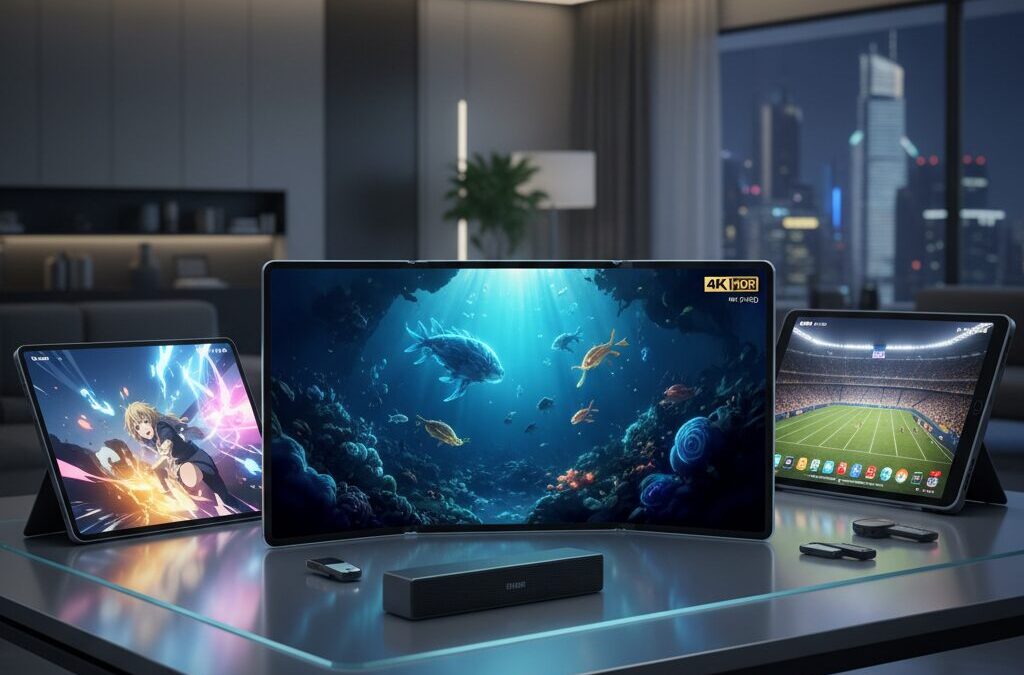
Streaming is no longer just a casual pastime. For millions of users worldwide, it has become the primary way to experience movies, series, anime, and live content every single day.
In 2025, tablets are evolving from “bigger smartphones” into highly specialized immersive media devices, designed specifically to maximize video quality, sound performance, and viewing comfort. With 4K HDR content, Dolby Atmos audio, and AI-powered image enhancement becoming mainstream, the gap between average and exceptional viewing experiences is wider than ever.
In this article, you will discover the latest market data, cutting-edge display technologies such as OLED and advanced anti-reflection coatings, the rise of tri-fold devices, and in-depth comparisons of the most powerful tablets for video streaming. If you want to build the ultimate portable cinema setup, this guide will help you choose the right device with confidence.
- Why 2025 Is a Turning Point for Video-Centric Tablets
- Tablet Market Trends: Shipments, Polarization, and Brand Competition
- OLED vs Advanced LCD: The Display Technologies Redefining Black Levels and HDR
- Anti-Reflection Breakthroughs and Outdoor Visibility Improvements
- Resolution, Refresh Rate, and Variable Refresh: Do 120Hz and 144Hz Really Matter for Streaming?
- Aspect Ratio Wars: 16:10 vs 4:3 for Movies, YouTube, and Cinematic Content
- The Rise of Tri-Fold Devices: Can One Device Replace Your Phone and Tablet?
- Flagship Showdown: Samsung Galaxy Tab S10 Ultra for Ultimate Immersion
- High Performance on a Budget: Xiaomi Pad 7 and 7 Pro Explained
- Large-Screen Alternatives: NEC LAVIE Tab T14 and Hybrid Use Cases
- Entry-Level Disruption: Amazon Fire Max 11 and the Shift Toward Standard Android
- Streaming Services in 2025: User Satisfaction, 4K Limits, and Ad-Supported Plans
- The Science of Comfortable Viewing: Ergonomics, Tech Neck, and Smart Accessories
- 参考文献
Why 2025 Is a Turning Point for Video-Centric Tablets
In 2025, tablets are no longer positioned as oversized smartphones or lightweight laptop substitutes. They are increasingly designed and marketed as immersive media consumption devices, with video at the center of the experience.
This shift is not abstract. It is backed by measurable market recovery and changing user behavior. According to MM Research Institute, tablet shipments in Japan reached 3.71 million units in the first half of fiscal 2025, marking a second consecutive period of growth. At the same time, ICT Research Institute projects that paid video streaming users in Japan will reach 38.9 million in 2025.
When hardware demand rebounds in parallel with record-level streaming adoption, the product definition itself begins to change.
| Indicator | 2025 Status | Implication |
|---|---|---|
| Tablet shipments (Japan, H1) | 3.71 million units | Market recovery and renewed demand |
| Paid video streaming users | 38.9 million (projected) | Video as daily infrastructure |
The pandemic normalized streaming, but 2025 is different. Viewers are no longer satisfied with “it plays.” 4K HDR content has become mainstream across major platforms, and Dolby Atmos support is expanding into mobile environments. This raises the minimum hardware threshold for what feels acceptable.
Industry coverage from outlets such as PhoneArena and SamMobile highlights how flagship tablets now emphasize OLED contrast performance and advanced anti-reflection technologies as primary selling points. That language would have been reserved for TVs a few years ago.
The competitive battlefield has moved from productivity specs to perceptual quality: contrast, peak brightness, reflection control, and color accuracy.
Another structural change is market polarization. Retail data reported by BCN Ranking shows iPad models dominating top sales positions in 2025, while Android devices are gaining ground in specific value-driven segments. Consumers are clustering around two clear choices: premium cinematic immersion or aggressive cost-performance for dedicated streaming use.
Mid-range compromise devices are losing narrative power because streaming ecosystems themselves have matured. Netflix, Amazon Prime Video, and YouTube Premium optimize for offline playback, adaptive streaming, and recommendation engines. The device is now judged by how faithfully it renders that ecosystem.
Finally, form factor innovation signals a deeper inflection point. As reported by ITmedia, Samsung’s tri-fold Galaxy Z TriFold expands to a tablet-sized display while retaining smartphone portability. This challenges the historical boundary between phone and tablet and reframes video viewing as a fluid, context-driven behavior rather than a fixed-device activity.
In other words, 2025 is not just another product cycle. It is the year when tablets are redefined around a single, dominant use case: high-fidelity, anywhere, uninterrupted video immersion.
Tablet Market Trends: Shipments, Polarization, and Brand Competition
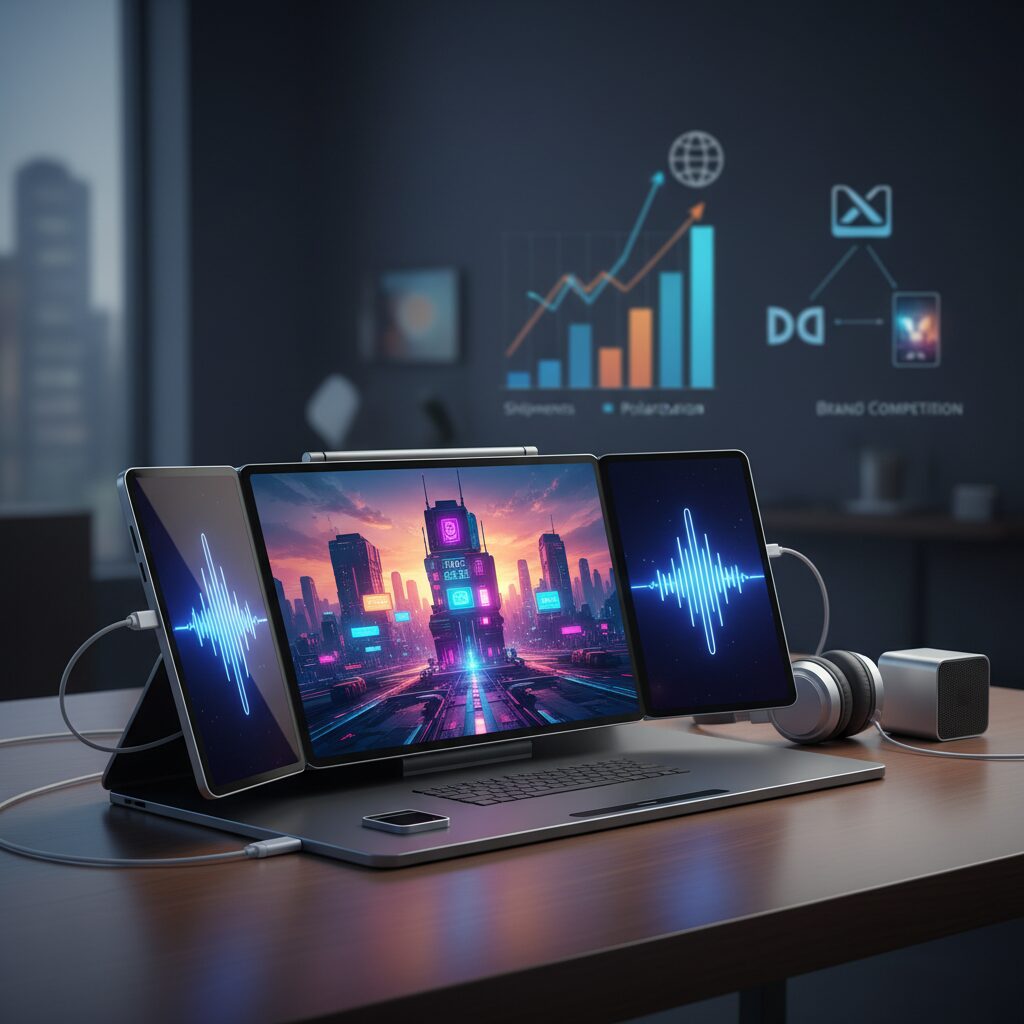
The Japanese tablet market in 2025 is no longer in decline. According to MM Research Institute, domestic shipments reached 3.71 million units in the first half of fiscal 2025, marking the second consecutive period of growth. This signals a structural recovery rather than a temporary rebound.
Behind this recovery, demand has clearly shifted from education-driven bulk purchases to entertainment and secondary screen usage. As smartphones plateau in size, consumers seeking immersive video experiences are returning to larger displays.
The market is not expanding evenly. It is polarizing.
| Segment | Consumer Intent | Market Behavior |
|---|---|---|
| Premium | High-end display & performance | Strong brand loyalty, higher ASP |
| Entry | Maximum cost efficiency | Price-sensitive, sub-device demand |
| Mid-range | Balanced specs | Declining presence |
EC market analysis by Nint highlights fluctuations in price composition, suggesting consumers are choosing either “premium experience” or “aggressive affordability.” Devices positioned ambiguously in the middle are losing visibility.
Brand competition reflects this divide. BCN Ranking data for 2025 shows that iPad models occupy the top six positions in sales rankings. The 11-inch iPad Wi-Fi 128GB remains particularly strong, demonstrating continued trust in Apple’s ecosystem integration and app optimization quality.
However, momentum is building elsewhere. Android tablets are gaining ground in lower-ranking positions and specific use cases. Samsung’s Galaxy Tab A9+ appearing in rankings indicates that value-oriented Android devices are capturing sub-device demand for video consumption.
Currency dynamics also influence competition. With the yen remaining weak, iPad pricing has risen, increasing sensitivity among buyers. This creates space for competitively priced Android alternatives offering large displays and sufficient performance for streaming and media playback.
What makes 2025 distinctive is not just shipment recovery but competitive restructuring. Apple maintains dominance in volume and brand power, yet Android manufacturers compete aggressively through pricing strategy and differentiated display technology.
In other words, the battlefield is no longer about tablet versus PC replacement. It is about who can deliver the most compelling media consumption experience at either extreme of the price spectrum. The brands that understand this polarization are the ones shaping the next phase of the tablet market.
OLED vs Advanced LCD: The Display Technologies Redefining Black Levels and HDR
When it comes to cinematic immersion on a tablet, display technology is the single most decisive factor. In 2025, the competition between OLED and advanced LCD panels is no longer about simple brightness or resolution. It is about how faithfully a device reproduces true black, subtle shadow detail, and high dynamic range as intended by creators.
Black level performance is the foundation of HDR. Without deep blacks, highlight brightness alone cannot deliver convincing contrast. This is where OLED and next-generation LCD diverge most clearly.
| Technology | Black Reproduction | HDR Strength |
|---|---|---|
| OLED (Self-emissive) | Pixel-level shutoff (true black) | Near-infinite contrast, precise shadow detail |
| Advanced LCD (Quantum Dot / Local Dimming) | Backlight-controlled black | High brightness, improved color volume |
OLED panels, such as those used in flagship models like the Galaxy Tab S10 series and LAVIE Tab T14, rely on self-emissive pixels. Each pixel can turn off completely, producing what reviewers often describe as “true black.” According to Samsung’s technical briefings and independent evaluations cited by PhoneArena, this enables contrast ratios that approach theoretical infinity, because black pixels emit no light at all.
In dark scenes from films like The Batman or series with heavy low-light grading, this capability becomes immediately visible. Instead of washed-out gray shadows, you see nuanced gradations within darkness. This precision dramatically enhances perceived depth and realism.
Advanced LCD, however, should not be underestimated. Recent implementations, such as the 3.2K panel in the Xiaomi Pad 7 series, combine high-resolution backplanes with refined backlight control and wide color gamut coverage. Xiaomi’s official specifications highlight a 144Hz panel with strong color reproduction, and reviews from GSMArena note that brightness levels are competitive for HDR playback.
Where LCD traditionally struggled was black uniformity. Because a backlight is always present, even with local dimming, some light leakage can occur. Yet improvements in backlight segmentation and quantum dot enhancement have narrowed the perceptual gap, especially in bright HDR scenes where peak luminance matters more than absolute black.
HDR performance itself depends on two pillars: peak brightness and contrast. OLED historically led in contrast, while LCD often led in sustained brightness. In 2025 models, OLED efficiency improvements have reduced this gap, allowing high-end tablets to deliver impactful HDR highlights without sacrificing longevity.
The real-world takeaway is contextual. If you frequently watch dark, cinematic content in dim rooms, OLED provides unmatched shadow fidelity. If you consume mixed content in brighter environments, a high-quality LCD with strong brightness and wide color support can offer excellent HDR impact at a lower cost.
Ultimately, both technologies have matured. The difference is no longer about “good versus bad,” but about which display philosophy aligns with your viewing habits and expectations for black depth and dynamic range.
Anti-Reflection Breakthroughs and Outdoor Visibility Improvements
Outdoor viewing has long been the Achilles’ heel of high-end tablets. Even with OLED’s perfect blacks and high peak brightness, ambient light reflections can wash out contrast and destroy immersion. In 2025, however, anti-reflection engineering has shifted from a minor coating upgrade to a core display differentiator.
According to Samsung’s official product communications and third-party evaluations such as SamMobile and PhoneArena, the Galaxy Tab S10 Ultra and S10+ adopt an advanced anti-reflection layer derived from the Gorilla Glass Armor lineage. The key breakthrough is a dramatic reduction in surface reflectance from around 5% in conventional glass to below 2%.
This numerical drop may sound incremental, but perceptually it transforms usability under strong indoor lighting and even direct sunlight.
| Display Surface | Typical Reflectance | Visual Impact Outdoors |
|---|---|---|
| Standard glossy glass | ~5% | Noticeable mirror-like glare |
| Advanced anti-reflection (S10 series) | <2% | Significantly reduced reflections, preserved contrast |
Traditional anti-glare solutions often relied on matte diffusion layers. While effective at scattering reflected light, they introduced a trade-off: softened text, reduced micro-contrast, and a subtle grain that dulled HDR highlights. The new nano-layered approach instead cancels reflected ambient light while allowing emitted panel light to pass through with minimal distortion.
The result is a rare combination: low glare without sacrificing OLED sharpness or color intensity. In practical terms, this means you can watch a high-contrast HDR scene on a balcony at noon without constantly tilting the screen to dodge reflections.
Outdoor visibility is not only about reflection control. Samsung’s “Vision Booster,” highlighted in its newsroom materials, dynamically adjusts tone mapping based on ambient illumination. Rather than simply pushing brightness higher, it selectively enhances shadow detail and mid-tones to prevent color washout under intense light.
This approach aligns with broader display science principles: perceived contrast depends as much on ambient luminance adaptation as on peak brightness. By combining reflectance reduction with adaptive tone mapping, manufacturers are tackling both sides of the visibility equation.
For users who frequently stream sports, dramas, or YouTube on commutes or in bright living rooms, anti-reflection performance now directly affects real-world image quality more than raw resolution increases. A 3.2K or 4K panel cannot compensate for heavy glare.
From a buying perspective, evaluating outdoor usability should include three checkpoints: surface reflectance specification, presence of adaptive brightness or tone technologies, and panel type. Among these, reflectance has emerged in 2025 as the most underappreciated yet impactful metric.
In short, anti-reflection innovation has redefined what “portable cinema” truly means. Tablets are no longer confined to dim indoor environments. With sub-2% reflectance and intelligent luminance control, premium models now deliver consistent clarity across cafés, trains, and sunlit terraces—bringing immersive video consumption closer to an anywhere experience.
Resolution, Refresh Rate, and Variable Refresh: Do 120Hz and 144Hz Really Matter for Streaming?
When choosing a tablet for streaming, resolution and refresh rate often dominate the spec sheet. You may see 3.2K, 120Hz, or even 144Hz and wonder whether those numbers truly change your viewing experience. The answer depends less on marketing claims and more on how modern video content is actually produced and delivered.
Most films are mastered at 24fps, while television broadcasts and YouTube commonly use 30fps or 60fps. That means a 144Hz panel does not magically turn a 24fps drama into ultra-smooth motion. However, refresh rate still plays a meaningful role when paired with advanced display control technologies.
| Content Type | Typical Frame Rate | Display Impact |
|---|---|---|
| Movies | 24fps | Benefits from stable frame pacing |
| TV / YouTube | 30–60fps | Smoother on 120Hz panels |
| AI Frame Interpolation | Up to 60fps+ | Higher refresh enables fluid motion |
High refresh rate becomes particularly relevant when the tablet supports Variable Refresh Rate (VRR). VRR dynamically adjusts the panel’s refresh cycle to match the frame rate of the content. This reduces judder and uneven motion, especially noticeable in slow camera pans or high-contrast scenes. In practical terms, a 120Hz or 144Hz display with VRR can present 24fps content using evenly divisible refresh cycles, minimizing micro-stutter.
The real advantage of 120Hz and above for streaming is not raw speed, but motion consistency and responsiveness. According to multiple device reviews cited by PhoneArena and GSMArena, users consistently report smoother scrolling and more stable playback transitions on 120Hz-class panels compared to traditional 60Hz screens. While this includes UI interactions, it also affects how seamlessly apps handle buffering, subtitle rendering, and bitrate shifts.
Resolution is another critical variable. Tablets like the Xiaomi Pad 7 series feature a 3.2K display on an 11.2-inch panel. At typical viewing distances of 30–40 cm, this pixel density exceeds what most viewers can individually discern. However, higher resolution becomes meaningful when streaming high-bitrate 4K HDR content, where fine textures—such as film grain or detailed costume fabrics—are preserved.
It is important to note that streaming services may limit resolution depending on subscription tier. As reported by ICT総研, the expansion of ad-supported plans sometimes includes restrictions on maximum playback quality. A 144Hz, high-resolution display only reaches its full potential if the streaming tier allows UHD playback.
There is also a battery-life trade-off. Running at 120Hz or 144Hz consumes more power than 60Hz. Many modern tablets automatically switch refresh rates based on content to balance smoothness and efficiency. This adaptive behavior ensures you gain the benefits of high refresh when needed without constantly draining the battery during static scenes.
Ultimately, if your primary use case is cinematic streaming at standard frame rates, 120Hz is more than sufficient, and 144Hz offers diminishing returns. But if you value motion refinement, UI fluidity, and compatibility with AI-based frame enhancement, high refresh rate panels paired with VRR deliver a visibly more polished experience. The difference is subtle on paper, yet unmistakable once you watch a complex action sequence or smoothly panning landscape on a well-implemented 120Hz+ display.
Aspect Ratio Wars: 16:10 vs 4:3 for Movies, YouTube, and Cinematic Content
When choosing a tablet primarily for video, aspect ratio is not a minor specification. It directly determines how much of the panel you actually use when watching movies, YouTube, or cinematic content.
In 2025, most premium Android tablets adopt 16:10, while iPad continues to use 4:3. The difference sounds subtle, but in real viewing scenarios, it changes immersion dramatically.
The key question is simple: do you optimize for documents and browsing, or for modern video formats?
| Aspect Ratio | Best For | Video Impact |
|---|---|---|
| 4:3 | Reading, Web, Productivity | Thicker black bars in 16:9 video |
| 16:10 | Movies, YouTube, Streaming | Minimal black bars, larger active image |
Most streaming platforms distribute content in 16:9. This includes YouTube, Netflix series, and broadcast-style productions. When you play 16:9 video on a 4:3 display, black bars appear at the top and bottom. That means part of your expensive display is not used.
On an 11-inch 4:3 tablet, the effective diagonal for 16:9 content becomes noticeably smaller. In contrast, a similarly sized 16:10 tablet uses more of its physical area for actual video.
Even with identical diagonal sizes, 16:10 delivers a visibly larger cinematic window.
The difference becomes even more pronounced with widescreen films shot in 2.35:1 or 2.39:1. According to standards referenced by SMPTE for theatrical presentation, many modern blockbusters use ultra-wide formats. On 4:3 tablets, black bars grow significantly thicker, reducing perceived immersion.
On 16:10 panels, letterboxing still exists for cinematic content, but it is less aggressive. The viewing area remains wider and closer to the director’s intended composition.
This matters more than many users expect, especially as 4K HDR streaming becomes mainstream, as noted in current market analyses of 2025 tablets. High-resolution panels amplify the importance of usable surface area.
YouTube presents a slightly different case. While most standard uploads are 16:9, creators increasingly publish vertical 9:16 Shorts and mixed-format content. Here, 4:3 can feel more balanced for vertical videos, because the unused side space is less extreme.
However, for long-form horizontal content, which still dominates watch time, 16:10 remains more efficient and visually satisfying.
That said, 4:3 is not a mistake. It offers a taller canvas that improves split-screen multitasking and script reading, which can appeal to creators reviewing content. But for pure media consumption, especially films and series, it sacrifices active image size.
In the end, aspect ratio is about alignment with content standards. Today’s dominant video ecosystem is wide. Choosing 16:10 means your screen geometry matches that reality, maximizing immersion without increasing device size.
For serious movie and YouTube viewers, that geometric advantage translates into something simple but powerful: a bigger picture, without buying a bigger tablet.
The Rise of Tri-Fold Devices: Can One Device Replace Your Phone and Tablet?
Tri-fold devices have emerged as one of the most disruptive form factors in 2025, directly challenging the long-standing separation between smartphones and tablets.
Samsung’s Galaxy Z TriFold, as reported by ITmedia, introduces a dual-hinge structure that allows the device to transform from a compact smartphone into a wide-screen display approaching small-tablet territory.
This structural shift forces us to reconsider a fundamental question: do we still need two separate devices?
From Pocket to Panorama
| Mode | Approx. Size | Primary Use Case |
|---|---|---|
| Folded | ~6.5-inch class | One-handed phone tasks |
| Partially unfolded | Expanded multitasking view | Messaging + video preview |
| Fully unfolded | Up to ~10-inch class | Immersive video consumption |
In its closed state, the TriFold behaves like a conventional premium smartphone, maintaining portability and pocketability.
When fully expanded, however, it delivers a display size comparable to compact tablets, enabling a dramatically more immersive viewing experience.
Unlike earlier dual-fold designs that resulted in near-square inner screens, the tri-fold structure is engineered to achieve a wider aspect ratio, which is significantly better suited for modern 16:9 video content.
The Economic Argument: Consolidation vs. Specialization
According to MM Research Institute, Japan’s tablet shipments reached 3.71 million units in the first half of 2025, indicating sustained demand for dedicated large-screen devices.
This data suggests that consumers still value specialized hardware for media consumption.
Yet tri-fold devices introduce a consolidation logic: instead of upgrading both a smartphone and a tablet, users may invest in a single premium hybrid.
If one device can handle commuting, casual browsing, and full-screen streaming at home, the total cost of ownership may become justifiable despite a high upfront price.
User Experience: The End of Context Switching
The most compelling advantage is not screen size alone, but continuity.
With a tri-fold device, users can start watching short-form video in phone mode during transit and seamlessly expand the screen in a café or living room without switching hardware.
This eliminates friction—no syncing, no app relaunch, no device handoff.
In a market where, according to ICT Research, paid video streaming users in Japan are projected to reach 38.9 million in 2025, frictionless access becomes a decisive competitive edge.
That said, replacement viability depends on user priorities.
Heavy multitaskers who rely on desktop-like tablet workflows may still prefer larger 14-inch-class devices such as the Galaxy Tab S10 Ultra.
However, for video-centric users who prioritize portability and screen expansion on demand, tri-fold hardware presents the first credible pathway toward true device unification.
The rise of tri-fold technology signals a broader industry ambition: to make the distinction between “phone time” and “tablet time” disappear entirely.
Whether it fully replaces both categories will depend on durability, pricing strategy, and software optimization, but the trajectory is unmistakable.
The era of carrying two screens may soon give way to carrying one that simply unfolds to meet the moment.
Flagship Showdown: Samsung Galaxy Tab S10 Ultra for Ultimate Immersion
If you are seeking the most immersive tablet experience available in 2025, the Galaxy Tab S10 Ultra stands in a class of its own. It is not merely large; it is engineered to dominate your field of vision and minimize every external distraction that breaks immersion.
At the core of this experience is its 14.6-inch Dynamic AMOLED 2X display with a 120Hz refresh rate. According to Samsung’s official specifications and third-party reviews such as PhoneArena, this panel represents the pinnacle of the company’s mobile display technology.
| Feature | Galaxy Tab S10 Ultra | Immersion Impact |
|---|---|---|
| Display Size | 14.6-inch | Near laptop-class visual presence |
| Panel Type | Dynamic AMOLED 2X | True blacks, infinite contrast |
| Refresh Rate | 120Hz | Smoother motion & UI fluidity |
| Audio | Quad speakers (AKG), Dolby Atmos | Expanded spatial soundstage |
The sheer surface area dramatically increases visual dominance. When watching cinematic content mastered in HDR, the self-emissive OLED pixels produce true black levels that LCD panels cannot replicate. Dark scenes retain depth and separation, allowing subtle shadow detail to emerge exactly as creators intended.
What truly elevates the S10 Ultra in 2025 is its advanced anti-reflection technology. As reported by SamMobile, Samsung reduced reflectivity to below 2%, a significant drop from conventional tablet glass. This means ambient light no longer competes with your content. Even in bright living rooms or near windows, glare is dramatically suppressed without sacrificing sharpness.
Complementing this is Vision Booster, which dynamically adjusts tone mapping based on surrounding brightness. Instead of simply increasing overall luminance, it intelligently enhances contrast to prevent highlight washout under strong lighting conditions. The result feels closer to a calibrated TV experience than a typical mobile display.
Immersion is not visual alone. The quad-speaker system, tuned by AKG and supporting Dolby Atmos, creates convincing channel separation despite the thin chassis. Dialogue remains centered and clear, while ambient effects extend laterally, giving a sense of width uncommon in tablets.
Powered by the Snapdragon 8 Gen 3 for Galaxy, the tablet handles high-bitrate 4K streams and HDR playback without frame drops. Variable refresh rate support ensures smooth playback alignment, reducing judder when switching between 24fps film and higher-frame-rate content.
For users who value cinematic immersion above portability compromises, this device effectively replaces the need for a secondary TV in personal spaces. It is large, premium, and unapologetically flagship—but if ultimate immersion is your priority, few devices in 2025 come close.
High Performance on a Budget: Xiaomi Pad 7 and 7 Pro Explained
For gadget enthusiasts who demand maximum value from every dollar, the Xiaomi Pad 7 and Pad 7 Pro stand out as rare devices that genuinely disrupt the mid-range tablet segment.
Instead of cutting corners, Xiaomi strategically reallocates budget toward the elements that matter most for media consumption: display resolution, refresh rate, and processor performance.
This is not “cheap for the sake of cheap.” It is high performance with calculated compromises.
| Model | Display | Chipset | Refresh Rate |
|---|---|---|---|
| Xiaomi Pad 7 | 11.2-inch 3.2K LCD | Snapdragon 7+ Gen 3 | Up to 144Hz |
| Xiaomi Pad 7 Pro | 11.2-inch 3.2K LCD | Snapdragon 8s Gen 3 | Up to 144Hz |
The headline feature is the 11.2-inch 3.2K LCD panel. While OLED dominates the premium tier, Xiaomi leverages advanced LCD tuning to deliver sharpness and color performance that approach higher-priced competitors.
According to Xiaomi’s official product disclosures, the 3.2K resolution significantly increases pixel density over standard 2K-class tablets, which directly benefits high-bitrate streaming and detailed UI rendering.
For users watching 4K content downscaled to tablet resolution, the additional pixel density reduces aliasing and preserves fine textures in films and documentaries.
The 144Hz refresh rate may appear excessive for 24fps or 60fps video, but it contributes to smoother UI navigation and improved responsiveness when switching between streaming apps, multitasking, or using AI-enhanced playback features.
More importantly, adaptive refresh rate support ensures that power consumption remains controlled during static viewing sessions.
You get flagship-level fluidity without paying flagship-level pricing.
Performance separation between the standard and Pro models centers on the chipset.
The Snapdragon 8s Gen 3 in the Pad 7 Pro is positioned close to upper-tier silicon, enabling stable 4K playback, efficient codec handling, and smooth multitasking.
As performance testing coverage from outlets such as GSMArena indicates for comparable Snapdragon platforms, this class of processor comfortably handles high-resolution media and demanding Android workloads.
The standard Pad 7, powered by Snapdragon 7+ Gen 3, still delivers more than sufficient capability for streaming, browsing, and split-screen use.
For many users focused purely on entertainment, the real-world difference will be minimal unless heavy multitasking or gaming is involved.
This makes the non-Pro model one of the most strategically positioned tablets in the current Android ecosystem.
There are, however, rational trade-offs.
Water resistance is limited; Xiaomi’s support documentation indicates only basic dust and splash tolerance rather than full waterproof certification.
That means bathroom or poolside usage requires caution or protective accessories.
Yet when evaluating total value, the equation remains compelling.
In a market increasingly polarized between ultra-premium and entry-level devices, the Xiaomi Pad 7 series proves that mid-range does not have to mean mediocre.
It delivers resolution, speed, and scalability that punch far above its price bracket—precisely what performance-focused buyers have been waiting for.
Large-Screen Alternatives: NEC LAVIE Tab T14 and Hybrid Use Cases
For users who feel that 11 inches is no longer enough, large-format tablets offer a fundamentally different viewing experience. In 2025, the shift toward immersive media consumption has made 14-inch-class devices increasingly relevant, especially for home streaming and hybrid productivity setups.
Among them, the NEC LAVIE Tab T14 stands out as a rare combination of a 14.5-inch OLED display and PC-like versatility. It is not positioned merely as a “bigger tablet,” but as a bridge between entertainment and workstation environments.
| Model | Display | SoC | Unique Capability |
|---|---|---|---|
| NEC LAVIE Tab T14 | 14.5″ OLED (3000×1876) | Dimensity 9000 | External display input support |
The 14.5-inch OLED panel with 3000×1876 resolution provides a significantly larger effective viewing area compared to standard 11-inch devices. Because many Android tablets adopt a 16:10 aspect ratio, cinematic 16:9 content fills the screen with minimal letterboxing. This translates directly into higher immersion for movies and long-form streaming.
According to Kakaku.com Magazine’s hands-on evaluation, the Dimensity 9000 delivers more than sufficient performance for high-bitrate video playback and mainstream gaming. While it may not match the very latest flagship Snapdragon chips, it handles 4K streaming and multitasking smoothly, which is what most video-centric users actually require.
The most distinctive feature, however, is its support for external display input via HDMI or USB-C. This allows the T14 to function as a monitor for a laptop or desktop PC. In compact Japanese living environments, where desk space is limited, this dual-purpose design has clear advantages.
During work hours, it can act as a secondary display; after hours, it instantly reverts to a standalone Android entertainment hub. This hybrid use case reduces the need for a separate monitor and tablet, consolidating both into a single large-screen device.
For content creators and remote workers, this flexibility is particularly compelling. You can edit documents or manage spreadsheets on your primary PC while referencing materials on the T14. Then, with one cable removed, you transition seamlessly into Netflix, Prime Video, or YouTube viewing on a vibrant OLED canvas.
Large-screen tablets like the LAVIE Tab T14 are therefore not just alternatives to mainstream models. They represent a different category altogether: devices that redefine how entertainment and productivity coexist. If your priority is maximizing visual scale without sacrificing functional versatility, this class of tablet deserves serious consideration.
Entry-Level Disruption: Amazon Fire Max 11 and the Shift Toward Standard Android
Amazon’s Fire Max 11 represents a pivotal moment in the entry-level tablet market. While Fire tablets have long been positioned as affordable gateways to Prime Video and Kindle, the Max 11 elevates that formula with a 2K display and an aluminum chassis, signaling a clear ambition to move beyond “budget-only” perception.
According to reporting by Impress Watch, the Fire Max 11 launched with notable hardware upgrades compared to previous Fire HD models. This shift is not merely cosmetic. It reflects Amazon’s recognition that video streaming in 2025 demands sharper panels, better build quality, and a more premium feel—even at aggressive price points.
Multiple industry reports, including coverage by GIGAZINE, indicate that Amazon is developing a project codenamed “Kittyhawk,” which could transition future Fire tablets from Amazon’s heavily customized Fire OS to a version closer to mainstream Android. If realized, this would mark the most significant strategic change in Fire tablet history.
Historically, Fire OS has limited users to Amazon’s Appstore, requiring workarounds for full Google Play access. For video enthusiasts, this has meant occasional friction—whether in app compatibility, update timing, or UI optimization.
| Aspect | Traditional Fire OS | Standard Android (Expected) |
|---|---|---|
| App Ecosystem | Amazon Appstore 중심 | Official Google Play access |
| YouTube Experience | Browser or limited app | Full native app support |
| Update Flexibility | Amazon-controlled | Broader Android compatibility |
For users deeply invested in streaming, this transition could dramatically improve stability and app optimization. Native YouTube, broader codec support alignment, and faster app updates would enhance the Fire Max line’s appeal as a true video-first tablet rather than a Prime-centric device.
Strategically, this move also aligns with broader market polarization noted by MM Research Institute and BCN rankings: consumers increasingly choose either premium flagship tablets or aggressively priced value models. By combining low pricing with open Android flexibility, Amazon could dominate the latter category.
In practical terms, a standard Android-based Fire Max would transform the device from a “secondary media tablet” into a legitimate primary streaming terminal for budget-conscious users. For households considering a second screen dedicated to Netflix, Prime Video, or YouTube Premium, the value proposition becomes extremely compelling.
If Amazon successfully executes this shift, the entry-level segment will no longer be defined by compromise—but by strategic sufficiency. That would not just pressure other budget Android makers. It would fundamentally redefine expectations for what a sub-premium tablet should deliver in 2025.
Streaming Services in 2025: User Satisfaction, 4K Limits, and Ad-Supported Plans
By 2025, paid video streaming has become a social infrastructure in Japan, with user numbers projected to reach 38.9 million, according to ICT Research Institute. As hardware evolves toward larger OLED displays and anti-reflective panels, user expectations for streaming quality have risen in parallel.
User satisfaction is no longer driven only by content volume, but by experience quality across devices. Smooth playback, intuitive UI, offline stability, and multi-device optimization now directly influence subscription retention.
User Satisfaction Rankings and What They Mean
| Service | Satisfaction Score | Key Strength |
|---|---|---|
| d Anime Store | 84.6 | Price-to-content value |
| Netflix | 84.5 | Original content & UI |
| YouTube Premium | 82.8 | Ad-free & background play |
The narrow gap between services suggests intense competition. d Anime Store’s top score reflects how pricing strategy and niche focus can outperform global giants. Netflix maintains high satisfaction due to refined recommendation algorithms and consistent app optimization across tablets. YouTube Premium earns loyalty primarily by removing ads, a surprisingly powerful psychological benefit during long-form viewing.
The Reality of 4K Streaming on Tablets
While many tablets now feature high-resolution panels, actual 4K streaming depends on subscription tier, codec support, and platform restrictions. Some services limit 4K playback to premium plans, and certain ad-supported tiers cap resolution at Full HD.
For users investing in 3.2K or OLED displays, this creates a mismatch risk. Paying for high-end hardware without a compatible streaming plan may prevent access to UHD content. Netflix and Prime Video both offer 4K libraries, but only under specific pricing tiers. This increasingly pushes enthusiasts toward higher-cost plans to unlock device potential.
The Expansion of Ad-Supported Plans
Ad-supported subscriptions have expanded rapidly in 2025 as platforms seek revenue diversification. ICT industry coverage notes growing consumer acceptance, especially among cost-sensitive users.
However, trade-offs exist. Some ad-supported plans restrict:
• Maximum resolution (often limited below 4K)
• Offline downloads
• Simultaneous streams
For tablet users who prioritize immersive viewing, these limitations can undermine the value of premium displays. On the other hand, casual viewers using midrange LCD tablets may find the lower monthly fee justifiable.
The strategic question in 2025 is no longer “Which service has the most content?” but rather “Which plan fully leverages my device’s capabilities?” Streaming satisfaction now sits at the intersection of hardware performance, subscription tier, and ad tolerance. Choosing wisely determines whether your tablet becomes a cinema-grade screen or simply a larger smartphone display.
The Science of Comfortable Viewing: Ergonomics, Tech Neck, and Smart Accessories
As tablets evolve into immersive media devices, comfort becomes as critical as display quality. Extended viewing sessions without ergonomic awareness can quietly undermine the very experience high-end hardware promises. In 2025, optimizing viewing posture is no longer optional but essential.
Medical professionals have increasingly warned about so-called “tech neck,” a condition linked to prolonged forward head posture. According to clinical commentary cited by orthopedic and chiropractic practitioners, bending the neck forward for extended periods significantly increases cervical spine load. When you watch a tablet while lying down with your head propped at a steep angle, that strain accumulates quickly.
Screen quality enhances immersion, but posture determines sustainability. Even the most advanced OLED panel cannot compensate for chronic neck or eye fatigue.
Common viewing postures and associated risks can be summarized as follows.
| Viewing Style | Primary Strain Area | Typical Risk |
|---|---|---|
| Holding tablet above face (supine) | Neck, shoulders, wrists | Muscle fatigue, device drop risk |
| High pillow, bent neck | Cervical spine | “Tech neck,” headaches |
| Close-distance binge watching | Eyes (ciliary muscles) | Eye strain, focus fatigue |
Eye health is another overlooked factor. When the screen is held too close, the ciliary muscles responsible for focus remain contracted. Over time, this can contribute to digital eye strain. Ophthalmology guidelines generally recommend maintaining a comfortable viewing distance and positioning the screen slightly below eye level to reduce tension.
The solution is not to shorten your viewing sessions alone but to redesign the environment. Adjustable tablet arms, such as clamp-based models designed for beds or desks, allow precise positioning at eye level. By eliminating the need to grip the device, they significantly reduce shoulder and wrist load.
A stable, hands-free setup transforms tablet viewing from a strain-inducing habit into a sustainable routine. Multi-joint arms with 360-degree rotation enable micro-adjustments that align the display directly with your natural line of sight.
Support accessories further refine comfort. When lying on your side, a body pillow helps maintain spinal alignment. When on your back, placing a cushion under the knees reduces lumbar stress. These small biomechanical adjustments distribute pressure more evenly and prevent cumulative fatigue.
Ultimately, the science of comfortable viewing integrates ergonomics, device engineering, and smart accessories. High-resolution panels and anti-reflective coatings improve visual clarity, but proper alignment preserves physical well-being. For serious gadget enthusiasts, optimizing both technology and posture is the true upgrade.
参考文献
- ケータイ Watch:MM総研、2025年度上期の国内タブレット出荷台数を発表 iPadが6割を占める
- BCN+R:2025年に売れたタブレット端末(シリーズ別)TOP10、iPadが1位から6位までを占める
- PR TIMES:「創る、観る、AIタブレット」11.2インチの高精細3.2K解像度のディスプレイに豊富な周辺アクセサリーも用意「Xiaomi Pad 7シリーズ」を3月13日(木)より発売
- PhoneArena:Samsung Galaxy Tab S10 Ultra review: they ain’t getting bigger than this!
- SamMobile:Galaxy Tab S10+ and Ultra anti-reflection displays are wonderful
- ITmedia Mobile:3つ折り「Galaxy Z TriFold」を、2つ折りFold7ユーザー視点で解説 実機比較で分かったこと
- Branc:有料動画配信サービス利用者数は2025年に3,890万人へ Amazonが首位、広告付きプラン容認も進展【ICT総研調べ】