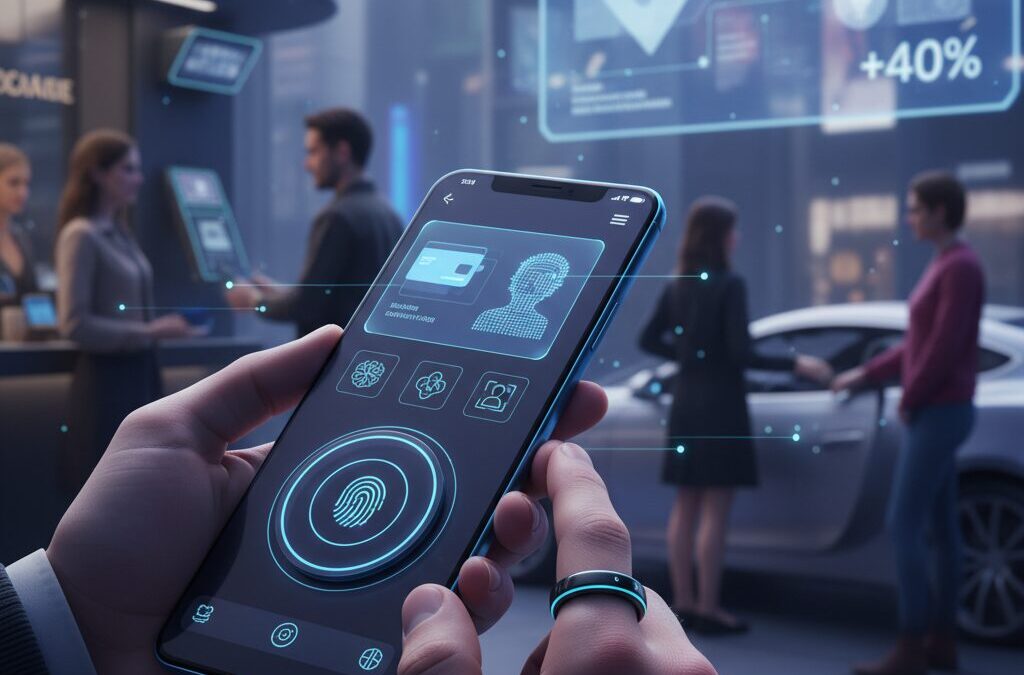
Have you ever wondered how much of your daily life could run on a single device in your pocket?
In 2026, mobile minimalism is no longer just a lifestyle trend. It is becoming a rational response to rapidly evolving payment systems, biometric authentication, and government-led digital ID integration. From cashless ratios surpassing 40% in advanced economies to face-recognition payments at large-scale global events, the infrastructure supporting a smartphone-centered life is maturing at an unprecedented speed.
This article explores how wallets are disappearing, IDs are merging into digital platforms, and accessories like MagSafe modules and smart rings are redefining what we carry. You will discover data-backed shifts in payment behavior, real-world biometric deployments, and the emerging philosophy of “strategic disconnection” that prevents digital overload. If you are passionate about gadgets and curious about the future of ownership, this deep dive into the Smartphone Singularity will show you where mobile life is heading next.
- The Arrival of the Smartphone Singularity and the Structural Shift of Minimalism
- Cashless Adoption at 42.8%: What the Data Reveals About the Disappearance of the Wallet
- QR Code Dominance and the Rise of Frictionless Mobile Payments
- Face Recognition Payments and Device-Free Transactions in Real-World Deployments
- Digital ID Convergence: The Integration of National ID and Driver’s License Systems
- Hybrid Risk Management in the Transition to Fully Digital Identity
- MagSafe, Qi2, and the Modular Smartphone Ecosystem
- Ultra-Slim Power Banks and the Critical Importance of Energy Redundancy
- Smart Rings and Wearable Payments: Invisible Health Tracking and Contactless Commerce
- Inside the Minimalist Tech Pouch: USB-C Standardization and Cognitive Load Reduction
- Digital Minimalism and Strategic Idleness: Managing Attention in an Always-Connected World
- Looking Toward 2030: Will the Smartphone Itself Disappear?
- 参考文献
The Arrival of the Smartphone Singularity and the Structural Shift of Minimalism
In the mid-2020s, minimalism has evolved from an aesthetic preference into a structural adaptation to technology. What we are witnessing is not simply a trend toward owning fewer things, but a systemic consolidation of social, economic, and identity functions into a single device. This phenomenon can be described as the smartphone singularity: the point at which the smartphone becomes the primary gateway to society.
Between 2025 and 2026, advances in payment infrastructure, administrative digitization, and biometric authentication have accelerated this shift. The smartphone is no longer just a communication tool. It is a wallet, a key, a ticket, a bank terminal, and increasingly, an identity container. As Japan’s Ministry of Economy, Trade and Industry reported, the country’s cashless payment ratio reached 42.8% in 2024, surpassing the government’s 40% target ahead of schedule. This signals not convenience alone, but structural dependency.
Minimalism is no longer about reducing possessions. It is about maximizing access while minimizing physical friction.
The shift can be understood as a transition from ownership to access. In the past, a minimalist’s bag symbolized refinement: a slim leather wallet, a lightweight laptop, a premium pen. These were curated objects. Today, the emphasis has moved toward eliminating the bag itself. When QR payments process billions of transactions annually, and facial recognition enables hands-free authentication at large-scale events, the logic of carrying redundant physical tools begins to erode.
This structural transformation can be visualized through three concentric layers that define the modern mobile lifestyle.
| Layer | Role | Typical Examples |
|---|---|---|
| Tier 1 | Body-adjacent automation | Smart rings, smartwatches |
| Tier 2 | Smartphone augmentation | Magnetic wallets, straps |
| Tier 3 | Backup and support | Power banks, laptops |
In earlier years, Tier 3 defined mobility. Today, Tier 1 and Tier 2 increasingly dominate. Wearables collect biometric data and enable contactless payments without deliberate action. Magnetic ecosystems transform the smartphone into a modular platform. The center of gravity has shifted inward, toward the body and the device that rarely leaves it.
Crucially, this is not merely technological convergence. It represents a reduction of ownership cost. Physical items require maintenance, storage, updates, and replacement. Digital access requires infrastructure trust. As biometric platforms from companies such as NEC and Hitachi expand beyond payments into access control and transportation, identity itself becomes portable without being tangible.
The smartphone singularity marks the moment when carrying less is not an aesthetic choice but a rational optimization strategy. When a single device mediates finance, mobility, communication, and verification, redundancy becomes inefficiency. Minimalism thus transforms from decluttering to system design.
We are living through a transitional phase where physical artifacts still coexist with digital counterparts. Yet the direction is clear. As infrastructure matures and authentication becomes ambient, the logic of possession weakens. What remains is controlled access, centralized in a device that functions less as an object and more as a personal operating system for daily life.
Cashless Adoption at 42.8%: What the Data Reveals About the Disappearance of the Wallet
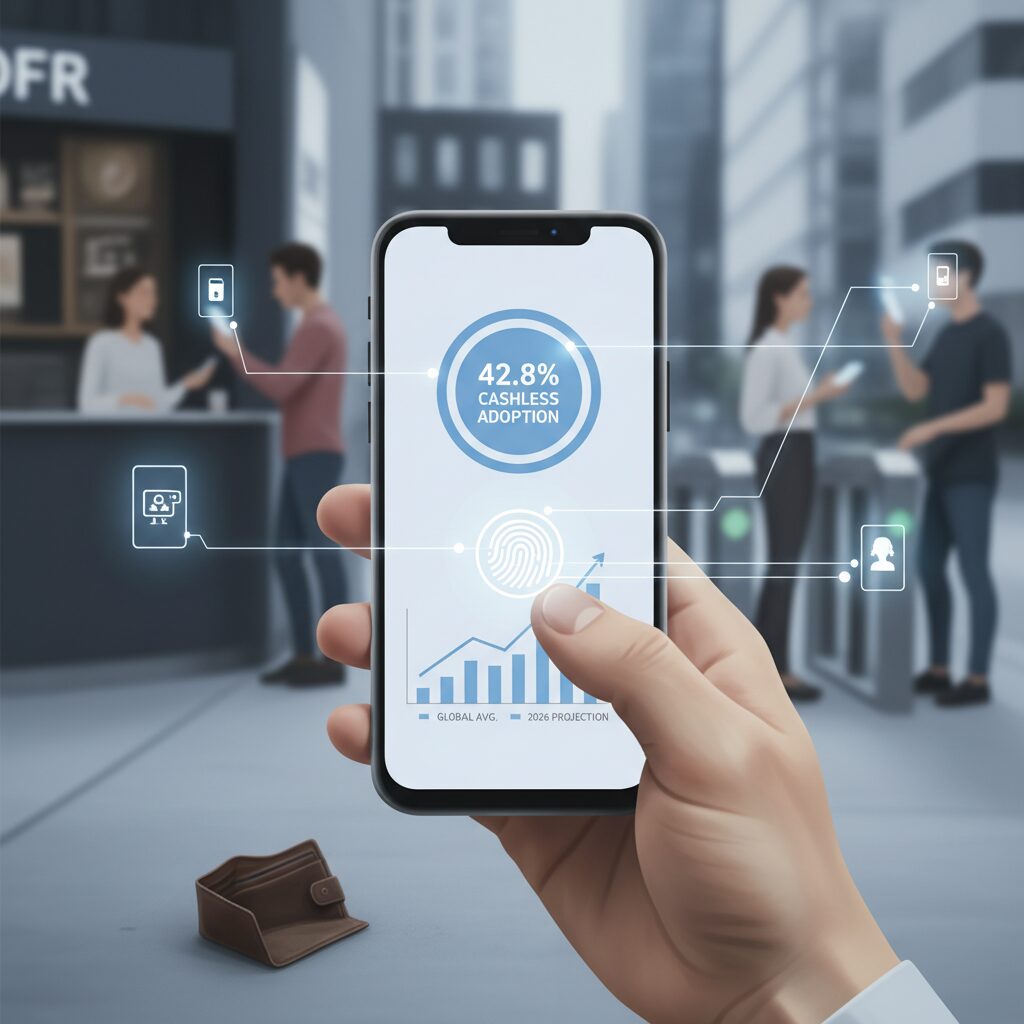
Japan’s cashless payment ratio reached 42.8% in 2024, according to the Ministry of Economy, Trade and Industry. The total transaction value climbed to approximately 141 trillion yen, surpassing the government’s original 2025 target ahead of schedule. This is not merely a financial milestone. It signals a structural shift in how people move, buy, and live.
For gadget enthusiasts and early adopters, this number represents something tangible: the growing plausibility of leaving the wallet at home. When nearly half of all payments are already digital, the psychological barrier to abandoning cash begins to collapse.
| Indicator | 2024 Figure | Implication |
|---|---|---|
| Cashless ratio (Japan) | 42.8% | Mainstream behavioral shift |
| Total cashless volume | Approx. ¥141 trillion | Infrastructure maturity |
| PayPay transactions (2024) | 7.46 billion | QR dominance |
PayPay alone processed 7.46 billion transactions in 2024, and the company reports that roughly one in five cashless payments in Japan flows through its network. This concentration matters. It means that QR-based systems are no longer urban conveniences limited to chain stores. They have penetrated local retailers, small eateries, and even peer-to-peer transfers.
The disappearance of the wallet is not driven by ideology, but by friction reduction. Users increasingly prefer systems directly linked to bank accounts or credit lines over prepaid electronic money that requires manual top-ups. The decline in share for traditional prepaid e-money reflects this subtle but powerful preference shift toward seamlessness.
Compared with South Korea, where cashless ratios approach 99%, or China at around 83%, Japan still has room to grow. However, the trajectory is clear. The question is no longer whether cashless will dominate, but how quickly physical cash becomes situational rather than default.
From a behavioral economics perspective, every successful QR scan rewires habit loops. When paying with a smartphone becomes faster than opening a bifold wallet, convenience reshapes identity. The device in your hand evolves from communication tool to economic interface.
For minimalists, 42.8% represents a tipping point. Once digital payments cross a critical mass, redundancy shifts from “carry extra cash” to “ensure battery and connectivity.” The risk model changes. The wallet, once a symbol of adulthood and security, becomes optional hardware in a software-defined economy.
In practical terms, this means fewer cards, slimmer pockets, and lighter daily carry. In structural terms, it means trust in infrastructure has reached a level where ownership of physical payment instruments is no longer mandatory. The data does not simply reveal growth. It reveals the early stages of the wallet’s quiet extinction.
QR Code Dominance and the Rise of Frictionless Mobile Payments
The rapid spread of QR code payments has redefined what it means to leave home prepared. According to Japan’s Ministry of Economy, Trade and Industry, the country’s cashless payment ratio reached 42.8% in 2024, totaling approximately 141 trillion yen in transaction value. This milestone, achieved ahead of the government’s 2025 target, signals a structural shift rather than a temporary trend.
Within that growth, QR code payments stand out as the most transformative force. PayPay alone recorded 7.46 billion transactions in 2024, and the company states that roughly one in five cashless payments in Japan is processed through its platform. This concentration of volume around smartphone-based QR ecosystems demonstrates that the device in your pocket has effectively become a primary economic interface.
The advantage of QR codes is not technological novelty but infrastructural simplicity. Unlike traditional card terminals, QR systems require minimal hardware investment from merchants, enabling rapid adoption even among small local shops and pop-up vendors. This low barrier to entry has accelerated nationwide standardization.
| Payment Type | Adoption Driver | User Friction Level |
|---|---|---|
| QR Code (App-based) | Low-cost merchant setup | Very Low |
| Prepaid E-money | Transport integration | Medium (requires top-up) |
| Credit Card (Physical) | Global acceptance | Low |
A particularly important behavioral shift is the move away from prepaid electronic money models that require manual top-ups. As reported by industry data referenced in 2024 summaries, users increasingly prefer post-pay or direct bank-linked systems. The elimination of the “top-up step” removes cognitive and operational friction, making payments feel invisible.
This frictionless design extends beyond retail checkout. QR ecosystems integrate peer-to-peer transfers, bill payments, tax settlements, and loyalty programs into a single interface. The smartphone screen becomes a unified financial dashboard, collapsing what were once separate economic actions into a continuous flow.
Another defining development is the normalization of device-free authentication layered on top of QR infrastructure. At the 2025 Osaka-Kansai Expo, facial recognition–linked electronic payment systems allowed visitors to complete transactions without presenting a device. Technology providers such as NEC and Hitachi have expanded biometric platforms that combine payment, access control, and identity verification.
What matters here is redundancy. Even if a smartphone battery fails, biometric authentication can serve as a fallback, ensuring continuity of mobility and consumption. Frictionless does not merely mean faster; it means resilient against interruption.
For gadget enthusiasts and early adopters, the implication is profound. Optimizing mobile payments is no longer about adding more cards to a digital wallet. It is about designing a payment stack that minimizes steps, reduces hardware dependency, and leverages infrastructure-level trust. QR code dominance represents not just a payment method, but a re-architecture of everyday economic behavior around the smartphone as a singular node.
Face Recognition Payments and Device-Free Transactions in Real-World Deployments

Face recognition payments are no longer experimental concepts confined to tech expos. In 2025, real-world deployments such as the Osaka–Kansai Expo demonstrated that device-free transactions can operate at scale under heavy foot traffic, fundamentally redefining what “mobile” means.
At the Expo, visitors could pre-register their facial data and link it to a digital wallet, enabling payments without presenting a smartphone or card. This implementation signaled a shift from smartphone-centric minimalism to identity-centric infrastructure.
According to official announcements from participating technology providers, the system architecture combined biometric authentication with payment processing and access control, allowing a single face scan to handle entry, verification, and checkout in one flow.
| Deployment Context | Authentication Method | Integrated Functions |
|---|---|---|
| Osaka–Kansai Expo (2025) | Pre-registered facial recognition | Payment, admission control |
| Retail & Transit Pilots | On-site biometric verification | Checkout, ticket gates, membership ID |
Hitachi’s SAKULaLa platform aims to expand this model beyond events into railway gates, office access, and retail checkout, integrating multiple authentication points into a unified biometric layer. NEC has similarly positioned face recognition as a fintech solution that merges settlement and identity verification.
The strategic implication is profound. The “wallet” becomes a cloud-linked biometric credential rather than a physical object or even a device-bound app. For high-frequency environments such as transit hubs or stadiums, eliminating the need to unlock a phone reduces friction by seconds per transaction, which scales dramatically across thousands of users.
From an operational standpoint, device-free systems also address redundancy. If a smartphone battery dies, the user’s purchasing capability remains intact. In minimal carry scenarios—running, short errands, or crowded events—this resilience becomes a decisive advantage.
However, deployment at scale requires robust enrollment management and clear governance. Biometric templates must be securely stored and matched under strict compliance frameworks. Industry leaders emphasize that authentication accuracy and false acceptance rates are continuously benchmarked to maintain trust, especially in financial contexts.
For gadget enthusiasts, the most compelling shift is experiential. You no longer reach for a device; you simply exist within the system. The boundary between identity and transaction dissolves.
Device-free payments represent the next phase of mobile singularity: mobility without devices. As infrastructure matures, the competitive edge will not be hardware specs, but the seamless orchestration of biometric authentication, financial rails, and real-world usability.
Digital ID Convergence: The Integration of National ID and Driver’s License Systems
The convergence of national ID cards and driver’s license systems marks a decisive shift in how identity is carried, verified, and managed. In Japan, the nationwide launch on March 24, 2025 of the integrated My Number Card and driver’s license—often referred to as the “MyNa License”—has transformed identity from a multi-card burden into a single, IC-enabled credential.
This integration is not merely about reducing the number of cards in a wallet. It restructures the relationship between citizens and administrative systems.
According to the National Police Agency, the new scheme enables driver’s license data to be embedded into the My Number Card’s IC chip, allowing users to choose between three formats: integrated card only, traditional license only, or dual holding. This optionality is crucial in a transitional society.
| Item | Traditional License | Integrated MyNa License |
|---|---|---|
| Number of cards carried | 2 (ID + License) | 1 |
| Address change procedure | Municipality + Police | Municipality only (one-stop) |
| Renewal fee | 2,850 yen | 2,100 yen |
The economic incentive is clear. The renewal fee for the integrated card is set at 2,100 yen, compared with 2,850 yen for the conventional license alone. Over a lifetime of renewals, this seemingly small difference compounds into meaningful savings.
More importantly, the one-stop address change eliminates the need to visit both a municipal office and a police station. Time, not plastic, is the true resource being optimized.
However, convergence introduces new design challenges. The integrated card does not display the driver’s license expiration date on its surface. Users must rely on an official reading app provided under the National Police Agency framework to confirm validity. This shifts responsibility from passive visual confirmation to active digital management.
For tech-forward users, this is a feature rather than a flaw. A smartphone-based check integrates naturally into existing digital routines. Yet for rental car operators and other private businesses, the adoption of compatible card readers remains uneven. As reported in industry coverage surrounding the rollout, some services still depend on visual inspection, creating friction in edge cases.
This reveals a broader truth about digital ID convergence: infrastructure maturity determines usability. A single card can technically unify identity layers, but its practical value depends on ecosystem alignment—government databases, private-sector terminals, and user literacy.
Identity is no longer a static object but a dynamic dataset stored in a secure chip and accessed through interoperable systems. The physical card becomes a gateway, not the identity itself.
For gadget enthusiasts, the significance lies in system architecture. The IC chip enables cryptographic verification, reducing forgery risks compared to purely visual IDs. At the same time, consolidation increases the impact of loss or damage, making digital backups and secure authentication workflows essential.
Digital ID convergence therefore represents both compression and amplification: fewer objects in hand, greater complexity in the background. It is a structural upgrade of civic infrastructure that aligns perfectly with mobile minimalism, provided that redundancy and literacy evolve alongside integration.
Hybrid Risk Management in the Transition to Fully Digital Identity
The shift toward fully digital identity does not eliminate risk; it redistributes it. As driver’s licenses merge with My Number cards and payments migrate to smartphones and biometrics, convenience increases dramatically, but so does systemic dependency. A fully digital identity stack means that authentication, authorization, and access to mobility or finance are tightly coupled to infrastructure.
According to the National Police Agency, the integrated My Number–driver’s license system requires users to check validity periods through a dedicated app because expiration dates are no longer printed on the card surface. This design improves data centralization but introduces a new behavioral risk: overlooked renewals due to reduced visual cues.
Hybrid risk management therefore becomes essential during the transition phase. Instead of choosing between analog and digital, advanced users design redundancy into their identity workflow.
| Risk Category | Fully Digital Model | Hybrid Mitigation |
|---|---|---|
| Battery depletion | Loss of payment and ID access | Ultra-slim backup battery or biometric fallback |
| System outage | QR and app verification unavailable | Physical card as secondary credential |
| Verification gaps | Reader not installed at merchant | Carry legacy license during travel |
At events such as Expo 2025 Osaka, face recognition payments demonstrated that device-less authentication is viable at scale. Solutions from companies like NEC and Hitachi integrate entry management and payments through biometric platforms. However, deployment density varies by region and industry, meaning interoperability remains uneven.
This unevenness is precisely why hybrid operation is rational rather than conservative. For example, when renting a car in areas where card readers are not fully deployed, presenting a visually verifiable license still reduces friction. The goal is not nostalgia for plastic, but minimizing edge-case failure.
Redundancy should be intentional, lightweight, and temporary. A MagSafe wallet with one physical card, a secondary SIM for connectivity resilience, or a biometric payment ring as tertiary access layer are strategic buffers—not regressions.
Importantly, trust in infrastructure must be matched by literacy in its limits. Digital identity centralizes power and simplifies life, but it also concentrates failure points. By architecting layered authentication—biometric, device-based, and physical—users maintain agency during the migration toward full digital identity without sacrificing mobility or security.
The transition era rewards those who think like system designers. Rather than asking whether to go fully digital, the better question is how to sequence de-risking so that each removed object is replaced by a verified, resilient alternative.
MagSafe, Qi2, and the Modular Smartphone Ecosystem
MagSafe and Qi2 have transformed the smartphone from a sealed slab of glass and aluminum into a magnetic expansion hub. What began with Apple’s MagSafe on the iPhone 12 has now evolved into a cross‑platform ecosystem through the Qi2 standard, which incorporates a magnetic alignment profile. This shift is not merely about convenience. It represents a structural change in how we design, attach, and replace functionality.
The key innovation is magnetic alignment combined with standardized wireless charging. According to the Wireless Power Consortium, Qi2 builds on Apple’s magnetic approach to ensure optimal coil positioning, improving charging efficiency and interoperability across devices. In practice, this reduces energy loss caused by misalignment and enables accessory makers to design around a predictable physical interface.
| Feature | MagSafe | Qi2 |
|---|---|---|
| Magnetic Alignment | Apple proprietary (initially) | Standardized profile adopted industry-wide |
| Charging Efficiency | Optimized for iPhone | Improved alignment reduces power loss |
| Ecosystem Reach | Mainly Apple devices | Android and multi-brand support |
This standardization has accelerated the rise of a modular smartphone ecosystem. A wallet, stand, battery, or grip is no longer a separate object stored in a bag. It becomes a temporary layer that attaches and detaches depending on context. The smartphone shifts from being a finished product to becoming a base unit.
MOFT’s Snap-on series demonstrates this logic clearly. By integrating stand, wallet, and grip into a thin magnetic module, it reduces the need for separate accessories while preserving flexibility. At the same time, ultra‑slim magnetic batteries such as CIO’s SMARTCOBY Slim 5K show how energy redundancy can be embedded without cables, maintaining usability while charging.
From a marketing perspective, this ecosystem creates recurring engagement. Instead of upgrading the entire phone annually, users upgrade modules. This mirrors the PC peripheral economy of the 2000s but in a far more compact and lifestyle-driven form. Accessory brands now compete on magnet strength, material durability, and tactile experience, not just on electrical specifications.
Qi2’s broader adoption is particularly significant for Android users. For years, magnetic ecosystems were effectively locked into Apple hardware. With Qi2, flagship Android devices can support magnetically aligned accessories without proprietary workarounds. This lowers entry barriers for third-party manufacturers and expands total addressable market size.
Importantly, modularity also supports mobile minimalism. Instead of carrying multiple standalone tools, users selectively attach what the moment requires. Commuting may require only a magnetic wallet. Remote work may add a stand. Travel may add a battery pack. The phone remains constant, while capability scales.
In this sense, MagSafe and Qi2 are not just charging standards. They are architectural decisions that redefine ownership. Functionality becomes fluid, detachable, and situational. The smartphone is no longer a monolith. It is a magnetic core around which a dynamic ecosystem continuously reconfigures itself.
Ultra-Slim Power Banks and the Critical Importance of Energy Redundancy
As smartphones become the singular hub for payments, identification, tickets, and communication, battery life is no longer a convenience issue. It is an infrastructure issue. When your phone dies, your access to money, transport, and identity can disappear instantly.
According to Japan’s Ministry of Economy, Trade and Industry, cashless payments reached 42.8% in 2024, totaling approximately 141 trillion yen. With services like PayPay processing 74.6 billion transactions in a single year, society increasingly assumes that your device is powered and connected. Energy redundancy has therefore become a prerequisite for digital minimalism.
Ultra-slim power banks represent a structural response to this reality. Instead of carrying bulky backup batteries in a bag, users now integrate power directly into the smartphone layer itself.
| Device Type | Typical Capacity | Portability Impact | Use Case |
|---|---|---|---|
| Conventional Power Bank | 10,000–20,000mAh | Requires cable and bag | Travel, long trips |
| Ultra-Slim 5,000mAh (e.g., SMARTCOBY Slim) | 5,000mAh | MagSafe-integrated, pocketable | Urban daily redundancy |
CIO’s SMARTCOBY Slim 5K, for example, uses an aluminum alloy body and is engineered to be thin enough to remain attached via MagSafe (Qi2) while still fitting in a pocket. Reviews report that it can raise an iPhone battery from 20% to 52% in around 30 minutes. That margin is often the difference between being locked out of mobility and completing a commute without friction.
What makes ultra-slim models strategically important is not raw capacity but behavioral compatibility. Traditional batteries create friction: extra cables, thicker silhouettes, conscious setup. Slim magnetic units dissolve that friction. The easier redundancy becomes, the more consistently users maintain it.
This aligns with the broader mobile minimalism trend described in recent ecosystem analyses: Tier 3 carrying layers are shrinking, while Tier 2 attachments are becoming smarter and thinner. Energy backup is migrating from “bag equipment” to “body-adjacent infrastructure.”
There is also a psychological dimension. In a face-recognition payment environment such as the Osaka-Kansai Expo’s device-less settlement model, users may rely less visibly on their phones. Yet authentication systems, transit apps, and fallback credentials still reside in the device. Redundancy is not about distrust of infrastructure. It is about respecting its dependency chain.
For high-engagement gadget users, the key question is not whether to carry backup power, but how invisibly it can be integrated. The ideal ultra-slim power bank achieves three conditions simultaneously: magnetic alignment, thermal safety, and pocket neutrality.
In a world approaching smartphone singularity, energy is identity continuity. Ultra-slim power banks are not accessories. They are compact insurance policies that preserve access, autonomy, and mobility in a system that assumes you are always on.
Smart Rings and Wearable Payments: Invisible Health Tracking and Contactless Commerce
Smart rings represent the ultimate expression of mobile minimalism. Instead of taking out a smartphone or even glancing at a smartwatch, you simply wear intelligence on your finger and let it work quietly in the background.
Because they have no large displays and rarely demand active input, smart rings embody what researchers call calm technology. They collect, analyze, and synchronize data invisibly, reducing cognitive load while preserving full functionality.
High-end models such as Oura Ring 4 continuously measure sleep stages, heart rate variability, resting heart rate, and body temperature trends. According to product testing reported by 360LiFE in 2025, leading devices demonstrate stable overnight tracking performance comparable to wrist-worn wearables, particularly for sleep analytics.
| Function | Smart Ring | Smartwatch |
|---|---|---|
| Sleep tracking | Highly accurate, comfortable overnight | Accurate but bulkier during sleep |
| Display | No screen, passive feedback | Interactive screen, notifications |
| Battery focus | Optimized for background sensing | Balanced between sensing and display |
The absence of a display is not a weakness. It is a strategic advantage. Many users report that wearing a ring at night feels significantly less intrusive than a watch, leading to more consistent long-term data collection.
At the same time, the market has expanded rapidly. In addition to premium devices, entry models such as SOCOCO R4 have appeared in the 3,000-yen range in Japan, lowering the barrier to experimentation. This diversification accelerates adoption among health-conscious gadget enthusiasts.
Beyond health tracking, the second revolution is contactless commerce. Payment-enabled rings like EVERING integrate Visa touch payment functionality, allowing transactions with a simple hand gesture. No phone, no wallet, no battery anxiety in the moment of purchase.
This matters most in friction-sensitive scenarios. During a morning run, a quick stop at a convenience store becomes effortless. When commuting, a subtle tap replaces fumbling through pockets. The ring effectively acts as a secure, wearable payment token.
Security is maintained through tokenization and the same network standards used in contactless cards. Because the ring contains no open app environment, the attack surface is structurally limited compared to smartphones.
In the broader context of the smartphone singularity, smart rings shift functionality from “carrying” to “being.” You no longer access health metrics or payment tools as external utilities. They become ambient capabilities embedded in your body.
The result is a new layer of redundancy. Even if your smartphone battery depletes, your ring can still enable essential payments. Even if you mute notifications entirely, your physiological data continues to accumulate quietly.
Invisible health tracking combined with seamless contactless payment transforms the ring into both a biometric sensor and a financial interface. For readers deeply invested in next-generation gadgets, this convergence signals not just convenience, but a structural redesign of how we interact with infrastructure itself.
As wearable payments mature and biometric sensing improves, smart rings are positioned not as accessories, but as foundational nodes in a post-wallet, post-screen lifestyle.
Inside the Minimalist Tech Pouch: USB-C Standardization and Cognitive Load Reduction
When you open a modern minimalist tech pouch in 2026, the most striking change is not what is inside, but what is no longer there.
Multiple proprietary cables, bulky adapters, and brand-specific chargers have quietly disappeared. In their place, a small set of USB-C cables and perhaps a single slim hub now define the entire ecosystem.
This shift toward USB-C standardization is not only about hardware efficiency. It is fundamentally about reducing cognitive load.
From Fragmentation to Convergence
| Before USB-C Convergence | After USB-C Convergence |
|---|---|
| Lightning + USB-C + micro-USB | USB-C unified |
| Multiple chargers | Single GaN charger |
| Device-specific cables | Cross-device compatibility |
With the iPhone 15 series adopting USB-C, the last major proprietary cable in many users’ daily carry was effectively eliminated. As observed in 2025 gadget pouch breakdowns by creators such as monograph, the number of cables carried has measurably decreased.
Instead of “Which cable do I need today?”, the question becomes irrelevant. One cable powers a smartphone, charges a MacBook Air, tops up a smart ring case, and even connects to a portable battery.
This simplification may look trivial, but neuroscience suggests otherwise. According to research discussed by cognitive load theory scholars, every additional variable in a task environment increases working memory demand.
In practical terms, three cable types mean three decision branches. One cable means none.
Standardization compresses decision trees. When your pouch contains two identical USB-C cables and one compact hub, your brain no longer needs to simulate compatibility scenarios before leaving home.
The Anker-style ultra-slim USB-C hub frequently cited in 2025 minimalist setups embodies this logic. Rather than carrying separate HDMI adapters, SD card readers, and Ethernet dongles, a single lightweight hub centralizes expansion.
From a systems perspective, this is architectural elegance. Fewer nodes, fewer failure points, fewer mental checks.
There is also a temporal dimension. Each moment spent untangling cables or confirming port compatibility is a micro-interruption. Behavioral science consistently shows that task switching, even briefly, imposes a cognitive penalty.
By eliminating heterogeneity in connectors, USB-C reduces these interruptions at scale. Over weeks and months, this translates into smoother workflows and lower background stress.
Minimalism in the tech pouch, therefore, is not only about grams and millimeters. It is about mental bandwidth.
A unified charging standard transforms the pouch from a toolbox of contingencies into a predictable extension of your workflow.
When every device speaks the same physical language, your attention is liberated for higher-order tasks: writing, designing, negotiating, creating.
In that sense, USB-C is less a port and more a cognitive optimization strategy—one that quietly turns a cluttered pouch into a frictionless, low-noise command center.
Digital Minimalism and Strategic Idleness: Managing Attention in an Always-Connected World
In an era where your smartphone functions as wallet, ID, and workstation, the ultimate form of minimalism is no longer about reducing objects but about managing attention. Digital minimalism is the discipline of deciding what deserves your focus in an always-connected world. Without this layer, even the most streamlined mobile setup becomes a source of cognitive overload.
Research in cognitive science shows that constant notifications fragment concentration and increase task-switching costs. Scholars at institutions such as Stanford University have pointed out that heavy media multitaskers tend to perform worse on tasks requiring sustained attention. This aligns with what many gadget enthusiasts experience daily: powerful tools can quietly erode deep work if left unmanaged.
The concept of “Strategic Idleness,” popularized in Japan by Shodai Morishita of the Japan Digital Detox Association, reframes downtime as productive infrastructure. By intentionally disconnecting, you allow the brain’s default mode network to activate, which neuroscientific studies associate with creativity, memory consolidation, and long-term planning.
Practical implementation does not require abandoning technology. Instead, it requires redesigning how you interact with it.
| Method | Mechanism | Friction Level |
|---|---|---|
| Grayscale Mode | Removes color stimuli that trigger dopamine-driven scrolling habits | Low |
| Screen Time Limits | OS-level caps on app usage with soft lockouts | Medium |
| Time-Locking Box | Physically prevents device access for a set duration | High |
Grayscale mode works by reducing visual reward cues, making social feeds less stimulating. Screen time controls add a layer of conscious friction, though they rely on willpower. Time-locking containers, increasingly popular among productivity-focused users, externalize discipline by removing choice altogether.
Importantly, digital minimalism also includes software decluttering. By limiting your home screen to utility apps such as calendar, notes, and payments, and burying entertainment apps behind search-only access, you redesign your interface to reduce impulsive taps. This is attention architecture, not mere organization.
For high-interest gadget users, the paradox is clear: the more integrated and powerful your device becomes, the more intentional you must be about disconnection. Strategic idleness transforms absence of input into competitive advantage. In a hyperconnected ecosystem, focus becomes the rarest resource—and the one worth protecting with the same rigor as battery life or network redundancy.
Looking Toward 2030: Will the Smartphone Itself Disappear?
As we look toward 2030, a provocative question emerges: will the smartphone itself disappear?
What we are witnessing today is not a sudden collapse of the device, but a gradual diffusion of its functions into the environment and the body.
The smartphone is no longer just a product category. It is becoming an invisible infrastructure layer.
The 2025 Osaka Expo offered a preview of this shift. With face-recognition payment systems such as “Myakpe!” and large-scale biometric authentication provided by companies like NEC and Hitachi, visitors were able to complete payments and access control without touching a device.
According to Hitachi’s announcements regarding its SAKULaLa platform, biometric authentication is expanding beyond payments into railway gates and office entry systems.
In such environments, the smartphone becomes optional rather than essential.
| Phase | Primary Interface | User Action |
|---|---|---|
| 2020s | Smartphone screen | Tap / Swipe |
| Late 2020s | Wearables + Biometrics | Gesture / Presence |
| 2030+ | Ambient systems | Implicit authentication |
The critical shift is from “device-centered computing” to “ambient computing.”
When payment ratios exceed 40% cashless in Japan, as reported by the Ministry of Economy, Trade and Industry, and QR ecosystems process billions of transactions annually, society no longer depends on physical artifacts for economic participation.
The smartphone unified these capabilities in the 2010s and 2020s, but unification is not the final state. Distribution is.
Wearables such as smart rings and watches already handle health tracking and contactless payments. Biometric IDs are replacing physical cards. Ultra-thin magnetic batteries blur the boundary between phone and accessory.
Each innovation reduces the psychological necessity of “holding a slab of glass.”
By 2030, the question may not be whether smartphones vanish, but whether they recede into the background.
Author and digital minimalism advocates discussing “strategic boredom” argue that the next frontier is not hardware reduction but attention control.
If AR glasses project information directly into our field of vision, and authentication happens through face or gait recognition, the screen itself may lose centrality.
The device could fragment into rings, glasses, sensors, and cloud AI agents working silently around us.
However, disappearance does not mean extinction.
Infrastructure tends to become invisible rather than obsolete. Electricity did not disappear; it faded into the walls.
The smartphone may follow the same trajectory—shifting from object to atmosphere.
For gadget enthusiasts, this is not a loss but an evolution.
The most exciting innovations toward 2030 may not be thinner phones or larger displays, but systems that remove the need to reach for a phone at all.
When identity, payment, communication, and intelligence flow seamlessly through ambient layers, “owning a smartphone” may feel as outdated as carrying a standalone MP3 player does today.
The real disruption ahead is conceptual.
We will move from asking “What device do I carry?” to “What capabilities surround me?”
And in that shift, the smartphone as a visible centerpiece of digital life may quietly dissolve into the background of everyday existence.
参考文献
- au PAY magazine:Japan’s Cashless Payment Ratio Surpasses 40% in 2024
- PayPay Corporation:PayPay Transactions Surpass 7.46 Billion in 2024
- Hitachi, Ltd.:Biometric Authentication Service ‘SAKULaLa’ Expands to Railway Gates, Retail Payments, and Access Control
- NEC Corporation:Face Recognition Payment Service – FinTech
- National Police Agency of Japan:Integration of My Number Card and Driver’s License & Online Renewal Lectures
- MOFT Japan:MOFT Snap-on Phone Stand & Wallet Series
- iPhone Mania:Review: CIO’s Latest Ultra-Thin Aluminum Alloy Battery
- 360LiFE:Best Smart Rings of 2025: Comprehensive Comparison for Health and Value