If you think Suica is just a transit card, you are already behind. In 2026, Mobile Suica functions as a lifestyle operating system that processes over 10 million daily transactions and connects transportation, retail, identity, and loyalty into one seamless tap.
For gadget enthusiasts outside Japan, Suica offers a rare case study of how hardware, firmware, cloud infrastructure, and fintech incentives converge into a real-world platform used by tens of millions. From Sony’s FeliCa architecture achieving sub-0.2 second gate processing to 5G-powered cloud ticketing and wearable integration, the system represents one of the most advanced NFC ecosystems on the planet.
In this guide, you will discover how to set up Mobile Suica on iPhone, Android, and smartwatches, how Welcome Suica Mobile reshapes inbound travel, how JRE POINT optimization can reach 1.5% or more in returns, and how QR, MaaS, and touchless gates are shaping the next generation of urban mobility. Whether you are a power user, traveler, or mobility tech observer, this deep dive will help you understand—and leverage—the full Suica ecosystem.
- Suica as a Lifestyle Operating System in 2026
- Why FeliCa Wins: The 0.2-Second Processing Advantage Over Standard NFC
- From Edge Computing to Cloud Gates: The Architecture Behind Modern Ticketing
- Mobile Suica on iPhone: Express Transit, Secure Element, and Power Reserve
- Android and the Osaifu-Keitai Barrier: Hardware Compatibility Explained
- Smartwatch Integration: Apple Watch, Pixel Watch, Garmin, and the FeliCa Divide
- Welcome Suica Mobile: How Japan Solved the Inbound Traveler Problem
- Transaction Scale and Adoption Data: Millions of Daily Taps Explained
- Optimizing the Ecosystem: JRE POINT, VIEW Cards, and the 1.5% Strategy
- Maintenance Windows, Error 2040, and Real-World Troubleshooting
- QR Codes, MaaS Integration, and the Road Toward Touchless Gates
- What Global Transit Systems Can Learn from Suica’s Platform Model
- 参考文献
Suica as a Lifestyle Operating System in 2026
In 2026, Suica is no longer just a transit IC card. It functions as a de facto lifestyle operating system that quietly orchestrates mobility, payments, and identity across urban Japan.
Since its launch in 2001, Suica has evolved from a stored-value card into a cloud-connected platform embedded in smartphones, wearables, and backend infrastructure. According to JR East’s medium-term strategy “Beyond the Border,” the 2025–2026 upgrades accelerated this shift from hardware-bound card to service-centric ecosystem.
What makes Suica unique in 2026 is not a single feature, but its role as an invisible coordination layer for daily life.
The scale alone illustrates this transformation. As reported in JR East’s investor materials, Suica processes over 11 million transactions per day at peak and more than 300 million per month, across roughly 2.2 million affiliated locations. These numbers exceed simple commuter usage and indicate deep penetration into retail and lifestyle spending.
This ubiquity allows Suica to function less like a ticket and more like middleware for city life. A morning commute, a convenience store coffee, a station mall purchase, and a Green Car upgrade can all flow through the same ID and balance layer.
The operating system analogy becomes clearer when viewed structurally.
| Layer | Function | 2026 Evolution |
|---|---|---|
| Mobility | Rail, bus, regional transit | Cloud fare calculation, MaaS linkage |
| Payment | Retail & station commerce | 2.2M+ merchants, wearable expansion |
| Identity | User authentication (IDm) | JRE ID integration (2026) |
Technically, this evolution is supported by FeliCa’s high-speed processing—around 0.1 seconds per interaction, as documented by Sony’s specifications—and increasingly by hybrid edge-cloud architectures. The legacy model completed fare calculations inside the gate hardware. The new cloud-oriented model shifts intelligence toward centralized systems while preserving sub‑0.2‑second user experience.
This architectural shift enables dynamic incentives that were previously impractical. For example, cross-domain benefits linking station retail purchases with transport rewards become feasible when transaction data and user identity are unified under a single backend logic layer.
In 2026, the integration of JRE ID further consolidates this ecosystem. Rail reservations, e-commerce, point management, and Mobile Suica credentials begin operating under a unified identity framework. According to JR East disclosures, this allows behavioral data across transport and shopping to interconnect more fluidly.
For gadget enthusiasts, the key insight is that Suica is no longer merely stored value. It is an always-on credential residing in secure elements, synchronized with cloud services, and extended to devices like Apple Watch or domestic Wear OS models.
The real innovation is experiential continuity. You do not open an app, authenticate manually, or switch contexts. The system anticipates motion and transaction as default states of urban living.
Seen through this lens, Suica in 2026 resembles a lightweight urban OS: hardware-agnostic within Japan, latency-optimized at the network edge, identity-linked in the cloud, and economically reinforced through points and services.
It operates quietly, but it governs the rhythm of modern Japanese city life.
Why FeliCa Wins: The 0.2-Second Processing Advantage Over Standard NFC
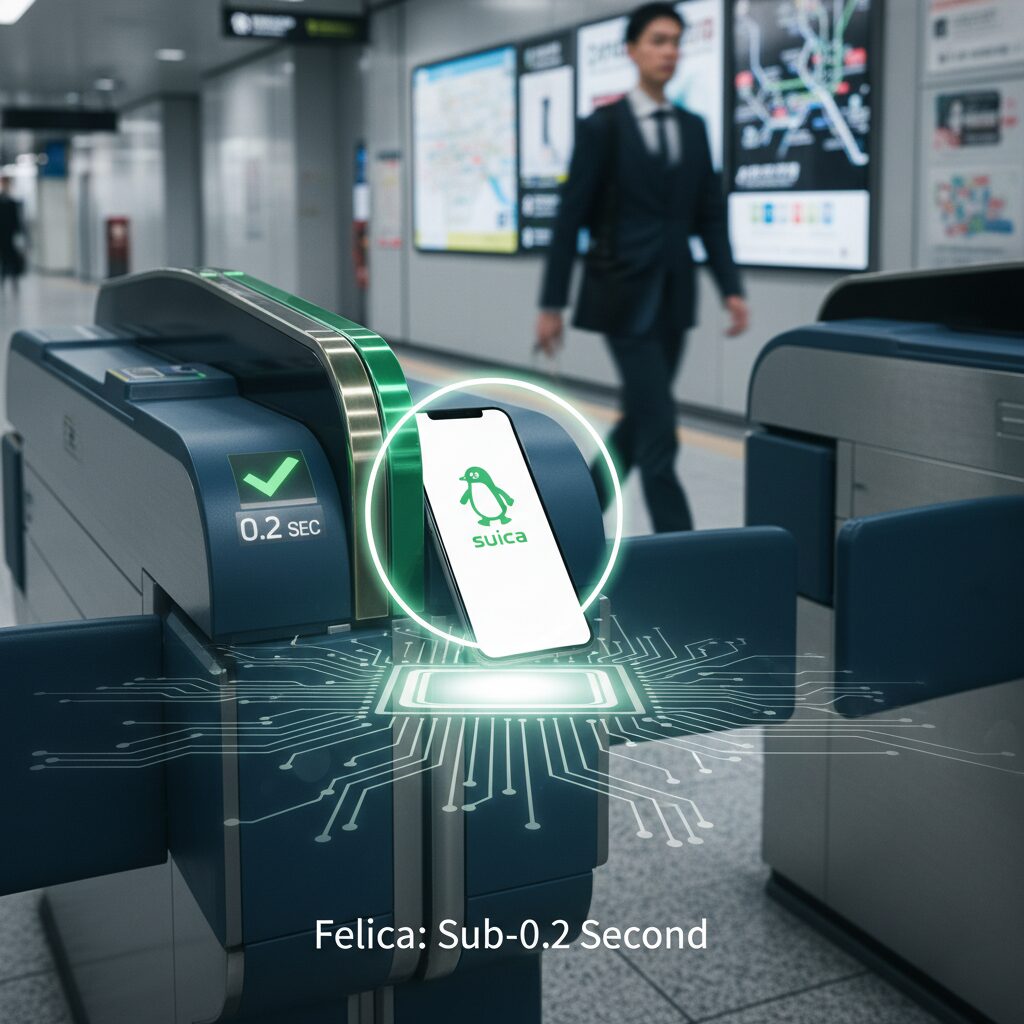
Speed is not a luxury in Japan’s rail network; it is a non‑negotiable requirement. JR East has long imposed a strict benchmark: ticket gate processing must be completed within 0.2 seconds from touch to approval. This single constraint explains why FeliCa, not standard NFC Type‑A/B, became the technological backbone of Suica.
According to Sony’s official FeliCa documentation, FeliCa (ISO/IEC 18092, NFC‑F) supports communication speeds of 212 kbps or 424 kbps and completes mutual authentication, encrypted data exchange, and balance updates in roughly 0.1 seconds. That performance leaves headroom within the 0.2‑second gate requirement, even under peak load.
By contrast, typical EMV contactless transactions over NFC Type‑A/B often take around 0.5 seconds. While half a second may feel instantaneous at a retail checkout, it becomes a bottleneck when more than 60 passengers per minute must pass through a single gate during rush hour.
| Specification | FeliCa (NFC‑F) | Standard NFC Type‑A/B (EMV) |
|---|---|---|
| International Standard | ISO/IEC 18092 | ISO/IEC 14443 |
| Typical Speed | 212 / 424 kbps | Up to 106–424 kbps (varies) |
| Transit Processing Time | ~0.1 sec | ~0.5 sec (typical EMV) |
| Design Priority | High‑speed transit | Retail payments |
The difference lies not only in raw bitrate but in protocol design. FeliCa minimizes handshake overhead between card and reader, allowing rapid polling and immediate mutual authentication. This streamlined negotiation reduces latency before actual value processing even begins.
Another key factor is encoding and signal robustness. FeliCa uses ASK modulation with Manchester encoding, which improves resilience against signal fluctuation caused by imperfect taps or motion. This tolerance enables the famous “tap‑and‑go while walking” behavior seen in Japanese stations.
In a dense urban rail system handling over 10 million daily Suica transactions at peak levels, even a 0.3‑second delay per passenger would cascade into platform congestion. The 0.2‑second ceiling is therefore not arbitrary; it is a systems‑engineering necessity.
JR East’s Group Reports highlight how legacy gate systems were engineered to complete fare calculation and balance rewriting locally at the edge device. This architectural decision worked in tandem with FeliCa’s fast cryptographic processing, ensuring approval without round‑trip server communication.
In practical terms, when you tap your smartphone or card, the reader captures the IDm, performs mutual authentication, verifies entry status, calculates fare, updates stored value, and writes back the record—all within roughly one‑tenth of a second. The remaining margin absorbs mechanical gate response time.
That tight integration of silicon design, radio protocol, and gate hardware is why FeliCa continues to outperform standard NFC in high‑throughput transit scenarios. It was engineered from the outset for railways, not retrofitted from retail payments, and that origin story still defines its competitive edge today.
From Edge Computing to Cloud Gates: The Architecture Behind Modern Ticketing
Modern ticketing no longer lives solely inside a plastic card or a single gate. It is now a distributed system where intelligence is shared between devices at the edge and powerful cloud platforms. In the case of Suica, this architectural shift is what enables both sub‑0.2 second gate processing and increasingly sophisticated digital services.
Historically, ticket gates operated as autonomous edge nodes. Fare tables, balance calculations, and write operations were executed locally inside each gate, minimizing dependency on central servers. According to JR East Group reports, this design guaranteed resilience even during network outages, because value deduction and record updates occurred directly on the card’s FeliCa chip.
This edge-first architecture was the key to achieving the strict “under 0.2 seconds” requirement at crowded urban gates.
| Layer | Primary Role | Latency Sensitivity |
|---|---|---|
| FeliCa Device | ID authentication, value storage | Ultra-high |
| Gate (Edge) | Immediate fare logic, access control | Critical (<0.2s) |
| Cloud Core | Account management, analytics, dynamic services | Moderate |
However, as ticketing expanded beyond transport into retail, loyalty, and MaaS integration, purely edge-based logic became limiting. Complex promotions, cross-service discounts, and personalized incentives require centralized data processing. JR East’s move toward a cloud-integrated gate system represents a structural evolution rather than a simple upgrade.
The challenge is physics. Sending every transaction to a distant data center risks breaking the 0.2-second barrier. Industry research from ETSI on Multi-access Edge Computing explains that physical distance alone introduces measurable transmission delay. Even light-speed fiber cannot ignore geography.
To solve this, modern ticketing adopts a hybrid model. Authentication and provisional approval occur locally or via nearby edge servers, while heavier computations—point allocation, campaign logic, mobility bundling—are processed asynchronously in the cloud.
In practical terms, when a passenger taps a device, the gate verifies the Suica ID and entry status instantly. The user walks through without friction. Meanwhile, backend systems reconcile balances, update JRE POINT accruals, and synchronize account data across apps and services.
This separation of “real-time permission” and “post-event enrichment” is subtle but transformative. It allows innovation without compromising throughput. According to financial disclosures on Suica’s digital expansion, transaction volumes exceed hundreds of millions per month. At that scale, even a 0.1-second delay compounds into operational congestion.
Cloud-connected gates also enable dynamic service models. Fare adjustments tied to shopping behavior, regional mobility subscriptions, or integration with reservation platforms become feasible because computation is no longer trapped inside a hardware cabinet.
Yet resilience remains non-negotiable. Modern systems therefore implement fallback logic: if network latency spikes, the gate reverts to localized decision rules. This layered redundancy preserves commuter flow even under partial connectivity loss.
From an architectural standpoint, modern ticketing is no longer a “gate with a reader.” It is a distributed computing mesh spanning secure elements, edge processors, 5G transport, and centralized cloud intelligence. The magic of a frictionless tap is supported by a carefully balanced stack designed to reconcile speed, scalability, and service flexibility.
Mobile Suica on iPhone: Express Transit, Secure Element, and Power Reserve
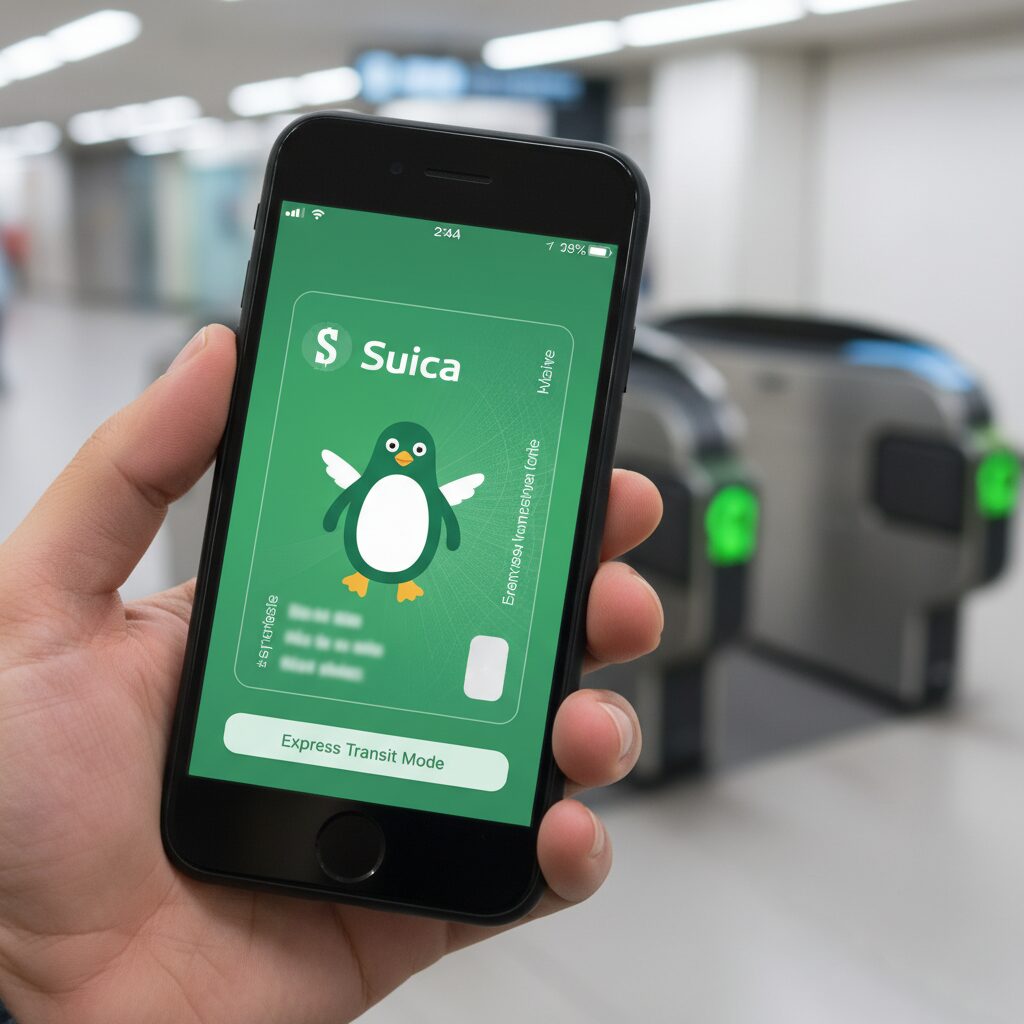
On iPhone, Mobile Suica reaches its most refined form through three tightly integrated technologies: Express Transit, the Secure Element, and Power Reserve. These are not marketing labels but architectural decisions that directly affect speed, security, and reliability in daily commuting.
Express Transit allows you to pass through ticket gates without Face ID, Touch ID, or even waking the screen. Once Suica is set as the Express Card in Wallet, the iPhone communicates with the gate reader instantly when held near it. According to Apple Support documentation, authentication is bypassed specifically for transit use, enabling true tap-and-go behavior.
This matters because JR East’s infrastructure is designed around sub‑0.2 second processing at the gate. FeliCa itself completes mutual authentication and encrypted data exchange in roughly 0.1 seconds, as outlined by Sony’s FeliCa technical overview. Express Transit ensures the phone does not add biometric latency on top of that window.
With Express Transit enabled, the iPhone behaves like a dedicated IC card, not a smartphone payment app.
Under the hood, this seamless experience depends on the Secure Element. Suica credentials are not stored in iOS as ordinary app data. They reside inside a hardware-isolated chip designed for contactless transactions. When you migrate a physical Suica into Wallet, the original card is invalidated server-side and its cryptographic keys are transferred into the Secure Element.
This hardware isolation has two important implications. First, even if iOS were compromised, the transit credentials remain protected. Second, Express Transit can function at the NFC controller level without fully booting the operating system, which directly enables Power Reserve behavior.
Power Reserve, available on iPhone XS and later, addresses the biggest psychological barrier to mobile transit: battery anxiety. If the iPhone shuts down due to low battery, a small power buffer remains allocated to NFC operations for a limited time. Apple states that Express Transit cards can continue to function for up to about five hours after shutdown, depending on remaining reserve capacity.
| Feature | Authentication Required | Works When iPhone Is Off? |
|---|---|---|
| Standard Apple Pay | Face ID / Touch ID | No |
| Express Transit (Normal Power) | No | No |
| Express Transit (Power Reserve) | No | Yes (limited time) |
In real-world scenarios, this design prevents a dead battery from immediately turning into a mobility failure. You can still exit a station or complete a transfer even after the screen goes dark. However, if the device is manually powered off or left fully discharged for an extended period, Power Reserve will not function.
Another subtle advantage of the Secure Element architecture is reliability under network constraints. Suica transactions at the gate are processed locally via FeliCa communication; no cellular signal is required at the moment of tap. This separation between secure hardware and cloud services ensures that Express Transit remains operational even in underground environments.
For gadget enthusiasts, the takeaway is clear: Mobile Suica on iPhone is not merely an app layered over NFC, but a hardware-backed transit credential engineered for speed and fault tolerance. Express Transit removes friction, the Secure Element enforces cryptographic integrity, and Power Reserve closes the last remaining gap between digital convenience and physical card dependability.
Android and the Osaifu-Keitai Barrier: Hardware Compatibility Explained
For Android users, the biggest obstacle to using Mobile Suica is not software but hardware. Unlike iPhone, where FeliCa support is standardized across global models, Android devices must pass through what is commonly called the “Osaifu-Keitai barrier.”
Osaifu-Keitai is not just an app. It is a Japan-specific platform layer that integrates FeliCa secure elements, firmware, and carrier certification into the device. Without this stack properly implemented at the hardware level, Mobile Suica simply cannot function.
Having NFC does not mean having FeliCa. Many Android phones support NFC Type-A/B for global contactless payments, yet lack the FeliCa secure element required for Suica.
According to Sony’s FeliCa technical documentation, Suica relies on NFC-F (ISO/IEC 18092) with secure cryptographic processing inside a dedicated secure element. That secure element must be physically present and provisioned with the appropriate applet area—often referred to as the FeliCa “pocket.”
In Android devices sold in Japan, this secure element is embedded and activated at the factory. In many overseas models, even if the NFC controller chip is identical, the FeliCa function is either omitted or disabled at the firmware level.
| Device Category | FeliCa Hardware | Mobile Suica Support |
|---|---|---|
| Japan domestic model (Pixel, Galaxy, Xperia) | Installed and enabled | Fully supported |
| Global/overseas Android model | Often absent or disabled | Not supported |
| iPhone (iPhone 8 or later) | Standardized globally | Supported worldwide |
This distinction explains why travelers who import flagship Android phones frequently discover that Mobile Suica cannot even be set up. The Google Wallet interface may appear compatible, but without Osaifu-Keitai services managing the secure element, the card cannot be provisioned.
Google’s official documentation for Suica on smartwatches also makes this limitation clear: only Japanese-market Pixel Watch models support Suica. The constraint is physical, not merely regional software policy.
The technical reason ties back to Japan’s strict 0.2-second gate processing requirement. As JR East has emphasized in its system architecture discussions, authentication and value updates must occur with extreme speed and cryptographic reliability. This demands tight integration between the FeliCa chip, secure element, and OS-level middleware.
In other words, Android’s openness becomes a disadvantage here. Manufacturers decide whether to license and embed FeliCa. Carriers certify compatibility. Firmware must expose the correct APIs to Osaifu-Keitai services. If any layer is missing, the ecosystem breaks.
For gadget enthusiasts, the takeaway is straightforward but critical: when choosing an Android device for life in Japan, “FeliCa supported” must be confirmed at the model-number level. Marketing pages listing “NFC” are insufficient proof.
The Osaifu-Keitai barrier is not an arbitrary restriction. It is the hardware gatekeeper that ensures Suica’s speed, security, and reliability. Understanding that architectural reality is essential before assuming any Android flagship can replace a physical IC card.
Smartwatch Integration: Apple Watch, Pixel Watch, Garmin, and the FeliCa Divide
Smartwatch integration has become one of the most decisive battlegrounds in the Suica ecosystem. For gadget enthusiasts, the question is no longer whether Suica works on a phone, but which watch can truly replace your wallet at the gate.
As Apple and Google expand their wearable strategies, the underlying reality remains simple: Suica depends on FeliCa (NFC-F). If a device lacks FeliCa hardware and a secure element configured for Japan, it cannot support full transit functionality.
This hardware divide explains why two visually identical smartwatches may offer completely different Suica experiences.
| Device | Suica Support | Key Limitations |
|---|---|---|
| Apple Watch (Series 3+) | Full support worldwide | No regional restriction |
| Pixel Watch (Japan model) | Supported | Overseas models often lack FeliCa |
| Galaxy Watch (Japan model) | Supported | Requires compatible phone pairing |
| Garmin (select models) | Garmin Pay Suica | Limited features, transit constraints |
Apple Watch represents the most frictionless implementation. According to Apple Support documentation, Express Transit works identically to iPhone: no Face ID, no button press, no app launch. Even global models sold outside Japan support FeliCa, eliminating the regional fragmentation seen on Wear OS devices.
This uniform hardware strategy gives Apple a structural advantage. A traveler who purchased an Apple Watch in the U.S. can land in Tokyo and activate Suica instantly.
By contrast, Pixel Watch and Galaxy Watch are highly region-dependent. Google Wallet officially supports Suica on Wear OS in Japan, but community reports and Google documentation indicate that many overseas models lack FeliCa entirely. The limitation is not software; it is physical silicon and secure element configuration.
The FeliCa divide is fundamentally a hardware licensing issue, not an app problem.
Garmin occupies a different category. Through Garmin Pay Suica, select models enable stored-value payments, appealing strongly to runners who prefer battery endurance over smartwatch ecosystems. However, as documented by user forums and product guides, functionality can be narrower than Apple or Pixel solutions. In many cases, recharge methods are constrained and commuter pass functionality is limited.
This distinction matters for urban commuters. A smartwatch that cannot reliably handle monthly passes or seamless recharge is better suited to occasional use than daily rail dependence.
Another overlooked factor is ergonomics at the gate. Apple Watch users often cross their left wrist toward the reader on the right side of Japanese gates. The 0.1–0.2 second FeliCa processing window, described by Sony’s FeliCa technical documentation, ensures that even this angled tap remains reliable under rush-hour conditions.
Wear OS watches perform similarly when equipped with FeliCa, but latency stability ultimately depends on correct hardware provisioning. Without NFC-F support, the 0.2-second transit requirement cannot be met.
For gadget-driven readers, the strategic takeaway is clear. If Japan transit is central to your workflow, verify FeliCa support at the model level before purchasing any smartwatch. The difference between “NFC supported” and “FeliCa supported” determines whether your watch is a lifestyle accessory or a fully integrated mobility tool.
In the Suica ecosystem, wearable freedom is not defined by brand alone. It is defined by the chip inside.
Welcome Suica Mobile: How Japan Solved the Inbound Traveler Problem
For years, Japan’s IC card ecosystem was both admired and criticized. While Suica delivered world‑class speed and reliability, inbound travelers often struggled with language barriers, deposit rules, and the need to physically purchase a card after arrival. Welcome Suica Mobile fundamentally changed that equation.
Launched by JR East in March 2025 as an iOS app dedicated to overseas visitors, Welcome Suica Mobile was designed to remove friction at the very first touchpoint of a trip: transportation from the airport. According to JR East’s official release, the goal was simple but ambitious—allow travelers to issue and charge a Suica before even boarding their flight to Japan.
What Makes Welcome Suica Mobile Different
| Feature | Physical Welcome Suica | Welcome Suica Mobile |
|---|---|---|
| Deposit | None | None |
| Validity | 28 days | 180 days |
| Pre‑arrival setup | Not possible | Yes |
| Language support | Limited | Full English UI |
The extension from 28 days to 180 days is particularly significant. It supports longer stays, repeat visits, and digital trip planning. Travelers can land at Narita or Haneda and tap through the gate immediately—no ticket machines, no queues, no confusion.
Equally important is the integration with JR‑EAST Train Reservation. From autumn 2025 onward, users have been able to purchase Shinkansen e‑tickets inside the app and link them directly to their mobile Suica. This means a traveler can book a Hayabusa seat from Tokyo to Sendai and pass through the gate using the same digital credential. The transport ticket and the stored-value wallet are unified in a single interface.
This shift addresses a structural weakness long pointed out by tourism analysts: Japan’s rail system was technologically advanced but procedurally complex for non‑Japanese speakers. By moving onboarding into a globally familiar smartphone flow—download, add card, pay with Apple Pay—JR East effectively translated a domestic infrastructure into an international UX standard.
However, the solution is not universal. As of early 2026, Welcome Suica Mobile remains iOS‑only. The technical reason is rooted in hardware: many overseas Android devices lack FeliCa secure elements, making full compatibility impossible without device‑level support. In practice, this means iPhone users benefit from seamless pre‑arrival setup, while Android travelers may still rely on physical cards.
Even with that limitation, the strategic impact is clear. According to JR East’s medium‑term management materials, expanding digital touchpoints for inbound visitors is central to its “Beyond the Border” initiative. Welcome Suica Mobile is more than an app—it is a bridge between Japan’s ultra‑fast FeliCa infrastructure and the expectations of global travelers accustomed to mobile‑first ecosystems.
For gadget enthusiasts, the story is fascinating. Japan did not abandon its proprietary speed advantage. Instead, it layered an internationalized software experience on top of a domestically optimized hardware system. Rather than replacing FeliCa, Japan made it globally accessible through mobile abstraction.
The result is a rare example of technological localization working in reverse: a uniquely Japanese infrastructure re‑packaged for the world without sacrificing performance. In solving the inbound traveler problem, Welcome Suica Mobile demonstrates how legacy strength and modern UX design can coexist—and scale.
Transaction Scale and Adoption Data: Millions of Daily Taps Explained
Suica’s scale in 2026 is best understood not as a feature list, but as a flow of staggering daily transactions moving through Japan’s cities. According to JR East’s disclosed materials and related reporting, Suica now processes a peak of over 11.8 million transactions per day, with monthly usage surpassing 323 million transactions.
These are not abstract figures. They represent commuters tapping through ticket gates, office workers buying coffee, and shoppers paying at convenience stores. Suica has effectively become a real-time financial rail layered on top of physical mobility infrastructure.
The following snapshot illustrates the current transaction footprint.
| Metric | Latest Reported Figure |
|---|---|
| Peak Daily Transactions | Over 11.8 million |
| Monthly Transactions | Approx. 323 million |
| Merchant Acceptance | Approx. 2.2 million locations |
With acceptance at roughly 2.2 million locations nationwide, Suica’s usage has clearly expanded beyond railway gates. As JR East’s investor materials highlight, the service now spans transportation, retail, and digital integrations, forming a multi-layered ecosystem rather than a single-purpose fare card.
One of the most revealing aspects of these numbers is density. Japan’s population is around 125 million, yet monthly transaction counts exceed 300 million. This implies that heavy users are tapping multiple times per day—entering and exiting stations, purchasing drinks, paying for lunch, and topping up balances.
Adoption is not shallow; it is habitual. The data indicates repeated daily engagement rather than occasional use.
The semiconductor shortage that limited physical card distribution further accelerated the shift to Mobile Suica. As physical anonymous cards became harder to obtain, smartphone issuance grew into the primary channel. This structural shift increased the number of always-connected accounts, enabling tighter integration with cloud services and ID systems.
Apple Pay Suica, in particular, benefited from global iPhone FeliCa compatibility. Meanwhile, Android growth has followed domestic FeliCa-enabled devices. The result is a steady migration from plastic to secure element–based mobile credentials, increasing both transaction frequency and ecosystem stickiness.
Another important lens is throughput capability. Handling over 11 million daily taps requires not just user adoption, but infrastructure resilience. Suica’s FeliCa-based architecture was originally designed for sub-0.2 second processing at gates. That performance envelope enables extreme concurrency during rush hour, supporting dozens of passengers per minute per gate without visible delay.
From a marketing and platform perspective, transaction scale translates into leverage. Each tap becomes a potential data point for loyalty integration, point issuance, or cross-service promotion. JR East’s financial disclosures emphasize the growing role of Suica in its broader digital strategy, positioning it as a central ID and payment layer rather than a transport accessory.
Millions of daily taps are not merely evidence of popularity; they are proof of embedded infrastructure. Suica’s adoption data shows that it operates at national utility scale, with behavioral frequency comparable to major digital payment networks.
For gadget-focused users and mobility enthusiasts, these figures clarify one key reality: Suica is no longer just widely used—it is deeply integrated into everyday urban behavior, processing hundreds of millions of trusted micro-transactions each month without friction.
Optimizing the Ecosystem: JRE POINT, VIEW Cards, and the 1.5% Strategy
For power users, Mobile Suica is not just a transit tool but the core node of the JR East economic sphere. By aligning JRE POINT, VIEW Cards, and auto-charge settings correctly, you can systematically extract maximum value from everyday commuting.
According to JR East’s financial materials and JRE POINT program documentation, the difference between a standard setup and an optimized one easily reaches tens of thousands of points per year. The key lies in understanding the 1.5% strategy.
The 1.5% Core: VIEW Card + Mobile Suica
VIEW Cards are the only credit cards that officially support Mobile Suica auto-charge. When you use eligible VIEW Card variants such as VIEW Card Gold, Mobile Suica charging qualifies for the VIEW Plus program, delivering 1.5% point return.
| Transaction Type | Standard Card | VIEW Card (Eligible) |
|---|---|---|
| General Shopping | ~0.5% | ~0.5% |
| Mobile Suica Charge | 0–1.0% | 1.5% |
| Mobile Suica Commuter Pass | Varies | Up to 3%+ |
If you commute ¥20,000 per month and charge via VIEW Card at 1.5%, that alone yields ¥3,600 worth of JRE POINT annually. Add commuter pass purchases and in-station shopping, and the compounding effect becomes significant.
The structural advantage is stability. While multi-layered “point hacking” routes via Kyash, Toyota Wallet, or airline wallets were gradually restricted between 2024 and 2025 due to profitability concerns, VIEW Card’s ecosystem remains officially supported and strategically aligned with JR East’s revenue model.
Why Auto-Charge Is More Than Convenience
Auto-charge activates when your balance falls below a preset threshold at the ticket gate. Functionally, it removes friction. Strategically, it guarantees that every recharge flows through your highest-yield card.
Because auto-charge is exclusive to VIEW Cards within Mobile Suica, it effectively locks in the 1.5% pathway. There is no need to remember manual top-ups, and no leakage to lower-return cards.
JRE POINT Multipliers: Hidden Yield Layers
Charging is only the first layer. When your Mobile Suica is linked to JRE POINT, JR East train rides generate additional points—typically 2% for registered Mobile Suica users, significantly higher than physical card rates.
Frequent route usage within a single month can also trigger repeat-ride bonuses, effectively digitizing what used to be commuter-style incentives. According to JRE POINT guides and program updates, Mobile Suica users receive structurally preferential treatment compared to plastic card holders.
The 2026 JRE ID integration further strengthens this loop. With railway usage, e-commerce purchases on JRE MALL, and ticket reservations unified under a single identity layer, behavioral data enables cross-sector incentives. Shopping in an affiliated station building may indirectly amplify your transport-side returns.
This is no longer just a payment method—it is a vertically integrated mobility-finance ecosystem.
For gadget enthusiasts and optimization-minded users, the takeaway is clear: chasing unstable arbitrage routes adds complexity and downgrade risk. Building around the officially reinforced 1.5% VIEW Card axis delivers predictable, compounding efficiency within JR East’s expanding digital infrastructure.
In 2026, optimization is not about hacks. It is about alignment with the platform’s strategic incentives.
Maintenance Windows, Error 2040, and Real-World Troubleshooting
For power users, Mobile Suica is not just about speed and convenience. It is also about understanding when the system deliberately slows down. The most common blind spot is the nightly maintenance window, which directly affects charging, ticket purchases, and device transfers.
According to the official Welcome Suica Mobile FAQ and multiple operator notices, server maintenance runs every day from around 0:50 a.m. to 5:00 a.m., with the most restrictive period between 2:00 a.m. and 4:00 a.m. During this time, any operation that requires cloud communication is suspended.
| Time | Available | Unavailable |
|---|---|---|
| 0:50–2:00 | Basic transit & payments | Some server operations |
| 2:00–4:00 | Stored balance usage only | Credit card charge, new passes, device transfer |
| 4:00–5:00 | Gradual restoration | Intermittent functions |
This means your already-loaded balance continues to work at gates and shops, but you cannot top up with a credit card. In real life, this becomes critical after late-night events or business trips. If your balance drops below the fare and it is 2:15 a.m., app-based charging will fail. The only practical workaround is cash recharge at a convenience store or ticket machine, or using an alternative payment method.
Another frequent pain point is Error 2040, typically displayed as “Payment Not Completed.” As documented in troubleshooting guides and user reports, this error is most often linked to card issuer security blocks or 3D Secure authentication failures rather than a Suica-side outage.
In many cases, overseas-issued Visa cards trigger automated fraud detection when repeated or high-value top-ups occur. The transaction is silently declined by the issuer. Contacting the card company to remove the temporary restriction usually resolves the issue. Since the rollout of stronger 3D Secure requirements, timeout during authentication has also become a trigger.
If Error 2040 appears, assume the problem is upstream at the card network before reinstalling the app or deleting your Suica.
iOS updates have addressed certain Visa-related compatibility issues, but card-to-card variance remains. Advanced users often keep a secondary card registered specifically for Suica charging to mitigate downtime risk.
At the gate level, a different class of problems can occur: incomplete processing. If you hear an unusual tone or the gate closes after contact, do not repeatedly tap. Instead, enable Help Mode in Wallet before approaching station staff. This allows station terminals to properly read and reconcile the transaction state.
Repeated tapping can create layered entry/exit inconsistencies that require manual correction. Help Mode stabilizes the card state for staff intervention and shortens recovery time.
Understanding these operational constraints transforms Mobile Suica from a black box into a predictable system. For heavy commuters and gadget enthusiasts, anticipating maintenance windows, diversifying payment cards, and knowing recovery procedures is what separates inconvenience from seamless mobility.
QR Codes, MaaS Integration, and the Road Toward Touchless Gates
Suica’s next evolution is not about replacing FeliCa, but about expanding the interface layer around it. QR codes, MaaS platforms, and touchless authentication are being positioned as complementary technologies that extend the ecosystem beyond the traditional 0.2‑second tap.
JR East has already introduced next‑generation ticket gates that integrate both IC readers and QR scanners in a single chassis. According to company announcements and public demonstrations, these combo gates are part of a broader plan to phase out magnetic tickets by 2027 while maintaining high-throughput IC lanes for commuters.
From a processing perspective, the distinction is clear.
| Technology | Typical Use Case | Processing Speed |
|---|---|---|
| FeliCa (NFC-F) | Commuter gates, retail payment | ~0.1–0.2 sec |
| QR Code | Online tickets, inbound users | ~0.5–1.0 sec |
This difference explains why QR is unlikely to replace IC for rush-hour gates. Instead, QR functions as a flexible layer for users without FeliCa hardware, event-based entry points, or special tickets purchased via online platforms such as eki-net.
The more transformative shift lies in MaaS integration. Under the “Beyond the Border” strategy, Suica is increasingly treated as a unified mobility ID rather than a prepaid fare medium. Through services such as TOHOKU MaaS, users can combine rail tickets, local buses, sightseeing passes, and reservations within a single smartphone flow.
By moving fare logic and entitlement management to the cloud, operators can dynamically bundle transport with retail or tourism incentives. JR East’s financial materials indicate ongoing ID consolidation under JRE ID, enabling cross-service authentication across rail, e-commerce, and digital ticketing.
This architecture opens the door to contextual pricing and seamless transfers between modes. A traveler could reserve a Shinkansen seat, unlock a share cycle at the destination, and redeem points for a station mall purchase—without switching payment credentials.
Looking further ahead, the ultimate UX target is touchless gates. Experimental deployments of facial recognition and walk-through concepts have demonstrated technical feasibility, including trials showcased around Expo 2025 discussions. However, scaling such systems requires solving latency, accuracy, and privacy governance simultaneously.
Unlike FeliCa’s short-range, intentional tap model, facial or UWB-based detection introduces continuous sensing. Maintaining the sub‑0.2‑second decision window while minimizing false positives is a nontrivial engineering challenge.
In practical terms, the road toward touchless access will likely follow a hybrid path: IC for high-speed commuter throughput, QR for digital flexibility, and biometric or UWB authentication for controlled environments such as premium lanes or reserved services.
The future gate is not defined by a single technology, but by layered identity orchestration. Suica’s strength lies in its ability to absorb these layers while preserving the reliability commuters already trust.
What Global Transit Systems Can Learn from Suica’s Platform Model
Suica is often described as a transit card, but global operators should view it as something far more strategic: a platform that integrates mobility, payments, identity, and data into a single operating layer. That shift in perspective is where the real lesson lies.
According to JR East’s public materials and investor reports, Suica processes hundreds of millions of transactions per month and is accepted at roughly 2.2 million locations. This density turns a transit credential into everyday infrastructure. The insight for other cities is clear: scale and ubiquity are not side effects—they are design goals.
From Ticketing Tool to Urban Platform
| Traditional Transit Card | Suica Platform Model |
|---|---|
| Fare collection only | Transit + retail + e-commerce integration |
| Edge-based validation | Hybrid edge + cloud architecture |
| Limited data feedback | Cross-sector behavioral insights |
| Static pricing | Dynamic incentives via points |
Many global systems such as Oyster or OMNY focus primarily on fare media modernization. Suica demonstrates that the higher-value opportunity lies in ecosystem orchestration. By linking rail usage with JRE POINT incentives and station retail, JR East effectively aligns transportation demand with commercial activity.
Investor disclosures highlight the strategic integration of Suica with e-commerce platforms like JRE MALL and digital ID consolidation under JRE ID. This unification allows transaction data from trains, shops, and online services to reinforce one another. The card becomes an identity layer, not just a payment token.
Speed as a Foundational Requirement
Sony’s FeliCa architecture, standardized as NFC-F, enables processing times around 0.1 seconds. In contrast, typical EMV contactless transactions often approach 0.5 seconds. That technical decision shaped everything that followed.
Because Suica clears gates within JR East’s strict 0.2-second requirement, it supports extreme passenger throughput during rush hour. Global cities aiming to layer additional services on top of transit must first ensure that their validation layer can handle comparable latency constraints.
Platform ambition without performance discipline creates bottlenecks. Suica proves that infrastructure speed is not an optimization—it is a prerequisite.
Hybrid Cloud Architecture for Service Agility
JR East’s shift toward cloud-integrated gates illustrates another transferable lesson. By moving fare calculation and value management toward centralized systems while retaining edge resilience, operators gain flexibility for dynamic pricing, loyalty programs, and MaaS integration.
ETSI’s work on Multi-access Edge Computing underscores how low-latency processing near the network edge can preserve real-time performance even in cloud-connected environments. This hybrid model allows Suica to maintain reliability during outages while enabling complex, cross-service incentives.
For global agencies, this suggests a roadmap: modernize hardware, adopt edge-assisted cloud processing, then introduce value-added services.
Monetization Beyond Fares
Suica’s platform model diversifies revenue beyond ticket sales. Retail acceptance, point ecosystems, and data-driven promotions transform riders into long-term ecosystem participants. JR East’s financial materials emphasize Suica’s role in broader business strategy rather than treating it as a cost center.
This mindset shift is crucial. Transit systems can evolve from infrastructure providers into digital platform operators—but only if governance, data strategy, and partner integration are designed from the outset.
In short, Suica teaches global transit leaders that the future is not just contactless—it is composable, data-driven, and ecosystem-centered.
参考文献
- JR East:Going beyond the Common Notion for Suica
- JR East:JR East Group Report 2025
- Sony:FeliCa Contactless IC Card System
- Apple Support:Use Suica, PASMO, or ICOCA cards on iPhone or Apple Watch in Japan
- Business Wire:East Japan Railway Company: Releasing the Welcome Suica Mobile App for Overseas Visitors to Japan
- Google Wallet Help:Pay with Suica & PASMO on your smartwatch (Japan only)
- ETSI:Multi-access Edge Computing (MEC)