
For years, the tech industry has pushed faster chips, sharper displays, and bigger camera sensors as the ultimate reasons to upgrade. However, in 2026, a new value standard is clearly taking over: product longevity. With Google and Samsung promising up to seven years of OS and security updates, and Apple continuing long-term iOS support, the real competition is no longer just about performance, but about how long your device can stay secure and relevant.
At the same time, stricter EU ecodesign regulations, the global right-to-repair movement, and the end of Windows 10 support have highlighted a hard truth. Unsupported software is not just inconvenient; it is a security and financial risk. Mobile malware is increasing, zero-click exploits are being reported, and resale markets are starting to price devices based on remaining update years rather than raw specs.
In this article, you will discover how long-term software support is transforming hardware engineering, storage design, battery management, security strategy, and even resale value. If you care about gadgets, sustainability, and smart buying decisions, understanding this shift will help you choose devices that stay powerful, secure, and valuable for years to come.
- From Spec Wars to Longevity: Why 2026 Marks a Turning Point for Smartphones
- The 7-Year Update Promise: Google, Samsung, and the New Industry Baseline
- EU Ecodesign Regulations and the Global Right-to-Repair Movement
- Android’s Technical Breakthrough: Project Treble and Google Requirements Freeze (GRF)
- The Trade-Offs of Longevity GRF: Feature Fragmentation and Hardware Limits
- Storage Durability Explained: eMMC vs UFS and Why It Matters for 7-Year Use
- Battery Chemistry, Charge Cycles, and Smart Charging Technologies
- Windows 10 End of Support and the Rising Cost of Unpatched Devices
- Mobile Malware Trends, Zero-Click Exploits, and Patch Delays
- Resale Value Rewritten: How Long-Term Support Is Turning Android into an Asset
- Sustainability Data: How Keeping a Phone for 5 Years Cuts Emissions by Up to 50%
- On-Device AI in 2026 and Why NPU and RAM Will Define Future-Proofing
- A Practical Checklist for Buying a Long-Lasting, Secure Smartphone in 2026
- 参考文献
From Spec Wars to Longevity: Why 2026 Marks a Turning Point for Smartphones
For more than a decade, smartphones were defined by measurable escalation: higher clock speeds, more megapixels, sharper displays. Each year promised a visible leap in hardware performance. However, as we enter 2026, that narrative is clearly shifting from peak specs to product longevity.
The turning point is not a faster chip, but a longer promise. Google and Samsung now guarantee up to seven years of OS and security updates on flagship models, fundamentally redefining what “premium” means. According to Google’s official Pixel support policy, selected devices receive updates well beyond the traditional three-year window. This single commitment changes purchasing logic from short-cycle upgrades to long-term ownership.
At the same time, regulation accelerates this shift. The European Union’s Ecodesign Regulation, applied from June 2025, requires at least five years of OS updates and long-term spare parts availability for smartphones sold in the EU. IDC notes that such regulation effectively sets a global baseline because manufacturers cannot economically maintain different standards per region.
| Old Value معيار | New Value Standard (2026) |
|---|---|
| CPU speed, camera pixels | Years of OS & security support |
| Annual upgrade cycle | 5–7 year ownership model |
| Design novelty | Repairability & durability |
This transformation is also economic. Omdia projects that longer support cycles may reduce shipment volumes while strengthening refurbished and repair markets. A device that remains secure for seven years retains resale value and utility. It becomes an asset rather than a rapidly depreciating gadget.
Security pressure reinforces this reality. Microsoft’s lifecycle policy around Windows end-of-support illustrates what happens when updates stop: unsupported systems become structurally vulnerable. The lesson translates directly to smartphones. In an era of escalating mobile malware, as highlighted in Zimperium’s 2025 mobile threat reporting, software lifespan equals risk management.
Environmental impact adds another layer. Research cited by the Wuppertal Institute shows that extending smartphone lifetimes from two to five years can significantly reduce annual CO2 impact. Because most emissions occur during manufacturing, keeping devices longer is the most effective sustainability strategy.
In 2026, longevity becomes the new innovation frontier. The competitive edge no longer lies solely in benchmark scores, but in how long a device remains secure, functional, and economically viable. The smartphone is evolving from a disposable tech product into a durable digital infrastructure component of everyday life.
This is why 2026 marks a turning point. The industry’s center of gravity has shifted from performance spikes to lifecycle engineering. And for informed consumers, the most powerful spec is no longer gigahertz or megapixels, but years.
The 7-Year Update Promise: Google, Samsung, and the New Industry Baseline
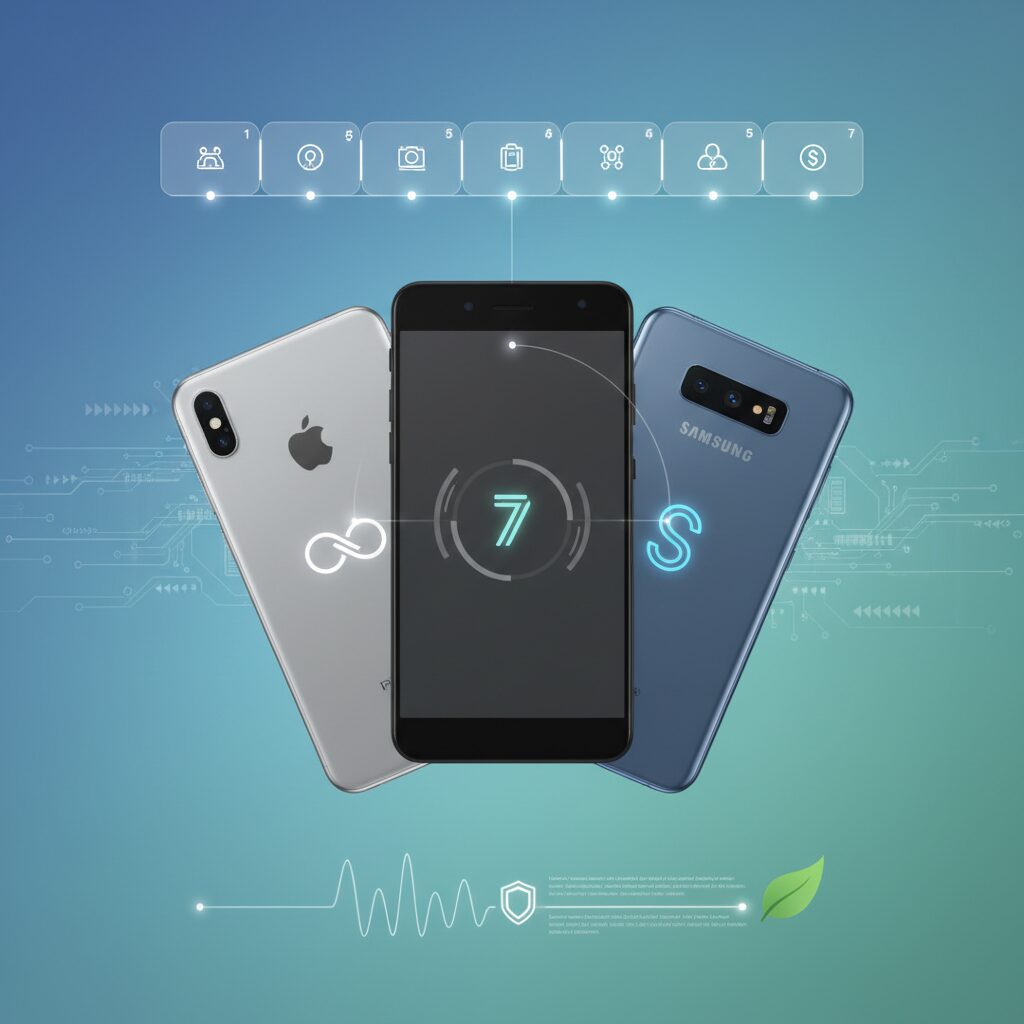
The promise of seven years of OS and security updates from Google and Samsung has fundamentally reset expectations in the smartphone industry. What was once considered exceptional support is now becoming a competitive baseline. According to Google’s official Pixel update policy, recent flagship models are guaranteed up to seven years of Android OS and security updates, a commitment that directly challenges the traditional two-to-three-year cycle.
Samsung quickly aligned with a similar pledge for its Galaxy S series, signaling that long-term software support is no longer a niche differentiator but a strategic necessity. This shift is not purely marketing-driven. It reflects structural changes in regulation, supply chains, and consumer behavior.
Seven-year support transforms a smartphone from a short-term gadget into a long-term digital asset.
The backdrop is clear. The European Union’s Ecodesign Regulation, which began applying in June 2025, requires at least five years of OS updates after a product is withdrawn from sale. As IDC notes in its analysis of the regulation, global manufacturers rarely design separate support systems for different regions. In practice, EU rules tend to become global defaults. Offering seven years not only exceeds the legal minimum but future-proofs compliance.
| Brand | OS Updates | Security Updates | Strategic Impact |
|---|---|---|---|
| Google Pixel (recent models) | Up to 7 years | Up to 7 years | Platform leadership, ecosystem control |
| Samsung Galaxy S series | Up to 7 years | Up to 7 years | Premium differentiation, resale value boost |
For consumers with strong interest in gadgets, the implication is profound. A device purchased in 2026 could remain officially supported until 2033. In security terms, that dramatically reduces exposure to unpatched vulnerabilities. The U.S. Federal Trade Commission has previously highlighted fragmentation and inconsistent update delivery as systemic Android risks. A standardized seven-year window directly addresses that historical weakness.
There is also a financial dimension. In secondary markets such as Japan, resale value has long favored iPhones due to extended support cycles. By matching or exceeding that timeframe, Android flagships begin to compete on lifecycle value rather than raw hardware specs. A three-year-old device with four years of guaranteed updates remaining carries measurable economic credibility.
Most importantly, this commitment signals a new industry baseline. When two of the largest Android ecosystem leaders align on seven years, competitors face pressure to respond. Shorter support periods increasingly appear outdated rather than acceptable. The competitive battlefield has shifted from peak performance at launch to durability over time.
EU Ecodesign Regulations and the Global Right-to-Repair Movement
The EU Ecodesign Regulation, which began applying to smartphones and tablets on June 20, 2025, is more than an environmental rule—it is a structural intervention into how devices are designed, supported, and repaired. According to the European Commission, manufacturers must now guarantee at least five years of OS updates after a product is withdrawn from sale and supply critical spare parts for up to seven years.
This is paired with mandatory access to repair information for professional repairers and, in certain cases, end users. In practical terms, it means batteries, displays, and back covers cannot simply disappear from supply chains two or three years after launch. Software longevity and physical repairability are now legally intertwined.
| Requirement | Minimum Standard | Impact |
|---|---|---|
| OS updates | 5 years after end of sales | Extends secure usability |
| Spare parts | 7 years availability | Supports repair market |
| Battery durability | 800 cycles at 80% capacity | Encourages longer ownership |
| Physical robustness | Defined drop resistance | Reduces premature failure |
Industry analysts at Omdia describe the regulation as a necessary shock to a market long optimized for annual refresh cycles. IDC similarly notes that global vendors are unlikely to create EU-specific hardware variants because fragmented production lines would raise costs and complexity. As a result, EU standards are rapidly becoming global de facto standards, influencing product strategies in Asia and North America.
This regulatory push aligns with the broader Right-to-Repair movement, which argues that consumers should have access to parts, tools, and documentation needed to maintain their own devices. Advocacy groups such as Repair.eu have welcomed the spare-parts mandate but stress that true repairability also depends on modular design and reasonable parts pricing. Regulation opens the door, but ecosystem behavior determines how wide it stays.
One underappreciated consequence is the reshaping of secondary markets. With guaranteed update timelines and spare-part supply, refurbished devices gain measurable credibility. Pre-owned markets in Europe have already shown signs of stabilization rather than collapse, suggesting that longer lifecycles do not eliminate demand but redistribute value across repair, refurbishment, and resale channels.
For manufacturers, this marks a pivot from shipment volume to lifecycle management. Devices must now be engineered with disassembly, firmware maintenance, and component traceability in mind. Durability is no longer a marketing slogan—it is a compliance requirement.
In this sense, the EU Ecodesign Regulation functions as both environmental policy and industrial strategy. By codifying longevity, it accelerates a global transition from disposable electronics toward sustainable technology ecosystems where software support, hardware endurance, and user repair rights reinforce one another.
Android’s Technical Breakthrough: Project Treble and Google Requirements Freeze (GRF)

For years, Android’s greatest weakness was not hardware performance but update complexity. Each major OS release required chipmakers to rewrite low-level drivers and board support packages, after which OEMs had to reintegrate and retest everything. This relay-style process created fragmentation and short support windows. According to the Android Developers Blog, this structural dependency was the core bottleneck slowing ecosystem-wide updates.
The turning point came with Project Treble, introduced in Android 8.0. Treble separated the Android OS framework from vendor-specific implementations, creating a stable boundary between high-level software and hardware-dependent code. In practical terms, this meant the Android framework could evolve without forcing silicon vendors to rebuild their entire stack for every release.
| Phase | Before Treble | After Treble / GRF |
|---|---|---|
| OS Update Process | Chipset code rewritten each version | Framework updated independently |
| Vendor Dependency | Tightly coupled | Interface-based separation |
| Support Horizon | 2–3 years typical | Up to 7 years possible |
However, Treble alone did not guarantee long-term support. The true institutional shift arrived with Google Requirements Freeze (GRF). GRF formalized the idea that once a vendor implementation is validated, it can be reused across multiple future Android generations without mandatory rewrites. As explained by Esper’s technical analysis and industry coverage by Android Authority, this policy transformed update economics at the silicon level.
Initially, GRF allowed reuse across roughly three OS generations. With the introduction of Longevity GRF, that window expanded to as many as seven Android releases for participating chipsets. This extension made 7-year update commitments from companies like Google and Samsung technically and financially viable. Instead of rebuilding hardware abstraction layers for each cycle, vendors now maintain and certify a stable interface.
For chipset manufacturers such as Qualcomm, this change is strategic. Maintaining one validated vendor interface over several years is significantly more efficient than rebuilding it repeatedly. The reduced engineering burden lowers total cost of ownership for OEMs, making multi-year guarantees economically rational rather than purely marketing-driven.
That said, GRF is not without trade-offs. Because the vendor interface is effectively frozen, certain future OS features that require new low-level driver capabilities may not function on older implementations. In other words, a device may run Android version N+6, but it might not support every hardware-dependent enhancement introduced in that release.
This introduces a new form of differentiation: version longevity does not always equal feature parity. Advanced camera APIs, new radio-layer optimizations, or emerging AI acceleration pathways may depend on updated HAL components. If those require changes beyond the frozen interface, backward compatibility becomes technically constrained.
From an ecosystem perspective, however, this is a calculated compromise. The Android security model primarily benefits from framework-level updates, monthly patches, and modular components delivered via Google Play System Updates. Many security and core system improvements do not require deep vendor modifications. The FTC’s device-centric research on Android update behavior has shown that delayed or missing patches significantly increase risk exposure, so extending baseline support delivers measurable security value even if feature evolution is partially limited.
Another important dimension is predictability. OEM product planning used to depend heavily on chipset vendor willingness to backport changes. Under Longevity GRF, support timelines are aligned earlier in the development cycle. This alignment enables companies to publicly commit to 7-year update policies with greater confidence, reinforcing consumer trust in device longevity.
For power users and enterprise buyers, this structural change is particularly meaningful. Enterprise mobility programs demand stable security baselines over multi-year deployment cycles. A frozen vendor interface reduces regression risk and simplifies compliance validation. In practical terms, IT departments can deploy Android fleets with longer depreciation schedules.
Ultimately, Project Treble solved the architectural bottleneck, and GRF institutionalized the solution. Together, they represent one of the most consequential backend reforms in Android’s history. Rather than chasing annual hardware leaps alone, the ecosystem now supports sustained software evolution across nearly a decade.
This transformation is not merely technical. It redefines Android’s value proposition in the era of product longevity. By decoupling innovation velocity from hardware rewrite cycles, Google has created the structural foundation for long-term update commitments that were previously unrealistic. For a market increasingly focused on durability and lifecycle assurance, that breakthrough changes everything.
The Trade-Offs of Longevity GRF: Feature Fragmentation and Hardware Limits
Longevity GRF makes seven-year Android updates technically feasible, but it does not come without compromises. By freezing the vendor interface for multiple OS generations, Google dramatically reduces the need for chipset vendors to rewrite low-level drivers. However, this architectural stability introduces a new kind of fragmentation that shifts from “version fragmentation” to “feature fragmentation.”
According to Esper’s technical analysis of GRF, the Hardware Abstraction Layer remains largely unchanged during the freeze period. This means that when a future Android release introduces hardware-dependent capabilities, devices running on an older frozen vendor implementation may not fully support them. The OS version number advances, but certain low-level hooks remain anchored in the past.
The practical impact becomes clearer when we consider concrete layers of the stack.
| Layer | Frozen Under GRF | Potential Limitation |
|---|---|---|
| Vendor HAL | Yes | New hardware APIs may be unavailable |
| Android Framework | No | Core features updated regularly |
| Kernel/Drivers | Partially stabilized | Limited adoption of new low-level capabilities |
For example, if a future Android version enhances camera pipelines with new low-level processing interfaces, a device tied to an earlier HAL may receive UI-level improvements but miss advanced computational photography features. Similarly, emerging connectivity standards or AI acceleration pathways could require driver-level modifications that fall outside the frozen contract.
Android Authority’s coverage of Longevity GRF highlights that the program primarily reduces integration overhead for chipmakers such as Qualcomm. Economically, this is transformative. Technically, however, it formalizes a boundary: innovation above the framework layer can continue rapidly, while innovation below it must respect long-term compatibility constraints.
Hardware ceilings compound this effect. Even if the software stack remains supported, RAM capacity, NPU throughput, and storage bandwidth set hard limits. IDC has noted that AI workloads are becoming central to smartphone differentiation. A device launched in 2024 with adequate AI acceleration may, by 2029, technically run the latest Android but offload advanced models to the cloud or disable them entirely due to insufficient on-device resources.
This creates a subtle but important distinction between security longevity and experiential parity. Security patches and core OS refinements remain deliverable under Longevity GRF. Cutting-edge experiences, however, may bifurcate across generations despite identical version numbers.
In other words, Longevity GRF solves the historical problem of update abandonment, but it introduces a managed form of capability divergence. For informed users, this means evaluating not only the promised support window but also the baseline hardware headroom at launch. A seven-year commitment is powerful, yet its real-world value depends on how much performance and architectural margin the device carries from day one.
Storage Durability Explained: eMMC vs UFS and Why It Matters for 7-Year Use
When we talk about 7-year software support, we often focus on OS updates and security patches. However, none of that matters if the storage silently degrades after three or four years.
Storage durability is the hidden foundation of long-term usability. The difference between eMMC and UFS is not just about speed benchmarks. It directly affects whether your device still feels reliable in year six or becomes frustratingly slow.
Architectural Differences That Impact Longevity
| Feature | eMMC 5.1 | UFS 3.1 / 4.0 |
|---|---|---|
| Communication | Half-duplex | Full-duplex |
| Controller sophistication | Basic | Advanced (SSD-like) |
| Wear leveling efficiency | Limited | Highly optimized |
| Typical segment | Entry-level | Mid-high to flagship |
Both eMMC and UFS rely on NAND flash memory, which physically degrades with each program/erase cycle. As explained in USENIX research on NAND wear management, uneven write concentration accelerates cell failure. This is where controller quality becomes critical.
eMMC integrates a simpler controller and operates in half-duplex mode, meaning it cannot read and write simultaneously. Under long-term usage with system updates, app installs, cache writes, and background logging, this limitation compounds wear concentration and latency.
UFS, by contrast, uses full-duplex communication and a more advanced command queue system. According to Synopsys and KIOXIA technical documentation, UFS behaves closer to SSD architecture, enabling parallel operations and more efficient data distribution across memory blocks.
Modern UFS 4.0 modules from vendors such as Micron also integrate refresh mechanisms that redistribute data proactively. This reduces the risk of performance collapse after years of heavy writes. In practical terms, that means fewer random slowdowns, fewer corrupted writes, and more consistent app launch behavior in year five or six.
Community reports and teardown discussions frequently show that budget devices with eMMC experience noticeable degradation after prolonged use. While anecdotal evidence should not replace lab testing, the pattern aligns with the known architectural limits of simpler flash management systems.
Another overlooked factor is file system optimization. Android increasingly supports F2FS, a flash-friendly file system designed to convert random writes into sequential patterns. Google’s Android kernel documentation explains that F2FS reduces write amplification, which directly lowers cumulative wear.
When F2FS runs on UFS, the benefits compound. When legacy EXT4 runs on eMMC, the system lacks both advanced controller intelligence and file-system-level optimization. Over seven years, that difference becomes tangible.
If you are buying a device with 7-year update promises, pairing that with UFS storage is not optional—it is structural. A long software roadmap assumes the hardware will survive constant background updates, security patch installations, and expanding app sizes.
Storage failure rarely happens overnight. It appears gradually as slower installs, longer boot times, unexplained app crashes, and eventually read/write errors. By the time symptoms become visible, NAND degradation is already advanced.
Choosing UFS 3.1 or 4.0 does not guarantee immortality, but it significantly increases the probability that your device remains stable across thousands of charge cycles, dozens of OS upgrades, and years of daily writes.
In the 7-year era, storage is no longer a spec-sheet footnote. It is the silent determinant of whether long-term support is a marketing claim—or a practical reality.
Battery Chemistry, Charge Cycles, and Smart Charging Technologies
Battery technology is now the decisive factor in whether a device can truly survive a seven-year software lifecycle. While processors and displays often remain functionally adequate, lithium-ion cells degrade chemically from day one. According to the European Commission’s 2025 Ecodesign Regulation, smartphones sold in the EU must retain at least 80% of their original capacity after 800 full charge cycles. This requirement alone has pushed manufacturers to rethink cell chemistry, thermal management, and charging algorithms.
Lithium-ion batteries age primarily due to electrolyte decomposition and lithium plating, both accelerated by high voltage and heat. Research cited in electrochemical studies shows that keeping a battery at 100% state of charge significantly increases stress on the cathode structure. In practical terms, a user who charges from 0% to 100% daily will reach 800 cycles in roughly 2–3 years. Without mitigation, that falls far short of a seven-year device strategy.
| Factor | Impact on Degradation | Mitigation Strategy |
|---|---|---|
| High Voltage (100%) | Accelerates chemical wear | Charge limit (80–90%) |
| Heat (>35°C) | Increases electrolyte breakdown | Thermal throttling |
| Deep Discharge (0%) | Structural stress | Avoid full depletion |
This is where smart charging technologies become essential rather than optional. Google’s official Pixel documentation explains adaptive charging that delays topping off to 100% until just before predicted unplug time. Samsung provides a battery protection mode that caps charging at 80%. Sony’s adaptive charging learns user routines to reduce overnight high-voltage exposure. These systems directly target the electrochemical stress factors identified in academic battery research.
Modern smartphones increasingly treat battery longevity as a software-defined feature. Instead of maximizing short-term endurance, manufacturers intentionally sacrifice a small percentage of daily capacity to preserve long-term health. Reports from Pixel users indicate voltage management adjustments after a few hundred cycles, aligning with the industry’s shift toward lifespan optimization.
From a marketing perspective, charge cycle transparency is becoming a differentiator. Users can now check cycle counts and battery health metrics in system settings, transforming what was once hidden degradation into measurable data. As Deloitte notes in sustainability analyses, extending device lifespan has outsized environmental benefits because most carbon emissions occur during manufacturing. Smart charging therefore supports both durability compliance and ESG positioning.
The strategic implication is clear: in the era of long-term OS support, battery chemistry and intelligent charging control determine whether seven years of updates translate into seven years of usable performance. Without advanced cycle management, extended software promises would be technically meaningless.
Windows 10 End of Support and the Rising Cost of Unpatched Devices
When Windows 10 reaches its end of support, the issue is not simply that new features stop arriving. The real problem is that security updates cease, and that changes the risk profile of every connected device overnight.
According to Microsoft’s official lifecycle policy, once support ends, devices no longer receive security patches unless organizations enroll in paid Extended Security Updates programs. For most consumers and many small businesses, that means running an operating system that attackers know will never be fixed again.
An unpatched device does not stay neutral. It becomes progressively more vulnerable over time.
| Status | Security Patches | Risk Trend |
|---|---|---|
| Supported OS | Monthly updates | Managed and reduced |
| End of Support | No regular patches | Compounding exposure |
Security researchers consistently warn about “patch diffing,” a technique where attackers analyze fixes released for newer systems and trace similar vulnerabilities in unsupported ones. As explained by cybersecurity analysts covering Windows 10 EOS, once patches stop, every newly discovered flaw becomes a permanent weakness on legacy machines.
Microsoft has previously reported that unsupported systems such as Windows XP experienced significantly higher malware infection rates compared to supported versions. The pattern is clear: unsupported software correlates with measurable increases in successful attacks.
For businesses, the financial impact extends far beyond the cost of upgrading hardware. Ransomware incidents can halt operations for days or weeks. Data breach remediation, regulatory fines, and reputational damage often dwarf the price of a new device fleet. Industry commentary on Windows 10 EOS highlights that doing nothing is not a cost-saving strategy; it is deferred risk with interest.
For individual users, the rising cost is less visible but equally real. Online banking, digital IDs, and remote work tools all rely on OS-level protections. Once those protections stop evolving, phishing kits, spyware, and exploit frameworks increasingly target the weakest installed base.
The true cost of an unpatched device is not the upgrade price you avoid today, but the breach you may pay for tomorrow.
There is also a structural ecosystem effect. As developers optimize applications for supported platforms, legacy systems gradually lose compatibility. Browsers may stop updating. Security certificates expire. Cloud services raise minimum OS requirements. The device may still power on, but its safe usability shrinks month by month.
In this context, Windows 10 End of Support serves as a case study in lifecycle economics. Hardware that appears functional can rapidly become a liability once its software foundation freezes in time. The lesson for both consumers and enterprises is clear: lifecycle planning must be proactive, not reactive.
Running an unpatched system in 2026 is no longer a temporary inconvenience. It is an expanding attack surface in a threat landscape that grows more automated and more aggressive each year.
Mobile Malware Trends, Zero-Click Exploits, and Patch Delays
Mobile threats are no longer limited to shady APK files or obvious phishing links. According to Kaspersky’s Securelist Q2 2025 report, mobile banking trojans and spyware continue to evolve, with malware increasingly distributed through social engineering and compromised legitimate apps.
In parallel, Zimperium’s 2025 Global Mobile Threat Report highlights a sharp rise in mobile-targeted phishing and exploit-based attacks, especially those abusing unpatched vulnerabilities. The attack surface is expanding precisely because smartphones now store financial credentials, biometric data, and corporate access tokens.
The shift is structural: attackers follow value, and mobile devices now represent both identity and wallet.
| Threat Type | Infection Vector | Primary Target |
|---|---|---|
| Banking Trojans | SMS links, fake updates | Financial credentials |
| Spyware | Malicious apps, exploits | Messages, mic, camera |
| Zero-click Exploits | Messaging frameworks | Full device compromise |
Among the most concerning developments are zero-click exploits. These attacks require no user interaction; a specially crafted message or data packet triggers a vulnerability in the OS or messaging framework. Recent disclosures such as CVE-2025-48633 and CVE-2025-48572 demonstrate how Android framework flaws can enable information disclosure or privilege escalation when exploited in the wild.
The danger lies in invisibility. Users cannot “be careful” against something they never tap. In such scenarios, only timely security patches stand between a secure device and silent compromise.
This is where patch delay becomes a critical risk multiplier.
Google publishes monthly Android security bulletins and pushes updates immediately to Pixel devices. However, as the FTC’s device-centric analysis of Android security updates has shown, fragmentation and OEM/carrier validation layers can delay rollout across other devices.
Even a delay of several weeks matters. Attackers routinely perform patch-diffing—analyzing security updates to reverse-engineer the underlying vulnerability. Once details are inferred, unpatched devices become predictable targets.
An outdated security patch level effectively advertises exploitable weaknesses.
For power users and enterprise administrators alike, three indicators deserve close monitoring: the Android security patch date, the vendor’s historical update cadence, and whether the device participates in extended support programs.
In a long-term software support era, support duration alone is not enough. A device promised seven years of updates but delivered with chronic delays creates a window of exposure every single month.
Mobile security in 2026 is defined not only by how long updates last, but by how fast they arrive.
Resale Value Rewritten: How Long-Term Support Is Turning Android into an Asset
For years, Android phones were treated as fast-depreciating gadgets. The moment you broke the seal, resale value dropped sharply, especially compared to iPhones. That assumption is now being rewritten.
Seven years of OS and security updates fundamentally change how Android devices are priced, traded, and perceived in the secondary market. Long-term support transforms a smartphone from a short-lived consumable into a semi-durable digital asset.
Support Remaining = Value Remaining
| Device Age | Old Android Model | 7-Year Support Model |
|---|---|---|
| 3 years after launch | 1 year or less updates left | 4 years updates left |
| Security perception | Potential risk | Still officially protected |
| Resale appeal | Budget-only buyers | Mainstream second owners |
A three-year-old Pixel 8 or Galaxy S24 is not “old” in software terms. It still carries four remaining years of guaranteed updates. In resale logic, that remaining support horizon becomes a measurable asset.
According to industry observations cited by secondary market reports in Japan and Europe, devices with longer official support windows maintain stronger buyer confidence. Buyers are not just purchasing hardware; they are purchasing time.
This directly contrasts with short-support Android models, where update termination immediately signals elevated security risk. As seen in analyses of buyback pricing trends, once OS updates stop, resale value drops disproportionately because the device is categorized as vulnerable.
There is also a structural shift at play. Omdia notes that longer device lifetimes reduce overall shipment volumes but stimulate refurbishment and recommerce ecosystems. When a phone is supported for seven years, it can realistically serve two or even three owners.
Consider the lifecycle economics. If a flagship costs ¥150,000 and retains usability for seven years, it can circulate across multiple users while still receiving patches. Each transfer preserves digital trust. Without updates, that chain breaks.
The pre-owned market in Japan has historically favored iPhone, as resale rankings from major retailers consistently show. The primary driver was long software support. Now that premium Android devices match or exceed that duration, the competitive gap narrows.
Software longevity has become a pricing signal. Devices advertised with “7 years of updates” communicate predictable residual value. This transparency reduces buyer hesitation and stabilizes second-hand pricing models.
At the same time, polarization intensifies. Budget Android phones with short update commitments face rapid value erosion. A two-year-old device with no remaining support is effectively a liability in security-conscious markets.
The asset transformation is not only economic but psychological. Buyers now calculate remaining support life much like remaining warranty coverage. Years of updates function as a countdown of protected utility.
In practical terms, Android is no longer automatically the weaker resale proposition. With enforced long-term update frameworks and vendor commitments under Longevity GRF, supported models now carry time-backed credibility. In a market increasingly shaped by sustainability, regulation, and security awareness, time itself has become tradable value.
Sustainability Data: How Keeping a Phone for 5 Years Cuts Emissions by Up to 50%
When we talk about sustainability, many people focus on charging efficiency or recyclable packaging. However, according to multiple life cycle assessments, the real impact lies elsewhere. Most of a smartphone’s carbon footprint is generated before you even turn it on.
Omdia and Deloitte both report that roughly 85% to 95% of a smartphone’s total greenhouse gas emissions occur during raw material extraction, component manufacturing, and assembly. That means replacing a device every two years repeatedly triggers the most carbon-intensive phase of its life cycle.
Extending usage dramatically changes this equation. Research from the Wuppertal Institute shows that increasing a smartphone’s lifespan from around two years to five years can cut annualized CO2 emissions by up to 50%. The environmental logic is simple: you spread the fixed manufacturing emissions over a longer period.
| Usage Period | Manufacturing Emissions | Annualized Impact |
|---|---|---|
| 2 years | High (one device) | Concentrated per year |
| 5 years | Same device | Up to 50% lower per year |
Fraunhofer IZM, analyzing Fairphone’s life cycle data, found that keeping a phone for five years reduces its yearly global warming impact by about 31% compared to shorter replacement cycles. The exact percentage varies by model and energy mix, but the direction is consistent across studies.
Why is the effect so large? Smartphones require energy-intensive semiconductor fabrication, rare earth mining, and complex global logistics. These processes cannot be “optimized away” by small efficiency gains during use. Charging a phone consumes relatively little electricity compared to producing its chipset and display.
The single most powerful sustainability action for a gadget enthusiast is simply to delay replacement. Even one additional year of use meaningfully lowers lifetime emissions.
This shift also reframes software support. Without long-term OS and security updates, consumers feel forced to upgrade despite hardware still functioning. Longer update guarantees therefore act as indirect climate policy tools, enabling five-year ownership without compromising safety.
For environmentally conscious users, the takeaway is clear. Choosing a device designed for durability, repairability, and extended software support is not just about cost efficiency. It directly reduces demand for new manufacturing, cuts resource extraction, and shrinks your personal carbon footprint in measurable, science-backed ways.
In a market historically driven by annual upgrades, keeping a smartphone for five years transforms sustainability from marketing rhetoric into quantifiable climate action.
On-Device AI in 2026 and Why NPU and RAM Will Define Future-Proofing
By 2026, the conversation around long-term software support is evolving again. Even if a device receives seven years of OS and security updates, that alone does not guarantee a “future-proof” experience. The real determinant is whether the hardware can keep up with the AI workloads that increasingly run directly on the device.
According to IDC, chipset innovation has become the primary battleground for smartphone differentiation, overtaking display or camera upgrades. At the center of this shift is the NPU, or Neural Processing Unit, which handles on-device AI tasks such as image enhancement, voice recognition, and generative features without relying on the cloud.
In the long update era, NPU performance and RAM capacity define practical longevity more than raw CPU speed.
Why On-Device AI Changes the Equation
On-device AI processes data locally, reducing latency and improving privacy because sensitive information does not leave the handset. This model is becoming standard for features like real-time transcription, AI photo editing, and context-aware assistants. However, these capabilities require sustained matrix computation performance and large memory buffers.
TechRadar’s analysis of older flagship devices shows that even when OS updates continue, newer AI features are often limited or shifted to cloud processing due to insufficient hardware acceleration. In other words, the OS may be current, but the experience is not equivalent to that of newer models.
| Component | Role in On-Device AI | Impact on 5–7 Year Usability |
|---|---|---|
| NPU | Accelerates neural network inference | Determines support for future AI features |
| RAM | Stores AI models and intermediate data | Affects multitasking and model size limits |
| Storage Speed (UFS) | Loads large models quickly | Reduces lag in AI-heavy workflows |
As AI models grow in parameter size, memory pressure becomes a critical bottleneck. A device with 8GB of RAM may run today’s AI tools comfortably, but future multimodal assistants combining vision, language, and contextual awareness will demand significantly more headroom. When RAM is saturated, systems fall back to storage swap, degrading responsiveness.
This creates a new form of obsolescence: functional limitation rather than security risk. The device remains safe and updated, yet advanced features are inaccessible or throttled.
From a strategic purchasing perspective, this means evaluating not only update policy but also AI silicon capability. Google’s longevity-focused platform initiatives make seven-year updates technically feasible, yet they do not override physical compute limits. IDC notes that AI-ready chipsets increasingly integrate dedicated NPUs precisely to address this long-term demand curve.
For users who intend to keep a device for five years or more, prioritizing higher-tier chipsets and ample RAM is no longer overkill. It is a hedge against software evolution. In 2026 and beyond, future-proofing is less about GHz and more about TOPS and gigabytes.
As AI becomes the core interface layer of smartphones, hardware decisions made at purchase will echo for years. Choosing stronger AI silicon today determines whether your device simply survives seven years—or remains genuinely capable throughout them.
A Practical Checklist for Buying a Long-Lasting, Secure Smartphone in 2026
Buying a smartphone in 2026 is no longer about chasing peak benchmark scores. It is about selecting a device that will remain secure, repairable, and performant for the next five to seven years. If you want to avoid costly mistakes, you should evaluate the following criteria with discipline.
In 2026, the true flagship feature is longevity backed by guaranteed security updates.
1. Verify the Update Commitment (Not Marketing Claims)
Start by confirming the official OS and security update policy on the manufacturer’s support page. Google publicly states update timelines for Pixel devices, and Samsung does the same for Galaxy models. You should look for at least five years of OS updates and seven years of security patches as a practical benchmark.
This matters because, as Microsoft has shown with Windows 10’s end of support, unsupported systems rapidly become security liabilities. Security researchers have repeatedly demonstrated that once patches stop, attackers reverse-engineer fixes from newer systems and exploit unpatched devices.
| Checklist Item | Minimum Target (2026) | Why It Matters |
|---|---|---|
| OS Updates | 5+ years | Access to new features and APIs |
| Security Patches | 7 years | Protection from newly discovered exploits |
| Patch Frequency | Monthly or near-monthly | Reduced exposure window |
2. Choose Storage Built for Endurance
Long-term usability depends heavily on storage quality. You should prioritize devices equipped with UFS 3.1 or UFS 4.0 rather than eMMC. According to semiconductor vendors such as KIOXIA and Micron, UFS integrates advanced controllers that improve wear leveling and sustained performance over time.
NAND flash memory physically degrades with write cycles. Lower-end storage often shows performance drops after years of heavy use. If you plan to keep your device for seven years, selecting 256GB or more also reduces write pressure and extends practical lifespan.
3. Plan for Battery Replacement from Day One
EU regulations now require higher durability standards, including battery performance targets after hundreds of charge cycles. Even so, lithium-ion batteries typically fall to around 80% capacity after 500–800 cycles. If you charge daily, that means two to three years before noticeable decline.
You should confirm whether official battery replacement is available in your region and at what cost. Features such as 80% charge limits or adaptive charging, offered by major brands, meaningfully slow chemical aging and improve long-term reliability.
4. Assess Repairability and Legal Constraints
In markets like Japan, technical certification rules can complicate third-party repairs. You should verify whether authorized repair networks or registered repair providers are accessible. EU eco-design rules requiring spare parts availability for up to seven years are already reshaping global supply chains, according to IDC and Omdia analysis.
A long update policy means little if you cannot replace a worn battery or broken display affordably.
5. Future-Proof for On-Device AI
IDC notes that chipsets, particularly NPUs and memory capacity, are central to the next wave of on-device AI. Even with seven years of OS support, future AI features may require stronger hardware. You should therefore select sufficient RAM and a modern chipset to avoid functional limitations later.
A secure smartphone in 2026 is one that remains patch-supported, physically durable, storage-resilient, and economically repairable. If your purchase meets these conditions, you are not just buying a gadget—you are investing in a stable digital platform for the rest of the decade.
参考文献
- European Commission:New EU rules for durable, energy-efficient and repairable smartphones and tablets start applying
- Android Authority:Here’s how Google is making it easier for Android devices to get 7 years of updates
- Microsoft:Ending Support in 2026 – Microsoft Lifecycle
- Zimperium:2025 Global Mobile Threat Report
- Wuppertal Institut:Extending Smartphone Lifetimes: How We Can Cut Emissions in Half
- Deloitte:Making smartphones sustainable: Live long and greener