
Imagine landing in a new country, losing signal, and still holding a real-time AI interpreter in your pocket. In 2026, offline translation is no longer a backup feature—it is a showcase of edge AI performance and privacy-first design.
Powered by dedicated Neural Processing Units (NPUs) such as Snapdragon 8 Elite and Google Tensor, today’s smartphones run quantized large language models directly on-device. This shift eliminates round-trip latency to the cloud, reduces energy consumption, and keeps sensitive conversations private.
For gadget enthusiasts and global travelers, this evolution changes how devices are evaluated. Token-per-second benchmarks, model quantization (Int4/Int8), speech-to-speech latency, and OS-level AI integration now matter as much as camera specs or battery size. In this article, you will explore the hardware breakthroughs, software compression techniques, real-world case studies, and competitive app landscape shaping the disconnected future of translation technology.
- Why Offline Translation Became a Core AI Battleground in 2025–2026
- The Rise of the NPU: Snapdragon 8 Elite, Tensor G5, and Apple Neural Engine Compared
- Tokens Per Second, Latency, and Energy Efficiency: The Metrics That Actually Matter
- From NMT to Quantized LLMs: How Model Compression Enables On-Device Intelligence
- TranslateGemma, Gemini Nano, and the Shrinking of Foundation Models
- Speech-to-Speech Translation Breakthroughs and Prosody Preservation
- Google Translate vs Papago vs Apple Translate: Offline Capabilities in 2026
- Why DeepL and VoiceTra Still Depend on the Cloud—and What That Means
- Japan as a Stress Test: Keigo, Multiscript OCR, and Disaster Resilience
- Case Study: Pixel Dual-Screen Interpreter Mode in Secure Business Meetings
- AR and Non-Verbal Translation: Disaster Scope and Visual Risk Communication
- The Future: OS-Level Universal Translation and Hybrid Edge-Cloud AI
- 参考文献
Why Offline Translation Became a Core AI Battleground in 2025–2026
Between 2025 and 2026, offline translation has shifted from a convenience feature to a strategic AI battleground. What used to be a fallback for poor connectivity is now a showcase of edge intelligence, silicon innovation, and privacy-first design. For gadget enthusiasts, this shift is not incremental but structural.
The core driver is the migration of large language models from the cloud to the device. Over the past decade, neural machine translation was defined by hyperscale data centers. Today, quantized LLMs such as Gemini Nano and TranslateGemma run directly on smartphones, powered by dedicated NPUs in chips like Snapdragon 8 Elite and Google Tensor G5. According to Google Developers, optimized NPU pipelines can reduce inference latency by up to 99% compared to CPU-only execution, fundamentally changing real-time translation performance.
Offline translation is no longer about surviving without signal. It is about delivering sub-second, privacy-preserving, context-aware AI at the edge.
This transformation is visible at the hardware level. Token generation speed has become a competitive metric. Qualcomm reports up to 35 tokens per second on 7B-class models with its latest flagship silicon. In practical terms, a 20–30 token sentence can be translated in under a second, making speech translation feel instantaneous rather than sequential.
| Era | Architecture | Offline Quality | Required Hardware |
|---|---|---|---|
| 2015–2018 | SMT / Early NMT | Dictionary-like output | CPU |
| 2019–2023 | Compressed NMT | Literal, limited context | CPU + DSP |
| 2024–2026 | Quantized LLM | Context-aware, nuanced | Dedicated NPU |
The battlefield is not only technical but geopolitical and psychological. As infrastructure fragility becomes more visible through climate-related disasters and regional instability, resilience matters. In scenarios where networks fail, cloud-dependent systems such as strictly server-based translation apps simply stop functioning. Edge-based systems continue operating, making offline AI a component of digital preparedness.
Privacy concerns further intensify competition. Apple emphasizes on-device processing through its Neural Engine, while Google integrates Gemini Nano into Android’s AI Core. Both approaches respond to rising user sensitivity around voice data leaving the device. Offline translation becomes a trust signal: conversations processed locally are less exposed to data harvesting or third-party interception.
Software compression breakthroughs also fuel this race. Research on quantization and knowledge distillation, documented in recent arXiv papers on mobile LLM optimization, shows that model sizes can shrink by 75–80% with minimal degradation in translation metrics. Google’s release of TranslateGemma in 4B and 12B variants demonstrates that open, mobile-ready translation models are now viable at scale.
In short, 2025–2026 marks the moment when offline translation evolves into a proving ground for edge AI leadership. Chipmakers compete on token throughput and energy efficiency. OS vendors compete on system-level integration. Model developers compete on compression without losing nuance. For users who care about performance, privacy, and preparedness, the outcome of this battleground directly shapes the device in their pocket.
The Rise of the NPU: Snapdragon 8 Elite, Tensor G5, and Apple Neural Engine Compared
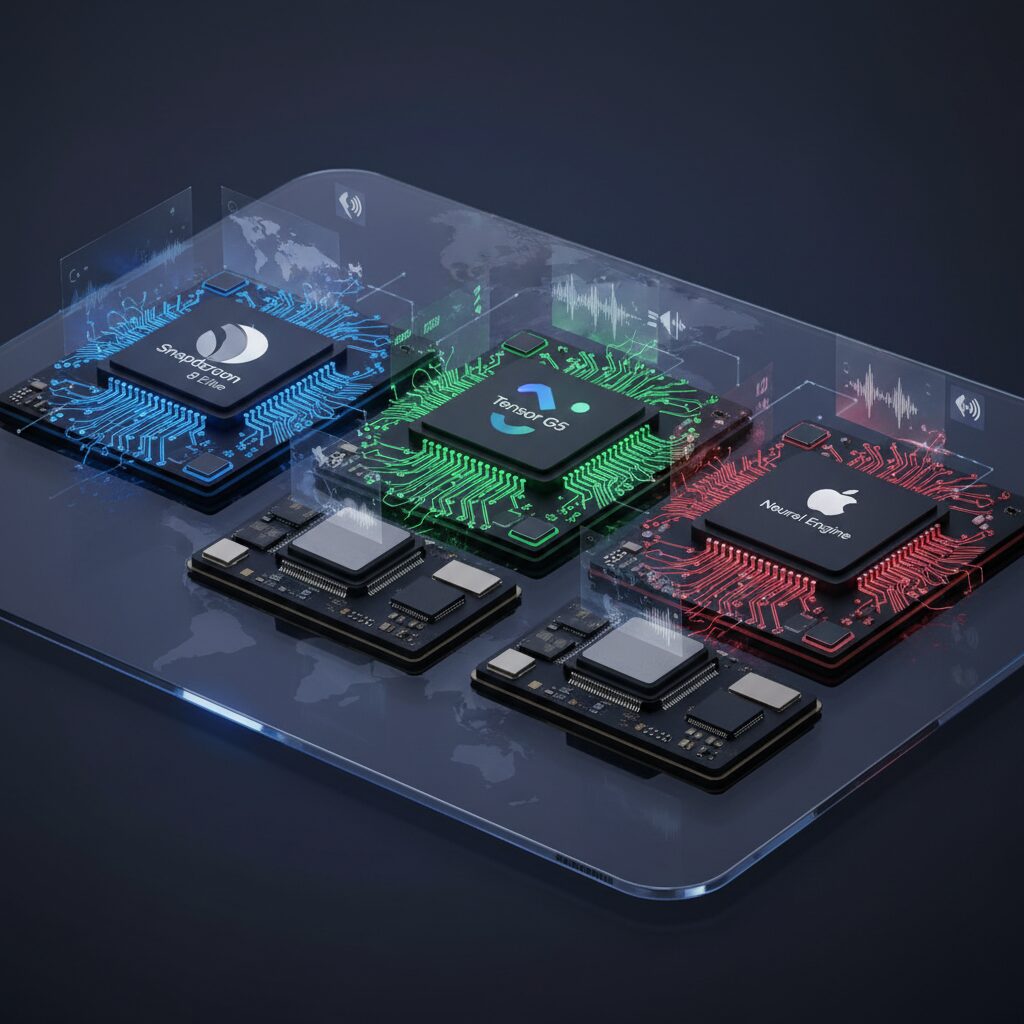
The center of gravity in mobile AI has clearly shifted to the NPU. While CPUs handle general tasks and GPUs accelerate graphics, the Neural Processing Unit is purpose-built for tensor operations that power modern neural networks. As edge AI moves from experiment to default, Snapdragon 8 Elite, Google Tensor G5, and Apple’s Neural Engine represent three distinct philosophies competing at the silicon level.
The key metric is no longer raw CPU clock speed, but how efficiently a chip can execute on-device inference for large language models. Translation, summarization, and speech-to-speech processing all depend on this capability.
| Chip Platform | AI Focus | Notable Capability |
|---|---|---|
| Snapdragon 8 Elite | High-throughput NPU (Hexagon) | Up to 35 tokens/sec on 7B-class models |
| Tensor G5 | Gemini Nano integration | On-device multimodal AI |
| Apple A18/A19 | Neural Engine + Core ML | System-level private processing |
Qualcomm’s Snapdragon 8 Elite embodies an NPU-first design. According to benchmark previews and developer documentation, its Hexagon NPU can generate up to 35 tokens per second on 7B-parameter-class models. In practical terms, that means a 20–30 token sentence can be translated in under a second, enabling near real-time dialogue without cloud latency. Google has also demonstrated that optimized inference on Qualcomm NPUs can reduce latency by roughly 99% compared to CPU-only execution.
Google’s Tensor G5 takes a vertically integrated approach. Rather than chasing peak token throughput alone, it optimizes for tight coupling with Gemini Nano. On Pixel devices, Gemini Nano can remain resident in memory, enabling Live Translate and multimodal processing entirely offline. This means text, voice, and even camera input can be processed simultaneously on-device, without round trips to the cloud. The strategic advantage is not just speed, but architectural coherence across hardware, OS, and AI model.
Apple’s Neural Engine, embedded in A18 and A19 chips, emphasizes privacy and system integration. Apple Intelligence routes many translation workloads directly through on-device Core ML pipelines. As Apple explains in its platform documentation, offline translation data never leaves the device. The differentiation here lies in tight OS-level optimization: translation is woven into iOS itself, reducing overhead that third-party apps typically incur.
The competitive battlefield is therefore defined by three axes: throughput, integration, and privacy architecture. Qualcomm leads in raw generative speed metrics, Google in multimodal AI orchestration, and Apple in vertically controlled private processing.
For gadget enthusiasts, this shift signals something deeper. The smartphone is evolving into a pocket-scale AI supercomputer, where the NPU determines not just benchmark scores, but real-world capabilities like instantaneous offline translation and speech-to-speech conversion. As large language models continue to shrink through quantization and optimization, the NPU becomes the decisive enabler of edge intelligence.
In this new era, choosing a flagship device is effectively choosing an AI acceleration strategy. The rise of the NPU is not incremental progress. It is the hardware foundation of the edge AI decade.
Tokens Per Second, Latency, and Energy Efficiency: The Metrics That Actually Matter
When evaluating offline translation performance in 2026, raw model size or parameter count no longer tells the full story. What truly shapes the user experience are three tightly linked metrics: Tokens Per Second (TPS), latency, and energy efficiency. These determine whether translation feels instantaneous, conversational, and sustainable on battery-powered devices.
TPS measures how fast a model generates output tokens. In practical terms, this defines how quickly a translated sentence appears after input. Qualcomm reports that Snapdragon 8 Elite can reach up to 35 tokens per second on 7B-class models. Assuming an average sentence contains 20–30 tokens, this means a full translation can be generated in under one second, effectively matching natural human dialogue speed.
| Metric | What It Measures | Why It Matters |
|---|---|---|
| Tokens Per Second | Output generation speed | Determines responsiveness of translation |
| Latency | Total response delay | Impacts conversational flow |
| Energy Efficiency | Performance per watt | Preserves battery during sustained use |
However, TPS alone is not enough. Latency is the metric users actually feel. Even a fast model can appear slow if system overhead, memory transfer, or network round-trip delays interfere. According to Google’s developer benchmarks on Qualcomm NPUs, inference latency can be reduced by approximately 99 percent compared to CPU-only execution when optimized correctly. Eliminating cloud round-trip time further compresses delay to near-zero network overhead.
In real-time speech-to-speech translation, latency becomes even more critical. Google Research reports that end-to-end S2ST systems have reduced delays from roughly 4–5 seconds in cascaded pipelines to around 2 seconds. That difference is not incremental—it fundamentally changes whether a conversation feels interrupted or fluid.
Energy efficiency is the silent constraint behind both speed and practicality. Running large language models continuously on a mobile CPU would drain battery rapidly and generate thermal throttling. Dedicated NPUs are architected specifically for tensor operations, delivering significantly higher performance per watt. Offloading translation workloads to NPUs allows sustained real-time translation without aggressive battery depletion—an essential requirement for travelers or field professionals.
Academic research on model compression and quantization, including recent arXiv studies on edge AI optimization, reinforces this balance. Int4 and Int8 quantization shrink memory footprint while maintaining acceptable translation quality, enabling higher TPS and lower energy draw simultaneously. Smaller, optimized models reduce memory bandwidth pressure, which directly lowers latency and power consumption.
For gadget enthusiasts, the implication is clear: benchmark numbers should be interpreted holistically. A device claiming high AI TOPS is irrelevant if it cannot sustain consistent TPS under thermal constraints. Conversely, slightly lower peak performance paired with efficient NPU scheduling may deliver a smoother real-world translation experience.
Ultimately, offline translation performance in 2026 is defined not by theoretical model intelligence, but by how quickly, how smoothly, and how efficiently intelligence can be delivered at the edge. These three metrics are the difference between a technical demo and a truly usable communication tool.
From NMT to Quantized LLMs: How Model Compression Enables On-Device Intelligence

The journey from early Neural Machine Translation (NMT) to today’s quantized Large Language Models (LLMs) marks a fundamental shift in how intelligence is delivered to our devices.
In the 2019–2023 era, compressed NMT models running offline typically occupied 100–300MB and often produced literal, context-light translations. By contrast, the 2024–2026 generation of quantized LLMs ranges from 1GB to 4GB and demonstrates genuine contextual awareness.
This leap has been made possible not by bigger clouds, but by smarter compression.
| Era | Model Type | Offline Quality |
|---|---|---|
| 2019–2023 | Compressed NMT | Literal, rule-like output |
| 2024–2026 | Quantized LLM | Context-aware, nuanced |
The core breakthrough is quantization. Traditional models relied on 32-bit floating point precision (FP32), which is memory-intensive and impractical for smartphones with 12–16GB of RAM. By reducing weights to 8-bit or even 4-bit integers (Int8/Int4), developers can shrink model size by roughly 75–80% while maintaining translation fidelity within an acceptable BLEU score range, as discussed in recent arXiv research on mobile LLM optimization.
This is not just theoretical efficiency. It directly determines whether a 7B-class model can run locally at all.
Without quantization, on-device intelligence at this scale would simply not exist.
Knowledge distillation adds another layer of refinement. Instead of deploying a massive teacher model with tens of billions of parameters, engineers train a smaller student model to replicate its behavior. Google’s TranslateGemma, introduced in 4B and 12B parameter variants, exemplifies this approach by delivering competitive multilingual performance in a footprint suitable for edge deployment.
The 4B variant, in particular, is engineered for mobile inference, demonstrating how carefully distilled architectures can preserve linguistic nuance while remaining computationally feasible.
This balance between compression and capability defines the modern edge AI stack.
The impact becomes clear in ambiguity resolution. Earlier offline NMT systems often mistranslated polysemous words because they relied heavily on sentence-local patterns. Quantized LLMs, however, maintain broader contextual embeddings, enabling them to distinguish whether “bank” refers to a financial institution or a riverbank without querying the cloud.
According to Google Research’s work on real-time speech-to-speech systems, reducing model size while preserving contextual modeling is essential for sub-second inference on mobile NPUs.
Compression no longer means compromise; it means optimization for the edge.
Equally important is energy efficiency. Integer arithmetic dramatically reduces computational overhead compared to floating-point operations. On dedicated NPUs, this translates into lower latency and lower battery drain, making continuous real-time translation viable during travel or field operations.
In practical terms, compression transforms a smartphone from a thin client into an autonomous AI node.
The evolution from NMT to quantized LLMs therefore represents more than incremental improvement—it is the architectural foundation of truly on-device intelligence.
TranslateGemma, Gemini Nano, and the Shrinking of Foundation Models
The most important shift in offline translation is not just better chips, but the radical downsizing of foundation models themselves. TranslateGemma and Gemini Nano embody a new philosophy: intelligence must be small enough to live on your device, yet powerful enough to rival cloud systems.
For years, state-of-the-art translation depended on massive cloud-hosted LLMs with hundreds of billions of parameters. That paradigm is now being inverted. Instead of scaling up endlessly, researchers are asking how much intelligence can be compressed without collapsing linguistic nuance.
Google’s TranslateGemma, introduced as an open suite of translation models, is available in 4B and 12B parameter variants, with support for 55 languages. According to Google’s announcement, the 4B model is specifically optimized for mobile deployment, targeting edge environments where memory and latency constraints are strict.
Gemini Nano follows a similar logic but is deeply integrated into Android’s AICore. Rather than being a general-purpose giant, it is engineered for on-device inference, enabling features like Live Translate without sending data to the cloud.
| Model | Target Environment | Design Focus |
|---|---|---|
| TranslateGemma 4B | Mobile / Edge | Efficient multilingual translation |
| TranslateGemma 12B | High-end devices / servers | Higher capacity, broader nuance |
| Gemini Nano | Android on-device | Low-latency multimodal tasks |
The enabler behind this shrinkage is aggressive model compression. Research published on arXiv highlights how quantization techniques such as Int8 and even Int4 reduce memory footprints by up to roughly 75 percent while preserving most task accuracy. In translation workloads, this means acceptable BLEU score degradation with dramatic gains in deployability.
Knowledge distillation also plays a central role. Large teacher models transfer linguistic behavior to compact student models, allowing smaller architectures to inherit contextual reasoning. The result is not a toy translator, but a specialized, distilled intelligence tuned for multilingual inference.
What makes this moment historically significant is that foundation models are no longer synonymous with hyperscale infrastructure. A 4B parameter model today can outperform much larger neural machine translation systems from just a few years ago, especially when paired with dedicated NPUs.
Gemini Nano’s multimodal capability further illustrates the shift. It processes text and audio natively on supported Pixel devices, enabling speech-to-speech translation pipelines to operate locally. This collapses the traditional ASR → MT → TTS cascade into a tighter, more efficient loop, reducing latency and privacy exposure simultaneously.
The shrinking of foundation models therefore represents more than technical optimization. It signals a redistribution of AI power from centralized data centers to personal hardware. For gadget enthusiasts, this is the ultimate flex of modern silicon: your phone is no longer a terminal to the cloud, but a host for a multilingual foundation model that thinks in your pocket.
Speech-to-Speech Translation Breakthroughs and Prosody Preservation
Speech-to-Speech Translation (S2ST) has moved from experimental demos to production-ready features on flagship devices in 2025–2026. Unlike traditional pipelines that chain Automatic Speech Recognition (ASR), Machine Translation (MT), and Text-to-Speech (TTS), modern end-to-end models generate translated speech directly from input audio. According to Google Research, this architectural shift has reduced end-to-end latency from roughly 4–5 seconds in cascaded systems to around 2 seconds in real-time scenarios.
That two-second threshold is not just a benchmark number. It fundamentally changes conversational rhythm. When translation delay drops below the natural pause humans tolerate in dialogue, interactions begin to feel simultaneous rather than sequential.
The breakthrough is not only speed, but the preservation of prosody—intonation, rhythm, stress, and emotional tone.
Prosody preservation has historically been the weakest link in machine-mediated conversations. Conventional TTS systems produced neutral, flattened speech that stripped away urgency, sarcasm, or empathy. End-to-end S2ST models now encode acoustic features such as pitch contours and speaking rate directly into the translation process, enabling the output voice to mirror the speaker’s emotional state.
In practical terms, this means a raised, urgent voice in English can emerge as an equally urgent Japanese or Spanish utterance, rather than a calm robotic sentence. Google’s real-time speech translation research highlights style transfer techniques that carry speaker characteristics across languages, while maintaining intelligibility.
| Aspect | Traditional Pipeline | End-to-End S2ST |
|---|---|---|
| Latency | 4–5 seconds typical | ~2 seconds reported |
| Voice Tone | Neutralized TTS | Prosody preserved |
| Emotion Transfer | Limited | Speaker style reflected |
Edge deployment amplifies these gains. On devices powered by NPUs such as Snapdragon 8 Elite or Google Tensor, prosody-aware S2ST can run locally without cloud round trips. This not only reduces network latency but also protects sensitive vocal data. Research on privacy-preserving real-time translation on iOS demonstrates that compact edge models can handle Vietnamese–English speech translation while keeping processing on-device.
For gadget enthusiasts, the most exciting shift is qualitative rather than quantitative. A business negotiation no longer sounds like two robots relaying transcripts. A traveler asking for help conveys stress or gratitude in a way the listener can intuitively grasp.
When prosody survives translation, communication regains its human texture. That is the true breakthrough of modern speech-to-speech systems.
Google Translate vs Papago vs Apple Translate: Offline Capabilities in 2026
Offline translation in 2026 is no longer a fallback feature. It is a direct reflection of how each ecosystem approaches edge AI, privacy, and hardware acceleration. Google Translate, Papago, and Apple Translate all support offline use, but their philosophies and technical depth differ in meaningful ways.
| App | Offline Languages | Core On-Device Tech | Notable Strength |
|---|---|---|---|
| Google Translate | 50+ language packs | Gemini Nano (on supported Android devices) | Context-aware real-time translation |
| Papago | ~13 major languages | Naver proprietary NMT | Asian language nuance & honorifics |
| Apple Translate | ~20 languages | Apple Neural Engine + Core ML | Privacy-first system integration |
Google Translate delivers the broadest offline coverage. Users can download language packs and perform text, camera, and voice translation without connectivity. On recent Pixel devices, Gemini Nano runs locally through Android’s AI stack, enabling context-sensitive output even in airplane mode. Google has publicly stated that Gemini integration improves idiom handling and fluency, narrowing the historical gap between offline and cloud results.
Performance is closely tied to hardware. Devices powered by Snapdragon 8 Elite or Google Tensor chips benefit from dedicated NPUs that dramatically reduce inference latency. According to Google’s developer documentation, on-device inference can cut processing delays by orders of magnitude compared to CPU-only execution. In practice, this means near real-time speech translation without network round trips.
Papago takes a different approach. Its offline packs focus on fewer languages but excel in Korean–Japanese–Chinese pairs. For travelers navigating keigo in Japan or honorific speech in Korea, Papago often feels more culturally tuned. Naver emphasizes neural models optimized for these language structures, and user reviews in Asian travel communities consistently highlight more natural honorific handling compared to generalist engines.
Apple Translate positions offline capability as a privacy guarantee. When offline mode is active, translations are processed entirely on-device using the Apple Neural Engine. Apple’s support documentation makes clear that downloaded languages enable translation without sending data to servers. For users concerned about data sovereignty, Apple’s tightly controlled hardware–software stack is a decisive advantage.
However, language breadth differs. Google supports significantly more downloadable languages, while Apple’s catalog is more curated. Papago remains regionally strong but globally narrower. PCMag’s 2026 app comparisons note that Google leads in coverage, Apple in ecosystem integration, and Papago in East Asian linguistic nuance.
In real-world offline scenarios—mountain travel, disaster resilience, secure business meetings—the distinction becomes practical. Google offers maximum flexibility across regions. Papago offers depth where cultural precision matters most. Apple offers seamless, private translation embedded at the OS level. Choosing among them in 2026 depends less on basic functionality and more on which edge AI philosophy aligns with your device and priorities.
Why DeepL and VoiceTra Still Depend on the Cloud—and What That Means
DeepL and VoiceTra are often praised for their outstanding translation quality. However, both still rely primarily on cloud-based processing, especially on mobile. This is not a technical oversight. It is a deliberate architectural choice rooted in how their systems are designed.
The core reason is model scale and specialization. DeepL’s strength comes from large, highly optimized neural networks running on powerful server infrastructure. According to comparative reviews such as those from PCMag and Taia, DeepL consistently ranks at the top for fluency and nuance in European language pairs. Delivering that level of quality requires models that are computationally intensive and memory-heavy, making full on-device deployment difficult on today’s smartphones.
| Service | Primary Processing | Offline Support (Mobile) |
|---|---|---|
| DeepL | Cloud servers | No |
| VoiceTra | NICT cloud infrastructure | No |
VoiceTra follows a similar philosophy but for different reasons. Developed by Japan’s National Institute of Information and Communications Technology (NICT), it processes speech recognition, translation, and synthesis on centralized servers. NICT explicitly states that VoiceTra relies on server-side processing to achieve high accuracy across supported languages. In other words, its performance is tightly coupled with its backend infrastructure.
This cloud dependence enables two major advantages. First, continuous model updates can be deployed instantly without requiring user downloads. Second, large-scale training improvements can be reflected in production systems in real time. For enterprise and institutional use cases, this centralized control ensures consistency and quality assurance.
However, the trade-offs are increasingly visible. When connectivity drops—whether in rural travel, underground transit, or disaster scenarios—these services simply cannot function. In contrast to on-device systems powered by NPUs, there is no fallback inference layer.
Privacy is another dimension. Because speech and text must be transmitted to remote servers, users must trust the provider’s data handling policies. While companies implement encryption and compliance frameworks, the architectural reality remains: processing occurs outside the device.
For gadget enthusiasts and power users, this creates a clear segmentation. If your priority is maximum linguistic nuance in stable network environments, cloud-native services like DeepL remain compelling. But if your workflow demands autonomy, low latency without round-trip delays, or guaranteed operation during outages, cloud dependence becomes a structural limitation rather than a minor inconvenience.
Ultimately, DeepL and VoiceTra are optimized for peak accuracy under connected conditions. That strategic focus explains both their strengths and their constraints in an era increasingly defined by edge intelligence.
Japan as a Stress Test: Keigo, Multiscript OCR, and Disaster Resilience
Japan functions as one of the most demanding real-world laboratories for offline translation technology. The country combines linguistic complexity, dense urban infrastructure, and frequent natural disasters, creating a perfect stress test for edge AI systems. If a device performs reliably here, it will likely perform anywhere.
The challenge begins with language itself. Japanese communication is shaped by keigo, a sophisticated system of honorific and humble forms that signals hierarchy, distance, and intent. A literal translation is rarely sufficient; the system must infer social context in real time.
In Japan, translation accuracy is not only semantic—it is social. Choosing the wrong politeness level can undermine trust in business or create friction in daily interactions.
Naver Papago has gained recognition for its explicit politeness controls, allowing users to toggle honorific levels in Japanese and Korean. This reflects an architectural decision: models must encode sociolinguistic signals, not just vocabulary mappings. Global systems such as Google Translate have improved contextual handling through Gemini-enhanced models, but keigo remains a precision benchmark.
According to NICT, which operates VoiceTra, high-accuracy speech translation in Japanese requires extensive domain-specific data and contextual modeling. While VoiceTra is cloud-based, its performance illustrates how demanding Japanese honorifics and domain vocabulary can be. Edge models attempting similar quality offline must compress this capability into a few gigabytes.
The second stress factor is multiscript OCR. Japanese text blends kanji, hiragana, katakana, and frequently Latin characters within a single sentence. For offline camera translation, the NPU must simultaneously detect script boundaries, perform character recognition, and resolve ambiguous kanji readings.
| Challenge | Technical Requirement | Edge Constraint |
|---|---|---|
| Mixed scripts | Robust multilingual OCR model | Limited memory footprint |
| Ambiguous kanji | Context-aware language modeling | No cloud fallback |
| Vertical text | Layout-aware vision processing | Real-time inference |
Applications such as Google Lens and dedicated tools like Yomiwa demonstrate how offline OCR combined with local dictionaries can assist travelers and learners. The difficulty is not only recognizing characters but disambiguating meaning without server-side reinforcement. This pushes quantized LLMs and multimodal models to their limits.
The third and most critical dimension is disaster resilience. Japan’s exposure to earthquakes and typhoons makes connectivity unreliable during emergencies. In such moments, cloud-dependent systems become inaccessible.
The Japan National Tourism Organization promotes the Safety tips app, which delivers multilingual emergency alerts and includes preloaded guidance accessible even when networks are congested. This design philosophy mirrors edge translation: critical functions must survive infrastructure failure.
Research presented through initiatives like Disaster Scope further shows how smartphones can process environmental simulations locally using AR. While not a translation tool per se, it illustrates a broader principle: edge intelligence enables comprehension even when language and connectivity both fail.
For gadget enthusiasts evaluating offline translation in 2026, Japan is the definitive proving ground. Handling keigo tests sociolinguistic intelligence. Multiscript OCR tests multimodal processing. Disaster scenarios test architectural resilience. Together, they define whether edge AI is merely convenient—or truly mission-critical.
Case Study: Pixel Dual-Screen Interpreter Mode in Secure Business Meetings
In high-stakes business meetings, language is only one layer of complexity. Confidentiality, latency, and conversational flow often matter just as much as raw translation accuracy. Pixel’s Dual-Screen Interpreter Mode demonstrates how edge AI can reshape secure cross-border negotiations without relying on the cloud.
The setup is straightforward yet strategically powerful. When a Pixel Fold device such as Pixel 9 Pro Fold is opened and placed on a table, the inner display shows the speaker’s original language, while the outer display—facing the counterpart—shows the translated text in real time. According to Google’s Pixel support documentation, this mode is designed specifically for face-to-face communication scenarios.
Consider a negotiation between a U.S. semiconductor firm and a Japanese manufacturing partner. The discussion includes supplier pricing structures, projected yields, and proprietary component specifications. In many Japanese enterprises, especially those handling export-controlled or confidential industrial data, cloud-based transcription APIs are contractually restricted. In such contexts, on-device inference is not a convenience but a compliance requirement.
| Factor | Cloud Translation | On-Device (Pixel) |
|---|---|---|
| Data Transmission | Sent to remote servers | Processed locally |
| Latency Sensitivity | Dependent on network RTT | Independent of connectivity |
| Confidentiality Control | Policy-dependent | Device-contained |
Latency plays a subtle but decisive role in negotiation psychology. Research from Google on real-time speech-to-speech systems indicates that reducing end-to-end delay from several seconds to around two seconds significantly improves conversational naturalness. Even when using text-based interpreter mode, eliminating network round trips reduces hesitation gaps that can otherwise disrupt bargaining rhythm.
The dual-screen form factor also alters interpersonal dynamics. Instead of passing a single device back and forth, both parties maintain eye contact while reading their respective sides. This preserves what communication scholars describe as “interactional symmetry,” a key factor in trust formation during multilingual exchanges.
Another advantage emerges in regulated industries such as finance, healthcare, or defense supply chains. Because Gemini Nano operates within Android’s AI Core framework, the inference pipeline stays on the device’s secure hardware boundary. For organizations with strict data residency or audit requirements, this architecture aligns more closely with internal IT governance standards than generic web-based translation tools.
Importantly, this does not eliminate the need for human interpreters in complex legal or diplomatic settings. However, in mid-level procurement meetings, factory visits, or exploratory technical briefings, Pixel’s Dual-Screen Interpreter Mode offers a pragmatic balance between speed, privacy, and usability.
The case illustrates a broader shift: in secure business environments, edge AI translation is becoming not merely a backup to the cloud, but a strategic enabler of trust-sensitive communication.
AR and Non-Verbal Translation: Disaster Scope and Visual Risk Communication
Augmented Reality is redefining how we understand risk across language barriers. In disaster scenarios, speed and clarity matter more than linguistic perfection. By overlaying digital hazard data directly onto the physical environment, AR functions as a form of non-verbal translation, converting complex warnings into instantly comprehensible visuals.
According to research presented at the UNISDR Global Platform, the Disaster Scope application demonstrates how flood depth and smoke spread can be simulated through a smartphone camera in real time. Instead of reading evacuation manuals, users see virtual water rising to their actual eye level. This transforms abstract risk into embodied perception.
| Communication Mode | Dependency on Language | Reaction Speed |
|---|---|---|
| Text Alerts | High | Moderate |
| Audio Announcements | High | Moderate |
| AR Visual Overlay | Low | High |
Traditional emergency communication relies heavily on text or speech. Even when translated, cognitive processing takes time. AR-based visualization reduces that delay because it leverages spatial awareness rather than vocabulary. For foreign residents or tourists unfamiliar with local terminology, this shift is critical.
In flood simulations using Disaster Scope, depth rendering adapts to the user’s height and position, creating a personalized risk map. The technology uses smartphone cameras and positional sensors to align CG elements with real-world coordinates. The message is not “there may be flooding,” but “water will reach here.”
This approach aligns with findings in risk communication studies cited by international disaster reduction frameworks, which emphasize that visual cues improve hazard comprehension across cultural contexts. Images bypass grammatical complexity and reduce ambiguity, especially under stress.
Non-verbal translation through AR also addresses accessibility. People with limited literacy, hearing impairments, or limited proficiency in the dominant language benefit from visual hazard indicators. Smoke overlays, directional escape arrows, and building stability simulations communicate without requiring sentence parsing.
From a technological perspective, the evolution of edge AI processors makes this feasible offline. Rendering environmental simulations locally ensures that visual risk guidance remains available even when networks fail. In disaster conditions where cellular congestion is common, this resilience is not optional.
For gadget enthusiasts, this represents a paradigm shift: translation is no longer confined to converting words between languages. It expands into converting data into perception. AR becomes a universal semantic layer, mapping invisible threats into visible reality.
As edge computing grows more powerful, we can expect richer environmental modeling, such as real-time earthquake impact visualization or evacuation flow projections. The future of translation in crisis management may not be linguistic at all. It may be spatial, immersive, and fundamentally visual.
The Future: OS-Level Universal Translation and Hybrid Edge-Cloud AI
By 2026, translation is no longer confined to a standalone app. It is becoming an operating system capability, deeply embedded into the audio, camera, and messaging pipelines of your device. Apple Intelligence and Android’s Live Translate already hint at this direction, where the OS itself intercepts speech, processes it on-device, and outputs translated audio before the signal even leaves the phone.
This shift from app-level to OS-level translation fundamentally changes user expectations. Instead of launching a translator, users simply speak, type, or point their camera. The system layer handles inference through integrated AI cores such as Apple’s Neural Engine or Qualcomm’s Hexagon NPU, ensuring low latency and privacy-first execution.
According to Google Research, real-time speech-to-speech systems have already reduced latency to around two seconds in end-to-end architectures. When such models are embedded directly into the OS audio stack, the experience feels conversational rather than transactional.
From App-Based to System-Level Translation
| Layer | Where AI Runs | User Experience |
|---|---|---|
| App-Based (2023) | Cloud or isolated on-device model | Manual launch, session-based use |
| OS-Integrated (2025) | On-device NPU via system service | Always available, cross-app support |
| Hybrid OS + Cloud (2026→) | Edge for instant output, cloud for refinement | Seamless, context-aware augmentation |
The most important evolution, however, is not just integration but architecture. The future is hybrid edge-cloud AI. Immediate translation happens locally for speed and resilience, while more complex contextual reasoning is processed asynchronously in the cloud when connectivity allows.
Edge handles “fast thinking,” cloud handles “deep thinking.” This mirrors the broader AI trend identified by industry analysts in 2025: lightweight quantized models execute on-device, while larger foundation models such as Gemini-class systems provide contextual corrections, cultural notes, or domain-specific terminology updates in the background.
For example, during a multilingual video call, your device may generate instant translated speech offline. If connected, a cloud model can later refine phrasing, adjust honorific nuance, or suggest alternative interpretations—without interrupting the live flow.
This hybrid model also strengthens disaster resilience. If networks fail, translation remains fully functional at the edge. When connectivity returns, synchronization improves accuracy and updates language packs. The system becomes adaptive rather than binary online/offline.
Privacy architecture evolves alongside this shift. Apple’s on-device processing model and Android’s AICore framework both emphasize minimizing raw audio transmission. Sensitive conversations—business negotiations, healthcare interactions, legal consultations—can remain local, with only optional anonymized metadata sent for improvement.
Looking ahead, universal translation may operate invisibly across phone calls, AR glasses, and wearables. As industry forecasts for 2026 suggest, translation will become an ambient layer of computing rather than a discrete tool. When hardware acceleration, quantized LLMs, and cloud supermodels cooperate fluidly, language barriers fade into background infrastructure.
The future is not offline versus online. It is intelligent orchestration between edge immediacy and cloud intelligence.
参考文献
- Google Blog:TranslateGemma: A new suite of open translation models
- Google Research Blog:Real-time speech-to-speech translation
- Google Blog:The latest AI news we announced in December
- Android Developers:Gemini Nano | AI
- Apple Newsroom:New Apple Intelligence features are available today
- NICT:Multilingual Speech Translation Application VoiceTra – FAQ
- JNTO:Safety tips for travelers
- Google Help:Translate speech & text on your Pixel phone or Pixel Tablet
- arXiv:Optimizing LLMs Using Quantization For Mobile Execution