Your smartphone is no longer just recording your voice. It is understanding it, structuring it, and turning it into actionable intelligence.
In 2026, voice AI on smartphones has evolved far beyond basic speech-to-text. Thanks to breakthroughs in Transformer-based ASR models, distilled architectures like Kotoba-Whisper, and on-device AI powered by custom chips such as Google Tensor, real-time transcription, speaker diarization, emotion analysis, and automatic meeting summaries have become mainstream features.
At the same time, the global text analytics market is projected to reach tens of billions of dollars by 2032, driven by the need to convert massive volumes of unstructured voice and conversation data into operational intelligence. From enterprise-grade platforms like Notta and CLOVA Note to hardware disruptors like PLAUD NOTE, the competition is reshaping how businesses capture knowledge and how individuals extend their memory.
In this in-depth 2026 analysis, you will discover the latest technological breakthroughs, real-world enterprise case studies, security standards such as SOC 2 and HIPAA, and the future of full-duplex conversational AI. If you are passionate about gadgets, AI, and the next wave of human–machine interaction, this guide will give you a strategic edge.
- From Speech-to-Text to Meeting Intelligence: The Paradigm Shift in Voice AI
- Market Explosion: Why Text Analytics Is Becoming a $35+ Billion Industry
- Breaking the Latency Barrier: Distillation, Edge AI, and 6x Faster Models
- Academic Breakthroughs: LiteASR Compression and NTT’s Mamba-Based Diarization
- Emotion AI and Paralinguistics: When Voice Assistants Start Reading the Room
- Software Battle 2026: Notta, CLOVA Note, Google Recorder, and Otter.ai Compared
- On-Device vs Cloud: Privacy, Performance, and the Rise of Offline AI
- Hardware Comeback: How PLAUD NOTE Bypasses OS Recording Restrictions
- Enterprise-Grade Security: SOC 2, HIPAA, GDPR, and AI Training Opt-Out Controls
- Case Studies: How Companies Reduced Documentation Work by 75% with Voice AI
- Toward 2030: Full-Duplex Conversations, AI Secretaries, and Multimodal Authentication
- 参考文献
From Speech-to-Text to Meeting Intelligence: The Paradigm Shift in Voice AI
For years, the goal of voice AI was simple: convert speech into accurate text.
Automatic Speech Recognition improved punctuation, reduced word error rates, and identified speakers with increasing precision.
With the emergence of large-scale models such as OpenAI’s Whisper and its derivatives, **high-accuracy transcription has largely become a solved problem at a practical level**.
But in 2026, the real transformation lies beyond transcription.
The integration of Generative AI and Large Language Models has shifted the objective from recording conversations to understanding them.
This is the rise of Meeting Intelligence.
| Phase | Primary Goal | Output |
|---|---|---|
| Speech-to-Text Era | Accuracy of recognition | Raw transcript |
| Meeting Intelligence Era | Contextual understanding | Structured decisions & actions |
According to recent market analyses, the broader text analytics market is projected to reach 35.63 billion USD by 2032, growing at a CAGR of nearly 20%.
This growth reflects a crucial reality: over 80% of enterprise data is unstructured, including voice, emails, and chat logs.
Simply storing conversations is no longer enough; organizations must transform them into operational intelligence.
Meeting Intelligence systems now extract key decisions, detect action items, summarize discussions, and even interpret sentiment in real time.
Instead of scrolling through a 90-minute transcript, users receive structured outputs such as “Background,” “Decisions,” and “Next Steps.”
**The value shifts from documentation to acceleration of decision-making.**
Technically, this shift became possible through the convergence of ASR, speaker diarization, and LLM-based natural language understanding.
Modern pipelines do not treat speech as isolated sentences but as contextual sequences embedded in broader semantic frameworks.
Research communities and industry leaders alike emphasize embedding-based meaning representation as the backbone of this transition.
Another critical change is emotional and paralinguistic analysis.
Human communication is shaped not only by words but also by tone, pauses, and emphasis.
Advanced voice AI models now score emotional signals such as urgency or frustration, adding a qualitative layer to structured outputs.
This evolution effectively turns voice data into a knowledge asset.
Conversations become searchable, comparable, and strategically analyzable across teams and time.
Instead of asking “What was said?” organizations increasingly ask “What does this mean, and what should we do next?”
The paradigm shift is therefore not incremental but architectural.
Speech-to-text optimized for recognition accuracy; Meeting Intelligence optimizes for comprehension, synthesis, and execution.
**Voice AI is no longer a passive recorder. It is becoming an active cognitive partner.**
Market Explosion: Why Text Analytics Is Becoming a $35+ Billion Industry

The text analytics market is no longer a niche segment of enterprise IT. It is becoming one of the fastest-growing pillars of digital transformation, with projections indicating it will reach $35.63 billion by 2032, expanding at a CAGR of 19.76%.
According to recent market research covering 2025–2032, the market stood at $8.41 billion in 2024. If this trajectory holds, the industry will grow more than fourfold within less than a decade.
This is not incremental growth. It is structural expansion driven by a fundamental shift in how organizations treat data.
| Year | Market Size (USD) | Growth Signal |
|---|---|---|
| 2024 | $8.41 Billion | Acceleration Phase |
| 2032 (Forecast) | $35.63 Billion | Mainstream Adoption |
The core driver behind this explosion is the dominance of unstructured data. Industry analyses consistently estimate that more than 80% of enterprise data is unstructured, including emails, chat logs, voice recordings, customer feedback, regulatory documents, and social media conversations.
Until recently, most of this data was archived rather than activated. Today, text analytics transforms it into operational intelligence that directly influences decision-making.
Companies are no longer asking whether to analyze text data. They are asking how fast they can operationalize it.
Advances in natural language processing, deep learning architectures, and embedding-based semantic representations have dramatically improved entity extraction, intent classification, and relationship mapping.
This means organizations can automatically detect risk signals in compliance documents, identify churn indicators in customer messages, or surface emerging product issues from support tickets in near real time.
What was once retrospective reporting is becoming predictive insight.
Another catalyst is the maturation of AI deployment itself. Between 2024 and 2025, enterprises moved decisively from proof-of-concept experimentation to production-scale implementation.
Governance frameworks addressing hallucination risks, data privacy concerns, and model explainability have reduced executive hesitation.
As a result, procurement criteria now emphasize compliance alignment, integration capability, and auditability as much as raw model accuracy.
In highly regulated sectors such as finance and healthcare, text analytics is becoming embedded in compliance workflows. Automated review of filings, clinical notes, and transaction logs reduces manual review time while improving consistency.
Meanwhile, in customer-facing industries, real-time sentiment analysis and intent detection are reshaping service operations and marketing responsiveness.
The expansion is horizontal across industries and vertical within enterprise stacks.
Crucially, generative AI has amplified the market’s momentum. Traditional analytics extracted keywords and entities. Modern systems synthesize summaries, recommend actions, and contextualize meaning across multiple documents.
This transition from extraction to interpretation increases perceived ROI, making budget allocation easier to justify at the board level.
As authoritative industry forecasts suggest, the trajectory toward a $35+ billion market is not speculative hype but a reflection of enterprise dependency on language-driven intelligence.
Text is the dominant interface of modern business. As long as organizations communicate, negotiate, document, and decide in language, the infrastructure that analyzes that language will continue to expand.
Breaking the Latency Barrier: Distillation, Edge AI, and 6x Faster Models
The biggest bottleneck in voice AI has never been accuracy alone. It has been latency.
Even a one- or two-second delay between speech and transcription disrupts conversation flow, especially in live meetings or interviews. In 2026, that barrier is finally being dismantled through model distillation, edge AI optimization, and radically faster inference pipelines.
The shift from cloud-dependent processing to real-time, near-zero-latency transcription is redefining what “responsive AI” truly means.
| Model | Inference Speed | Japanese Accuracy | Optimization Strategy |
|---|---|---|---|
| Whisper large-v3 | 1.0x (baseline) | High | Large general-purpose model |
| Kotoba-Whisper v1.0 | 6.3x | Comparable to large-v3 | Knowledge distillation + dataset specialization |
Kotoba Technologies demonstrated that Japanese-specialized ASR models can achieve 6.3 times faster inference than Whisper large-v3 while maintaining comparable word error rates. The key enabler is distillation, a technique where a large “teacher” model transfers its learned representations into a smaller “student” model.
This compression does not simply shrink parameters. It strategically preserves linguistic knowledge while eliminating redundancy. By training on 1,253 hours of the ReazonSpeech dataset, the distilled model retains domain strength without excessive computational overhead.
The result is practical real-time transcription on smartphones and edge devices without sacrificing reliability.
Latency improvements are not limited to commercial optimization. Academic research is pushing the frontier further.
The paper “LITEASR: Efficient ASR via Low-Rank Adaptation” on arXiv proposes leveraging the low-rank properties of encoder activations. By approximating linear transformations using PCA-based compression, researchers reduced the encoder size of Whisper large-v3 by over 50 percent while maintaining accuracy comparable to Whisper medium.
This is not incremental tuning. It establishes a new Pareto frontier between speed and performance, particularly valuable for on-device deployment.
Edge AI plays a complementary role in breaking the latency barrier. When inference runs locally on specialized hardware such as mobile NPUs or TPUs, network round-trip delay disappears entirely.
Google’s Pixel Recorder, powered by Tensor chips, demonstrates how offline transcription with speaker identification can operate without internet connectivity. In practical terms, this eliminates unpredictable latency spikes caused by bandwidth congestion.
For professionals recording interviews, legal notes, or confidential meetings, deterministic latency is as critical as accuracy.
Another dimension of latency reduction lies in architectural efficiency. Traditional Transformer-based models scale quadratically with sequence length, making long meetings computationally heavy. Research presented by NTT at ICASSP and Interspeech highlights alternative architectures such as state space models like Mamba, which scale linearly with sequence length.
Linear scaling means sustained responsiveness even during extended sessions. Instead of slowing down as context grows, the system maintains consistent processing speed.
This architectural evolution ensures that real-time transcription remains real-time, regardless of meeting duration.
Ultimately, 6x faster models are not just about benchmarks. They transform user experience.
When text appears nearly simultaneously with speech, AI can begin higher-order processing instantly, from summarization to action extraction. The gap between listening and understanding collapses.
Breaking the latency barrier turns transcription from a passive recording tool into an active cognitive partner.
Academic Breakthroughs: LiteASR Compression and NTT’s Mamba-Based Diarization
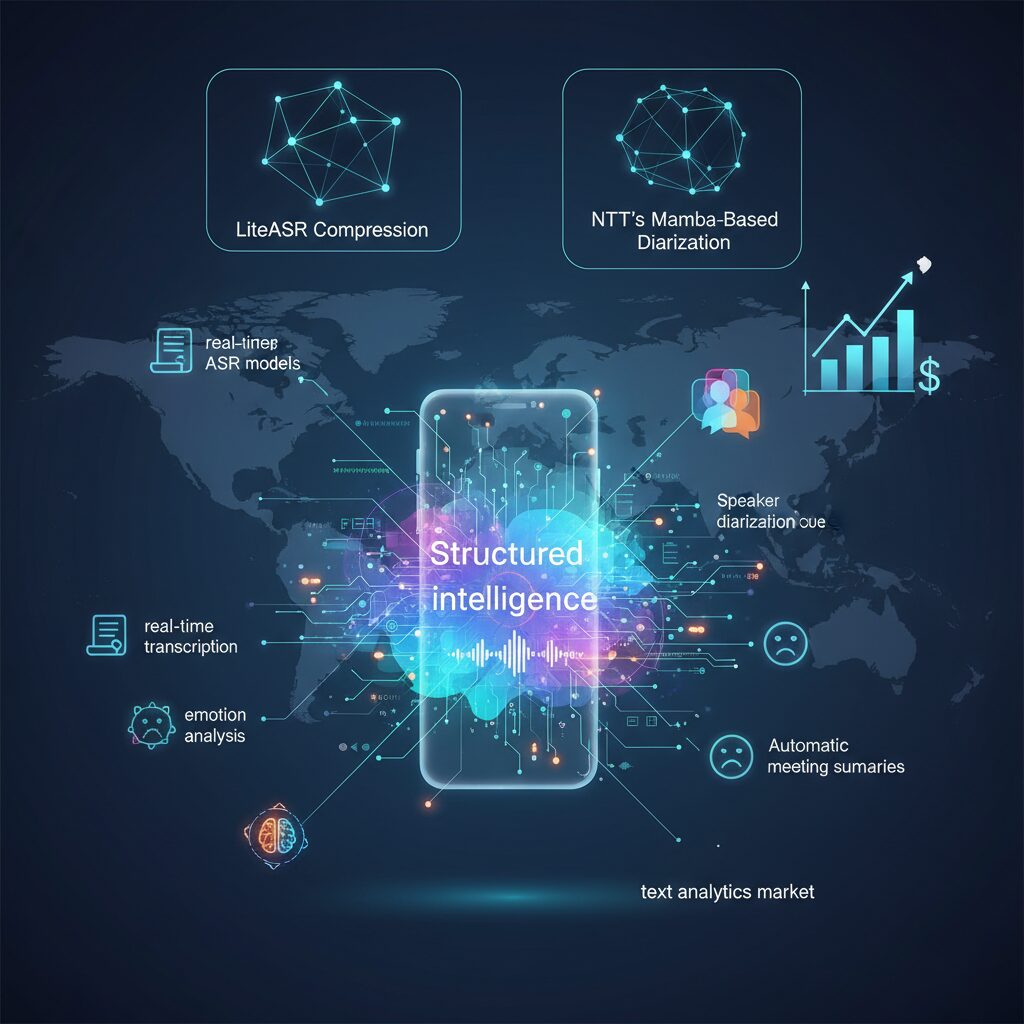
Beyond commercial competition, 2026 is marked by notable academic breakthroughs that directly reshape how speech AI runs on smartphones. Two research directions stand out: model compression for automatic speech recognition and next-generation speaker diarization architectures.
Both aim at the same goal. Delivering high accuracy with drastically lower computational cost is now the central challenge as speech models move from data centers to edge devices.
LiteASR: Low-Rank Compression as a New Efficiency Frontier
In early 2025, a paper published on arXiv introduced LITEASR: Efficient ASR via Low-Rank Adaptation. The researchers focused on a structural bottleneck in modern encoder–decoder ASR systems such as Whisper. The encoder layers consume the majority of inference cost, especially on long audio streams.
The key insight is mathematical rather than brute-force engineering. The authors observed that intermediate activations in deep ASR encoders exhibit low-rank properties. By applying principal component analysis to approximate linear transformations, they significantly reduced redundant dimensions without collapsing representational power.
| Aspect | Conventional Whisper large-v3 | LiteASR Approach |
|---|---|---|
| Encoder Size | Full-scale | Reduced by 50%+ |
| Computation Cost | High | Substantially Lower |
| Recognition Accuracy | High | Comparable to Whisper medium |
This is not merely incremental optimization. It pushes the Pareto frontier between accuracy and efficiency, making high-quality ASR feasible on edge hardware with limited memory and power budgets. For gadget enthusiasts, this means faster real-time transcription and longer battery life without sacrificing precision.
Academic validation through arXiv publication adds credibility, and the methodology aligns with broader trends in low-rank adaptation research seen across NLP and vision domains.
NTT’s Mamba-Based Speaker Diarization
While ASR converts speech to text, diarization answers a different question: who spoke when. According to NTT’s 2025 ICASSP and Interspeech disclosures, the company became the first to apply the Mamba state space model to speaker diarization tasks.
Traditional Transformer-based diarization models scale quadratically with sequence length. This becomes computationally prohibitive for long meetings or multi-hour recordings. Mamba, by contrast, operates with linear complexity while modeling long-range dependencies.
The shift from quadratic to linear scaling is critical for enterprise and smartphone use cases where recordings can exceed several hours.
In practical terms, this enables more stable speaker tracking over extended sessions. Long business meetings, academic lectures, and hybrid conferences benefit from consistent diarization without fragmentation or identity drift.
NTT has also advanced Target Sound Extraction, designed to isolate a specific speaker’s voice under overlapping speech conditions. Overlap remains one of the hardest problems in diarization, particularly in Japanese meetings where backchannel responses frequently occur.
Together, LiteASR and Mamba-based diarization illustrate a broader academic trend. Rather than simply scaling models larger, researchers are redesigning architectures for structural efficiency. For the smartphone ecosystem, this signals a future where high-end speech intelligence runs locally, in real time, and at scale, powered not by brute force but by mathematical elegance.
Emotion AI and Paralinguistics: When Voice Assistants Start Reading the Room
Voice assistants are no longer limited to recognizing words. They are beginning to interpret how those words are spoken. This shift is driven by Emotion AI and paralinguistics, fields that analyze vocal cues such as tone, pitch, rhythm, pauses, and intensity.
According to research in human communication, a significant portion of meaning is conveyed not by lexical content but by non-verbal signals. In voice interfaces, these signals appear as subtle fluctuations in prosody. Emotion AI attempts to quantify and model these fluctuations in real time.
For gadget enthusiasts, this marks a profound upgrade: your device is not just listening to what you say, but how you say it.
From Words to Emotional Signals
| Layer | What Is Analyzed | Practical Output |
|---|---|---|
| Lexical | Spoken words and syntax | Accurate transcription |
| Paralinguistic | Tone, pitch, tempo, pauses | Emotion scoring |
| Contextual | Conversation history and intent | Adaptive responses |
Modern systems integrate these layers into a unified inference pipeline. For example, call center solutions now score customer emotions such as anger, frustration, or satisfaction in real time, as reported by industry analyses of voice AI deployments.
This scoring is not guesswork. Acoustic features such as fundamental frequency variation, speech rate acceleration, and amplitude shifts are extracted frame by frame. Machine learning models then map these features to probabilistic emotional states.
The result is a dashboard where emotional escalation can be detected before a conversation collapses.
Backchanneling and the Illusion of Presence
Emotion AI is not limited to detection. It also informs generation. The J-Moshi model developed by researchers at Nagoya University demonstrates real-time backchanneling, producing natural interjections such as “I see” or “Right” at appropriate moments.
This capability relies on predicting conversational turn-taking cues from prosodic signals. Instead of waiting for silence, the system anticipates speaker intent mid-utterance.
When an assistant responds with well-timed acknowledgments, users perceive it as attentive rather than mechanical.
Advanced speech synthesis platforms, including models highlighted in recent AI case studies, are also improving emotional expressiveness. They modulate pitch contours and micro-pauses to reflect empathy or enthusiasm, rather than delivering flat, robotic output.
This is especially relevant in mental health support bots, customer service automation, and language learning companions, where emotional tone directly influences trust and engagement.
Emotion-aware voice systems transform assistants from command executors into socially responsive agents.
However, interpreting emotion from voice alone is probabilistic, not deterministic. Cultural context, individual speaking habits, and situational stress can all distort signals. Researchers and enterprises alike emphasize the importance of transparency and human oversight when deploying these systems.
For tech-forward users, the takeaway is clear. The next generation of voice assistants will not merely answer queries. They will adapt their pacing, vocabulary, and tone based on your emotional state.
When your device starts slowing its speech because it detects frustration in your voice, or escalates a support ticket because stress markers cross a threshold, you are witnessing paralinguistics in action. The room is no longer silent to machines. They are beginning to read it.
Software Battle 2026: Notta, CLOVA Note, Google Recorder, and Otter.ai Compared
When it comes to transcription apps in 2026, the real competition is no longer about who can simply convert speech into text. The battlefield has shifted to intelligence, ecosystem integration, and trust. Notta, CLOVA Note, Google Recorder, and Otter.ai each represent a distinct philosophy of how voice AI should serve power users.
The key differences emerge in three areas: language optimization, AI summarization depth, and deployment model (cloud vs. on-device). For gadget enthusiasts and productivity-focused professionals, these distinctions directly impact daily workflows.
| Service | Core Strength | Deployment Model | Best Fit |
|---|---|---|---|
| Notta | Structured AI summaries & integrations | Cloud-based | Business teams |
| CLOVA Note | Japanese LLM optimization | Cloud-based | JP professionals |
| Google Recorder | Offline, on-device AI | On-device (Pixel) | Privacy-focused users |
| Otter.ai | English meeting intelligence | Cloud-based | Global teams |
Notta positions itself as a business intelligence layer rather than a recorder. Its AI templates generate structured outputs such as decisions and next actions, reflecting the broader shift toward “meeting intelligence.” Case studies published by the company show up to 75% reduction in post-meeting documentation time in recruitment settings. For organizations using Slack, Salesforce, or Notion, this ecosystem connectivity is a decisive advantage.
CLOVA Note, powered by NAVER’s HyperCLOVA large language model, excels in Japanese-language segmentation and contextual summarization. According to NAVER’s official announcements, the service evolved into a full AI minutes management tool, automatically chaptering long meetings. For users operating primarily in Japanese, this linguistic optimization often produces more natural summaries than globally trained English-centric systems.
Google Recorder takes a radically different approach. Running entirely on-device via the Pixel Tensor chip’s TPU, it performs real-time transcription and speaker labeling without internet connectivity. The November 2025 Pixel Drop expanded multilingual summarization, including Japanese. This offline capability is not merely convenient; it fundamentally changes the privacy equation. No cloud upload means reduced exposure to data governance risks.
Otter.ai remains dominant in English-speaking markets. Its real-time collaboration features and automated meeting summaries are highly refined for English dialogue. However, third-party comparative reviews in 2025 suggest its Japanese performance trails specialized services, making it stronger for global teams operating primarily in English.
The decisive factor in 2026 is not raw transcription accuracy—modern ASR models have largely commoditized that layer—but how well each platform transforms speech into actionable knowledge. Business users may favor Notta’s structured outputs, Japanese professionals may lean toward CLOVA Note’s language fluency, Pixel owners gain unmatched offline reliability, and English-first teams continue to rely on Otter.ai’s collaboration depth.
Choosing the right tool therefore depends less on features listed on a spec sheet and more on workflow alignment, language environment, and security posture.
On-Device vs Cloud: Privacy, Performance, and the Rise of Offline AI
As voice AI becomes embedded in smartphones, the architectural choice between on-device and cloud processing is no longer technical trivia. It directly shapes privacy, latency, reliability, and even regulatory compliance.
In 2026, this debate is intensifying as lightweight models, distillation techniques, and specialized mobile chips make fully offline AI not only possible but practical.
Core Differences at a Glance
| Dimension | On-Device AI | Cloud AI |
|---|---|---|
| Data Processing | Processed locally on smartphone | Audio sent to remote servers |
| Latency | Near real-time, minimal delay | Network-dependent |
| Privacy Risk | Data stays on device | Requires transmission and storage |
| Model Scale | Optimized, compressed models | Large-scale LLMs available |
Privacy is the most visible fault line. In cloud-based systems, audio must be transmitted, processed, and often temporarily stored. Even with SOC 2 Type II or GDPR compliance, enterprises remain cautious about sensitive board meetings or medical consultations leaving the device.
On-device systems, by contrast, eliminate transmission risk entirely. Google Pixel’s Recorder app processes speech locally using the Tensor chip’s TPU, enabling transcription and speaker labeling even in airplane mode. This architecture inherently reduces attack surfaces.
Performance used to favor the cloud. Massive models required server-grade GPUs. However, model compression and distillation have shifted the balance. Kotoba-Whisper v1.0, for example, achieves 6.3× faster inference than Whisper large-v3 while maintaining comparable Japanese accuracy, according to published model benchmarks.
This class of optimization makes real-time offline transcription feasible on consumer hardware. Academic research such as LiteASR further demonstrates that encoder compression can reduce computational load by over 50% without catastrophic accuracy loss, pointing toward a sustainable edge-AI future.
Latency is where users feel the difference immediately. Cloud transcription is vulnerable to bandwidth fluctuations, packet loss, and server congestion. In high-stakes environments like live interviews or field reporting, a few seconds of delay can disrupt workflow.
Offline AI removes the network variable. Speech appears almost synchronously with the speaker’s voice, enabling near-simultaneous translation and summarization. For journalists, researchers, and engineers working in low-connectivity environments, this reliability is transformative.
Yet cloud AI retains a structural advantage: scale. Large language models with hundreds of billions of parameters still exceed what smartphones can host efficiently. Advanced reasoning, cross-document synthesis, and enterprise-wide knowledge retrieval often rely on centralized infrastructure.
The emerging pattern is hybridization. Sensitive raw audio is processed locally, while abstracted summaries or embeddings are optionally synchronized to the cloud for deeper analysis. This layered architecture balances compliance and capability.
As regulators tighten data protection standards and enterprises demand stronger governance, edge processing is becoming a strategic differentiator rather than a niche feature. Offline AI is no longer a backup mode. It is rapidly becoming a core expectation for next-generation voice intelligence.
Hardware Comeback: How PLAUD NOTE Bypasses OS Recording Restrictions
In recent years, smartphone operating systems have steadily tightened their control over call recording.
Both iOS and Android restrict third-party apps from directly accessing system audio during voice calls, especially the other party’s voice. This is largely driven by privacy protection policies and platform governance.
As a result, many users discovered that traditional call-recording apps either stopped working or relied on unstable workarounds.
This is precisely where PLAUD NOTE reintroduces hardware as a strategic advantage.
Instead of attempting to bypass OS restrictions through software exploits, PLAUD NOTE sidesteps the issue entirely by moving the recording layer outside the operating system.
It does not “hack” the phone. It listens to physics.
| Approach | Access Method | Dependency on OS |
|---|---|---|
| Traditional App | System audio API | High |
| PLAUD NOTE | Vibration Conduction Sensor (VCS) | None |
PLAUD NOTE attaches magnetically to the back of an iPhone via MagSafe. During a call, the smartphone’s speaker generates minute vibrations across the chassis.
The built-in Vibration Conduction Sensor detects these physical vibrations directly from the device body, converting them back into audio data.
Because this process happens at the hardware level, the operating system has no control over it.
According to product reviews and technical breakdowns, this method allows PLAUD NOTE to record standard cellular calls, VoIP services like LINE, and even app-based meetings such as Zoom without requiring special permissions.
In other words, the recording is not captured from digital audio streams but from mechanical resonance.
It is an elegant reminder that software limitations cannot override the laws of physics.
This hardware-first strategy reflects a broader shift in AI devices. As platforms become more restrictive, innovation migrates toward edge hardware that operates independently of centralized control.
Google’s on-device Tensor processing demonstrates a similar philosophy in computation. PLAUD applies that independence to capture.
The difference is that instead of accelerating AI inference, it restores recording capability that software alone can no longer guarantee.
Importantly, this is not merely about convenience.
For business users who rely on accurate documentation of phone negotiations, remote interviews, or compliance-sensitive conversations, recording reliability is critical.
If an OS update silently disables an app-based recorder, operational risk increases immediately.
By externalizing the capture mechanism, PLAUD NOTE creates a stable recording layer that is insulated from future OS policy changes.
Even if Apple or Google further restrict API-level audio access, the physical vibration pathway remains unaffected.
This separation between software intelligence and hardware capture is what defines the comeback of dedicated devices.
In an era dominated by apps, PLAUD NOTE demonstrates that sometimes the most forward-thinking solution is not deeper integration—but deliberate independence.
Enterprise-Grade Security: SOC 2, HIPAA, GDPR, and AI Training Opt-Out Controls
When voice AI moves from individual productivity to enterprise-wide deployment, security and compliance stop being optional features and become board-level concerns.
In highly regulated industries such as finance, healthcare, and public infrastructure, a transcription tool must prove not only accuracy but also accountability, auditability, and strict data governance.
Enterprise-grade security is therefore defined by independent certification, regulatory alignment, and explicit control over AI training data.
| Standard | Primary Focus | Enterprise Implication |
|---|---|---|
| SOC 2 Type II | Security, availability, confidentiality controls | Third-party audited operational safeguards |
| HIPAA | Protection of health information (PHI) | Eligibility for medical and clinical use |
| GDPR | Personal data protection in the EU | Strict data handling and user rights compliance |
SOC 2 Type II certification, defined by the American Institute of Certified Public Accountants, evaluates how a company manages security controls over time, not just at a single point. Providers such as Notta and Plaud publicly state their SOC 2 Type II compliance, meaning their internal processes for encryption, access control, and incident response are externally audited.
For enterprise buyers, this reduces vendor risk and accelerates procurement, especially when security questionnaires and due diligence reviews are mandatory.
HIPAA alignment raises the bar further. In healthcare contexts, transcription systems may process protected health information, including diagnoses or treatment discussions.
According to healthcare compliance guidelines, systems handling PHI must implement strict administrative, physical, and technical safeguards. When a voice AI vendor supports HIPAA-ready configurations, hospitals and clinics can integrate automated documentation without violating federal privacy rules.
GDPR compliance extends the discussion globally. The regulation enforces principles such as data minimization, purpose limitation, and the right to erasure.
For multinational enterprises operating in Europe, this means transcription vendors must provide transparent data processing agreements, clear data retention policies, and mechanisms for responding to user data access requests.
The decisive factor for many enterprises in 2026 is AI training opt-out control. Companies need contractual guarantees that confidential meeting data will not be used to retrain foundation models.
Concerns about proprietary strategy discussions being absorbed into generalized AI models are not theoretical. Information security teams increasingly require written assurances that customer data is excluded from model training pipelines.
Enterprise plans from leading providers explicitly state that customer content is not used for machine learning training, while consumer-facing services often provide in-app opt-out mechanisms for AI learning preferences.
This distinction matters. An opt-out toggle empowers users at the interface level, but enterprise-grade contracts embed data isolation into legal frameworks and technical architecture.
Dedicated storage environments, role-based access controls, encryption at rest and in transit, and restricted internal access policies form part of this layered defense model.
As AI adoption moves beyond experimentation into production environments, procurement leaders increasingly evaluate vendors through security certifications first and feature lists second.
In practice, enterprise-grade voice AI is defined not only by transcription accuracy or summarization quality, but by verifiable compliance, transparent governance, and enforceable data sovereignty guarantees.
Case Studies: How Companies Reduced Documentation Work by 75% with Voice AI
Voice AI is no longer just a convenience feature. In several Japanese companies, it has become a core infrastructure that dramatically reduces documentation workload while improving decision quality.
According to documented case studies published by Notta, some organizations have achieved up to a 75% reduction in documentation time after deploying AI-powered transcription and summarization in daily workflows.
The key shift is not faster typing. It is the elimination of manual documentation as a primary task.
| Company | Use Case | Measured Impact |
|---|---|---|
| Entetsu Group | Recruitment interviews | 75% reduction in post-interview documentation time |
| JKK Technologies | Client meetings & consulting | Meeting minutes creation virtually eliminated |
At Entetsu Group, interviewers previously spent significant time taking notes and later compiling evaluation sheets. This fragmented attention during interviews and extended administrative work afterward.
By integrating real-time transcription and AI-generated summaries with structured templates, the company reduced post-interview documentation time to one quarter of the previous workload. That translates to a 75% time saving.
More importantly, interviewers were freed from note-taking and could focus on candidates’ tone, expressions, and nuance.
JKK Technologies presents a different but equally compelling example. As a small, expert-driven firm where individuals handle sales, consulting, and execution simultaneously, documentation was a bottleneck.
After implementing automatic transcription and AI summary generation, meeting minutes were completed at the moment a meeting ended. There was no separate documentation phase.
This enabled immediate follow-up communication with clients, improving responsiveness and perceived professionalism.
Industry-wide, this aligns with a broader trend noted in the rapidly expanding text analytics market, which is projected to reach over 35 billion USD by 2032 according to market research cited in the 2026 analysis. Organizations are recognizing that unstructured voice data is an operational asset.
Voice AI systems now extract decisions, action items, and contextual summaries automatically, transforming raw speech into structured knowledge.
The 75% reduction figure reflects not just automation, but workflow redesign powered by AI intelligence.
These case studies demonstrate that measurable productivity gains emerge when transcription, summarization, and system integration are deployed together. The result is not incremental efficiency, but a structural reduction in documentation labor across the organization.
Toward 2030: Full-Duplex Conversations, AI Secretaries, and Multimodal Authentication
By 2030, voice AI will no longer feel like a tool you operate. It will feel like a presence that collaborates with you in real time. The shift is already visible in three converging trends: full-duplex conversations, autonomous AI secretaries, and multimodal authentication designed for a world of synthetic media.
The interface itself is disappearing. What remains is continuous dialogue, contextual memory, and secure identity verification layered beneath the surface.
Full-Duplex Conversations: From Turn-Taking to Co-Speaking
Most current voice systems still rely on turn-based interaction. You speak, the AI waits, then it responds. However, research such as Nagoya University’s J-Moshi model demonstrates natural backchanneling—timely “uh-huh” and “I see” responses that signal active listening. This is a foundational step toward true full-duplex systems.
Full-duplex means the AI can process, respond, and even gently interrupt while you are still speaking. In long meetings, this enables real-time clarification: if you mention “next Tuesday,” the system can immediately confirm availability or flag scheduling conflicts without halting the flow of conversation.
NTT’s work on advanced speaker diarization using Mamba-based architectures further supports this future. Because Mamba models scale linearly with sequence length, they maintain speaker continuity across extended discussions. That continuity is essential for overlapping speech scenarios—where humans naturally interject.
| Capability | 2026 Baseline | 2030 Direction |
|---|---|---|
| Dialogue Flow | Turn-based | Simultaneous, interruptible |
| Backchanneling | Limited | Context-aware and adaptive |
| Speaker Tracking | Accurate diarization | Overlap-resilient, real-time |
AI Secretaries: From Summaries to Autonomous Execution
Meeting intelligence platforms already extract decisions and next actions. According to enterprise case studies from Notta, documentation time has been reduced by up to 75 percent in recruitment workflows. By 2030, extraction will evolve into execution.
Imagine whispering, “Let’s follow up in two weeks,” and the AI not only scheduling the meeting but drafting the agenda based on prior context, attaching relevant documents, and updating CRM records automatically. This builds on today’s integrations with Slack, Salesforce, and calendar systems, but removes the need for manual triggers.
The defining shift is agency. AI will not just summarize what happened; it will act on what should happen next. In small teams where one person handles sales, consulting, and operations, this effectively adds a digital operations layer without increasing headcount.
Multimodal Authentication: Trust in the Age of Deepfakes
As generative models improve, voice cloning and synthetic video become increasingly convincing. Security must therefore move beyond single-factor voice biometrics. NEC and others are advancing liveness detection technologies that combine voice patterns with facial micro-movements and behavioral signals.
By 2030, authentication in voice AI systems will likely fuse multiple streams:
Voiceprint consistency, real-time facial motion analysis, and contextual behavioral cues such as typing rhythm or device usage patterns will be evaluated simultaneously. This reduces the risk of impersonation attacks against AI agents managing calendars, financial approvals, or confidential meetings.
Trust will become a multimodal calculation rather than a single biometric check. For enterprises operating under SOC 2, HIPAA, or GDPR frameworks, such layered verification will be essential before delegating real authority to AI secretaries.
Toward 2030, the trajectory is clear. Conversations become fluid, AI becomes proactive, and identity becomes multidimensional. Voice technology will not merely record or summarize human intent. It will participate, execute, and protect—quietly embedded within the devices we already carry.
参考文献
- Global Information, Inc.:Text Analytics Market by Technology, Application – Forecast 2025-2032
- AIModels.fyi:kotoba-whisper-v1.0 | AI Model Details
- arXiv:LITEASR: Efficient ASR via Low-Rank Adaptation
- NTT Group:NTT’s 22 papers accepted for ICASSP2025
- NAVER:NAVER Announces Official Launch of ‘CLOVA Note,’ an AI-Powered Meeting Minutes Tool
- Google Play:Recorder – Apps on Google Play
- 9to5Google:Google Recorder update brings ‘Create music’ to Pixel 9, more
- Notta:AI-powered efficiency improvement case study – Entetsu Group
- PLAUD.ai:Plaud.ai is now SOC 2 Type II certified: here’s what that actually means