Have you ever wished your Android phone could snap perfectly into place on a charger, car mount, or wallet accessory, just like an iPhone does with MagSafe? Many gadget enthusiasts outside Japan share this frustration, especially as wireless charging becomes a daily habit rather than a luxury.
In recent years, the Android ecosystem has entered a major transition phase with the arrival of the Qi2 standard. By introducing magnetic alignment into a previously fragmented wireless charging landscape, Qi2 promises better efficiency, safer charging, and a more unified accessory ecosystem. At the same time, the reality is far more complex, with terms like “Qi2 Ready,” inconsistent charging speeds, and device-specific limitations creating confusion among even well-informed users.
This article helps you clearly understand what Qi2 really means for Android today. You will learn how major brands like Samsung and Google are approaching magnetic charging, why some phones still rely on cases instead of built-in magnets, and how real-world performance often differs from advertised specifications. By reading to the end, you will gain practical insight into whether Qi2 accessories are worth your investment right now and how Android’s magnetic future is likely to evolve over the next few years.
- Why Magnetic Alignment Changed Wireless Charging Forever
- From Classic Qi to Qi2: What the New Standard Actually Improves
- Two Paths in Android: Built-In Magnets vs Case-Based Solutions
- Samsung Galaxy S25 and the Meaning of “Qi2 Ready”
- Real Charging Speeds: Lab Claims vs Everyday Use
- Google Pixel’s Transitional Strategy and What Pixel 10 May Change
- Why Some Android Brands Resist Qi2 Despite Its Momentum
- Accessory Ecosystems: Cases, Power Banks, and Car Mounts
- Heat, Efficiency, and Battery Health in Magnetic Charging
- The Road Ahead: Qi2.2, 25W Wireless Power, and Market Adoption
- 参考文献
Why Magnetic Alignment Changed Wireless Charging Forever
Wireless charging promised convenience, but for nearly a decade it quietly frustrated users. Early Qi chargers worked only when the transmit and receive coils were aligned with millimeter-level precision, and even a slight offset caused efficiency to collapse. According to technical analyses published by the Wireless Power Consortium and testing labs such as Granite River Labs, a few millimeters of misalignment could significantly increase energy loss, which then appeared as heat rather than usable power. **This heat not only slowed charging but also accelerated long-term battery degradation**, undermining trust in wireless charging as a daily solution.
Magnetic alignment fundamentally changed this situation by removing guesswork from positioning. When Apple introduced MagSafe in 2020, magnets were not added for aesthetics, but as a mechanical enforcement of optimal coil alignment. The device no longer relied on the user to “find the sweet spot.” Instead, physics ensured that the coils locked into the most efficient position every time. This idea later became the foundation of Qi2, where Apple contributed its magnetic alignment concept to the open standard, allowing the broader industry to benefit from the same principle.
| Aspect | Pre-magnetic Qi | Magnetic-aligned Qi2 |
|---|---|---|
| Coil positioning | User-dependent | Physically enforced |
| Energy efficiency | Highly variable | Consistently stable |
| Heat generation | Frequent hotspots | Reduced and predictable |
Qi2’s Magnetic Power Profile refined this idea further by pairing strict alignment with a higher operating frequency of around 360kHz. Research shared by WPC members shows that this combination shortens device–charger handshakes and improves foreign object detection accuracy. **In practical terms, charging starts faster, remains safer, and behaves more predictably**, even when accessories like stands or power banks are involved.
Just as important, magnetic alignment transformed wireless charging from a single-purpose utility into a platform. Once the phone could reliably snap into a known position, accessories such as wallets, car mounts, and cooling docks became feasible without compromising charging performance. This shift explains why experts often describe magnetic alignment not as an incremental improvement, but as the moment wireless charging finally became dependable enough to replace cables in everyday use.
From Classic Qi to Qi2: What the New Standard Actually Improves
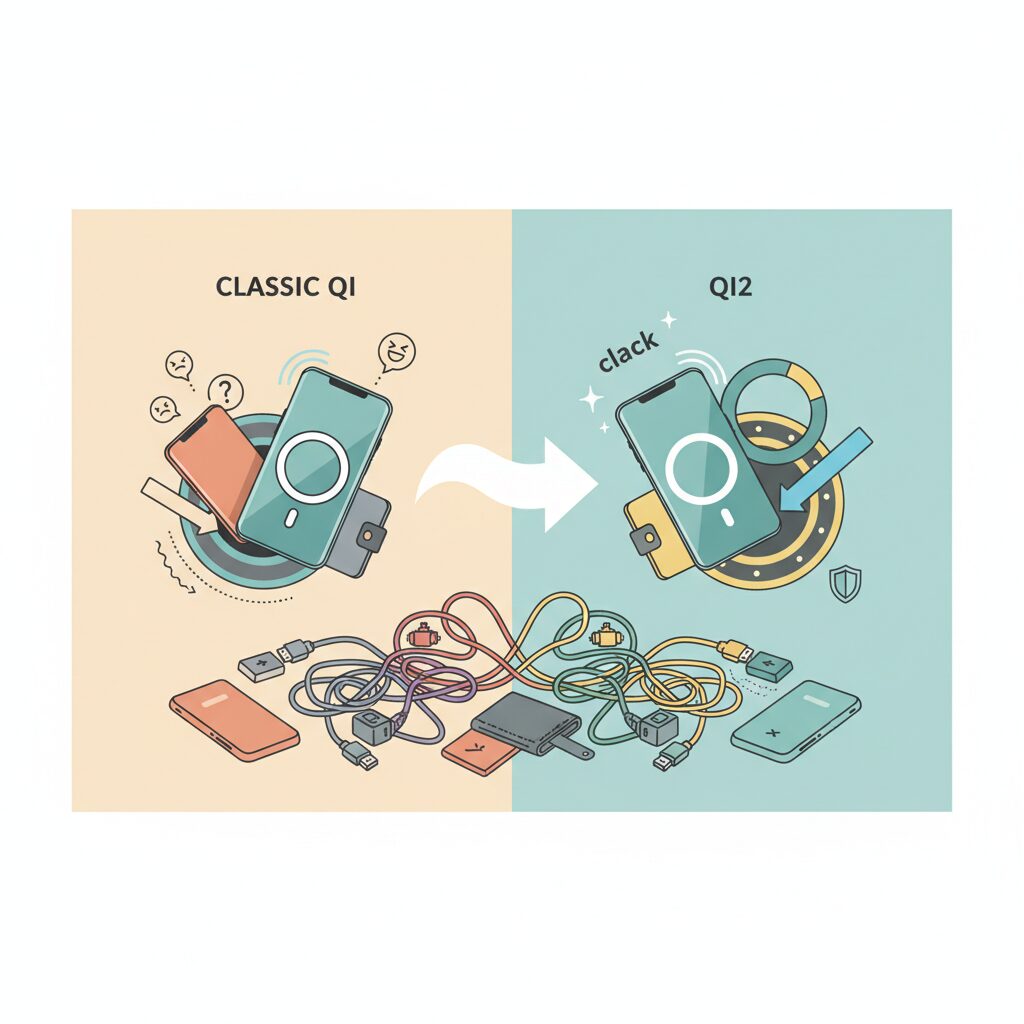
The shift from classic Qi to Qi2 is often described as a simple upgrade, but in reality it represents a structural correction to long‑standing weaknesses in wireless charging. Traditional Qi succeeded in making cable‑free charging mainstream, yet it relied heavily on user precision. Even a few millimeters of coil misalignment could reduce efficiency, increase heat, and slow charging in ways users could feel over time.
Qi2 directly addresses this through the Magnetic Power Profile, which introduces mandatory magnetic alignment as part of the power negotiation process. According to the Wireless Power Consortium, this alignment is not an accessory feature but a core requirement for achieving stable and predictable performance. **By physically locking the transmitter and receiver into the optimal position, Qi2 reduces energy loss before software-level optimizations even begin.**
Another underappreciated improvement is the change in operating frequency. While classic Qi operated across a wide and variable band, Qi2’s MPP standardizes operation around a higher frequency. Testing data published by accredited compliance labs such as Granite River Labs shows that this allows faster handshake communication between charger and device, meaning charging ramps up more quickly and with fewer failed negotiation cycles.
| Aspect | Classic Qi | Qi2 (MPP) |
|---|---|---|
| Alignment method | User-dependent placement | Magnetic forced alignment |
| Handshake stability | Variable | Highly consistent |
| Heat generation risk | Higher under misalignment | Lower due to precision fit |
Safety is another area where Qi2 quietly improves the experience. Precise alignment enhances foreign object detection accuracy, reducing the chance that stray metal causes localized heating. Engineers involved in WPC certification have noted that this mechanical consistency makes thermal behavior more predictable, which in turn allows manufacturers to tune charging curves more aggressively without compromising battery health.
In practical terms, Qi2 does not magically make wireless charging as fast as wired solutions. What it improves is trust. **Users no longer have to wonder whether their phone is charging efficiently or slowly cooking itself on a pad.** That reliability, rather than raw wattage, is the most meaningful upgrade Qi2 brings over classic Qi.
Two Paths in Android: Built-In Magnets vs Case-Based Solutions
As Qi2 rolls out across the Android ecosystem, manufacturers are clearly split between two implementation paths: integrating magnets directly into the phone body or relying on magnet-equipped cases. This choice is not merely cosmetic; it fundamentally shapes charging reliability, accessory compatibility, and long-term ecosystem value.
Native, built-in magnets represent the most seamless interpretation of Qi2’s Magnetic Power Profile. Devices like HMD Skyline demonstrate that when magnets, coils, and firmware are designed together, alignment accuracy improves measurably, reducing thermal loss and stabilizing charging behavior. According to technical briefings from the Wireless Power Consortium, precise magnetic alignment directly enhances foreign object detection accuracy, which in turn lowers unnecessary power throttling during extended charging sessions.
| Approach | User Experience | Trade-offs |
|---|---|---|
| Built-in magnets | Consistent snap-on alignment, case-free use | Design constraints, potential stylus interference |
| Case-based magnets | Flexible adoption across models | Variable alignment, added cost and thickness |
By contrast, the case-based strategy, widely labeled as “Qi2 Ready,” prioritizes hardware flexibility. Samsung and Xiaomi favor this route to preserve thin chassis designs and avoid conflicts with components like EMR digitizers. However, reports summarized by GSMArena and Android Police indicate that charging performance can fluctuate depending on case precision, sometimes falling back to legacy Qi speeds despite Qi2-certified chargers.
Ultimately, built-in magnets favor ecosystem coherence, while case-based solutions favor short-term scalability. For enthusiasts invested in magnetic accessories, this divergence explains why not all Qi2 experiences feel equal, even when the logo on the box suggests otherwise.
Samsung Galaxy S25 and the Meaning of “Qi2 Ready”
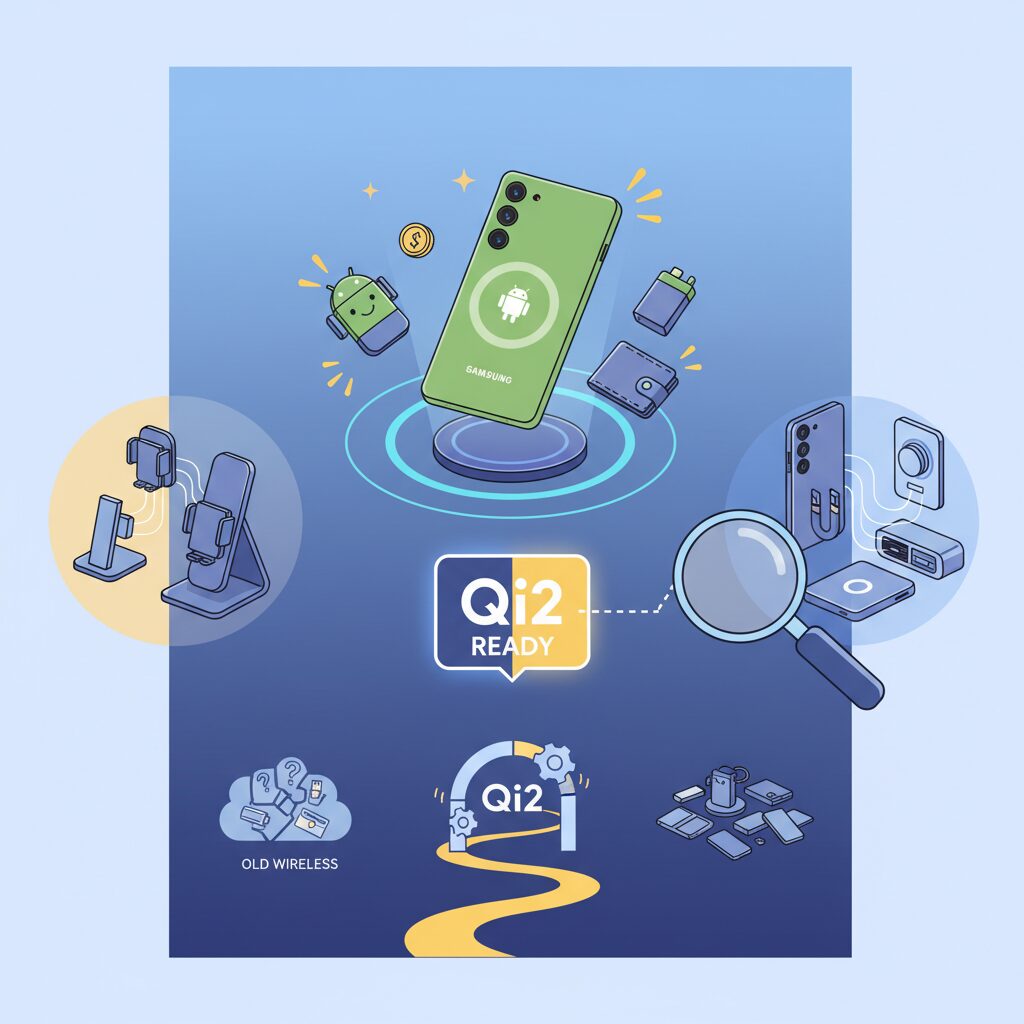
The Galaxy S25 series introduces a carefully chosen phrase: “Qi2 Ready.” At first glance, it sounds like full adoption of the next-generation wireless charging standard, but in practice it represents a more nuanced positioning by Samsung. According to the Wireless Power Consortium, Qi2 certification alone does not mandate integrated magnets, and Samsung has taken advantage of that flexibility.
In concrete terms, the Galaxy S25 supports Qi v2.1 communication and power negotiation, while the magnetic alignment required for Qi2’s Magnetic Power Profile is delegated to external cases. This design choice is not accidental. Industry analysts cited by Android Police note that Samsung prioritized device thinness, internal layout freedom, and avoidance of electromagnetic interference over native magnet integration.
“Qi2 Ready” on the Galaxy S25 means protocol-level compatibility without built-in magnetic hardware, requiring a compatible case to unlock the full experience.
Real-world charging behavior further clarifies this distinction. Independent measurements shared within the Galaxy user community and summarized by GSMArena show that many Qi2-certified third-party chargers deliver only 5W to 7.5W when paired with the S25, despite advertising 15W capability. Samsung’s own wireless chargers, using its proprietary Fast Wireless Charging 2.0 handshake, consistently reach near-maximum output.
| Charger Type | Protocol | Observed Output |
|---|---|---|
| Samsung official charger | Fast Wireless Charging 2.0 | 14–15W |
| Qi2-certified third party | Qi2 MPP | 5–7.5W |
| Legacy Qi charger | Qi BPP | 3–5W |
This gap between specification and experience explains why “Qi2 Ready” has generated mixed reactions among enthusiasts. From Samsung’s perspective, however, it is a strategic compromise. By shifting magnets to cases, the company avoids potential conflicts with components such as the S Pen digitizer, while still signaling future alignment with the Qi2 ecosystem endorsed by the WPC and major accessory brands.
For readers interested in ecosystem longevity rather than immediate convenience, the Galaxy S25’s approach can be understood as a transitional step. It does not redefine wireless charging on its own, but it prepares the hardware and market expectations for a more unified magnetic standard in the Android world.
Real Charging Speeds: Lab Claims vs Everyday Use
On spec sheets, Qi2 and MagSafe-style charging often look straightforward, promising up to 15W with perfect magnetic alignment. In everyday use, however, **real charging speeds frequently fall short of laboratory claims**, especially on current Android devices that advertise Qi2 compatibility without native magnets.
Independent measurements shared by experienced users and engineers indicate that devices such as the Galaxy S25 series rarely sustain the advertised peak output when paired with third‑party Qi2 chargers. According to discussions referencing Wireless Power Consortium certification data and community testing, initial charging may briefly approach higher wattage, only to settle into much lower levels once thermal and protocol limits intervene.
| Charging setup | Advertised output | Observed everyday range |
|---|---|---|
| Samsung official wireless charger | Up to 15W | About 14–15W |
| Qi2-certified third-party charger | Up to 15W | Roughly 5–7.5W |
| Older Qi charger | 5–10W | Around 3–5W |
These gaps are not measurement errors. **Protocol handshakes and vendor-specific charging profiles play a decisive role**. Samsung, for example, prioritizes its own Fast Wireless Charging implementation, which can limit power delivery when the charger does not explicitly support it. Even with correct magnetic alignment via a Qi2-ready case, the phone may default to conservative power levels to avoid instability.
Thermal behavior further widens the lab-to-life gap. Controlled tests are typically conducted in cool environments, while daily charging happens on desks, in cars, or beside beds. Reports show battery temperatures exceeding 40°C within 20–30 minutes, triggering automatic throttling. As battery researchers often note, sustained wireless charging speed is governed less by headline wattage and more by heat dissipation.
The practical takeaway is simple: **Qi2 improves alignment and consistency, but it does not guarantee fast charging on today’s Android hardware**. Users expecting MagSafe-like performance should interpret maximum wattage as a best-case scenario, not a promise, and evaluate chargers based on real-world behavior rather than certification logos alone.
Google Pixel’s Transitional Strategy and What Pixel 10 May Change
Google Pixel’s approach to magnetic wireless charging can best be described as deliberately transitional, and that choice reveals much about Google’s broader hardware philosophy. With the Pixel 9 series, Google stood at the doorstep of Qi2 but stopped short of full adoption, opting instead for compatibility without commitment. This was not a simple omission, but a calculated decision shaped by reliability, ecosystem timing, and cost control.
Multiple reports summarized by Android Authority and Engadget indicate that Pixel 9 relies on legacy Qi EPP behavior even when paired with Qi2-certified chargers. As a result, users often experience fallback to 5W charging or intermittent charging stops when magnetic cases are used. From a user-experience perspective, this inconsistency undermines the promise of Qi2, but from Google’s standpoint, it avoids shipping hardware that cannot yet guarantee predictable behavior across the global accessory market.
Google’s internal reasoning aligns with comments referenced by Japanese tech media, which note that Qi2 offered “no clear end-user advantage” at the time Pixel 9 was finalized. Without native magnets and without full MPP handshake support, adopting Qi2 branding alone would have risked confusing consumers rather than delighting them. This restraint contrasts sharply with competitors that embraced “Qi2 Ready” messaging despite similar limitations.
| Model | Magnet Integration | Qi2 MPP Support | User Experience Outcome |
|---|---|---|---|
| Pixel 9 / 9 Pro | No | No | Stable Qi charging, inconsistent magnetic use |
| Pixel 10 (expected) | Yes | Yes | Consistent magnetic alignment and charging |
This cautious stance, however, appears to be reaching its limit. Leaked imagery and supply-chain reporting highlighted by Engadget strongly suggest that Pixel 10 will integrate magnets directly into the chassis, enabling native Qi2 Magnetic Power Profile support. If accurate, this would mark a strategic pivot from defensive compatibility to proactive ecosystem leadership within Android.
The implications extend beyond charging speed. Native magnetic alignment improves thermal predictability, reduces coil misalignment losses, and unlocks a broader class of accessories such as wallets, camera grips, and vehicle mounts without reliance on third-party cases. According to Wireless Power Consortium documentation, MPP-certified devices also benefit from faster authentication handshakes, which minimizes start-stop charging behavior that Pixel 9 users have frequently reported.
Equally important is Google’s influence over the Android ecosystem. Pixel devices often act as reference hardware for accessory makers, and the absence of a true magnetic baseline has slowed Qi2 accessory optimization on Android. A fully Qi2-native Pixel 10 would likely serve as the de facto development target, accelerating accessory quality in a way that fragmented “case-dependent” strategies have not.
From a marketing perspective, this transition also simplifies the message. Rather than asking consumers to understand nuanced distinctions between Qi, Qi2, and “Qi2 Ready,” Google can present a single, tangible benefit: magnets that just work. Analysts quoted in Android Police argue that clarity, not peak wattage, will be the decisive factor for mainstream adoption of magnetic charging on Android.
In this light, Pixel 9’s limitations appear less like a failure and more like a holding pattern. Google chose to wait until the technology, certification process, and accessory landscape matured enough to support a coherent experience. Pixel 10 is therefore poised not merely as an upgrade, but as a reset—transforming Pixel from a cautious follower into a standard-setter for Qi2 on Android.
Why Some Android Brands Resist Qi2 Despite Its Momentum
Despite the growing momentum behind Qi2, several major Android brands have been cautious about fully embracing it, and this hesitation is rooted in practical engineering and business realities rather than simple resistance to standards. **Qi2 promises alignment, efficiency, and ecosystem clarity, but it also introduces trade-offs that not every manufacturer is ready to accept**.
One of the most significant barriers is hardware interference. Samsung’s decision to avoid native magnets in its Galaxy S25 series is widely understood, and industry engineers cited by the Wireless Power Consortium have pointed to electromagnetic interference risks with components like EMR-based stylus systems. In devices that rely on precise digitizer accuracy, even a small magnetic field can degrade user experience, which explains why some brands prefer a case-based approach instead.
Cost and design constraints also play a decisive role. Integrating a magnetic array requires internal space, tighter tolerances, and additional shielding. According to analysis published by GSMArena, this can conflict with priorities such as thinner profiles, larger camera modules, or region-specific features like NFC and FeliCa. **For brands selling globally, a one-size-fits-all Qi2 design is not always commercially rational**.
| Concern | Impact on Adoption | Typical Brand Response |
|---|---|---|
| Magnetic interference | Stylus or NFC instability | Case-dependent Qi2 support |
| Charging speed limits | Seen as inferior to 50W+ proprietary systems | Delay or partial adoption |
| Internal space & cost | Thicker devices or higher BOM | Selective market rollout |
Another often overlooked factor is differentiation. Chinese manufacturers such as Xiaomi and OnePlus have invested heavily in ultra-fast proprietary wireless charging. From their perspective, adopting a 15W Qi2 baseline could dilute a key marketing advantage. Analysts at Android Police have noted that, until Qi2 evolves beyond this ceiling, these brands have limited incentive to switch.
Ultimately, resistance to Qi2 is less about rejecting progress and more about timing. **Many Android brands appear to be waiting for higher power profiles and clearer ecosystem returns before committing fully**, choosing flexibility today over uniformity tomorrow.
Accessory Ecosystems: Cases, Power Banks, and Car Mounts
The real impact of magnetic charging on Android is most clearly felt in accessories, where cases, power banks, and car mounts form a tightly linked ecosystem rather than isolated add-ons.
Unlike the early Qi era, where accessories merely enabled charging, Qi2-based magnetic designs actively shape daily usage patterns by stabilizing alignment and expanding modular use.
This shift turns accessories into functional extensions of the device rather than optional extras.
Cases are the foundation of this ecosystem, especially for Qi2 Ready smartphones that lack built-in magnets.
Manufacturers such as TORRAS and Spigen design magnet arrays directly into the case shell, optimizing coil alignment and holding force.
Independent durability tests referenced by SGS and similar certification bodies show that integrated magnetic cases outperform adhesive rings in both drop resistance and alignment consistency.
| Case Type | Magnet Integration | Practical Advantage |
|---|---|---|
| Integrated Qi2 Case | Molded magnet ring | Stable charging and mounting |
| Adhesive Ring | External metal ring | Low cost, higher misalignment risk |
In Japan, case design faces an added constraint: coexistence with FeliCa.
Accessory makers like Elecom explicitly acknowledge this challenge, adjusting magnet placement or shielding to reduce NFC interference.
This localization effort highlights how accessory ecosystems evolve differently by market, not just by platform.
Magnetic power banks represent the most convenience-driven category, yet they also expose the technical limits of wireless efficiency.
Testing discussed by Wireless Power Consortium contributors indicates that Qi2 magnetic alignment improves consistency but does not eliminate conversion loss.
Real-world measurements commonly show only 40 to 50 percent of stored capacity reaching the phone battery.
Brands like Anker and Belkin position magnetic power banks as situational tools rather than full replacements for wired charging.
This framing aligns with expert commentary from power electronics researchers, who note that thermal constraints remain the dominant bottleneck.
Magnetic power banks excel at stability and usability, not raw energy transfer.
Car mounts complete the ecosystem by combining magnetic fixation with charging and thermal management.
In high-temperature environments, especially summer driving in Japan, heat buildup can rapidly throttle charging speeds.
Spigen’s CryoMax series addresses this by integrating active cooling, a design choice supported by lab data showing sustained output under load.
According to evaluations referenced by automotive accessory engineers, magnetic mounts reduce vibration-induced misalignment compared with clamp-based designs.
This directly improves charging reliability and lowers connector wear, a long-term durability benefit often overlooked.
The car mount becomes both a charger and a thermal control device.
Taken together, cases, power banks, and car mounts illustrate how Qi2 pushes Android accessories toward system-level thinking.
Each component influences the performance of the others, making brand compatibility and design precision more important than ever.
This interdependence marks a decisive break from the fragmented Qi accessory landscape of the past.
Heat, Efficiency, and Battery Health in Magnetic Charging
Heat is the single most important factor that links magnetic wireless charging to efficiency and long-term battery health, and this point is often underestimated. Even with Qi2’s Magnetic Power Profile, which improves coil alignment and reduces energy loss, wireless charging still converts a meaningful portion of input power into heat rather than stored energy.
According to testing methodologies commonly referenced by the Wireless Power Consortium and independent labs such as Granite River Labs, a misalignment of just a few millimeters can increase resistive loss and eddy currents, raising device temperature by several degrees Celsius. **Magnetic alignment minimizes this risk, but it does not eliminate it**, especially when thick cases or metal rings are involved.
| Charging Method | Typical Efficiency | Thermal Impact | Battery Stress |
|---|---|---|---|
| Wired USB-C | 85–90% | Low | Minimal |
| Qi (non-magnetic) | 60–70% | Moderate to High | Noticeable |
| Qi2 Magnetic | 70–80% | Moderate | Reduced but present |
From a battery chemistry perspective, lithium-ion cells degrade fastest when exposed to sustained temperatures above roughly 40°C. Field reports and community measurements on Qi2-ready Android devices show that temperatures can approach this threshold within 20 to 30 minutes when charging at 15W without active cooling. **Once this happens, thermal throttling reduces charging speed, negating the very benefit of fast wireless charging**.
Apple has publicly stated in its battery health documentation that heat is the primary driver of long-term capacity loss, and the same physics applies across Android devices. Magnetic charging improves consistency, but users who rely on it daily, especially overnight or in warm environments, may see accelerated battery aging compared to slow wired charging.
For users who value battery longevity, the practical takeaway is balance. Magnetic charging excels at convenience and alignment efficiency, but **reserving it for desk use, short top-ups, or actively cooled mounts helps preserve battery health**. Treating Qi2 as a complement rather than a replacement for wired charging leads to the best real-world outcome.
The Road Ahead: Qi2.2, 25W Wireless Power, and Market Adoption
The next phase of magnetic wireless charging is already taking shape, and it centers on Qi2.2 and its promise of up to 25W of wireless power. According to the Wireless Power Consortium, Qi2.2 is not a cosmetic revision but a substantial upgrade that tightens thermal control requirements while extending the Magnetic Power Profile concept introduced with Qi2.
This matters because higher wattage without standardized heat management would simply recreate the inefficiencies that early Qi suffered from. Industry briefings from WPC members emphasize that Qi2.2 certification will place stronger emphasis on sustained power delivery rather than peak figures, a point echoed by Belkin’s technical documentation for its upcoming 25W chargers.
| Specification | Qi2 | Qi2.2 |
|---|---|---|
| Max wireless power | 15W | 25W |
| Magnetic alignment | MPP mandatory | Enhanced MPP |
| Thermal requirements | Baseline | Stricter, sustained-load focused |
From a market perspective, adoption will likely be uneven. Accessory makers are moving faster than smartphone OEMs, because chargers, car mounts, and power banks can absorb added cooling hardware more easily. Analysts cited by GSMArena note that smartphones face tighter constraints around thickness, camera modules, and regional features such as NFC and FeliCa.
The result is a short-term asymmetry: Qi2.2-ready accessories may arrive before a critical mass of fully compatible phones. Over time, however, regulatory pressure toward standardization and consumer fatigue with fragmented “fast wireless” branding are expected to push major Android vendors toward native support, turning 25W magnetic charging from a niche advantage into a baseline expectation.
参考文献
- Granite River Labs:Evolution of Qi Wireless Charging Standard & What’s New With Qi2
- Android Police:Qi2 Ready is causing more problems than it solves
- Engadget:Google’s Pixel 10 may get magnetic Qi2 charging after all
- GSMArena:Be warned: some Qi2 devices don’t have magnets and it can be hard to tell
- Belkin:Qi2 Compatibility with MagSafe & Older Qi Chargers
- Wireless Power Consortium:Qi Wireless Charging Standards