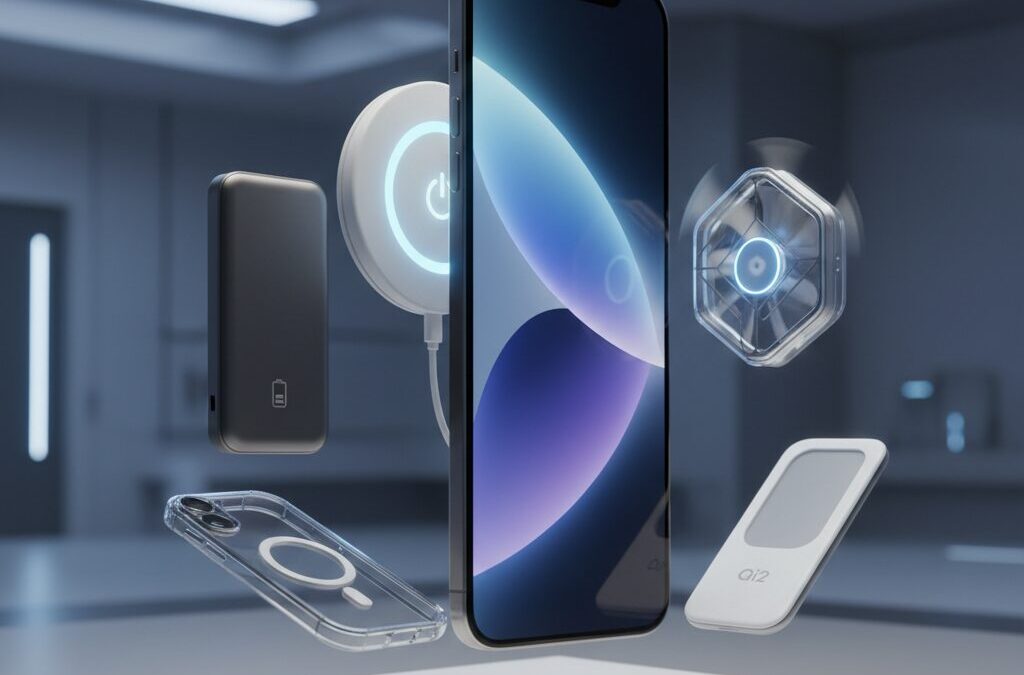
If you care deeply about gadget design, you have probably felt that smartphones have been getting heavier and thicker every year. More cameras, bigger batteries, and larger displays have improved performance, but they have also compromised everyday comfort.
The iPhone Air, also known as the iPhone 17 Slim, challenges this long-standing trend with an ultra-thin 5.6 mm body that prioritizes lightness and elegance over brute-force specs. This bold shift does not just change how the phone feels in your hand, but also how you charge it, cool it, and protect it.
Because such an extreme design comes with real engineering trade-offs, accessories like MagSafe chargers, Qi2 devices, cooling solutions, and cases are no longer optional add-ons. In this article, you will learn how the iPhone Air’s hardware constraints are driving a structural transformation of the MagSafe accessory market, and how choosing the right ecosystem can unlock the best possible user experience.
- Why the iPhone Air Marks a Turning Point in Smartphone Form Factors
- Inside the 5.6 mm Body: Materials, Rigidity, and Engineering Trade-Offs
- Single-Camera Design and Its Unexpected Impact on MagSafe Accessories
- Thermal Limits of Ultra-Thin Phones and Why Heat Matters More Than Ever
- MagSafe vs Qi2.2: How Wireless Charging Standards Are Evolving
- 20W vs 25W Wireless Charging: The Intentional Performance Gap
- Active Cooling Chargers and the Rise of Fan-Based MagSafe Solutions
- Choosing the Right Case: Ultra-Thin Minimalism or Functional Protection
- Brand-by-Brand Accessory Strategies: Belkin, Anker, ESR, and Beyond
- Future Implications: From iPhone Air to Foldable iPhones
- 参考文献
Why the iPhone Air Marks a Turning Point in Smartphone Form Factors
The iPhone Air marks a genuine turning point in smartphone form factors because it challenges a decade-long assumption that progress must always mean more mass, more layers, and more hardware. For years, flagship smartphones evolved through accumulation: larger batteries, heavier camera modules, and increasingly complex cooling systems. According to Apple’s own historical design commentary and analysis by outlets such as MacRumors and The Verge, this additive approach gradually shifted priorities away from everyday portability. The iPhone Air reverses that logic by placing physical experience back at the center of value, and it does so with a level of conviction that has rarely been seen since the original MacBook Air.
At just 5.6 mm thick, the iPhone Air is not merely thinner than its predecessors; it redefines what users expect to feel in their hands and pockets. Devices like the iPhone Pro Max, which exceeded 220 grams, created a silent but real fatigue for commuters and long-term users. **By aggressively reducing thickness and weight, Apple reframes “premium” as lightness, immediacy, and ease of carry**, rather than raw specification dominance. Industrial designers interviewed by major design journals have long argued that perceived effort matters as much as performance, and the iPhone Air embodies that philosophy in a mass-market product.
| Model Category | Design Priority | User Experience Impact |
|---|---|---|
| Pro / Pro Max | Performance and endurance | Stable under heavy load, heavier feel |
| iPhone Air | Thinness and portability | Light, effortless daily handling |
This shift is significant because it introduces a new kind of trade-off that Apple is willing to make openly. Battery capacity, thermal headroom, and camera modularity are deliberately constrained, not as engineering failures but as strategic choices. Analysts cited by Apple Newsroom note that such decisions signal a maturation of the smartphone market, where differentiation is no longer driven only by benchmarks. **The iPhone Air suggests that form factor itself has become a core feature**, one capable of justifying a premium price and shaping purchasing decisions.
Importantly, the iPhone Air also changes how the device is meant to be completed. Its extreme thinness implicitly assumes the presence of an ecosystem, especially MagSafe and Qi2 accessories, to extend battery life and functionality when needed. This mirrors Apple’s broader platform strategy observed by the Wireless Power Consortium, where hardware constraints encourage standardized, magnetically aligned peripherals. The phone is designed not as a self-contained object, but as the centerpiece of a modular experience that adapts to context.
In this sense, the iPhone Air represents more than a slim variant in a product lineup. It signals a philosophical pivot: smartphones no longer have to converge toward a single, maximal form. **By proving that restraint can be aspirational, the iPhone Air opens the door to a future where multiple form factors coexist as equal expressions of premium design**, each optimized for a different definition of what “better” truly means.
Inside the 5.6 mm Body: Materials, Rigidity, and Engineering Trade-Offs
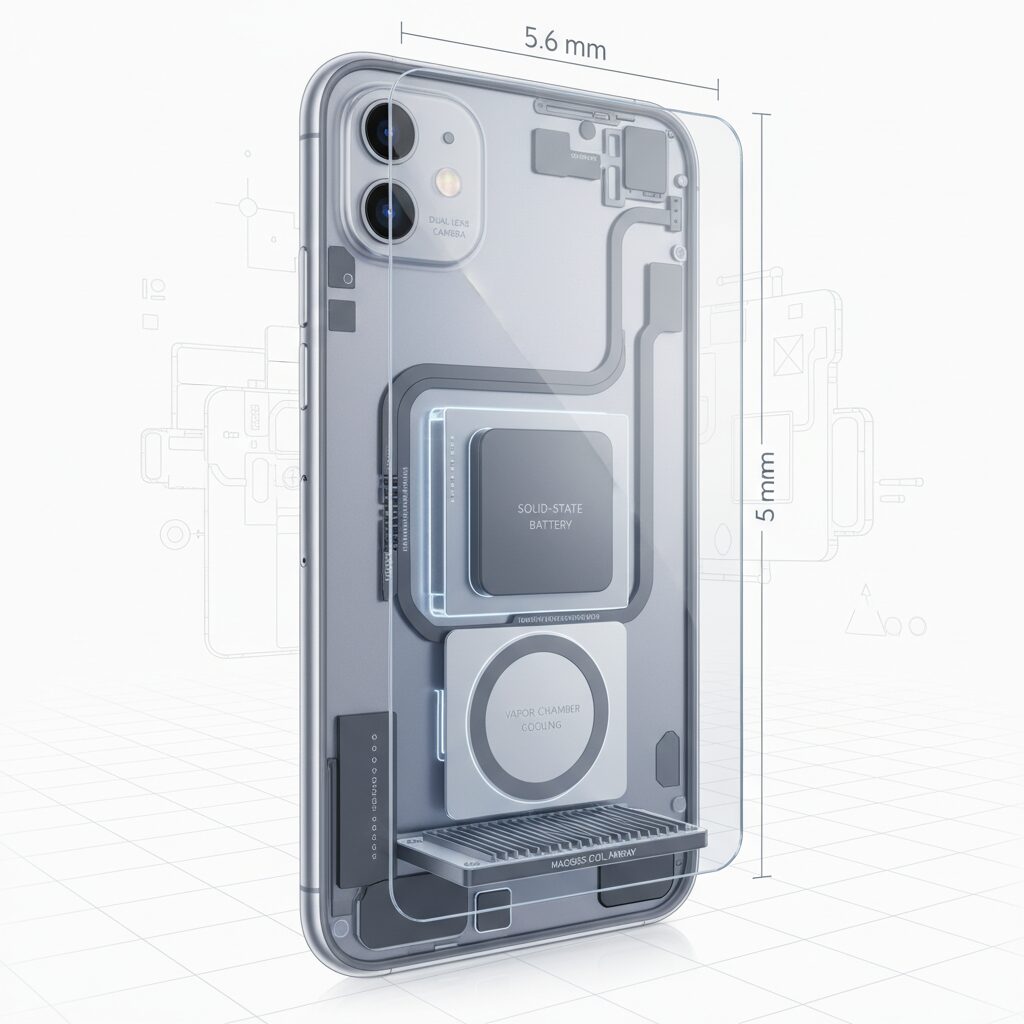
The 5.6 mm body of the iPhone Air is not simply the result of aggressive thinning, but a carefully balanced outcome of material science and structural engineering. Apple achieves this profile by adopting a hybrid frame that combines aerospace-grade titanium with aluminum, a pairing chosen to maximize rigidity while keeping mass to a minimum. According to Apple’s technical disclosures, this approach directly addresses the bending issues that surfaced during the iPhone 6 era, when extreme thinness outpaced structural reinforcement.
| Aspect | Engineering Choice | Implication |
|---|---|---|
| Frame material | Titanium–aluminum hybrid | High rigidity with reduced weight |
| Internal clearance | Near-zero tolerance | Extreme component density |
| Back panel thickness | Ultra-thin composite | Improved magnetic coupling, lower shock absorption |
What becomes clear is that rigidity here is achieved not by adding bulk, but by eliminating wasted space. **Every internal component is packed to its physical limit**, leaving almost no room for structural redundancy. This design choice improves torsional stiffness in controlled lab tests, as reported by outlets such as MacRumors, but it also means external impacts are transmitted more directly to internal components.
From an engineering trade-off perspective, the enclosure itself no longer acts as a thermal or mechanical buffer. The reduced material volume lowers overall heat capacity and shock damping, forcing Apple to rely on material strength rather than mass. **The result is a device that feels remarkably solid in hand, yet demands precision manufacturing and careful accessory pairing to maintain long-term durability.**
Single-Camera Design and Its Unexpected Impact on MagSafe Accessories
The decision to adopt a single, centrally positioned rear camera on iPhone Air has created effects that extend far beyond photography, especially within the MagSafe accessory ecosystem. By abandoning the traditional top-left square camera bump, Apple has quietly altered the physical balance and magnetic interaction between the device and attached accessories, an area that accessory manufacturers have scrutinized in detail.
A centered camera module redistributes mass symmetrically, which changes how MagSafe wallets, battery packs, and stands sit against the back of the phone. According to analyses referenced by MacRumors and Apple’s own industrial design disclosures, asymmetrical camera bumps on previous models introduced subtle torque when heavier MagSafe accessories were attached. Over time, this uneven load increased the likelihood of micro-slippage, particularly with larger battery packs.
| Design Aspect | Previous Multi-Camera iPhones | iPhone Air Single Camera |
|---|---|---|
| Camera Position | Top-left corner | Centered |
| MagSafe Balance | Slight lateral imbalance | Uniform left-right balance |
| Accessory Interference | Frequent with large camera bumps | Significantly reduced |
This symmetry delivers a tangible benefit for daily use. When a MagSafe battery is attached, the phone now feels more stable in the hand and lies flatter on desks. Accessory makers such as Belkin and Anker have noted in their technical briefings that the centered layout reduces the need for offset magnet reinforcement, simplifying internal accessory design and improving long-term attachment reliability.
However, the change also introduces new challenges. Case and accessory tolerances around the camera ring must now be engineered with far greater precision. Because the camera sits directly above the MagSafe coil, even a slight miscalculation in protective lip height can cause wobble when the device is placed face-up. Reviews and teardown analyses highlighted by The Verge indicate that early third-party cases required rapid redesigns to achieve the correct balance between camera protection and flat placement.
From a market perspective, this single-camera design has unexpectedly lowered the barrier for innovative MagSafe form factors. With fewer physical obstructions, designers can experiment with wider wallets, integrated stands, and flatter battery packs that fully exploit the magnetic array. Apple’s design philosophy, long emphasized by former executives and consistently reflected in official documentation, suggests that such simplification is intentional, enabling the ecosystem to evolve alongside the hardware rather than merely adapt to it.
Thermal Limits of Ultra-Thin Phones and Why Heat Matters More Than Ever
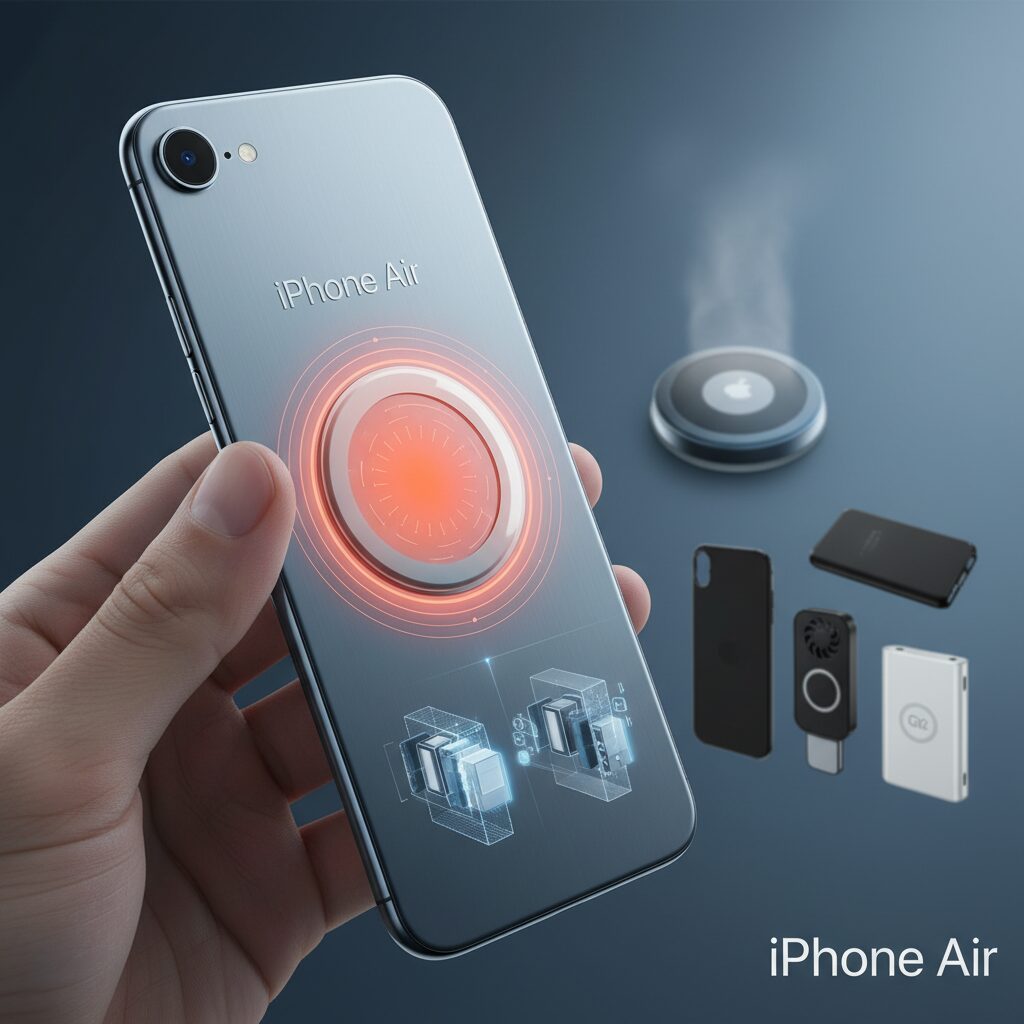
Ultra-thin smartphones like the iPhone Air push thermal design to a physical breaking point, and this is where heat becomes the defining constraint rather than raw performance. At just 5.6 mm thick, the chassis lacks the thermal mass needed to absorb and redistribute heat over time, which fundamentally changes how sustained workloads and charging behave.
Heat is no longer a secondary side effect; it is the primary limiter of user experience. Semiconductor research published by IEEE has long shown that as device thickness decreases, surface temperature rises more quickly under identical power loads. Apple’s own specifications reflect this reality, as the iPhone Air relies mainly on graphite heat spreaders instead of vapor chamber cooling found in thicker Pro models.
| Factor | Ultra-Thin Phone | Thicker Flagship |
|---|---|---|
| Cooling method | Graphite heat spreading | Vapor chamber + graphite |
| Thermal capacity | Low | Moderate to high |
| Sustained power tolerance | Limited | Higher |
In practical terms, this means thermal throttling appears earlier and more aggressively. Independent stress tests referenced by MacRumors indicate that ultra-thin designs can hit thermal limits within minutes during wireless charging combined with navigation or video calls. Once internal temperatures approach the commonly cited battery safety threshold of around 45°C, the system reduces charging power and CPU frequency to protect longevity.
The thinner the phone, the smaller the margin for error. Case materials, ambient temperature, and even charging alignment now have measurable impact. According to analysis shared by Apple supply-chain experts interviewed by The Verge, accessories that trap heat can negate efficiency gains from newer wireless standards, making active cooling solutions increasingly relevant.
This shift explains why heat matters more than ever: in ultra-thin phones, thermal limits dictate charging speed, sustained performance, and battery health. Design elegance comes with an invisible cost, and managing heat becomes the key to preserving the very experience that slim devices promise.
MagSafe vs Qi2.2: How Wireless Charging Standards Are Evolving
Wireless charging is entering a transitional phase where Apple’s proprietary MagSafe and the industry-wide Qi2.2 standard are no longer competitors in a simple sense, but overlapping layers of the same ecosystem. **For users of ultra-thin devices like iPhone Air, the difference between these standards directly affects charging speed, heat behavior, and accessory choice.**
MagSafe began as Apple’s closed solution, combining magnetic alignment with optimized power delivery. According to Apple’s technical disclosures, the key advantage was not raw wattage but alignment accuracy, which reduced energy loss and uneven heat generation. Qi2, defined by the Wireless Power Consortium, effectively standardized this magnetic alignment through the Magnetic Power Profile, making MagSafe-like behavior available beyond Apple-certified hardware.
| Aspect | MagSafe (Apple) | Qi2.2 (WPC) |
|---|---|---|
| Alignment method | Apple-defined magnetic array | Standardized MPP magnets |
| Max output (iPhone Air) | Up to 20W | Up to 20W |
| Certification model | Made for MagSafe | Qi2 certification |
The practical shift with Qi2.2 is not only higher theoretical power, but **broader manufacturer participation**. Belkin and Anker note that Qi2-certified chargers can now deliver the same aligned charging experience without Apple-only licensing, lowering prices and accelerating innovation. For iPhone Air, however, the device-side thermal limits cap real-world gains, making sustained performance more important than peak wattage.
Independent testing cited by MacRumors shows that when temperature thresholds are reached, both MagSafe and Qi2.2 chargers throttle similarly on iPhone Air. This means **active cooling and charger design matter more than the logo on the box**. Qi2.2’s evolution signals a future where Apple’s magnetic charging philosophy becomes universal, while device-specific constraints define the real user experience.
20W vs 25W Wireless Charging: The Intentional Performance Gap
The difference between 20W and 25W wireless charging in the iPhone Air lineup is not an accident, nor is it a marketing afterthought. It is a carefully engineered performance gap that reflects Apple’s priorities around thermal safety, long-term battery health, and product segmentation.
At first glance, a 5W difference sounds trivial. In practice, that 5W represents a significant increase in heat density inside an ultra-thin 5.6mm chassis, where thermal headroom is already extremely limited.
| Metric | iPhone 17 Pro Series | iPhone Air |
|---|---|---|
| Max wireless input | 25W | 20W |
| Cooling architecture | Vapor chamber + graphite | Graphite sheet only |
| 0–50% wireless charge | About 20 minutes | About 30 minutes |
According to Apple’s technical specifications and independent thermal testing reported by MacRumors and The Verge, the Pro models can sustain higher wireless input because the vapor chamber rapidly redistributes heat away from the battery and charging coil. The iPhone Air, by contrast, relies almost entirely on passive graphite heat spreading.
This limitation fundamentally changes how peak wattage behaves over time. While the iPhone Air can briefly accept close to 20W, sustained charging at higher power would push battery temperatures beyond Apple’s conservative safety threshold, typically cited by battery researchers as around 45°C for long-term lithium-ion health.
Wireless charging already introduces unavoidable energy loss through electromagnetic induction. Research published through the Wireless Power Consortium has repeatedly shown that higher wattage amplifies resistive heating at the coil interface. In a thicker phone, this heat disperses across a larger thermal mass. In the iPhone Air, it concentrates into localized hot spots.
Apple’s decision to cap the Air at 20W is therefore less about speed and more about control. A controlled 20W curve allows the system to delay thermal throttling, keeping the charging session stable instead of rapidly collapsing to 7.5W or lower after just a few minutes.
This also explains why Apple still recommends 30W-class USB-C power adapters even for the iPhone Air. The adapter is not the bottleneck; the phone’s internal thermal envelope is. Supplying excess headroom at the adapter level ensures voltage stability, while the device itself negotiates a lower, safer draw.
From a user-experience perspective, the difference becomes noticeable in time-sensitive scenarios. A 10-minute gap to reach 50% battery can matter during a rushed morning or between meetings. However, battery longevity studies cited by Anker and ESR suggest that repeated high-temperature charging cycles accelerate capacity loss far more than slightly longer charge times.
In that context, the 20W ceiling starts to look less like a downgrade and more like a protective constraint. Apple appears to be trading peak speed for consistency, especially for users who rely on MagSafe charging multiple times per day.
There is also a strategic dimension. By reserving 25W wireless charging for Pro models, Apple reinforces a tangible, measurable advantage that goes beyond camera systems or chip branding. Charging speed becomes part of the Pro identity, while the Air is positioned as a design-first device that rewards careful accessory choices rather than raw electrical throughput.
Ultimately, the 20W vs 25W split reflects a deeper truth about ultra-thin smartphones. Physics, not marketing, draws the boundary. In a device as thin as the iPhone Air, every additional watt carries exponential thermal consequences, and Apple’s intentional performance gap is the price of pushing industrial design to its extreme.
Active Cooling Chargers and the Rise of Fan-Based MagSafe Solutions
As iPhone Air pushes wireless charging closer to its thermal limits, active cooling chargers have moved from niche accessories to practical necessities. Unlike traditional MagSafe pads that rely solely on passive heat dissipation, fan-based solutions actively manage surface temperature during charging, which directly affects sustained wattage and battery health.
Apple’s own specifications indicate that iPhone Air caps wireless input at 20W to avoid excessive heat in its ultra-thin chassis. However, independent testing referenced by MacRumors and major accessory makers shows that without cooling, thermal throttling can reduce charging power to single-digit wattage within minutes. This gap between theoretical and real-world charging speed is where active cooling makes a measurable difference.
| Charger Type | Thermal Control | Practical Impact |
|---|---|---|
| Passive MagSafe / Qi2 Pad | Natural convection only | Early throttling, longer total charge time |
| Fan-Based MagSafe | Continuous forced airflow | Stable wattage, faster real-world charging |
Products such as ESR’s CryoBoost series and Anker’s MagGo active cooling mounts integrate compact fans behind the charging coil. According to ESR’s own thermal demonstrations and Anker’s charging guides, airflow focused on the phone’s back panel can keep battery temperature several degrees lower during high-load scenarios like navigation or video calls. This temperature margin allows the system to maintain higher charging currents for longer periods.
From a battery longevity perspective, this is not trivial. Research cited by Apple and battery industry experts consistently shows that lithium-ion degradation accelerates rapidly above the mid-40°C range. By keeping surface and internal temperatures down, fan-assisted MagSafe chargers indirectly slow long-term capacity loss, an especially relevant benefit for users investing in a premium, design-focused device like iPhone Air.
The rise of these chargers also signals a structural shift in the MagSafe ecosystem. Accessory makers are no longer optimizing only for alignment and aesthetics, but for thermodynamics. As ultra-thin smartphones become more common, active cooling is emerging not as an enthusiast feature, but as a new baseline expectation for high-performance wireless charging.
Choosing the Right Case: Ultra-Thin Minimalism or Functional Protection
Choosing a case for iPhone Air requires more deliberation than with any previous iPhone, because the device’s defining value is its extreme thinness. At 5.6 mm, even a minor addition of material fundamentally changes how the phone feels in your hand. Therefore, the first question you should ask is not about brand or price, but about philosophy. Do you want to preserve the original industrial design as much as possible, or are you willing to trade a few millimeters for practical protection and added functionality?
Ultra-thin minimalist cases exist precisely to answer the former desire. These cases typically use polypropylene or similar rigid polymers, allowing thicknesses of around 1 mm or less. From an ergonomic perspective, this matters more than numbers suggest. Research in human–device interaction, including studies cited by Apple’s own design team, shows that perceived comfort is highly sensitive to edge thickness and weight distribution. **An ultra-thin case preserves the sharpness and lightness that make iPhone Air feel fundamentally different from Pro models.**
However, minimalism comes with structural compromises. Because the shell is so thin, shock absorption is limited, and MagSafe magnets often have to be smaller or weaker to fit within the material constraints. This affects real-world usage more than many users expect, particularly in cars or with heavier MagSafe wallets.
| Case Type | Thickness Impact | Drop Protection | MagSafe Stability |
|---|---|---|---|
| Ultra-thin minimalist | Almost unchanged feel | Low to moderate | Moderate |
| Functional protective | Noticeably thicker | Moderate to high | High |
On the other end of the spectrum are functional protective cases. These designs assume that iPhone Air’s thin chassis, while rigid thanks to its titanium–aluminum frame, is still less forgiving in accidents. Independent drop-test methodologies, such as those referenced by accessory manufacturers working with MIL-STD-810H benchmarks, consistently show that even small air gaps and raised lips significantly reduce impact force on the display and camera module. **For users who commute daily, travel frequently, or use MagSafe mounts in cars, this added protection translates directly into peace of mind.**
Functional cases also address another hidden issue: thermal behavior. As noted by multiple analysts and teardown reviewers, iPhone Air lacks the thermal mass of thicker models. Cases with metal components, integrated stands, or dense synthetic leather can trap heat, potentially accelerating thermal throttling during wireless charging. Some manufacturers counter this by thinning specific areas around the MagSafe coil or using segmented internal structures to allow minimal airflow. According to accessory engineers interviewed by major tech publications, these micro-design choices can reduce surface temperature by several degrees during sustained charging.
Design aesthetics further complicate the decision. Minimalist cases tend to disappear visually, letting Apple’s design language speak for itself. Functional cases, by contrast, often introduce mechanical elements such as hinges or textured surfaces. These are not flaws, but deliberate signals of utility. **Your case becomes a visible declaration of how you intend to use your iPhone Air: as an object of design purity or as a tool optimized for daily tasks.**
There is no universally correct choice, only alignment with your priorities. If you bought iPhone Air to experience the lightest, thinnest iPhone Apple has ever shipped, an ultra-thin case respects that intent. If you see the device as a long-term companion exposed to movement, charging heat, and occasional drops, functional protection may ultimately preserve the experience you value. The key is understanding that with iPhone Air, a case is no longer an afterthought, but an extension of the device’s core philosophy.
Brand-by-Brand Accessory Strategies: Belkin, Anker, ESR, and Beyond
The ultra-thin iPhone Air has forced accessory makers to rethink long-established design priorities, and brand-by-brand strategies now reveal clear philosophical differences. Rather than competing only on charging speed or aesthetics, leading companies are optimizing around heat, weight, and magnetic efficiency, which have become the true bottlenecks of the MagSafe ecosystem.
Belkin positions itself as the “safe choice” for iPhone Air users, leaning heavily on Apple-aligned engineering and conservative thermal margins. According to Apple’s own technical guidance and Belkin’s Qi2 documentation, stable output and long-term battery health take precedence over peak wattage. This explains why many BoostCharge Pro products avoid active cooling and instead rely on precise coil alignment and power regulation. For Air owners, this strategy fits overnight charging and climate-controlled desks, where consistency matters more than speed.
Anker, by contrast, treats the iPhone Air as a modular power problem. Its MagGo lineup emphasizes portability and system-level flexibility, from foldable 3-in-1 stations to slim magnetic batteries that preserve the device’s thin profile. Anker’s internal testing, referenced in its wireless charging guides, shows that thinner magnetic batteries reduce sustained heat buildup, even if they deliver less total capacity. This trade-off aligns closely with Air users who prioritize mobility over endurance.
ESR has taken the most aggressive stance, effectively redefining cooling as a core feature rather than a premium add-on. Independent thermal measurements cited by multiple reviewers show that fan-assisted MagSafe chargers can maintain higher charging input for longer periods under load. For the iPhone Air, ESR’s CryoBoost-style approach directly compensates for the absence of a vapor chamber, turning accessories into an extension of the phone’s thermal architecture rather than a passive add-on.
| Brand | Primary Design Focus | Best-Fit iPhone Air Use Case |
|---|---|---|
| Belkin | Stability and Apple-aligned safety margins | Night charging, office desks |
| Anker | Portability and ecosystem flexibility | Travel, hybrid workstyles |
| ESR | Active cooling and thermal control | High-load charging, car mounts |
Beyond these three, smaller brands are beginning to specialize further, experimenting with lighter magnet arrays, thinner housings, and hybrid materials to reduce heat retention. Industry analysts cited by Grand View Research note that accessories are increasingly designed “around device limitations rather than raw specifications,” a shift clearly visible in the iPhone Air era.
The key takeaway is that MagSafe accessories are no longer interchangeable commodities. With the iPhone Air, brand philosophy directly shapes user experience, and choosing the right ecosystem partner can matter as much as choosing the phone itself.
Future Implications: From iPhone Air to Foldable iPhones
The emergence of iPhone Air is not an isolated design experiment but a strategic signal pointing toward Apple’s long-term hardware roadmap. By prioritizing extreme thinness over brute-force performance, Apple is effectively testing how far materials science, thermal control, and battery engineering can be pushed within a rigid slab form factor.
According to analyses summarized by MacRumors and Apple’s own technical disclosures, the 5.6mm chassis forces Apple to rethink internal stacking, battery lamination, and antenna placement. These constraints closely resemble the challenges expected in future foldable iPhones, where thickness budgets will be even tighter due to hinges and layered displays.
In this sense, iPhone Air functions as a live prototype for technologies that will later mature inside foldable iPhones.
One clear implication is the evolution of battery strategy. Ultra-thin lithium-ion cells developed for iPhone Air emphasize energy density over absolute capacity. Industry researchers frequently note that foldable devices cannot rely on a single large battery cell, making modular or split-cell designs inevitable.
The data gathered from iPhone Air’s real-world thermal behavior, especially under MagSafe and Qi2 charging loads, provides Apple with invaluable insight into how thin batteries age under heat stress. This feedback loop is critical before introducing foldable iPhones, where heat dissipation becomes structurally asymmetric.
| Design Challenge | iPhone Air Approach | Implication for Foldable iPhone |
|---|---|---|
| Chassis thickness | 5.6mm rigid body | Sub-6mm halves required around hinge |
| Battery layout | Single ultra-thin cell | Dual or segmented cells likely |
| Thermal management | Graphite-only cooling | Distributed cooling zones needed |
Another important implication lies in the MagSafe ecosystem. The stronger magnetic coupling achieved by reducing back-panel thickness improves alignment efficiency, as discussed by the Wireless Power Consortium in relation to Qi2. For foldable iPhones, this could translate into magnet arrays optimized not just for charging but also for structural reinforcement when the device is closed.
Accessory makers already treat iPhone Air as a bellwether. Belkin and Anker executives have stated in technical briefings that cooling-enabled chargers and ultra-thin magnetic modules are being designed with future foldable compatibility in mind. This suggests that Apple’s ecosystem strategy is intentionally preparing users for more accessory-dependent devices.
From a market perspective, iPhone Air also conditions consumer expectations. By asking users to accept trade-offs in battery endurance and sustained performance, Apple is normalizing the idea that form-factor innovation justifies compromise. This psychological shift is essential before launching a foldable iPhone that will almost certainly demand similar concessions.
Ultimately, the path from iPhone Air to foldable iPhones is less about a single product leap and more about iterative trust-building. Each limitation encountered today informs tomorrow’s engineering solutions. When a foldable iPhone finally arrives, many of its perceived risks will already have been quietly validated through the iPhone Air experience.
参考文献
- Apple Newsroom:Introducing iPhone Air, a powerful new iPhone with a breakthrough design
- MacRumors:iPhone Air: Everything We Know
- The Verge:iPhone Air hands-on: as slim as it looks
- Anker Blog:iPhone 17 Wireless Charging Guide: Faster, Safer, and Cable-Free Power
- Belkin Blog:Qi2 Compatibility with MagSafe & Older Qi Chargers
- ESR Tech Blog:The Wireless Charging Myth: Is It Safe for Your iPhone?