Have you ever wondered whether a screen protector is still necessary on today’s ultra-premium smartphones?
As flagship devices now cost well over USD 1,000, the display is no longer just a component but a major asset that directly affects resale value and daily satisfaction. At the same time, manufacturers like Corning continue to push the limits of glass durability, leading many gadget enthusiasts to question if protective glass has become redundant.
This article explores how the role of screen protectors is quietly changing in 2024 and 2025. Instead of focusing only on crack prevention, modern protectors are evolving into tools for scratch resistance, optical performance, and long-term value preservation. By understanding the real meaning behind terms like “9H hardness,” the differences between Gorilla Glass generations, and the rapid innovation in installation technology, you can make smarter decisions that match your usage style.
If you care about display clarity, smooth touch response, gaming performance, and maintaining your phone’s value over time, this guide will help you rethink what screen protection really means today, and how to choose the right option without falling for misleading marketing claims.
- Why Smartphone Displays Are Now Considered High-Value Assets
- How User Expectations for Screen Protection Have Changed
- The Truth Behind “9H Hardness” and Common Marketing Myths
- Understanding Real Glass Strength: Vickers Hardness and Fracture Toughness
- How Gorilla Glass Victus 2 Redefines Drop and Scratch Resistance
- Gorilla Armor and the New Limits of Scratch Resistance
- Why Screen Protectors Still Matter Even on the Toughest Displays
- Market Trends: How Competition Is Shaping Screen Protector Innovation
- Installation Technology Breakthroughs That Eliminate User Error
- High-Function Screen Protectors: AR Coatings, Gaming Focus, and Case Compatibility
- 参考文献
Why Smartphone Displays Are Now Considered High-Value Assets
Smartphone displays are no longer treated as simple front panels but are increasingly regarded as high-value assets that directly influence the overall worth of a device. This shift is largely driven by the dramatic rise in flagship smartphone prices, which now frequently exceed the equivalent of 1,300 US dollars. According to industry analysts and resale platform operators, the display alone can account for more than 40 percent of repair costs when damaged, making it the single most financially sensitive component.
From an asset-management perspective, the display functions much like the exterior of a luxury watch. Even when internal performance remains flawless, visible surface defects immediately reduce perceived value. **Market evaluations in the secondary smartphone trade consistently show that micro-scratches on the display can downgrade a device’s condition ranking**, leading to resale price reductions ranging from tens to several hundreds of dollars depending on the model and storage tier.
This is not merely anecdotal. Organizations that aggregate refurbishment data, along with statements from Corning’s materials engineers, emphasize that modern cover glass has become extremely resistant to catastrophic shattering but remains vulnerable to cumulative surface wear. Daily contact with quartz-containing dust, which has a Mohs hardness of around 7, creates gradual abrasion that is often invisible at first glance yet clearly detectable under inspection lighting used by professional buyers.
| Factor | Impact on Display Value | Economic Consequence |
|---|---|---|
| Visible cracks | Severe structural damage | High repair cost or buyback rejection |
| Micro-scratches | Surface quality degradation | Lower resale grading and price cuts |
| Worn oleophobic coating | Reduced touch feel and clarity | Perceived aging of device |
Another reason displays are now considered assets lies in their role as the primary human–machine interface. Users interact with the screen thousands of times per day, far more frequently than with cameras or buttons. Research cited by display engineers indicates that tactile smoothness and optical clarity have a measurable impact on user satisfaction, even when resolution and brightness remain unchanged. **A compromised display therefore diminishes both monetary and experiential value at the same time.**
Importantly, manufacturers themselves acknowledge this asset-like status. The massive investment poured into advanced cover glass technologies such as Gorilla Glass Victus 2 and Gorilla Armor reflects a strategic focus on protecting long-term value, not just preventing immediate breakage. Corning’s technical documentation highlights improvements in fracture toughness and surface compression, explicitly addressing the economic risk associated with display failure.
For gadget enthusiasts, this context reframes display protection as a rational value-preservation strategy rather than a matter of fear. The display is the window through which all functions are accessed, evaluated, and ultimately judged by future owners. Treating it as a high-value asset aligns with how the modern smartphone is bought, used, and eventually resold in an increasingly data-driven market.
How User Expectations for Screen Protection Have Changed
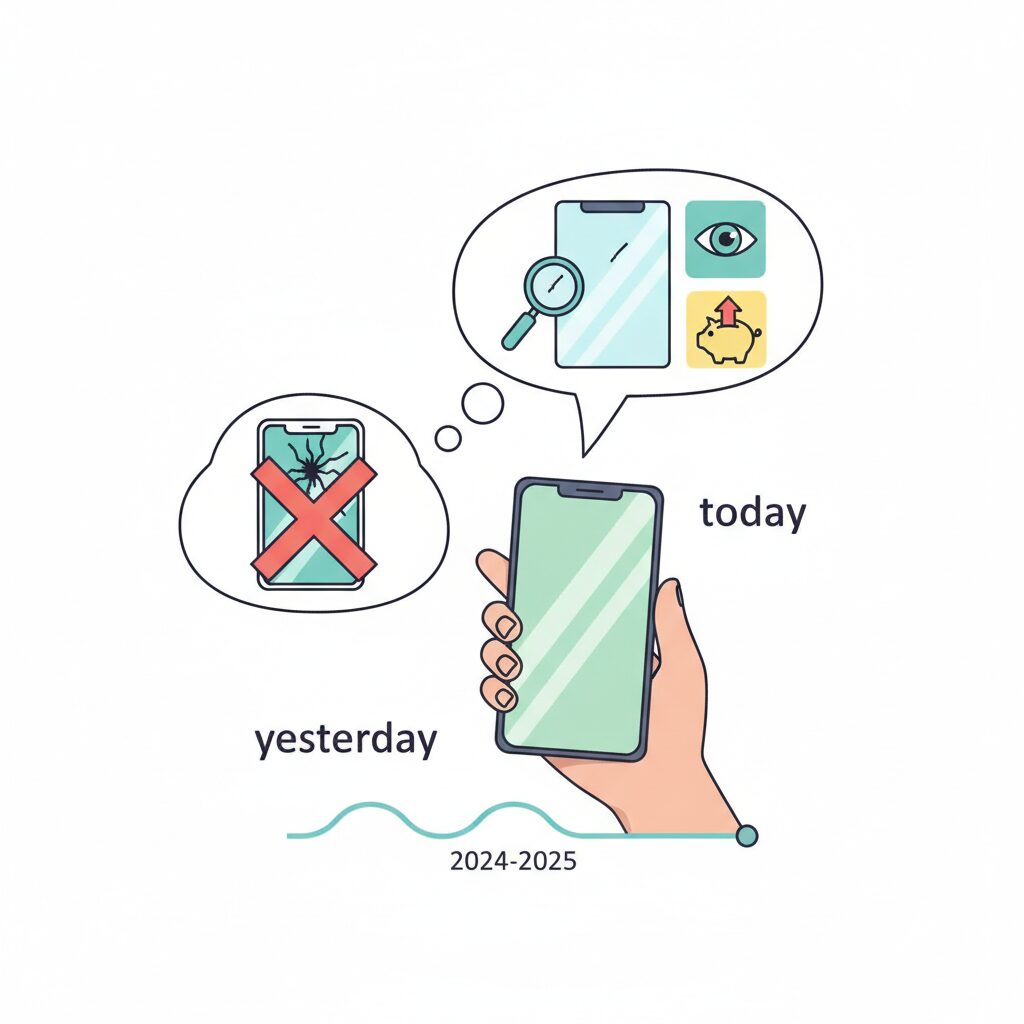
User expectations for screen protection have changed dramatically over the past few years, and the shift is driven less by fear of catastrophic breakage and more by everyday usability and long-term value.
As Corning’s technical disclosures show, modern cover glass such as Gorilla Glass Victus 2 already delivers a level of drop resistance that was unimaginable a decade ago. Because of this, many users no longer expect a screen protector to act as a primary shock absorber.
Instead, protection is now expected to preserve the display’s original condition over time, especially against micro-scratches that accumulate invisibly. These fine abrasions may not affect touch input, but they directly impact resale value, a point emphasized by multiple secondary-market evaluators.
| Past Expectations | Current Expectations |
|---|---|
| Prevent screen shattering | Prevent micro-scratches |
| Maximum hardness claims | Optical clarity and coating quality |
| Cheap and disposable | Asset value preservation |
Another major change lies in touch and visual experience. High-brightness, high-refresh displays have raised the bar, and users now demand that a protector be virtually invisible. According to materials engineers cited in Corning-related analyses, low-quality coatings can reduce contrast and increase reflections, negating advances made at the panel level.
As a result, users increasingly judge screen protectors as part of the display system itself, not as an external accessory. Expectations now include smooth finger glide, durable oleophobic coatings, and consistent performance over months of use.
This evolution reflects a broader mindset: smartphones are treated as long-term assets. Screen protection is no longer about surviving a single accident, but about maintaining perfection day after day.
The Truth Behind “9H Hardness” and Common Marketing Myths
In the screen protector market, few phrases are as powerful and as misunderstood as “9H hardness.” Many users intuitively associate this label with extreme durability, sometimes even imagining a diamond-like surface. **Please note that this impression is scientifically inaccurate**, and understanding why is essential for making a rational purchasing decision.
The “9H” commonly printed on glass film packaging refers not to mineral hardness, but to the pencil hardness test defined by the Japanese Industrial Standards. According to JIS K 5600, a coating is evaluated by scratching it with pencils ranging from soft to hard, and the hardest pencil that does not leave a visible mark determines the rating. **In simple terms, 9H only means “not scratched by a 9H pencil.”**
This distinction becomes clearer when compared with mineral hardness, which materials scientists typically describe using the Mohs scale. Glass used in smartphone displays is primarily silica-based, and even before chemical strengthening, it already exceeds the hardness of graphite-based pencil cores. As materials engineers and Corning’s own technical documentation have pointed out, most glass surfaces naturally pass the 9H pencil test without difficulty.
| Hardness Indicator | What It Measures | Practical Meaning for Users |
|---|---|---|
| Pencil Hardness (9H) | Resistance to graphite-based scratching | Baseline performance for any glass surface |
| Mohs Hardness | Relative resistance between minerals | Real-world scratch risk from sand and dust |
| Vickers Hardness | Indentation resistance under load | Quantitative indicator of surface durability |
Here lies the core marketing illusion. Because the pencil hardness scale sounds numerical and absolute, it creates the impression of measurable superiority. **However, a 9H label does not tell you whether the glass can resist quartz particles**, which are abundant in everyday dust and rate around 7 on the Mohs scale. This is why micro-scratches can still appear on so-called “9H” films during normal use.
Industry experts increasingly emphasize that more meaningful indicators are Vickers hardness and fracture toughness. These metrics, used in Corning’s Gorilla Glass specifications, quantify how a surface responds to real mechanical stress and how cracks propagate once formed. Compared with these data-driven values, pencil hardness is closer to a pass-or-fail checkbox than a true performance metric.
Another common myth is that higher “H” numbers automatically translate into better protection. In reality, excessively hard coatings can become more brittle, increasing the likelihood that a protector shatters on impact. **Durability is always a balance between hardness and toughness**, a point repeatedly highlighted in materials science literature and validated by third-party drop and scratch tests.
By recognizing how this term is used as a marketing shortcut, readers can shift their focus toward specifications and features that genuinely affect daily experience. Transparency, surface treatment quality, and the underlying glass technology matter far more than a single oversized number on the box. This perspective allows you to evaluate products with clarity rather than being swayed by familiar but misleading claims.
Understanding Real Glass Strength: Vickers Hardness and Fracture Toughness
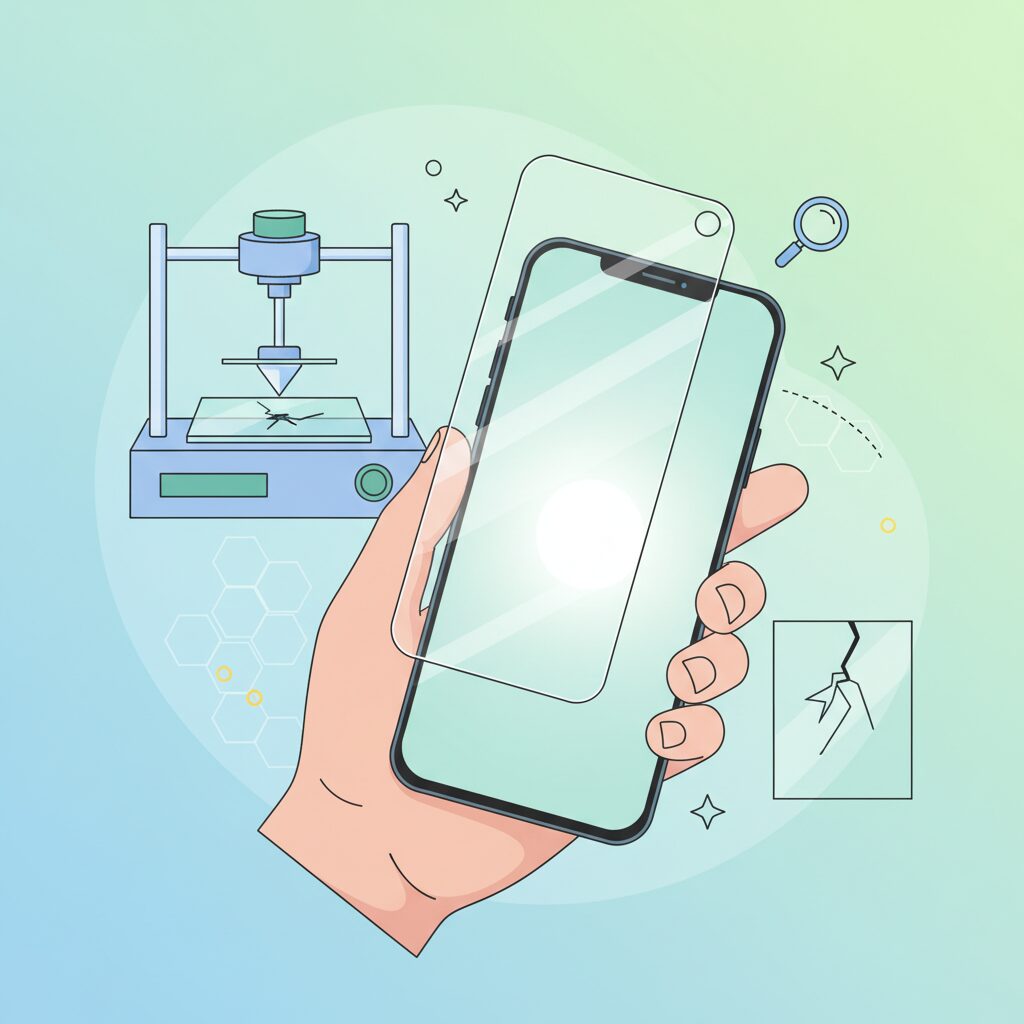
When discussing real glass strength, marketing labels quickly lose meaning, and two material science metrics become essential: Vickers hardness and fracture toughness. These values are widely used in academic research and by manufacturers such as Corning, making them far more reliable than consumer-facing hardness claims.
Vickers hardness explains how resistant a glass surface is to permanent scratches, while fracture toughness describes how well that glass resists crack growth once damage begins. Understanding the difference between these two is critical for evaluating real-world durability.
The Vickers hardness test presses a diamond indenter into the glass with a controlled load and measures the resulting indentation. Because diamond is vastly harder than glass, this method provides a precise, quantitative value that can be compared across materials.
| Material | Vickers Hardness (Hv) | Interpretation |
|---|---|---|
| Untreated soda-lime glass | ≈ 590 | Baseline scratch resistance |
| Chemically strengthened glass | ≈ 650–670 | Improved resistance to fine scratches |
| Gorilla Glass Victus 2 | ≈ 670 | High-end smartphone cover glass |
According to Corning’s published technical documentation, the increase from roughly 595 Hv to around 670 Hv may appear modest numerically, but it represents a meaningful reduction in micro-scratch formation during daily use. This is particularly relevant for fine quartz particles, which are a major cause of invisible wear over time.
However, hardness alone does not prevent shattering. This is where fracture toughness becomes decisive. Fracture toughness measures how difficult it is for an existing crack to propagate through the material, expressed in MPa·m to the power of one-half.
Glass is inherently brittle, so manufacturers rely on chemical strengthening through ion exchange to improve this property. By replacing smaller sodium ions with larger potassium ions at the surface, a compressive stress layer is created that actively suppresses crack growth.
Independent materials research and Corning’s own data indicate that modern cover glass has reached fracture toughness values around 0.8 MPa·m^0.5, compared with roughly 0.7 in early generations of smartphone glass. This improvement directly correlates with higher survival rates during drops onto rough surfaces.
From a practical perspective, this explains a common user experience: a screen may resist scratches impressively yet still shatter from a single unlucky impact. High Vickers hardness protects against abrasion, while high fracture toughness determines whether that impact remains cosmetic or becomes catastrophic.
Evaluating glass strength therefore requires balancing both metrics. A surface optimized only for hardness may feel durable day to day but fail dramatically under stress, whereas a well-balanced glass can tolerate minor scratches while preventing cracks from spreading.
For gadget enthusiasts seeking to understand true durability, these two values offer a far clearer picture than any simplified hardness label ever could.
How Gorilla Glass Victus 2 Redefines Drop and Scratch Resistance
Gorilla Glass Victus 2 significantly changes how drop and scratch resistance are balanced in modern smartphones, and this shift is grounded in material science rather than marketing language. According to Corning’s official technical documentation, Victus 2 is engineered with a clear priority: surviving real-world drops onto rough surfaces such as concrete, not just smooth laboratory floors. This focus reflects how users actually damage their devices in daily life.
The most important breakthrough is the optimization of fracture toughness without excessively sacrificing surface hardness. Victus 2 achieves a Vickers hardness of approximately 670 kgf/mm² after chemical strengthening, while its fracture toughness reaches 0.82 MPa·m^0.5. These values indicate that the glass can resist crack propagation even when microscopic flaws are introduced during impact.
Corning’s internal testing, which has been cited and independently discussed by materials engineers, shows that Victus 2 can withstand drops from up to 1 meter onto surfaces equivalent to 80-grit sandpaper, and up to 2 meters onto 180-grit surfaces. These abrasiveness levels closely resemble concrete and asphalt, making the results highly relevant for everyday accidents.
| Property | Standard Glass | Gorilla Glass Victus 2 |
|---|---|---|
| Vickers Hardness | ≈595 kgf/mm² | ≈670 kgf/mm² |
| Fracture Toughness | ≈0.70 MPa·m^0.5 | ≈0.82 MPa·m^0.5 |
| Designed Drop Surface | Smooth or mild | Concrete-equivalent |
When it comes to scratch resistance, Victus 2 deliberately accepts a known physical limitation. As explained by materials science research and demonstrated in Mohs hardness pick tests widely referenced by display analysts, glass based on silica cannot realistically exceed Mohs level 6 to 7 without becoming brittle. Victus 2 stays within this boundary, meaning quartz particles found in sand can still cause micro-scratches.
This design choice is intentional and rational. By not pushing surface hardness beyond the glass stability threshold, Victus 2 avoids catastrophic shattering during drops. Corning engineers have repeatedly emphasized that an ultra-hard but fragile glass would perform worse in real consumer environments, a position supported by peer-reviewed fracture mechanics studies.
In practical terms, Victus 2 redefines durability by shifting expectations. It does not promise an unscratchable surface, but it dramatically reduces the probability of screen failure from accidental drops. For users, this means fewer cracked displays and more predictable aging behavior, where minor cosmetic wear may appear long before structural damage occurs.
This philosophy marks a clear evolution from earlier generations of cover glass and explains why many industry experts view Victus 2 as a realistic, physics-aware solution rather than an overengineered experiment. It is this balance, not absolute hardness, that truly redefines drop and scratch resistance.
Gorilla Armor and the New Limits of Scratch Resistance
The arrival of Corning Gorilla Armor marks a clear inflection point in the long-running battle against smartphone screen scratches. Until recently, even the most advanced cover glasses were constrained by what materials scientists often call the Mohs hardness ceiling. **Conventional strengthened glass, including Gorilla Glass Victus 2, typically begins to show visible scratches at Mohs level 6 and suffers deeper grooves at level 7**, a range that inconveniently overlaps with quartz particles commonly found in sand and household dust.
Gorilla Armor fundamentally shifts this baseline. Independent scratch tests conducted by well-known device teardown and durability reviewers, and later analyzed by Android-focused technical media, demonstrated that Gorilla Armor resisted damage until Mohs level 8. From a practical standpoint, this places it beyond the hardness of steel keys, utility blades, and most environmental abrasives encountered in daily use.
| Material | Initial Scratch Level (Mohs) | Typical Real-World Abrasives |
|---|---|---|
| Standard Tempered Glass | 6 | Dust, fine sand |
| Gorilla Glass Victus 2 | 6–7 | Quartz particles |
| Gorilla Armor | 8 | Rare minerals only |
This leap is not simply a marketing milestone but a materials-engineering achievement. According to Corning’s published technical disclosures and expert commentary in materials science journals, Gorilla Armor benefits from an optimized ion-exchange process that increases surface compressive stress while preserving optical clarity. **Higher compressive stress makes it dramatically harder for micro-abrasions to nucleate and propagate**, which is why superficial scuffs that plagued earlier generations are effectively suppressed.
Another overlooked implication lies in long-term aesthetics. Micro-scratches are rarely catastrophic, yet they scatter light and degrade contrast over time. Display engineers have repeatedly noted that even sub-micron surface damage can reduce perceived sharpness, particularly on high-brightness OLED panels. By pushing scratch resistance to Mohs 8, Gorilla Armor helps preserve native contrast ratios and color fidelity months or even years into ownership.
Industry analysts also highlight a secondary effect relevant to resale markets. Smartphone refurbishment standards increasingly penalize any visible surface wear. **A display that resists everyday abrasion retains higher grading classifications**, directly translating into better trade-in and resale values. This economic dimension explains why manufacturers are willing to absorb the higher production costs associated with Gorilla Armor.
It is important, however, to recognize the boundary conditions. Scratch resistance does not equate to invulnerability. Corning itself emphasizes that extreme point impacts or contact with rarer, harder minerals can still damage the surface. What Gorilla Armor realistically delivers is a redefinition of “normal use,” where pockets, bags, desks, and keys are no longer credible threats.
For gadget enthusiasts, this development resets expectations. **Gorilla Armor represents the first time that bare-glass usage becomes a technically defensible choice from a scratch-resistance perspective**, rather than a lifestyle gamble. In that sense, it establishes a new reference point against which all future display protection strategies will be measured.
Why Screen Protectors Still Matter Even on the Toughest Displays
Even as smartphone displays reach unprecedented levels of durability, screen protectors still play a meaningful role in real-world use, and this is not a contradiction but a shift in purpose. **Modern cover glass has become harder to shatter, but it has not become immune to everyday wear.** According to Corning’s own technical disclosures, materials like Gorilla Glass Victus 2 are engineered primarily to resist drops on rough surfaces, not to eliminate fine abrasion from daily contact.
In practice, the most common form of damage in 2024 and 2025 is not catastrophic cracking but micro-scratches caused by particles containing quartz, which has a Mohs hardness of around 7. Laboratory demonstrations cited by Android Police and other expert reviewers show that even advanced glass begins to mark at this level. These marks may be invisible at first, yet they accumulate and degrade clarity over time.
| Type of Damage | Native Display Glass | With Screen Protector |
|---|---|---|
| Micro-scratches | Gradual accumulation | Mostly absorbed by film |
| Oleophobic wear | Permanent degradation | Replaceable surface |
| Resale impact | Value reduction | Condition preserved |
Another overlooked factor is the oleophobic coating. Display glass may survive for years, but the fingerprint-resistant layer typically wears down within months, as materials researchers and accessory manufacturers consistently note. A protector effectively turns this into a consumable layer, restoring smooth touch and clean visuals with a simple replacement.
Finally, from a market perspective, smartphones are now treated as assets. Industry resale standards penalize even faint display marks, a point emphasized in multiple consumer behavior studies referenced in recent market reports. **A thin sheet of glass costing a few dollars functions as insurance, preserving both usability and long-term value**, even on the toughest displays available today.
Market Trends: How Competition Is Shaping Screen Protector Innovation
Competition in the screen protector market is no longer driven by simple durability claims but by how convincingly brands can redefine value in a mature category. As device-side glass such as Corning Gorilla Glass Victus 2 and Gorilla Armor has become significantly stronger, manufacturers are forced to differentiate elsewhere. **This competitive pressure has shifted innovation from brute-force protection to user experience, optics, and installation reliability**, according to analyses based on BCN Ranking market data and Corning’s own technical disclosures.
A clear signal of this shift can be seen in market share movements. Elecom continues to dominate the Japanese market with over 40 percent share, largely due to distribution strength and rapid product launches. However, Trinity’s growth to over 20 percent reflects a different competitive strategy: reducing user anxiety through guided installation systems. Industry observers cited by BCN note that “ease of successful application” has become a decisive factor at the point of sale, especially as functional differences in glass hardness narrow.
| Competitive Axis | Past Focus | Current Innovation Driver |
|---|---|---|
| Material Performance | Impact resistance | Micro-scratch prevention |
| User Experience | Minimal consideration | Auto-alignment, dust control |
| Optical Quality | Transparency claims | AR coatings, color fidelity |
Another competitive catalyst is the erosion of credibility around marketing terms such as “9H.” As clarified by materials science references and Corning-related documentation, this pencil hardness metric offers limited real-world insight. **Brands that continue to rely on exaggerated hardness labels risk losing trust among gadget-savvy consumers**, while competitors investing in measurable optical and tactile improvements gain reputational advantage.
Competition is also intensifying due to changes in the device market itself. Google’s rise to the top of Android sales in Japan has forced accessory makers to expand beyond iPhone-centric strategies. This has accelerated innovation in thinner, fingerprint-reader-friendly glass protectors, a niche that did not exist at scale several years ago. Analysts following the smartphone supply chain emphasize that accessory innovation now closely tracks OEM feature roadmaps rather than reacting after the fact.
Ultimately, the market shows signs of moving toward commoditization at the material level and premiumization at the experience level. **In a crowded field where true hardness gains are marginal, competition rewards brands that solve friction points users actually feel**, such as glare under sunlight, degraded oleophobic coatings, or the frustration of failed installation. This dynamic explains why recent innovation feels less dramatic on spec sheets yet far more noticeable in everyday use.
Installation Technology Breakthroughs That Eliminate User Error
One of the biggest barriers to adopting glass screen protectors has never been material performance, but installation failure. Misalignment, trapped dust, and residual bubbles have historically undermined even premium products, leading to frustration and wasted cost. Between 2024 and 2025, installation technology itself has become the primary battleground for differentiation, fundamentally reframing screen protection as a system rather than a sheet of glass.
The most impactful breakthrough is the widespread adoption of physical alignment architectures. Guide-frame and box-type installers mechanically constrain placement along the X and Y axes, removing human estimation from the process. According to evaluations referenced in BCN market analyses, products equipped with dedicated alignment frames demonstrate a markedly higher first-pass success rate compared with freehand application, especially among non-expert users. This shift mirrors principles long established in industrial assembly, where jigs exist precisely to eliminate variability.
| Installation Element | Traditional Method | Modern Systemized Method |
|---|---|---|
| Positioning | Visual alignment by user | Mechanical guide or enclosure |
| Dust Control | Manual wiping and stickers | Electrostatic self-removal |
| Consistency | User skill dependent | Process standardized |
Equally transformative is the integration of electrostatic dust-removal mechanisms. During the peel-and-drop motion, friction-generated static charge actively attracts airborne micro-particles away from the display surface. This is not a marketing gimmick but a direct application of basic electrostatics, similar to cleanroom handling techniques described in materials engineering literature. By automating dust mitigation at the moment of contact, these systems address the single most common cause of visual defects.
At the extreme end of this evolution lies fully automated installation. All-in-one machines, now deployed in select retail environments, perform cleaning, alignment, lamination, and pressure control in a closed cycle lasting roughly two minutes. Industry observers have noted that this approach removes both user error and technician skill variance, producing uniform results regardless of location or operator. From a UX standpoint, this represents a decisive shift from craftsmanship to reproducibility.
What makes these breakthroughs especially significant is their timing. As modern cover glass such as Gorilla Glass Victus 2 improves intrinsic durability, the remaining value proposition of protectors increasingly lies in optical coatings and asset preservation. A flawed installation directly negates these benefits. Corning’s own documentation emphasizes surface uniformity for optimal optical performance, indirectly underscoring why precision mounting matters as much as the glass itself.
For gadget enthusiasts, the implication is clear. Evaluating a screen protector without scrutinizing its installation technology now overlooks a core determinant of real-world performance. The industry’s quiet consensus is that eliminating user error is not an accessory feature, but a prerequisite, and the rapid market adoption of these systems strongly supports that conclusion.
High-Function Screen Protectors: AR Coatings, Gaming Focus, and Case Compatibility
High-function screen protectors have evolved from simple scratch barriers into precision accessories that actively improve how you see, touch, and use your smartphone. In the 2024–2025 market, three themes stand out: optical AR coatings, gaming-focused surface tuning, and careful case compatibility. These are not marketing buzzwords but responses to concrete user pain points identified in both consumer surveys and manufacturer testing.
AR, or anti-reflection coatings, represent the most significant optical upgrade in recent years. Unlike traditional matte anti-glare films that rely on surface roughness to diffuse light, AR coatings use thin-film interference—similar to camera lens filters—to cancel reflected light wavelengths. According to Corning’s optical material documentation and independent verifications cited in industry reports, properly tuned AR layers can reduce surface reflectance from roughly 8 percent on bare glass to around 1–2 percent, without sacrificing contrast or pixel sharpness.
This difference becomes immediately apparent outdoors. High-luminance OLED displays now exceed 2,000 nits on flagship devices, but without reflection control, much of that brightness is wasted. AR-coated protectors allow the display’s native performance to be perceived more directly, which is why brands like NIMASO and Torras have positioned AR glass as their premium tier rather than matte finishes.
| Feature | Matte Anti-Glare | AR Coating |
|---|---|---|
| Reflection Reduction | Moderate (diffusion) | High (optical interference) |
| Image Sharpness | Slightly reduced | Near-native |
| Color Accuracy | Lower | High |
For users who prioritize gaming, however, visibility is only half the story. Surface friction and touch consistency directly affect performance in rhythm games, FPS titles, and competitive mobile esports. Market analysis shows that a subset of players still deliberately chooses finely tuned anti-glare or “super smooth” coatings, even at the cost of some visual clarity. Products such as Rastabanana’s Super Sarasar series are engineered to minimize dynamic friction, reducing finger drag during rapid swipes and long tracking motions.
This design choice aligns with feedback from professional and semi-professional mobile gamers, who often report reduced finger fatigue and more stable input timing on low-friction surfaces. While these coatings scatter light more than AR glass, their tactile advantage can outweigh optical compromises for gaming-centric users. Importantly, this is not about hardness ratings but about micro-texture control at the nanometer level.
The third pillar, case compatibility, addresses a practical issue that became widespread as smartphone designs adopted curved edges and thicker protective cases. Fully curved 3D glass protectors offer seamless aesthetics, but studies of return reasons in Japanese retail channels show that edge lifting caused by case interference remains one of the top dissatisfaction factors.
As a result, the industry has largely standardized on 2.5D “case-friendly” designs. These protectors intentionally stop a few millimeters short of the display edge, ensuring coexistence with rugged cases such as iFace-style bumpers. Reports from accessory manufacturers and retail chains indicate that this compromise dramatically reduces installation failures and long-term peeling, even if it slightly exposes the extreme edge of the display glass.
From a market perspective, this shift reflects a broader understanding of how devices are actually used. Few consumers run a naked phone, and fewer still accept a protector that conflicts with their case choice. High-function screen protectors therefore succeed not by maximizing one specification, but by harmonizing optical physics, surface engineering, and real-world ergonomics into a single, quietly effective layer.
参考文献
- BCN AWARD:Smartphone Protective Sheet Category Overview
- Corning:Corning® Gorilla® Glass Victus® 2 Product Information Sheet
- Android Police:Samsung Galaxy S24 Ultra squares off against Mohs hardness picks
- Wikipedia:Gorilla Glass
- BCN Corporation:BCN AWARD 2025 Interim Report: Google Tops Android Smartphone Sales
- FILMLABO:Fully Automated Screen Protector Installation Machine