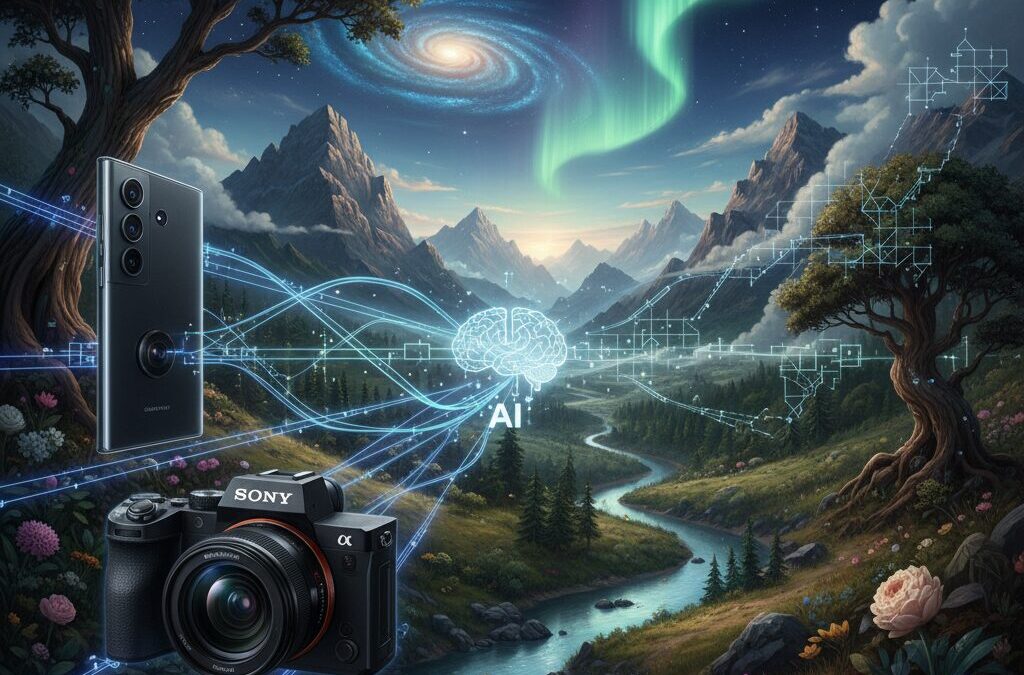
Have you ever wondered whether the breathtaking landscape you saw online was truly captured in-camera—or intelligently reconstructed by AI? In 2026, that question is no longer philosophical. It is a daily reality for photographers, gadget lovers, and anyone who owns a flagship smartphone.
From the Samsung Galaxy S25 Ultra’s ProVisual Engine to Sony’s AI-powered subject recognition in the α1 II and α9 III, cameras are no longer just recording light. They are interpreting scenes, predicting motion, and even generating missing details in real time.
At the same time, tools like Adobe Firefly Image 3 and Luminar Neo are transforming photo editing into collaborative creation, while AI-related photo contest scandals and new authentication standards are reshaping trust in visual media. In this article, you will discover how AI is redefining what we call “nature photography,” what the data says about user behavior, and why the future of imaging may split between perfect algorithmic images and imperfect human experiences.
- Computational Photography in 2026: From Recording Light to Reconstructing Reality
- Samsung Galaxy S25 Ultra and the Rise of Real-Time Semantic Scene Understanding
- Google Pixel, iPhone, and the Philosophy of AI Interpretation vs. Natural Rendering
- Sony α1 II and α9 III: Pose Estimation, Global Shutter, and the End of Missed Wildlife Moments
- Canon EOS R1 and Nikon Z9: Predictive Autofocus and the Limits of AI Subject Detection
- Adobe Firefly Image 3: Structure Reference and the Shift from Editing to Co-Creation
- Luminar Neo and the Democratization of Landscape Retouching
- Inside the Algorithms: Diffusion Models, Semantic Simplification, and Texture Synthesis
- When AI Wins Awards: The Japanese Photo Contest Scandal That Shook the Industry
- Copyright, RAW Files, and the New Rules of Authenticity in Photography Competitions
- Market Data 2025–2026: AI Adoption, Local Data Shortages, and the Return to Original Photography
- Why a Low-Spec Kodak Became a Bestseller: The Emotional Rebellion Against Perfect AI Images
- AI as a New Brush: Digital Nature, AI Art, and Cultural Experiments like AI Hokusai
- C2PA, Content Credentials, and the Coming Era of Image Provenance
- Two Futures of Photography: Data-Optimized Images vs. Human Experience-Driven Capture
- 参考文献
Computational Photography in 2026: From Recording Light to Reconstructing Reality
In 2026, photography is no longer defined solely as the act of recording light. It has evolved into a process of interpreting, predicting, and reconstructing reality through algorithms. What began with silver plates and chemical reactions has entered a fourth wave: AI-driven inference layered on top of digital sensors.
Today’s camera does not just capture photons; it computes meaning. Neural Processing Units embedded in smartphones and mirrorless cameras analyze scenes in real time, separating sky from foliage, subject from background, motion from noise. The result is an image shaped as much by trained models as by optics.
This shift is especially visible in flagship devices released between 2025 and 2026.
| Device | Core AI Function | Impact on Image |
|---|---|---|
| Galaxy S25 Ultra | ProVisual Engine + AI Zoom | Semantic tone mapping and inferred detail reconstruction |
| Pixel 10 Pro | Camera Coach + Night Sight | Composition guidance and multi-frame light synthesis |
| Sony α9 III | AI Pose Estimation + Global Shutter | Predictive autofocus without rolling distortion |
According to DPReview’s early analyses of Sony’s latest bodies, subject recognition has moved from pattern matching to pose estimation. The camera infers where a bird’s head should be even when partially hidden. This is not simple detection; it is probabilistic reconstruction based on learned anatomical models.
Smartphones push this logic further. CNET reports that Samsung’s AI tools can isolate textures within a single landscape frame, applying localized tone mapping to rocks in sunlight and vegetation in shadow. The image is no longer a uniform exposure but a composite of context-aware decisions.
Meanwhile, generative editing tools such as object removal do more than erase distractions. They synthesize plausible backgrounds using diffusion-based models, similar in principle to those described in recent computer vision research presented at CVPR. Missing pixels are not filled—they are imagined.
This marks a philosophical turning point: photography is shifting from evidence to estimation. When multiple frames are merged, noise is statistically suppressed, and details are enhanced through learned priors, the final image represents an optimized hypothesis of reality rather than a raw trace of light.
Even RAW files are touched by computation. Modern pipelines apply AI-driven denoising and color science before the photographer ever opens editing software. The boundary between capture and post-production has effectively collapsed.
For gadget enthusiasts, this is thrilling. Hardware is no longer limited by sensor size alone; performance depends on model training, firmware updates, and cloud-assisted processing. Cameras improve over time not only through new lenses but through new neural weights.
Yet the deeper transformation is conceptual. If a camera predicts the decisive moment through pre-capture buffering, or reconstructs fine feather detail during digital zoom, what we see is partly a statistical expectation shaped by vast datasets. The device becomes an interpretive engine at the edge of reality.
Computational photography in 2026 therefore represents a transition from passive recording to active reconstruction. The lens gathers light, but the algorithm decides what that light ultimately means.
Samsung Galaxy S25 Ultra and the Rise of Real-Time Semantic Scene Understanding

The Samsung Galaxy S25 Ultra represents a decisive shift in smartphone photography from simple scene detection to what engineers now describe as real-time semantic scene understanding. Instead of merely identifying that a frame contains “sky” or “mountain,” the device interprets contextual relationships between objects, light sources, textures, and depth in real time.
According to coverage by Tom’s Guide and CNET, Samsung’s latest ProVisual Engine works in tandem with an advanced Scene Optimizer pipeline, powered by an upgraded on-device NPU. This architecture allows the camera to analyze multiple regions within a single frame independently, applying localized tone mapping and texture enhancement rather than global adjustments.
This is not about making photos brighter or more saturated. It is about teaching the camera to understand what it is looking at.
In practical terms, consider a high-contrast mountain landscape. Traditional HDR systems merge exposures to preserve highlights and shadows, but they treat the scene as a uniform whole. The S25 Ultra instead segments the frame into semantic regions. Sunlit granite receives one tone curve, shadowed forest foliage another, and distant sky gradients yet another.
This micro-adjustment approach helps mitigate clipping and crushed blacks beyond what purely optical improvements can achieve. It effectively extends perceived dynamic range through inference and reconstruction, a hallmark of computational photography’s fourth wave: AI-driven interpretation.
Zoom photography further illustrates this transformation. When users engage high magnification, the AI Zoom system captures multiple frames in rapid succession. Rather than relying on conventional interpolation, the ProVisual Engine reduces noise through frame stacking and then reconstructs fine detail by referencing learned patterns such as fur textures or feather structures.
The distinction is critical. Bicubic scaling enlarges pixels mathematically. Semantic reconstruction predicts what detail should exist based on prior training data. As discussed in industry analysis, this produces sharper edges and more convincing micro-contrast, particularly in wildlife scenarios where physical proximity is limited.
The following comparison highlights the conceptual shift:
| Feature | Traditional Processing | Galaxy S25 Ultra Approach |
|---|---|---|
| Scene Recognition | Category labeling (e.g., “landscape”) | Context-aware regional segmentation |
| HDR Handling | Global exposure blending | Localized tone mapping by semantic zone |
| Digital Zoom | Pixel interpolation | Multi-frame AI detail reconstruction |
Another dimension of semantic intelligence appears in editing tools such as Object Eraser and Generative Edit. Removing unwanted elements like power lines or background tourists no longer depends solely on patching adjacent pixels. Instead, the system identifies the removed object’s spatial and contextual role, then regenerates plausible background textures consistent with the surrounding environment.
Community reports and technical reviews note that this hybrid processing model combines on-device inference with optional cloud-based generative models for more complex reconstructions. The result is higher fidelity texture synthesis, especially in organic patterns such as grass, stone, or rippling water.
Importantly, these capabilities blur the boundary between capture and post-production. The camera is no longer a passive recorder of light but an edge AI device performing semantic reasoning at shutter speed. Each frame becomes the product of layered inference: segmentation, exposure modeling, texture prediction, and context-aware reconstruction.
This evolution aligns with broader research trends in computer vision. As presented at leading conferences such as CVPR, semantic simplification and region-aware modeling enable machines to reinterpret visual data through structured representations before reconstructing photorealistic outputs. The S25 Ultra operationalizes similar principles inside a consumer device.
For gadget enthusiasts, the excitement lies not only in sharper photos but in the philosophical shift. When the camera anticipates what detail “should” look like, it participates in image creation. The device is no longer constrained by sensor physics alone; it compensates for optical limits with learned visual priors.
The rise of real-time semantic scene understanding marks the moment when smartphone photography transitions from capturing light to interpreting meaning.
In this sense, the Galaxy S25 Ultra exemplifies a broader industry trajectory. Hardware improvements remain important, but competitive advantage increasingly depends on neural processing sophistication. The lens gathers photons, yet the model defines the final image.
For users deeply invested in mobile imaging, this shift invites a new mindset. Evaluating a camera now requires examining not only megapixels and aperture sizes but also inference speed, segmentation accuracy, and reconstruction logic. The intelligence behind the glass matters as much as the glass itself.
As AI continues to mature, real-time semantic understanding will likely expand beyond still photography into video, augmented reality overlays, and adaptive exposure systems that evolve dynamically within a scene. The Galaxy S25 Ultra stands as a concrete milestone in that journey, demonstrating how deeply machine perception has integrated into the act of seeing.
Google Pixel, iPhone, and the Philosophy of AI Interpretation vs. Natural Rendering
When we compare Google Pixel and iPhone, the real difference is no longer megapixels or lens count. It is philosophy. Both rely heavily on computational photography, yet they interpret reality in fundamentally different ways.
According to industry reviews and manufacturer briefings, Pixel devices lean into semantic interpretation, while iPhone prioritizes perceptual naturalness. This divergence shapes how “green” forests, blue skies, and human skin are ultimately rendered.
One aims to enhance what the scene could be. The other aims to preserve what the scene felt like.
| Aspect | Google Pixel | iPhone |
|---|---|---|
| Core Philosophy | AI-driven interpretation | Natural color preservation |
| Night Processing | Multi-frame computational reconstruction | Balanced noise reduction with realism |
| User Perception | “Enhanced clarity” | “True-to-life tone” |
Google’s approach, seen in features like Night Sight and Video Boost, uses multi-frame fusion and machine learning models to reconstruct detail beyond what a single exposure can capture. As reported by multiple camera analyses, Pixel devices often brighten shadows aggressively and refine textures using learned priors. The result is an image that feels information-rich, sometimes even hyper-real.
This reflects Google’s long-standing expertise in computational imaging and large-scale model training. The camera does not merely record photons. It interprets the scene through statistical knowledge of millions of images.
The forest becomes greener not because it was greener, but because the model predicts that is what a forest should look like.
Apple, by contrast, emphasizes restrained processing. Its color science, often described in reviews as “natural” or “neutral,” avoids excessive saturation. Skin tones are carefully calibrated, and highlights are preserved to prevent the artificial HDR look that early computational photography sometimes produced.
Apple’s implementation is intentionally subtle. AI operates invisibly in the background, optimizing exposure and white balance without dramatically altering scene mood. The goal is continuity between what the user saw and what appears on screen.
This philosophical split has psychological implications. Research in visual perception suggests that viewers often prefer images that align with memory color rather than measured color. Pixel leans into this cognitive bias, amplifying detail to match expectation. iPhone leans into perceptual trust, reducing the risk of uncanny over-processing.
For gadget enthusiasts, the question becomes existential rather than technical. Do you want your camera to interpret the world for you, or to mediate it as lightly as possible?
In 2026, the debate is no longer about camera hardware. It is about who defines reality: the algorithm, or the eye.
Sony α1 II and α9 III: Pose Estimation, Global Shutter, and the End of Missed Wildlife Moments

For wildlife photographers, the difference between a once-in-a-lifetime shot and a missed opportunity is often measured in milliseconds.
With the Sony α1 II and α9 III, that fragile margin has dramatically narrowed thanks to AI-driven pose estimation and, in the case of the α9 III, a full-frame global shutter sensor.
According to DPReview’s in-depth coverage and Sony’s own technical briefings, these cameras do not merely improve autofocus speed; they fundamentally change how subjects are understood and captured.
Key Technologies at a Glance
| Model | Core AI Feature | Sensor Advantage | Wildlife Impact |
|---|---|---|---|
| α1 II | AI Subject & Pose Estimation | High-resolution stacked CMOS | Persistent tracking even when eyes are obscured |
| α9 III | AI Subject Recognition | Global Shutter (no rolling distortion) | Distortion-free high-speed action |
The breakthrough lies in pose estimation. Traditional AF systems relied heavily on visible features such as eyes or contrast edges.
In contrast, the α1 II’s dedicated AI processing unit analyzes learned skeletal and structural patterns of humans, animals, birds, and even insects.
Even if a bird turns its head away or briefly hides behind its wings, the system predicts where the head should be in three-dimensional space and keeps focus locked.
This predictive layer is particularly transformative in dense forests or wetlands, where branches and reeds frequently interrupt line of sight.
Field testers cited by wildlife specialists such as Matt Kloskowski note that tracking consistency has improved in erratic flight scenarios, where earlier systems would often jump to background foliage.
The camera is no longer reacting to pixels alone; it is interpreting posture and intent.
The α9 III adds another historic shift: the world’s first full-frame global shutter sensor.
Unlike rolling shutters that read pixels sequentially, the global shutter exposes all pixels simultaneously.
This eliminates the wing-bending distortion that plagued high-speed bird photography and removes banding under artificial lighting.
DPReview’s analysis emphasizes that this is not just a technical milestone but a practical one for action specialists.
When combined with up to 120 frames per second continuous shooting and advanced AI AF calculations per second, the result is an unprecedented capture rate for decisive moments.
Consider a kingfisher diving. Human reaction time averages roughly 0.2 seconds.
With pre-capture functionality buffering frames before the shutter is fully pressed, photographers effectively step outside biological limits.
The camera records the instant before you realize it has happened.
Importantly, this does not mean skill becomes irrelevant.
Understanding animal behavior, anticipating motion, and positioning remain essential.
However, the technological barrier between intention and execution has been significantly reduced.
In practical wildlife scenarios, missed focus due to momentary occlusion or sensor distortion is no longer the primary failure point.
Instead, photographers can concentrate on composition, light, and storytelling.
The fusion of pose-aware AI and distortion-free global shutter technology signals something profound: the end of many technically missed wildlife moments.
Canon EOS R1 and Nikon Z9: Predictive Autofocus and the Limits of AI Subject Detection
In the flagship arena, Canon EOS R1 and Nikon Z9 represent two of the most advanced interpretations of predictive autofocus powered by deep learning. Both cameras move beyond simple face or eye detection and instead attempt to model subject behavior in real time.
According to reviews by Amateur Photographer and field reports from wildlife specialists, the EOS R1’s Action Priority AF is designed to anticipate decisive motion rather than merely react to it. The system analyzes subtle pre-movement cues such as posture shifts or muscle tension before a leap or takeoff.
This shift from reactive tracking to predictive modeling fundamentally changes how photographers capture fast wildlife sequences.
| Camera | Core AI Focus | Strength |
|---|---|---|
| Canon EOS R1 | Action Priority AF | Pre-movement prediction |
| Nikon Z9 (FW 5.3+) | Advanced Subject Detection | Refined bird recognition |
Canon’s Dual Pixel Intelligent AF also demonstrates resilience in cluttered environments. In dense forests or reed beds, the system attempts to ignore foreground distractions and maintain lock on an animal’s eye. Field testers shooting birds in Latin America have reported that the camera holds focus even when branches briefly obscure the subject.
Nikon has taken a slightly different path. With firmware updates such as version 5.3, the Z9’s bird detection has been significantly refined. Independent reviewers and experienced bird photographers note improved accuracy in identifying small, partially hidden birds within foliage.
Firmware evolution has effectively turned the Z9 into a continuously learning platform rather than a static product.
However, AI subject detection is not infallible. Reports from photographers indicate occasional misclassification, such as insects being interpreted as birds or textured backgrounds triggering false positives. These edge cases reveal a fundamental limitation: neural networks rely on learned patterns and can overgeneralize when confronted with ambiguous shapes.
This is not merely a technical footnote. It reshapes the photographer’s role. Instead of manually selecting AF points, professionals now manage AI behavior—switching subject modes, constraining detection ranges, or overriding automation when the model’s assumptions diverge from reality.
From a computer vision perspective, both cameras rely on large-scale training datasets and convolutional neural network architectures similar to those discussed at CVPR workshops. Pose estimation and semantic segmentation techniques allow the system to infer where a head or eye should be, even when temporarily obscured.
Yet inference remains probabilistic. The camera predicts what is most likely present, not what is philosophically certain. In high-speed wildlife scenarios, that probability is often sufficient to secure frames that were previously unattainable. But in visually chaotic scenes, prediction can drift.
Ultimately, Canon EOS R1 and Nikon Z9 demonstrate that AI autofocus has reached a stage where anticipation rivals human reflexes. At the same time, their limitations remind us that subject detection is a statistical model layered onto optical reality. Mastery in 2026 is no longer about focusing faster than the camera. It is about understanding when to trust the algorithm—and when to override it.
Adobe Firefly Image 3: Structure Reference and the Shift from Editing to Co-Creation
Adobe Firefly Image 3 marks a decisive shift from conventional editing to true co-creation. Instead of merely correcting exposure or removing objects, creators can now collaborate with the model through Structure Reference and Style Reference, redefining how intent is translated into pixels.
According to Adobe’s official announcement and engineering blog, Firefly Image 3 significantly improves photorealism, especially in complex natural scenes such as forests, water reflections, and atmospheric light. The model’s ability to preserve spatial logic while generating new content is central to this transformation.
Structure Reference allows creators to preserve composition and perspective while generating new visual elements, shifting AI from a tool of correction to a partner in design.
With Structure Reference, users upload a base image that defines layout, depth, and geometry. The AI then generates new imagery that respects this structural blueprint. Style Reference, by contrast, transfers tonal qualities, color mood, or surface texture without copying the underlying composition.
| Feature | Primary Role | Creative Impact |
|---|---|---|
| Structure Reference | Preserves composition and spatial arrangement | Maintains photographer’s intent |
| Style Reference | Transfers color and aesthetic mood | Enhances expressive consistency |
In practical terms, a photographer might upload a flat, overcast forest shot as a structural guide and prompt “golden sunset light with soft mist.” The resulting image retains the original framing and perspective, yet introduces newly generated illumination and atmosphere. This is no longer retouching; it is guided reconstruction.
Traditional text-to-image workflows often struggle with precise compositional control. Research presented at venues such as CVPR highlights the difficulty of aligning semantic prompts with spatial accuracy. By anchoring generation to a user-provided structure, Firefly reduces ambiguity between language and layout.
Technically, this capability builds on diffusion-based generation. As described in NVIDIA’s generative AI overview and related academic literature, diffusion models iteratively denoise random input into coherent imagery. Conditioning that process on structural signals constrains randomness, producing outputs that feel intentional rather than accidental.
The psychological impact is equally significant. Creators are no longer surrendering authorship to an opaque system. Instead, they define boundaries—composition, perspective, framing—while delegating texture synthesis and lighting variation to the model. The balance of control shifts from manual pixel manipulation to conceptual direction.
This approach resonates beyond photography. Studies on text-to-image applications in landscape architecture show that designers use generative AI to explore spatial variations rapidly while preserving layout logic. Firefly’s reference system mirrors this workflow, enabling iterative ideation without discarding structural coherence.
For gadget enthusiasts and creative professionals, the implication is clear: the creative act increasingly happens before generation, in how references and prompts are selected. Mastery is less about sliders and more about intentional constraint. In this new paradigm, editing becomes orchestration, and AI becomes a responsive collaborator rather than a mere automated filter.
Luminar Neo and the Democratization of Landscape Retouching
Luminar Neo has become a symbolic tool in the democratization of landscape retouching. What once required years of Photoshop experience, complex masking, and manual luminosity blending can now be achieved through AI-driven sliders and generative tools designed for intuitive control.
According to a 2025 review by Japanese photography media LogCamera, Luminar Neo is particularly strong for landscape photographers because it automates depth analysis and scene segmentation without requiring advanced technical knowledge. This shift lowers the barrier to entry dramatically.
The result is simple but profound: creative control is no longer limited to those who master technical workflows.
Key AI Features That Reshape Landscape Editing
| Feature | What It Does | Impact on Users |
|---|---|---|
| Sky Replacement | Automatically masks and swaps skies | Eliminates complex manual masking |
| Relight AI | Adjusts foreground/background lighting separately | Simulates depth-based relighting |
| GenErase | Removes objects using generative fill | Simplifies cleanup of distractions |
Unlike traditional RAW development in Lightroom, which relies heavily on user-controlled parameter adjustments, Luminar Neo analyzes depth maps and semantic elements within an image. This allows Relight AI to brighten a mountain range without flattening the sky, or to subtly lift shadows in a forest while preserving atmospheric contrast.
Such automation reflects broader trends in generative AI. As NVIDIA explains in its technical overview of generative models, modern AI systems infer structure from data rather than applying uniform global edits. Luminar Neo applies this principle to photography by treating each region as context-aware rather than pixel-based alone.
This context-sensitive editing model effectively turns complex retouching into guided decision-making.
However, democratization has side effects. When Sky Replacement can instantly insert a dramatic sunset into a flat midday capture, aesthetic standards begin to converge. The “epic landscape look” becomes reproducible at scale. While empowering for enthusiasts, it risks visual homogenization.
Professional photographers often maintain hybrid workflows—using Luminar Neo for speed, then refining in Photoshop for precision. This indicates that democratization does not eliminate expertise; instead, it reallocates where expertise matters.
In practical terms, Luminar Neo shifts the creative bottleneck from technical execution to artistic judgment. Anyone can remove power lines or enhance golden-hour glow, but choosing when restraint serves the image becomes the new differentiator.
Ultimately, Luminar Neo embodies a broader transformation in computational photography. Landscape retouching is no longer an elite craft reserved for those fluent in layers and masks. It is an accessible, AI-assisted dialogue between photographer and algorithm—where the real advantage lies not in knowing how to edit, but in knowing why.
Inside the Algorithms: Diffusion Models, Semantic Simplification, and Texture Synthesis
At the core of today’s AI photo editing lies a quiet revolution in generative mathematics. What feels like a simple tap on “Erase” or “Enhance” is in fact the result of diffusion models, semantic abstraction, and advanced texture synthesis working together in carefully orchestrated stages.
Understanding these internal mechanisms is essential for gadget enthusiasts who want to grasp not just what AI does, but how it reconstructs visual reality.
Diffusion Models: From Noise to Photorealism
Modern generative editing tools such as Adobe Firefly Image 3 rely heavily on diffusion models, particularly Denoising Diffusion Probabilistic Models (DDPM), as described in academic literature and summarized by NVIDIA’s generative AI glossary. The process begins with structured images gradually corrupted into Gaussian noise during training.
The model then learns the reverse process: step‑by‑step denoising guided by learned probability distributions. When generating or editing an image, the system starts from noise and iteratively “imagines” pixels consistent with textual prompts or structural constraints.
This gradual refinement explains why diffusion outputs exhibit coherent lighting and global consistency. Because each step corrects noise while referencing learned distributions of real images, the final result preserves plausible shadows, reflections, and material responses.
| Phase | Function | Impact on Editing |
|---|---|---|
| Forward Diffusion | Adds noise during training | Teaches robustness to variation |
| Reverse Diffusion | Removes noise stepwise | Generates realistic structure |
| Conditional Guidance | Uses text or reference input | Aligns output with user intent |
Semantic Simplification: Deconstructing Complexity
One of the most intriguing research directions presented at CVPR 2025 involves “Semantic Simplification,” including work such as layered image vectorization via semantic abstraction. Instead of treating an image as raw pixels, the system first decomposes it into meaningful regions: sky, foliage, water, rock, human subject.
By reducing visual complexity into semantic maps, AI can rebuild scenes with greater structural clarity. This approach is particularly effective in landscape editing, where dense textures like forests are first simplified into categorical regions before high-frequency detail is reintroduced.
This two-step strategy—simplify, then regenerate—reduces artifacts and improves consistency in large-area edits such as sky replacement or object removal.
Texture Synthesis: Rebuilding the Invisible
When an object is removed from a photo, the empty space must be filled with texture that matches lighting, scale, and perspective. Texture synthesis algorithms leverage both learned texture priors and contextual sampling from surrounding pixels.
Unlike older patch-based cloning techniques, modern systems synthesize texture probabilistically. Grass blades, water ripples, or rock grain are generated based on statistical distributions learned from massive datasets. According to architectural AI literature reviews on arXiv, similar generative methods are already used to prototype landscape designs through text-to-image workflows.
The key innovation is that texture is not copied—it is inferred. The model predicts what “should” exist behind the removed object, guided by semantic labels and diffusion refinement.
For hardware enthusiasts, this layered computation also explains the need for powerful NPUs and cloud-assisted processing. Each stage—segmentation, probabilistic sampling, iterative denoising—requires substantial parallel computation.
As algorithms continue evolving, the boundary between captured pixels and generated pixels becomes increasingly fluid. What appears to be a photograph is often the output of structured inference, guided by mathematics that reconstructs nature through probability rather than light alone.
When AI Wins Awards: The Japanese Photo Contest Scandal That Shook the Industry
In 2025, Japan’s photography community was shaken by a scandal that crystallized a growing fear: AI was no longer just assisting photographers—it was outperforming them in their own arenas.
The incident occurred at the 42nd Saitama Prefecture Photo Salon, a long-running contest organized by the All Japan Association of Photographic Societies’ Saitama branch and the Asahi Shimbun. The grand prize-winning image, titled “It’s My Head!”, depicted a dragonfly perched humorously atop a frog’s head.
Judges praised the impeccable timing and near-perfect composition. But shortly after publication, online viewers began raising doubts.
| Stage | What Happened | Impact |
|---|---|---|
| Award Announcement | Grand prize given to frog-and-dragonfly image | Celebrated for timing and humor |
| Public Reaction | Social media users question image authenticity | AI suspicion spreads rapidly |
| Investigation | Organizer contacts entrant | Entrant admits not self-produced |
| Outcome | Award revoked | Industry-wide credibility debate |
According to reporting by ChosunBiz and related English coverage, online commentators pointed to subtle visual inconsistencies often associated with generative imagery. The resemblance to images circulating on overseas AI platforms further intensified suspicion.
When questioned, the entrant admitted that the work was not personally photographed or created. While the organizers stated they could not technically prove AI generation, the admission of misrepresentation violated contest rules. The grand prize was revoked.
This distinction mattered enormously: the issue was not only AI usage, but authorship fraud.
However, the deeper shock came from something more unsettling. Experienced judges—seasoned photographers with decades of field expertise—had been unable to identify the image as suspicious during evaluation. If experts could not reliably distinguish real from synthetic, what did that mean for the future of competitions?
The scandal exposed three structural vulnerabilities in traditional photo contests.
First, most legacy rulebooks prohibited “composite images” but did not explicitly address AI-generated works. Second, verification relied heavily on trust rather than forensic validation. Third, there was no standardized technical mechanism to confirm provenance.
The Asahi-affiliated organizers acknowledged the regulatory gap and moved to clarify submission requirements. Across Japan, other competitions began reviewing policies, with some introducing mandatory RAW data submission for finalists.
Globally, similar shifts were already visible. Nature photography contests such as Nature Photographer of the Year require original RAW files to validate authenticity. The Saitama case accelerated that conversation within Japan.
What changed was not just one award decision—it was the presumption of photographic truth.
The Japan Professional Photographers Society (JPS) had previously emphasized that photography rests on a fundamental premise: the subject existed in front of the camera at a specific moment. This “premise of reality” has underpinned photographic credibility for nearly two centuries. The Saitama controversy forced that philosophical position into practical urgency.
For gadget enthusiasts and AI-savvy creators, the lesson is nuanced. Generative tools are powerful, democratizing, and creatively liberating. But competitions built on documentary authenticity operate under a different contract.
The scandal did not signal the end of photography. Instead, it marked the moment when AI crossed from experimental novelty into institutional disruption.
In hindsight, the frog and dragonfly image may be remembered less for its humor and more for what it revealed: that in 2025, algorithms had matured to the point where they could convincingly win human trust. The industry’s challenge now is not stopping AI—but redefining what, exactly, deserves a medal.
Copyright, RAW Files, and the New Rules of Authenticity in Photography Competitions
As AI editing tools become more powerful, photography competitions are rewriting their rules at an unprecedented pace.
What used to be a simple question—”Was this really taken by the photographer?”—has evolved into a far more complex debate about authorship, authenticity, and digital intervention.
Copyright, RAW data, and proof of reality are now central to competitive photography.
In 2025, a major Japanese photo contest revoked its grand prize after suspicions emerged that the winning image had not been genuinely captured by the entrant. According to reporting by ChosunBiz, the organizer could not technically prove AI generation, yet the entrant admitted the work was not self-produced. That admission alone violated contest rules.
This incident exposed a critical weakness: traditional regulations banning “composites” or “excessive editing” were never designed for generative AI.
Judges—many of them seasoned professionals—found it increasingly difficult to distinguish real photographs from AI-generated imagery.
The problem is no longer manipulation. It is provenance.
Leading organizations have responded by tightening submission requirements.
| Requirement | Purpose | Impact on Photographers |
|---|---|---|
| RAW file submission | Verify sensor-captured data | Requires original capture workflow |
| Editing disclosure | Clarify post-processing extent | Greater transparency |
| AI prohibition clauses | Define generative boundaries | Clearer eligibility criteria |
International competitions such as Nature Photographer of the Year and Nature’s Best Photography Asia now commonly require RAW files from finalists. RAW data contains minimally processed sensor information, making it significantly harder to fabricate compared to JPEG outputs.
However, even RAW is no longer philosophically simple. Modern cameras apply AI-based noise reduction and subject recognition before or during RAW generation. This raises a new question: what counts as “untouched” in the age of computational photography?
The boundary between capture and computation continues to blur.
The Japan Professional Photographers Society (JPS) has emphasized that photography historically rests on the premise that “the subject existed at that moment.” Generative AI, which can produce imagery without a physical referent, challenges that premise directly.
From a copyright perspective, Japanese law permits AI training under certain conditions, yet JPS warns that deliberate stylistic imitation for commercial gain may carry infringement risks. This tension affects competitions as well, particularly when images resemble a known artist’s visual language.
Authenticity is therefore both legal and cultural.
For gadget enthusiasts and serious photographers alike, this shift changes competitive strategy. Shooting in RAW is no longer optional. Archiving original files, maintaining metadata integrity, and understanding contest-specific AI clauses are becoming part of professional discipline.
Winning today is not only about timing or composition—it is about verifiable authorship.
The new rules do not reject technology; they demand accountability for how it is used.
In 2026, the most competitive photographers are those who understand both sensor physics and algorithmic influence. Mastery now includes knowing when AI enhancement strengthens your vision—and when it disqualifies it.
Photography competitions are no longer just aesthetic battlegrounds.
They are testing grounds for what “real” means in a computational era.
Market Data 2025–2026: AI Adoption, Local Data Shortages, and the Return to Original Photography
Between 2025 and 2026, the photography market has entered a paradoxical phase. AI adoption is accelerating across devices and workflows, yet demand for original, locally captured photography is rising at the same time.
What we are witnessing is not a simple shift toward automation, but a structural rebalancing between synthetic imagery and verifiable reality.
AI is expanding visual production capacity, while trust and locality are becoming premium assets.
AI Adoption in Imaging Workflows
According to PIXTA’s 2025 survey on AI development and visual data usage, 75.2% of AI developers rely on open datasets, primarily due to low or zero cost. This highlights how deeply AI training now depends on large-scale image scraping and public datasets.
However, nearly 90% of respondents reported a shortage of Japan-specific visual data, including local landscapes, architecture, cultural assets, and everyday urban scenes.
This imbalance reveals a structural weakness: models trained predominantly on Western-centric datasets struggle with accurate cultural representation.
| Indicator | 2025 Survey Insight |
|---|---|
| Use of Open Datasets | 75.2% of AI developers |
| Perceived Shortage of Japan-Specific Data | Approx. 90% report insufficiency |
In practical terms, this means generative systems often misinterpret tatami layouts, seasonal cues such as cherry blossoms, or architectural proportions of traditional houses. These are not minor aesthetic errors; they are signs of dataset bias.
As research presented at venues like CVPR 2025 suggests, model performance is fundamentally constrained by training data diversity. When local data is thin, realism collapses at the cultural layer.
This creates an unexpected opportunity for professional photographers.
The Data Shortage That Revives Real-World Shooting
To improve model accuracy, companies are increasingly commissioning original photo shoots to build proprietary datasets. Instead of replacing photographers, AI development is, in some cases, rehiring them.
High-quality, properly licensed, geographically specific images are becoming strategic infrastructure.
Original photography is no longer just content; it is training fuel for next-generation AI systems.
This shift changes pricing logic. Generic stock imagery faces commoditization pressure from generative tools, yet verified, high-resolution, metadata-rich local datasets gain enterprise value.
The competitive advantage lies in authenticity, resolution, and contextual labeling.
Ironically, the more synthetic images flood the internet, the more valuable clean, traceable originals become.
Consumer Signals: Imperfection as a Countertrend
Retail data reinforces this dual movement. Map Camera’s 2025 sales rankings, reported by PetaPixel and Digital Camera World, showed the Kodak PixPro FZ55—an inexpensive compact camera—outselling many high-end mirrorless models.
This device offers neither AI enhancement nor computational correction. Its appeal lies in softness, noise, and unpredictability.
For younger users especially, imperfection signals authenticity.
At the same time, flagship mirrorless cameras with AI subject detection and computational smartphones continue to perform strongly. The market is not rejecting AI; it is segmenting.
One segment optimizes for efficiency and output quality. Another optimizes for emotional texture and proof of presence.
The return to original photography is not nostalgia. It is a response to algorithmic abundance.
As generative capacity scales in 2026, differentiation increasingly depends on provenance. RAW files, embedded metadata, and controlled capture environments become competitive safeguards.
In a world where images can be generated instantly, scarcity shifts from pixels to credibility.
Market data therefore suggests a defining trend: AI adoption will keep expanding, but the economic and cultural value of verifiable, locally grounded photography will rise in parallel.
Why a Low-Spec Kodak Became a Bestseller: The Emotional Rebellion Against Perfect AI Images
In 2025, one of the most surprising stories in the camera market was not about a flagship mirrorless body or an AI-powered smartphone. It was about the Kodak PixPro FZ55, a modest, low-spec compact camera that climbed to the top of Map Camera’s annual sales ranking in Japan.
According to reports covered by PetaPixel and Digital Camera World, this inexpensive point-and-shoot outsold many advanced 40MP mirrorless models. For a generation raised on computational photography, this result was more than a curiosity. It was a signal.
| Category | AI Smartphone | Kodak FZ55 |
|---|---|---|
| Image Processing | AI scene optimization, noise removal, HDR stacking | Minimal in-camera processing |
| Output | Bright, sharp, algorithmically enhanced | Noisy, sometimes overexposed, imperfect |
| User Perception | Technically perfect | “Emotional,” raw, nostalgic |
As smartphones increasingly rely on multi-frame synthesis, semantic segmentation, and AI-driven tone mapping, the resulting images are undeniably impressive. Shadows are lifted, skies are balanced, and skin tones are corrected automatically. Yet many users describe these photos as “too perfect.”
The FZ55 offers the opposite experience. Its small sensor, limited dynamic range, and basic processing pipeline produce images with visible noise and blown highlights. Objectively, these are flaws. Subjectively, they feel honest.
This reaction can be understood as an emotional rebellion against algorithmic mediation. When every smartphone photo is optimized by AI trained on massive datasets, the output starts to converge toward a shared aesthetic. The individuality of failure disappears.
Industry observers noted that younger users in particular were drawn to what they call “old compact” cameras. The appeal is not technical superiority but unpredictability. You do not know exactly how the image will look. That uncertainty restores a sense of authorship.
In a market saturated with AI enhancements—scene recognition, generative editing, object removal—the act of using a simple camera becomes a statement. It says: I accept the limitations. I accept the light as it was.
There is also a trust dimension. As AI-generated and AI-edited images become harder to distinguish from reality, low-spec cameras symbolize minimal intervention. Even if technically digital, they feel closer to optical capture than computational reconstruction.
Importantly, this does not mean users reject technology. The same consumers may own flagship smartphones. What they reject is invisibility of intervention. With the FZ55, the constraints are visible. The imperfections are readable.
The bestseller status of a low-spec Kodak camera is therefore not nostalgia alone. It is a cultural correction.
In an era when AI can fabricate skies, erase crowds, and reconstruct textures that never existed, choosing a simple point-and-shoot becomes a quiet protest. It is a way of reclaiming randomness, friction, and the small accidents that make a photograph feel lived rather than computed.
The market data tells us something profound: as AI images approach technical perfection, desire shifts toward imperfection. The more seamless the algorithm becomes, the more visible humanity wants to be.
AI as a New Brush: Digital Nature, AI Art, and Cultural Experiments like AI Hokusai
AI is no longer just a correction tool. It is becoming a new brush in the hands of artists who want to rethink what “nature” means in a digital age.
Rather than competing with photography, these creators treat algorithms as collaborators. The result is not fake nature, but expanded nature.
AI functions here as a medium of interpretation, not mere imitation.
One compelling example is Hana Katoba, who trains AI systems on botanical morphology and the symbolic language of flowers. According to features highlighting her work, she generates fictional plants that do not exist in the physical world, yet feel botanically plausible.
These creations are not random hallucinations. They reflect learned structural rules such as fractal branching and color harmony that exist in real ecosystems.
Viewers encounter something unfamiliar yet strangely credible, a digital ecosystem born from data.
| Approach | Input | Creative Outcome |
|---|---|---|
| Botanical AI Art | Plant morphology, flower symbolism | Imaginary but plausible species |
| Historical Style Transfer | Classical art datasets | Contemporary scenes in past aesthetics |
The “AI Hokusai” project pushes this idea further. By training models on Katsushika Hokusai’s ukiyo-e style, the system reinterprets modern landscapes through Edo-period visual language.
This is not simple filtering. It involves learning compositional rhythm, line dynamics, and spatial flattening characteristic of ukiyo-e.
The algorithm becomes a cultural translator across centuries.
ArtTech research initiatives behind projects like AI Hokusai frame this as cultural preservation through computation. Instead of archiving the past statically, they simulate how a master’s gaze might reinterpret today’s world.
In this sense, AI does not replace the artist. It reconstructs historical perception models.
Nature becomes layered: physical landscape, historical aesthetic, and computational reinterpretation coexist.
Contemporary exhibitions such as those featured in KYOTOGRAPHIE show how digital projection and algorithmic processes can visualize invisible connections between history, migration, and land. Artists like Ai Iwane explore memory and place through digital means, suggesting that technology can reveal emotional geographies embedded in nature.
The forest or shoreline is no longer just terrain. It is data, memory, and narrative space.
This reframes nature from object to experience.
For gadget enthusiasts, this cultural experimentation signals something profound. GPUs and diffusion models are not just performance metrics. They are tools that reshape aesthetic possibility.
The same generative architectures discussed in academic venues like CVPR workshops now power artistic reinterpretations of wind, water, and mountains.
In 2026, owning powerful creative hardware means holding a brush that can paint both reality and possibility.
C2PA, Content Credentials, and the Coming Era of Image Provenance
As AI-generated and heavily edited images become indistinguishable from reality, the question is no longer “Is this real?” but “Can we prove where this came from?” This is where C2PA and Content Credentials enter the spotlight.
The Coalition for Content Provenance and Authenticity (C2PA) is an industry initiative backed by major technology and camera companies. Its goal is simple but transformative: attach verifiable, tamper-evident metadata to digital content so that viewers can trace its origin and editing history.
In the era of generative AI, trust shifts from visual judgment to cryptographic verification.
Unlike traditional EXIF metadata, which can be altered or stripped, C2PA-compliant systems use cryptographic signatures. These signatures create a secure record of when, where, and how an image was captured or modified. If any part of the file is changed without authorization, the signature breaks.
Adobe has been a key driver of this movement through its Content Authenticity Initiative. With Content Credentials, Photoshop and other Creative Cloud tools can embed a detailed edit history directly into the file. According to Adobe’s official announcements, this includes information such as the device used, AI tools applied, and specific adjustments made.
| Aspect | Traditional Metadata | C2PA / Content Credentials |
|---|---|---|
| Edit History | Limited or absent | Recorded and traceable |
| Tamper Resistance | Easily modified | Cryptographically signed |
| AI Disclosure | Not standardized | Explicitly labeled |
This shift is particularly significant for photojournalism and nature photography contests. As seen in recent controversies where AI-generated images passed initial judging, visual inspection alone is no longer sufficient. Provenance systems offer a structural solution rather than a subjective one.
Camera manufacturers are also moving in this direction. By embedding digital signatures at the moment of capture, future devices can function as secure origin points. In such a workflow, the camera acts not just as a sensor, but as a trusted node in a verification network.
However, adoption is not automatic. For Content Credentials to become meaningful, platforms must display them clearly, and audiences must learn to check them. If social media strips metadata or fails to surface provenance indicators, the chain of trust weakens.
There is also a philosophical shift underway. For nearly two centuries, photography’s authority relied on its indexical link to reality. With AI reconstruction and generative fill now commonplace, that indexicality becomes optional unless technically enforced.
The coming era of image provenance is less about detecting fakes and more about certifying authenticity at the source. Instead of asking algorithms to guess whether something is synthetic, we move toward a model where authenticity is declared and verifiable.
For gadget enthusiasts and early adopters, this represents a new frontier. The next camera upgrade may not only promise better dynamic range or faster autofocus, but also stronger cryptographic integrity. In a world where pixels can be imagined as easily as captured, provenance becomes the ultimate premium feature.
Two Futures of Photography: Data-Optimized Images vs. Human Experience-Driven Capture
Photography in 2026 is no longer moving in a single direction. Instead, it is splitting into two powerful futures that coexist and sometimes collide.
One future is driven by data optimization, where AI refines, reconstructs, and even predicts the ideal image. The other is rooted in human experience, where the act of being there matters as much as the pixels recorded.
This divergence is not about old versus new technology. It is about what we expect a photograph to represent.
Data-Optimized Images: The Era of Algorithmic Perfection
Smartphones such as the Galaxy S25 Ultra and advanced mirrorless systems like the Sony α1 II demonstrate how AI has transformed cameras into inference engines. According to DPReview and Tom’s Guide, modern devices use semantic scene analysis, pose estimation, and multi-frame synthesis to produce results that often exceed the physical limits of optics.
In this model, a photograph is treated as data first and light second. Multiple exposures are merged, noise is statistically reduced, and missing detail is reconstructed through learned patterns.
The goal is clarity, usability, and visual optimization.
| Aspect | Data-Optimized Approach | Primary Value |
|---|---|---|
| Detail | AI reconstruction and enhancement | Maximum legibility |
| Noise | Algorithmic reduction | Clean output |
| Editing | Generative fill and object removal | Idealized scene |
This direction aligns with broader AI research presented at conferences such as CVPR, where diffusion models and semantic simplification techniques aim to reconstruct visually coherent scenes from incomplete data. In practical terms, the camera is no longer just capturing photons. It is predicting what the scene should look like.
For industries such as e-commerce, mapping, journalism under controlled conditions, and even AI training datasets highlighted in PIXTA’s 2025 survey, this optimization is not optional. It is essential.
Here, the photograph becomes infrastructure.
Human Experience-Driven Capture: The Value of Presence
At the same time, a countercurrent is growing stronger. Map Camera’s 2025 sales data, reported by PetaPixel and Digital Camera World, showed unexpected demand for simple compact cameras like the Kodak PixPro FZ55.
These cameras are objectively inferior in dynamic range and resolution. Yet they are emotionally superior for certain users.
The imperfections are not flaws. They are evidence of experience.
Human experience-driven capture prioritizes process over perfection. It values the friction of manual focus, the unpredictability of motion blur, and even the delay between seeing and pressing the shutter.
Unlike data-optimized systems that buffer pre-capture frames to defeat human reaction time, this approach accepts human limitation as part of authorship. The decisive moment is not guaranteed. It is earned.
Organizations such as the Japan Professional Photographers Society emphasize the importance of indexicality, the idea that a photograph testifies to something that existed in front of the lens. In this future, authenticity is not measured by sharpness but by presence.
The emotional response described in interviews with photographers like Mitsuaki Iwago illustrates this clearly. Viewers connect not to technical perfection but to the sense that the photographer shared time and space with the subject.
That relational dimension cannot be generated by optimization alone.
We are therefore entering an era where photographs either function as intelligent data products or as embodied memories.
Most creators will move fluidly between these modes. We may rely on AI to refine a landscape for commercial work while deliberately choosing an imperfect compact camera for personal projects.
The real question is no longer whether AI should be used. It is whether we are creating an image to inform, or an image to remember.
Understanding this distinction allows us to choose tools consciously rather than passively accepting algorithmic defaults. In doing so, we shape not only our images, but also our relationship with reality itself.
参考文献
- Tom’s Guide:How Galaxy AI takes the Samsung Galaxy S25 camera to the next level
- DPReview:Sony a1 II initial review: is Sony’s flagship camera another game changer?
- DPReview:Sony a9 III in-depth review
- Adobe Newsroom:Adobe Introduces Firefly Image 3 Foundation Model to Take Creative Exploration and Ideation to New Heights
- CHOSUNBIZ:Japanese Photo Contest Cancels Grand Prize Over AI Suspicions
- PetaPixel:Map Camera’s Best-Selling Camera of 2025 Was a Kodak Point-and-Shoot
- 公益社団法人 日本写真家協会:生成AI 画像についてその考え方の提言