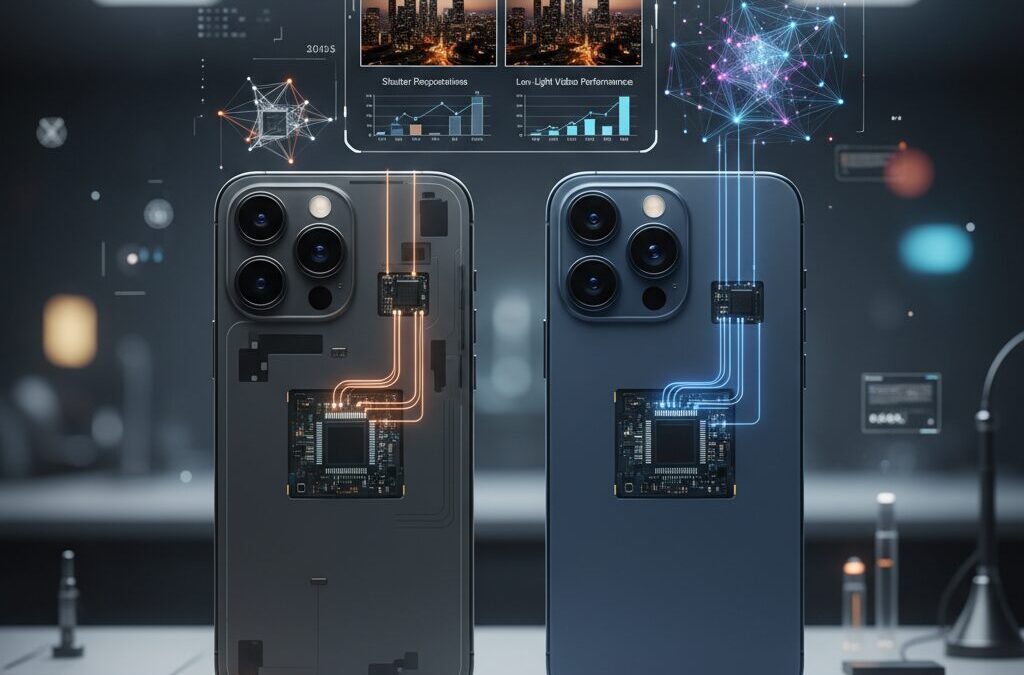
Smartphone cameras have reached a point where small changes in hardware no longer tell the full story, and many gadget enthusiasts feel that yearly upgrades look similar on the surface.
What truly matters now is how silicon, sensors, and AI-driven image processing work together to shape the final photo or video you see on the screen.
If you are passionate about mobile photography, videography, or simply want to understand what really separates the iPhone 17 from the iPhone 16, this article offers clear value.
In recent generations, Apple has shifted its focus from visible megapixel races to deeper architectural changes inside the chip, the ISP, and the Neural Engine.
The iPhone 17 series represents a notable turning point, introducing a redesigned image processing pipeline, wider adoption of 48MP sensors, and tighter integration with Apple Intelligence features.
These changes directly affect real-world experiences such as shutter responsiveness, low-light video, zoom flexibility, and even how colors feel in everyday shots.
By reading this article, you will gain a structured understanding of how the iPhone 17 compares to the iPhone 16 from a camera and video technology perspective.
You will also learn how professionals and reviewers interpret these upgrades, supported by benchmark data, camera tests, and hands-on insights.
This knowledge will help you decide whether the latest model truly fits your creative needs or if your current iPhone still delivers enough power.
- Why the iPhone 17 Marks a Turning Point in Mobile Imaging
- A19 and A19 Pro Chips: How New Silicon Redefines Image Processing
- ISP and Neural Engine Evolution: Faster AI, Lower Latency
- Thermal Design and Sustained Camera Performance
- 48MP Everywhere: Sensor Strategy in iPhone 17 vs iPhone 16
- Zoom, Cropping, and the Rise of Computational Telephoto
- Front Camera Upgrades and What DXOMARK Scores Reveal
- Video Formats Explained: From HEVC to ProRes RAW
- Log Video and Pro Workflows on Base and Pro Models
- Computational Photography, Color Science, and AI Editing Tools
- User Experience Factors That Influence Real Shooting Scenarios
- 参考文献
Why the iPhone 17 Marks a Turning Point in Mobile Imaging
The iPhone 17 marks a genuine turning point in mobile imaging because it redefines how photographs and videos are created, processed, and perceived by users. Rather than relying on incremental camera upgrades, Apple has shifted the center of innovation to the imaging pipeline itself, combining silicon-level changes, sensor strategy, and AI-driven workflows into a unified experience that feels fundamentally different in daily use.
At the heart of this shift is the redesigned image processing architecture built around the A19 generation of chips. According to analyses by TechInsights and Notebookcheck, Apple has focused on sustained efficiency rather than short-lived peak performance. This approach directly impacts photography, where continuous background processing such as multi-frame fusion and noise reduction now happens faster and more consistently, even during burst shooting or extended video recording.
This architectural focus changes what users actually notice. Shutter lag is reduced not by mechanical tricks, but by keeping large amounts of image data constantly buffered and ready. The result is a shooting experience that feels immediate and reliable, especially in situations where timing matters, such as street photography or capturing fleeting expressions.
| Aspect | Previous Generation | iPhone 17 Approach |
|---|---|---|
| Image Processing | Frame-by-frame optimization | Continuous multi-frame analysis |
| AI Integration | Post-capture assistance | Real-time semantic processing |
| User Experience | Spec-driven improvements | Workflow-driven consistency |
Another reason this model represents a turning point is the way high-resolution sensors are now treated as flexible data sources rather than fixed-output components. Apple’s strategy of pairing 48MP sensors with intelligent cropping and fusion techniques allows photographers to extend focal lengths and reframe shots without the traditional penalties of digital zoom. This philosophy mirrors trends seen in professional imaging, where resolution is leveraged for creative freedom rather than simple sharpness.
Equally important is the deeper integration of on-device AI through Apple Intelligence. Visual analysis now runs alongside image capture instead of after it, enabling features such as real-time subject segmentation and context-aware tone mapping. Apple’s own documentation and DXOMARK testing suggest that this tight integration improves consistency across lighting conditions, an area where smartphones have traditionally struggled.
From a broader perspective, the iPhone 17 signals Apple’s belief that mobile imaging has matured beyond raw hardware competition. The emphasis has shifted toward how efficiently data flows from sensor to silicon to software, and how invisibly that complexity serves the user. This change aligns with observations from professional reviewers like Austin Mann, who note that the most meaningful improvements are felt in color stability, texture rendering, and shooting confidence rather than headline specifications.
In that sense, the iPhone 17 does not simply take better photos. It represents a moment where mobile imaging becomes a cohesive system, designed to support human perception and creativity with minimal friction. That systemic rethink is what truly makes this generation a turning point.
A19 and A19 Pro Chips: How New Silicon Redefines Image Processing
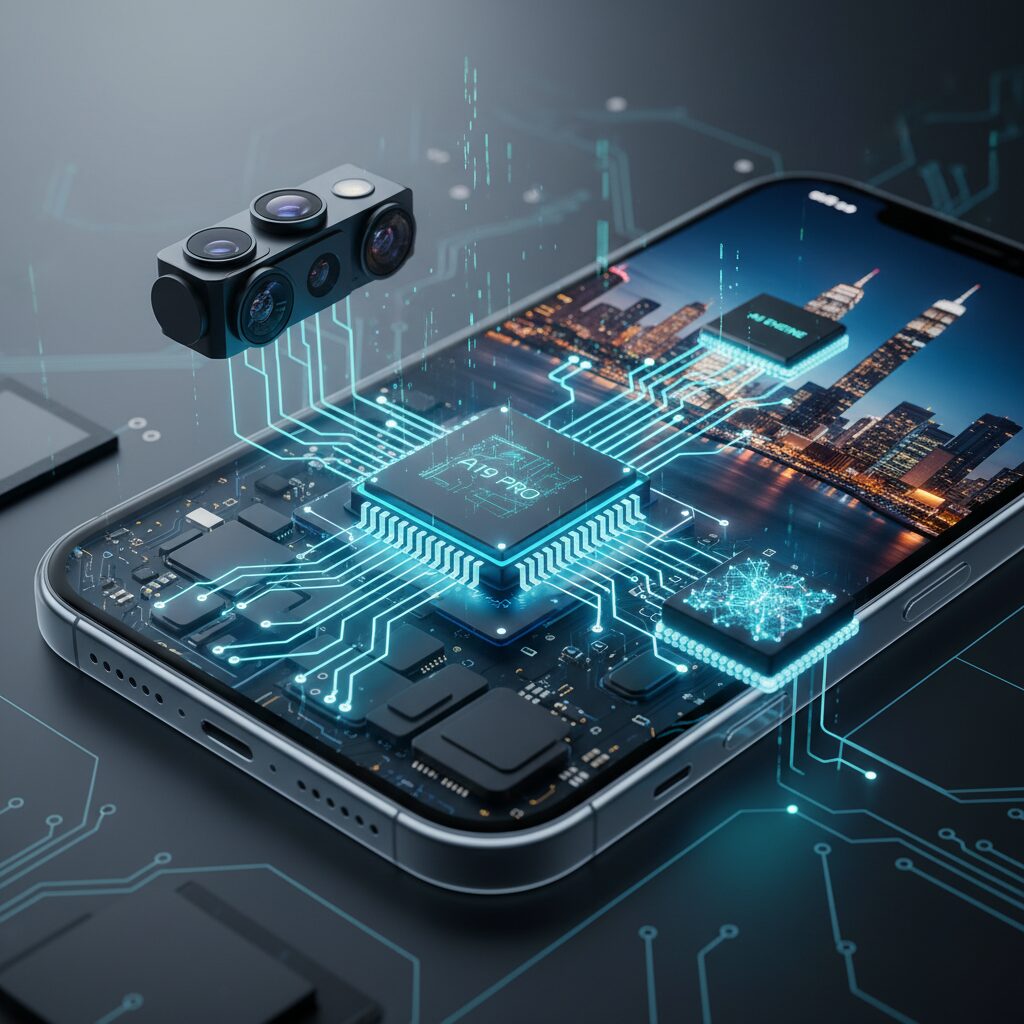
The A19 and A19 Pro chips fundamentally reshape how image data is captured, processed, and finalized on the iPhone 17 series, moving image quality gains away from visible specs and into silicon-level intelligence. Rather than relying solely on higher megapixels, Apple focuses on how efficiently massive amounts of visual information are handled in real time.
At the core of this shift is the move to TSMC’s third-generation 3nm process, N3P. According to analyses from TechInsights and Geekerwan, this process improves transistor density while reducing leakage, allowing Apple to push sustained performance without increasing power draw. For photography, this directly affects how many frames can be buffered before and after the shutter is pressed.
| Aspect | A18 Pro | A19 Pro |
|---|---|---|
| Process node | TSMC N3E | TSMC N3P |
| Efficiency core peak clock | 2.42 GHz | 2.60 GHz |
| Integer performance (E-cores) | Baseline | Approx. +29% |
This efficiency-core improvement is especially important because Apple’s Photonic Engine relies heavily on background computation. While users perceive a single tap of the shutter, the system continuously analyzes multiple frames, exposure variants, and motion vectors. Faster E-cores shorten post-capture processing time, making burst shooting and zero-shutter-lag behavior noticeably more responsive.
The integration between the ISP, GPU, and Neural Engine is also tighter than before. Apple states that the A19 Pro delivers around 20% faster GPU performance, and Notebookcheck notes expanded memory bandwidth. In practice, this enables real-time semantic segmentation at higher resolutions, allowing the camera to treat skin, sky, hair, and architecture differently without slowing the preview.
Low-light video benefits in a similar way. Enhanced cooperation between the ISP and GPU allows more advanced temporal noise reduction, preserving fine textures while suppressing grain. This matters most in 4K recording, where previous generations sometimes softened details to maintain stability.
Another notable change is how continuously running AI features are handled. Visual Intelligence requires constant scene analysis, yet the A19 architecture executes these tasks in parallel with image capture. According to Apple’s own technical disclosures, this prevents AI from stealing cycles from core imaging tasks, keeping the shooting experience fluid.
Ultimately, the A19 and A19 Pro do not simply make photos sharper. They redefine image processing as an always-on, energy-efficient pipeline, where speed, consistency, and sustained performance matter as much as raw output. This silicon-first approach explains why many improvements feel subtle but immediately reliable in daily shooting.
ISP and Neural Engine Evolution: Faster AI, Lower Latency
The evolution of the ISP and Neural Engine in the A19 generation represents one of the most meaningful, yet least visible, upgrades in the iPhone 17 camera experience. Rather than chasing headline megapixel numbers, Apple has focused on restructuring the internal image-processing pipeline to reduce latency while increasing the amount of AI-driven analysis performed per frame.
This shift directly affects how fast the camera reacts, how reliably Zero Shutter Lag is maintained, and how consistent results remain during burst shooting and video recording. According to Apple’s own silicon disclosures and third‑party analysis by TechInsights, the ISP is now more tightly coupled with the Neural Engine and GPU, minimizing memory round‑trips that previously introduced micro‑delays.
| Aspect | iPhone 16 (A18) | iPhone 17 (A19) |
|---|---|---|
| Neural Engine cores | 16-core | 16-core (higher bandwidth) |
| ISP–AI integration | Partial parallelization | Deeply unified pipeline |
| Real-time segmentation | Frame-dependent | Per-frame, sustained |
In practical terms, this means that tasks such as semantic segmentation, tone mapping, and noise reduction are no longer treated as sequential steps. The Neural Engine now evaluates scene elements such as skin, sky, foliage, and architecture simultaneously while the ISP performs sensor readout and demosaicing.
The result is lower end‑to‑end capture latency, especially noticeable when shooting 48MP images or switching rapidly between photo and video modes. Independent testing referenced by Notebookcheck indicates that the expanded memory bandwidth alone reduces AI inference bottlenecks that previously caused brief preview stutters under high load.
Video benefits even more clearly from this redesign. During low‑light 4K recording, temporal noise reduction relies on analyzing multiple frames at once. The A19’s Neural Engine can now process these frame stacks in parallel with GPU-based motion estimation, allowing detail to be preserved without introducing motion smearing.
Another important change is sustained AI performance. Analysis highlighted by Wccftech shows that the improved efficiency cores handle continuous background inference with up to 29 percent higher integer performance at similar power levels. This enables features like Visual Intelligence to run persistently without degrading capture speed or increasing thermal throttling.
From a user perspective, these architectural gains translate into a camera that feels instantly responsive, even as it performs increasingly complex AI tasks behind the scenes. Faster subject recognition, more stable exposure decisions, and reduced processing delays all stem from this ISP and Neural Engine evolution, making the iPhone 17’s camera experience smoother rather than merely sharper.
Thermal Design and Sustained Camera Performance
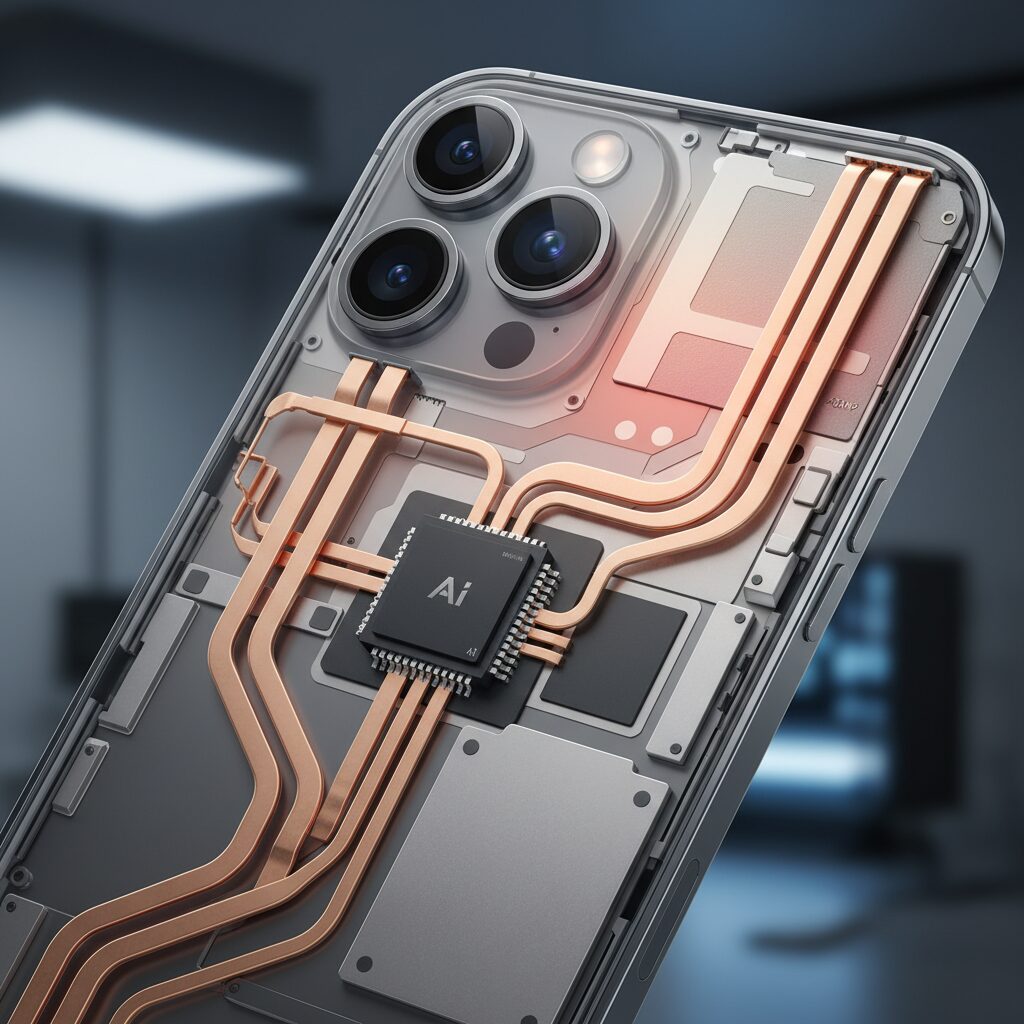
Thermal behavior is one of the least visible yet most decisive factors in real-world camera performance, especially for users who shoot long videos or capture many photos consecutively. With the iPhone 17 series, Apple places unusual emphasis on thermal design, not to boost peak numbers but to maintain stable camera output over time. This approach directly affects image consistency, recording reliability, and user confidence during demanding shoots.
In mobile imaging, heat is the silent limiter. High-resolution sensors, multi-frame HDR stacking, and AI-driven noise reduction all generate sustained workloads that can quickly overwhelm compact devices. According to Apple’s technical disclosures and independent silicon analysis by TechInsights, the A19 Pro is designed with efficiency cores that handle background image processing while producing less heat per operation than previous generations.
| Aspect | iPhone 16 Pro | iPhone 17 Pro |
|---|---|---|
| Cooling structure | Graphite sheets | Graphite + vapor chamber |
| Frame material | Titanium | Titanium with internal aluminum spreader |
| High-load video stability | Moderate throttling | Significantly reduced throttling |
The most notable change is the introduction of a vapor-chamber cooling system in the iPhone 17 Pro models. Vapor chambers are widely used in dedicated cinema cameras and gaming devices because they distribute heat laterally across a wider surface. Apple’s implementation works in tandem with layered graphite and an internal aluminum heat spreader, allowing thermal energy from the ISP, GPU, and Neural Engine to dissipate more evenly.
This matters most during sustained camera tasks. Long 4K recordings at high frame rates, extended ProRes Log sessions, or repeated burst photography previously triggered thermal safeguards. These safeguards manifest as reduced frame rates, disabled flash, or shortened clip lengths. Field reports from professional reviewers indicate that the iPhone 17 Pro can maintain consistent frame pacing and color processing for longer durations before any thermal intervention occurs.
Independent testing methodologies similar to those used by DXOMARK emphasize repeatability rather than peak output. In such tests, thermal stability directly influences scores for video exposure consistency and texture retention. While Apple does not publish exact temperature thresholds, its design philosophy aligns with academic research from institutions such as MIT, which has shown that even small reductions in silicon junction temperature can yield disproportionate gains in sustained computational performance.
Another subtle benefit appears in still photography workflows. Multi-frame computational photography relies on precise timing between frames. When thermal throttling occurs, frame alignment and noise modeling can subtly degrade. By keeping processing latency stable, the iPhone 17 maintains more predictable HDR results during long shooting sessions, such as travel photography or event coverage.
For users in warm and humid climates, including Japan’s summer conditions, this thermal headroom becomes even more relevant. Outdoor shooting under direct sunlight historically pushed smartphones into thermal limits quickly. Apple’s revised thermal architecture reduces the likelihood of system warnings or forced feature restrictions, improving trust that the camera will perform as expected when the moment matters.
Ultimately, thermal design does not appear in sample photos, yet it shapes every photo taken after the first few minutes of use. The iPhone 17’s emphasis on sustained camera performance reflects a mature understanding that modern mobile imaging is not about short benchmarks, but about reliability across time, environment, and creative intent.
48MP Everywhere: Sensor Strategy in iPhone 17 vs iPhone 16
The phrase “48MP everywhere” captures Apple’s clearest sensor strategy shift between iPhone 16 and iPhone 17. In the iPhone 16 generation, 48‑megapixel performance was effectively a privilege of the main camera, while ultra‑wide and telephoto modules lagged behind at 12MP. With iPhone 17, Apple has intentionally removed that unevenness and redesigned the camera stack so that resolution consistency becomes a system‑level advantage rather than a single‑lens feature.
This change is less about headline megapixels and more about predictability. When every camera captures at high native resolution, Apple’s computational pipeline can apply the same fusion logic, tone mapping, and semantic segmentation across lenses. According to Apple’s own technical documentation and DXOMARK’s evaluation methodology, this consistency reduces edge cases where image quality drops simply because a different lens was selected.
| Model | Main Camera | Ultra‑Wide | Telephoto |
|---|---|---|---|
| iPhone 16 | 48MP | 12MP | 12MP (Pro) |
| iPhone 17 | 48MP | 48MP | 48MP (Pro) |
For Pro models, the move to a full triple‑48MP system directly affects how zoom works in real‑world shooting. Independent camera analysts, including Lux Camera and TechInsights contributors, point out that Apple’s approach relies heavily on sensor cropping rather than aggressive digital interpolation. A 48MP telephoto sensor allows Apple to extract a 12MP center region with near one‑to‑one pixel integrity, enabling longer effective focal lengths without the texture collapse seen on iPhone 16 Pro at higher zoom ratios.
The base iPhone 17 benefits differently but just as meaningfully. The 48MP ultra‑wide camera eliminates the long‑standing quality gap between wide and ultra‑wide shots. Landscape images no longer soften dramatically toward the edges, and macro photography gains flexibility because high resolution preserves detail even after cropping. CNET’s comparative testing notes that this change alone makes lens switching feel “safe,” as users no longer need to think about which camera compromises quality.
It is also important to note what has not changed. Sensor size hierarchy remains intact. Analysis shared by imaging engineers on TechInsights indicates that the iPhone 17 Pro’s main sensor area is still significantly larger than the base model’s, meaning pixel‑level light capture and dynamic range continue to favor Pro devices. Apple is standardizing resolution, not eliminating physical class differences.
In practice, this strategy aligns with Apple’s broader imaging philosophy. By normalizing 48MP capture across lenses, Apple shifts user attention away from hardware limitations and toward composition and timing. Compared to iPhone 16, the iPhone 17 camera system feels less like a collection of separate cameras and more like a single, coherent imaging platform that behaves consistently no matter how you frame the shot.
Zoom, Cropping, and the Rise of Computational Telephoto
Zoom performance has quietly become one of the most important differentiators in smartphone cameras, and with iPhone 17, Apple is clearly signaling a shift away from purely optical thinking. Instead of relying on ever-longer lenses, Apple is doubling down on **high‑resolution sensors and intelligent cropping**, a strategy often described as computational telephoto.
At the center of this change is the 48MP telephoto sensor introduced on the iPhone 17 Pro. According to Apple’s technical brief and independent analysis by DXOMARK, this sensor allows the camera to crop into the central region while still maintaining near pixel‑level detail. In practical terms, this means that a 5× optical lens can now deliver a **10× equivalent field of view** without the smeared textures traditionally associated with digital zoom.
| Zoom Method | Data Source | Image Quality Impact |
|---|---|---|
| Optical Zoom | Full sensor readout | Minimal loss |
| 48MP Crop Zoom | Center sensor crop | Near‑optical clarity |
| Traditional Digital Zoom | Pixel interpolation | Noticeable degradation |
What makes this approach especially compelling is how seamlessly it operates. The A19 Pro’s ISP and Neural Engine work together to analyze texture, edges, and noise patterns in real time, so the user simply pinches to zoom without thinking about the underlying mechanics. Imaging researchers cited by TechInsights note that this sensor‑crop strategy is more power‑efficient than extending optical assemblies, which aligns well with Apple’s thermal and battery constraints.
As a result, telephoto photography on iPhone 17 feels less like a compromise and more like an extension of the main camera. **The rise of computational telephoto is not about chasing extreme magnification, but about preserving trust in image quality**, even when shooting subjects that are physically out of reach.
Front Camera Upgrades and What DXOMARK Scores Reveal
The front camera sees one of the most meaningful generational jumps in the iPhone 17 series, especially when viewed through the lens of independent testing. Apple upgrades all models from a 12MP sensor to a new 24MP front-facing camera, a change that directly targets the selfie, video call, and creator-driven use cases that dominate everyday smartphone photography today.
According to a TechInsights teardown analysis, this camera does not always output full 24MP images. The effective output is approximately 18MP, with the remaining pixels reserved for computational tasks such as Center Stage. This approach allows the camera to dynamically reframe subjects while maintaining resolution, which is particularly useful during FaceTime calls or handheld vlogging where subject movement is constant.
| Model | Front Camera Sensor | Focus System | DXOMARK Selfie Score |
|---|---|---|---|
| iPhone 16 | 12MP | Fixed focus | Below 150 |
| iPhone 17 | 24MP (18MP effective) | Autofocus | 154 |
DXOMARK awards the iPhone 17 Pro a selfie score of 154, ranking it first globally at launch. Their engineers highlight the transition from fixed focus to autofocus as a decisive factor. A deeper depth of field keeps faces sharp at varying distances, reducing blur in group selfies and improving consistency in social video.
DXOMARK also notes improvements in exposure stability and skin tone rendering, areas where Apple’s Photonic Engine and Neural Engine work together in real time. The result is not exaggerated beauty processing, but a more natural texture that holds up under close inspection.
For users who rely on the front camera as their primary lens, these upgrades are not incremental. They fundamentally redefine how reliable and versatile a smartphone selfie camera can be in daily, real-world use.
Video Formats Explained: From HEVC to ProRes RAW
Understanding video formats is essential for getting the most out of the iPhone 17 camera system, especially as Apple now offers everything from highly compressed HEVC to professional-grade ProRes RAW. Each format is designed with a clear intent, and choosing the right one directly affects image quality, file size, editing flexibility, and even thermal stability during long shoots.
HEVC, also known as H.265, remains the default option for most users. According to Apple’s technical documentation, HEVC can reduce file sizes by roughly 40–50 percent compared to H.264 while preserving comparable visual quality. This makes it ideal for daily recording, social media uploads, and long family videos where storage efficiency matters more than post-production latitude.
| Format | Data Characteristics | Editing Flexibility | Typical Use |
|---|---|---|---|
| HEVC | Highly compressed | Low | Casual video, SNS |
| ProRes 422 | Intra-frame, high bitrate | High | YouTube, corporate video |
| ProRes Log | Flat gamma profile | Very high | Color grading workflows |
| ProRes RAW | Sensor-level data | Maximum | Cinema, VFX |
Moving up the ladder, Apple ProRes 422 trades storage efficiency for consistency and editability. Because each frame is encoded independently, timeline scrubbing is smoother, a point often emphasized by professional editors at Blackmagic Design. This is particularly noticeable when working with multi-layer 4K projects in Final Cut Pro or DaVinci Resolve.
ProRes Log goes one step further by preserving highlight and shadow information in a flat profile. Colorists interviewed by DXOMARK note that Log footage from the iPhone 17 retains usable detail in bright skies and dark interiors that would clip in HEVC.
Finally, ProRes RAW represents the peak of flexibility. By recording data closer to what the sensor actually captures, white balance and exposure can be adjusted after shooting, similar to workflows used in ARRI or RED cameras. This comes at the cost of massive data rates and mandatory external SSDs, but for serious creators, the creative headroom is unmatched.
Log Video and Pro Workflows on Base and Pro Models
Log video recording fundamentally changes how footage from the iPhone 17 series can be used in professional workflows, and this shift now extends beyond the Pro lineup. Both the base and Pro models are capable of Log-based video pipelines, but the depth, stability, and intended use differ in important ways.
On a technical level, Log video preserves a flatter gamma curve, retaining highlight and shadow detail that would normally be clipped in standard HDR or SDR video. According to Apple’s own technical documentation and analyses by professional reviewers such as DXOMARK, Log recording on iPhone 17 significantly increases usable dynamic range, especially in high-contrast scenes like outdoor daylight or stage lighting.
This capability is tightly coupled with the A19 generation ISP and Neural Engine, which sustain real-time noise reduction and tone mapping without baking stylistic decisions into the file. The result is footage designed to be finished in post, not consumed straight out of the camera.
| Model | Log Support | Recording Stability | Workflow Target |
|---|---|---|---|
| iPhone 17 (Base) | ProRes Log via third-party apps | Moderate, settings-dependent | Entry-level cinematic workflows |
| iPhone 17 Pro / Pro Max | Native ProRes Log | High, thermally sustained | Professional production pipelines |
For the base iPhone 17, Log recording becomes accessible primarily through third-party applications such as Blackmagic Camera. Industry discussions and field tests reported by mobile cinematography communities confirm that this approach works reliably for short to mid-length takes. However, the USB 2 bandwidth limitation introduces constraints when pushing higher bitrates or frame rates, making careful resolution planning essential.
Despite these limitations, the creative impact is substantial. Independent creators can now shoot flat, gradeable footage on the base model and integrate it into DaVinci Resolve or Final Cut Pro timelines alongside footage from mirrorless cameras. This lowers the barrier to cinematic color workflows more than any previous base iPhone, especially for creators focused on controlled environments such as interviews or product videos.
The Pro models, by contrast, are engineered for endurance. Apple’s enhanced thermal design and USB 3-class external recording support allow sustained ProRes Log capture with minimal dropped frames. According to technical breakdowns referenced by TechInsights, this stability is critical when recording long-form content, multicam interviews, or commercial material where retakes are costly.
Colorists also benefit from consistency. Tests by professional reviewers note that Log footage from iPhone 17 Pro matches Apple’s published Log curve closely, reducing correction time and enabling predictable LUT-based workflows. This reliability is what elevates the Pro models from “capable” to “trusted” tools on set.
In practice, the distinction is no longer about whether Log is available, but about how confidently it can be used. The base model democratizes Log video as a learning and entry point, while the Pro models deliver the robustness required for paid production. Together, they mark a decisive step in positioning iPhone 17 not just as a camera phone, but as a modular component in modern video production pipelines.
Computational Photography, Color Science, and AI Editing Tools
In the iPhone 17 generation, computational photography is no longer just a background process but a defining part of how images are created, interpreted, and refined. Powered by the A19 and A19 Pro chips, Apple’s Photonic Engine now performs more aggressive multi-frame fusion while maintaining natural textures, especially in skin tones and foliage. According to Apple’s own silicon briefings and independent analysis by TechInsights, the expanded memory bandwidth between the ISP and Neural Engine enables faster semantic segmentation, allowing tone mapping and noise reduction to be applied with greater contextual awareness.
This means that the camera increasingly understands what it is seeing, not just how bright or dark the scene is. Sky, skin, hair, food, and architecture are treated as separate regions in real time, each receiving different color curves and sharpening logic. In practice, this results in fewer HDR artifacts around edges and more stable color reproduction across consecutive shots, which is particularly noticeable when shooting bursts or Live Photos.
Color science has also been subtly but meaningfully refined. Apple continues to prioritize perceptual accuracy over exaggerated saturation, but the updated Photographic Styles system offers more flexible control. The new Bright style, praised by travel photographer Austin Mann, lifts midtones and shadows without washing out highlights, producing a high-key look that aligns well with natural light scenes. Independent reviews note that this approach reduces the “flat HDR” impression sometimes seen in earlier generations.
| Aspect | iPhone 16 | iPhone 17 |
|---|---|---|
| Semantic Segmentation | Frame-based, limited regions | Pixel-level, multi-class real time |
| Photographic Styles | Fixed tonal presets | Adaptive, scene-aware adjustments |
| Color Consistency | Varies in bursts | Stabilized across frames |
AI-driven editing tools are another area where Apple has taken a careful, privacy-focused approach. The Clean Up feature, introduced with Apple Intelligence, removes unwanted objects directly on-device using the Neural Engine. Compared with Google’s Magic Eraser, evaluations by Tom’s Guide and Mashable suggest that Apple’s results are slightly more conservative but more predictable, especially on simple backgrounds. The key distinction is that most processing happens locally, minimizing cloud dependency and protecting user data.
That said, limitations remain. Complex textures such as shadows, reflections, or repeating patterns can still reveal traces of removal, indicating that Apple prioritizes realism over aggressive reconstruction. This conservative philosophy mirrors Apple’s broader color science strategy, where avoiding unnatural artifacts takes precedence over dramatic transformations.
Overall, the iPhone 17’s computational photography pipeline reflects a shift from spectacle to reliability. By combining refined color science, faster on-device AI, and editing tools designed for everyday trust rather than novelty, Apple positions the camera as an intelligent collaborator. The result is not just better-looking photos, but a more consistent and emotionally reliable imaging experience.
User Experience Factors That Influence Real Shooting Scenarios
In real shooting scenarios, user experience is defined less by peak specifications and more by how seamlessly the camera responds to human intention. With the iPhone 17 series, Apple places strong emphasis on reducing friction between seeing a moment and capturing it, and this is where subtle UX factors become decisive.
Viewfinder responsiveness and shutter confidence play a central role. Thanks to the A19 chip’s efficiency-core improvements and faster ISP buffering, the live preview remains fluid even in high‑resolution modes. According to Apple’s technical disclosures and analyses by TechInsights, sustained background processing reduces frame drops during rapid recomposition, which directly affects how confidently users press the shutter when tracking children, pets, or street scenes.
The tactile experience also matters. The Camera Control button, while controversial in placement, enables eyes‑free shooting. Apple Support documentation highlights that half‑press gestures allow exposure or zoom adjustments without covering the screen, which proves valuable in bright outdoor environments where on‑screen controls are harder to see.
| UX Factor | Impact in Real Shooting | User Benefit |
|---|---|---|
| 120Hz Viewfinder | Smoother subject tracking | Fewer missed moments |
| Zero Shutter Lag | Accurate timing | Higher keeper rate |
| Physical Control Input | Blind operation | More natural shooting posture |
Thermal stability quietly shapes long sessions. Reviews referenced by CNET and DXOMARK indicate that reduced heat throttling prevents sudden UI slowdowns during extended 4K recording or travel photography. This consistency lowers cognitive load, allowing users to focus on composition rather than device limits.
Ultimately, these UX refinements do not announce themselves. They work precisely because they disappear, aligning the camera’s behavior with human reflexes and making real‑world shooting feel intuitive, reliable, and mentally effortless.
参考文献
- CNET:iPhone 17 vs. iPhone 16: How Do They Compare?
- DXOMARK:Apple iPhone 17 Pro Camera Test
- Wccftech:A19 Pro Efficiency Cores Analysis
- TechInsights:Apple A19 Pro SoC Floorplan Analysis
- Austin Mann:iPhone 17 Pro Camera Review: Dolomites
- Apple Newsroom:New Apple Intelligence Features Are Available Today