
Tablet prices have climbed dramatically over the past few years, driven by premium silicon, extended software support, and global cost pressures. Flagship models now rival high-end laptops in price, pushing many tech enthusiasts to reconsider how—and where—they invest in their next device.
At the same time, the secondary market for tablets has evolved into a sophisticated ecosystem with professional grading standards, certified data erasure, and warranty programs that rival new-product protection. Buying used is no longer a compromise. It is a strategic decision grounded in value retention, lifecycle analysis, and risk management.
In this article, you will discover how depreciation curves really work, why software support is more important than raw specs, how network restrictions can instantly destroy resale value, and which sales channels offer true buyer protection. If you care about performance, sustainability, and maximizing ROI on your gadgets, this guide will help you make a smarter move in 2026.
- Tablets as Digital Assets: Why the Secondary Market Has Matured
- Macroeconomic Forces: Inflation, Currency Volatility, and the Rise of Used Demand
- Depreciation Curves Explained: When a Tablet Hits the Value Sweet Spot
- iPad vs Android: Structural Differences in Resale Stability
- Software Lifespan as Hidden Value: OS Support and Functional Obsolescence
- Apple Silicon vs Legacy Chips: Feature Gaps That Affect Long-Term ROI
- The 7-Year Android Update Era: How Extended Support Is Reshaping Resale Markets
- Network Restrictions and IMEI Locks: The Structural Risk of Cellular Models
- Professional Retailers vs Peer-to-Peer Platforms: Warranty, Data Erasure, and Buyer Protection
- Hardware Inspection Protocol: Battery Chemistry, OLED Burn-In, and Port Degradation
- Legal and Compliance Considerations: Power Adapter Safety and Certified Data Wiping
- Best Used Tablet Picks for 2026: Creators, Students, Media Consumers, and Budget Buyers
- 参考文献
Tablets as Digital Assets: Why the Secondary Market Has Matured
By the mid-2020s, tablets have clearly shifted from optional media devices to fully capable primary machines for work and creation. With Apple’s M-series chips delivering desktop-class performance and high-end Android tablets evolving into serious multitasking tools, the technical gap between tablets and laptops has narrowed dramatically. At the same time, flagship pricing has climbed to levels once reserved for premium PCs.
In Japan in particular, prolonged yen weakness and global semiconductor cost pressures have amplified retail prices. High-end models such as the latest iPad Pro now sit in what many consumers perceive as “luxury asset” territory. As a result, the secondary market is no longer a fallback for budget buyers. It has become a rational, strategic arena for acquiring performance at a discounted entry point.
Used tablets are increasingly treated as depreciating digital assets rather than disposable electronics. Price curves, support lifecycles, and resale value are now analyzed much like financial instruments.
Data compiled by domestic price-tracking services such as Used-Lab shows that iPad models typically experience their steepest depreciation in the first two to three years after release. After this initial drop, prices stabilize, forming a predictable “mature phase” where supply from corporate lease returns and early adopters increases liquidity. This structural predictability signals a market that has moved beyond opportunistic trading.
| Lifecycle Stage | Typical Age | Market Behavior |
|---|---|---|
| Launch Phase | 0–1 year | Minimal discount, limited supply |
| Depreciation Phase | 1–3 years | Sharp price correction |
| Stabilization Phase | 3–4+ years | High liquidity, value equilibrium |
Equally important is the institutionalization of trust. Major retailers such as GEO, Iosys, and Janpara have implemented ISO-aligned data erasure workflows and standardized grading systems. According to ITmedia Mobile’s coverage of GEO’s processing centers, industrial-scale inspection and certified wiping tools like Blancco are now embedded in resale operations. This dramatically reduces the information asymmetry that once defined secondhand electronics.
Warranty structures further illustrate maturity. Red-ROM lifetime guarantees for network restrictions, clearly defined grading tiers, and 30–90 day defect coverage transform risk into quantifiable variables. In economic terms, uncertainty is being priced and insured rather than ignored.
The secondary tablet market in 2026 functions less like a flea market and more like a structured asset exchange. Buyers evaluate chipset generation, OS support horizon, and residual value before committing capital. Sellers factor in depreciation curves and support longevity when timing upgrades.
This convergence of high primary-market pricing, longer hardware lifespans, and professionalized resale infrastructure explains why tablets are now treated as durable digital assets. The maturity of the secondary market is not accidental. It is the logical outcome of technological plateauing, transparent pricing data, and institutional risk management working together.
Macroeconomic Forces: Inflation, Currency Volatility, and the Rise of Used Demand

From 2024 to 2026, the Japanese gadget market has been shaped by a powerful macroeconomic trio: inflation, yen depreciation, and global component cost pressure. As flagship tablets such as the iPad Pro and other premium models cross the psychologically significant 100,000‑yen threshold—and in high-end configurations approach 300,000 yen—purchasing decisions are no longer purely about specs. They are about timing, currency exposure, and asset preservation.
Because most leading tablets are priced in U.S. dollars at the global level, retail prices in Japan move almost in tandem with exchange rate fluctuations. When the yen weakens, import costs rise immediately. According to industry coverage and retail analysis cited by ITmedia and major resale platforms, even mid-cycle price revisions have become more frequent in recent years. For consumers, this creates a structural incentive to look backward rather than forward.
In this context, used tablets function as a practical hedge against inflation. While secondhand prices do rise when new-device prices climb, the increase is typically more moderate. The result is an expanding spread between new and used markets.
| Market Phase | New Price Trend | Used Price Reaction |
|---|---|---|
| Yen depreciation | Immediate upward revision | Gradual upward adjustment |
| High inflation | Cost pass-through to retail | Partial absorption via supply |
| Model aging (2–3 years) | Minimal discounts | Stabilized “value zone” pricing |
This widening price gap is particularly visible in models that are two to four years old. By that stage, the steep initial depreciation has already occurred, yet performance remains more than sufficient for creative and business workloads. Buyers are effectively purchasing post-depreciation computing power.
Another macro driver is corporate device turnover. Many enterprises operate on three-year lease cycles. When those leases expire, large volumes of professionally maintained tablets enter the secondary market simultaneously. This predictable supply injection increases liquidity and suppresses price volatility, creating buying windows that do not exist in the new market.
On the Android side, volatility behaves differently. Carrier-driven promotions—sometimes effectively pricing entry models at near-zero upfront cost—can flood the resale channel with unused inventory. As resale analysts and sales rankings from major retailers indicate, this oversupply can push prices down sharply even for near-new devices. In macro terms, this is a distortion created by subsidy policy rather than intrinsic product value.
The key insight is that used demand is no longer a sign of constrained budgets but a rational response to currency risk and inflation uncertainty. In a market where flagship tablets resemble durable assets more than disposable electronics, secondhand purchasing becomes a strategic allocation decision. For tech-savvy consumers, understanding these macro forces transforms the used market from a bargain hunt into a calculated investment in computing capability.
Depreciation Curves Explained: When a Tablet Hits the Value Sweet Spot
Tablet prices do not fall in a straight line. They follow a depreciation curve shaped by supply cycles, software lifespan, and macroeconomic pressure. Understanding this curve is the key to identifying the true value sweet spot.
In the Japanese market between 2024 and 2026, new flagship tablets have crossed psychologically significant thresholds, with premium configurations approaching or exceeding ¥100,000. As new prices rise, used prices also increase, but not at the same speed. This widening spread creates opportunity.
The sweet spot typically appears after the steep initial depreciation has stabilized but before software support anxiety sets in.
| Lifecycle Phase | Age Since Release | Price Behavior | Buyer Advantage |
|---|---|---|---|
| Early Stage | 0–12 months | Minimal decline | Low |
| Adjustment Phase | 1–3 years | Sharp drop | Rising |
| Stability Phase | 3–4 years | Gradual decline | Highest |
| Obsolescence Risk | 5+ years | Volatile | Declining |
According to aggregated secondary market tracking data published in early 2026, newly released models such as recent iPad Pro generations show only marginal month‑to‑month declines, sometimes under 2 percent. Limited supply and strong demand for near-new condition units keep resale values elevated.
This means buying a current-generation tablet secondhand rarely delivers meaningful savings. Warranty duration and battery freshness often make new or certified refurbished purchases more rational at this stage.
The real inflection point emerges around the three-year mark. Corporate lease cycles in Japan commonly run for approximately three years, after which large batches of well-maintained devices enter the secondary market. This surge in supply exerts downward pressure on prices.
When supply expands but performance remains competitive, value density peaks. Processing power in modern tablets has outpaced typical usage needs, so a three-year-old high-end model often exceeds everyday productivity or creative requirements.
Macroeconomic conditions amplify this effect. As new-device pricing climbs due to currency shifts and semiconductor costs, older flagship models become relatively more attractive. The absolute price may not collapse, but the relative performance-per-yen ratio improves dramatically.
However, depreciation curves differ by ecosystem. iPad models historically follow smoother and more predictable trajectories, supported by long OS lifecycles. In contrast, Android tablets—especially carrier-distributed entry models—can experience abrupt value drops when promotional campaigns flood the market.
This structural difference creates two distinct sweet spot strategies. With iPads, patience until the stabilization phase tends to be rewarded. With certain Android models, extreme short-term oversupply can generate sudden bargain windows, particularly for specific use cases such as media consumption or child devices.
Timing also interacts with software support expectations. As ITmedia and other industry analyses have noted, extended OS support policies—such as multi‑year update commitments from leading manufacturers—directly influence resale stability. Longer guaranteed support flattens the late-stage decline.
The optimal purchase window is therefore not defined only by age, but by remaining software runway. A four-year-old tablet with several years of confirmed updates left may offer more strategic value than a cheaper five-year-old device nearing end-of-support.
In practical terms, the value sweet spot is the moment when depreciation slows, supply is abundant, and software lifespan still feels secure. Buyers who align these three variables do not simply save money—they maximize technological leverage per yen spent.
iPad vs Android: Structural Differences in Resale Stability
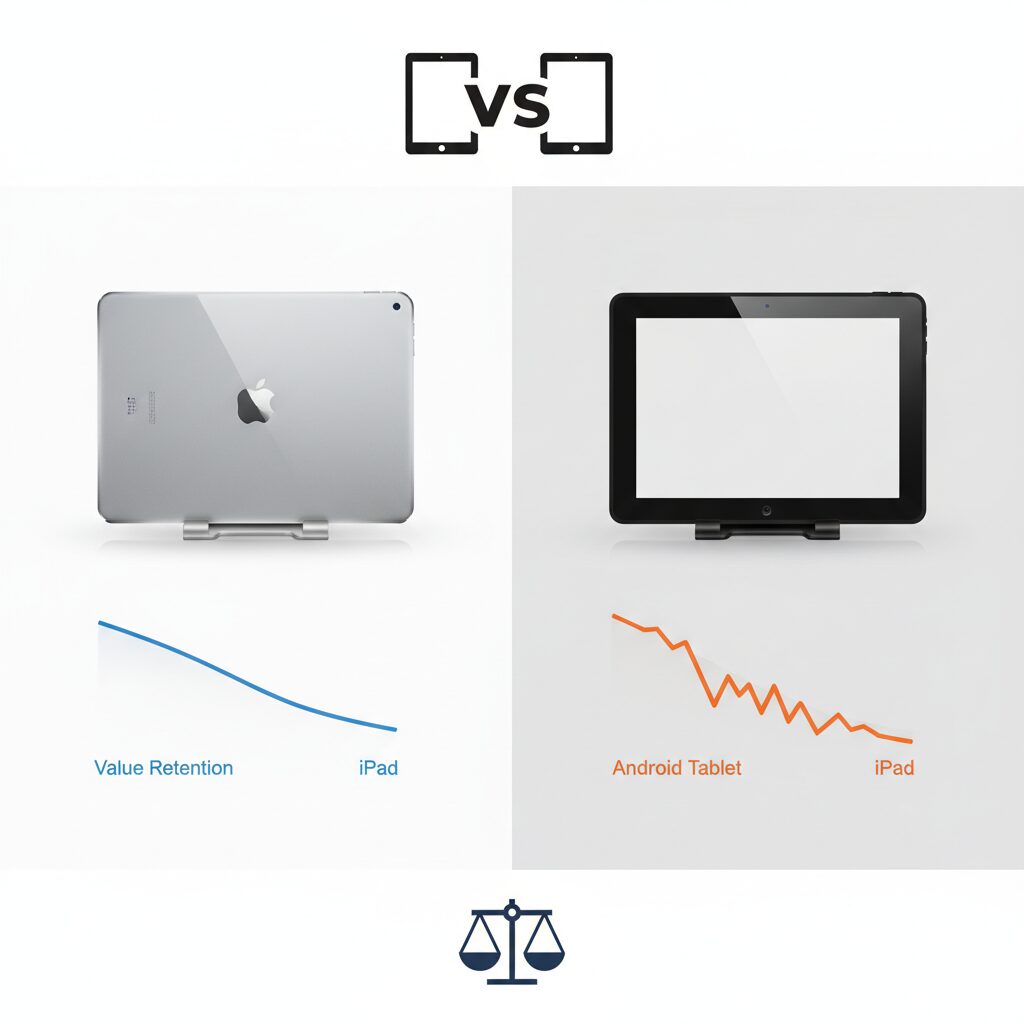
When discussing resale stability, the structural differences between iPad and Android tablets become impossible to ignore.
It is not simply a matter of brand popularity. The divergence is rooted in ecosystem control, product segmentation, update policy consistency, and supply dynamics.
According to aggregated used-market data in Japan, iPad models tend to follow a gradual and predictable depreciation curve, whereas Android tablets show far wider price dispersion depending on brand and tier.
| Factor | iPad | Android Tablets |
|---|---|---|
| Ecosystem Control | Fully integrated (Apple) | Multi-vendor, fragmented |
| Model Segmentation | Clear lineup hierarchy | Extreme high–low polarization |
| OS Support Visibility | Historically long, consistent | Brand-dependent |
| Price Volatility | Relatively stable | Highly variable |
The first structural pillar is ecosystem centralization. Apple designs the chipset, OS, hardware, and distribution strategy in-house.
This vertical integration creates long-term demand predictability in the secondary market. Buyers trust that even older iPads will retain functional relevance for years.
This trust directly translates into stronger resale floors.
Android, by contrast, operates as a distributed ecosystem. Samsung, Google, Lenovo, Xiaomi, and numerous regional brands compete across dramatically different price bands.
As ITmedia reports regarding extended Android update policies, long-term support is improving, but it remains manufacturer-specific rather than platform-wide.
This means resale value depends less on “Android” as a category and more on the exact model lineage.
The second structural factor is lineup clarity. Apple releases a limited number of iPad models each year, maintaining a simple tier system: standard, Air, mini, and Pro.
This clarity reduces internal cannibalization in the used market. A three-year-old iPad Pro does not suddenly compete with dozens of nearly identical low-cost alternatives.
In contrast, Android tablets face aggressive internal competition, especially in entry segments where carrier-distributed models can flood the market.
As seen in Japanese resale channels, certain entry-level Android devices experience rapid price compression once promotional stock enters circulation.
Even unopened units may trade at steep discounts due to oversupply dynamics.
Such supply shocks rarely occur within the iPad ecosystem.
Another key distinction lies in perceived longevity. Historically, iPads have received major OS updates for five to seven years.
This track record conditions buyers to assume long usability, even if exact timelines are not guaranteed per model.
Android’s recent shift toward seven-year support for flagship models, particularly from Samsung and Google, is beginning to stabilize high-end resale values, but the effect is concentrated at the top tier.
Finally, brand equity functions differently. In resale environments, “iPad” operates almost as a category name rather than merely a product line.
Liquidity remains high because demand is broad and brand perception is consistent across generations.
Android tablets, however, trade on brand-specific reputations. A Galaxy Tab S series unit may retain value strongly, while a lesser-known brand depreciates sharply despite similar specifications.
In structural terms, iPad resale stability is driven by ecosystem cohesion and supply discipline, whereas Android resale performance is model-dependent and tier-sensitive.
For buyers analyzing second-hand markets strategically, the implication is clear.
Choosing an iPad often means betting on systemic stability. Choosing Android requires precise model selection and awareness of brand-level policy commitments.
The difference is not merely about hardware quality, but about how each platform is architected at the ecosystem level.
Software Lifespan as Hidden Value: OS Support and Functional Obsolescence
When evaluating a used tablet, many buyers focus on visible wear or battery health. However, the true hidden value lies in its software lifespan. A device may look pristine, yet once OS support ends, its practical utility begins to erode rapidly.
Modern tablets are technically capable of running for five years or more. The limiting factor is not silicon degradation, but the vendor’s update policy. As security patches and major OS updates cease, the device transitions from productive tool to potential liability.
Software support defines functional longevity more than raw hardware power. This is the critical lens through which secondhand buyers should evaluate value.
| Support Status | Security Updates | New Features | Market Value Impact |
|---|---|---|---|
| Full Support | Active | Eligible | High resale stability |
| Security Only | Limited | Restricted | Gradual depreciation |
| End of Support | None | None | Sharp value decline |
Apple historically provides iPadOS updates for approximately five to seven years, according to longitudinal device tracking by industry observers. Yet a subtle shift has emerged in the Apple Silicon era. While older A‑series iPads may still receive OS updates, certain advanced capabilities—such as external display expansion or AI-driven features—require M‑series chips.
This creates what can be described as “functional obsolescence.” The device is technically supported, but strategically limited. A buyer who chooses an A13 or A14-based model may receive security patches, yet miss out on platform-defining innovations.
In contrast, Google and Samsung have reshaped expectations in the Android ecosystem. As reported by ITmedia and confirmed by manufacturer policy disclosures, flagship Galaxy Tab and Pixel devices now promise up to seven years of OS and security updates. This dramatically alters depreciation curves in the secondary market.
A seven-year commitment does not merely extend usability. It stabilizes residual value. A tablet guaranteed updates into the early 2030s carries fundamentally different risk compared to a device nearing its final patch cycle.
The key risk in used tablets is not physical failure, but support horizon uncertainty.
Functional obsolescence also affects app compatibility. Once major OS upgrades stop, developers gradually raise minimum requirements. Productivity suites, banking apps, and creative tools may drop support within a few years after the final OS version. This phenomenon is well documented in both the App Store and Google Play ecosystems.
For enterprise or security-conscious users, the stakes are higher. Without active security patches, vulnerabilities remain unmitigated. In regulated environments, deploying unsupported devices may violate compliance policies.
Therefore, the strategic question is not “How old is this tablet?” but “How many supported years remain?” A three-year-old flagship with four years of guaranteed updates can be a smarter investment than a two-year-old midrange model with one year left.
In secondhand computing, time-to-end-of-support functions like a countdown clock. Buyers who understand this invisible timer gain a decisive informational advantage in the market.
Apple Silicon vs Legacy Chips: Feature Gaps That Affect Long-Term ROI
When evaluating long-term ROI in the used tablet market, the most decisive dividing line is no longer brand or storage capacity. It is whether the device runs on Apple Silicon (M-series) or legacy A-series chips.
At first glance, both may receive iPadOS updates. However, feature eligibility—not just OS support length—determines the real economic lifespan of the device.
Apple has clearly segmented advanced capabilities around M1 and later chips, creating structural feature gaps that directly impact resale value and productivity potential.
| Category | Apple Silicon (M1 or later) | Legacy A-Series (A12–A14 etc.) |
|---|---|---|
| External Display | Full external monitor support | Mirroring only (limited) |
| Multitasking | Stage Manager supported | Traditional Split View only |
| AI Features | Eligible for Apple Intelligence-class features | Limited or unsupported |
| Future App Demands | Desktop-class architecture | Mobile-first architecture |
The introduction of Stage Manager is a practical example. On M1 iPads and later, users can run multiple resizable windows and drive a full external display environment. On A-series models, this workflow is structurally unavailable. For professionals using external monitors, this difference alone changes the device from a consumption tablet into a lightweight workstation.
According to industry analysis discussed by ITmedia and other Japanese tech outlets, Apple’s silicon transition effectively aligned iPad architecture with Mac-class performance. This convergence is not merely about speed benchmarks—it affects software roadmaps.
Developers increasingly optimize high-end creative and AI-driven applications for unified memory architecture and desktop-class GPUs. Over time, legacy chips may technically run the OS but fail to unlock next-generation workflows.
Another hidden ROI factor is AI acceleration. Apple Intelligence and related on-device processing rely on Neural Engine advancements present in newer silicon. Even if older iPads remain secure and functional, exclusion from AI ecosystems reduces their strategic relevance in a productivity-first environment.
This creates what can be called a “functional obsolescence gap.” The device works, but its competitive utility declines faster.
In resale markets, this distinction is already visible. M1-equipped models such as iPad Air (5th generation) maintain stronger price floors compared to similarly aged A14-based models. Buyers are pricing in future feature access, not just current performance.
For cost-sensitive buyers, legacy A-series iPads may still offer excellent short-term value for media consumption or education. However, from a capital efficiency standpoint, choosing Apple Silicon extends both functional longevity and resale defensibility.
In a secondary market shaped by inflation and high flagship prices, architectural eligibility becomes an asset class of its own.
Understanding this structural divide allows buyers to move beyond sticker price comparisons and evaluate tablets as long-duration digital infrastructure investments.
The 7-Year Android Update Era: How Extended Support Is Reshaping Resale Markets
For years, Android tablets were seen as disposable hardware, often receiving only one or two major OS updates. That perception is now rapidly becoming outdated.
Since 2024, leading manufacturers such as Samsung and Google have publicly committed to significantly longer update policies for flagship devices. According to ITmedia, this shift has been driven by sustainability demands and regulatory pressure in regions such as the EU, fundamentally changing the lifecycle economics of Android devices.
The move toward up to seven years of OS and security updates is not just a software policy change. It is a structural shock to the resale market.
Longer software support directly increases expected residual value, extends liquidity in secondary markets, and reduces depreciation volatility.
Consider Samsung’s Galaxy Tab S series, where recent flagship models are promised extended OS and security patch coverage for up to seven years. This means a device purchased in 2024 could remain officially supported into the early 2030s. From a resale perspective, this dramatically alters the “functional lifespan” calculation.
Previously, Android tablets often faced steep depreciation after year two, when update uncertainty began to erode buyer confidence. Now, a three-year-old flagship with four years of guaranteed updates remaining becomes an attractive mid-cycle asset rather than a near-obsolete device.
| Factor | Short Support Era (2–3 yrs) | 7-Year Support Era |
|---|---|---|
| Buyer Confidence (Year 3) | Low | High |
| Residual Value Stability | Volatile | More Predictable |
| Enterprise Resale Appeal | Limited | Significantly Improved |
This change also affects institutional supply. Corporate lease cycles typically run three years. In the past, off-lease Android tablets entering the secondary market were already halfway to software obsolescence. Under a seven-year policy, those same units still retain more than half of their official support window.
That transforms them into viable long-term purchases for schools, small businesses, and budget-conscious professionals. The secondary market no longer absorbs “aging stock” but redistributes devices still firmly within their supported lifecycle.
According to manufacturer policy summaries compiled by industry analysts in 2026, the support gap between flagship and entry-level Android models remains wide. This creates a clear segmentation effect in resale pricing.
Flagship Android tablets now behave more like iPads in depreciation curves, while entry models continue to depreciate aggressively.
In practical terms, buyers are beginning to price software years remaining as a tangible asset. A used Galaxy Tab S device with five years of updates left commands a measurable premium over a comparable model with only one remaining update cycle.
The psychological shift is equally important. When update longevity becomes predictable, resale markets gain transparency. Predictability reduces risk premiums, which stabilizes pricing and improves liquidity.
In the 7-year Android update era, software policy has become a financial variable. Extended support is no longer just a feature for end users. It is a valuation driver that reshapes how Android tablets are bought, sold, and held as digital assets.
Network Restrictions and IMEI Locks: The Structural Risk of Cellular Models
When you choose a cellular tablet instead of a Wi‑Fi model, you are not just buying mobility. You are also inheriting a structural dependency on carrier systems and payment histories that you cannot directly control.
In Japan’s secondary market, this risk is crystallized in the concept of network usage restrictions, commonly known as “red ROM” status. According to NTT Docomo and other major carriers, devices can be remotely restricted at the IMEI level if installment payments are not completed or if fraud or theft is suspected.
This restriction is not tied to the SIM card. It is tied to the device itself.
| Status | Meaning | Practical Risk |
|---|---|---|
| ◯ | Fully paid, no restriction risk | Safest option, stable resale value |
| △ | Installments ongoing | Future lock possible if payment stops |
| × | Restricted (red ROM) | No cellular connectivity available |
| – | No carrier sales record | Often SIM‑free, verification required |
The structural issue lies in the time lag. A device marked △ may function perfectly today. However, if the original owner defaults months later, the carrier can change the status to × without notice to the second buyer.
LINEMO’s official guidance clearly explains that once restricted, even MVNO services operating on the same network become unusable. In practical terms, your LTE or 5G‑enabled tablet instantly becomes a Wi‑Fi‑only device.
The financial damage is asymmetric: you bear 100% of the loss, while the original debtor disappears from the equation.
IMEI verification systems published by Docomo and other carriers allow buyers to check status before purchase. Yet verification is only a snapshot in time. It does not eliminate future default risk.
This is where structural market differences emerge. Major retailers such as GEO, Iosys, and Janpara publicly state that they provide red ROM guarantees, including replacement or refund if a device later becomes restricted. ITmedia Mobile reports that large chains implement industrial‑scale inspection and tracking systems to mitigate such risk.
In contrast, C2C marketplaces provide no long‑term protection once a transaction is completed. Even if the listing claims “no restriction,” the platform typically does not compensate for future IMEI locks.
From a strategic perspective, this changes valuation logic. A Wi‑Fi model’s risk is primarily technical. A cellular model’s risk is partly financial and contractual.
For risk‑averse buyers, paying a premium for a ◯ status device with documented red ROM warranty is economically rational. For aggressive bargain hunters, purchasing △ status without guarantee is effectively speculating on someone else’s repayment behavior.
Understanding this structural asymmetry is essential before deciding that a cheaper cellular model is truly a better deal.
Professional Retailers vs Peer-to-Peer Platforms: Warranty, Data Erasure, and Buyer Protection
When choosing a used tablet, the most critical difference is not price but risk allocation. Professional retailers and peer-to-peer platforms operate under fundamentally different assumptions about warranty, data erasure, and post-purchase protection.
In short, you are not just buying a device—you are buying a risk management framework.
| Factor | Professional Retailers | Peer-to-Peer Platforms |
|---|---|---|
| Warranty | 30–90 days standard, optional extensions | Usually none after transaction |
| Red-ROM Protection | Often unlimited exchange/refund | No future protection |
| Data Erasure | Certified tools (e.g., Blancco) | Seller-dependent |
| Dispute Resolution | Clear corporate policy | Platform mediation, limited scope |
Major Japanese retailers such as GEO, Iosys, and Janpara provide written warranty terms. According to their published policies, standard used-device coverage typically ranges from 30 days to three months, with paid extensions available in some cases. GEO and Janpara also explicitly state that red-ROM incidents are covered even beyond the initial defect period.
This matters because network restrictions can occur months after purchase if a previous owner defaults on installment payments. With a retailer, the liability shifts away from you. In peer-to-peer transactions, it does not.
Data erasure standards reveal an even sharper contrast. ITmedia reports that GEO uses Blancco, a globally recognized enterprise-grade data sanitization solution adopted by governments and large corporations. Certified erasure provides auditability and compliance assurance, which is especially relevant for business users.
On peer-to-peer platforms, erasure depends entirely on the seller’s technical literacy. A factory reset is often sufficient for encrypted modern devices, but there is no verification trail. You are trusting an individual, not a process.
Buyer protection mechanisms also differ structurally. Retailers operate under Japan’s commercial law framework and must clearly disclose return policies and defect handling procedures. In contrast, platforms like Mercari or Yahoo! Auctions primarily mediate disputes only before transaction completion. Once the deal is finalized, latent defects become difficult to contest.
This asymmetry creates what economists call “information imbalance.” The seller knows more about the device history than the buyer. Professional retailers attempt to neutralize this imbalance through grading standards and inspection protocols. Peer-to-peer markets price it in through lower upfront cost.
For high-value tablets—especially cellular models with network dependency—the financial downside of a single failure can easily exceed the initial savings. Conversely, for low-cost Wi-Fi-only devices intended as secondary units, some users may rationally accept that risk.
The decision is therefore strategic rather than moral: do you prefer predictable cost with institutional backing, or variable cost with personal due diligence? Understanding that distinction allows you to choose the channel that aligns with your tolerance for uncertainty.
Hardware Inspection Protocol: Battery Chemistry, OLED Burn-In, and Port Degradation
When evaluating a used tablet, surface scratches are the least of your concerns. The real determinants of long-term value lie in three invisible domains: battery chemistry, display degradation, and physical port integrity. A disciplined inspection protocol transforms a risky purchase into a calculated investment.
Battery Chemistry: Capacity Is Only Half the Story
Lithium-ion batteries degrade through charge cycles, heat exposure, and calendar aging. As capacity declines, internal resistance increases, reducing peak voltage delivery. This is why aging devices may shut down unexpectedly under load, even if the remaining percentage appears sufficient.
Apple does not universally display battery health percentages on all iPad models, unlike iPhones. Therefore, buyers often rely on third-party diagnostics such as CoconutBattery or iMazing after purchase to check cycle count and maximum capacity. If maximum capacity falls below 80%, replacement costs must be factored into the acquisition price, typically in the range of 15,000–20,000 yen in Japan.
According to industry practices cited by major refurbishers, enterprise-grade inspection tools are commonly used before resale, but disclosure standards vary by retailer. Always request measurable data rather than subjective labels such as “good battery.”
Display Technology: OLED Burn-In vs. LCD Pressure Damage
| Panel Type | Primary Risk | Inspection Method |
|---|---|---|
| OLED | Burn-in (image retention) | Display full white and gray screens to detect ghosting |
| LCD | White spots, yellowing | Check brightness uniformity on white background |
OLED panels, used in premium models such as high-end Galaxy Tab S devices and recent iPad Pro variants, are susceptible to burn-in when static UI elements remain displayed for long periods. Demo units are particularly vulnerable. Faint status bar shadows or icon outlines are early warning signs.
LCD panels face different aging patterns. Pressure-induced white spots and uneven color temperature shifts are more common. Some retailers classify minor uniformity issues as within manufacturer tolerance, meaning they may not qualify as defects under warranty terms. Inspection under neutral lighting conditions is essential before finalizing purchase.
Port Degradation: The Overlooked Failure Point
USB-C and Lightning ports experience mechanical stress with every insertion cycle. Over time, solder joints and internal connectors loosen. A simple but effective test involves gently moving the cable while charging. If power intermittently disconnects, internal wear is already advanced.
Port replacement is far more invasive than battery service and often not economically viable for mid-range tablets. For productivity users relying on external displays or high-speed data transfer, compromised port stability directly reduces functional lifespan.
A comprehensive hardware inspection is not about cosmetic perfection. It is about predicting failure vectors. By systematically evaluating electrochemical health, display integrity, and mechanical stress points, you align purchase price with realistic remaining service life and avoid hidden depreciation traps.
Legal and Compliance Considerations: Power Adapter Safety and Certified Data Wiping
When buying or selling a used tablet, performance and price tend to dominate the conversation. However, legal compliance and safety standards are equally critical factors, especially regarding power adapters and certified data wiping.
Ignoring these elements can expose you to fire hazards, regulatory violations, or serious data breaches. For gadget enthusiasts who value both optimization and risk control, understanding these compliance layers is essential.
Power Adapter Safety and PSE Compliance
In Japan, the Electrical Appliance and Material Safety Act (DENAN) regulates electrical products, including AC adapters and lithium-ion battery devices. As reported by Impress Watch, the sale of non-compliant mobile batteries without the PSE mark has been prohibited since regulatory tightening in 2019.
While tablets themselves are classified as devices with built-in batteries and treated differently from standalone battery packs, AC adapters included with used tablets must carry the appropriate PSE mark.
| Item | PSE Requirement | User Risk if Non-Compliant |
|---|---|---|
| Tablet (built-in battery) | Handled as integrated device | Low if original product |
| AC Adapter (charger) | PSE mark required | Fire or overheating hazard |
| Unknown third-party charger | Often non-compliant | High electrical safety risk |
Major secondary retailers typically replace missing original adapters with certified PSE-compliant alternatives. In contrast, peer-to-peer marketplaces may bundle unverified overseas chargers. From a risk-management perspective, discarding uncertified adapters and purchasing from reputable brands is a rational decision.
A discounted tablet is never worth the risk of electrical fire caused by a non-certified charger.
Certified Data Wiping and Compliance Standards
Equally important is data sanitization. Modern iPadOS and Android devices use full-disk encryption, and performing a factory reset effectively destroys encryption keys, rendering previous data inaccessible. For individual users, this cryptographic erasure is generally sufficient.
However, commercial resale channels apply higher standards. According to ITmedia’s coverage of GEO Mobile, major refurbishers deploy enterprise-grade data erasure solutions such as Blancco. This software is widely used by governments and large enterprises worldwide to overwrite storage areas and generate tamper-proof erasure certificates.
The distinction matters in two scenarios: when selling a device that previously handled sensitive corporate data, and when purchasing a used tablet for business deployment. In both cases, traceable and certified data erasure becomes a compliance requirement, not just a convenience.
Specialized retailers often industrialize this process through centralized processing centers, ensuring standardized wiping, logging, and auditability. This systematic approach significantly reduces the asymmetry of trust that exists in informal resale markets.
For security-conscious buyers, asking whether certified erasure tools were used is not excessive—it is due diligence. In a mature secondary market, safety marks and data sanitization protocols are not optional add-ons but foundational pillars of responsible digital asset circulation.
Best Used Tablet Picks for 2026: Creators, Students, Media Consumers, and Budget Buyers
Choosing the right used tablet in 2026 is no longer about simply picking the cheapest option. It is about aligning performance lifespan, OS support policy, and market depreciation timing with your actual use case.
As major manufacturers extend software support and flagship prices continue to rise, the secondary market has become a strategic entry point rather than a compromise. According to industry coverage by ITmedia, long-term Android update commitments and Apple’s chip transition have fundamentally reshaped resale value dynamics.
The smartest buyers in 2026 do not chase the newest model. They target the most efficient point on the depreciation curve.
Recommended Used Tablet Picks by User Type
| User Type | Recommended Model Tier | Why It Makes Strategic Sense |
|---|---|---|
| Creators | iPad Pro (M1 generation) | Desktop-class performance, full Stage Manager support, strong resale stability |
| Students | iPad Air (M1) | Long OS horizon, lightweight, best balance of price and longevity |
| Media Consumers | Galaxy Tab S8/S9 series | OLED display quality, bundled S Pen, extended Android support |
| Budget Buyers | Carrier-distributed Android entry models | Severely depreciated pricing, ideal for limited-use scenarios |
For creators working with illustration, video editing, or advanced multitasking, the M1-generation iPad Pro remains a rational sweet spot. It supports Apple’s advanced multitasking environment and external display features while trading at a substantial discount compared to newer M-series models. Given Apple’s historically long OS support window, its functional lifespan still stretches years ahead.
Students benefit most from the M1-based iPad Air. It avoids the performance ceiling of older A-series chips while maintaining portability and lower acquisition cost. Because software feature segmentation increasingly follows chip generation, choosing M1 over older A14-class devices protects future usability.
For media-focused users, Samsung’s Galaxy Tab S-series offers a different value equation. ITmedia reports that Samsung now commits up to seven years of updates on flagship lines, materially improving long-term viability. Combined with OLED panels and bundled stylus support, used S8 or S9 units often outperform similarly priced LCD-based alternatives in entertainment immersion.
Budget-oriented buyers should approach the market differently. Devices originally distributed through aggressive carrier promotions frequently flood the resale channel. As seen in resale trend tracking by major Japanese retailers, these models experience extreme price compression. While they lack long update horizons, they excel as disposable-purpose devices: bath streaming tablets, children’s YouTube machines, or navigation terminals.
The key distinction is not price alone but expected remaining utility years per dollar spent.
In 2026, the optimal used tablet is the one positioned just after steep early depreciation, still within active software support, and aligned precisely with your performance ceiling. When chosen strategically, a second-hand tablet is not a downgrade. It is a calculated digital asset acquisition.
参考文献
- Goopass Magazine:Where to Buy Used Tablets and What to Watch Out For
- Used Lab:Historical iPad Used Price Trends and Market Analysis
- ITmedia Mobile:Why Android OS Update Support Is Getting Longer
- LINEMO Guide:What Happens When Network Restrictions Are Applied?
- GEO Mobile:20+ Quality Assurance Measures for Used Smartphones
- Janpara:Warranty Policy and Terms of Service
- Impress Watch:Check the PSE Mark When Buying Mobile Batteries