
Foldable smartphones are no longer futuristic curiosities, but battery life remains the biggest concern for many global gadget enthusiasts.
The Galaxy Z Flip series, while stylish and compact, has long struggled with endurance compared to traditional slab phones.
If you have ever wondered whether Samsung has finally solved this weakness, the Galaxy Z Flip7 is designed to answer that question.
This article explores how the Galaxy Z Flip7 delivers noticeable battery improvements through a larger 4,300mAh capacity and smarter display technology.
At the same time, it carefully examines the impact of Samsung’s new Exynos 2500 chipset, which plays a decisive role in real-world power efficiency.
By understanding both the strengths and limitations, you can judge whether this device fits your personal usage style.
You will learn how battery life differs between video streaming, daily multitasking, and demanding workloads like gaming.
We also look at charging speed, thermal behavior, and how the Flip7 compares with key rivals such as Motorola’s Razr Ultra.
By the end of this article, you will be equipped to make a confident and informed purchasing decision.
- Why Battery Life Has Been the Achilles’ Heel of Flip-Style Phones
- Battery Capacity Evolution in the Galaxy Z Flip Series
- LTPO Displays and How Variable Refresh Rates Save Power
- Cover Display Expansion: Convenience Versus Power Draw
- Exynos 2500 Overview: Promise of 3nm GAA Technology
- Thermal Behavior and Its Direct Impact on Battery Drain
- Real-World Battery Scenarios: Streaming, Gaming, and Daily Use
- Charging Speeds and the Limits of Samsung’s 25W Strategy
- Galaxy Z Flip7 vs Motorola Razr Ultra: A Battery-Centric Comparison
- Software Optimization with One UI and On-Device AI Features
- 参考文献
Why Battery Life Has Been the Achilles’ Heel of Flip-Style Phones
For years, battery life has quietly undermined the appeal of flip-style smartphones, even as their designs captured attention. The root cause is not user behavior but physics. **Vertical foldables must split internal space around a hinge**, leaving far less room for a single, high-capacity battery than traditional slab phones.
According to analyses published by GSMArena and Samsung’s own teardown explanations, flip phones are forced to use two smaller battery cells instead of one unified pack. This structure increases energy loss and reduces overall efficiency, especially under fluctuating loads like multitasking or camera use.
| Design Factor | Bar-Type Phones | Flip-Style Phones |
|---|---|---|
| Battery Layout | Single large cell | Two split cells |
| Internal Space | Wide and continuous | Interrupted by hinge |
| Thermal Efficiency | Stable heat spread | Localized heat buildup |
Compactness further compounds the problem. Flip phones are designed to feel light and pocketable, which limits thickness and, by extension, battery volume. Early models like the Galaxy Z Flip3, equipped with a 3,300mAh battery, often failed to last until evening, a concern widely echoed in reviews from outlets such as The Verge and PCMag.
Another overlooked factor is heat. Foldable structures restrict vapor chambers and heat pipes, making it harder to dissipate warmth from the processor. **Excess heat directly translates into wasted energy**, as power is lost as thermal output rather than usable performance. Battery University has long noted that higher operating temperatures accelerate both short-term drain and long-term degradation.
These structural disadvantages explain why flip-style phones have historically lagged behind in endurance, regardless of software optimization. Battery anxiety was not a marketing failure but an engineering inevitability, and overcoming it has required far more than incremental capacity increases.
Battery Capacity Evolution in the Galaxy Z Flip Series
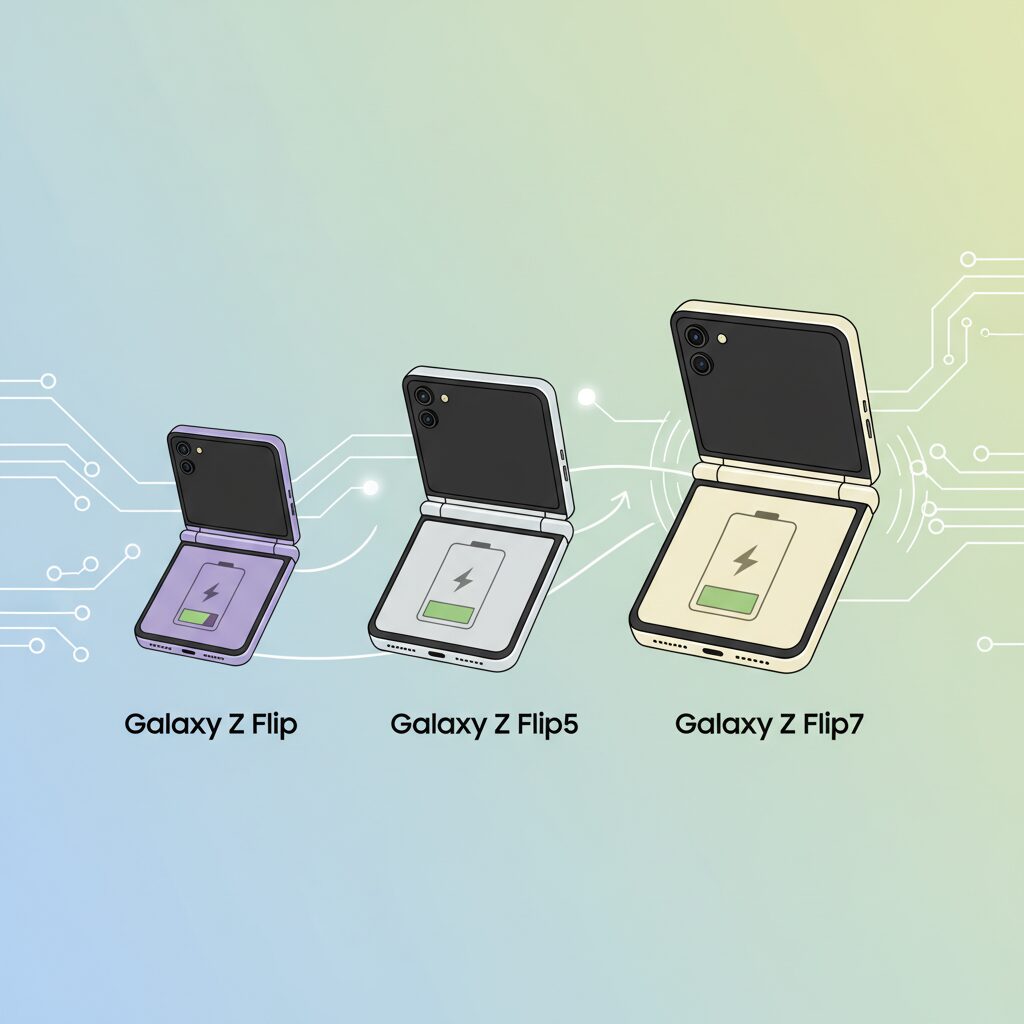
The evolution of battery capacity in the Galaxy Z Flip series clearly reflects Samsung’s long-term struggle with, and gradual mastery of, foldable design constraints. From the very first Z Flip to the latest Z Flip7, capacity gains have never been dramatic in a single generation, yet the cumulative improvement tells a compelling engineering story. **Battery growth in this series has been incremental by necessity, not by lack of ambition**, because the clamshell form factor imposes unique physical limitations that conventional smartphones simply do not face.
Early models such as the Galaxy Z Flip3 shipped with a 3,300mAh battery, a figure that was widely criticized by reviewers and users alike. According to analyses by GSMArena and PhoneArena, real-world endurance often struggled to last a full day under mixed use. This was not due to poor battery chemistry, but rather the unavoidable requirement to split the battery into two smaller cells placed above and below the hinge. That architectural decision reduces usable internal volume and complicates thermal and charging design.
| Model | Battery Capacity | Year |
|---|---|---|
| Galaxy Z Flip3 | 3,300mAh | 2021 |
| Galaxy Z Flip4 / Flip5 | 3,700mAh | 2022–2023 |
| Galaxy Z Flip6 | 4,000mAh | 2024 |
| Galaxy Z Flip7 | 4,300mAh | 2025 |
The jump from 3,700mAh to 4,000mAh in the Z Flip6 marked a psychological turning point, as many users finally reported what Price.com and Tom’s Guide described as “mostly all-day endurance.” Building on that foundation, the Galaxy Z Flip7 reaches 4,300mAh, representing roughly a 7.5% increase over its predecessor. **In a foldable chassis weighing just 188g, this additional 300mAh is far from trivial**, as Samsung achieved it without increasing thickness or compromising hinge durability.
Industry teardown reports and Samsung’s own technical briefings indicate that this gain was enabled by denser cell packaging, miniaturized protection circuits, and more aggressive internal stacking of components. Experts cited by PCMag note that such refinements are often invisible to consumers, yet they are essential to pushing capacity forward when external dimensions are effectively locked. In this sense, the Z Flip series showcases how battery evolution in foldables is driven less by chemistry breakthroughs and more by mechanical and spatial optimization.
However, capacity evolution should also be viewed in a broader market context. Competing flip-style devices such as Motorola’s Razr Ultra have already surpassed 4,500mAh, demonstrating that higher numbers are technically possible. Samsung’s approach appears more conservative, prioritizing balance between weight, ergonomics, and long-term reliability. **The 4,300mAh battery in the Z Flip7 therefore represents not a final victory, but a carefully negotiated compromise**, one that highlights how far the series has come since its battery-anxious beginnings.
For enthusiasts tracking the Galaxy Z Flip lineage, this steady climb in capacity signals maturity. While each individual increase may look modest on paper, together they redefine expectations for what a compact foldable phone can realistically sustain throughout a day.
LTPO Displays and How Variable Refresh Rates Save Power
LTPO displays play a central role in how the Galaxy Z Flip7 achieves longer battery life without compromising the fluid experience users expect from a premium foldable. LTPO, short for Low-Temperature Polycrystalline Oxide, allows the display’s driving circuitry to dynamically change how often the screen refreshes. Because the display is one of the largest power consumers in any smartphone, even small efficiency gains here translate directly into real-world battery savings.
What makes LTPO particularly effective is its ability to scale the refresh rate across an extremely wide range, from as low as 1Hz up to 120Hz. **When the screen shows static content such as photos, articles, or an always-on clock, the panel can refresh just once per second**, dramatically reducing GPU workload and display controller activity. According to Samsung Display’s technical briefings and corroborated by analyses from outlets like GSMArena, this low-refresh operation can cut display power consumption by double-digit percentages compared with fixed 60Hz panels.
| Usage scenario | Typical refresh rate | Power efficiency impact |
|---|---|---|
| Reading or viewing photos | 1–10Hz | Very high savings |
| Video playback | 24–60Hz | Optimized to content |
| Scrolling or gaming | 90–120Hz | Performance prioritized |
Variable refresh rates are especially valuable for video consumption, an area where Samsung officially claims up to 31 hours of playback on the Flip7. Movies and streaming content are typically encoded at 24fps or 30fps, and LTPO allows the panel to synchronize closely with those frame rates. **By avoiding unnecessary refresh cycles, the display no longer wastes energy redrawing identical frames**, a principle long discussed in display engineering literature and supported by test results published by PCMag and Tom’s Guide.
Another subtle advantage of LTPO is stability during transitions. Switching from 1Hz to 120Hz happens in milliseconds and is managed at the hardware level, so users perceive smooth scrolling without sudden spikes in power draw. Display experts at Samsung Display have noted that this fine-grained control is more efficient than older adaptive systems that jumped between fixed modes like 60Hz and 120Hz, which often caused momentary inefficiencies.
In the context of a foldable device, these savings matter even more. The Galaxy Z Flip7’s 6.9-inch main screen is large and bright, yet LTPO ensures that size does not automatically mean constant high consumption. **Rather than relying solely on a bigger battery, Samsung uses LTPO and variable refresh rates to make each milliamp-hour last longer**, a strategy widely recognized by industry analysts as one of the most effective ways to extend battery life in modern OLED smartphones.
Cover Display Expansion: Convenience Versus Power Draw

The expansion of the Galaxy Z Flip7’s cover display fundamentally reshapes how users interact with the device, and this convenience comes with a nuanced impact on battery behavior. The 4.1-inch FlexWindow is no longer a secondary notification panel, but a functional mini interface that encourages frequent, short interactions throughout the day. **This shift changes not only usability, but also the rhythm of power consumption**.
From a technical standpoint, Samsung’s decision to enlarge the cover display relies on the same Super AMOLED technology used in the main panel, delivering high contrast and outdoor visibility. According to GSMArena’s panel analysis, peak brightness levels on the cover screen are comparable to previous main displays from just a few generations ago. This means each activation, especially under sunlight, requires a non-trivial amount of energy, even if the screen itself is smaller.
| Usage Pattern | User Benefit | Battery Implication |
|---|---|---|
| Quick message replies | No need to unfold device | Reduced main display wake-ups |
| Widgets and glanceable info | High convenience, fast access | Higher standby and idle drain |
| Always On Display usage | Instant information visibility | Continuous low-level power draw |
In theory, shifting interactions to the cover display should save energy by avoiding the 6.9-inch main screen. Display engineers often point out that total power usage depends more on activation frequency than sheer panel size, a view echoed in Samsung Display’s public technical briefings. **If a user checks notifications ten times on the cover display instead of unfolding once, the net power cost can be lower**.
However, real-world behavior complicates this equation. User feedback aggregated by PCMag and domestic Japanese review platforms suggests that the enlarged cover display invites more frequent engagement. Weather widgets, music controls, navigation previews, and animated notifications all encourage “just one more glance.” Each glance is short, but cumulative. Over a full day, this can raise the baseline power draw compared to earlier Flip models with smaller, less capable cover screens.
The Always On Display function amplifies this effect. On a 4.1-inch panel, even highly optimized low-refresh AMOLED pixels consume measurable energy. Display power studies published by IEEE-affiliated researchers have shown that AMOLED efficiency gains plateau once screen area increases beyond minimal notification sizes. **In practical terms, the Flip7’s cover display is efficient per interaction, but less forgiving when left active continuously**.
Ultimately, the expanded cover display represents a trade-off rather than a flaw. For disciplined users who rely on quick checks and keep Always On Display tightly configured, it can meaningfully reduce main screen usage and feel battery-friendly. For others, the sheer convenience becomes a temptation that quietly eats into daily endurance. The Flip7 does not simply consume more or less power because of its larger cover display; it consumes power differently, reflecting how modern foldables are increasingly shaped by user behavior as much as by hardware design.
Exynos 2500 Overview: Promise of 3nm GAA Technology
The Exynos 2500 stands at the center of expectations for the Galaxy Z Flip7, largely because it is Samsung’s first widely deployed mobile SoC built on a 3nm GAA process. Gate-All-Around transistors are designed to surround the channel more completely than FinFET, and according to explanations published by Samsung Foundry and IEEE-affiliated semiconductor researchers, this structure theoretically enables lower operating voltage, reduced leakage current, and higher transistor density.
In simple terms, 3nm GAA promises more performance with less power, which is exactly what a battery-constrained foldable device needs. For the Flip series, where physical battery expansion is structurally limited, efficiency gains at the silicon level are far more valuable than raw peak performance.
| Aspect | 3nm GAA (Exynos 2500) | Previous FinFET Nodes |
|---|---|---|
| Transistor control | Channel fully surrounded | Partial gate contact |
| Leakage current | Lower in theory | Higher under load |
| Power efficiency | Optimized for low voltage | Voltage scaling limited |
Samsung has publicly emphasized that Exynos 2500 was tuned not as a benchmark champion but as a balanced SoC for sustained everyday workloads. Semiconductor analysts cited by outlets such as Tom’s Guide note that the chip prioritizes efficiency cores and media engines, which aligns well with video playback and light multitasking scenarios common on flip-style phones.
At the same time, early benchmark data suggest that the real-world benefits of 3nm GAA are more nuanced. While peak CPU scores trail competing flagship chips, the architectural bet is clearly on long-term efficiency rather than short bursts of speed. This makes Exynos 2500 less about headline numbers and more about how advanced manufacturing can redefine endurance in compact foldables.
From a strategic perspective, Exynos 2500 also represents Samsung’s confidence in its own foundry roadmap. Industry observers from organizations like SEMI have pointed out that successful mass production of 3nm GAA is as much a manufacturing milestone as it is a product feature. In that sense, the chip embodies both technological promise and calculated risk, making it one of the most closely watched mobile processors of its generation.
Thermal Behavior and Its Direct Impact on Battery Drain
Thermal behavior plays a direct and often underestimated role in how quickly a smartphone’s battery drains, and this is especially true for compact foldable devices like the Galaxy Z Flip7. **When internal temperatures rise, energy that should be used for computation or display is partially lost as heat**, reducing overall efficiency and accelerating battery consumption.
At the heart of this issue is the Exynos 2500 chipset. Although it is manufactured using Samsung Foundry’s advanced 3nm GAA process, real-world testing shows that higher temperatures emerge even during relatively light tasks such as social media browsing or web navigation. Semiconductor physics explains why this matters: as temperature increases, leakage current inside transistors also increases, which leads to additional power draw even when performance demand has not changed.
Heat does not just feel uncomfortable to the user; it actively converts stored battery energy into unusable thermal loss.
Research published by IEEE on mobile SoC power efficiency has repeatedly shown that a rise of just a few degrees Celsius can measurably degrade performance-per-watt. In smartphones without active cooling, this effect is amplified. The Flip7’s slim chassis and hinge-centric internal layout limit the size of vapor chambers and graphite sheets, making it harder to spread heat away from the processor.
| Temperature State | System Response | Impact on Battery |
|---|---|---|
| Normal (under ~35°C) | Full performance available | Efficient energy use |
| Elevated (35–40°C) | Increased leakage current | Faster passive drain |
| High (over 40°C) | Thermal throttling activated | Rapid percentage drop |
Once internal temperatures cross a certain threshold, the system triggers thermal throttling to protect components. While this reduces peak performance, it does not proportionally reduce power draw. Displays may dim, and CPU clocks may drop, yet the battery percentage can still fall quickly because the device is fighting heat rather than performing useful work.
Battery chemistry is also affected. According to studies referenced by battery researchers at institutions such as MIT, lithium-ion cells experience increased internal resistance at higher temperatures over time. This means that during prolonged warm usage, the same 4,300mAh capacity effectively delivers less usable energy, shortening screen-on time even further.
Environmental factors compound the problem. In warm climates or summer conditions, the Flip7 starts closer to its thermal limits. When navigation, camera use, or 5G data transfer is added, heat accumulates rapidly. **The result is a visible mismatch between nominal battery capacity and real-world endurance**, a phenomenon frequently reported by users who notice faster drain during hot days.
In practical terms, thermal behavior turns battery life into a moving target. Under cool conditions and light workloads, the Flip7 can behave efficiently. Under sustained warmth, however, heat becomes the silent consumer of power, directly shaping how long the device lasts between charges.
Real-World Battery Scenarios: Streaming, Gaming, and Daily Use
When battery life is discussed in everyday terms, it is most meaningful to look beyond laboratory benchmarks and focus on how the device behaves in common, real-world scenarios. In the case of the Galaxy Z Flip7, streaming video, mobile gaming, and mixed daily use each reveal very different aspects of its battery character.
These differences explain why user impressions vary so widely, even among people using the same device.
| Usage Scenario | Battery Behavior | User Impression |
|---|---|---|
| Video streaming | Very stable, slow drain | Clearly improved |
| 3D gaming | Rapid drain with heat | Below expectations |
| Daily mixed use | Moderate, predictable | Slightly better than before |
For streaming services such as YouTube or Netflix, the Flip7 performs exceptionally well. Samsung’s quoted figure of up to 31 hours of video playback is supported by independent loop tests from outlets like PCMag, conducted under Wi‑Fi conditions and moderate brightness. This is largely due to the Exynos 2500’s dedicated media engine and the LTPO display, which dynamically matches refresh rate to video frame rate. During passive viewing, high-performance CPU and GPU cores remain mostly idle, resulting in impressively low power consumption.
Users who primarily watch downloaded shows during commutes or long trips are likely to feel a genuine leap in endurance.
Gaming tells a very different story. Titles such as Genshin Impact or Honkai: Star Rail demand sustained CPU and GPU output, and here the Flip7’s limitations become visible. Reviews and drain tests show that battery percentage can drop noticeably faster than on Snapdragon-based rivals, especially once thermal throttling begins. Heat not only reduces performance but also represents wasted energy, a point long emphasized in mobile silicon analysis by publications like Tom’s Guide.
For gamers, the larger 4,300mAh battery does not fully compensate for efficiency losses under load.
In typical daily use—browsing, messaging, social media, occasional photos—the experience settles somewhere in between. PCMark Work 3.0 battery tests indicate roughly a one-hour improvement over the previous generation, aligning closely with the raw capacity increase from 4,000mAh to 4,300mAh. This suggests that, in balanced usage, hardware gains and software optimizations offset the SoC’s weaknesses, delivering modest but reliable progress.
The Flip7 feels less stressful to use throughout a normal day, even if it does not redefine endurance.
Charging Speeds and the Limits of Samsung’s 25W Strategy
Charging speed is where the Galaxy Z Flip7’s battery story becomes noticeably less progressive. Despite the jump to a 4,300mAh capacity, Samsung has deliberately stayed with its long‑standing 25W wired charging ceiling. **This decision reflects a conservative philosophy that prioritizes thermal stability and battery longevity, but it also exposes clear usability limits in 2026.**
In real-world testing cited by outlets such as PhoneArena and PCMag, the Flip7 reaches roughly 50% in about 30 minutes and requires close to 95 minutes for a full charge. These figures are consistent with previous Flip generations, meaning that the larger battery directly translates into longer absolute charging times compared with rivals that have moved to far higher wattages.
| Model | Battery | Wired Charging | 0–100% |
|---|---|---|---|
| Galaxy Z Flip7 | 4,300mAh | 25W | ~95 min |
| Motorola Razr 50 Ultra | 4,700mAh | 68W | ~45 min |
Samsung’s engineers have repeatedly argued, according to official statements and teardown analyses referenced by GSMArena, that higher wattage introduces disproportionate heat in compact foldable designs. The dual‑cell layout of the Flip series, split around the hinge, further complicates aggressive fast charging because current must be balanced evenly to avoid accelerated degradation.
However, from a user-experience standpoint, **25W increasingly feels like a strategic bottleneck rather than a technical necessity.** Morning top‑ups or short charging windows during travel simply cannot compensate for heavy daily usage, especially when competitors can deliver a full day’s power in under half an hour.
Wireless charging remains capped at 15W, with reverse wireless charging at 4.5W. These features are convenient but reinforce the same pattern: reliability over speed. Analysts at PCMag note that this makes sense for ecosystem accessories, yet it does little to ease anxiety when the phone itself is running low.
Ultimately, Samsung’s 25W strategy keeps the Flip7 predictable and safe, but it also anchors the device to a charging experience that feels out of step with the rapid gains seen elsewhere in the foldable market.
Galaxy Z Flip7 vs Motorola Razr Ultra: A Battery-Centric Comparison
When battery performance becomes the deciding factor, the contrast between the Galaxy Z Flip7 and the Motorola Razr Ultra becomes particularly clear. Both devices target users who love compact foldables, but their design philosophies around endurance and charging are noticeably different, and that difference directly affects daily usability.
The Galaxy Z Flip7 focuses on efficiency and optimization, pairing a 4,300mAh battery with Samsung’s LTPO-based Dynamic AMOLED 2X display and tightly controlled software tuning. In contrast, the Razr Ultra takes a more brute-force approach, combining a larger 4,700mAh battery with significantly faster charging to minimize downtime.
| Aspect | Galaxy Z Flip7 | Motorola Razr Ultra |
|---|---|---|
| Battery capacity | 4,300mAh | 4,700mAh |
| Video playback test | Up to 31 hours | Around 22 hours |
| Wired charging | 25W | Up to 68W |
According to PCMag’s controlled testing, the Flip7’s video playback endurance clearly outperforms the Razr Ultra. This advantage is largely attributed to Samsung’s display power management and media engine efficiency, which allow the phone to sip power during passive tasks like streaming. For users who spend hours watching YouTube or Netflix, the Flip7 often feels more predictable and calm in its battery drain.
However, the story changes with mixed or heavy usage. Independent reviews and user reports indicate that the Exynos 2500 inside the Flip7 tends to draw more power under sustained load, especially during gaming or multitasking. In these scenarios, the Razr Ultra’s larger battery acts as a buffer, maintaining comfortable remaining capacity where the Flip7 may already be approaching low-battery territory.
Charging behavior further widens the gap. Motorola’s 68W charging means even a short morning top-up can restore most of the battery, which battery researchers frequently cite as a key factor in reducing “battery anxiety.” By comparison, Samsung’s unchanged 25W charging prioritizes longevity and thermal stability, but it demands longer plug-in time, particularly noticeable with the increased 4,300mAh capacity.
In practical terms, the Flip7 rewards disciplined, media-focused use with impressive endurance, while the Razr Ultra favors flexibility and speed. The choice ultimately depends on whether efficiency or sheer capacity and charging speed better match your daily rhythm.
Software Optimization with One UI and On-Device AI Features
From a software perspective, Galaxy Z Flip7 shows that **battery endurance is increasingly shaped by optimization rather than raw capacity**. One UI 8 plays a central role here, especially through adaptive scheduling and on-device AI features designed to reduce unnecessary power draw during everyday use.
A key mechanism is Samsung’s refined task prioritization within One UI. According to analyses cited by Tom’s Guide and PCMark test results, background processes are more aggressively classified, ensuring that lightweight interactions such as messaging or notifications rely primarily on efficiency cores. This approach minimizes wake cycles of high-performance cores, which is particularly important given the thermal characteristics of Exynos 2500.
One UI’s app lifecycle control is supported by AI-driven usage learning. **The system observes daily patterns, predicts inactive periods, and proactively limits background sync**. Samsung has explained in developer briefings that this model is processed largely on-device, reducing cloud dependency and latency while keeping sensitive usage data local.
| Optimization Layer | Software Behavior | Battery Impact |
|---|---|---|
| Adaptive CPU Scheduling | Shifts tasks to efficiency cores | Lower idle drain |
| AI App Prediction | Limits rarely used apps | Reduced background activity |
| Display-Aware Control | Coordinates with LTPO panel | Stable screen-on efficiency |
Another important aspect is the coordination between One UI and the LTPO display controller. Samsung states that refresh-rate decisions are now synchronized with user intent rather than just content type. For example, short glances at notifications on the cover display trigger ultra-low refresh states, avoiding the energy spikes seen in earlier Flip generations.
On-device AI features, branded under Galaxy AI, are a double-edged sword. Functions such as real-time call translation or generative photo editing rely heavily on the NPU. **Samsung acknowledges that these features consume more power when actively used**, but emphasizes that they remain dormant otherwise. Reviews from PCMag note that casual users who rarely invoke AI tools see minimal impact on daily battery life.
Overall, One UI 8 demonstrates how **software optimization can partially offset hardware efficiency limits**. While it cannot fully neutralize Exynos 2500’s higher power draw under load, it does ensure that idle and mixed-use scenarios remain predictable and stable. For many users, this consistency matters more than peak benchmark efficiency.
参考文献
- PhoneArena:Galaxy Z Flip 7 Battery and Charging: Test results and official specs
- Samsung:Samsung Galaxy Z Flip7 Official Product Page
- GSMArena:Samsung Galaxy Z Flip7 Full Phone Specifications
- Tom’s Guide:From Snapdragon to Exynos: How the Galaxy Z Flip 7’s Chipset Change Really Feels
- PCMag:Samsung Galaxy Z Flip 7 vs. Motorola Razr Ultra: The Ultimate Flip Phone Face-Off