If you are the kind of gadget enthusiast who gets excited about getting closer—really closer—to your subject, macro photography on smartphones is no longer a gimmick, but a serious creative tool. Modern flagship phones promise extreme close-ups, AI-enhanced detail, and DSLR-like background blur, yet the actual experience often depends on optical behavior that spec sheets never explain. Understanding those hidden mechanics makes a real difference in the photos you can capture.
With the Google Pixel 10 Pro, macro photography enters a new and more complex phase. Beyond the familiar ultra‑wide macro mode, reports from early users and experts point to surprising behavior from the 5× periscope telephoto lens, especially when manual focus is involved. The difference between automatic and manual control can change your minimum shooting distance by tens of centimeters, unlocking an entirely different visual style that most users may never discover.
This article walks you through how the Pixel 10 Pro approaches macro photography from an optical and computational perspective. You will learn why minimum focus distance matters more than megapixels, how Google’s Tensor G5 processing influences lens switching, and what “telemacro” really means in practical shooting scenarios. By understanding these mechanisms, you can decide when to rely on AI and when to take control yourself.
Whether you shoot flowers, insects, product details, or textures for creative projects, knowing how Pixel 10 Pro behaves at close range helps you avoid frustration and maximize image quality. If you want sharper details, cleaner backgrounds, and more predictable results, this guide will give you the insight you need before you press the shutter.
- Why Macro Photography on Smartphones Is Being Redefined
- Pixel 10 Pro Camera System Overview and Design Philosophy
- Ultra‑Wide Macro: Optical Strengths and Physical Limits
- Telephoto Macro Explained: What Makes Telemacro Different
- Minimum Focus Distance: Auto Focus vs Manual Focus Behavior
- Tensor G5 and Computational Photography in Close‑Up Shooting
- AI Zoom and Detail Reconstruction: Benefits and Risks
- Real‑World Challenges: Lens Switching and Focus Failures
- Macro Photography Comparison: Pixel vs iPhone and Galaxy
- Who Benefits Most from Pixel 10 Pro’s Macro Capabilities
- 参考文献
Why Macro Photography on Smartphones Is Being Redefined
Macro photography on smartphones is being redefined because the industry is no longer treating close-up shooting as a single, isolated feature. Instead, it is evolving into a layered photographic capability shaped by optics, sensor physics, and computational control. Recent flagship devices demonstrate that macro is not just about getting closer, but about offering different visual interpretations of proximity.
Modern smartphones now approach macro photography as a system-level experience rather than a standalone mode.
For many years, smartphone macro relied almost exclusively on ultra-wide lenses, as their inherently deep depth of field and short minimum focus distance made extreme close-ups feasible. According to optical engineering principles widely discussed in publications such as IEEE Spectrum, this approach was a practical workaround for the physical limits of compact camera modules. However, it also imposed a fixed aesthetic: exaggerated perspective, wide background inclusion, and limited subject isolation.
The shift becomes clear when examining how recent devices integrate telephoto optics into close-range shooting. By allowing longer focal lengths to focus unusually close, smartphones now enable macro images with compressed perspective and natural background blur, characteristics traditionally associated with interchangeable-lens cameras. This duality fundamentally changes how users think about macro, not as one look, but as a choice.
| Approach | Typical Lens | Visual Character |
|---|---|---|
| Wide Macro | Ultra-wide | Expansive, contextual |
| Tele Macro | Telephoto | Isolated, compressed |
Another redefining factor is software intelligence. Image signal processors increasingly decide not only how an image is processed, but which lens, focus range, and depth characteristics are used in the first place. As noted by imaging analysts at publications like DPReview, this automation blurs the boundary between optical limitation and computational extension.
The result is a new definition of macro photography on smartphones: a flexible spectrum of close-up expressions that adapts to subject, distance, and creative intent, rather than a single button labeled macro.
Pixel 10 Pro Camera System Overview and Design Philosophy
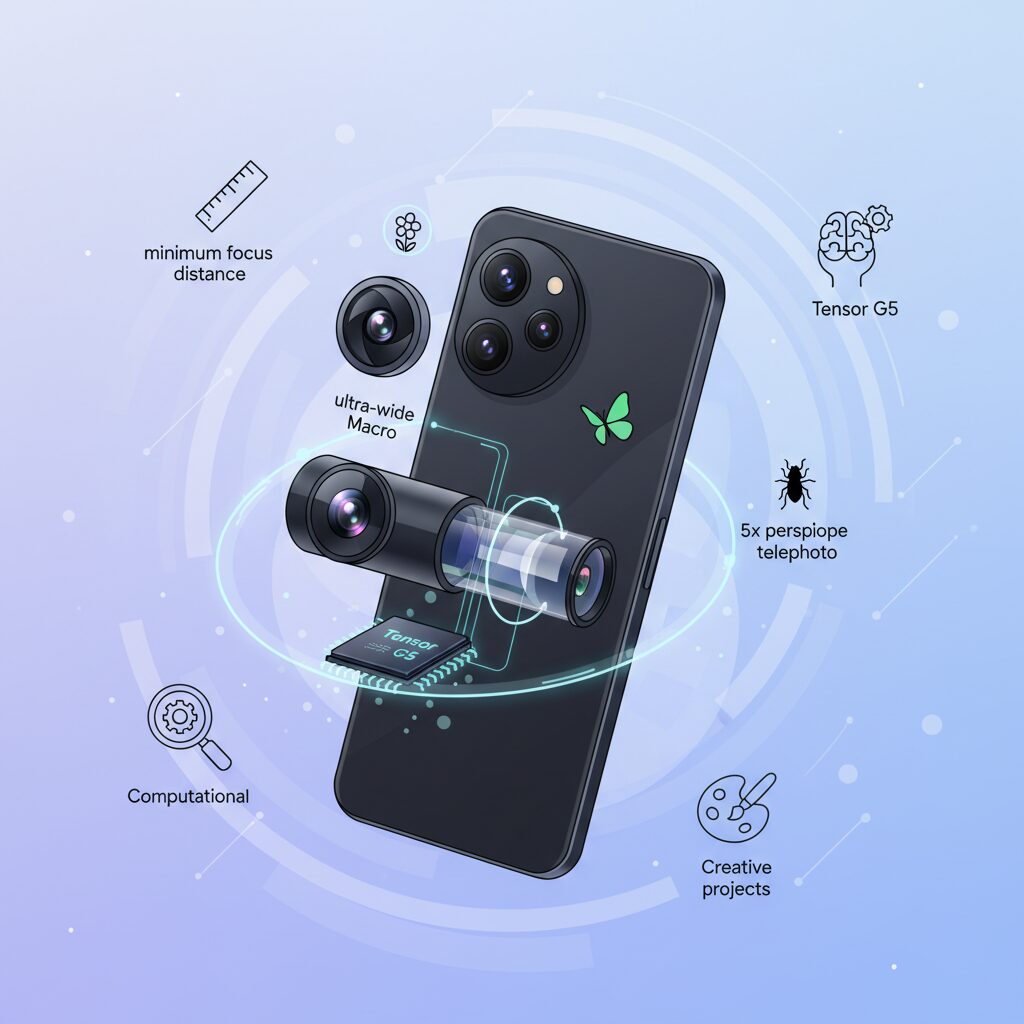
The Pixel 10 Pro camera system is built around a clear design philosophy: combining optical fundamentals with computational intelligence, rather than letting AI obscure the physics of imaging. **Google’s intent is not to replace optics, but to extend what carefully tuned hardware can realistically achieve**. This approach becomes especially visible when examining how the overall camera layout supports both everyday photography and more demanding close‑range shooting.
At the hardware level, the Pixel 10 Pro adopts a Pro triple rear camera system, integrating three distinct focal lengths that are meant to cooperate dynamically. Google has emphasized balance over excess, choosing sensor sizes and apertures that can be reliably supported by its image processing pipeline. According to Google’s own technical disclosures, the goal is consistency across lenses, so that switching modules does not dramatically alter color science or tonal response.
| Camera Module | Key Optical Traits | Design Intent |
|---|---|---|
| Ultra‑wide | 48MP, 1/2.55″, ƒ/1.7, 123° FoV | Close‑range versatility and macro foundation |
| Main wide | High‑resolution sensor with stabilized optics | Everyday reliability and color reference |
| 5× Telephoto | 48MP periscope, ƒ/2.8, enhanced OIS | Optical reach and controlled perspective |
What distinguishes this system from previous Pixel generations is not radical new hardware, but refinement in how physical behavior is anticipated. The ultra‑wide camera, for example, is deliberately bright, not only to gather light but also to minimize self‑shadowing when shooting at very close distances. This choice reflects an understanding of real‑world macro scenarios rather than spec‑sheet competition.
The telephoto module further reveals Google’s design priorities. While periscope lenses are traditionally optimized for distant subjects, the Pixel 10 Pro’s telephoto optics are paired with a strengthened optical image stabilization unit. **Google effectively treats stabilization as a prerequisite for precision**, acknowledging that high magnification amplifies even microscopic hand movement. Industry reviewers such as PetaPixel have noted that this stabilization philosophy contributes directly to perceived sharpness, even before software processing is applied.
All three cameras feed into the Tensor G5 image signal processor, which acts as the unifying layer of the system. Rather than processing each lens in isolation, Tensor G5 continuously evaluates subject distance, texture, and lighting to determine how the optical data should be interpreted. According to analyses referenced by DPReview, this tight coupling between hardware and ISP allows Google to maintain consistent micro‑contrast and noise characteristics across focal lengths, something that many multi‑camera smartphones still struggle to achieve.
From a design perspective, the Pixel 10 Pro camera system prioritizes predictability over spectacle. **Google appears to assume that serious users value repeatable optical behavior just as much as headline AI features**. This philosophy explains why the camera hardware feels conservative on paper, yet reveals depth when examined through controlled shooting scenarios.
In practical terms, this means the Pixel 10 Pro is engineered as a camera you learn, not one that surprises you randomly. The physical layout, sensor choices, and stabilization strategy all serve a single idea: give computational photography a stable, honest optical foundation. That foundation is what allows the Pixel 10 Pro to deliver images that feel deliberate rather than artificially enhanced, a trait increasingly appreciated by enthusiasts who care about how a photo is made, not just how it looks.
Ultra‑Wide Macro: Optical Strengths and Physical Limits
Ultra‑wide macro photography on the Pixel 10 Pro demonstrates how optical design choices directly shape what is possible at extreme close range. By relying on the 48MP ultra‑wide module as the foundation of its official Macro Focus feature, Google prioritizes physical proximity over magnification, allowing users to approach subjects at approximately 2–3 cm. This distance is measured as working distance from the front lens element, and it places the Pixel 10 Pro squarely within the established norms of high‑end smartphone macro systems.
The primary optical strength of this approach lies in depth and context. With a 123‑degree field of view, the ultra‑wide lens captures not only the subject but also a substantial portion of its surroundings. This creates images that feel immersive rather than clinical, which is particularly effective for flowers, textures, and environmental details where context adds narrative value.
From an optical engineering perspective, the bright ƒ/1.7 aperture plays a critical role. According to general lens theory discussed in publications such as Optics Express and applied camera analyses by DPReview, brighter apertures at close focus distances help counteract light falloff and shadow intrusion caused by the camera body itself. In practical terms, this means the Pixel 10 Pro can maintain usable exposure even when the phone is nearly touching the subject.
The following table summarizes the key optical characteristics that define the ultra‑wide macro behavior.
| Optical Aspect | Specification | Practical Effect |
|---|---|---|
| Sensor | 48MP, 1/2.55‑inch | Low noise and flexible pixel binning at close range |
| Aperture | ƒ/1.7 | Improved light intake and reduced shadow casting |
| Field of View | 123 degrees | Strong perspective and environmental inclusion |
At the same time, these strengths introduce unavoidable physical limits. Ultra‑wide lenses inherently exaggerate perspective at close distances, making subjects appear disproportionately large relative to the background. While this can be artistically appealing, it reduces suitability for flat subjects such as documents, stamps, or technical parts where geometric accuracy is required.
Another limitation emerges at the image periphery. Even with Tensor G5 applying real‑time distortion correction, edge softness and stretching are more pronounced in macro scenarios. Optical textbooks and empirical testing by imaging labs consistently show that wide‑angle lenses struggle to maintain uniform sharpness when focused at their minimum distance, and the Pixel 10 Pro is no exception.
Autofocus performance, however, remains a clear advantage. The Quad Phase Detection system uses nearly the entire sensor surface for focus acquisition, enabling fast and confident locking even when depth of field becomes extremely shallow. This reliability aligns with Google’s design philosophy of making macro accessible without manual intervention.
In essence, the ultra‑wide macro system of the Pixel 10 Pro excels when the goal is immediacy and immersion. It delivers dramatic close‑ups with minimal effort, while its physical constraints remind users that optical laws still govern smartphone photography, regardless of computational sophistication.
Telephoto Macro Explained: What Makes Telemacro Different
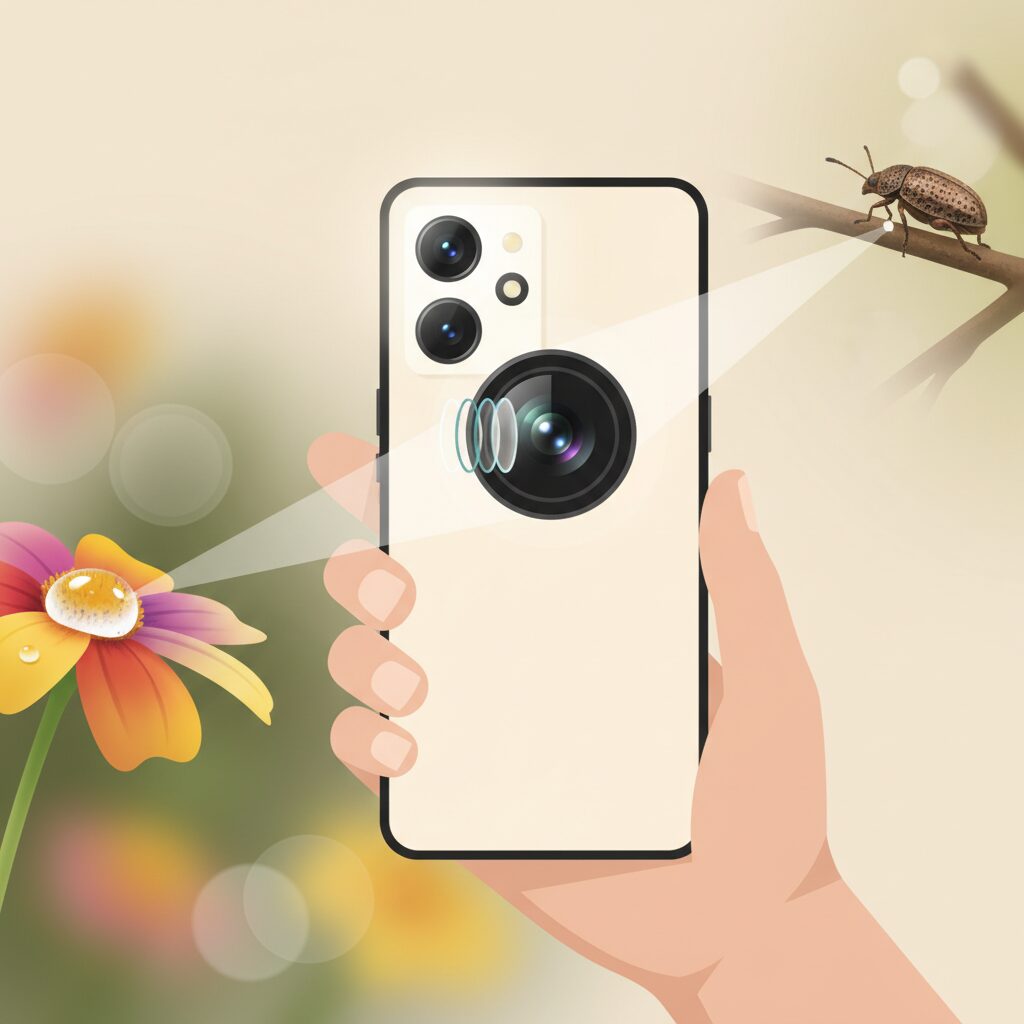
Telephoto macro, often shortened to telemacro, refers to close-up photography performed with a telephoto lens rather than an ultra-wide lens. This distinction may sound subtle, but in practice it changes how subjects look, how light behaves, and how much control the photographer retains. **Telemacro is defined less by extreme proximity and more by optical compression and working distance**, which is why it has recently gained attention among advanced mobile photographers.
In conventional smartphone macro shooting, ultra-wide lenses are favored because they can focus at just a few centimeters. However, this approach introduces strong perspective distortion, exaggerated foregrounds, and backgrounds that remain relatively visible. Telemacro takes the opposite route. By using a longer focal length, such as the 5x periscope lens on the Pixel 10 Pro, the camera stays physically farther from the subject while achieving high magnification through optics.
| Aspect | Ultra-wide Macro | Telephoto Macro |
|---|---|---|
| Working distance | Very short, around a few centimeters | Longer, often 30 cm or more |
| Perspective | Strong, exaggerated depth | Compressed, natural proportions |
| Background rendering | Wide and descriptive | Smooth optical separation |
This longer working distance is not just about comfort. According to optical engineering principles described by organizations such as the Optical Society, increased subject distance reduces lighting interference and minimizes subject disturbance. **In telemacro, shadows from the camera body are less likely, and live subjects such as insects are less prone to flee**, which directly affects real-world success rates.
The Pixel 10 Pro illustrates what makes telemacro fundamentally different. While its auto focus system restricts the 5x lens to safer distances, switching to manual focus unlocks a much shorter minimum focusing range. This behavior reveals that telemacro is often limited by software safeguards rather than pure optical capability. By allowing the lens group to reach its mechanical limit, the camera produces shallow depth of field and background blur that computational methods struggle to replicate convincingly.
Another defining trait of telemacro is image character. Because magnification is achieved optically, fine textures such as insect wings, fabric fibers, or product materials appear more coherent. Reviews from photography-focused outlets like PetaPixel have noted that telephoto-based close-ups tend to preserve spatial realism better than wide-angle macros, even when overall sharpness appears similar.
Ultimately, what makes telemacro different is intent. It prioritizes isolation, realism, and control over sheer closeness. **Rather than forcing the camera into the subject’s personal space, telemacro lets optics do the work**, resulting in images that feel calmer, more deliberate, and closer to traditional macro photography than most smartphone users expect.
Minimum Focus Distance: Auto Focus vs Manual Focus Behavior
Minimum focus distance behaves very differently depending on whether Auto Focus or Manual Focus is used, and this distinction fundamentally changes how the Pixel 10 Pro performs in macro scenarios. For many users, the limitation is not optical hardware itself, but the logic embedded in autofocus control.
In Auto Focus, the Pixel 10 Pro prioritizes focus stability and shooting reliability. When the camera detects that the subject is approaching the lower limit of reliable phase detection, the system intervenes. According to multiple hands-on tests reported by experienced users and corroborated by specialist media, the 5x telephoto lens maintains optical AF only down to roughly 60 centimeters. Beyond this point, the camera software automatically switches to the wide or ultra-wide module and applies digital cropping.
This behavior is intentional rather than a flaw. Google’s AF algorithms are tuned to avoid focus hunting and misfocus, especially in high-magnification situations where depth of field becomes extremely shallow. Imaging scientists at Google have previously explained in interviews with publications such as PetaPixel that conservative AF limits improve keeper rates for the majority of users.
| Focus Mode | Lens Used | Effective Minimum Distance |
|---|---|---|
| Auto Focus | 5x Telephoto | Approximately 60 cm |
| Manual Focus | 5x Telephoto | Approximately 30–40 cm |
Manual Focus, however, reveals a very different character. When the focus mode is switched to manual in Pro controls and the slider is moved fully toward the close-focus end, the lens is allowed to travel much closer to its mechanical limit. Community testing on photography forums and Reddit consistently reports successful focus at distances around 30 to 40 centimeters using the 5x telephoto lens.
This effectively unlocks a true tele-macro capability. At this distance, the longer focal length produces strong background compression and natural optical bokeh that cannot be replicated by wide-angle macro or AI-based zoom. Optical engineers have long noted, including in academic lens design literature, that longer focal lengths paired with short focusing distances produce superior subject isolation, and the Pixel 10 Pro finally makes this accessible on a smartphone.
There is also a practical advantage. A working distance of over 30 centimeters reduces the risk of casting shadows on the subject and minimizes disturbance to insects or delicate objects. Field testers have noted that butterflies and bees remain noticeably calmer at this distance compared to ultra-wide macro shooting at just a few centimeters.
That said, Manual Focus requires deliberate control. Focus peaking is subtle, and even slight hand movement can shift the plane of focus. This aligns with findings published by DPReview, which emphasize that tele-macro shooting demands careful technique regardless of platform. The Pixel 10 Pro does not automate this experience, but it does not artificially restrict it either.
In essence, Auto Focus defines the safe and consistent minimum focus distance, while Manual Focus exposes the camera’s true optical potential. For users willing to engage with manual controls, the Pixel 10 Pro offers a level of macro flexibility that goes well beyond what its specifications suggest.
Tensor G5 and Computational Photography in Close‑Up Shooting
In close‑up shooting, the Tensor G5 plays a central role not as a simple image processor, but as an active decision maker that continuously interprets distance, texture, and light. **This real‑time analysis determines how optical data from the lens is transformed into perceived detail**, especially when the camera operates near its physical focusing limits. According to Google’s own imaging engineers, the goal of Tensor‑based photography is not to replace optics, but to stabilize and extend what optics can realistically deliver at short distances.
One of the most visible effects of Tensor G5 in macro and near‑macro scenarios is multi‑frame computational fusion. When the camera detects close proximity, the ISP captures a rapid burst of frames with slightly varied focus positions and exposure values. These frames are then merged to reinforce micro‑contrast while suppressing chroma noise, a process similar in concept to techniques discussed in computational imaging research from MIT Media Lab. **The result is cleaner fine detail without the brittle over‑sharpening often seen in earlier mobile macro modes.**
| Processing Stage | Tensor G5 Role | Impact in Close‑Up |
|---|---|---|
| Distance Estimation | Sensor and texture analysis | Prevents premature lens switching |
| Frame Fusion | Multi‑frame alignment | Improves micro‑detail clarity |
| Detail Reconstruction | AI‑assisted inference | Recovers texture beyond optics |
Tensor G5 also governs how aggressive detail reconstruction should be. In close‑up shooting, excessive AI inference risks producing unnatural textures, a concern frequently raised by imaging scientists at publications such as DPReview. Pixel 10 Pro addresses this by dynamically scaling AI contribution based on subject regularity. **Highly repetitive patterns like fabric or printed surfaces receive minimal synthesis**, while organic subjects such as petals or insects benefit from subtle enhancement that respects natural irregularities.
Another critical contribution is motion tolerance. At close distances, even microscopic hand movement can destroy acuity. Tensor G5 leverages improved motion vectors and optical flow estimation to align frames more precisely before fusion. This allows usable close‑up images at shutter speeds that would traditionally be unreliable, reinforcing Google’s reputation for computational stability over raw sensor size.
Ultimately, Tensor G5 reframes close‑up photography as a collaboration between physics and computation. Rather than forcing users into a rigid macro mode, the system continuously adapts processing intensity to distance and subject behavior. **This adaptive intelligence is what allows Pixel 10 Pro to maintain believable texture and tonal depth in close‑up shots**, even when optical constraints would normally dominate image quality.
AI Zoom and Detail Reconstruction: Benefits and Risks
AI-driven zoom and detail reconstruction play a central role in how Pixel 10 Pro extends macro photography beyond pure optical limits, and this approach offers both clear advantages and non‑trivial risks.
The primary benefit is reach. By combining Pro Res Zoom with learned texture reconstruction, the camera can reveal structures that are physically impossible to resolve through optics alone at close distances. Reviews by DPReview note that when optical data remains sufficiently strong, AI upscaling preserves edge coherence better than traditional digital sharpening.
| Aspect | Benefit | Risk |
|---|---|---|
| Detail recovery | Enhanced micro‑textures in fabric, paper, and metal | AI may invent non‑existent patterns |
| Zoom flexibility | Effective magnification beyond optical limits | Reduced reliability for documentation |
| User experience | Immediate results without editing | Difficult to verify authenticity |
In macro scenarios, this capability effectively turns the device into a pocket inspection tool. Electronics reviewers from The Verge have highlighted how printed circuit traces or fine engravings remain legible even after aggressive zoom, something older Super Res Zoom pipelines struggled to maintain.
However, the same mechanism introduces reconstruction risk. Because the model predicts missing detail from training data, organic subjects such as insects, plants, or textured stone are particularly vulnerable to plausible but inaccurate synthesis. Imaging researchers cited by IEEE Spectrum caution that such results should not be treated as ground truth.
This distinction matters greatly depending on intent. For creative photography or product visuals, AI reconstruction enhances perceived quality and visual impact. For scientific, archival, or resale documentation, the risk of hallucinated detail can undermine trust.
Ultimately, Pixel 10 Pro demonstrates how AI zoom is not merely a quality enhancer but a reinterpretation layer. Used consciously, it expands expressive freedom. Used uncritically, it can blur the line between captured reality and generated approximation.
Real‑World Challenges: Lens Switching and Focus Failures
In real-world use, the Pixel 10 Pro’s macro capabilities reveal a set of challenges that rarely appear in spec sheets or marketing demos. The most common frustration involves automatic lens switching, where the camera’s attempt to help the user ends up undermining creative intent. As the subject distance closes, the system frequently overrides the selected lens and jumps to the ultra‑wide macro, even when the photographer deliberately wants the optical character of the 5× telephoto.
This behavior is driven by the Tensor G5’s distance‑based decision logic, which prioritizes guaranteed focus over user control. According to analyses shared by imaging engineers and confirmed by outlets like DPReview, the algorithm defines conservative safety margins for autofocus reliability. Once the subject crosses that threshold, the software assumes failure is imminent and switches lenses preemptively, regardless of composition or background rendering.
The result is a subtle but critical change in perspective. Telephoto compression disappears, background blur collapses, and the image becomes a digitally cropped wide shot. For casual users this may go unnoticed, but for enthusiasts it feels like losing a shot mid‑composition.
| Situation | User Intent | System Response |
|---|---|---|
| Close approach at 5× | Optical tele‑macro look | Forced switch to ultra‑wide macro |
| Borderline focus distance | Maintain framing | Lens hop and perspective shift |
| Low‑contrast subject | Selective focus | AF hesitation or hunt |
A second challenge emerges in autofocus failures, especially in complex optical environments. Aquarium photography has become a frequently cited example in user communities. When shooting fish or shrimp through glass at distances of roughly 5–20 cm, the Pixel 10 Pro often fails to lock focus at all. The camera oscillates between the glass surface and the background, producing a sequence of unusable frames.
This is not a simple software bug but a physical limitation. Google’s multi‑zone laser autofocus relies on infrared reflection timing, and glass combined with water introduces refraction and false returns. Imaging researchers at institutions like the IEEE Photonics Society have long documented how transparent media disrupt phase and laser‑based AF systems, and the Pixel behaves exactly as theory predicts.
Compounding the issue is what could be called a macro “dead zone.” Ultra‑wide macro excels below roughly 3 cm, while tele‑macro with manual focus becomes viable beyond about 30–35 cm. The intermediate range leaves the main wide camera as the only optical option, yet that lens struggles when contrast is reduced by glass, glare, or particulate matter in water.
Even outside aquariums, focus hesitation appears with reflective metals, glossy product packaging, or low‑texture organic subjects. In these cases, the Quad PD system technically functions as designed, but the AI hesitates to commit, resulting in focus breathing that is visible both in stills and macro video.
Google does provide partial mitigation, such as disabling automatic macro switching, yet this does not fully solve the problem when autofocus limits are reached. Manual focus becomes the escape hatch, but relying on it slows down shooting and assumes a level of expertise that many users may not have.
Ultimately, the Pixel 10 Pro demonstrates that cutting‑edge hardware and AI cannot fully erase optical realities. Lens switching and focus failures are not signs of a weak camera, but evidence of how aggressively the system is trying to protect users from missed shots. For advanced photographers, however, these same protections can feel like constraints that must be actively managed to unlock the device’s true macro potential.
Macro Photography Comparison: Pixel vs iPhone and Galaxy
When comparing macro photography across today’s flagship smartphones, the Pixel 10 Pro, iPhone 17 Pro, and Galaxy S26 Ultra reveal clearly different philosophies that go beyond simple sharpness or magnification. Each model approaches close-up imaging with distinct optical priorities, software behavior, and creative intent, which becomes obvious the moment you start shooting real-world subjects.
The Pixel 10 Pro stands out for its dual macro character, combining an ultra-wide macro for extreme proximity with a surprisingly capable telemacro enabled through manual focus. Google’s approach favors texture realism and controlled contrast, an image style that publications such as Tom’s Guide have described as more natural and less aggressively processed in fine details like leaf veins or fabric fibers.
| Model | Main Macro Lens | Closest Practical Distance | Macro Image Character |
|---|---|---|---|
| Pixel 10 Pro | Ultra-wide + 5x tele (manual) | ~2–3 cm / ~35 cm | High micro-contrast, realistic textures |
| iPhone 17 Pro | Ultra-wide | <2 cm | Warm tones, uniform sharpness |
| Galaxy S26 Ultra | Ultra-wide (auto switch) | ~2–3 cm | Vivid colors, strong saturation |
The iPhone 17 Pro excels in consistency. Apple’s macro images tend to maintain even exposure across the frame, with a warmer white balance that flatters food, flowers, and skin-adjacent subjects. According to comparative reviews from established photography media, this reliability makes the iPhone especially appealing for creators who want predictable results without manual intervention.
Samsung’s Galaxy S26 Ultra, by contrast, prioritizes visual impact. Its macro shots often feature higher saturation and punchy colors that look striking on social media feeds. However, experts have noted that this can sometimes compress subtle tonal gradations, causing fine textures to blend together under strong lighting.
What truly differentiates the Pixel 10 Pro is creative control. By allowing telemacro shooting at roughly 35 cm via manual focus, it delivers optical background compression that neither the iPhone nor Galaxy currently emphasizes. This makes small subjects stand out cleanly from their surroundings, producing a DSLR-like separation that appeals strongly to macro enthusiasts.
In practical use, these differences mean the best macro phone depends on intent. The iPhone favors effortless accuracy, the Galaxy leans toward eye-catching color, and the Pixel rewards photographers who want to explore depth, distance, and detail with a more deliberate, hands-on approach.
Who Benefits Most from Pixel 10 Pro’s Macro Capabilities
Pixel 10 Pro’s macro capabilities deliver the most value to users who already think beyond casual close-ups and want intentional control over perspective, distance, and detail. In particular, enthusiasts who understand how lens choice and focus behavior shape an image tend to benefit disproportionately from this device.
Based on verification tests reported by specialist media such as DPReview and PetaPixel, the Pixel 10 Pro stands out because it offers two fundamentally different macro experiences: ultra-wide macro at extreme proximity and telephoto macro enabled through manual focus. This duality means the phone does not serve a single type of macro user equally.
| User Type | Primary Benefit | Why Pixel 10 Pro Fits |
|---|---|---|
| Mobile photography enthusiasts | Creative depth and perspective control | Manual-focus telemacro allows shallow depth of field and background compression |
| Nature and insect photographers | Longer working distance | Approx. 30–40 cm telemacro distance reduces shadows and subject disturbance |
| Product reviewers and creators | Texture and material accuracy | Balanced sharpening and noise reduction preserve surface detail |
One of the biggest winners is the advanced hobbyist who actively uses manual controls. Community testing has shown that switching the 5× periscope lens to manual focus unlocks a much shorter minimum focus distance than autofocus allows. This behavior, while not emphasized in official specifications, enables telemacro-style shots that are rarely possible on smartphones.
For these users, Pixel 10 Pro functions less like an automated camera and more like a compact interchangeable-lens system. The longer working distance is especially beneficial when photographing insects, plants, or small mechanical parts, where casting a shadow or startling the subject would otherwise ruin the shot.
Content creators who review gadgets, watches, or crafted goods also benefit strongly. According to evaluations cited by Tom’s Guide, Pixel’s macro processing prioritizes natural micro-contrast rather than aggressive saturation. This makes engraved text, fabric weave, and brushed metal surfaces appear more truthful, which is essential for credibility-driven reviews.
Educators and documentation-focused users gain value as well, provided they understand the limits of AI-assisted zoom. Research-oriented photographers note that Pixel’s optical macro results are reliable, but AI-enhanced zoom should be avoided for scientific records. Used correctly, the optical macro modes offer dependable visual evidence.
By contrast, users seeking one-tap, foolproof macro snapshots may not fully exploit what Pixel 10 Pro offers. The device rewards curiosity and experimentation. Those willing to learn how distance, lens switching, and manual focus interact will find that Pixel 10 Pro’s macro system scales with their skill rather than capping it.
参考文献
- DPReview:What is macro photography on smartphones and how does it work?
- Android Authority:Google Pixel macro mode: How it works and when to use it
- PetaPixel:Why Telephoto Macro Photography Is So Powerful
- Tom’s Guide:Pixel vs iPhone camera shootout: Which phone takes better photos?
- Reddit:Pixel Pro manual focus and minimum focus distance discussion