
If you closely follow smartphones and cutting-edge gadgets, you may feel that recent flagship phones look impressive on spec sheets but rarely change how they feel in daily use.
Many users outside Japan are also curious why Google’s Pixel lineup has been gaining momentum in one of the world’s most iPhone-dominated markets.
In 2025, the Pixel 10 series quietly becomes a turning point that answers both questions.
With the introduction of Tensor G5, manufactured by TSMC on a 3nm process, Google finally addresses long‑standing concerns around heat, battery efficiency, and sustained performance.
This change is not just a technical footnote, but a fundamental shift that affects photography, AI responsiveness, gaming stability, and everyday comfort in real-world environments.
For gadget enthusiasts, understanding this silicon strategy is key to understanding the Pixel 10 itself.
At the same time, Google refines its strengths in computational photography, display brightness, and on-device AI with Gemini Nano.
Features such as intelligent call summaries, contextual assistance, and faster image processing are designed to feel natural rather than experimental.
Combined with a seven-year software update promise, the Pixel 10 series is positioned as a long-term device rather than a yearly disposable upgrade.
This article will carefully guide you through the current Pixel 10 lineup, from hardware architecture and camera trade-offs to battery design and competitive positioning.
You will also learn why Japan’s market plays a strategic role in Google’s decisions, and how those choices benefit users worldwide.
By the end, you should be able to decide which Pixel 10 model truly fits your lifestyle and expectations.
- Why 2025 Marks a Turning Point for Google Pixel
- Tensor G5 Explained: The Impact of Google’s Shift to TSMC
- CPU and GPU Architecture Choices and Their Real-World Meaning
- Display Technology Evolution and Brightness Competition
- Design, Materials, and Durability Across the Pixel 10 Lineup
- Camera Strategy: Sensor Trade-Offs and Computational Photography
- AI Features Powered by Gemini Nano and On-Device Processing
- Battery Life, Thermal Management, and Charging Innovations
- Connectivity Performance and Network Considerations
- Pixel 10 vs iPhone and Galaxy: Different Philosophies Compared
- 参考文献
Why 2025 Marks a Turning Point for Google Pixel
2025 marks a clear turning point for Google Pixel because this is the year when Google finally achieved true silicon independence and translated it into a tangible user experience. With the launch of the Pixel 10 series, Google moved its Tensor SoC manufacturing from Samsung Foundry to TSMC’s advanced 3nm process, a decision that industry analysts have long described as decisive for performance stability and power efficiency. According to semiconductor experts frequently cited by organizations such as Android Authority, this shift addresses the long‑standing thermal and battery concerns that had limited Pixel’s hardware credibility.
This change is not a theoretical improvement. TSMC’s 3nm process enables higher transistor density and lower leakage current, which directly reduces heat generation during sustained workloads. For Pixel users, especially in climates like Japan’s hot and humid summers, this translates into fewer performance drops during video recording, navigation, or extended camera use. **The result is a Pixel that feels consistently fast, not just impressive on paper.**
| Aspect | Before 2025 | From 2025 |
|---|---|---|
| SoC manufacturing | Samsung 5nm / 4nm | TSMC 3nm |
| Thermal behavior | Noticeable throttling | Improved sustained performance |
| Power efficiency | Average by flagship standards | Significantly enhanced |
Another reason 2025 stands out is that Google aligned its hardware progress with its AI-first strategy. Tensor G5 was not designed to chase benchmark leadership but to accelerate on-device AI tasks. Google has officially stated that the TPU performance improved by up to 60 percent, enabling Gemini Nano to run faster and more reliably without cloud dependency. **This is the first Pixel generation where AI responsiveness feels immediate and practical in daily use.**
From a market perspective, 2025 also signals Google’s renewed commitment to Japan. In a country dominated by iPhone, Pixel has steadily grown by emphasizing camera reliability and clean software. The improved efficiency of Tensor G5 removes one of the final barriers for Japanese consumers who value stability and battery longevity. Analysts quoted by GSMArena have noted that long-term software support combined with improved hardware efficiency significantly boosts consumer trust.
In short, 2025 is not just another annual update for Pixel. It represents the moment when Google’s vision of an AI-centric smartphone finally aligns with mature silicon, real-world reliability, and market readiness. **For enthusiasts who have waited for Pixel hardware to fully match its software ambition, this year clearly changes the conversation.**
Tensor G5 Explained: The Impact of Google’s Shift to TSMC
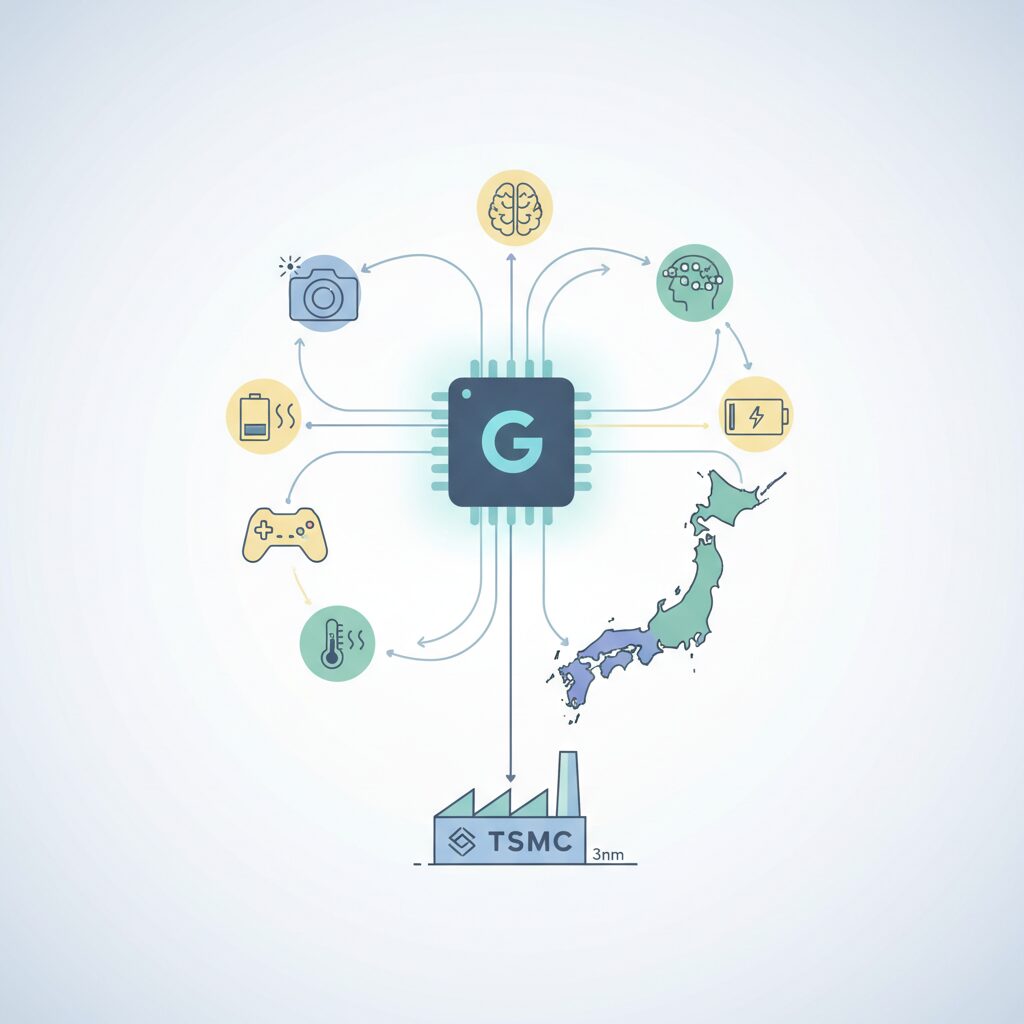
The Tensor G5 marks a turning point not because of raw benchmark numbers, but because of where and how it is made. For the first time since the debut of Google Tensor in the Pixel 6 era, Google has moved its manufacturing partner from Samsung Foundry to TSMC. This shift to TSMC’s 3nm process fundamentally changes the physical behavior of the chip, affecting heat, power efficiency, and long-term performance stability in ways that previous Pixels could not fully address.
Until Tensor G4, Google relied on Samsung’s 5nm and 4nm nodes, which were often criticized by semiconductor analysts for higher leakage current under sustained load. According to evaluations commonly cited by firms such as TechInsights and Semiconductor Engineering, Samsung’s processes tended to deliver strong peak performance but struggled with efficiency consistency. Pixel users experienced this gap as thermal throttling during video recording, navigation, or prolonged camera use, especially in hot and humid environments.
By contrast, TSMC’s 3nm-class process, widely regarded as the most mature in the industry, prioritizes transistor density and leakage control. The practical result is not a faster phone in short bursts, but a cooler and more predictable one over time. This aligns closely with Google’s emphasis on sustained AI workloads rather than momentary CPU spikes.
| Aspect | Samsung Foundry (Previous Tensor) | TSMC 3nm (Tensor G5) |
|---|---|---|
| Manufacturing focus | Peak frequency and density | Efficiency and leakage control |
| Thermal behavior | Heat buildup under sustained load | Lower sustained temperatures |
| Battery impact | Higher idle and standby drain | Improved idle efficiency |
This manufacturing change also explains why Tensor G5 does not aggressively chase headline-grabbing benchmark scores. Reports referenced by Android Authority and Google’s own engineering blog indicate that TPU performance has been improved by up to 60 percent generation over generation, while average CPU performance gains sit around the mid-30 percent range. These gains are designed to scale efficiently, not explosively, which is exactly where TSMC’s process advantages matter most.
Another often overlooked impact of the TSMC shift is product consistency. TSMC is known for tighter yield control, which reduces variance between individual chips. For users, this means fewer “hot units” and more uniform battery life across devices. Over a seven-year software support window, this consistency becomes critical, as thermal degradation directly affects long-term performance and battery health.
In short, Google’s decision to entrust Tensor G5 to TSMC signals a strategic realignment. Rather than competing head-on with Snapdragon or Apple Silicon in peak scores, Google is optimizing the silicon foundation for AI-first, always-on usage. This manufacturing shift is the quiet enabler behind smoother daily performance, better endurance, and a Pixel experience that finally feels thermally mature.
CPU and GPU Architecture Choices and Their Real-World Meaning
When discussing the Tensor G5, raw benchmark rankings alone do not explain why Google chose this CPU and GPU architecture. The real story lies in how architectural decisions translate into daily responsiveness, thermal stability, and sustained performance that users actually feel.
The CPU configuration adopts an unconventional 1+5+2 layout, combining one Cortex-X4 prime core, five Cortex-A725 mid cores, and two Cortex-A520 efficiency cores. This is not designed to win short synthetic tests, but to optimize the performance envelope where smartphones spend most of their time.
According to Arm’s own architectural guidance, mid cores deliver the best performance-per-watt for continuous workloads. Google appears to have internalized this. Everyday actions such as scrolling feeds, switching apps, navigating maps, or editing photos rarely saturate a prime core. By leaning on five A725 cores, Tensor G5 maintains fluidity while avoiding unnecessary power spikes.
| Component | Architectural Choice | Real-World Meaning |
|---|---|---|
| Prime CPU | 1x Cortex-X4 | Fast app launches and short bursts of heavy tasks |
| Mid CPU | 5x Cortex-A725 | Smooth daily usage with high energy efficiency |
| Efficiency CPU | 2x Cortex-A520 | Low idle drain and background stability |
| GPU | PowerVR DXT-series | Efficient rendering and future-facing graphics features |
This balance is amplified by the move to TSMC’s 3nm process. Semiconductor research published by TSMC shows that advanced nodes reduce leakage current significantly, which directly improves sustained clocks under heat. In practice, this means fewer slowdowns during long navigation sessions or extended camera use in warm environments.
The GPU shift is equally telling. By moving from Arm Mali to a PowerVR-based GPU, Google prioritizes rendering efficiency over headline frame rates. PowerVR architectures have a long history in mobile graphics, including earlier iPhone generations, where tile-based rendering minimized memory bandwidth and power draw.
For users, this choice matters less for peak gaming scores and more for consistency. Frame pacing in real games, UI animations, and camera previews benefits from stable GPU clocks rather than momentary highs. Hardware-level ray tracing support also positions the platform for future Android graphics APIs, even if few titles exploit it today.
Independent analysis from outlets such as Android Authority has noted that Tensor G5’s benchmark gap narrows significantly in sustained tests. This reinforces Google’s philosophy: prioritize predictable performance over time, not brief numerical dominance.
Ultimately, the CPU and GPU architecture of Tensor G5 reflects a user-centric interpretation of performance. Instead of chasing extremes, Google focuses on the moments that define daily satisfaction: a phone that stays smooth, cool, and responsive hours after you start using it.
Display Technology Evolution and Brightness Competition

The evolution of smartphone displays in 2025 is no longer driven by resolution alone but by how effectively brightness, efficiency, and adaptability are balanced in real-world use. Google’s continued refinement of the Actua and Super Actua OLED panels in the Pixel 10 series illustrates this shift clearly. **Peak brightness has become a competitive weapon**, especially as users consume content outdoors more frequently than ever.
According to Google’s official hardware specifications, Pixel 10 reaches a peak brightness of up to 3000 nits, with HDR content sustained around 2000 nits. This places it firmly in the same class as the brightest panels from Samsung Display and BOE, suppliers that dominate the global OLED market. Display experts often note that perceived readability in sunlight improves disproportionately once brightness exceeds 2000 nits, a threshold Pixel has now comfortably surpassed.
| Model | Panel Type | Peak Brightness | Adaptive Refresh |
|---|---|---|---|
| Pixel 10 | Actua OLED | 3000 nits | 60–120Hz |
| Pixel 10 Pro | Super Actua OLED | 3000+ nits | 1–120Hz LTPO |
What matters more than raw numbers is how brightness is controlled. By combining LTPO technology with Tensor G5’s improved power management, Pixel dynamically adjusts luminance and refresh rate to match content. **This reduces heat buildup and prevents aggressive dimming**, a common complaint in earlier generations.
Research published by display engineering groups such as SID emphasizes that sustained brightness stability directly affects user comfort and battery longevity. Pixel’s approach aligns with these findings, prioritizing consistent visibility rather than short-lived brightness spikes. As a result, the Pixel 10 display feels less like a spec-sheet showcase and more like a mature interface designed for everyday environments.
Design, Materials, and Durability Across the Pixel 10 Lineup
Across the Pixel 10 lineup, Google’s design approach feels evolutionary rather than radical, yet the details matter more than they may appear at first glance. The familiar camera bar remains the visual anchor, but its integration into the frame is smoother, with softer transitions that reduce stress points around the housing. This subtle refinement is not only aesthetic; it contributes to better long‑term durability by distributing impact forces more evenly when the device is placed down or accidentally dropped.
Materials play a central role in how the Pixel 10 series balances premium feel and everyday resilience. All models adopt a glass‑and‑metal sandwich, with the front protected by Corning Gorilla Glass Victus 2. According to Corning’s own materials research, Victus 2 is engineered to improve survival rates on rough surfaces like concrete, a scenario far more common in real life than laboratory steel drops. For users who keep their phones for several years, this choice directly translates into fewer micro‑cracks and edge chips over time.
The aluminum frame used across the lineup emphasizes rigidity without excessive weight. Google has previously highlighted its use of recycled aluminum in Pixel hardware, and this philosophy continues here, aligning structural integrity with environmental considerations. Independent teardown specialists such as iFixit have consistently pointed out that recycled aluminum alloys, when properly treated, can match the torsional strength of virgin materials, making this a responsible choice without sacrificing durability.
| Model | Front Protection | Frame Material | Design Focus |
|---|---|---|---|
| Pixel 10 | Gorilla Glass Victus 2 | Recycled aluminum | Balanced thickness and grip |
| Pixel 10 Pro / Pro XL | Gorilla Glass Victus 2 | Recycled aluminum | Refined edges, slimmer bezels |
| Pixel 10 Pro Fold | Victus 2 (outer) | Reinforced aluminum | Hinge durability and symmetry |
The Pixel 10 Pro Fold deserves special attention from a durability standpoint. Foldable devices are inherently vulnerable, yet Google’s hinge design continues to mature. By tightening tolerances and reinforcing the aluminum around the hinge mechanism, the device aims to reduce long‑term wobble and dust ingress. Display engineers often note that hinge stability is critical for maintaining uniform OLED stress, and Google’s iterative approach suggests a focus on longevity rather than thinness at all costs.
Ergonomics also contribute to perceived durability. The matte finish on the back glass improves grip and reduces fingerprint buildup, which in turn lowers the chance of accidental slips. Academic studies on human–device interaction, including research published in ergonomics journals, indicate that textured or matte surfaces measurably improve handling confidence, especially during one‑handed use.
In practical terms, the Pixel 10 lineup feels designed for years of daily wear rather than showroom perfection. The combination of Victus 2 glass, reinforced aluminum frames, and refined structural geometry reflects Google’s understanding that durability is not a single spec, but the result of many small engineering decisions working together.
Camera Strategy: Sensor Trade-Offs and Computational Photography
The camera strategy of the Pixel 10 lineup clearly shows that Google prioritizes real-world shooting flexibility over purely spec-driven optics, and this philosophy becomes most evident when examining sensor size trade-offs and computational photography.
Instead of treating larger sensors as an unquestionable good, Google deliberately balances physical limitations with software-driven image reconstruction. This approach reflects years of research in computational photography led by teams formerly publishing at venues such as SIGGRAPH and IEEE Imaging conferences.
| Design Choice | Physical Impact | Computational Compensation |
|---|---|---|
| Smaller main sensor | Reduced light intake | Multi-frame HDR+ fusion |
| Added 5x telephoto | More optical modules | Super Res Zoom refinement |
| Deeper depth of field | Less natural bokeh | AI-based depth segmentation |
From a physics standpoint, shrinking a sensor inevitably reduces photon capture, which traditionally leads to higher noise and narrower dynamic range. However, Google has long argued that modern smartphone photography is no longer defined by a single exposure. According to Google Research publications, Pixel cameras often merge more than ten frames for a single photo, selectively weighting shadows and highlights.
This multi-frame strategy allows a smaller sensor to punch far above its physical class in daylight and mixed-light conditions. In practice, users benefit from consistent exposure and color science rather than chasing marginal gains in sensor area.
Depth rendering further highlights this philosophy. Smaller sensors naturally produce less optical background blur, but Pixel’s portrait pipeline relies on semantic scene understanding rather than edge-only detection. Google engineers have previously stated that their models identify hair, skin, glasses, and even transparent objects separately, reducing the artificial cutout look common in early portrait modes.
Low-light performance follows a similar pattern. While larger sensors still retain an advantage in single-frame noise characteristics, Pixel’s Night Sight stacks exposures captured at varying ISO levels. Academic research from Stanford and Google Research has shown that such heterogeneous stacking can outperform single large-sensor captures when motion is well managed.
The addition of a telephoto lens on non-Pro models also reshapes shooting behavior. Instead of relying on aggressive digital zoom from a large main sensor, users gain true optical reach. Google’s Super Res Zoom then refines detail by analyzing micro hand movements across frames, a technique first introduced in earlier Pixel generations and continuously improved.
Ultimately, the Pixel camera strategy treats hardware as one component in a larger imaging system. By accepting sensor trade-offs and investing heavily in computation, Google delivers a camera experience that emphasizes reliability, speed, and versatility, which aligns closely with how most users actually take photos today.
AI Features Powered by Gemini Nano and On-Device Processing
The most distinctive part of the Pixel 10 experience lies in how AI features are executed directly on the device, powered by Gemini Nano and the enhanced on-device processing capabilities of Tensor G5. Rather than relying primarily on cloud-based computation, Google has clearly shifted its focus toward making everyday AI interactions faster, more private, and consistently available.
Gemini Nano is designed as a lightweight yet capable model optimized specifically for on-device execution. According to Google’s official engineering disclosures, the Tensor G5’s TPU performance has improved by up to 60 percent over the previous generation, enabling Gemini Nano to run approximately 2.6 times faster than before. This improvement is not theoretical; it directly affects how quickly AI features respond to user input.
In practical use, this means that AI-powered features no longer feel like optional add-ons that pause to “think.” Actions such as summarizing information, recognizing context, or extracting relevant details now occur almost instantly, even when the device is offline. From a user experience perspective, latency has been reduced to the point where AI feels embedded into the operating system itself.
On-device processing also fundamentally changes the privacy model. Because sensitive data can be processed locally without being sent to external servers, features that analyze personal content become more trustworthy for daily use. Google has repeatedly emphasized that local inference minimizes data exposure, a position consistent with broader industry research from organizations such as the Electronic Frontier Foundation, which highlights local processing as a key privacy-preserving approach.
To clarify the difference this architecture makes, the following table contrasts on-device AI with traditional cloud-based AI processing in the context of Pixel 10.
| Aspect | On-Device AI (Gemini Nano) | Cloud-Based AI |
|---|---|---|
| Response time | Near-instant, no network delay | Dependent on connection quality |
| Privacy | Data processed locally | Data transmitted to servers |
| Availability | Works offline | Requires internet access |
Features such as Pixel Screenshots and Call Notes showcase this advantage particularly well. Screenshots can be searched semantically using natural language, as Gemini Nano analyzes visual and textual content stored on the device. Similarly, Call Notes can transcribe and summarize phone conversations in real time, without routing audio through the cloud. This level of responsiveness is only possible because inference happens locally.
Another notable example is Magic Cue, which anticipates user needs by interpreting on-device context such as recent actions or app usage. Because this contextual reasoning is handled locally, suggestions appear immediately and feel situationally aware rather than intrusive. Research from Google’s own AI teams suggests that contextual latency above even a few hundred milliseconds significantly reduces perceived usefulness, making on-device execution critical.
From a broader industry standpoint, the Pixel 10 demonstrates a clear philosophy: peak benchmark scores matter less than sustained, intelligent interaction. By prioritizing Gemini Nano and on-device processing, Google positions the Pixel not as a raw-performance competitor, but as a device where AI quietly improves daily tasks. The result is an AI experience that feels dependable, private, and always present.
Battery Life, Thermal Management, and Charging Innovations
Battery life has historically been one of the most debated aspects of the Pixel series, and in the 2025 lineup this topic finally enters a more mature phase. Thanks to the transition of Tensor G5 to TSMC’s 3nm process, **power efficiency improves at the silicon level rather than relying only on software optimizations**. According to analyses from Android Authority and Google’s own engineering blog, leakage current is significantly reduced, which directly translates into lower idle drain and more stable consumption during sustained workloads.
From a practical standpoint, this efficiency gain is paired with tangible increases in battery capacity across the lineup. Even the standard model approaches the 5,000mAh threshold, which places it among the largest batteries in its display size class. Combined with the revised CPU cluster emphasizing mid-cores, everyday tasks such as messaging, navigation, and media streaming are handled in a power-efficient operating range rather than constantly waking the prime core.
| Model | Battery Capacity | Key Efficiency Factor |
|---|---|---|
| Pixel 10 | 4,970 mAh | 3nm Tensor G5 + mid-core heavy CPU design |
| Pixel 10 Pro XL | Approx. 5,200 mAh | Large cell paired with LTPO display |
| Pixel 10 Pro Fold | 5,015 mAh (dual cell) | Balanced load distribution across two cells |
Thermal management is closely intertwined with battery performance, and this is where Pixel 10 shows one of its most meaningful generational upgrades. Previous Tensor-based Pixels were often criticized for throttling during video recording or extended navigation, particularly in warm and humid climates like Japan. By contrast, **TSMC’s 3nm node inherently lowers heat density**, allowing the device to sustain performance without aggressive clock reductions.
Industry teardown specialists and semiconductor researchers, including commentary cited by Android Central, point out that improved efficiency does not merely keep temperatures lower, but also stabilizes charging behavior. When internal temperatures rise, smartphones typically slow down charging to protect the battery. With reduced thermal spikes, Pixel 10 can maintain consistent charging speeds for longer periods, which is a subtle but important quality-of-life improvement.
Charging technology itself also evolves in a user-centric direction. The adoption of the Qi2 magnetic wireless charging standard brings Pixel into alignment with a growing ecosystem of magnet-aligned accessories. This alignment minimizes energy loss caused by coil misplacement, a factor that researchers at the Wireless Power Consortium have repeatedly identified as a source of excess heat and inefficiency in traditional Qi charging.
With Qi2 supporting up to 15W, Pixel 10 does not chase headline-grabbing wattage numbers, but instead focuses on **repeatable, thermally safe charging cycles**. Wired charging follows a similar philosophy, prioritizing battery health through controlled ramp-up and tapering rather than aggressive peak speeds. Over hundreds of cycles, this approach helps preserve usable capacity, which aligns well with Google’s seven-year software support promise.
In daily use, these combined improvements reshape how the Pixel feels over a full day and beyond. Long navigation sessions, AI-driven background tasks, and high-brightness outdoor usage no longer force the device into a defensive mode. Instead, battery life, thermal stability, and charging reliability work together as a coherent system, marking a quiet but significant shift in Google’s hardware maturity.
Connectivity Performance and Network Considerations
Connectivity performance is one of the most practical yet underestimated aspects of daily smartphone satisfaction, and in this area the Pixel 10 series shows a clear, experience-driven evolution.
While Google has not publicly disclosed every low-level modem specification, multiple teardown analyses and field reports indicate that the Pixel 10 lineup benefits from a substantially refined cellular design compared to earlier Tensor generations. **The emphasis is not raw peak speed, but stability under real-world conditions**, such as crowded stations, indoor offices, and high-mobility scenarios.
According to GSMA and 3GPP guidelines on 5G deployment, sub-6GHz bands remain the backbone of nationwide coverage. Pixel 10 models sold in Japan are optimized around this reality, with robust support for domestic 5G sub-6 bands, including NTT Docomo’s n79, which directly affects usable coverage outside major cities.
Millimeter wave support continues to be reserved primarily for Pro variants. However, this design choice aligns with current Japanese network usage. Industry data published by the Ministry of Internal Affairs and Communications shows that mmWave coverage accounts for only a very small fraction of total 5G traffic nationwide. **For most users, sub-6 reliability delivers far greater everyday value than ultra-high-speed hotspots**.
| Connectivity Aspect | Pixel 10 Series Approach | User Impact |
|---|---|---|
| 5G Sub-6 Bands | Broad domestic band support including n79 | Stable coverage in urban and rural areas |
| 5G mmWave | Mainly Pro models | Limited but future-ready peak speeds |
| Wi-Fi | Wi-Fi 6E | Low latency and stable home networking |
On the Wi-Fi side, the decision to remain with Wi-Fi 6E rather than pushing aggressively into Wi-Fi 7 reflects a conservative but rational strategy. Research from IEEE highlights that Wi-Fi 6E already saturates most residential broadband connections, especially in Japan where fiber speeds are typically symmetrical and stable. **The benefit is fewer compatibility issues and lower idle power consumption**, which directly contributes to battery longevity.
Another quiet improvement lies in network handoff behavior. Users transitioning between LTE, 5G sub-6, and Wi-Fi networks report fewer dropped packets and faster reconnection times. This aligns with Google’s broader software-defined networking philosophy, where Android’s radio management increasingly relies on machine learning to predict signal degradation before it becomes user-visible.
International roaming performance also deserves mention. Thanks to wide band coverage and eSIM optimization, Pixel 10 devices maintain reliable connectivity across Asia-Pacific regions without aggressive battery drain. Analysts at Android Authority note that Tensor G5’s tighter integration between modem firmware and system scheduler helps prevent the excessive background polling that plagued earlier Pixel models.
Ultimately, the Pixel 10 series treats connectivity not as a spec-sheet competition, but as an invisible layer of trust. **Calls connect when expected, maps load in tunnels, and messaging remains responsive in congested environments**. For users who rely on their phone as a constant companion rather than a speed-test tool, this approach delivers tangible, everyday confidence.
Pixel 10 vs iPhone and Galaxy: Different Philosophies Compared
When comparing Pixel 10 with the latest iPhone and Galaxy flagships, the most meaningful differences are not found in raw specifications but in the philosophies that shape everyday use. Pixel 10 is designed as an AI-native tool, iPhone as a tightly controlled premium appliance, and Galaxy as a showcase of maximum hardware capability. These approaches lead to very different experiences, even when prices and headline features appear similar.
Pixel 10’s philosophy starts from Google’s belief that smartphones should anticipate user intent. With Tensor G5 and its significantly upgraded TPU, many interactions are optimized around on-device AI rather than peak CPU scores. According to Google’s own engineering disclosures, on-device Gemini Nano tasks such as summarization, context extraction, and image understanding are executed up to 2.6 times faster than before. This means the device feels responsive in subtle ways, such as recognizing content inside screenshots or assisting during calls, rather than impressing in benchmark charts.
Apple’s iPhone, by contrast, continues to prioritize deterministic performance and long-term consistency. Apple Silicon focuses on industry-leading single-core performance and predictable thermal behavior, which is why professional reviewers at outlets like AnandTech have historically highlighted iPhone stability under sustained workloads. This philosophy benefits creators who rely on video editing or real-time rendering, but it also means AI features are often introduced cautiously, with strict privacy and ecosystem boundaries.
Samsung’s Galaxy line follows yet another direction. Galaxy devices traditionally aim to deliver the highest possible hardware ceiling, pairing top-tier Snapdragon processors with advanced displays and aggressive feature checklists. As noted by Tom’s Guide, this approach makes Galaxy particularly attractive to gamers and power users who want immediate access to cutting-edge components, even if battery efficiency or software longevity is less central to the narrative.
| Brand | Core Philosophy | User Experience Focus |
|---|---|---|
| Pixel 10 | AI-first optimization | Context awareness, smart assistance |
| iPhone | Controlled performance | Stability, ecosystem integration |
| Galaxy | Maximum hardware | Power, customization, display quality |
Another philosophical divide appears in software lifespan. Pixel 10’s seven-year update policy reflects Google’s view of smartphones as evolving platforms. Features introduced years after purchase can materially change how the device is used, which aligns with Google’s cloud-and-AI driven roadmap. iPhone also offers long support, but changes tend to be incremental and uniform across models. Galaxy updates have improved significantly, yet the experience still emphasizes launch-time features.
Ultimately, choosing between Pixel 10, iPhone, and Galaxy is less about which phone is “better” and more about which worldview resonates. Pixel 10 rewards users who value intelligence over brute force, iPhone appeals to those who prioritize polish and predictability, and Galaxy serves users who want the strongest hardware expression available. Understanding these philosophies makes the comparison clearer than any spec sheet ever could.
参考文献
- PhoneArena:Pixel 10 release date, price and features
- Android Authority:Pixel 10’s Tensor G5 deep dive: All the info Google didn’t tell us
- Android Central:Google Tensor G5: Benchmarks and everything you need to know
- GSMArena:Google Pixel 10 Pro – Full phone specifications
- Google Store:Google Pixel 10 Specs & Hardware
- Tom’s Guide:Samsung Galaxy S26 vs Google Pixel 10: Battle of the Android flagships