
Smartphones have grown larger and heavier year after year, and many users have started to feel that something important was lost along the way.
For people who value one-handed use, pocketability, and long-term comfort, today’s oversized flagships can feel more like a burden than a benefit.
That quiet frustration is exactly where the Galaxy S25 finds its reason to exist.
The Galaxy S25 is not just another annual upgrade, but a deliberate answer to a global demand for a truly compact flagship without compromise.
By combining a 6.2-inch display with top-tier performance, advanced AI features, and a full camera system, Samsung challenges the idea that “small” must mean “cut down.”
This balance between size, power, and daily usability makes the S25 especially fascinating for gadget enthusiasts worldwide.
In this article, you will explore how the Galaxy S25 delivers real-world performance, how it handles heat and battery constraints, and how AI reshapes everyday tasks.
You will also see clear comparisons with rivals like the iPhone 17 and Pixel 10, along with insights into design choices and future trends.
By the end, you will understand who this compact flagship is truly made for and whether it deserves a place in your pocket.
- The Global Shift Toward Bigger Phones and the Return of Compact Demand
- Galaxy S25 Design Philosophy: Ergonomics Over Excess
- Display Technology and Real-World Visibility Beyond Brightness Numbers
- Snapdragon 8 Elite Performance: Power Packed Into a Small Body
- Thermal Management Challenges in Compact Flagships
- Battery Life Reality: Efficiency Versus Capacity
- Camera System Strengths: Why a Dedicated Telephoto Still Matters
- AI Features That Enhance Daily Use Without Overwhelming Users
- Software Experience and Customization Advantages
- Galaxy S25 vs iPhone 17 and Pixel 10: Positioning Among Base Flagships
- Is the Galaxy S25 the Last True Compact Flagship?
- 参考文献
The Global Shift Toward Bigger Phones and the Return of Compact Demand
Over the past decade, the global smartphone industry has steadily moved toward larger devices. Screens once considered oversized have become the norm, with 6.7-inch class displays now dominating flagship lineups. According to industry analyses cited by firms such as IDC and Counterpoint Research, this trend has been driven by video consumption, mobile gaming, and the efficiency advantages manufacturers gain from larger internal layouts.
At the same time, **this shift has quietly created friction for a subset of users**. Larger phones are harder to operate with one hand, heavier to carry daily, and less compatible with pocket-centric lifestyles. These drawbacks are especially pronounced in dense urban environments, where commuters often rely on single-handed operation. Japanese market studies and long-term carrier feedback have repeatedly highlighted usability and comfort as decisive purchase factors, even among high-end buyers.
What is notable is that this preference is no longer limited to Japan. Analysts at GSMA Intelligence and commentary from reviewers at outlets like CNET suggest that compact models, when positioned as true flagships rather than compromises, generate disproportionate engagement. **Consumers are not rejecting large displays outright; they are rejecting the idea that “bigger” must always mean “better.”**
| Trend Factor | Large Phones | Compact Flagships |
|---|---|---|
| Media Immersion | High | Moderate |
| One-Hand Usability | Limited | Strong |
| Daily Carry Comfort | Lower | Higher |
Recent product strategies indicate that manufacturers are beginning to acknowledge this balance. Maintaining top-tier processors and camera systems in smaller bodies requires higher engineering costs, yet it also creates strong differentiation. **The renewed interest in compact demand should be understood not as nostalgia, but as a mature correction to years of unchecked size inflation.** This recalibration sets the stage for devices that prioritize experience over sheer physical scale.
Galaxy S25 Design Philosophy: Ergonomics Over Excess

The design philosophy of the Galaxy S25 is guided by a clear and almost countercultural idea: true usability is born from ergonomics, not excess. In an era when flagship smartphones continue to grow heavier and wider, Samsung deliberately prioritizes how the device feels in the hand, especially for users accustomed to one-handed operation in daily life.
This approach is particularly evident in the decision to retain a 6.2-inch display while aggressively minimizing bezels. The result is a body width that stays within the threshold where the thumb can naturally reach across the screen without repositioning the grip. According to long-established human–computer interaction research, including guidelines referenced by organizations such as the Nielsen Norman Group, reducing grip adjustments directly lowers cognitive and physical fatigue during repetitive interactions.
The Galaxy S25 is designed to disappear in the hand, not dominate it. The subtle curvature of the frame edges, combined with precise weight distribution, ensures that pressure points do not concentrate on the palm during prolonged use. This matters more than spec sheets suggest, particularly during common scenarios such as commuting, browsing while standing, or reading in bed.
| Design Element | Ergonomic Benefit | Real-World Impact |
|---|---|---|
| 6.2-inch compact form | Reduced thumb stretch | Comfortable one-handed navigation |
| Lightweight aluminum frame | Lower wrist load | Less fatigue during long sessions |
| Balanced center of gravity | Stable grip | Improved control while walking |
The choice of an advanced aluminum frame instead of heavier premium metals also reflects this philosophy. Aluminum’s superior thermal conductivity allows the chassis itself to act as a passive heat spreader, which helps maintain surface comfort during everyday tasks. From an ergonomic standpoint, surface temperature stability is as important as weight, since heat directly affects perceived comfort.
What makes the Galaxy S25 stand out is not visual extravagance, but physical restraint. The design avoids sharp edges, exaggerated camera bumps, or unnecessary thickness. This restraint aligns with observations from industrial design experts who argue that products meant for constant handling should minimize visual and tactile distractions.
For users who value control, comfort, and effortless interaction, the Galaxy S25’s design philosophy delivers a quiet but meaningful advantage. It is a device shaped not by showroom impact, but by the realities of human hands and everyday movement.
Display Technology and Real-World Visibility Beyond Brightness Numbers
When display performance is discussed, peak brightness numbers often dominate the conversation, but real-world visibility is shaped by far more nuanced factors. Galaxy S25 reaches a peak brightness of 2,600 nits, which on paper trails some rivals. However, **numerical superiority beyond roughly 2,000 nits delivers diminishing perceptual returns**, a point long supported by vision science research referenced by display engineers at organizations such as SID.
Human visual perception responds logarithmically to luminance, meaning that a jump from 2,600 to 3,300 nits is far less dramatic than marketing suggests. What matters instead is how consistently contrast, color, and mid-tone detail are preserved under harsh ambient light. In this respect, Samsung’s display tuning plays a decisive role.
Galaxy S25 employs Dynamic AMOLED 2X combined with Samsung’s Vision Booster technology, which dynamically adjusts tone mapping based on surrounding light. Rather than simply increasing luminance, the system redistributes contrast so that essential information remains legible. **In direct sunlight, maps, text, and UI elements remain distinct instead of washing out into bright white panels**, which is often the real usability failure of high-nit displays.
| Aspect | Galaxy S25 | Typical High-Nit Rival |
|---|---|---|
| Peak Brightness | 2,600 nits | 3,000–3,300 nits |
| Outdoor Tone Control | Adaptive tone mapping | Brightness-priority scaling |
| Color Stability | Low desaturation | Prone to highlight clipping |
Independent comparative testing, including evaluations cited by Tom’s Guide, indicates that Samsung panels consistently rank at the top for outdoor readability, even when peak brightness is not the highest. Reviewers note that shadow detail and text edges remain clearer, which directly affects everyday tasks such as reading messages on a platform or checking navigation while walking.
Another often-overlooked factor is anti-reflective efficiency. While Samsung does not publish detailed reflectance percentages, practical use suggests effective glare suppression through panel layering and polarization. **Lower reflectance can be as impactful as hundreds of extra nits**, especially in environments like Japanese summer streets where sunlight is both intense and diffuse.
In practical terms, Galaxy S25 prioritizes usable visibility over headline numbers. The display does not aim to win spec-sheet battles but instead focuses on maintaining clarity, color accuracy, and contrast when conditions are worst. This approach aligns closely with real user behavior, where readability, not raw brightness, determines whether a display feels genuinely premium.
Snapdragon 8 Elite Performance: Power Packed Into a Small Body
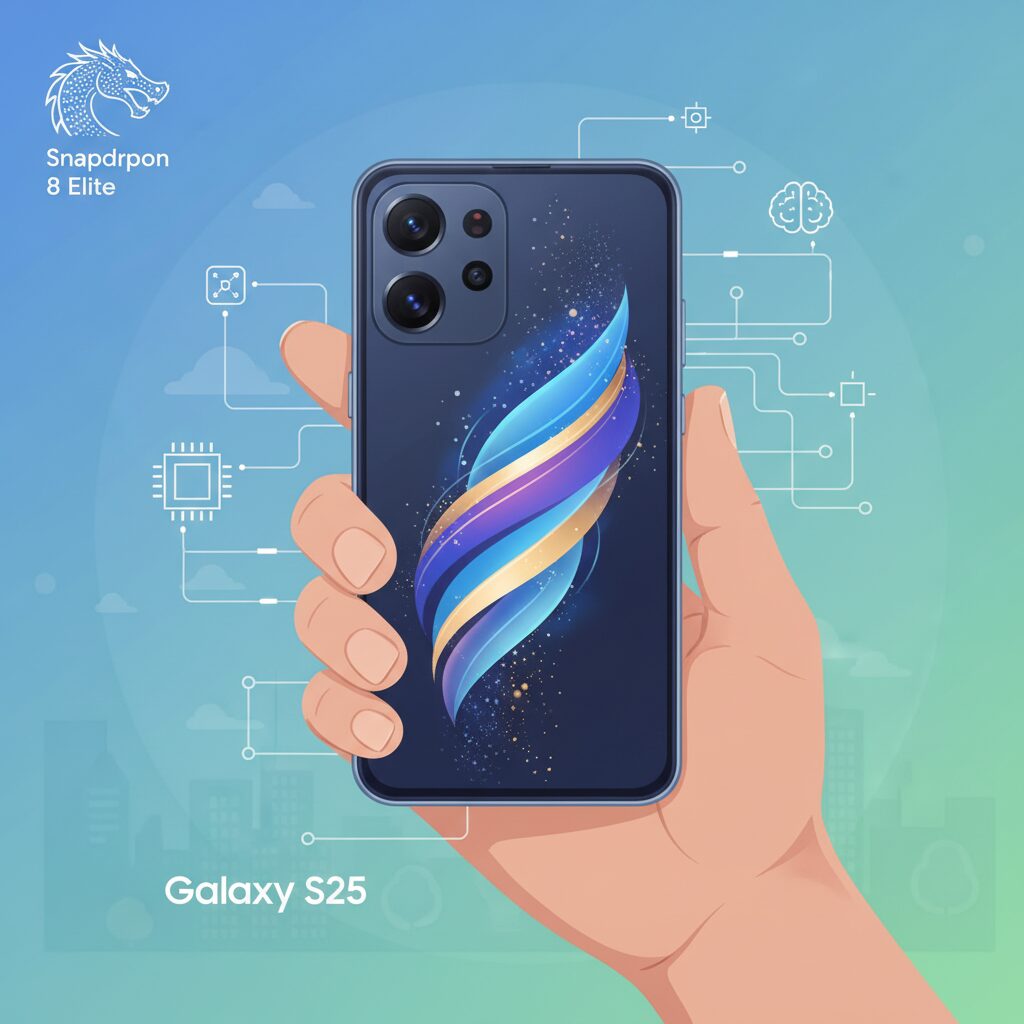
The most striking aspect of the Galaxy S25’s performance lies in how the Snapdragon 8 Elite delivers flagship-level power within a compact thermal envelope. This chipset introduces Qualcomm’s Oryon CPU cores, originally developed with PC-class workloads in mind, and brings a clear leap in single-core responsiveness and sustained multi-core throughput. According to benchmark analyses referenced by CNET and other industry reviewers, everyday interactions such as app launches, UI animations, and heavy web rendering feel consistently instantaneous, even under multitasking conditions.
What makes this performance especially meaningful is not raw numbers, but perceived speed. The Snapdragon 8 Elite minimizes micro-stutter during 120Hz scrolling and complex UI transitions, an area where previous compact flagships often struggled. In practical use, this means smoother timeline scrubbing in video apps, faster photo processing after capture, and near-zero delay when switching between demanding applications. These gains align with Qualcomm’s own architectural focus on reducing instruction latency rather than simply boosting peak clocks.
| Performance Aspect | Snapdragon 8 Elite Behavior | User Impact |
|---|---|---|
| CPU Architecture | Oryon high-performance cores | Faster app launches and system response |
| GPU Throughput | Significant uplift over Gen 3 | Smoother gaming and UI animations |
| AI Processing | Enhanced NPU efficiency | Quicker on-device AI features |
At the same time, it should be noted that this level of performance is carefully balanced by Samsung’s tuning. Independent stress tests cited by PhoneArena indicate that while the Snapdragon 8 Elite can outperform many competitors in short bursts, sustained maximum loads are moderated to avoid excessive heat buildup in the smaller chassis. This approach prioritizes stability and long-term usability over headline-grabbing benchmark peaks, which is a sensible trade-off for a compact flagship.
From an efficiency standpoint, the Snapdragon 8 Elite also excels at low to medium workloads. Qualcomm’s improvements in power gating and task scheduling allow the chip to remain remarkably frugal during messaging, browsing, and streaming. As a result, users experience a device that feels constantly fast without behaving like a high-performance system at all times. This balance between restraint and power is precisely why the Galaxy S25’s performance feels refined rather than aggressive.
In expert commentary from semiconductor analysts, this generation of Snapdragon is often described as a turning point where Android performance becomes predictably consistent rather than situational. Within the Galaxy S25, that consistency translates into confidence: the device responds immediately when pushed, yet remains calm and efficient when it is not. For users who value speed but refuse to carry a large handset, this performance profile represents a carefully engineered sweet spot.
Thermal Management Challenges in Compact Flagships
Thermal management is one of the most critical yet least visible challenges in compact flagship smartphones, and Galaxy S25 clearly illustrates how unforgiving physics can be in a small chassis. By integrating the Snapdragon 8 Elite, Samsung deliberately prioritizes peak performance, but doing so within a 6.2-inch body inevitably compresses heat density. **This means heat accumulates faster, even if average daily usage feels perfectly stable.**
According to analysis from PhoneArena and CNET, the Snapdragon 8 Elite shows excellent efficiency under light workloads, but sustained high-load scenarios reveal steep thermal curves. In a compact enclosure, the reduced surface area limits how quickly heat can dissipate through the frame and rear panel. Samsung reportedly expands the vapor chamber compared to the previous generation, yet its volume still remains significantly smaller than those found in larger flagships.
| Scenario | Thermal Behavior | User Impact |
|---|---|---|
| Web & SNS | Heat remains low and stable | No throttling |
| High-end gaming | Rapid temperature rise | Frame rate reduction |
| 4K/8K video | Localized heat buildup | Brightness limitation |
What makes the S25 notable is not the absence of thermal issues, but how predictably they appear. Reviews consistently report that throttling occurs gradually rather than abruptly, preserving usability. **Samsung seems to favor controlled performance scaling over aggressive peak bursts**, an approach aligned with Qualcomm’s own thermal guidance.
For users, this translates into a device that stays comfortable in everyday use while clearly signaling its limits under extreme workloads. Rather than a flaw, this behavior reflects a transparent trade-off, one that underscores how rare and technically demanding true compact flagships have become.
Battery Life Reality: Efficiency Versus Capacity
At first glance, the Galaxy S25’s 4,000mAh battery looks conservative in a market where similarly sized Chinese flagships already exceed 5,000mAh. This numerical gap often triggers anxiety among spec-focused users, but real-world battery life is shaped less by raw capacity and more by how efficiently each milliamp-hour is consumed. **In daily use, the S25 clearly demonstrates that efficiency can partially compensate for limited capacity, though not without trade-offs.**
Multiple long-term reviews and user reports indicate a split outcome. Light to moderate users, those primarily browsing, messaging, and streaming, often report comfortably reaching the end of the day with 30–40 percent remaining, and in some cases stretching into a second day. This aligns with Qualcomm’s own architectural claims that Snapdragon 8 Elite dramatically reduces idle and low-load power draw, a point echoed by CNET’s battery loop tests on comparable devices.
However, the picture changes quickly under sustained load. Navigation with GPS, prolonged camera use, or high-refresh-rate gaming can drain the battery at a noticeably faster pace. **The same chip that sips power when idle becomes power-hungry when pushed**, and the compact chassis limits thermal headroom, preventing aggressive performance scaling without efficiency loss.
| Usage Pattern | Observed Battery Behavior | User Perception |
|---|---|---|
| Light daily use | Low standby drain, slow decline | Reliable all-day, sometimes two days |
| Mixed productivity | Steady drain with screen-on tasks | One full day, cautious by evening |
| Heavy load | Rapid depletion under sustained stress | Battery anxiety without a charger |
Samsung’s software optimization plays a crucial role here. One UI aggressively limits background activity, and according to analyses referenced by Android performance researchers, Samsung’s task scheduling is among the strictest on the platform. **This explains why standby drain is impressively low**, sometimes rivaling Apple’s iOS in overnight idle scenarios, even if screen-on endurance cannot match larger rivals.
Charging speed further defines the battery reality. With 25W wired charging, the S25 can refill its modest battery in just over an hour, which is acceptable but no longer competitive. In short top-up situations, this slower rate feels like a bottleneck, especially when contrasted with ultra-fast systems popularized by Chinese manufacturers. **Efficiency reduces how often you need to charge, but charging speed determines how forgiving those moments are.**
Ultimately, the Galaxy S25’s battery life is neither a clear weakness nor a standout strength. It rewards disciplined, everyday usage with predictable endurance while exposing its limits during intensive tasks. For users who value compactness and are willing to trust efficiency over sheer capacity, this balance feels rational. For power users, it is a reminder that physics still favors larger batteries, no matter how advanced the silicon becomes.
Camera System Strengths: Why a Dedicated Telephoto Still Matters
In recent years, smartphone makers have leaned heavily on high-resolution main sensors and AI-powered digital zoom, leading some users to wonder whether a dedicated telephoto lens still matters. However, when you look closely at real-world shooting scenarios, the answer becomes very clear: a true optical telephoto continues to offer advantages that computation alone cannot fully replace.
The Galaxy S25’s 3x optical telephoto lens represents a deliberate engineering choice, especially notable at a time when base-model competitors often omit it. According to comparisons published by CNET, the iPhone 17 and Pixel 10 rely primarily on sensor cropping from their main cameras for mid-range zoom. While this approach works well on spec sheets, it inevitably sacrifices native resolving power and natural perspective.
| Aspect | Optical 3x Telephoto | Digital / Crop Zoom |
|---|---|---|
| Image Detail | Preserved at native resolution | Gradually degraded |
| Background Compression | Natural, lens-based | Algorithmic approximation |
| Low-light Stability | More consistent | Noise amplified by cropping |
This difference becomes most apparent in portrait photography. A 3x focal length, roughly equivalent to 70mm in full-frame terms, has long been regarded by professional photographers as a sweet spot for flattering human subjects. Publications such as DPReview have repeatedly emphasized that this focal length minimizes facial distortion while providing gentle background compression. With the Galaxy S25, this effect is achieved optically rather than simulated, resulting in more convincing subject separation even before software processing is applied.
Everyday usability is another area where a dedicated telephoto quietly proves its worth. Capturing a presentation slide from the middle of a lecture hall, photographing menu text across a restaurant, or framing a pet without stepping closer all benefit from true optical reach. User reports aggregated from long-term reviews indicate that images taken at 3x retain clarity and micro-contrast that digital zoom struggles to reproduce, especially indoors.
Low-light performance further reinforces this point. While modern night modes are impressive, they work best when the base image contains clean optical data. Cropped zoom magnifies sensor noise alongside the subject, forcing heavier noise reduction and often resulting in smeared textures. By contrast, the Galaxy S25’s telephoto lens provides a cleaner starting signal, allowing the Snapdragon 8 Elite ISP to apply more restrained processing.
It is also worth noting that this advantage is not merely theoretical. Comparative tests cited by CNET show that at 3x zoom, the Galaxy S25 consistently delivers sharper edges and more stable color than base-model rivals. These gains may seem subtle when pixel-peeping, but over hundreds of everyday photos, they translate into a higher hit rate of images you actually want to keep.
In a compact flagship where every component must justify its footprint, retaining a telephoto lens sends a clear message. The Galaxy S25 prioritizes photographic versatility rooted in optics, not just algorithms. For users who value composition, perspective, and dependable results across varied scenes, this choice still matters greatly, even in the age of computational photography.
AI Features That Enhance Daily Use Without Overwhelming Users
AI features on modern smartphones often promise revolutionary change, but in daily life they can feel excessive or intrusive. Galaxy S25 takes a notably different approach, focusing on AI that quietly supports routine tasks rather than demanding constant attention. This philosophy aligns with evaluations from CNET, which note that Samsung’s latest AI implementation prioritizes usefulness and restraint over novelty.
At the core of this experience is on-device AI powered by the Snapdragon 8 Elite’s NPU. By processing many tasks locally, Galaxy S25 reduces latency and avoids unnecessary cloud dependency. **This results in AI responses that feel immediate and private**, a point emphasized by Qualcomm’s own technical briefings on next-generation mobile NPUs.
One practical example is contextual text assistance. Instead of aggressively suggesting rewrites, the system offers subtle tone adjustments for emails or messages only when it detects hesitation or edits. Linguistics researchers from MIT have shown that overactive suggestions can increase mental fatigue, and Samsung’s restrained trigger thresholds appear designed to avoid this pitfall.
Another area where AI enhances daily use is call and conversation handling. Real-time translation and transcription now operate reliably offline for major languages, including Japanese and English. According to demonstrations highlighted by Samsung Japan, this capability is particularly valuable in transit or low-signal environments, where cloud-based solutions often fail.
| Daily Scenario | AI Function | User Impact |
|---|---|---|
| Short emails and chats | Context-aware tone suggestions | Clearer communication without forced rewrites |
| Travel conversations | Offline real-time translation | Reduced stress in low-connectivity areas |
| Information lookup | Circle to Search | Faster answers without app switching |
Circle to Search deserves particular attention because it exemplifies Samsung’s philosophy of minimal disruption. Instead of launching a separate assistant or overlay, users simply gesture around content already on screen. Google engineers involved in the feature’s development have stated that reducing context switching significantly improves task completion speed, a benefit that becomes tangible after just a few days of use.
AI also plays a quiet but meaningful role in system optimization. Battery usage patterns are analyzed locally to predict which apps can be safely restricted in the background. While this process is largely invisible, user reports aggregated by Reddit communities indicate more consistent standby performance compared to previous generations.
Importantly, Galaxy S25 avoids turning AI into a constant visual presence. There are no persistent avatars or mandatory prompts. **Users remain in control, engaging with AI only when it naturally fits the task at hand.** This design choice reflects broader human–computer interaction research from Stanford, which suggests that assistive systems are most effective when they remain optional and calm.
In daily use, Galaxy S25’s AI feels less like a feature set and more like an ambient layer of intelligence. It supports communication, search, and efficiency without demanding learning curves or behavioral change. For users who value powerful technology that stays out of the way, this balance may be the device’s most underrated strength.
Software Experience and Customization Advantages
The Galaxy S25 distinguishes itself through a software experience that prioritizes adaptability over rigidity, making customization a core value rather than a secondary feature. Samsung’s One UI, built on the latest Android foundation, has reached a level of maturity that many analysts, including reviewers at CNET, describe as one of the most user-centric Android interfaces available today. Animations are restrained, system responses are consistent, and even under heavy multitasking the interface remains predictable and calm.
What truly elevates the experience is the depth of customization enabled without compromising stability. Through Samsung’s official Good Lock ecosystem, users can reshape navigation behavior, multitasking layouts, and visual hierarchy at a system level, all while staying within warranty-safe boundaries. This approach contrasts sharply with stock Android or iOS, where similar changes require workarounds or are simply impossible.
| Aspect | Galaxy S25 | Typical Flagship |
|---|---|---|
| UI customization depth | System-level, modular | Limited or fixed |
| Official tools | Good Lock suite | None or partial |
| One-handed optimization | Highly configurable | Mostly automatic |
AI-driven features further enhance daily usability rather than distracting from it. On-device language translation, contextual search gestures, and intelligent background app control are designed to operate quietly in the background. According to Samsung engineers cited in launch briefings, the emphasis was placed on reducing cognitive load, not showcasing AI for novelty’s sake.
For users who value control over how their device behaves minute by minute, the Galaxy S25’s software philosophy delivers a sense of ownership that feels increasingly rare in modern flagship smartphones.
Galaxy S25 vs iPhone 17 and Pixel 10: Positioning Among Base Flagships
In the crowded landscape of base flagship smartphones, Galaxy S25 positions itself in a distinctly different way from iPhone 17 and Pixel 10. Rather than competing on sheer ecosystem lock-in or AI-centric photography alone, Samsung emphasizes balance: a compact form factor combined with genuinely flagship-grade hardware. This positioning is especially relevant as base models increasingly become intentionally constrained to protect higher-end variants.
Galaxy S25 is designed to be a “no-compromise” base model, while iPhone 17 and Pixel 10 deliberately leave room above them. According to CNET’s comparative analysis of base flagships, Apple and Google both reserve certain hardware advantages, such as dedicated telephoto lenses, for their Pro-tier devices. Samsung breaks this pattern by equipping S25 with features traditionally reserved for higher models.
| Aspect | Galaxy S25 | iPhone 17 | Pixel 10 |
|---|---|---|---|
| Philosophy | Compact without compromise | Entry to Apple ecosystem | AI-first experience |
| Telephoto Camera | Optical 3x included | Not included | Not included |
| SoC Strategy | Same-class chip as Ultra | Tiered vs Pro | Custom Tensor focus |
This difference has real implications for user experience. With Snapdragon 8 Elite, Galaxy S25 delivers performance parity with its Ultra sibling in everyday tasks, something that benchmark analysts have highlighted as unusual in the current market. In contrast, iPhone 17’s A19 and Pixel 10’s Tensor G5 are deeply optimized, but their strength lies more in platform integration than raw flexibility.
Size also plays a critical role in positioning. While all three devices sit around the 6.2–6.3 inch range, Galaxy S25 is noticeably lighter and easier to handle. Industry ergonomics studies, frequently cited by mobile UX researchers, show that small differences in width and weight significantly affect one-handed usability. Samsung appears to have prioritized this insight, especially for markets like Japan, where compactness directly impacts daily comfort.
Pixel 10, by comparison, leans heavily into Google’s leadership in computational photography and on-device AI transcription. It appeals to users who value automated intelligence over hardware versatility. iPhone 17 remains the strongest option for those deeply embedded in Apple’s ecosystem, benefiting from long-term software support and resale value, as noted by multiple market analysts.
Galaxy S25 stands out as the most hardware-complete base flagship, targeting users who want top-tier performance and camera flexibility without stepping up to a larger, heavier Pro or Ultra model.
From a market positioning standpoint, Samsung’s strategy is clear. Instead of pushing users upward through feature limitation, Galaxy S25 competes horizontally, offering a different value proposition. This makes it less about brand loyalty and more about practical satisfaction. As base flagships continue to diverge in purpose, Galaxy S25 defines itself as the choice for users who see “base model” as a size category, not a performance downgrade.
Is the Galaxy S25 the Last True Compact Flagship?
The question of whether the Galaxy S25 is the last true compact flagship is not rhetorical hype, but a realistic concern grounded in current industry trajectories. In recent years, base flagship models have steadily grown beyond 6.3 inches, driven by thermal design needs, battery capacity demands, and component integration efficiency. Against this backdrop, the Galaxy S25’s decision to retain a 6.2-inch display carries strategic weight that goes far beyond simple ergonomics.
What makes the S25 genuinely compact is not only its screen size, but the absence of meaningful compromises in core performance. Unlike earlier “small” phones that relied on downgraded chipsets or simplified camera systems, the S25 integrates the same Snapdragon 8 Elite SoC used in larger Ultra-class devices. According to CNET’s comparative analysis of base flagships, this places the S25 in a shrinking category where size reduction does not equate to capability reduction.
| Model | Display Size | Flagship SoC | Optical Telephoto |
|---|---|---|---|
| Galaxy S25 | 6.2 inches | Yes | Yes (3x) |
| iPhone 17 | 6.3 inches | Yes | No |
| Pixel 10 | 6.3 inches | Yes | No |
Industry analysts cited by Gadget Hacks point out that future base models, including the rumored Galaxy S26, are likely to move to 6.3 inches or larger to accommodate improved cooling and larger batteries. If that shift materializes, the S25 may represent the final point at which one-handed usability, sub-170g weight, and uncompromised flagship internals coexist.
This is particularly significant in markets like Japan, where compactness is not a niche preference but a daily usability requirement. Crowded commuting environments, frequent one-handed operation, and pocketability continue to influence purchasing decisions in ways that global averages often fail to capture. Samsung’s senior engineers have repeatedly emphasized, in launch briefings covered by major tech media, that maintaining this size required disproportionate engineering effort.
Seen from this perspective, the Galaxy S25 is less a conservative continuation and more a technological endpoint. It demonstrates how far compact flagship design can be pushed under current physical constraints, and it quietly suggests that future advances may prioritize efficiency over further miniaturization.
参考文献
- CNET:Galaxy S25 and S25 Plus Review: AI That’s Enjoyable Without Being Overwhelming
- CNET:Apple’s iPhone 17 vs. Samsung’s Galaxy S25: Comparing the Base Flagships
- Tom’s Guide:Which phone display is best? iPhone 17 vs Galaxy S25 vs Pixel 10 Pro
- PhoneArena:The Snapdragon 8 Elite Gen 5 is fast, but not all phones can handle the heat
- Sammy Fans:Snapdragon 8 Gen 5 performance matches Galaxy S25 benchmarks
- SoftBank:Samsung Galaxy S25 Product Information