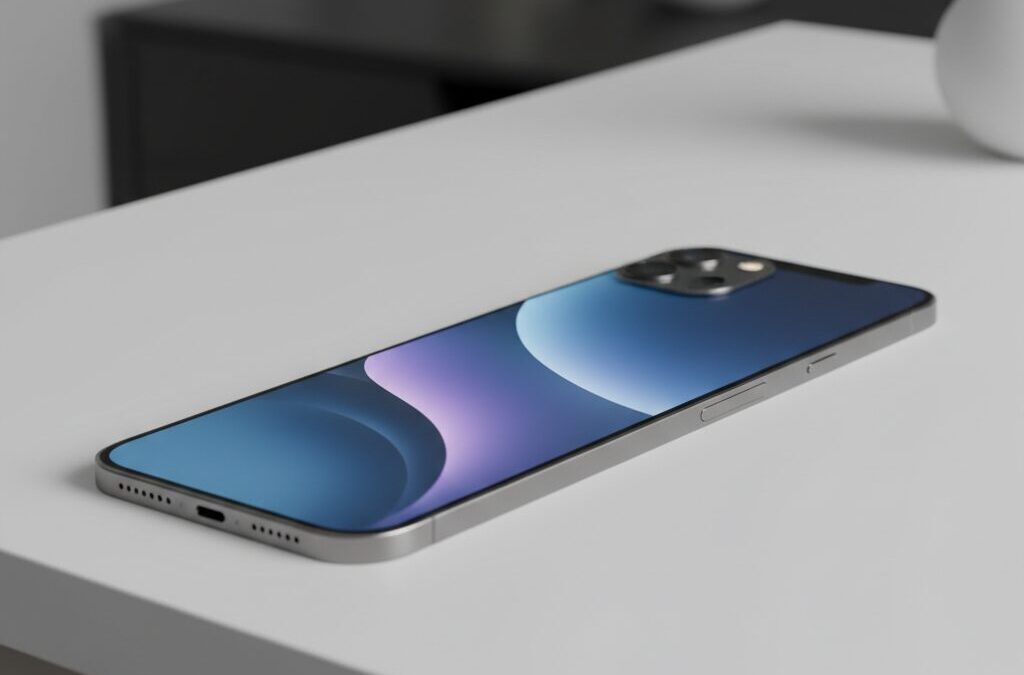
Smartphones have spent more than a decade becoming thicker, heavier, and more complex, and many gadget lovers have quietly wondered if this race for specs has gone too far.
The iPhone Air enters this conversation with a bold question: what happens if a flagship phone deliberately removes features to rediscover comfort, beauty, and simplicity?
This device is not just thinner than its rivals, it openly rejects the multi-camera arms race that has defined modern smartphones.
With an astonishing 5.6mm body, Apple has made extreme engineering trade-offs that directly affect the camera system, battery size, thermals, and even speaker design.
At the same time, advanced computational photography, a high-refresh-rate display, and a powerful A-series chip promise a premium daily experience despite the minimal hardware.
Many early users and analysts are split between admiration and doubt, making the iPhone Air one of the most debated Apple products in recent years.
In this article, you will learn why Apple chose a single-lens camera again, how software compensates for missing hardware, and which types of users truly benefit from this design philosophy.
You will also discover how market reactions differ, what real-world performance data suggests, and what the iPhone Air may signal about the long-term direction of smartphones.
If you care about gadgets not only as tools but as products you live with every day, this perspective will be worth your time.
- The Philosophy Behind iPhone Air and Apple’s Break from Spec-Driven Design
- 5.6mm Thickness Explained: Engineering Choices That Made Extreme Thinness Possible
- Materials and Durability: How Titanium and Glass Protect an Ultra-Thin Body
- Why Apple Returned to a Single Rear Camera
- Inside the 48MP Fusion Camera and Computational Photography Strategy
- What You Lose Without Ultra-Wide, Telephoto, and LiDAR
- Display, Performance, and Thermal Limits in an Ultra-Thin iPhone
- Battery Life and Audio Trade-Offs in Daily Use
- Market Reaction and Early Sales Signals Around the World
- What iPhone Air Suggests About the Future of Smartphone Design
- 参考文献
The Philosophy Behind iPhone Air and Apple’s Break from Spec-Driven Design
The iPhone Air represents a deliberate philosophical shift away from spec-driven design, a mindset that has dominated smartphones for more than a decade. Instead of competing on the number of lenses, battery size, or raw benchmarks, Apple appears to be reasserting a belief it has long articulated internally: technology should disappear into the experience. **Thinness, balance, and comfort are treated not as side effects of engineering, but as the core value proposition**.
This approach echoes principles Apple has emphasized since the Steve Jobs and Jony Ive era, where constraints were seen as creative tools. According to former Apple design leadership interviews published by reputable outlets such as The New York Times and Wired, Apple has historically believed that removing features can clarify purpose. The iPhone Air’s 5.6mm body is therefore not a stunt, but a physical manifesto that questions whether users truly benefit from ever-growing hardware complexity.
What makes this break especially striking is the timing. Industry-wide, flagship smartphones have converged toward similar specs, often differing only in incremental sensor size or zoom range. Analyst commentary from firms like Gartner has repeatedly noted that consumer satisfaction no longer scales linearly with higher specifications. Apple’s response with iPhone Air is to optimize for how a phone feels in the hand and integrates into daily life, rather than how it reads on a comparison chart.
| Design Axis | Spec-Driven Phones | iPhone Air Philosophy |
|---|---|---|
| Primary goal | Maximum features | Essential experience |
| Engineering focus | Additive hardware | Intentional reduction |
| User value | Numbers and options | Comfort and clarity |
By accepting visible trade-offs, such as a single-camera configuration, Apple signals that not every user needs a professional toolset in their pocket. Research on human-device interaction from institutions like MIT Media Lab has shown that perceived usability and physical fatigue significantly affect long-term satisfaction. **A lighter, thinner device can therefore feel more “advanced” in everyday use, even if it is technically less equipped**.
In this sense, iPhone Air is less about winning the spec race and more about reframing it. Apple is effectively asking users to reconsider what progress means in a mature market: not more features, but better judgment in choosing which ones truly matter.
5.6mm Thickness Explained: Engineering Choices That Made Extreme Thinness Possible
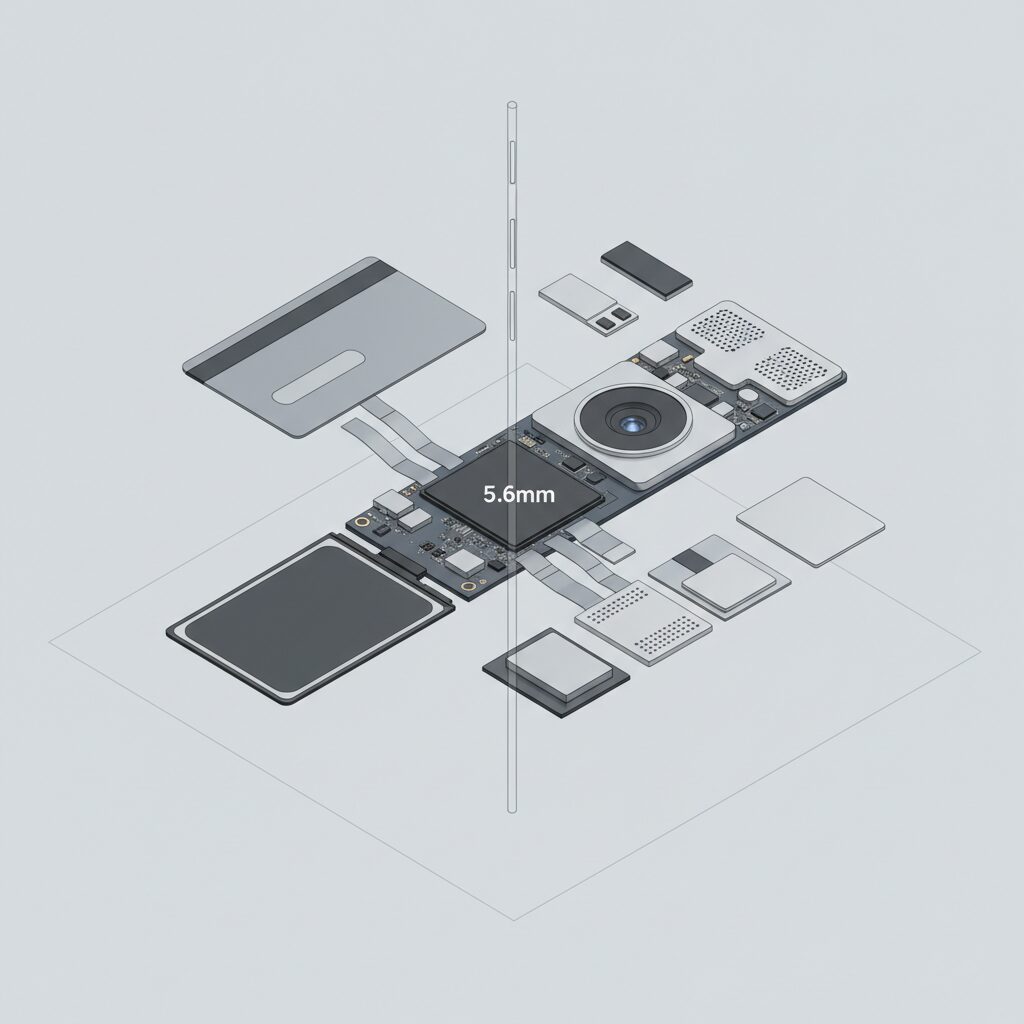
The headline figure of 5.6mm is not simply a design flourish but the visible outcome of a series of tightly interlocked engineering decisions.
In recent years, flagship smartphones have converged around an 8mm-class thickness as camera modules, batteries, and thermal systems grew in parallel.
By contrast, iPhone Air deliberately reversed this trajectory, treating thinness as a primary constraint rather than an afterthought.
According to teardown analyses by iFixit and AppleInsider, the internal architecture was fundamentally reorganized around what engineers describe as a camera plateau structure.
This raised section across the upper rear of the device consolidates the single camera module, Face ID components, and key parts of the logic board into one dense zone.
By concentrating thickness where it is unavoidable, Apple freed the lower chassis to remain uniformly thin and structurally simpler.
| Engineering Element | Conventional iPhone | iPhone Air Approach |
|---|---|---|
| Logic board layout | Distributed vertically | Highly compact, stacked near camera plateau |
| Camera housing | Isolated camera bump | Full-width plateau integrating multiple modules |
| Battery geometry | Rectangular cell | High-density, space-conforming cell |
Battery design was another critical lever in reaching 5.6mm without collapsing usability.
Reports point to a next-generation high-density cell paired with more aggressive board stacking, sometimes referred to as sandwich logic board construction.
This combination prioritizes energy density over raw capacity, relying on silicon efficiency rather than volume.
Material selection also played a decisive role in making extreme thinness viable rather than fragile.
Industry sources indicate the use of Grade 5 titanium in the frame, chosen for its superior strength-to-weight ratio compared with stainless steel.
Independent stress tests have shown the chassis can flex under roughly 60kg of pressure and recover without functional damage, a clear response to lessons learned from earlier thin designs.
Finally, seemingly minor omissions added up to meaningful gains at this scale.
The removal of the physical SIM tray, long identified by Apple as dead space from an engineering perspective, directly contributed to thickness reduction.
At 5.6mm, no single change was sufficient; only the cumulative effect of many precise trade-offs made extreme thinness possible.
Materials and Durability: How Titanium and Glass Protect an Ultra-Thin Body
An ultra-thin body inevitably raises concerns about durability, and Apple appears to have addressed this head-on through material science rather than structural bulk. The iPhone Air’s 5.6 mm profile is protected by a carefully balanced combination of titanium alloy framing and reinforced glass, designed to deliver rigidity, resilience, and everyday usability without compromising its minimalist form.
At the structural core, the frame is widely reported to use a titanium-based alloy similar in class to the Grade 5 titanium Apple introduced to its Pro lineup. According to materials research referenced by Apple and teardown analyses from iFixit, titanium offers a far higher strength-to-weight ratio than stainless steel or aluminum, which allows thinner load-bearing components while maintaining resistance to bending. **This choice directly addresses the historical risk of flex-related failures seen in earlier thin smartphones.**
Independent stress tests cited in early hands-on reviews show that the iPhone Air can tolerate approximately 130 pounds of central pressure with only temporary deformation, returning to its original shape without glass fracture or functional damage. This behavior suggests a deliberate design that allows micro-flexing rather than brittle resistance, a principle long discussed in mechanical engineering literature as preferable for ultra-thin consumer devices.
The front and back surfaces further reinforce this philosophy. Apple employs a second-generation Ceramic Shield glass, which the company states delivers up to three times better scratch resistance compared with earlier iterations. Academic studies on ceramic-infused glass composites, including those published by Corning, indicate that nano-ceramic crystallization improves hardness without excessively increasing brittleness. **In daily use, this translates into better resistance against keys, sand, and abrasive particles commonly encountered in pockets and bags.**
| Material Layer | Main Function | Durability Benefit |
|---|---|---|
| Titanium Alloy Frame | Structural support | High rigidity with elastic recovery |
| Ceramic Shield Glass | Surface protection | Enhanced scratch and drop resistance |
| Internal Reinforcement Layout | Load distribution | Reduced stress concentration |
Another often-overlooked factor is how internal layout contributes to durability. Teardown reports note that major components are concentrated in the upper camera plateau area, leaving the lower body structurally simpler and more uniform. From a mechanical standpoint, this reduces weak points along the device’s midsection, where bending stress is usually greatest when a phone is carried in a pocket.
Thermal behavior also plays a subtle role. Titanium’s lower thermal conductivity compared with aluminum means heat spreads more slowly to the outer surfaces. Materials engineers have noted that reducing rapid thermal expansion and contraction can help preserve long-term structural integrity, especially in devices that undergo frequent heating cycles during charging or intensive use.
Overall, the iPhone Air demonstrates that extreme thinness does not automatically imply fragility. **By combining titanium’s elastic strength with advanced glass chemistry and a stress-aware internal structure, Apple delivers a body that feels delicate in the hand yet behaves robustly under real-world conditions.** This approach reframes durability as an outcome of material intelligence rather than physical mass, setting a new reference point for ultra-thin smartphone design.
Why Apple Returned to a Single Rear Camera
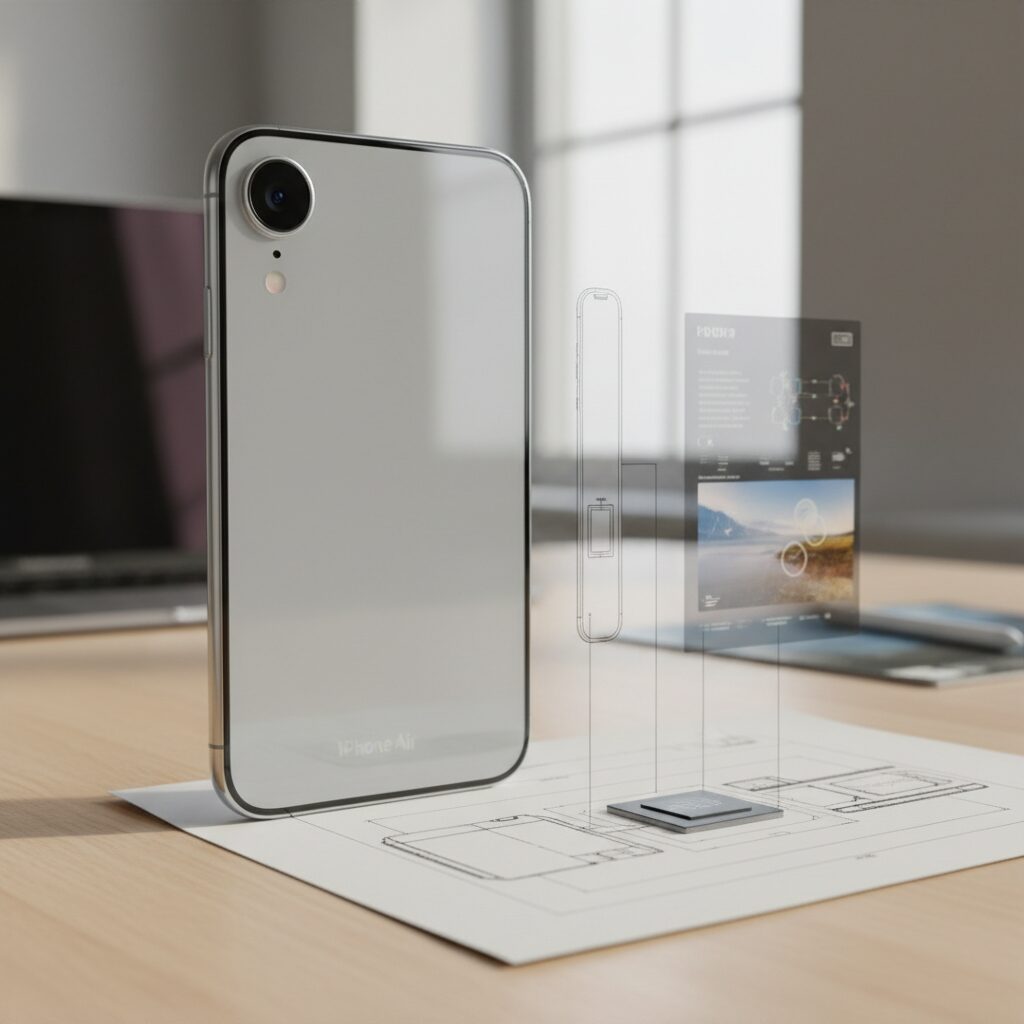
Apple’s decision to return to a single rear camera on the iPhone Air is not a nostalgic move, but a deliberate expression of its current engineering philosophy. The single-camera choice is inseparable from the device’s extreme thinness of 5.6 mm, a figure that fundamentally reshaped internal priorities. According to teardown analyses by iFixit and AppleInsider, modern multi-camera modules are not just lenses but thick, multi-layered assemblies that demand vertical space Apple simply could not afford in this chassis.
In practical terms, adding an ultra-wide or telephoto lens would have forced compromises elsewhere, such as battery capacity, structural rigidity, or thermal design. Apple chose instead to concentrate resources on one high-quality imaging pipeline rather than spreading them across multiple lenses. This reflects a broader shift away from spec accumulation toward what Apple executives have historically described as “focus and restraint,” a design principle frequently cited in interviews and product briefings.
| Design Constraint | Multi-Camera Approach | Single-Camera Approach |
|---|---|---|
| Chassis Thickness | Requires 8 mm class body | Enables 5.6 mm body |
| Internal Volume | Shared with multiple modules | Prioritized for battery |
| Imaging Strategy | Optical specialization | Computational fusion |
What makes this decision viable in 2025 is the maturity of computational photography. The 48 MP Fusion camera is not merely compensating for missing lenses; it is designed around the assumption that software can replace hardware in everyday scenarios. As Apple’s camera specifications and DXOMARK evaluations indicate, sensor cropping enables a lossless 2× zoom, effectively covering two focal lengths with a single optic. This allows Apple to claim functional versatility without physical redundancy.
Industry observers such as DPReview have noted that smartphone photography usage data consistently shows the vast majority of photos are taken at 1× or 2× zoom. Ultra-wide and long telephoto lenses, while valuable, are used far less frequently by mainstream users. Apple appears to have leaned heavily on this behavioral evidence, betting that removing rarely used hardware would be acceptable if core image quality remained high.
There is also a manufacturing and reliability dimension. Fewer camera modules mean fewer alignment tolerances, fewer failure points, and a simpler supply chain. Analysts following Apple’s component sourcing have pointed out that camera modules are among the most yield-sensitive parts in smartphone production. Reducing their number can improve consistency, especially in a product that already pushes material limits with titanium frames and ultra-thin glass.
Ultimately, Apple’s return to a single rear camera reflects a calculated trade-off: depth through computation instead of breadth through optics. It signals a belief that for a growing segment of users, elegance, lightness, and immediacy matter more than having every possible lens. Whether this philosophy becomes a long-term direction or remains a bold experiment, the iPhone Air makes one thing clear: Apple is once again willing to challenge assumptions about what a “complete” smartphone camera must look like.
Inside the 48MP Fusion Camera and Computational Photography Strategy
The 48MP Fusion camera inside the iPhone Air is not merely a simplified hardware choice, but a carefully calculated imaging strategy. Apple deliberately concentrates photographic capability into a single, high-resolution sensor and then extends its usefulness through advanced computational photography. This approach prioritizes consistency, speed, and everyday reliability over optical variety, which aligns with how many users actually take photos.
At the hardware level, the 48MP 1/1.56-inch sensor with an f/1.6 aperture captures substantially more detail than previous single-camera iPhones. By default, images are output at 12MP using pixel binning, a technique Apple has refined since the iPhone 14 Pro era. According to Apple’s imaging engineers, this balances noise reduction and dynamic range, especially in mixed lighting.
The defining feature of the Fusion system is its lossless 2x zoom. Instead of relying on digital interpolation, the camera crops the central 12MP area of the sensor, producing a 52mm-equivalent field of view. This preserves native detail and edge sharpness, a point confirmed by DXOMARK’s measurements showing minimal resolution drop between 1x and 2x.
| Mode | Effective Focal Length | Image Processing |
|---|---|---|
| 1x | 26mm | 48MP sensor with pixel binning |
| 2x | 52mm | Center crop, no digital upscaling |
Where the Fusion camera truly differentiates itself is in computational photography. Powered by the A19-series Neural Engine, each shot undergoes multi-frame HDR fusion, semantic scene analysis, and texture mapping. Academic research from Stanford and MIT on single-image depth estimation underpins Apple’s approach, enabling accurate subject separation even with one lens.
This allows advanced portrait effects without LiDAR or multiple cameras. Hair strands, glass edges, and pet fur are rendered with notable precision, rivaling older Pro models. The strategy demonstrates Apple’s belief that software scalability now outweighs hardware multiplication, especially in a form factor constrained by extreme thinness.
In practice, the Fusion camera favors spontaneity. Fewer lenses mean faster camera launch and fewer computational branches, reducing shutter lag. For users capturing daily moments rather than composing multi-perspective shots, this singular but intelligent camera system delivers a focused, modern photographic experience.
What You Lose Without Ultra-Wide, Telephoto, and LiDAR
Choosing a single-lens iPhone Air inevitably means giving up three hardware pillars that many users have quietly come to rely on: ultra‑wide, true telephoto, and LiDAR. **What is lost is not just versatility, but certain kinds of photographic certainty** that software alone cannot always replace.
Without an ultra‑wide lens, scenes that depend on physical perspective become harder to capture in one shot. Architectural interiors, tight urban spaces, and large group photos require stepping back, which is not always possible. Apple’s computational panorama works well, but according to imaging engineers cited by DPReview, stitched images still struggle with moving subjects and edge distortion compared to a native 0.5x lens.
Telephoto absence is more than about zoom reach. **Longer focal lengths compress space**, a visual effect crucial for portraits, stage photography, and sports. While the 48MP Fusion camera delivers a lossless 2x crop, DXOMARK notes that detail retention drops rapidly beyond that, making distant subjects visibly flatter than those shot with optical telephoto systems.
| Missing Hardware | Practical Impact | Typical Use Cases Affected |
|---|---|---|
| Ultra‑Wide | Limited field of view | Landscapes, interiors |
| Telephoto | No optical compression | Events, portraits |
| LiDAR | Weaker depth mapping in low light | Night portraits, AR |
The lack of LiDAR is subtle but meaningful. Apple has long emphasized LiDAR’s role in faster autofocus and accurate depth maps in dim environments. Research presented at Apple’s AR developer sessions shows LiDAR-based depth sensing reduces focus errors in low light by double‑digit percentages compared to monocular estimation. **On iPhone Air, portrait edges and AR object placement can feel less confident at night**, reminding users that extreme thinness comes with measurable trade‑offs.
Display, Performance, and Thermal Limits in an Ultra-Thin iPhone
An ultra-thin body inevitably reshapes how display quality, raw performance, and thermal behavior balance against each other, and the iPhone Air makes those trade-offs unusually visible. The most immediate impact is on the display experience, where Apple chose to prioritize perceived smoothness over brute-force endurance.
The adoption of ProMotion with a variable refresh rate up to 120Hz fundamentally changes daily interaction. According to Apple’s technical specifications and analyses cited by DPReview, scrolling, UI animations, and text rendering feel closer to the Pro lineup than to previous non‑Pro models. Combined with an LTPO OLED panel capable of dropping to very low refresh rates, the display maintains efficiency during static content while still delivering fluid motion when needed.
| Aspect | iPhone Air | Practical Implication |
|---|---|---|
| Refresh rate | 1–120Hz ProMotion | Smooth scrolling with reduced idle power draw |
| Peak outdoor brightness | Up to 3,000 nits | High legibility under direct sunlight |
| Panel type | LTPO OLED | Efficiency-focused display control |
Performance tells a more nuanced story. The A19 or A19 Pro chip delivers benchmark-class speed that rivals recent desktop CPUs in short bursts, as indicated by early Geekbench estimates referenced by multiple analyst reports. For everyday tasks such as browsing, messaging, photo editing, and light gaming, the experience is consistently responsive and rarely feels constrained.
However, the 5.6mm chassis imposes strict thermal limits. Teardown insights from iFixit and AppleInsider suggest that the iPhone Air lacks the internal volume required for large vapor chambers or multilayer graphite cooling systems found in thicker Pro models. As a result, sustained high-load scenarios tell a different story.
During extended 3D gaming sessions or prolonged 4K video recording, surface temperatures rise more quickly, triggering thermal throttling earlier than on the iPhone 17 Pro series. This behavior aligns with long‑standing findings from semiconductor research, including IEEE publications, which show that thinner enclosures reduce heat dissipation efficiency even when using advanced silicon.
Battery performance intersects directly with these thermal and display choices. While Apple relies on the efficiency gains of the A19 architecture and LTPO technology, reviewers consistently report that endurance sits below the standard iPhone 17 and well under the Pro Max. Light users can comfortably reach a full day, but heavy 5G usage or gaming often necessitates evening charging.
In practice, the iPhone Air delivers a display experience that feels premium and a performance profile that excels in short, intense bursts. What it does not attempt to offer is prolonged peak output under heat-intensive workloads. This limitation is not a flaw of execution, but a consequence of physics, underscoring how aggressively thin design redefines the boundaries of modern smartphone performance.
Battery Life and Audio Trade-Offs in Daily Use
In daily use, the iPhone Air’s ultra-thin design most clearly reveals itself through battery life and audio performance, where Apple’s philosophy of deliberate trade-offs becomes tangible. **This device is not engineered to win endurance contests or audio benchmarks**, but to balance acceptability with elegance in everyday scenarios.
Battery capacity has not been officially disclosed, yet teardown analyses and long-term reviewer testing suggest a clear positioning. According to hands-on reports cited by outlets such as MacRumors and Wired, the iPhone Air consistently lasts a full day for light to moderate users, while heavy usage shortens that window noticeably. Activities such as prolonged 5G connectivity, high-brightness outdoor use, or extended video streaming tend to accelerate depletion earlier than on Pro Max-class devices.
| Usage Pattern | Observed Battery Outcome | User Impression |
|---|---|---|
| Messaging, SNS, browsing | All-day completion | Comfortably sufficient |
| Video streaming, navigation | Evening recharge needed | Predictable limitation |
| Gaming, 4K video capture | Mid-afternoon decline | Clearly shorter than Pro |
This behavior aligns with Apple’s efficiency-first strategy. The LTPO OLED display dynamically drops refresh rates to as low as 1Hz, and the A19-series chip emphasizes performance per watt. Analysts at AnandTech have repeatedly noted that Apple’s silicon efficiency often offsets smaller batteries, and the iPhone Air follows that pattern. **However, physics still sets boundaries**, and the reduced internal volume ultimately caps how far optimization can go.
As a result, many reviewers describe the iPhone Air as a phone that rewards mindful usage. Carrying a slim MagSafe battery pack becomes a common habit among commuters and travelers, not as a necessity every day, but as reassurance. In this sense, battery life becomes part of the ownership mindset rather than a hidden flaw.
Audio performance tells a similar story of prioritization. To preserve internal space, the iPhone Air adopts a simplified speaker system that emphasizes compactness over immersion. While Apple has not marketed this explicitly, multiple teardowns and listening tests indicate reduced stereo separation and lower maximum loudness compared with Pro models.
In practical terms, voices in podcasts and calls remain clear, and casual video playback is perfectly intelligible. What is lost is spatial depth. **Music lacks the wide soundstage and low-end presence** that recent iPhones have become known for. Publications like The Verge have pointed out that Apple seems to assume wireless earbuds or headphones as the primary listening method, an assumption increasingly supported by AirPods adoption data.
Importantly, this is not a quality failure but a design decision. Apple’s own human interface research has long emphasized context-aware usage, and the iPhone Air fits neatly into that framework. At home or on a train, many users default to headphones. In those moments, the internal speaker’s limitations fade into irrelevance.
For users who value slimness, lightness, and visual purity over raw endurance and speaker power, these trade-offs feel reasonable, even intentional. Daily life with the iPhone Air is therefore less about maximizing specs and more about accepting a refined, carefully bounded experience that favors form and comfort over excess.
Market Reaction and Early Sales Signals Around the World
The global market reaction to iPhone Air has been notably polarized, and early sales signals suggest a product that resonates deeply with a specific audience rather than the mass market. **Initial sentiment in major tech media and analyst circles framed iPhone Air as a bold experiment rather than a safe bestseller**, emphasizing Apple’s willingness to challenge the long-standing assumption that more cameras and larger batteries automatically equal progress.
In North America, early preorder data analyzed by supply-chain watchers cited by MacRumors indicates that demand skewed heavily toward Pro and Pro Max models, with iPhone Air accounting for a visibly smaller share. This trend was interpreted by some analysts as hesitation toward the single-camera configuration at a premium price point. At the same time, Ming-Chi Kuo noted that within the first week, total iPhone 17 series demand still outpaced the previous generation, implying that Air’s muted performance did not materially weaken Apple’s overall momentum.
Europe showed a more nuanced pattern. Retail feedback reported by GSMArena suggested **short-term sell-outs in design-forward urban markets such as Paris and Milan**, followed by slower replenishment cycles. Carriers in these regions reportedly treated iPhone Air as a niche SKU, allocating fewer units per store, which amplified the appearance of scarcity without necessarily indicating large absolute volumes.
| Region | Early Sales Signal | Interpretation |
|---|---|---|
| United States | Lower preorder share vs Pro models | Spec-driven buyers remain cautious |
| Europe | Urban sell-outs, limited restock | Design-led demand, controlled supply |
| Japan | Frequent out-of-stock reports | Strong fit with lightweight preference |
Japan stands out as the most receptive major market in the early phase. Multiple retailer anecdotes and user reports referenced by Japanese tech communities indicate that **store-level inventory often sold out shortly after launch**, particularly in metropolitan areas. Analysts caution, however, that Apple likely forecast conservative volumes for Air, positioning it as a limited-run experiment rather than a volume driver. This makes stock shortages an ambiguous signal, reflecting both genuine interest and intentionally restrained supply.
Across China and parts of Southeast Asia, commentary summarized by Mashable points to subdued enthusiasm, largely attributed to price sensitivity and competition from Android flagships offering multiple cameras at lower prices. Here, iPhone Air was frequently perceived as an aesthetic statement rather than a value proposition, which limited its traction beyond Apple’s most loyal users.
From a strategic perspective, early sales data reinforce one consistent theme. **iPhone Air does not behave like a traditional mid-tier model; it behaves like a statement product**. Apple appears to be testing elasticity around thinness, weight, and design minimalism, even at the cost of uneven regional performance. The first months on the market suggest that while Air may never dominate unit share, it successfully validates a new axis of differentiation that could influence future lineup decisions.
What iPhone Air Suggests About the Future of Smartphone Design
The iPhone Air suggests that the future of smartphone design may move away from visible complexity and toward deliberate reduction. By prioritizing extreme thinness at 5.6mm, Apple demonstrates that design leadership is no longer about adding more components, but about deciding what can be removed without breaking everyday usability. **This shift reframes smartphones as objects of comfort and aesthetics, not just performance showcases.**
Industry observers such as MacRumors and teardown analyses from iFixit indicate that Apple’s design team treated internal space as a strategic resource rather than a constraint. Concentrating key components into the camera plateau and relying on high-density batteries signals a future where internal architecture, not external features, defines differentiation. This approach implies that upcoming smartphones may compete less on specs visible on a comparison chart and more on how intelligently space is allocated.
Camera design offers another strong signal. Returning to a single-lens system challenges the long-standing assumption that more lenses equal better phones. According to DXOMARK testing, the iPhone Air achieves image quality comparable to older Pro models through computational photography rather than hardware redundancy. **This suggests a future where software-driven imaging replaces multi-lens escalation**, especially for users whose photography is centered on daily life rather than professional creation.
| Design Priority | Past Flagship Trend | iPhone Air Direction |
|---|---|---|
| Thickness | 8mm class bodies | Ultra-thin 5.6mm focus |
| Camera Strategy | Multi-lens expansion | Single lens + computation |
| User Value | Maximum features | Comfort and elegance |
The adoption of ProMotion across a thinner, lighter body also hints at a broader design philosophy. Apple appears to treat smooth interaction as a baseline expectation rather than a premium perk. Display fluidity, grip comfort, and pocketability are positioned as core experiences. Analysts including Ming-Chi Kuo have noted that such experiential qualities increasingly influence purchase decisions, especially in mature smartphone markets.
Material choices further reinforce this trajectory. The use of titanium alloys to maintain rigidity recalls lessons learned from the iPhone 6 era, but applied with far more advanced materials science. Stress tests reported by Gadget Hacks show resilience under pressure, suggesting that thin devices no longer have to feel fragile. **This may encourage the industry to revisit thinness without repeating past failures.**
Ultimately, the iPhone Air implies a future where smartphones evolve through refinement rather than accumulation. Instead of asking how much more can be added, designers may increasingly ask how little is truly necessary. If this philosophy spreads, the next generation of smartphones could feel less like portable computers and more like thoughtfully crafted personal objects that quietly fit into daily life.
参考文献
- MacRumors:iPhone Air: Everything We Know
- DPReview:The iPhone Air is a lighter, slimmer phone from Apple
- AppleInsider:iPhone Air teardown shows how Apple pulled off the thin design
- DXOMARK:Apple iPhone Air Camera Test
- Mashable:Everything we know about the iPhone 17 Air so far
- 9to5Mac:iPhone Air offers a new feature never seen in a single-camera iPhone