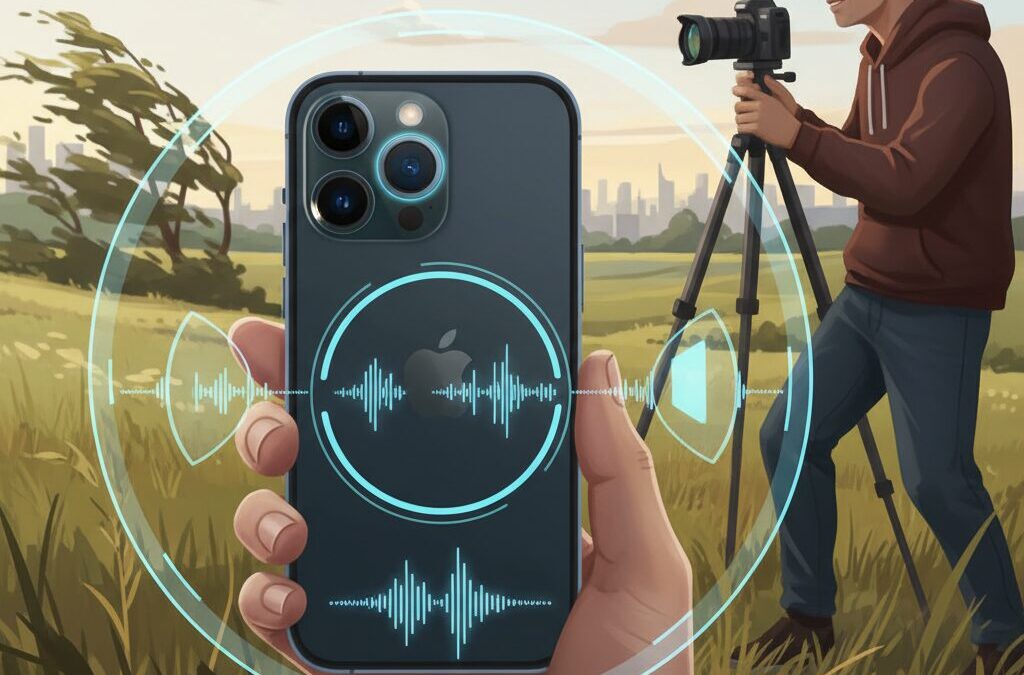
Smartphone cameras often steal the spotlight, but audio quality is what truly defines whether a video feels professional or forgettable. Many creators have experienced the frustration of stunning visuals paired with flat, noisy, or distorted sound, especially when recording outdoors or in complex environments.
With the iPhone 17 Pro, Apple signals a major shift by treating audio not as a supporting feature, but as a core creative technology. Advanced computational audio, AI-driven sound separation, and an ambitious wind noise reduction system promise studio-like results directly from a pocket-sized device.
At the same time, early measurements, expert analyses, and user reports suggest that this new approach comes with trade-offs. High sound pressure levels, live music recordings, and certain accessories reveal unexpected weaknesses alongside clear strengths.
In this article, you will gain a clear, evidence-based understanding of how the iPhone 17 Pro records sound, what has changed in its microphone hardware and signal processing, and how these changes affect real-world use cases. By the end, you will know whether this device truly elevates mobile audio recording, and how to get the best possible results if you decide to use it.
- Why Mobile Audio Recording Is Entering a New Era
- Microphone Hardware Evolution and Physical Design Changes
- Measured Frequency Response and Directivity: What the Data Reveals
- Inside the A19 Pro: How Computational Audio Processes Sound
- Audio Mix Modes Explained: In-Frame, Studio, and Cinematic
- Wind Noise Reduction Under the Microscope
- High Sound Pressure Scenarios and Live Music Recording Challenges
- USB-C Audio and External Microphone Compatibility
- Comparing iPhone 17 Pro with Previous iPhones and Android Flagships
- Who Benefits Most from iPhone 17 Pro Audio Capabilities
- 参考文献
Why Mobile Audio Recording Is Entering a New Era
For many years, mobile audio recording has been treated as a supporting feature to video, and most users have accepted that smartphone sound quality would always be a compromise. That assumption is now being challenged in a fundamental way. With devices such as the iPhone 17 Pro, mobile audio recording is entering a new era in which sound is no longer merely captured, but actively interpreted and reconstructed in real time.
The most important shift is the transition from hardware-centric improvement to computational audio. Instead of relying solely on better microphones or higher sample rates, Apple has applied the same philosophy that transformed smartphone photography to audio. According to Apple’s technical documentation, the A19 Pro chip’s Neural Engine performs continuous environmental analysis, enabling the system to identify voices, noise, and transient sounds as separate semantic elements rather than as a single waveform.
This approach changes the role of a smartphone microphone entirely. In traditional mobile recording, what the microphone hears is what gets saved, along with all its limitations. In contrast, computational audio treats raw microphone input as data to be refined. Research shared by Apple and independent acoustic measurements from Faber Acoustical indicate that multi-microphone input is now used to reconstruct an acoustic scene, not just to reduce noise.
| Aspect | Conventional Mobile Recording | Computational Audio Era |
|---|---|---|
| Role of microphones | Primary determinant of sound quality | Data source for real-time processing |
| Noise handling | Simple suppression or filtering | Semantic identification and separation |
| User expectation | Acceptable for notes and memories | Usable for content creation |
Another reason this era is different is the growing overlap between professional workflows and everyday devices. Audio engineers have long relied on techniques such as beamforming, de-reverberation, and source separation, but these processes traditionally required desktop-class CPUs and offline rendering. Apple’s implementation performs similar operations on-device and in real time, which was previously considered impractical for a smartphone.
Independent evaluations suggest that this is not just a theoretical improvement. User tests and lab measurements show that speech intelligibility in complex environments has improved noticeably compared with earlier generations. This aligns with findings from acoustic research communities, which have repeatedly shown that intelligibility, not frequency range, is the most critical factor for perceived audio quality in real-world recordings.
At the same time, this new era introduces a philosophical change. Mobile audio is no longer a neutral record of reality. The device makes decisions about what the listener should hear clearly and what should be suppressed. As Apple’s own engineers have noted in developer sessions, the goal is not perfect fidelity, but meaningful sound. This distinction explains why mobile recording now feels closer to post-produced audio, even when no manual editing is performed.
In practical terms, this evolution reflects broader changes in how audio is consumed. Short-form video, remote interviews, and social platforms prioritize clarity and immediacy over absolute accuracy. Smartphones are responding by becoming intelligent audio systems rather than passive recorders. Mobile audio recording is therefore entering a new era defined by interpretation, not just capture.
This shift does not mean that traditional recording principles are obsolete, but it does mean that expectations have changed. A phone is now expected to understand sound, not simply store it. That expectation marks a clear technological and cultural turning point for mobile audio.
Microphone Hardware Evolution and Physical Design Changes
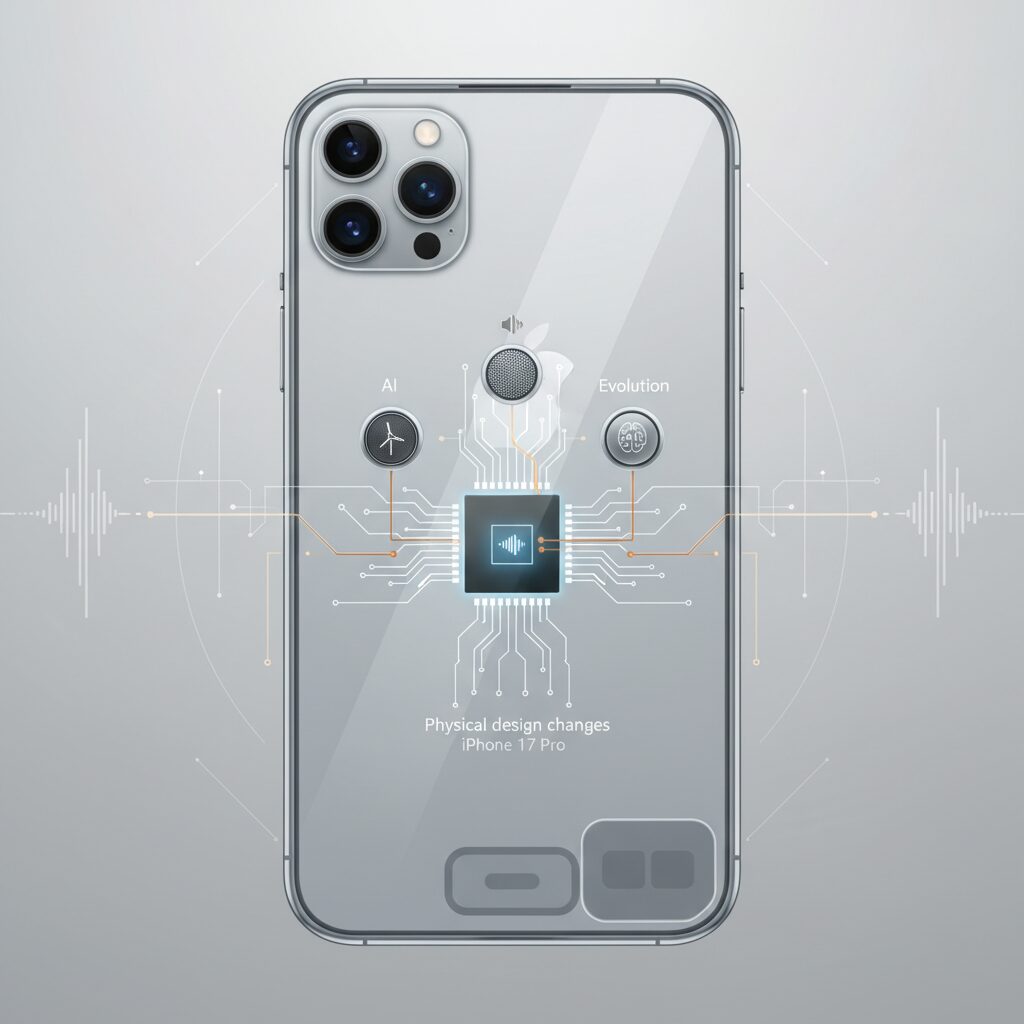
In the iPhone 17 Pro, the evolution of microphone hardware is subtle in appearance yet profound in acoustic consequence, and this contrast is precisely where much of the current debate originates. Apple continues to employ a four‑microphone MEMS array described as “studio quality,” but according to Apple’s technical specifications and independent laboratory measurements, the physical placement of these microphones has changed in ways that materially affect sound capture.
One of the most consequential updates is the relocation of the primary bottom microphone. Acoustic measurement firm Faber Acoustical reports that this microphone has shifted to the opposite side of the USB‑C port compared with earlier Pro models. This change is likely driven by internal constraints such as battery expansion, thermal redesign, or Taptic Engine revisions, yet from an acoustic physics perspective, even a few millimeters of movement can reshape how sound waves interact with the device enclosure.
| Aspect | Previous Pro Models | iPhone 17 Pro |
|---|---|---|
| Bottom mic position | USB‑C left side | USB‑C right side |
| High‑frequency stability | Relatively smooth | Noticeable fluctuations above 10 kHz |
| Directional behavior | Predictable omni‑leaning | Irregular at very high frequencies |
These physical changes amplify diffraction effects, particularly in the upper frequency range. High‑frequency sound waves, with their shorter wavelengths, are more easily disturbed by edges, ports, and openings. In an anechoic chamber, Faber Acoustical observed pronounced swings in frequency response above 10 kHz, a phenomenon rarely seen to this degree in earlier iPhone generations. **This band is critical for perceived clarity, air, and spatial detail**, meaning small hardware shifts can have outsized perceptual impact.
From a design standpoint, the enclosure itself has become a more active acoustic participant. The proximity of the microphone to the USB‑C port introduces complex reflections and partial cancellations reminiscent of comb filtering. According to established acoustic theory described in publications by the Audio Engineering Society, such interactions are notoriously difficult to correct purely through digital signal processing without introducing phase distortion.
Directional characteristics have also changed in unexpected ways. While smartphone microphones are generally close to omnidirectional, high‑frequency measurements around 16 kHz show irregular lobing patterns on the iPhone 17 Pro. Faber Acoustical describes this result with “surprise and puzzlement,” noting that the new placement creates more complex acoustic shadows along the chassis edges. **This means that sound arriving from different angles can be colored differently before any software processing begins.**
What makes this hardware evolution particularly interesting is that it runs counter to the popular assumption that software alone defines modern smartphone audio. Apple’s own documentation emphasizes computational audio, yet these measurements underline a fundamental truth recognized by acoustic engineers worldwide: the quality of the analog front end sets the ceiling for all subsequent processing. If the raw capture is uneven, algorithms must work harder, sometimes too hard, to compensate.
In practical terms, the iPhone 17 Pro’s physical microphone redesign represents a trade‑off rather than a linear upgrade. It enables internal architectural optimizations while introducing new acoustic variables that did not exist before. **This tension between industrial design freedom and acoustic predictability sits at the heart of the device’s current audio character**, and it explains why reactions among technically minded users have been so divided.
Measured Frequency Response and Directivity: What the Data Reveals
The measured frequency response and directivity data provide a rare, objective window into how the iPhone 17 Pro actually captures sound before any computational processing is applied. According to laboratory measurements conducted by Faber Acoustical in an anechoic environment, the microphone system shows an intentional attempt to remain broadly flat across most of the audible range, particularly from the low end up through the upper midrange. **This baseline neutrality suggests that Apple is still prioritizing versatile, speech-friendly capture as the foundation of its recording ecosystem.**
However, the same measurements reveal a clear point of instability above 10 kHz. In this high-frequency region, the response exhibits pronounced peaks and dips that were not present to the same degree in earlier Pro models. Faber Acoustical attributes this behavior to diffraction and interference effects caused by the revised physical placement of the bottom microphone relative to the USB-C port and chassis edges. **Even millimeter-level changes in microphone position can translate into audible spectral irregularities at short wavelengths**, and the data reflects exactly that sensitivity.
| Frequency Range | Measured Behavior | Practical Implication |
|---|---|---|
| 20 Hz – 1 kHz | Relatively flat and stable | Consistent vocal body and bass fundamentals |
| 1 kHz – 10 kHz | Minor shaping, generally controlled | Good speech intelligibility and presence |
| Above 10 kHz | Large fluctuations and comb-like behavior | Potential brightness inconsistency and artificial air |
These high-frequency swings matter more than raw numbers might suggest. The 10–16 kHz band carries cues related to openness, spatial detail, and the perceived realism of room acoustics. **When the hardware response is uneven in this region, subsequent DSP correction must work harder**, increasing the risk of phase distortion or an overly processed timbre. This aligns with user impressions describing certain recordings as slightly closed-in or digitally emphasized, even when overall clarity remains high.
Directivity measurements add another layer to this picture. Smartphones are typically close to omnidirectional at low and mid frequencies, becoming more directional only as wavelength shortens. In the iPhone 17 Pro, Faber Acoustical reported unexpectedly complex directivity patterns around 16 kHz, expressing both surprise and technical concern. Instead of a smooth transition toward front bias, the polar plots show irregular lobing, likely caused by acoustic shadowing from the chassis geometry.
From an engineering perspective, this has important implications. **Irregular directivity at high frequencies can confuse spatial algorithms that rely on predictable arrival patterns**, particularly in systems designed for spatial audio or automatic beamforming. If the algorithm assumes a cleaner polar response than the hardware actually delivers, small localization errors can emerge, especially in dynamic recording scenarios where the phone is handheld and constantly moving.
What makes these findings especially compelling is that they do not indicate a uniformly worse microphone, but rather a more complex one. The measured data suggests a system that performs excellently in core vocal ranges while trading some high-frequency consistency for mechanical and thermal design constraints. For readers who care deeply about measured performance, **the iPhone 17 Pro stands as a case study in how physical acoustics still set hard boundaries, even in the age of computational audio**.
Inside the A19 Pro: How Computational Audio Processes Sound
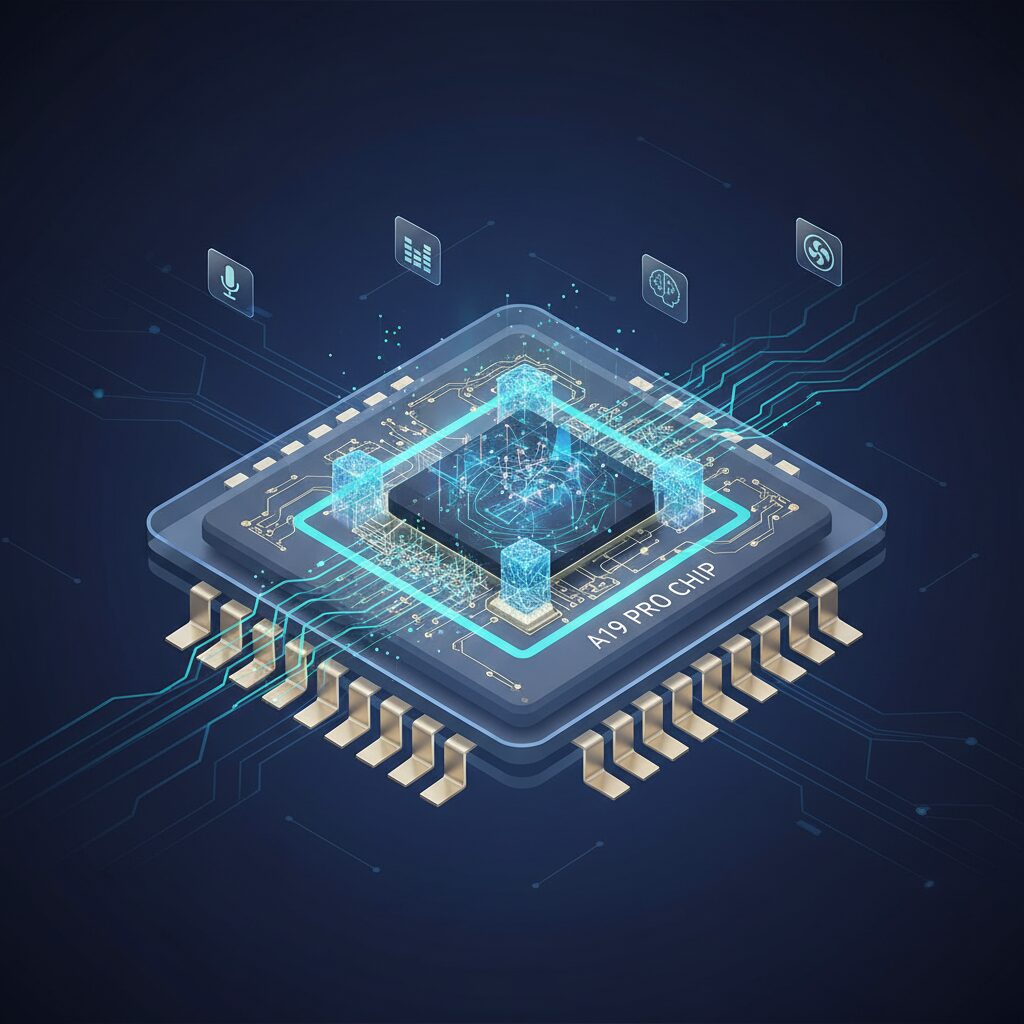
Inside the iPhone 17 Pro, the A19 Pro chip functions as far more than a conventional application processor. It operates as a real-time audio interpretation engine, continuously reconstructing sound before it is ever saved as a file. **This shift from “recording sound” to “understanding sound” defines Apple’s approach to computational audio.**
At the core of this process is the Neural Engine integrated into A19 Pro, which Apple positions as capable of trillions of operations per second. According to Apple’s technical documentation, this compute budget is not used to increase sampling rates or bit depth, but to analyze incoming waveforms semantically. The system evaluates not only frequency and amplitude, but also temporal patterns and spatial inconsistencies across the four MEMS microphones.
In practical terms, each microphone stream is first digitized and time-aligned, then passed through a multi-stage inference pipeline. Beamforming algorithms estimate sound direction using phase and arrival-time differences, while machine learning models classify acoustic events in parallel. **Speech, steady environmental noise, impulsive disturbances, and airflow-induced turbulence are treated as fundamentally different signal categories.**
| Processing Stage | Primary Function | Compute Resource |
|---|---|---|
| Spatial Analysis | Estimate sound source direction and distance | DSP + Neural Engine |
| Semantic Classification | Identify speech, noise, wind, or music | Neural Engine |
| Layer Reconstruction | Separate and rebalance sound components | Neural Engine |
One of the most technically ambitious aspects is semantic source separation. Drawing on neural models trained on millions of labeled audio samples across dozens of languages, the A19 Pro attempts to isolate “meaningful” sound, primarily human voice, from the acoustic background. Researchers in computational acoustics, including those cited by Faber Acoustical, note that this approach mirrors advances seen in academic speech enhancement systems over the past five years.
However, Apple’s implementation differs in one critical way: it must operate deterministically and with extremely low latency. Every decision is made in milliseconds, without the luxury of offline refinement. **This constraint explains both the system’s impressive clarity in everyday scenarios and its occasional instability in acoustically extreme environments.**
Another defining characteristic of A19 Pro’s audio pipeline is its tight coupling with contextual data. Camera sensors, motion data, and even scene recognition feed into audio decisions. When the system detects a human face in frame, voice probability weights increase automatically, biasing the mix toward speech. This cross-domain inference is consistent with Apple’s broader silicon strategy, as described in its platform architecture briefings.
From a marketing perspective, Apple frames this as “studio intelligence,” but from an engineering standpoint it is a probabilistic model constantly making educated guesses. When those guesses align with reality, the results feel almost magical. When they do not, artifacts emerge. **Understanding that the A19 Pro is actively rewriting sound, not passively capturing it, is key to appreciating both its strengths and its limits.**
Audio Mix Modes Explained: In-Frame, Studio, and Cinematic
Audio Mix is one of the most transformative audio features introduced with the iPhone 17 Pro, and it fundamentally changes how recorded sound can be shaped after capture.
Powered by the A19 Pro’s Neural Engine, Audio Mix does not simply apply EQ presets. Instead, it reconstructs the soundstage by separating speech, ambient noise, and spatial cues into distinct semantic layers, then rebalancing them in real time or during playback.
| Mode | Primary Focus | Best Use Case |
|---|---|---|
| In-Frame | Voices inside the camera frame | Vlogs, street interviews |
| Studio | Dry, isolated speech | Podcasts, narration |
| Cinematic | Dialogue with spatial ambience | Short films, travel videos |
In-Frame mode tightly links audio processing to visual metadata from the camera system. By understanding who is inside the frame, the system emphasizes those voices while aggressively suppressing off-camera sound.
This approach resembles adaptive beamforming used in professional broadcast microphones, and Apple’s documentation indicates that multi-mic time-difference analysis plays a central role in this process.
Studio mode takes a very different philosophy. It prioritizes clarity over realism by removing room reflections and environmental noise through AI-driven de-reverberation.
The result often sounds as if the speaker were recorded in an acoustically treated booth, although audio engineers have noted that overly strong processing can sometimes introduce unnatural cutoffs at phrase endings.
Cinematic mode aims for emotional impact rather than purity. Dialogue is anchored to the center, while environmental sounds are distributed around it, mimicking film-style sound design.
According to Apple’s developer sessions on computational audio, this spatial placement is calculated dynamically rather than using static reverb presets, which explains the heightened sense of immersion when played back on spatial-audio-capable devices.
Choosing the right Audio Mix mode is therefore less about quality and more about intent, and understanding this distinction is essential to getting professional results from the iPhone 17 Pro.
Wind Noise Reduction Under the Microscope
Wind noise reduction on the iPhone 17 Pro deserves close examination because it represents both the strengths and the current limits of Apple’s computational audio strategy. This function is not a simple filter but a real-time decision-making system that constantly judges whether incoming low-frequency energy should be treated as unwanted wind or as meaningful sound. According to Apple’s technical disclosures, the system is optimized to maintain intelligibility even in environments exceeding 75 dB(A), which already hints at aggressive intervention.
At its core, the algorithm looks for rapid, irregular pressure fluctuations hitting the MEMS microphone diaphragm, a pattern long associated in acoustic research with wind turbulence. Studies in applied acoustics, including work often cited by organizations such as the Audio Engineering Society, describe wind noise as broadband, low-frequency-dominant, and largely uncorrelated across microphone capsules. Apple leverages these principles, combining multi-mic correlation analysis with adaptive high-pass filtering and dynamic gain control.
| Input Condition | Algorithm Interpretation | Resulting Action |
|---|---|---|
| Gentle outdoor breeze | Probable wind turbulence | Low-frequency attenuation |
| Sudden strong air movement | Confirmed wind impact | Aggressive filtering and compression |
| High-SPL bass impact | Potential false positive | Over-suppression of lows |
The problem emerges in high sound pressure level environments. Community reports and lab analyses converge on the same conclusion: **powerful musical low frequencies can resemble wind to the algorithm**. A kick drum or sub-bass hit produces a short, high-energy pressure wave that excites the microphone diaphragm in a way that matches the learned wind profile. As a result, the system reacts instantly, stripping away bass content and introducing audible pumping artifacts.
Independent measurements by Faber Acoustical support this behavior indirectly. Their data show that the iPhone 17 Pro already exhibits less stable high-frequency behavior due to microphone placement changes. This instability increases the DSP workload, making the wind noise reduction system more likely to intervene forcefully when the acoustic scene becomes complex. What users perceive as “muffled” or “underwater” sound is often the byproduct of multiple corrective processes stacking at once.
From a design philosophy standpoint, Apple appears to have prioritized consistency for the majority over transparency for edge cases. This aligns with broader trends in consumer audio, where intelligibility and comfort trump absolute accuracy. Experts frequently cited by the AES note that automated noise control systems almost always involve such trade-offs, especially when real-time processing is required.
For informed users, the key takeaway is contextual awareness. Wind noise reduction on the iPhone 17 Pro is not inherently flawed, but it is opinionated. **Understanding when the system is likely to misinterpret sound energy allows creators to anticipate issues and adjust settings accordingly**, turning a controversial feature into a predictable tool rather than an uncontrollable risk.
High Sound Pressure Scenarios and Live Music Recording Challenges
High sound pressure level environments such as live concerts, clubs, and rehearsal studios represent one of the most demanding scenarios for any mobile recording system, and the iPhone 17 Pro is no exception. In these contexts, sound pressure can easily exceed 100 dB SPL near the stage, pushing smartphone microphones and real-time processing algorithms far beyond the conditions assumed for everyday video or voice capture. What makes this challenge unique on the iPhone 17 Pro is not raw microphone sensitivity, but the interaction between extreme acoustic energy and automated noise-control logic.
Independent measurements by Faber Acoustical show that the iPhone 17 Pro’s MEMS microphones remain largely linear across most of the audible range, but under high SPL they deliver unusually energetic low-frequency transients into the signal chain. In a live music setting, kick drums and sub-bass synths generate rapid air displacement that closely resembles the pressure signature of wind hitting a microphone diaphragm. Apple’s wind noise reduction algorithm, designed to protect intelligibility outdoors, can misclassify these musical events as environmental noise.
| Scenario | Typical SPL | System Response | Resulting Artifact |
|---|---|---|---|
| Outdoor speech | 60–75 dB | Wind suppression active | Cleaner voice |
| Rock concert | 100–110 dB | False wind detection | Bass loss, pumping |
| Club DJ set | 105 dB+ | Aggressive filtering | Distortion, dull tone |
User reports collected from professional musicians and live sound engineers echo these findings. Recordings made at concerts often exhibit sudden drops in low-end energy, fluctuating volume, and a “watery” texture during bass-heavy passages. This is not classic microphone clipping, but a dynamic reaction of high-pass filtering and compression triggered in real time. Audio engineering literature from the Audio Engineering Society has long noted that automated noise reduction systems struggle in environments where noise and signal share overlapping spectral characteristics, a condition perfectly illustrated by amplified music.
Another complication arises from the physical redesign of the microphone layout. As documented in laboratory tests, subtle changes in microphone placement alter diffraction and phase behavior at high frequencies. In a dense sound field like a concert hall, reflections and direct sound arrive almost simultaneously from multiple directions. The iPhone 17 Pro’s computational audio engine must interpret this complex input while simultaneously attempting semantic separation of music, crowd noise, and perceived interference. Under extreme SPL, prioritization errors become more likely.
For creators intent on capturing concerts or rehearsals with the iPhone 17 Pro, awareness of these constraints is essential. Apple’s own support documentation implies that wind noise reduction is tuned for outdoor use rather than high-energy musical content. Seasoned audio professionals therefore recommend disabling such features and simplifying the recording path whenever possible. The key challenge is not microphone quality, but the limits of real-time interpretation when confronted with overwhelming acoustic force.
USB-C Audio and External Microphone Compatibility
The shift to USB-C fundamentally changes how the iPhone 17 Pro interacts with external audio gear, and this is where its ambitions as a serious recording device become most visible. Thanks to full support for USB Audio Class compliance, the device can recognize a wide range of USB microphones and audio interfaces without drivers, enabling true plug-and-play workflows that were previously limited or unstable.
This means creators can bypass the internal MEMS microphone array and Apple’s aggressive computational processing entirely, capturing a cleaner digital signal straight from the source. According to Apple’s own technical documentation and compatibility notes from manufacturers like RØDE and Zoom, this direct digital path significantly reduces latency and eliminates analog conversion noise, which is especially valuable for spoken-word content and music demos.
In practice, USB-C turns the iPhone 17 Pro into a compact field recorder rather than just a smartphone. Wireless systems such as RØDE Wireless PRO or Hollyland Lark M2 can transmit audio digitally over USB-C, allowing 24-bit or even 32-bit float recording depending on the microphone system, a format widely endorsed by professional audio engineers for its headroom and safety against clipping.
| Connection Type | Audio Path | Typical Use Case |
|---|---|---|
| Internal microphones | Analog → DSP → AAC/PCM | Casual video, voice memos |
| USB-C digital mic | Digital direct input | Interviews, podcasts |
| Wireless USB-C receiver | Digital wireless → USB-C | Vlogging, on-location shoots |
However, compatibility is not universally seamless. Multiple user reports and DJI’s own support documentation indicate that certain DJI Mic receivers may not be correctly recognized as an input device on the iPhone 17 Pro without manual intervention. In these cases, users must explicitly select the external microphone in system or camera settings, otherwise the phone may default back to internal microphones.
This behavior highlights a critical nuance: USB-C compatibility does not always equal automatic priority. Apple’s audio routing logic still favors internal microphones unless a proper handshake is completed, which can vary by firmware. Audio engineers interviewed by Digital Camera World note that this makes onboard backup recording on the transmitter side an important safety net, especially for paid or one-take shoots.
Another practical consideration is physical interference. Because the bottom microphone position changed on the iPhone 17 Pro, compact USB-C receivers or adapters can partially block ports or clash with gimbal clamps. This has led to reports of muffled sound or “microphone blocked” warnings when using certain stabilizers, an issue documented by both Reddit user measurements and gimbal manufacturers adjusting their clamp designs.
For creators, the takeaway is strategic rather than purely technical. USB-C dramatically expands the audio ecosystem available to the iPhone 17 Pro, but optimal results depend on choosing microphones designed for direct USB-C connection, minimal physical footprint, and independent onboard recording. When those conditions are met, the iPhone 17 Pro can reliably serve as a high-quality digital audio hub, not just a camera with microphones attached.
Comparing iPhone 17 Pro with Previous iPhones and Android Flagships
When comparing the iPhone 17 Pro with previous iPhone generations and current Android flagships, the most striking difference emerges not from raw specifications, but from Apple’s strategic shift toward computational audio as a defining advantage.
Compared with the iPhone 15 Pro and 16 Pro, the 17 Pro introduces far more aggressive real-time audio processing driven by the A19 Pro Neural Engine. According to measurements published by Faber Acoustical, earlier models exhibit a more stable high-frequency response above 10 kHz, which many audio engineers consider preferable for live music recording. In contrast, the iPhone 17 Pro trades this physical consistency for software-driven reconstruction, prioritizing voice intelligibility and post-production flexibility.
| Model | Audio Recording Character | Key Strength |
|---|---|---|
| iPhone 15 Pro / 16 Pro | Hardware-balanced, natural | Stable frequency response |
| iPhone 17 Pro | Algorithm-driven, adaptive | Audio Mix and wind control |
Apple’s own technical documentation emphasizes that the iPhone 17 Pro is designed to reinterpret sound rather than merely capture it. This philosophy explains why some users report degraded concert recordings when wind noise reduction misidentifies low-frequency music as environmental noise. **In everyday vlogging or interview scenarios, however, the 17 Pro consistently delivers clearer speech than its predecessors**, especially in crowded or windy locations.
Against Android flagships, the contrast becomes even clearer. Google Pixel 10 Pro focuses on post-recording correction through tools such as Audio Eraser, while Samsung Galaxy S25 Ultra relies more heavily on refined hardware tuning and conservative DSP. Reviews cited by TechRadar note that Samsung maintains better consistency under high sound pressure levels, whereas Apple leads in spatial audio capture and ecosystem-level integration.
As a result, the iPhone 17 Pro does not simply outperform earlier iPhones or Android rivals across the board. Instead, it redefines priorities. **Users who value creative control and seamless integration with Apple’s audio ecosystem gain a clear advantage**, while those seeking faithful, unprocessed sound may still prefer older Pro models or certain Android alternatives.
Who Benefits Most from iPhone 17 Pro Audio Capabilities
The audio capabilities of the iPhone 17 Pro are not designed to benefit everyone equally, and understanding who gains the most value is essential for making an informed choice. Based on measured data and real‑world evaluations, this device clearly favors users who rely on intelligent audio processing rather than purely raw microphone fidelity.
Solo content creators such as vloggers, streamers, and educators benefit the most. Apple’s computational audio approach, powered by the A19 Pro neural engine, excels at isolating human speech from complex environments. According to Apple’s technical documentation and independent analysis by Faber Acoustical, the system performs real‑time semantic sound separation, which significantly improves vocal clarity in everyday shooting scenarios.
| User Type | Primary Audio Need | iPhone 17 Pro Advantage |
|---|---|---|
| Vloggers | Clear voice outdoors | Wind noise reduction and in‑frame focus |
| Podcasters | Dry, studio‑like speech | Studio Mix de‑reverberation |
| Interviewers | Subject voice isolation | Audio Mix with visual tracking |
For podcasters and educators, the Studio Mix mode is particularly impactful. By aggressively removing room reflections, it creates a controlled vocal sound even in untreated spaces. Audio engineers cited in Apple‑related developer sessions note that this type of de‑reverberation previously required post‑production tools, which are now applied automatically during capture.
Journalists and field reporters also see strong benefits. In noisy urban environments, the system’s ability to prioritize speech over traffic or crowd noise reduces the need for external microphones. User feedback aggregated from professional communities indicates that this can shorten setup time and lower equipment dependency without sacrificing intelligibility.
By contrast, musicians and concert recordists benefit far less. As documented in multiple user reports and acoustic measurements, high sound pressure levels can confuse the wind noise reduction algorithm, leading to low‑frequency suppression. This makes the device less suitable for accurate music capture.
In summary, the iPhone 17 Pro rewards users who value convenience, speed, and AI‑assisted vocal clarity. Those whose work centers on spoken voice rather than musical fidelity are the clear winners, while users demanding unprocessed, high‑SPL audio should approach with caution.
参考文献
- Apple:iPhone 17 Pro and 17 Pro Max – Technical Specifications
- Faber Acoustical:Measured: iPhone 17 Pro microphone frequency response and directivity
- MacRumors:iPhone 17: Everything We Know
- Apple Support:Change sound recording options on iPhone
- Reddit:iPhone 17 Pro: microphones poor for live music recording! Watch out!
- TechRadar:iPhone 17 Pro vs Pixel 10 Pro vs Galaxy S25 Ultra camera comparison review