Losing a smartphone in 2026 is no longer just about misplacing a piece of hardware. For many people, a phone now holds biometric data, digital identity credentials, payment methods, and even access to long-term investments. When such a device disappears, the emotional shock is often matched by a deep fear of financial and identity-related damage.
Fortunately, modern Lost Mode technologies have evolved far beyond simple screen locks. Apple’s iOS 19 and Google’s Android 16, with its newly unified Find Hub, now form large-scale, encrypted, and crowdsourced protection systems. Even when a device is offline or powered off, it can continue to signal its location securely, giving owners a realistic chance to recover it.
This article will help readers understand how these technologies work, why eSIM, UWB, and zero-trust security matter, and what practical steps can dramatically reduce risk. By learning how today’s Lost Mode truly protects digital assets, readers will be better prepared to safeguard their data, finances, and peace of mind in an increasingly mobile-first world.
- Why Smartphones Became the Core of Personal Digital Assets
- The Shift from Screen Locks to Full Asset Protection Systems
- Apple Find My in iOS 19: Network Scale and Security Design
- Android 16 Find Hub: Crowdsourced Tracking at Global Scale
- Power-Off and Offline Tracking: How Hardware-Level Defense Works
- eSIM and Stolen Device Protection as Theft Deterrents
- Ultra-Wideband and Bluetooth Tags for Precision Recovery
- Smartphone Loss, MFA Risk, and the Rise of Zero-Trust Security
- Digital Legacy Risks When Devices Stay Locked Forever
- Practical Preparation Before Loss Happens
- 参考文献
Why Smartphones Became the Core of Personal Digital Assets
By 2026, smartphones have quietly become the center of personal digital assets because they concentrate identity, authorization, and value into a single, constantly carried device. What once served mainly for calls and messages now functions as the primary gateway to biometric data, legal digital identities, and financial resources. According to Apple and Google platform documentation, modern smartphones are the default authenticator for cloud services, payments, and account recovery, meaning that possession of the device often equals control over the person’s digital life. This shift did not happen by accident, but as a result of deliberate platform design choices.
The most decisive factor is that smartphones unify three layers that used to be separate: identity verification, transaction approval, and secure storage. Face ID and fingerprint sensors replaced passwords as everyday credentials, while secure elements and trusted execution environments protect payment tokens and cryptographic keys. Research cited by IBM and Google’s Mandiant team shows that identity-based attacks now cause the majority of large-scale security incidents, which explains why platforms moved identity enforcement directly onto personal devices. The smartphone became the only object that can prove “it is really you” in real time.
| Function | Before Smartphones | Smartphone-Centered Model |
|---|---|---|
| Identity proof | ID cards, passwords | Biometrics on device |
| Payments | Cash, cards | Tokenized wallets |
| Account recovery | Email, paperwork | Device-based approval |
Another reason smartphones dominate personal assets is their role in multi-factor authentication. Okta and Duo report that by 2025 nearly 90 percent of technology users relied on smartphones to receive authentication prompts or generate cryptographic codes. Losing the phone therefore means losing the second factor for banks, workplaces, and social platforms at once. This is why operating systems increasingly treat device loss as an existential risk, not a minor inconvenience. The phone is no longer a tool; it is the trust anchor.
Finally, smartphones persist as digital assets because they are always connected, personalized, and hard to replace. Laptops can be shared, cards can be reissued, but a phone carries behavioral patterns, location history, and biometric signatures accumulated over years. Security researchers often describe this as “digital continuity,” where services assume the phone will remain with its owner. As long as ecosystems continue to optimize around this assumption, smartphones will remain the core container of personal digital assets.
The Shift from Screen Locks to Full Asset Protection Systems
For many years, protecting a smartphone mainly meant preventing someone else from unlocking the screen. A passcode, fingerprint, or face scan was considered sufficient, and once the display was locked, users felt reasonably safe. In 2026, however, this assumption no longer holds true, because a smartphone is not just a device but a gateway to identity, money, and legal credentials.
Industry leaders such as Apple and Google have therefore redefined what “loss protection” means. According to Apple’s security architecture documentation and Google’s Android security whitepapers, modern Lost Mode functions are designed to protect the entire digital asset ecosystem linked to a phone, not merely the hardware itself. **The focus has shifted from access control to asset continuity and damage containment.**
| Protection Model | Main Objective | Typical Capabilities |
|---|---|---|
| Traditional Screen Lock | Prevent casual access | PIN, password, biometrics |
| Asset Protection System | Preserve identity and assets | Remote freeze, tracking, payment lock |
This evolution is driven by real-world risk. Financial institutions and cybersecurity researchers, including IBM Security, consistently report that identity-related breaches cause the longest recovery times and the highest costs. When a phone is lost, attackers are no longer interested in the device’s resale value but in what it unlocks: wallets, cloud storage, authentication apps, and government-linked digital IDs.
Modern Lost Mode responds automatically at the system level. Once activated, payment credentials are suspended, authentication tokens are invalidated, and the device becomes a monitored node within a global tracking network. **Even if the phone is offline or powered down, it continues to defend the user’s assets by design.** This approach reflects a broader trend in digital governance, where devices are treated as extensions of personal infrastructure.
As security analysts from Google’s threat intelligence teams have pointed out, this shift dramatically reduces the incentive for theft. A locked screen can sometimes be bypassed, but a system that freezes payments, delays critical changes, and alerts networks turns a stolen phone into a liability. In 2026, effective protection is not about keeping others out of the screen, but about keeping your digital life intact.
Apple Find My in iOS 19: Network Scale and Security Design
In iOS 19, Apple Find My has evolved into a system that prioritizes both massive network scale and rigorous security design, and this balance is what defines its real-world effectiveness. Apple has emphasized that the Find My network now leverages hundreds of millions of active Apple devices globally, including iPhones, iPads, Macs, Apple Watches, and accessories. According to Apple’s own platform documentation, this scale enables lost devices to be detected even in low-density environments, without requiring the owner’s device to be online at the time.
The defining characteristic of Find My in iOS 19 is that scale never comes at the expense of user privacy. Each participating Apple device acts as a passive relay, scanning for encrypted Bluetooth signals emitted by lost devices or accessories. These signals are rotated frequently and are mathematically unlinkable to a specific Apple ID by third parties. Even Apple itself cannot decrypt location data without the owner’s private keys, a design choice that aligns with long-standing academic recommendations on privacy-preserving crowdsourced networks, such as those discussed in cryptography research cited by institutions like MIT and Stanford.
| Design Aspect | iOS 19 Find My Implementation | Security Implication |
|---|---|---|
| Network Scale | Hundreds of millions of Apple devices worldwide | High probability of detection in urban and rural areas |
| Signal Encryption | End-to-end encrypted, rotating identifiers | Prevents tracking or profiling by relays |
| Data Visibility | Only device owner can decrypt location | Zero-knowledge design for Apple and partners |
From a security architecture perspective, iOS 19 extends offline and power-off tracking by relying on a dedicated low-power hardware layer. Apple has confirmed that compatible iPhone models continue to broadcast Find My signals even after shutdown, for a limited period, using energy reserved for the Bluetooth controller. Security researchers have noted that this approach neutralizes a classic theft tactic, where attackers immediately power off devices to evade tracking.
What makes this approach particularly compelling is the asymmetric risk it creates for attackers. Even if a malicious actor passes near unrelated Apple devices, those devices only forward meaningless encrypted packets. There is no incentive or technical path for abuse. This principle echoes guidance from organizations such as the Electronic Frontier Foundation, which has repeatedly argued that large-scale sensing networks must minimize trust in intermediaries.
In practice, this network scale and security design converge into a single outcome: reliability without surveillance. Users benefit from a global, always-on detection fabric, while remaining confident that participation does not expose their movements or identities. In iOS 19, Apple Find My demonstrates that asset recovery at planetary scale can coexist with strong cryptographic guarantees, and this design philosophy is increasingly cited as a benchmark across the mobile security industry.
Android 16 Find Hub: Crowdsourced Tracking at Global Scale
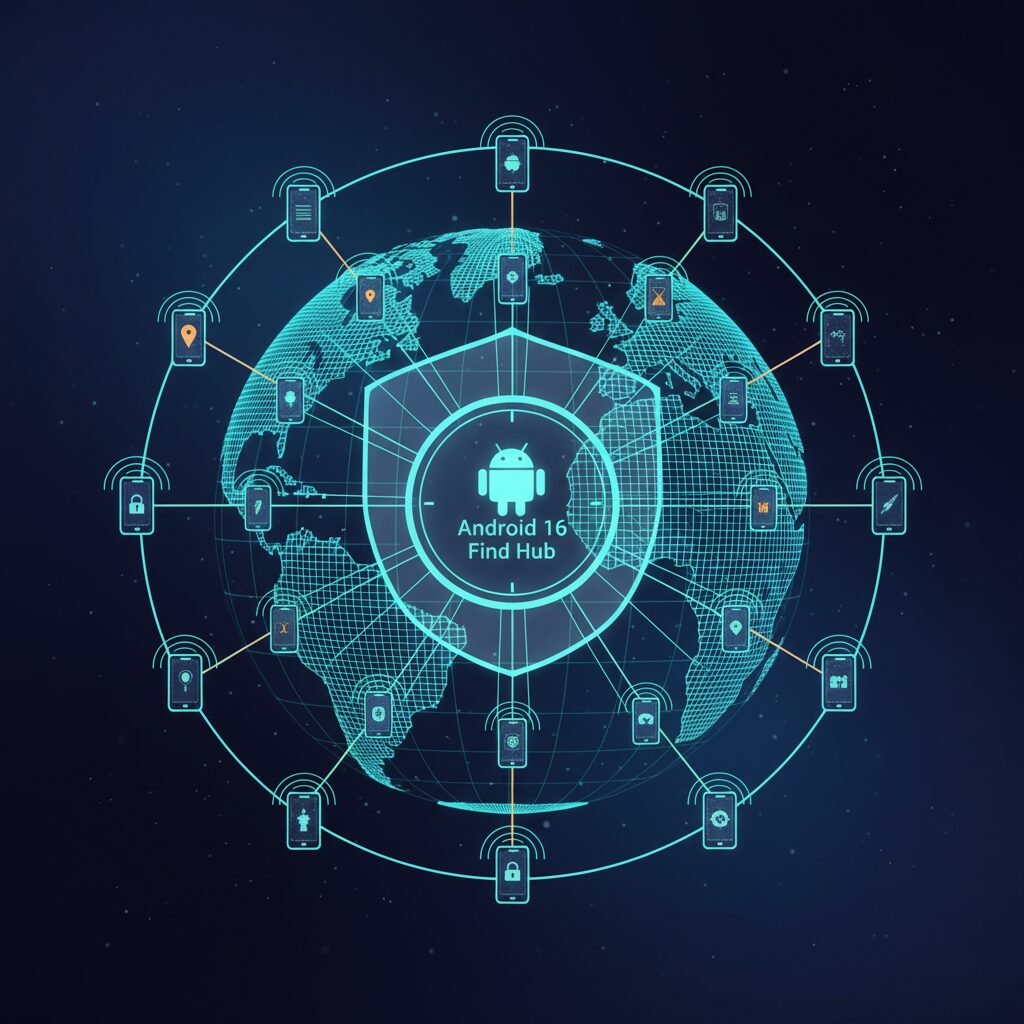
Android 16 introduces Find Hub as a reimagined foundation for global, crowdsourced tracking, and its significance lies in scale rather than novelty. **More than one billion active Android devices now participate as passive detectors**, quietly scanning for encrypted Bluetooth Low Energy signals emitted by lost phones and accessories. According to Google’s official platform documentation, this network effect dramatically increases recovery probability, especially in regions where traditional GPS or cellular connectivity is unreliable.
What makes Find Hub distinctive is its opt-in crowdsourcing model combined with strict end-to-end encryption. Nearby Android devices relay location hints without learning the identity of either the lost device or its owner. Security researchers cited by Google emphasize that even Google itself cannot reconstruct an individual’s movement history from these reports, which addresses long-standing privacy concerns around mass location sensing.
| Aspect | Find Hub (Android 16) | Conventional GPS Tracking |
|---|---|---|
| Offline detection | Yes, via nearby devices | No |
| Energy consumption | Ultra-low (BLE) | High |
| Coverage density | Urban and rural | Network-dependent |
In practical terms, this means a phone left in a taxi, café, or train station can still surface on the map hours later, triggered by strangers’ phones passing nearby. **Google engineers describe this as turning everyday mobility into a distributed sensor grid**, a concept aligned with academic research on opportunistic networks from institutions such as MIT.
Find Hub also extends beyond phones. Compatible trackers and earbuds benefit from the same infrastructure, creating a unified asset layer rather than isolated device silos. For users, the experience feels simple, but underneath operates one of the largest privacy-preserving location networks ever deployed at consumer scale.
Power-Off and Offline Tracking: How Hardware-Level Defense Works
One of the most striking shifts in mobile security by 2026 is that turning a smartphone off no longer guarantees invisibility. **Power-off and offline tracking now operate at the hardware level**, fundamentally changing the balance between device owners and thieves.
In modern flagship devices, a dedicated low-power subsystem continues to function even after the main processor shuts down. According to Apple and Google documentation, specific iPhone models from iPhone 11 onward and recent Pixel generations maintain power to the Bluetooth Low Energy controller after shutdown. This allows the device to emit encrypted location beacons for hours, and in some conditions longer, even when the screen shows zero battery.
| State | Active Components | Tracking Capability |
|---|---|---|
| Powered On | CPU, radios, sensors | Full GPS, BLE, UWB |
| Offline | BLE subsystem | Crowdsourced location |
| Powered Off | Secure BLE hardware | Encrypted beacon only |
This design directly targets a classic theft tactic: immediate shutdown. **Security researchers have noted that hardware-enforced beaconing dramatically increases recovery probability**, because the device can still be detected by nearby phones participating in Apple’s Find My or Google’s Find Hub networks.
Privacy concerns naturally arise, but both companies emphasize end-to-end encryption. As explained by their security engineering teams, location packets are anonymized and rotated, preventing even the platform provider from learning a device’s identity or movement history.
For users, this means that losing a phone no longer triggers an immediate race against time. **Hardware-level defense quietly keeps working**, buying critical hours for remote lock or recovery actions, even in scenarios that once meant total loss.
eSIM and Stolen Device Protection as Theft Deterrents
In 2026, smartphone theft deterrence no longer relies on a single feature but on a tightly integrated combination of connectivity and time-based security controls. At the center of this shift are eSIM adoption and the evolution of Stolen Device Protection, both of which fundamentally change the cost–benefit calculation for thieves. **The goal is not only to recover devices but to make stealing them irrational in the first place.**
eSIM removes what security researchers long described as the weakest physical link: the removable SIM card. With a physical SIM, a thief could disable cellular connectivity within seconds, cutting off tracking and remote lock commands. By contrast, eSIM is embedded and cannot be extracted without specialized equipment. According to mobile security analysts cited in 2026 asset protection reports, this alone significantly delays a thief’s initial actions, which is often the most critical window for owners to activate Lost Mode.
| Aspect | Physical SIM | eSIM (2026 standard) |
|---|---|---|
| Removal time after theft | Seconds | Not physically removable |
| Impact on tracking | Immediate disconnection | Tracking persists unless shielded |
| Remote lock reliability | Low | High |
In practice, this means a stolen phone with eSIM remains reachable long enough for cloud-based defenses to engage. Even if the device is placed in airplane mode, modern OS settings restrict toggling connectivity from the lock screen. Apple and Google both emphasize that this design choice intentionally favors the rightful owner, a position supported by academic discussions on crime prevention through environmental design applied to digital systems.
Connectivity alone, however, does not stop account takeover attempts. This is where Stolen Device Protection becomes decisive. Apple pioneered this approach, and by 2026 its core principles are widely recognized across the industry. When the device is outside familiar locations such as home or workplace, sensitive actions are no longer immediate. **Critical changes like password resets, biometric removal, or account sign-out trigger a mandatory security delay of approximately one hour.**
During this enforced waiting period, the owner can mark the device as lost, freeze payment credentials, and monitor its movement. Apple’s own support documentation explains that even if a thief has observed the passcode, they cannot bypass Face ID or Touch ID requirements tied to these delayed actions. Security experts frequently note that most theft scenarios depend on speed and confusion; delaying outcomes directly undermines that strategy.
From an economic perspective, this layered defense is remarkably effective. Analysts writing on mobile theft trends in 2025–2026 argue that resale value collapses when devices are both traceable and functionally locked. A phone that cannot be wiped, reactivated, or monetized becomes dead weight. **The security model succeeds precisely because it targets incentives rather than just technical vulnerabilities.**
Importantly, Apple and Google both stress that these protections operate under strict end‑to‑end encryption. Even though devices may continue emitting low‑power Bluetooth signals for location crowdsourcing, manufacturers themselves cannot access precise user locations. This balance between deterrence and privacy has been positively evaluated by independent researchers studying encrypted asset‑tracking networks.
When eSIM’s persistent connectivity is combined with Stolen Device Protection’s enforced delays, the result is a defense that works across minutes, hours, and days after theft. Instead of a single lock, users gain a sequence of escalating barriers. **In 2026, the safest smartphone is not the one that is impossible to steal, but the one that is impossible to profit from stealing.**
Ultra-Wideband and Bluetooth Tags for Precision Recovery
Ultra-Wideband and Bluetooth tracking technologies have fundamentally changed how lost smartphones and personal items are recovered in 2026. Unlike traditional GPS, these systems excel in short-range, high-precision scenarios, especially indoors, where most real-world losses actually occur. **The shift from “rough location” to centimeter-level guidance has redefined what recovery success looks like** for everyday users.
UWB works by measuring the time it takes for radio pulses to travel between devices, allowing the system to calculate both distance and direction with remarkable accuracy. According to Apple’s platform documentation and independent location-system evaluations, compatible iPhones and Pixels can now guide users visually to an object hidden under furniture or inside a bag. Bluetooth Low Energy complements this by enabling long-duration, low-power broadcasting that feeds into massive crowdsourced networks.
| Technology | Typical Accuracy | Primary Use Case |
|---|---|---|
| UWB | Within centimeters | Indoor, close-range recovery |
| Bluetooth LE | Several meters | Wide-area crowdsourced detection |
In practical terms, this hybrid approach means a lost phone can be detected anonymously by nearby devices via Bluetooth, then precisely located using UWB once the owner is nearby. Google’s Find Hub and Apple’s Find My both rely on this layered design, which researchers in the location-technology field describe as a balance between scalability and precision. **The result is faster recovery with minimal battery impact and strong end-to-end encryption**.
The ecosystem has also expanded beyond smartphones. Third-party tags such as AirTag, Pebblebee, and Chipolo inherit the same technical advantages, turning keys, wallets, and bags into traceable assets. Industry analysts note that recovery rates improve significantly when users attach UWB-enabled tags to frequently misplaced items, particularly in dense urban environments.
Equally important is the governance layer. Apple and Google’s jointly developed unwanted-tracker detection standard ensures that these powerful tools cannot be abused for covert tracking. By automatically alerting users to unknown tags moving with them, the platforms demonstrate how **precision recovery and personal safety can coexist without compromise**.
Smartphone Loss, MFA Risk, and the Rise of Zero-Trust Security
By 2026, losing a smartphone no longer means just replacing hardware. It directly threatens the integrity of multi-factor authentication, because the device itself has become the primary identity anchor.
When a phone is lost or stolen, MFA can shift from a protection layer into a single point of failure. This risk has fundamentally changed how security teams evaluate mobile loss scenarios.
According to Google’s Mandiant threat intelligence reports, attackers increasingly favor identity takeover through lost or stolen devices rather than deploying complex malware. If SMS codes or authenticator push approvals arrive on a compromised phone, cloud accounts can be accessed legitimately from the system’s point of view.
Industry data reinforces this concern. Okta reports that MFA adoption in the technology sector has reached 88 percent, yet Duo Security finds that 51 percent of organizations have already experienced identity-related breaches. The lesson is clear: MFA alone does not guarantee safety when the device is gone.
| Security Indicator | 2025–2026 Findings | Source |
|---|---|---|
| MFA adoption rate | 88% | Okta |
| Organizations hit by identity breaches | 51% | Duo Security |
| Average breach resolution time | 292 days | IBM |
This reality has accelerated the shift toward zero-trust security models. Zero trust assumes that no user, device, or session is inherently trustworthy, even if correct credentials and MFA codes are presented.
In a zero-trust environment, a lost smartphone immediately becomes a risk signal rather than a trusted factor. Location anomalies, unusual access times, and behavioral deviations automatically reduce or block access.
Research cited by Duo shows that 87 percent of security leaders now view phishing-resistant MFA as critical, while academic studies indicate that AI-optimized MFA systems can detect abnormal authentication attempts with roughly 96 percent accuracy.
IBM’s cost analysis further demonstrates why this matters. Organizations that integrate AI and automation into identity security reduce average breach costs by about 2.2 million dollars. Smartphone loss is no longer an IT inconvenience; it is a measurable financial liability.
The key insight is that device possession is no longer proof of trust. Security in 2026 is defined by continuous verification, not by ownership.
For users, this means that losing a phone triggers more than remote lock or wipe procedures. It initiates a cascade of automated distrust across accounts, networks, and services.
For organizations, it confirms that zero trust is not a theoretical framework but a practical response to the reality that smartphones now hold the keys to digital existence.
Digital Legacy Risks When Devices Stay Locked Forever
When a smartphone remains permanently locked, the risk extends far beyond inconvenience and becomes a digital legacy crisis. In 2026, smartphones function as the primary gateway to financial assets, identity credentials, and irreplaceable personal memories. If access is lost forever, those digital assets may effectively vanish, even though their real-world value remains.
Research cited by major Japanese consumer studies shows that nearly one in five bereaved families cannot unlock a deceased relative’s smartphone, forcing them to abandon confirmation of its contents. Experts in digital inheritance law note that this often delays or completely blocks access to online banks, securities accounts, and crypto wallets, especially as paper statements have largely disappeared. A locked device can therefore freeze an entire estate despite clear legal inheritance rights.
| Locked Device Impact | Practical Consequence | Long-Term Risk |
|---|---|---|
| No biometric access | Cloud accounts unreachable | Assets remain undiscovered |
| Unknown passcodes | Subscriptions continue billing | Ongoing financial loss |
Security specialists interviewed by legal and technology journals emphasize that modern encryption is intentionally designed to be unbreakable, even for manufacturers. Apple and Google both maintain that without prior consent or legacy access settings, they cannot unlock devices. This means strong security can unintentionally punish surviving families, not attackers.
Ironically, multiple studies point out that the most effective mitigation is not advanced technology but deliberate preparation. Writing down recovery instructions, appointing trusted legacy contacts, and documenting digital assets offline significantly reduces posthumous risk. In an era of unyielding encryption, thoughtful human planning remains the only reliable master key.
Practical Preparation Before Loss Happens
Losing a smartphone is often treated as an accident that must be dealt with after it happens, but in 2026 the real difference is made by preparation done beforehand. Modern lost modes on iOS 19 and Android 16 are extremely powerful, yet their effectiveness depends heavily on whether critical settings were enabled while the device was still in your hands. **Practical preparation is no longer optional risk management; it is a form of personal digital governance**.
Authoritative guidance from Apple and Google consistently emphasizes that lost-device recovery rates increase when offline tracking, last-location sharing, and account recovery paths are configured in advance. Security researchers also point out that many high-profile failures are not caused by technical limits, but by users leaving default settings untouched. In other words, the weakest link is rarely the platform.
One of the most overlooked preparations is account survivability. According to identity security analyses cited by IBM and Google’s Mandiant team, account lockout following device loss can extend recovery times to months if backup authentication paths are missing. Registering trusted recovery contacts and verifying secondary login methods ensures that lost mode can actually be triggered when your primary device is gone.
The table below summarizes key pre-loss preparations that materially change outcomes after a device disappears.
| Preparation Area | Recommended Action | Impact After Loss |
|---|---|---|
| Offline Tracking | Enable full network participation | Location updates continue even when powered off |
| Account Recovery | Add trusted contacts and backup email | Lost mode can be activated without 2FA deadlock |
| Payments | Bind cards only to secure elements | Automatic suspension when marked lost |
Another practical step is consciously designing friction for attackers. Apple’s Stolen Device Protection and Android’s tightened security flows rely on location awareness and behavioral baselines. These features work best when users clearly define trusted places such as home and work. According to Apple’s own security documentation, this spatial context is what allows the system to introduce time delays only when risk is high, not during everyday use.
eSIM adoption also belongs firmly in the category of pre-loss preparation. Security experts widely agree that removing the physical SIM was historically the fastest way to defeat remote locking. By contrast, eSIM makes connectivity persistent by default. **The practical benefit is time**: every extra minute before a device goes dark increases the probability that lost mode, payment suspension, and location reporting are successfully activated.
Preparation also extends beyond theft scenarios into human realities such as accidents or sudden illness. Research on digital estates published in Japan shows that families often face severe financial and emotional stress when a locked smartphone becomes inaccessible. Writing down master recovery information and storing it in a physically secure but discoverable place may feel old-fashioned, yet specialists increasingly recommend this hybrid approach as the only reliable safety net.
Ultimately, practical preparation before loss is about aligning advanced technology with human behavior. Smartphones in 2026 already assume they may be lost, stolen, or misused. Users who prepare their devices with the same assumption transform lost mode from a reactive tool into a resilient system that protects identity, assets, and continuity long before anything goes wrong.
参考文献
- Google Blog:5 ways to use the new Find My Device on Android
- Business Standard:Google’s ‘Find My Device’ officially becomes ‘Find Hub’ across platforms
- Apple Support:Mark a device as lost in Find My on iPhone
- Mashable:Google updated its Find My Device Android network: 5 new things it can do
- Android Police:Android Find My Device trackers suddenly work great
- Duo Security:Research insights: 4 trends reshaping identity security in 2025