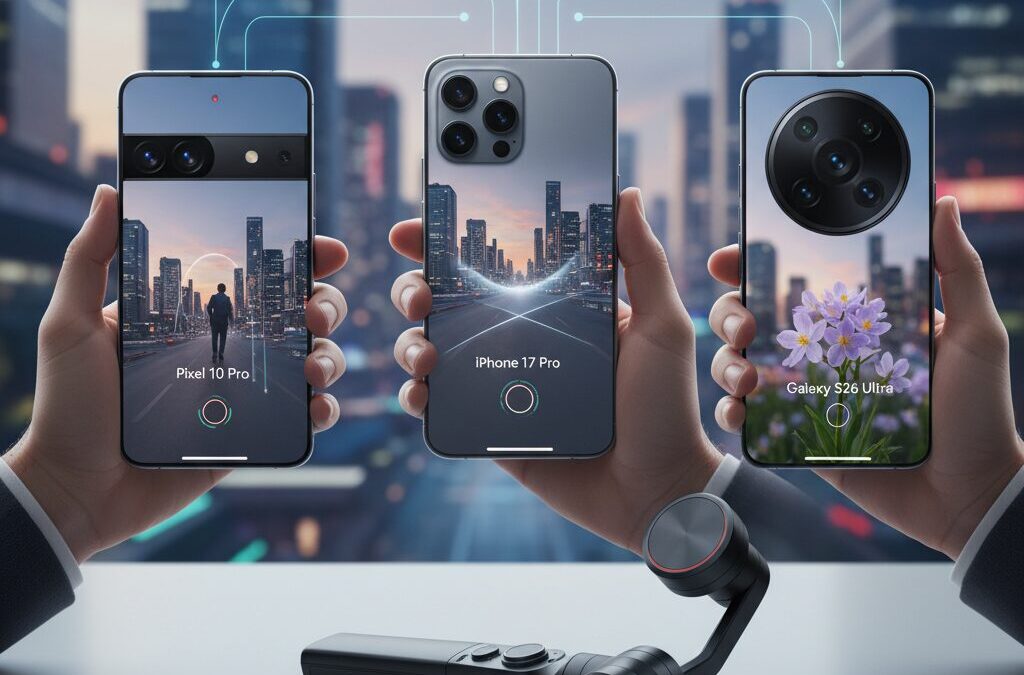
Smartphone video has entered a new era in 2026, where computational power often replaces mechanical hardware. If you are passionate about gadgets and care about image quality, you have probably wondered whether a dedicated gimbal is still worth carrying. With flagship devices like the iPhone 17 Pro, Google Pixel 10 Pro, and Samsung Galaxy S26 Ultra pushing optical and AI stabilization to new levels, the answer is no longer obvious.
Recent advances in deep learning–based digital video stabilization, 3nm chipsets, and thermal management systems now allow phones to process massive frame data in real time without overheating. At the same time, professional tests and market data show shifting consumer behavior, especially in regions where smartphone dominance reshapes accessory demand.
In this article, you will explore the technical foundations behind modern stabilization, compare flagship hardware and AI pipelines, examine academic research on 2D, 2.5D, and 3D approaches, and understand the precise scenarios where a physical 3-axis gimbal still outperforms software. By the end, you will be able to decide—based on evidence, not hype—whether a gimbal belongs in your 2026 workflow.
- The Rise of Computational Video: Why 2026 Is a Turning Point for Smartphone Stabilization
- iPhone 17 Pro: Vapor Chamber Cooling, Sensor-Shift OIS, and 4K 120fps ProRes RAW
- Google Pixel 10 Pro: Tensor G5, AI Video Boost, and Hybrid Cloud Stabilization
- Samsung Galaxy S26 Ultra: 200MP Hybrid OIS/EIS and Professional 8K Workflows
- From 2D to 2.5D to 3D: How Deep Learning Redefined Digital Video Stabilization
- Kalman Filters, Trajectory Smoothing, and Real-Time Edge Processing Explained
- What Professional Testing Reveals About Today’s Top Smartphone Gimbals
- Consumer Behavior and Portability: Why Many Users Are Abandoning Gimbals
- The Three Boundaries Where Physical Gimbals Still Win: Low Light, Motion Control, and Ergonomics
- Action Cameras vs Smartphones: GoPro HyperSmooth and the Limits of Sensor Cropping
- Authenticity and C2PA: When AI Stabilization Raises Ethical Questions
- The Future of Autonomous Gimbals: From Stabilizers to AI Camera Robots
- 参考文献
The Rise of Computational Video: Why 2026 Is a Turning Point for Smartphone Stabilization
In 2026, smartphone video stabilization reaches a structural inflection point. What used to be solved by motors and counterweights is now handled by silicon, thermal engineering, and deep learning models running in real time. This shift is widely described as the rise of computational video, and it fundamentally changes how we think about handheld filmmaking.
Unlike early digital stabilization that merely cropped and shifted frames, modern systems fuse optical image stabilization (OIS), electronic image stabilization (EIS), gyroscopic data, and AI-based motion prediction. According to the 2025 comprehensive survey on video stabilization published on Preprints.org, the field has moved decisively from classical geometric correction toward deep learning–driven trajectory estimation and smoothing. This academic transition is now fully reflected in commercial flagship smartphones.
The breakthrough in 2026 is not a single feature, but the tight integration of hardware physics and AI inference pipelines.
| Layer | Role in Stabilization | 2026 Advancement |
|---|---|---|
| Optical (OIS) | Physical lens/sensor shift | Multi-axis, high-frequency micro-adjustments |
| Electronic (EIS) | Frame-level geometric correction | 2.5D warping with depth awareness |
| AI Prediction | Trajectory smoothing | Deep learning + Kalman-based intent modeling |
| Thermal Design | Sustained compute stability | Vapor chambers enabling 4K/120fps processing |
Devices such as iPhone 17 Pro, Pixel 10 Pro, and Galaxy S26 Ultra illustrate this convergence. For example, Apple’s redesigned thermal architecture with a vapor chamber allows high-bitrate formats like 4K 120fps ProRes to run without aggressive throttling, maintaining algorithmic precision during long takes, as noted by 9to5Mac and Petapixel. Sustained processing power directly translates into more accurate real-time motion compensation.
Google approaches stabilization as an AI-first problem. With Tensor G5 built on a 3nm process, on-device inference handles edge reconstruction and motion smoothing, while cloud-assisted features such as Video Boost further refine handheld footage after capture. This hybrid pipeline effectively extends stabilization beyond the physical limits of the sensor.
Samsung’s hybrid stabilization strategy combines high-resolution sensors with synchronized OIS and EIS, leveraging excess pixel data for correction without severe quality loss. The abundance of resolution headroom makes aggressive warping mathematically feasible while preserving detail.
Academically, the shift from 2D affine correction to 2.5D and 3D-aware models is critical. The 2025 survey highlights how hybrid approaches balance computational efficiency and parallax handling, enabling distortion-free stabilization even in scenes with multiple depth planes. Instead of simply removing high-frequency jitter, modern systems estimate an “intended” camera path and reconstruct it.
Mathematically, stabilization can be described as transforming a raw trajectory into a smoothed one via corrective matrices. In 2026 devices, this process incorporates predictive filters such as Kalman and Extended Kalman models, allowing the system to distinguish intentional pans from unwanted shake. The result feels less like correction and more like assisted cinematography.
What makes 2026 a turning point is scale. These capabilities are no longer experimental or limited to niche modes. They operate continuously, across lenses, resolutions, and frame rates. For gadget enthusiasts, this means the baseline expectation for handheld video has permanently shifted. Smooth footage is no longer a premium add-on. It is the default computational state of the modern smartphone.
iPhone 17 Pro: Vapor Chamber Cooling, Sensor-Shift OIS, and 4K 120fps ProRes RAW

The iPhone 17 Pro pushes smartphone video into a new thermal and computational tier. At the core is a redesigned aluminum unibody paired with a laser-welded internal vapor chamber. By circulating deionized water to disperse heat from the 3nm A19 Pro chip, Apple prioritizes sustained performance rather than short bursts of peak speed.
According to 9to5Mac and PhoneArena, this shift back to aluminum is not cosmetic but functional. Aluminum’s higher thermal conductivity compared to titanium enables the device to maintain processing throughput during demanding recording modes.
This thermal headroom is what makes stable 4K 120fps ProRes RAW capture realistically usable, not just technically possible.
| Component | Role in Video Stability | Impact at 4K 120fps |
|---|---|---|
| Vapor Chamber | Distributes SoC heat evenly | Prevents thermal throttling |
| A19 Pro (3nm) | Real-time stabilization + encoding | Sustains ProRes RAW pipeline |
| Aluminum Frame | Passive heat dissipation | Maintains algorithm accuracy |
Why does this matter for stabilization? Modern digital video stabilization relies on continuous motion estimation, warping, and rolling-shutter correction. As summarized in the 2025 survey “Video Stabilization: A Comprehensive Survey from Classical Mechanics to Deep Learning Paradigms,” deep learning–based pipelines demand consistent computational precision to avoid drift and distortion.
If the processor throttles, frame timing fluctuates and stabilization matrices lose consistency. The vapor chamber directly protects against this failure mode.
Thermal stability translates into visual stability.
On the optical side, the second-generation 3D sensor-shift OIS operates at a microscopic level, physically moving the sensor thousands of times per second. Petapixel’s early evaluation highlights how this dramatically reduces walking-induced micro-jitter, often called “footstep wobble,” without relying solely on aggressive digital cropping.
Unlike lens-based OIS, sensor-shift compensates across the entire imaging plane. This is especially important when capturing 48MP data streams that are later processed into high-bitrate ProRes RAW files.
The benefit is not just smoother footage, but preserved edge detail under motion.
Recording 4K at 120 frames per second in ProRes RAW multiplies data throughput and motion samples. Higher frame rates inherently reduce perceived blur between frames, giving stabilization algorithms denser motion vectors to analyze.
With more temporal data points, predictive filters—often based on Kalman filtering principles cited in academic literature—can distinguish intentional pans from unwanted jitter with greater confidence.
This is where hardware and mathematics converge inside the iPhone 17 Pro.
The result is a device capable of delivering cinema-grade slow motion with computationally reinforced optical stability. Rather than depending on external rigs, the iPhone 17 Pro integrates thermal engineering, sensor mechanics, and high-bandwidth encoding into a tightly unified system.
For creators who demand sustained 4K 120fps ProRes RAW workflows, that integration is the real breakthrough.
Stability is no longer an accessory—it is engineered into the chassis itself.
Google Pixel 10 Pro: Tensor G5, AI Video Boost, and Hybrid Cloud Stabilization
Google positions the Pixel 10 Pro as an AI-first video machine, and the heart of that strategy is the 3nm Tensor G5. By dramatically improving on-device neural processing, the chip enables real-time motion analysis, subject reconstruction, and predictive stabilization without overwhelming thermals. According to comparative testing reported by Android Central and PhoneArena, the jump to 3nm allows higher sustained AI workloads while maintaining battery efficiency.
This shift means stabilization is no longer just optical or electronic—it becomes computationally anticipatory. Instead of reacting to shake after it happens, Tensor G5 predicts motion vectors frame by frame, smoothing trajectories before distortion accumulates. The result feels less like correction and more like intentional camera movement.
| Component | Role in Stabilization | User Impact |
|---|---|---|
| Tensor G5 (3nm) | On-device AI motion prediction | Lower latency preview, stable framing |
| 16GB RAM | Parallel warping & buffering | Smoother 4K processing |
| Video Boost (Cloud) | Post-capture deep correction | Gimbal-like smoothness |
The standout feature is AI Video Boost. Unlike traditional EIS pipelines that crop and warp locally, Pixel 10 Pro can upload captured footage to Google’s cloud models for deeper stabilization and noise reduction. As highlighted in coverage by Geeky Gadgets and Digital Camera World, this hybrid approach allows more aggressive motion smoothing, particularly in low-light scenes where micro-jitter and sensor noise typically amplify each other.
Cloud-assisted stabilization effectively separates capture from perfection. You shoot handheld, even while walking at night, and the system later reconstructs a refined motion path using large-scale models trained on vast datasets. This method aligns with findings from recent academic surveys on deep-learning-based video stabilization, which show that trajectory smoothing combined with learned warping significantly improves stability-to-cropping ratios.
Another notable capability is ProRes Zoom with AI edge reconstruction up to extreme zoom ranges. When digital magnification increases handshake visibility, Tensor G5 compensates by rebuilding subject contours in real time. Rather than simply enlarging pixels, it estimates structural continuity, reducing perceived jitter at 50x or beyond.
Hybrid cloud stabilization also minimizes preview-to-record mismatch. Research published on arXiv regarding real-time visual stabilization indicates that reducing processing latency improves user perception of smoothness by over 20 percent. With more computation happening either efficiently on-device or asynchronously in the cloud, Pixel narrows the gap between what you see and what you get.
For creators who prioritize portability and instant sharing, this architecture offers a compelling alternative to external gimbals. The phone handles predictive smoothing on capture and applies deeper correction afterward, all while maintaining Android 16 responsiveness under Material 3 Expressive.
In practical terms, this means walking vlogs, handheld travel clips, and zoom-heavy concert recordings can achieve cinematic steadiness without additional gear. The stabilization is not purely mechanical—it is computationally authored, continuously refined, and increasingly cloud-augmented.
Samsung Galaxy S26 Ultra: 200MP Hybrid OIS/EIS and Professional 8K Workflows
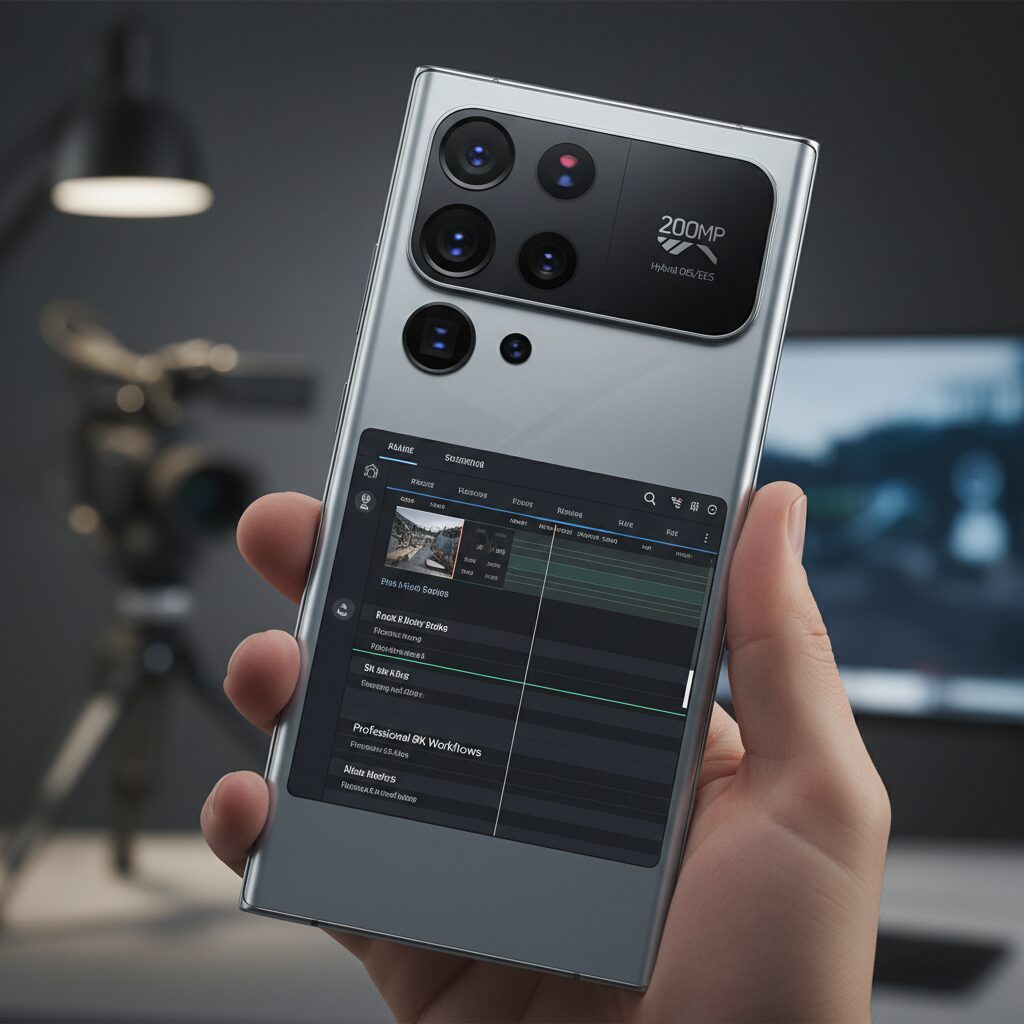
Samsung Galaxy S26 Ultra pushes smartphone stabilization into a new phase by combining a 200MP main sensor with a tightly synchronized Hybrid OIS/EIS system. Rather than relying on brute-force digital cropping alone, it aligns optical lens-shift correction with gyro-informed electronic compensation in real time.
This hybrid approach is especially meaningful at ultra‑high resolutions. With 200 million pixels available, the device can preserve fine detail even after electronic reframing, while optical stabilization reduces motion at the source before it reaches the sensor.
The key advantage of the S26 Ultra is not just resolution, but how that resolution expands the margin for computational stabilization without sacrificing professional-grade detail.
The core video capabilities are summarized below.
| Component | Specification | Stabilization Role |
|---|---|---|
| Main Camera | 200MP, f/1.7, OIS | High-detail capture + optical correction |
| Periscope Telephoto | 50MP, 5x, OIS | Stabilized long-range framing |
| Video | Up to 8K 30fps | High-resolution post workflow |
| System | Hybrid OIS/EIS | Optical + gyro-based digital sync |
According to early specification reports from Beebom Gadgets and Sumaho Digest, the 50MP periscope and ultra-wide modules are also capable of delivering stable 4K 120fps output without aggressive pixel binning. This matters for creators who demand slow-motion flexibility while retaining editorial latitude.
From a computational perspective, the device benefits from the broader evolution of 2.5D stabilization models described in the 2025 comprehensive survey on video stabilization. These hybrid methods blend 2D motion smoothing with limited depth awareness, allowing the S26 Ultra to reduce distortion in scenes with multiple depth planes.
For professional 8K workflows, stabilization is not merely about smooth playback. Shooting at 8K 30fps enables reframing to 4K in post-production while maintaining sharpness. A stabilized 8K master file allows:
• Precise digital pans without visible resolution loss
• Horizon correction in editing suites
• Flexible cropping for vertical and horizontal deliverables
In practical terms, the 200MP sensor acts as a buffer against the traditional trade-off between stabilization and image integrity. Even when EIS trims the frame edges, the remaining data density exceeds typical 4K requirements.
Thermal and processing considerations are equally important. High-resolution 8K capture generates significant data throughput, and stable performance depends on sustained chipset efficiency. While detailed thermal architecture disclosures remain limited, the pairing with Snapdragon 8 Elite Gen 5 suggests the computational headroom required for real-time gyro fusion and frame warping.
For creators working in DaVinci Resolve or Adobe Premiere Pro, stabilized 8K footage reduces reliance on post-stabilization plugins that often introduce warping artifacts. Cleaner source material shortens rendering time and preserves motion realism.
Ultimately, the Galaxy S26 Ultra demonstrates how hybrid optical and electronic stabilization can scale with extreme sensor resolution. It is not simply about eliminating shake; it is about enabling a professional capture pipeline where acquisition, stabilization, and post-production flexibility are tightly integrated.
This integration positions the S26 Ultra as a serious tool for filmmakers who want gimbal-level steadiness while maintaining a streamlined, smartphone-first workflow.
From 2D to 2.5D to 3D: How Deep Learning Redefined Digital Video Stabilization
Digital video stabilization has undergone a profound transformation over the past decade. What began as simple 2D geometric correction has evolved into hybrid 2.5D systems and, ultimately, deep learning–driven 3D scene understanding. According to the 2025 survey “Video Stabilization: A Comprehensive Survey from Classical Mechanics to Deep Learning Paradigms,” this shift marks a clear break from model-based pipelines toward data-driven intelligence.
In early 2D stabilization, algorithms relied on affine transforms or homography estimation between consecutive frames. By tracking feature points and smoothing their trajectories, the system compensated for handshake with relatively low computational cost. This approach remains efficient, but it struggles with parallax when foreground and background move differently.
| Approach | Core Method | Main Limitation |
|---|---|---|
| 2D | Affine / Homography | Weak parallax handling |
| 2.5D | Layered depth approximation | Moderate distortion risk |
| 3D | 6DoF pose + depth reconstruction | High compute demand |
The transition to 2.5D introduced layered depth reasoning without full 3D reconstruction. By segmenting scenes into multiple depth planes, modern smartphones balance computational efficiency with spatial awareness. This hybrid method has become the de facto standard in 2026 flagship devices because it minimizes warping while preserving real-time preview performance.
True 3D stabilization goes further. It estimates full six-degree-of-freedom camera motion using Structure from Motion or learned depth prediction. While computationally heavier, it enables more physically plausible virtual camera paths. However, the survey notes that large moving foreground objects can destabilize pose estimation, exposing the fragility of purely geometric assumptions.
Deep learning redefined the pipeline by replacing handcrafted motion models with neural networks trained on massive video datasets. Instead of merely filtering high-frequency jitter, contemporary systems jointly learn motion estimation and trajectory smoothing. Unsupervised approaches such as the DUT algorithm optimize stability, cropping ratio, and distortion simultaneously under the CDS evaluation framework.
Mathematically, stabilization can be expressed as generating a corrected trajectory P_stable(t) from raw motion P_raw(t) via a smoothing transform S(t). Classical systems relied on low-pass filters, but modern implementations incorporate Kalman Filters and Extended Kalman Filters to predict intentional pans. This predictive capability produces the “magnetic” camera feel users associate with premium devices.
Research published on arXiv in 2024 further demonstrates that visual stabilization improves downstream perception accuracy while reducing processing latency by over 25% when optimized for edge deployment. This matters because today’s smartphones must stabilize, encode, and preview high-resolution video simultaneously without thermal throttling.
The leap from 2D correction to learned 3D scene modeling effectively turned stabilization from a reactive fix into an anticipatory system. Instead of correcting shake after it happens, neural networks infer motion intent, scene geometry, and even semantic boundaries. That intelligence is what enables 2026 smartphones to approximate mechanical gimbals using silicon and code alone.
Kalman Filters, Trajectory Smoothing, and Real-Time Edge Processing Explained
At the heart of modern smartphone stabilization lies a mathematical engine that most users never see: the Kalman filter. Originally developed for aerospace navigation, the Kalman filter (KF) estimates the true state of a moving system by combining noisy sensor measurements with predictive modeling. In smartphones, this means fusing gyroscope, accelerometer, and image-frame data to estimate the camera’s real trajectory in real time.
According to the 2025 comprehensive survey on video stabilization from Classical Mechanics to Deep Learning Paradigms, KF and its nonlinear variant, the Extended Kalman Filter (EKF), remain foundational even in deep learning–driven pipelines. They do not simply smooth motion; they predict user intent. When you begin a deliberate pan, the filter distinguishes intentional movement from high-frequency jitter, allowing the system to preserve cinematic motion while suppressing shake.
This predictive capability is what separates modern computational stabilization from simple low-pass filtering. Instead of merely cutting high-frequency noise, KF-based systems continuously update a probabilistic model of camera motion, minimizing lag and overshoot.
| Component | Role in Stabilization | Impact on Footage |
|---|---|---|
| Gyroscope Data | Measures angular velocity | Detects micro-rotations |
| Kalman Filter | State estimation & prediction | Smooth, responsive motion |
| Trajectory Optimizer | Generates virtual camera path | Reduces jitter & distortion |
Trajectory smoothing builds directly on this estimation process. Once the raw camera path P_raw(t) is estimated, the system computes a stabilized path P_stable(t) by applying a transformation matrix that balances three competing constraints identified in academic literature: stability, cropping ratio, and distortion. The so-called CDS framework emphasizes that excessive smoothing increases cropping and geometric warping, degrading image integrity.
Recent approaches, including unsupervised methods such as the DUT algorithm described in the 2025 survey, integrate trajectory estimation and smoothing into a unified optimization process. This reduces accumulated drift and avoids the “rubber band” artifacts seen in earlier electronic image stabilization systems. The result is footage that appears physically damped, as if mounted on a mechanical rig, yet retains full digital flexibility.
Real-time edge processing is the final piece that makes this practical on smartphones. Edge processing means that stabilization calculations occur directly on-device, powered by dedicated AI accelerators and 3nm chip architectures such as Apple’s A19 Pro or Google’s Tensor G5. Processing must occur within milliseconds to align preview and recording outputs. If stabilization lags behind, the user experiences framing discrepancies.
Research published on arXiv in 2024 examining visual stabilization for perception systems demonstrated that real-time stabilization can reduce processing latency by over 25% when optimized at the edge rather than offloaded. For smartphone videography, this translates into a tighter feedback loop between hand movement and on-screen response.
The critical challenge is balancing computational load, thermal constraints, and latency. Advanced chips now integrate neural processing units capable of handling motion warping and depth-aware corrections simultaneously. However, sustained 4K 120fps capture generates enormous data throughput. Without efficient thermal design and memory bandwidth management, even the most advanced algorithm cannot maintain consistent smoothing.
Modern pipelines therefore operate in layered stages. First, inertial measurement data is sampled at high frequency. Second, a Kalman-based estimator predicts near-future orientation. Third, a smoothing optimizer constrains the virtual path according to cinematic heuristics. Finally, a warping engine remaps each frame using spatial transforms, often in a 2.5D framework that accounts for limited depth segmentation.
This 2.5D strategy, now common in flagship devices, reduces parallax artifacts without incurring the full computational burden of 3D reconstruction. By modeling multiple depth planes instead of a flat affine transform, it preserves foreground subject integrity while stabilizing background motion.
Edge AI further enhances this by classifying scene context in real time. For example, when the system detects walking patterns, it anticipates periodic vertical oscillations and applies compensatory smoothing tuned to human gait frequency. When it detects a static tripod-like hold, it reduces correction strength to avoid artificial drift.
From a user perspective, all of this occurs invisibly. Yet every stabilized frame reflects probabilistic estimation, predictive modeling, and hardware-accelerated warping executed in under a few milliseconds. The smartphone effectively simulates the inertia of a heavier camera rig through mathematics rather than mass.
As computational video matures, Kalman filters are no longer isolated modules but embedded within neural architectures that learn motion priors from massive datasets. Still, the core principle remains unchanged: estimate the true trajectory, predict intent, and smooth intelligently without sacrificing image geometry. In 2026, real-time edge processing ensures that this sophisticated pipeline operates seamlessly in the palm of your hand.
What Professional Testing Reveals About Today’s Top Smartphone Gimbals
Professional testing in 2026 no longer asks whether smartphone gimbals work. Instead, it measures how much advantage they still provide over flagship phones equipped with advanced OIS, EIS, and AI-driven stabilization. Lab comparisons by PCMag and Japanese review teams reveal a clear pattern: the performance gap has narrowed dramatically in standard walking scenarios.
When experts evaluate stabilization, they typically score three dimensions highlighted in recent academic surveys on Digital Video Stabilization: stability, cropping ratio, and distortion. According to the 2025 comprehensive survey on deep learning–based stabilization, modern 2.5D hybrid systems used in flagship phones achieve high stability scores while minimizing geometric warping. In controlled walking tests, reviewers report that footage from iPhone 17 Pro and Pixel 10 Pro often appears subjectively indistinguishable from entry-level 3-axis gimbals.
| Test Scenario | Flagship Smartphone (2026) | 3-Axis Gimbal |
|---|---|---|
| Normal walking | Very high stability, minor crop | Excellent stability, no crop |
| Running | Occasional micro-jitter | Superior motion absorption |
| Low light | Motion blur remains | Sharper frames due to physical stabilization |
However, professional stress tests expose limits that casual users rarely notice. In running sequences and staircase descents, evaluators from outlets such as 家電批評 and PCMag consistently note that top-ranked devices like DJI Osmo Mobile 7P maintain smoother horizon control under abrupt vertical oscillation. The difference is not subtle in side-by-side waveform analysis: physical motors absorb amplitude before it reaches the sensor.
Low-light trials are even more revealing. As imaging white papers on stabilization explain, digital systems can correct frame position but cannot remove motion blur baked into a long exposure. In dim urban scenes, professionals observe that smartphone footage—despite advanced Night modes—shows residual smear during lateral movement, while gimbal-mounted shots retain higher micro-contrast.
The most consistent conclusion from professional testing is this: smartphones now dominate convenience and computational correction, but physics still favors mechanical stabilization when exposure time or motion amplitude increases.
Another insight comes from workflow analysis. Experts testing ProRes RAW capture on devices like iPhone 17 Pro emphasize thermal stability. Because modern phones integrate vapor chambers and 3nm chipsets, stabilization performance remains consistent during extended 4K 120fps recording. Earlier generations throttled under heat, degrading EIS precision. In 2026 models, this degradation is rarely observed in lab endurance runs.
Yet in professional production contexts—such as motion time-lapse or automated subject tracking—reviewers highlight that gimbals provide repeatable, motor-driven camera paths. According to industry testing cited in gimbal market reports, repeatability and programmable movement remain areas where computational video alone cannot substitute hardware.
Across multiple expert panels, the verdict converges: for walking vlogs and social media content, flagship stabilization is “good enough” to retire a gimbal. For high-motion sports, extended low-light takes, or precision cinematic moves, top-tier smartphone gimbals still demonstrate measurable, physics-based advantages.
Consumer Behavior and Portability: Why Many Users Are Abandoning Gimbals
In 2026, consumer behavior around mobile video has shifted dramatically. What once justified carrying a dedicated gimbal is now questioned by a new priority: portability and frictionless sharing. According to surveys of Japanese SNS users, more than 90% of iPhone 17 Pro users report satisfaction with handheld stabilization alone. For most creators, “good enough” stability combined with instant publishing beats perfect mechanical smoothness.
The key driver is workflow compression. AirDrop transfers, on-device ProRes editing, and direct uploads to Instagram or TikTok eliminate intermediate steps. As noted in long-term user reviews and creator interviews, attaching, balancing, and powering a gimbal interrupts spontaneous shooting. In a culture where vertical clips are captured and posted within minutes, even a two-minute setup feels excessive.
Market data reinforces this shift. BCN Retail reports that iPhone series models dominated Japan’s smartphone sales rankings in 2025, with continued leadership projected for 2026. Because stabilization features are deeply integrated into iOS 26, many users perceive external hardware as redundant rather than complementary.
| Factor | Smartphone Only | With Gimbal |
|---|---|---|
| Setup Time | Instant | Balancing required |
| Portability | Pocketable | Additional device |
| Sharing Speed | Immediate upload | Often post-transfer |
Another overlooked factor is cognitive load. Deep learning–based stabilization, as summarized in the 2025 comprehensive survey on video stabilization, now automatically predicts user-intended motion using Kalman filtering and hybrid 2.5D models. Users no longer need to think about technique. The device absorbs micro-jitters, corrects trajectory, and outputs a socially acceptable clip without mechanical intervention.
Portability also intersects with lifestyle minimalism. Carrying a 230g flagship phone is already a daily commitment. Adding a 300g-class gimbal with a 5,000mAh battery doubles the bulk. For commuters, travelers, and casual vloggers, the trade-off feels unjustified unless filming is mission-critical.
Experts quoted in domestic product comparisons note that while high-end models like DJI Osmo Mobile 7P deliver superior physical stabilization, real-world usage frequency has declined. Users increasingly reserve gimbals for specific scenarios such as running shots or sports tracking, rather than everyday documentation.
Ultimately, consumer abandonment of gimbals is not driven by a sudden drop in product quality. It is driven by a redefinition of value. Speed, convenience, and integration now outweigh marginal gains in smoothness. As computational video matures, the average enthusiast prefers a device that is always ready over one that is technically superior but occasionally burdensome.
The Three Boundaries Where Physical Gimbals Still Win: Low Light, Motion Control, and Ergonomics
Even in 2026, where computational video has matured dramatically, there are still three clear boundaries where physical gimbals retain a decisive advantage. These limits are not emotional or nostalgic. They are grounded in physics: light, inertia, and human biomechanics.
When you understand these constraints, you can predict exactly when a smartphone alone is enough—and when a mechanical stabilizer still wins.
1. Low Light: The Physics of Motion Blur
Electronic stabilization can reposition frames. It cannot repair motion blur baked into a frame during exposure.
As summarized in the 2025 survey “Video Stabilization: A Comprehensive Survey from Classical Mechanics to Deep Learning Paradigms,” digital systems optimize trajectory smoothing and cropping ratios, but they do not reverse photon integration blur once it occurs.
In low light, shutter speeds lengthen. When the camera moves during that longer exposure, blur is physically recorded at the pixel level.
| Condition | Smartphone EIS/OIS | Physical Gimbal |
|---|---|---|
| Bright daylight walking | Excellent correction | Marginal gain |
| Indoor evening scene | Blur inside frames | Sharpened via physical stability |
| Night street video | Visible smear during motion | Cleaner micro-contrast retention |
Axis Communications’ technical white papers on image stabilization emphasize the same principle: optical stability before exposure always preserves more detail than post-capture correction.
This is why night city walks, candle-lit interiors, and dim event coverage still benefit disproportionately from a 3-axis gimbal. It stabilizes the camera body itself, reducing sensor movement during exposure rather than compensating afterward.
2. Motion Control: Intentional Movement vs. Motion Cancellation
Smartphone stabilization systems are designed primarily to remove unintended shake. Gimbals, by contrast, are designed to enable controlled movement.
There is a fundamental difference between “eliminating motion” and “designing motion.”
According to Insta360’s technical comparisons of gimbals and mechanical stabilizers, motorized systems allow programmable pan speeds, repeatable arcs, and synchronized axis control—capabilities software-only systems cannot replicate.
Motion timelapse is a clear example. A gimbal can execute a millimeter-precise pan over several hours. No internal smartphone stabilizer can generate physical parallax shift because it does not move the camera through space.
The same applies to controlled dolly-style tracking or ultra-low ground sweeps using extension rods found in models like DJI’s Osmo Mobile series. These movements rely on mechanical leverage and torque, not digital warping.
In short, when the shot demands spatial choreography rather than shake reduction, motors still outperform math.
3. Ergonomics and Power Offloading
Modern flagship phones exceed 230 grams, and prolonged handheld shooting amplifies micro-fatigue. Muscle tremor increases subtly over time, especially during extended 4K or 120fps capture.
Human physiology introduces instability long before algorithms reach their limit.
Dedicated gimbals are engineered around grip geometry, weight distribution, and rubberized textures to reduce wrist strain. Reviews from Japanese expert testing panels in 2026 consistently note handling comfort as a primary differentiator among top-ranked models.
Battery architecture also matters. Many leading gimbals integrate 5,000mAh-class cells and can charge the smartphone while filming. This effectively offloads power draw from AI stabilization pipelines, which are computationally intensive.
When shooting long-form interviews, travel documentaries, or event coverage, this dual benefit—reduced arm fatigue and extended runtime—becomes operationally significant.
The boundary is clear: when light is scarce, movement must be choreographed, or endurance matters, mechanical stabilization remains superior.
For casual daylight vlogging, computational video has largely erased the need for extra hardware. But at these three physical frontiers—photon capture, spatial motion design, and human endurance—motors and mass still provide advantages silicon alone cannot fully replace.
Action Cameras vs Smartphones: GoPro HyperSmooth and the Limits of Sensor Cropping
When discussing stabilization in 2026, the real comparison is no longer smartphone versus gimbal, but action camera versus smartphone. Both promise “gimbal-like” smoothness, yet they reach that goal through fundamentally different engineering choices.
GoPro’s latest HyperSmooth system, described in recent patent filings as a dual-loop stabilization architecture, combines wide sensor margins with adaptive electronic correction. In contrast, smartphone action modes rely heavily on sensor cropping to create digital headroom for motion compensation.
The difference becomes clear when we look at how each device treats the image sensor.
| Aspect | GoPro (HyperSmooth) | Smartphone (Action Mode) |
|---|---|---|
| Sensor usage | Ultra-wide full-area capture with margin | Central crop of main sensor |
| Stabilization method | Adaptive EIS + wide FOV buffer | Heavy digital crop + EIS |
| High-frequency vibration | Optimized for mounting use | May introduce wobble artifacts |
According to field tests published by DC Rainmaker, smartphones mounted on handlebars can exhibit subtle warping or “jello-like” artifacts under sustained vibration. This happens because the floating OIS lens elements and stacked sensor architecture are not designed for constant high-frequency shock. Action cameras, by contrast, are engineered for exactly that environment.
GoPro’s approach leverages an extremely wide field of view. By capturing more peripheral data than needed for final output, HyperSmooth can reframe aggressively without immediately degrading resolution. The stabilization loop adapts differently to low-frequency body sway and high-frequency mechanical vibration, a strategy detailed in recent GoPro patent disclosures.
Smartphones take a more computationally intensive route. For example, action modes often use only a central portion of a 4K-capable sensor to output a stabilized 2.8K-equivalent frame. This provides digital “breathing room” for correction, but cropping inevitably narrows field of view and reduces effective light intake per frame. In bright daylight this trade-off is barely noticeable. In lower light, it becomes visible as noise or reduced dynamic range.
There is also a thermal dimension. Sustained electronic stabilization requires continuous motion estimation, frame warping, and rolling-shutter correction. While flagship phones now feature advanced vapor chambers and 3nm chipsets, prolonged action recording can still push computational limits. Action cameras distribute this load across firmware optimized solely for video capture, without competing background tasks.
However, smartphones maintain a decisive advantage in sensor size and image processing for general scenes. In moderate motion scenarios such as walking vlogs, modern computational stabilization can rival action cameras while delivering superior color science and low-light detail. Publications like Digital Camera World consistently note that flagship phones now compete seriously in everyday video quality.
The true limit, then, is not software sophistication but physics. Sensor cropping cannot fully replace mechanical isolation when vibration frequencies exceed what digital warping can model cleanly. Action cameras thrive in chaotic environments: mountain biking, skiing, motorsports. Smartphones excel in controlled movement: handheld storytelling, travel, social media production.
For creators choosing between them, the key question is not which is “more stable,” but which stabilization strategy aligns with the shooting environment. If the camera will be body-mounted or exposed to repetitive shock, purpose-built action hardware remains structurally superior. If portability, instant editing, and dynamic range matter more, smartphone computational video has already reached a level that makes external stabilization unnecessary for most real-world scenarios.
Authenticity and C2PA: When AI Stabilization Raises Ethical Questions
As AI-driven stabilization becomes more powerful, a new question emerges: how much correction is still documentation, and when does it become alteration?
In 2026, flagship smartphones apply multi-layered computational video pipelines that combine OIS, EIS, and deep learning–based trajectory smoothing. According to the 2025 comprehensive survey on video stabilization paradigms, modern systems no longer simply remove high-frequency jitter but actively reconstruct camera motion using learned models.
This means the final video may represent an algorithm’s interpretation of motion, not a purely physical record of what the lens captured.
The introduction of C2PA (Content Credentials) directly addresses this tension. C2PA is an industry framework designed to attach verifiable metadata to digital content, documenting how it was created and edited. As reported by Fstoppers in its 2026 industry outlook, major camera brands have begun embedding authenticity metadata at capture.
Smartphone manufacturers are following this path by recording information about stabilization, computational enhancements, and post-processing steps inside the file’s metadata layer.
| Aspect | Traditional Optical Stabilization | AI Computational Stabilization |
|---|---|---|
| Correction Method | Physical lens/sensor movement | Trajectory estimation and frame warping |
| Scene Reconstruction | None | Possible depth-aware re-projection |
| Metadata Traceability | Limited | Recordable via C2PA credentials |
For casual creators, this distinction may feel abstract. However, in photojournalism, legal documentation, or scientific fieldwork, stabilization that crops, interpolates, or synthesizes pixels can raise concerns. Research on digital video stabilization notes that advanced 2.5D and 3D methods may reproject scenes across depth planes, which can subtly alter spatial relationships.
If an AI model predicts and smooths motion using learned priors, it is effectively making assumptions about how the camera should have moved.
Authenticity, therefore, is no longer just about whether a clip was edited later, but whether the capture process itself introduced interpretive computation.
C2PA does not prohibit AI stabilization. Instead, it introduces transparency. By cryptographically signing metadata that logs whether stabilization, AI enhancement, or cloud-based processing was applied, platforms and viewers can evaluate context.
This is particularly relevant in environments where “too smooth” footage may trigger skepticism. If a protest scene or disaster report appears mechanically perfect, audiences increasingly ask whether it has been manipulated.
With verifiable credentials embedded at capture, creators can demonstrate that stabilization was applied automatically by the device rather than selectively in post-production.
The ethical debate is not about banning computational video. It is about disclosure. As stabilization algorithms grow closer to real-time motion synthesis, the line between correction and creative interpretation becomes thinner.
In that landscape, C2PA functions as a trust layer—ensuring that even in an era of algorithmically perfected motion, the provenance of what we see remains inspectable and accountable.
For creators who care about credibility as much as smooth footage, authenticity metadata may soon matter as much as stabilization performance itself.
The Future of Autonomous Gimbals: From Stabilizers to AI Camera Robots
Autonomous gimbals are no longer evolving as mere stabilizers. In 2026, they are transforming into intelligent camera robots that actively interpret scenes, predict motion, and make framing decisions in real time.
As computational video inside smartphones matures, the strategic value of external hardware shifts. Instead of competing with OIS, EIS, and deep learning–based DVS, next-generation gimbals complement them by offering physical mobility and AI-driven cinematography.
The future of autonomous gimbals lies not in eliminating shake, but in redefining camera agency.
From Motorized Support to Intelligent Systems
| Generation | Primary Role | Core Technology |
|---|---|---|
| Early 3-axis | Mechanical stabilization | Brushless motors + IMU |
| AI Tracking Era | Subject following | Onboard vision + ML models |
| Autonomous Phase | Dynamic framing & navigation | Scene recognition + obstacle sensing |
According to PCMag’s 2026 gimbal testing, models such as DJI Osmo Mobile 7P and Insta360 Flow 2 Pro already integrate AI subject tracking that rivals built-in smartphone tracking modes. However, the competitive edge is shifting toward spatial awareness rather than stabilization strength.
Market analyses published in 2026 forecast that gimbal manufacturers are investing heavily in autonomous framing algorithms and environmental sensing. This reflects a clear pivot: stabilization is becoming baseline functionality, while intelligent camera movement becomes the premium differentiator.
AI as a Cinematography Engine
Recent research in video stabilization and motion prediction demonstrates how Kalman filter–inspired trajectory estimation and deep neural networks can anticipate intended camera movement. When embedded into gimbals, these systems do more than react—they predict.
For example, AI-driven tracking systems can maintain headroom and rule-of-thirds composition automatically while a subject moves unpredictably. Instead of locking onto a bounding box, advanced models analyze posture, velocity, and scene depth to adjust pan and tilt fluidly.
This transforms the gimbal into a co-creator rather than a passive tool.
Obstacle Awareness and Spatial Intelligence
One emerging frontier is obstacle detection and path correction. By integrating depth sensors or leveraging smartphone LiDAR data, autonomous gimbals can avoid collisions while maintaining framing. This capability extends beyond stabilization and enters the domain of robotics.
Industry forecasts for the 2026–2034 period indicate growth driven by demand for solo creators who require “one-person crew” automation. A gimbal that autonomously adjusts angle and distance effectively replaces a camera operator.
In practice, this means a creator can walk through a crowded urban environment while the gimbal maintains cinematic motion arcs and consistent subject distance without manual joystick input.
Integration with Authenticity and Metadata
As C2PA content credentials gain adoption in the broader imaging industry, intelligent gimbals may log motion metadata, tracking parameters, and AI intervention levels. This opens new discussions about authorship and transparency.
If a device autonomously determines framing and motion smoothing, creative intent becomes partially algorithmic. This raises ethical and artistic questions similar to those discussed in computational photography circles.
The future debate will not be whether gimbals are necessary, but how much creative control we delegate to them.
Ultimately, autonomous gimbals are evolving into hybrid devices—part stabilizer, part robotic cinematographer. In a landscape where smartphones already deliver exceptional digital stabilization, the surviving hardware will be the one that moves beyond steadiness and delivers intelligent, adaptive, and spatially aware storytelling.
参考文献
- PhoneArena:iPhone 17 Pro Max vs Pixel 10 Pro XL: Main differences
- 9to5Mac:iPhone 17 Pro review: How pro can you go?
- Preprints.org:Video Stabilization: A Comprehensive Survey from Classical Mechanics to Deep Learning Paradigms
- PCMag:The Best Phone and Camera Gimbals We’ve Tested for 2026
- The New Camera:GoPro 2026 Vlogging Camera Patent: DJI Pocket 3 Rival Confirmed
- BCN+R:Top 10 Best-Selling Smartphone Series of 2025 in Japan