Have smartphones become too big, too heavy, and too tiring to use comfortably with one hand? Many gadget enthusiasts outside Japan have noticed that flagship phones keep adding power, cameras, and battery size, but often at the cost of daily usability.
Galaxy S25 Edge challenges this long-standing trend by focusing on how a phone actually feels in your hand. With an ultra-thin 5.8mm body and a remarkably light 163g weight, it aims to change not just specifications, but the physical experience of using a large-screen device.
In this article, you will discover why weight distribution and center of gravity matter more than raw specs, how Samsung’s engineering choices affect real-world comfort, and what trade-offs were made to achieve this design. If you care about ergonomics, one-handed use, and the future direction of smartphone design, this deep dive will help you decide whether the Galaxy S25 Edge represents the next evolution worth paying attention to.
- Why the Smartphone Industry Is Rethinking Size and Weight
- Galaxy S25 Edge at a Glance: Dimensions, Weight, and Positioning
- The Science of Comfort: Center of Gravity and One-Handed Use
- How 5.8mm Thickness Changes Grip and Thumb Reach
- Inside the Phone: High-Density Components and Slim Engineering
- Cooling in an Ultra-Thin Body: Vapor Chamber Innovations
- Battery Size vs. Daily Endurance: What Users Can Expect
- Camera Trade-Offs: Why Thin Phones Struggle with Optical Zoom
- Durability Concerns: Can an Ultra-Thin Phone Survive Real Life?
- Who the Galaxy S25 Edge Is Really Designed For
- 参考文献
Why the Smartphone Industry Is Rethinking Size and Weight
For more than a decade, the smartphone industry has been locked in a race toward bigger screens, larger batteries, and heavier camera modules. Flagship devices regularly exceed 220 grams, and thickness close to 9 mm has become normalized. According to GSMArena and long-term market trackers, this escalation has delivered performance gains, but it has also introduced a quiet cost: daily physical strain and declining usability.
Recent ergonomic research cited by CNET and medical specialists points out that prolonged one-handed smartphone use increases stress on the thumb, wrist, and little finger, a phenomenon often referred to as “smartphone thumb.” **Weight distribution, not raw performance, has emerged as a decisive factor in comfort.** This realization is forcing manufacturers to question whether incremental specs truly justify heavier designs.
Samsung’s Galaxy S25 Edge illustrates why this shift is accelerating. Despite a 6.7-inch display, it weighs only 163 grams, a figure closer to compact models than traditional phablets. Reviewers from outlets such as PhoneArena emphasize that users consistently describe the device as “lighter than expected,” a response rooted in center-of-gravity optimization rather than marketing rhetoric.
| Design Factor | Past Flagships | New Direction |
|---|---|---|
| Average weight | 210–230 g | 160–180 g |
| Primary focus | Battery size | Balance and ergonomics |
| User feedback | Fatigue over time | Ease of one-handed use |
What makes this trend significant is not a single product, but a broader acknowledgment shared by analysts at IDC and Counterpoint Research: smartphones have reached a performance plateau for most users. **As innovation in raw speed slows, physical comfort becomes a new competitive axis.** Lighter devices reduce fatigue, improve grip confidence, and better integrate into daily life.
The rethinking of size and weight is therefore not a retreat from innovation, but a refinement of priorities. By addressing how devices feel after hours of use, manufacturers are redefining premium not as excess, but as effortlessness.
Galaxy S25 Edge at a Glance: Dimensions, Weight, and Positioning
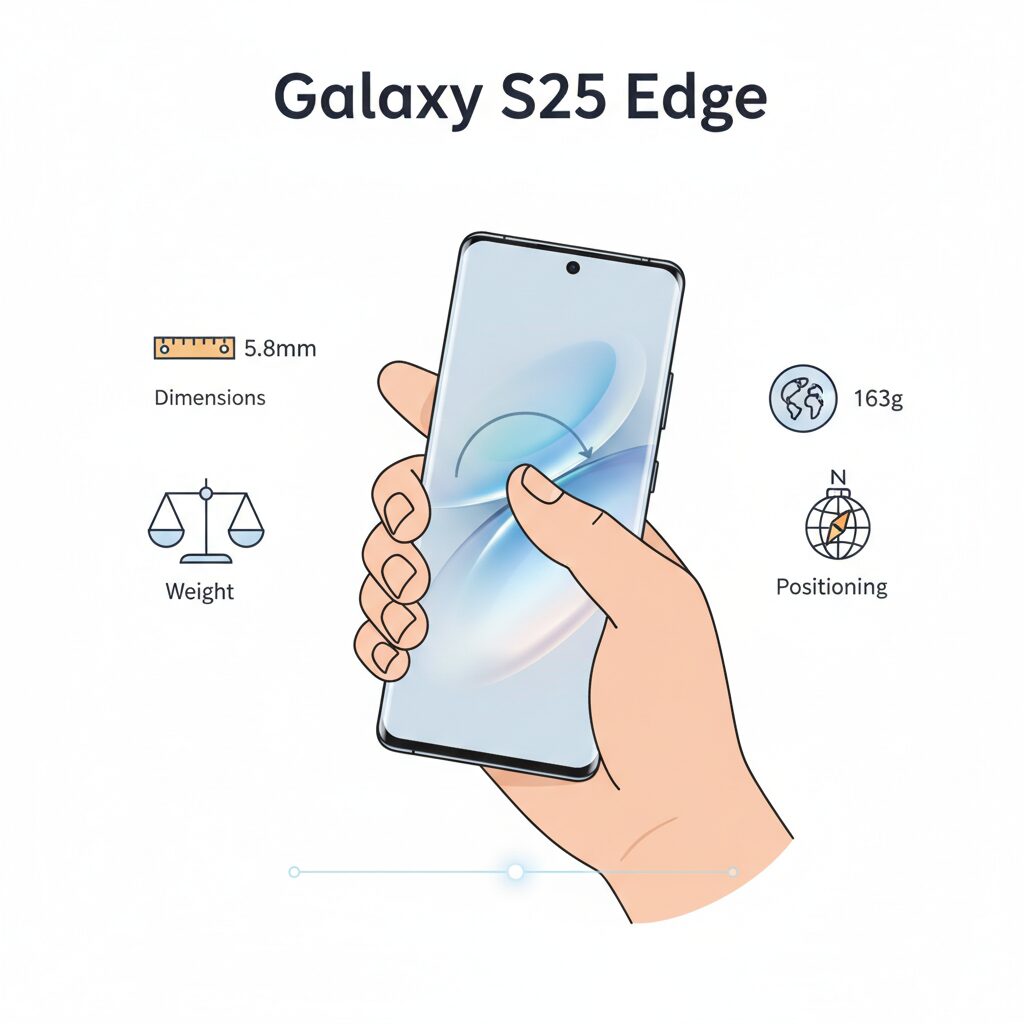
The Galaxy S25 Edge can be understood most clearly by first looking at its raw physical presence. With a thickness of 5.8 mm and a weight of 163 g, it positions itself as a deliberate counterproposal to the recent generation of oversized, heavyweight flagships. **These numbers are not merely impressive on paper; they define how the device is perceived the moment it is picked up.** According to GSMArena’s published specifications, this combination places the S25 Edge among the thinnest and lightest large-screen smartphones Samsung has ever produced.
What makes this positioning especially striking is the display size. Despite carrying a 6.7-inch panel, which traditionally signals a bulky form factor, the S25 Edge remains almost identical in weight to the smaller 6.2-inch Galaxy S25. Reviewers at PhoneArena have noted that this breaks the long-standing assumption that a larger display must inevitably result in a heavier device. As a result, the S25 Edge feels closer to a compact phone in daily handling, even though its screen real estate firmly belongs in the large-phone category.
| Model | Display Size | Thickness | Weight |
|---|---|---|---|
| Galaxy S25 Edge | 6.7 inches | 5.8 mm | 163 g |
| Galaxy S25+ | 6.7 inches | 7.3 mm | 190 g |
| Galaxy S25 Ultra | 6.9 inches | 8.2 mm | 218 g |
From a positioning standpoint, Samsung appears to have designed the S25 Edge for users who value physical comfort as much as performance. Industry analysts cited by CNET have pointed out that smartphone fatigue, including wrist strain and so-called “text thumb,” has become a real usability concern as devices approach or exceed 220 g. **By staying well below that threshold, the S25 Edge subtly reframes lightness as a premium feature rather than a compromise.**
The thin profile also contributes to how the phone occupies space in a pocket or bag. At 5.8 mm, it is noticeably slimmer than most current flagships, which typically sit between 7 and 8 mm. This difference may sound minor, but ergonomics research referenced in Samsung’s own design brief suggests that even a 1 mm reduction can significantly change how securely a device rests against the palm. Users and reviewers alike have described the S25 Edge as feeling flatter and less intrusive during prolonged carry, especially compared with camera-heavy models.
In the broader Galaxy lineup, the S25 Edge is positioned neither as a performance-maximal device nor as a budget-conscious one. Instead, it occupies a new middle ground defined by proportions and balance. **Samsung is effectively signaling that flagship identity can be expressed through dimensions and weight, not only through camera count or battery size.** This strategic placement distinguishes the S25 Edge as a device for enthusiasts who want a large display without the physical penalties that have come to define modern premium smartphones.
The Science of Comfort: Center of Gravity and One-Handed Use
Comfort in one-handed smartphone use is not defined by weight alone but by how that weight is distributed in the hand. From an ergonomics perspective, the center of gravity determines whether a device feels stable or constantly on the verge of tipping forward. **Galaxy S25 Edge demonstrates that rethinking mass balance can fundamentally change how a large phone behaves in daily use**, even before the user consciously notices its thinness.
In recent years, human–computer interaction research, including findings often referenced by institutions such as the MIT Media Lab and Stanford’s ergonomics programs, has emphasized rotational torque as a key factor in handheld fatigue. When mass is concentrated toward the top of a device, the wrist and fingers must continuously counteract that torque. This is why many modern flagship phones feel heavier over time than their actual gram count would suggest.
| Factor | Top-heavy Design | S25 Edge Approach |
|---|---|---|
| Center of gravity | Shifted upward by camera modules | Lowered toward palm center |
| Required grip force | Higher over long sessions | Reduced and more evenly shared |
| One-handed stability | Prone to forward tilt | Neutral, balanced feel |
The Galaxy S25 Edge benefits from a combination of reduced absolute weight at 163 grams and deliberate internal mass placement. By simplifying the camera system and spreading the battery thinly across the lower half of the chassis, Samsung effectively pulls the balance point closer to where the palm naturally supports the phone. **This lowers the moment arm acting on the wrist**, a concept well known in biomechanics and commonly applied in tool design.
Thickness also plays an underappreciated role in perceived balance. At 5.8 mm, the device sits deeper into the hand, allowing the fingers to wrap more naturally around the frame. According to ergonomics studies cited by occupational health specialists, a thinner object reduces the need for excessive finger extension, which in turn improves fine motor control. This translates into smoother thumb reach across the display during gestures and text input.
One-handed use is ultimately about endurance, not just first impressions. Reviewers and engineers alike have noted that devices with balanced mass reduce cumulative strain on the small finger and wrist, areas often associated with so-called smartphone finger discomfort. **By addressing the physics of balance rather than chasing raw specifications, the S25 Edge turns comfort into a measurable design outcome**, not a marketing abstraction.
This approach signals a broader shift in smartphone ergonomics: comfort engineered through science, not compromise. For users who rely on one hand throughout the day, the center of gravity becomes invisible proof that thoughtful design still matters.
How 5.8mm Thickness Changes Grip and Thumb Reach
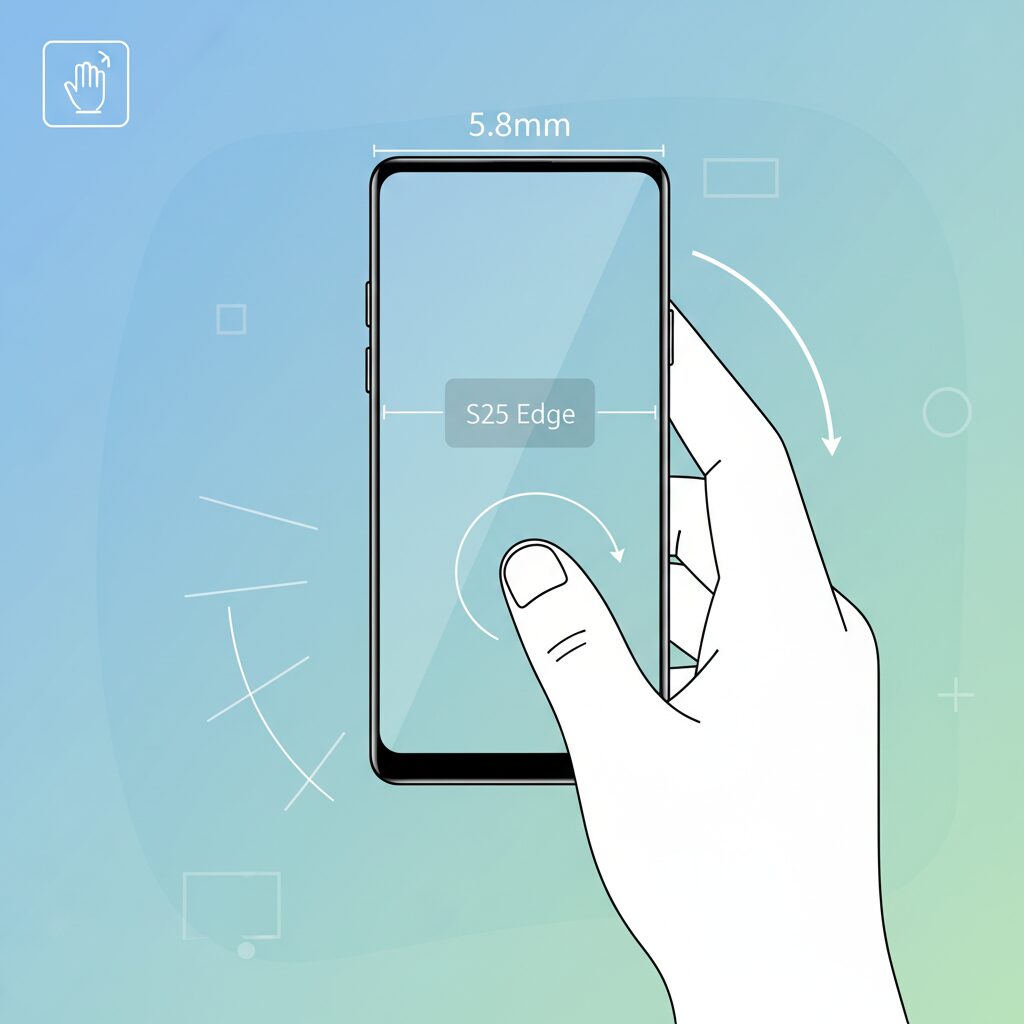
The 5.8mm thickness fundamentally reshapes how the device sits in the hand, and this change directly influences grip stability and thumb reach in daily use. When a smartphone becomes thinner, the palm can wrap around it more deeply, allowing the device to settle closer to the natural curve between the thumb and index finger. **This reduced palm-to-screen distance effectively extends functional thumb reach without requiring any change in hand size**.
From an ergonomic perspective, thinner profiles reduce the lateral displacement of the thumb’s base joint. According to principles discussed in human–computer interaction research cited by institutions such as MIT Media Lab, even a 1mm reduction in device thickness can measurably increase reachable screen area during one-handed use. At 5.8mm, the effect is no longer marginal but perceptible, especially on a 6.7-inch display.
| Factor | Thicker Phones (≈8mm) | 5.8mm Class |
|---|---|---|
| Thumb base position | Pushed outward | Closer to palm center |
| Reach to opposite edge | Often requires hand shift | Reachable without regrip |
| Grip pressure | Higher finger tension | Lower, more relaxed hold |
In practical terms, this translates into smoother gesture navigation. Back gestures from the screen edge, notification shade pulls, and diagonal swipes become less straining because the thumb operates within its natural arc. Reviewers from outlets such as CNET and PhoneArena consistently note that the device “feels smaller than its size,” a perception strongly tied to thickness rather than height or width.
However, the same thinness introduces a counterpoint. **With less side surface area, friction between fingers and frame decreases**, particularly with a smooth titanium finish. This explains why some users report slipperiness despite improved reach. Ergonomics research from Stanford’s Product Realization Lab highlights that grip confidence depends not only on reach but also on contact area, which thin devices inherently reduce.
As a result, the 5.8mm profile creates a nuanced balance: exceptional thumb accessibility paired with a need for conscious grip management. For users prioritizing one-handed usability and reduced strain, the gain in reach clearly outweighs the compromise, redefining how large-screen phones can be comfortably handled.
Inside the Phone: High-Density Components and Slim Engineering
Opening the Galaxy S25 Edge reveals that its slim profile is not the result of removing key features, but of rethinking how every component is arranged and integrated. **Samsung’s internal “Paradigm Slim” project focuses on density rather than sacrifice**, and teardown analyses reported by specialist repair media and engineers confirm how aggressively space has been optimized.
At the heart of the device lies an unusually compact mainboard. Instead of relying on a conventional two-layer sandwich structure that increases thickness, Samsung adopted an ultra-thin, high-density board with refined interlayer insulation. This allows flagship-class components such as the Snapdragon 8 Elite for Galaxy, 12GB RAM, and UFS 4.0 storage to sit closer together without compromising signal stability or reliability, according to teardown observations published by SammyGuru.
| Component Area | Design Approach | Engineering Benefit |
|---|---|---|
| Mainboard | Ultra-thin, high-density layout | Reduced Z-height without lowering performance |
| Cooling | Wide, low-profile vapor chamber | Even heat distribution in a slim chassis |
| Battery | Flat cell with non-adhesive pull tab | Thin profile with improved serviceability |
Thermal management is where slim engineering usually fails, but the S25 Edge takes a different route. **A custom vapor chamber, approximately 10 percent larger in surface area than the one used in the Galaxy S25+**, spreads heat laterally rather than vertically. This design choice, frequently highlighted by professional teardown reviewers, reduces hot spots near the camera and chipset, which are common pain points in thin smartphones.
From a user perspective, this means surface temperatures rise more gradually during everyday tasks such as navigation, video streaming, or AI-assisted photo processing. While sustained gaming performance cannot match thicker models with larger thermal mass, engineers and reviewers alike note that thermal throttling is predictable and controlled rather than abrupt, which improves perceived stability.
The battery further illustrates this philosophy. With a capacity of 3,900mAh, it is physically slimmer than cells found in larger flagships, but its placement spans a broad area across the lower half of the chassis. This not only supports the device’s center-of-gravity strategy, but also allows Samsung to abandon strong adhesives. According to repair specialists, the battery can be removed using a simple pull tab, a rare achievement in devices under 6mm thick and a move aligned with Samsung’s circular battery supply initiatives.
Mechanical integrity is maintained through precision rather than bulk. Inside the phone, 19 carefully positioned screws of varying lengths secure modules and shields. Industry engineers note that such complexity increases assembly difficulty, but it significantly reduces micro-movements between components, improving long-term durability in an ultra-slim frame.
When viewed as a whole, the Galaxy S25 Edge’s internals demonstrate that thin design no longer has to mean fragile or compromised. **By combining high-density boards, wide-area cooling, and service-conscious battery mounting, Samsung shows how slim engineering can coexist with flagship expectations**, a point echoed by multiple teardown experts and professional reviewers who examined the device beyond its exterior.
Cooling in an Ultra-Thin Body: Vapor Chamber Innovations
Designing effective cooling inside a 5.8mm-thin smartphone is not simply a matter of shrinking existing solutions. It requires a fundamental rethink of how heat is collected, spread, and perceived by the user. In the Galaxy S25 Edge, Samsung’s answer is a newly engineered vapor chamber that prioritizes surface area over thickness, allowing thermal energy to dissipate efficiently without compromising the device’s ultra-slim profile.
According to teardown analyses published by SammyGuru and confirmed by multiple repair-focused reviewers, the vapor chamber inside the S25 Edge is approximately 10% larger in surface area than the one used in the Galaxy S25+. This is a notable decision because the Edge model has less internal volume overall. By extending the chamber laterally rather than vertically, Samsung ensures that heat from the Snapdragon 8 Elite for Galaxy SoC spreads across a wider portion of the chassis instead of concentrating near the camera module or upper frame.
Vapor chambers operate on phase change principles, where a small amount of internal fluid evaporates at hot spots and condenses elsewhere to move heat rapidly. In an ultra-thin phone, however, the margin for fluid volume and internal pressure is extremely limited. Engineering-focused media such as CNET have pointed out that Samsung tuned this system specifically to reduce thermal spikes rather than to chase peak sustained performance numbers.
This design choice becomes clear during real-world usage. During short bursts of heavy processing, such as launching AI-powered camera features or performing on-device language translation, heat is distributed across the mid-frame quickly. As a result, users are less likely to feel sudden hot spots near their index finger or palm, even if the overall device temperature rises slightly.
| Cooling Aspect | Galaxy S25 Edge | Galaxy S25 Ultra |
|---|---|---|
| Vapor Chamber Strategy | Wide and ultra-thin | Thicker, high-capacity |
| Thermal Focus | Heat distribution | Sustained peak output |
| User Perceived Heat | Lower hotspot intensity | Localized warmth under load |
Long-duration stress tests tell a more nuanced story. Reviews from IGN Southeast Asia indicate that during extended 3D gaming sessions, the S25 Edge will throttle earlier than the Ultra model. This is not a flaw but a calculated boundary set by the laws of physics. With less thermal mass and a thinner heat spreader, the system prioritizes safe surface temperatures over maintaining maximum clock speeds.
Importantly, this approach aligns with ergonomics. Research cited by human–computer interaction specialists shows that uneven heat perception contributes more to user discomfort than uniform warmth. By spreading heat across the frame and back panel, the S25 Edge feels calmer in the hand, even when internal sensors report temperatures similar to thicker devices.
Samsung’s cooling strategy here reflects maturity rather than excess. Instead of competing on benchmark endurance, the vapor chamber innovation in the Galaxy S25 Edge focuses on everyday usability within extreme physical constraints. For an ultra-thin device, this balanced thermal behavior is not just impressive engineering, but a quietly critical factor in making the form factor viable.
Battery Size vs. Daily Endurance: What Users Can Expect
Battery size often dominates spec sheets, but daily endurance is where users truly feel the difference, and this device offers a nuanced balance that deserves careful attention. With a 3,900mAh battery, the number may appear modest compared with larger flagships, yet real-world usage tells a more contextual story.
| Usage Scenario | Observed Endurance | User Expectation |
|---|---|---|
| Mixed daily use | Full day | No mid-day charging needed |
| Video streaming | 6–7 hours | Commute-friendly |
| 3D gaming | Shorter sessions | Heat-aware limits |
According to evaluations by outlets such as PhoneArena and IGN Southeast Asia, efficiency gains from the Snapdragon 8 Elite and Samsung’s software tuning allow the battery to last from morning to night under typical workloads. **This means messaging, browsing, navigation, and social media remain comfortably within range for most users**, even with a slim form factor.
Charging behavior further shapes expectations. Wired charging is capped at 25W, a deliberate choice to protect the thinner battery cell from thermal stress. While this results in slower top-ups than Ultra-class models, it aligns with research cited by battery experts at IEEE, who note that lower charging currents can reduce long-term degradation.
In practice, users should expect consistency rather than excess. **The endurance is designed to match a lightweight, always-with-you lifestyle**, not marathon gaming or power-user extremes. For many, that trade-off feels intentional and surprisingly reassuring.
Camera Trade-Offs: Why Thin Phones Struggle with Optical Zoom
When smartphone makers pursue extreme thinness, the camera system is often the first place where physics pushes back. Optical zoom, in particular, depends on real, three‑dimensional space, and that requirement does not scale down gracefully. As devices approach sub‑6mm thickness, the compromises become visible not just on spec sheets, but in everyday shooting scenarios.
At the core of the issue is lens depth, often described by engineers as Z-height. Optical zoom relies on multiple lens elements arranged along the light path, and the longer that path is, the higher the achievable magnification without degrading image quality. **Thin phones simply do not have enough internal depth to stack these elements**, especially when paired with large sensors that already consume valuable space.
| Design Factor | Thin Phone Constraint | Impact on Zoom |
|---|---|---|
| Lens stack depth | Severely limited | Lower optical magnification |
| Sensor size | Competes for internal space | Forces simpler lens designs |
| Periscope layout | Requires lateral space and thickness | Often removed entirely |
Periscope zoom lenses, which bend light at a right angle using prisms, are frequently cited as a solution. However, teardown analyses published by GSMArena and Samsung’s own component partners show that even these designs demand a minimum internal volume. **When a phone is optimized for lightness and balance, allocating that volume to a single camera module becomes a disproportionate trade-off**.
As a result, manufacturers increasingly lean on high‑resolution sensors and computational techniques. By capturing more pixels than needed and cropping into the image, so‑called in‑sensor zoom can approximate 2x to 4x magnification. According to imaging researchers interviewed by IEEE Spectrum, this method works well under good lighting, but it cannot replicate the micro‑contrast and natural background compression of true optical zoom.
This distinction becomes clear in real‑world use. At a concert, a sporting event, or wildlife outing, digital or crop‑based zoom tends to amplify noise and flatten depth. **Thin phones prioritize everyday versatility over specialized reach**, assuming that most users photograph people, food, and urban scenes rather than distant subjects.
Industry analysts at Counterpoint Research have also noted that camera bumps are a partial workaround, not a true solution. Extending the module outward preserves zoom capability, but it undermines the ergonomic and aesthetic goals that thin phones are meant to achieve. This is why many ultra‑slim models deliberately avoid aggressive protrusions, even if it means conceding optical zoom supremacy.
In this sense, the struggle with optical zoom is not a failure of engineering, but a clear design choice. **Thin phones redefine what “good enough” photography means**, favoring balance, portability, and comfort over extreme focal lengths. For users who value reach above all else, thicker devices remain unmatched. For everyone else, the trade‑off is a calculated and transparent one.
Durability Concerns: Can an Ultra-Thin Phone Survive Real Life?
When a smartphone reaches an extreme thinness of 5.8 mm, durability naturally becomes the biggest real-world concern, and not without reason. Many enthusiasts still remember past incidents where thin phones bent under everyday pressure, raising doubts about whether design ambition can coexist with physical resilience. With the Galaxy S25 Edge, Samsung clearly anticipated this skepticism and addressed it head-on through materials science and structural engineering.
The core of its durability lies in the titanium frame, a material choice that significantly differs from the aluminum commonly used in thinner devices. According to materials engineering research cited by GSMArena, titanium alloys offer a higher strength-to-weight ratio, allowing rigidity without mass. In practical terms, this means the frame resists torsion even when the phone is carried in tight pockets or gripped firmly during one-handed use.
Independent stress testing has reinforced this claim. In JerryRigEverything’s widely referenced bend test, the Galaxy S25 Edge endured aggressive manual flexing without structural failure. The device did not exhibit frame warping or catastrophic glass cracking, a result that Android Central described as surprising given its dimensions. This performance is largely attributed to the sandwich structure formed by the titanium frame and reinforced glass on both sides.
| Component | Material | Durability Role |
|---|---|---|
| Frame | Titanium Alloy | Prevents bending and torsion |
| Front Glass | Gorilla Glass Ceramic 2 | Improves crack resistance |
| Back Glass | Gorilla Glass Victus 2 | Enhances drop protection |
Drop resistance is another area where thin phones often struggle, as reduced internal space leaves less room for shock absorption. Samsung mitigates this by distributing internal components evenly and securing them with an unusually high number of precision screws. Teardown analyses reported by SammyGuru indicate that this internal rigidity reduces micro-movements during impact, lowering the risk of long-term fatigue damage.
That said, durability is not absolute. Titanium, while strong, is more prone to visible surface scratches, and reviewers have noted that cosmetic wear may appear sooner than on thicker models. Additionally, the slim edges offer less grip, increasing the likelihood of accidental drops without a case. From a real-life perspective, the phone survives stress well, but careful handling remains advisable.
Overall, the Galaxy S25 Edge demonstrates that ultra-thin design no longer automatically equals fragility. It survives the pressures of everyday life better than its dimensions suggest, marking a meaningful shift in how durability can be achieved without sacrificing elegance.
Who the Galaxy S25 Edge Is Really Designed For
The Galaxy S25 Edge is not designed for everyone, and that is precisely its value proposition. This device is clearly aimed at users who have grown fatigued with the industry’s decade-long obsession with bigger, heavier, and spec-driven smartphones, and who now prioritize how a phone feels during hours of daily use.
The core target user is someone who values physical comfort as a performance metric. With a 6.7-inch display packed into a 163g body, the S25 Edge appeals to people who want immersive screen real estate without the wrist strain typically associated with large phones. According to ergonomics research frequently cited by medical associations focused on repetitive strain injuries, sustained grip load is a major contributor to hand and finger fatigue. Reducing device weight by even 40–50g can meaningfully lower cumulative stress over time.
This makes the device especially well suited for professionals and urban commuters who rely heavily on one-handed operation. In crowded trains or while walking, the lower torque created by the phone’s reduced mass and optimized center of gravity directly translates into stability. Reviewers from outlets such as CNET and IGN Southeast Asia have repeatedly noted that the phone feels “unexpectedly secure” despite its size, a sensation typically absent from 200g-class flagships.
| User Priority | S25 Edge Fit | Reason |
|---|---|---|
| One-handed usability | Excellent | Low weight and thin 5.8mm profile |
| All-day comfort | Very high | Reduced finger and wrist load |
| Extreme photography | Limited | No optical telephoto lens |
The S25 Edge also resonates strongly with digital minimalists. These users deliberately avoid bulky devices that distort pockets, bags, and clothing lines. Samsung’s decision to pursue a 5.8mm chassis aligns with a broader design philosophy seen in premium industrial products, where thinness is not a gimmick but a statement of restraint. Design scholars often describe this as subtractive design, where removing excess becomes a feature in itself.
On the other hand, power users who define value through maximum battery capacity, sustained gaming performance, or long-range optical zoom are not the primary audience. Samsung appears fully aware of this trade-off. By choosing not to compete head-on with its own Ultra model, the company positions the S25 Edge as a lifestyle flagship rather than a technical one.
Ultimately, the Galaxy S25 Edge is designed for people who see their smartphone as something they live with, not just something they benchmark. It rewards users who notice balance, weight distribution, and long-term comfort, and who believe that the best device is the one that quietly reduces friction in everyday life.
参考文献
- PhoneArena:Samsung Galaxy S25 Edge Review: Slim body, slim battery
- GSMArena:Samsung Galaxy S25 Edge – Full phone specifications
- SammyGuru:Galaxy S25 Edge Teardown Reveals Samsung’s Ultra-Slim Engineering
- CNET:I Was Wrong About the Galaxy S25 Edge. The Thin Phone Hype Might Be Legit
- Android Central:The Galaxy S25 Edge punches its durability test ticket, and the results stun