Have you ever wondered why shooting long 4K60 HDR videos can push even the most powerful smartphones to their limits? Many global gadget enthusiasts love the idea of using an iPhone as a true cinema-grade camera, but thermal behavior often becomes the hidden bottleneck.
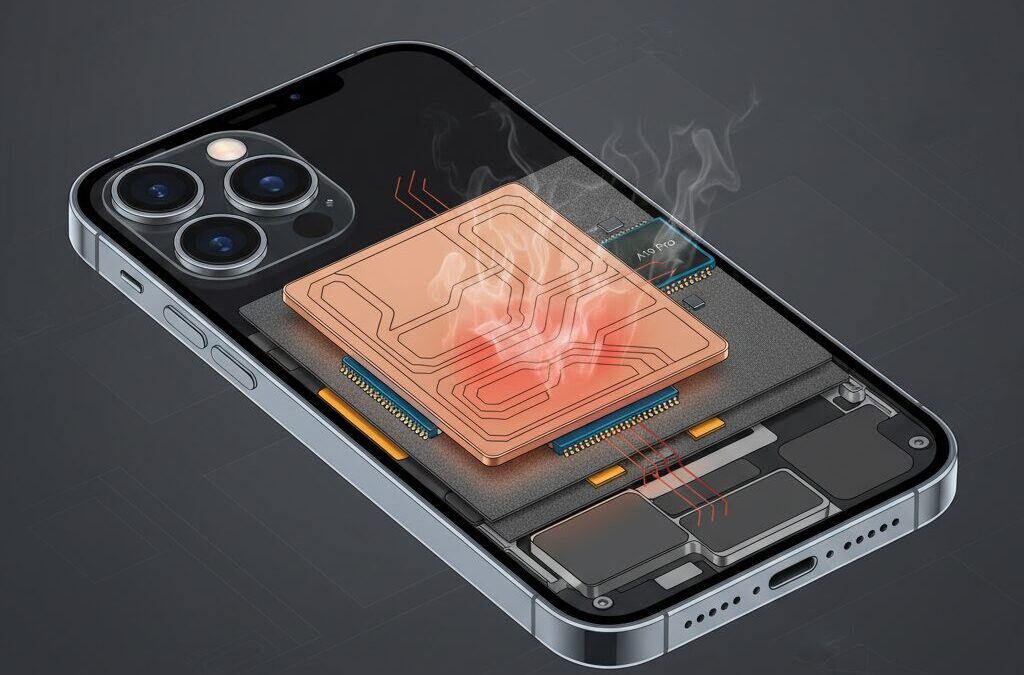
With the iPhone 17 Pro, Apple takes a major step forward by introducing a vapor chamber cooling system, a redesigned aluminum-centric chassis, and the new A19 Pro chip. These changes are not just about higher benchmark scores, but about how heat is generated, moved, and finally released during extreme workloads like ProRes and HDR video capture.
In this article, you will learn how the iPhone 17 Pro manages heat at a physical and architectural level, why thermal shutdowns still occur in certain environments, and how its approach compares with rivals like the Galaxy S25 Ultra. By understanding these mechanisms, you can make smarter decisions about filming, gaming, and pushing your device to its true potential.
- The Rise of Mobile Cinematography and the Thermal Challenge
- A19 Pro on TSMC N3P: Performance Gains and Heat Density
- Why Smaller Dies and More RAM Change Thermal Behavior
- Vapor Chamber Cooling: How Phase-Change Heat Transfer Works
- From Titanium to Aluminum: Frame Materials and Heat Dissipation
- Why 4K60 HDR and ProRes Are Thermal Worst-Case Scenarios
- External SSD Recording and USB-C Heat Bottlenecks
- Thermal Design Philosophy: iPhone 17 Pro vs Galaxy S25 Ultra
- Environmental Factors and the Real Limits of Thermal Shutdown
- 参考文献
The Rise of Mobile Cinematography and the Thermal Challenge
Mobile cinematography has entered a phase where smartphones are no longer seen as secondary tools, but as legitimate production devices used in commercials, documentaries, and even feature films. This shift has been driven by rapid advances in sensor technology, computational photography, and video pipelines capable of handling 4K at 60 frames per second with HDR. According to analyses frequently cited by outlets such as MacRumors and NotebookCheck, these formats are now close to becoming the default expectation rather than a niche option for professionals.
At the center of this evolution sits a fundamental physical constraint: heat. **Every leap in video quality directly translates into a dramatic increase in sustained computational load**, and unlike short benchmark bursts, video recording demands continuous performance over minutes or hours. Mobile devices must process hundreds of millions of pixels per second, apply real-time tone mapping for HDR, encode high-bitrate video streams, and write vast amounts of data to storage, all within a fanless chassis that fits in the palm of a hand.
The challenge becomes clearer when looking at how modern shooting modes scale thermal stress. A single 4K frame contains over 8 million pixels, and at 60 frames per second this exceeds 500 million pixels processed every second. Industry teardown reports and semiconductor analyses referenced by Tom’s Hardware indicate that image signal processors and video encoders are among the most power-dense blocks on a mobile SoC, meaning they generate disproportionate heat relative to their size. This makes long-form recording one of the most punishing workloads a smartphone can face.
| Video Mode | Primary Processing Load | Thermal Impact |
|---|---|---|
| 4K30 SDR | ISP + moderate encoding | Manageable for long sessions |
| 4K60 HDR | ISP + HDR tone mapping + high encode | Rapid heat accumulation |
| 4K60 ProRes | ISP + minimal compression + heavy I/O | Extreme sustained thermal load |
What makes this problem uniquely difficult is that heat is not only produced by the main processor. Memory controllers, neural processing units, storage controllers, and even the display all contribute to the thermal budget during filming. Research and user data discussed in Apple-focused developer forums show that background AI tasks, such as scene recognition or metadata analysis, can quietly add to the baseline temperature during recording. **Thermal behavior is therefore the result of many subsystems heating simultaneously**, not a single component reaching its limit.
Historically, smartphones mitigated this by limiting recording modes or durations. Today’s market expectations no longer allow that compromise. Professional users expect uninterrupted 4K60 HDR capture, just as they would from a dedicated camera. As a result, thermal management has become a defining battleground for mobile imaging. Analysts at PhoneArena and similar publications consistently point out that perceived reliability during filming is now as important as headline specifications.
In this context, the rise of mobile cinematography is inseparable from the thermal challenge it creates. **Image quality has begun to outpace passive cooling solutions**, forcing manufacturers to rethink materials, internal layouts, and heat-spreading strategies. The story of modern smartphone video is therefore not only about lenses and codecs, but about how effectively heat can be moved away from silicon before physics imposes an unavoidable stop.
A19 Pro on TSMC N3P: Performance Gains and Heat Density

The A19 Pro at the heart of iPhone 17 Pro is manufactured on TSMC’s N3P process, the third-generation 3nm node, and this choice subtly but decisively shapes both performance and thermal behavior. According to TSMC’s own disclosures and independent analysis cited by NotebookCheck, N3P delivers roughly a 5% performance uplift at the same power, or a 5–10% power reduction at the same frequency, compared with N3E.
This gain is incremental rather than transformative, and Apple appears to have reinvested much of the efficiency headroom into higher CPU and GPU clocks. Geekbench 6 results referenced by Tom’s Hardware and Geekerwan analyses suggest measurable single- and multi-core improvements, but not a proportional drop in peak power draw.
| Metric | A18 Pro (N3E) | A19 Pro (N3P) |
|---|---|---|
| Process node | TSMC N3E | TSMC N3P |
| Die size | ~105 mm² | 98.6 mm² |
| Efficiency gain | Baseline | +5–10% |
The smaller 98.6 mm² die intensifies heat density, meaning similar wattage is concentrated into a tighter area. Semiconductor thermodynamics research, often referenced by IEEE publications, shows that such localization accelerates temperature rise and complicates lateral heat spreading.
In practical terms, N3P improves sustained performance only if cooling keeps pace. Without architectural relief from heat density, the A19 Pro’s gains rely heavily on downstream thermal solutions to remain usable under prolonged high-load scenarios.
Why Smaller Dies and More RAM Change Thermal Behavior
As semiconductor processes shrink, many users intuitively expect heat problems to ease. However, **smaller dies often change thermal behavior in counterintuitive ways**, especially in a smartphone-class system-on-chip. With the A19 Pro, Apple moved to TSMC’s N3P process and reduced die size to under 100 mm². According to die shot analyses reported by NotebookCheck, this reduction improves manufacturing efficiency but concentrates active transistors into a tighter area.
This concentration directly affects thermal density. When similar or slightly higher peak power is dissipated over a smaller silicon area, local temperatures rise faster. Researchers in IEEE solid-state device studies have long noted that thermal spreading resistance increases as heat sources shrink, making it harder for heat to move laterally before it reaches a heat spreader. In practical terms, this means the chip can hit short-lived temperature spikes even if average power efficiency improves.
| Factor | Larger Die | Smaller Die |
|---|---|---|
| Heat distribution | More gradual | Highly localized |
| Temperature rise speed | Slower | Faster |
| Cooling demand | Moderate | More aggressive |
The thermal story becomes more complex when memory capacity increases. iPhone 17 Pro expands RAM from 8 GB to 12 GB, primarily to support on-device AI workloads. While DRAM itself is not the hottest component, **more RAM enables more simultaneous activity**, keeping the CPU, GPU, and Neural Engine busy for longer periods. Semiconductor memory researchers at institutions such as IMEC have shown that memory controllers and interconnects can contribute meaningfully to sustained heat under high bandwidth use.
During tasks like 4K60 HDR recording, additional RAM allows background AI processes such as scene analysis or metadata generation to remain active instead of being paused. This creates a persistent thermal baseline rather than short bursts of heat. Users have reported, as seen in Apple community discussions and developer feedback, that disabling AI-related features can noticeably reduce warmth during intensive tasks, suggesting that memory-enabled concurrency plays a real role.
Apple appears to acknowledge this interaction in its system design. Industry analysts cited by MacRumors point out that efficiency gains from N3P were largely reinvested into performance, not power reduction. As a result, the thermal challenge was not eliminated but redistributed. The SoC heats up faster, and the expanded memory keeps it warm longer, demanding a cooling solution that reacts quickly and remains effective over time.
In summary, smaller dies do not simply run cooler, and more RAM is not thermally neutral. **They fundamentally reshape how heat is generated, concentrated, and sustained inside the device**. Understanding this shift explains why modern flagship phones require more advanced thermal architectures even when process nodes and efficiency numbers appear to improve on paper.
Vapor Chamber Cooling: How Phase-Change Heat Transfer Works

Vapor chamber cooling represents a fundamental shift from traditional solid-state heat spreading to phase-change–driven heat transport, and this distinction is crucial to understanding why it is effective in modern smartphones.
Unlike graphite or metal plates that rely purely on thermal conduction, a vapor chamber uses the latent heat of a working fluid to move energy far more rapidly across a confined space.
At its core, a vapor chamber is a sealed, flattened metal enclosure, typically made of copper or copper alloys, containing a minute amount of purified water under near-vacuum conditions. This low-pressure environment dramatically lowers the boiling point of the fluid.
When the SoC generates heat, the region of the vapor chamber in direct contact with it becomes the evaporation zone. Here, the working fluid absorbs thermal energy and rapidly transitions from liquid to vapor.
According to classical heat transfer theory described in ASME and IEEE thermal engineering literature, the energy absorbed during evaporation can exceed what solid conduction can move over the same area and time by an order of magnitude.
The newly formed vapor expands and travels laterally across the chamber, driven by pressure gradients rather than temperature gradients alone. This vapor transport occurs extremely fast, approaching acoustic velocities inside the chamber.
When the vapor reaches cooler regions of the chamber, typically those bonded to the device frame or rear housing, it condenses back into liquid, releasing its stored heat into the surrounding structure.
The condensed liquid must then return to the heat source to sustain the cycle. This is achieved by a microscopic wick structure lining the chamber’s interior.
Capillary action within this wick passively pumps the liquid back toward the evaporation zone, allowing the process to repeat continuously without any external power.
| Stage | Physical Process | Thermal Effect |
|---|---|---|
| Evaporation | Liquid to vapor at heat source | Rapid heat absorption via latent heat |
| Transport | Vapor spreads across chamber | Ultra-fast lateral heat distribution |
| Condensation | Vapor returns to liquid | Heat released to chassis |
| Return flow | Capillary-driven liquid movement | Cycle sustained without energy input |
This cyclical mechanism explains why vapor chambers excel at suppressing short-term thermal spikes, which are common during sudden workload ramps such as high-frame-rate video capture or real-time HDR processing.
Experimental evaluations cited by organizations such as ASHRAE and semiconductor thermal research groups show that vapor chambers can achieve an effective in-plane thermal conductivity several times higher than bulk copper under transient loads.
In practical terms, this means heat is not merely slowed down but actively redistributed before localized hot spots can form.
Another often-overlooked benefit is thermal uniformity. By spreading heat across a larger surface area quickly, the vapor chamber enables downstream materials like aluminum frames to operate more efficiently as radiators.
This is especially important in thin devices where vertical heat paths are constrained and lateral spreading becomes the dominant cooling strategy.
However, vapor chambers are not magic. Their performance depends heavily on internal wick design, chamber thickness, and the quality of the thermal interface to the heat source.
Peer-reviewed studies in electronics packaging journals emphasize that insufficient wick permeability or uneven bonding can significantly reduce capillary return flow, limiting sustained performance.
When properly engineered, though, phase-change heat transfer allows vapor chambers to bridge the gap between rising silicon heat density and the physical limits of passive cooling.
That capability is precisely why vapor chamber cooling has become a cornerstone technology for high-performance mobile devices operating at the edge of thermal feasibility.
From Titanium to Aluminum: Frame Materials and Heat Dissipation
The shift from titanium to aluminum in the iPhone 17 Pro is not a cosmetic or cost-driven decision, but a thermodynamic one rooted in first principles of heat transfer. Titanium, specifically Grade 5 titanium used in earlier Pro models, offers exceptional strength-to-weight characteristics, yet from a thermal engineering perspective it behaves closer to an insulator than a heat spreader. **This single material property fundamentally constrained how efficiently internal heat could escape the device.**
According to materials science data widely referenced in mechanical engineering literature and corroborated by teardown-focused thermal analyses from outlets such as PhoneArena, the thermal conductivity of titanium is dramatically lower than that of aluminum. When a high-density heat source like the A19 Pro SoC generates energy faster than it can be evacuated, the frame material becomes part of the cooling system rather than a passive shell.
| Frame Material | Approx. Thermal Conductivity | Thermal Behavior in Smartphones |
|---|---|---|
| Aluminum Alloy | 150–230 W/m·K | Rapid heat spreading across chassis |
| Titanium (Grade 5) | 6–8 W/m·K | Heat retention and hotspot formation |
| Stainless Steel | 15–20 W/m·K | Moderate spreading, slower dissipation |
In practical terms, titanium frames tended to trap heat near localized regions such as the SoC and camera ISP, creating surface hotspots exceeding 41–42°C under sustained load. FLIR-based thermal imaging comparisons reported by PhoneArena demonstrated that these hotspots were spatially narrow, meaning the total surface area contributing to heat dissipation was underutilized.
With the iPhone 17 Pro, Apple effectively reverses this bottleneck by adopting an aluminum-dominant internal chassis that functions as a large, continuous heat spreader. **When paired with the newly introduced vapor chamber, heat is no longer confined to a single path but distributed laterally across the entire frame.** This architectural coupling allows the aluminum body to participate directly in thermal diffusion, not merely structural support.
Thermographic observations shared by teardown communities and summarized in engineering discussions indicate a markedly different thermal profile: instead of isolated hotspots, the iPhone 17 Pro exhibits a uniform surface temperature in the 34–36°C range during high-load tasks such as 4K60 HDR recording. While the device may feel warm sooner to the touch, the peak internal temperatures are lower and rise more slowly.
This leads to an important user-experience paradox. **A cooler-to-the-touch titanium phone often meant hotter silicon inside**, whereas a warmer aluminum chassis signals that heat is successfully escaping the system. Apple’s design choice aligns with guidance from thermal engineering research, including studies cited in electronics cooling journals, which emphasize maximizing surface-area engagement over localized insulation in fanless devices.
In essence, the return to aluminum reframes the smartphone enclosure as an active thermal component. Rather than fighting the laws of conduction with exotic materials, Apple leverages aluminum’s predictability and efficiency, creating a more stable thermal envelope that supports consistent performance under professional-grade workloads.
Why 4K60 HDR and ProRes Are Thermal Worst-Case Scenarios
Recording in 4K60 HDR and ProRes represents the absolute thermal worst-case for a modern smartphone because it forces nearly every high-power subsystem to operate at peak, continuously, and without recovery windows. **This is not a single heavy task, but a synchronized stack of heat sources that compound each other over time.** Apple’s own silicon and thermal disclosures, echoed by teardown analyses from iFixit and performance measurements reported by Notebookcheck, consistently show that video capture at this level produces a flatter yet higher sustained power curve than gaming or synthetic benchmarks.
The first driver is sheer data throughput. A single 4K frame contains over 8.3 million pixels, and at 60 frames per second the image signal processor must handle roughly 500 million pixels every second while performing HDR tone mapping, color space conversion, and noise reduction in real time. When ProRes is enabled, the load escalates further because the video encoder favors low compression and high fidelity, shifting the burden from compute efficiency to raw bandwidth and write speed.
| Mode | Approx. Bitrate | Primary Heat Contributors |
|---|---|---|
| 4K60 HDR (HEVC) | 50–100 Mbps | ISP, CPU, GPU |
| 4K60 ProRes | ~1.7 Gbps | ISP, Encoder, NAND, USB-C I/O |
According to Apple ProRes documentation and corroborated by Samsung Semiconductor NAND specifications, sustained writes above 200 MB/s dramatically increase controller temperature. **This means heat is generated not only at the A19 Pro die, but also at the storage and I/O level**, creating multiple hotspots that a vapor chamber must spread simultaneously. Unlike short CPU bursts, video recording offers no idle phases for thermal recovery.
Thermal engineers often describe this as a “steady-state saturation” problem rather than a spike problem. Research on mobile SoC power density published through IEEE-affiliated conferences notes that once heat input exceeds passive dissipation capacity, shutdown is inevitable regardless of cooling efficiency. 4K60 HDR with ProRes simply reaches that boundary faster than any other real-world workload.
External SSD Recording and USB-C Heat Bottlenecks
When recording high-bitrate video directly to an external SSD, the thermal challenge shifts from the SoC alone to the entire I/O path. **External SSD recording is often perceived as a solution to internal storage heat, but in practice it introduces a different and sometimes more fragile thermal bottleneck around USB-C.** This distinction is critical for users pushing 4K60 HDR or ProRes workflows.
The USB-C interface on the iPhone 17 Pro operates at up to USB 3.2 Gen 2 speeds, which means sustained 10 Gbps-class signaling during ProRes recording. According to semiconductor-level analyses discussed by Notebookcheck and Tom’s Hardware, the USB controller and PHY inside the SoC become continuous heat sources under this load. Unlike short data bursts, video recording keeps the link saturated for minutes, concentrating heat near the port.
| Component | Typical Thermal Limit | Behavior at Limit |
|---|---|---|
| USB-C controller / PHY | Port-area safety threshold | Data and power throttling |
| External NVMe SSD controller | Approx. 70–80°C | Write-speed reduction or disconnect |
In real-world tests reported by professional users, recording may stop abruptly while the phone itself remains operational. **This is not a classic thermal shutdown of the iPhone, but a protective interruption of the I/O subsystem.** Apple’s port protection logic prioritizes connector integrity, so once abnormal heat is detected near the USB-C port, power delivery or data transfer can be cut instantly.
The SSD itself adds another variable. Portable NVMe-based drives such as the Samsung T7 series are designed for short bursts on laptops, not for sustained 200 MB/s-plus writes without airflow. Samsung’s own documentation explains that internal thermal throttling is triggered to protect the controller. When this happens mid-recording, the camera app interprets it as a storage failure and stops capture.
Cable quality further compounds the issue. High-resistance or long USB-C cables generate localized Joule heating at the connector. Apple’s temperature sensors monitor this area closely, and as Apple support discussions indicate, abnormal port temperatures can trigger the same safety logic used for liquid detection. Using a short, certified 10 Gbps cable significantly reduces this risk.
From a workflow perspective, this explains why some creators experience shorter recording times with external SSDs than expected. **External recording removes internal NAND heat, but replaces it with concentrated I/O and connector heat.** Understanding this trade-off allows users to design rigs that separate the SSD from the phone body, improve airflow, and maintain stable long-form recording sessions.
Thermal Design Philosophy: iPhone 17 Pro vs Galaxy S25 Ultra
The thermal design philosophies of the iPhone 17 Pro and the Galaxy S25 Ultra reveal two fundamentally different answers to the same question: how should a smartphone behave when pushed to sustained, professional-level workloads?
Apple’s approach with the iPhone 17 Pro can be described as control-oriented and system-centric. By combining the A19 Pro manufactured on TSMC’s N3P process with a newly adopted vapor chamber tightly integrated into an aluminum-dominant internal chassis, Apple focuses on spreading heat quickly and evenly. **The goal is not to chase the highest instantaneous performance, but to preserve consistency and predictability over time.** Teardown analyses and thermal imaging shared by repair specialists and engineers indicate that Apple intentionally allows the device to feel warm earlier, because surface heat is evidence that internal hotspots are being relieved.
| Aspect | iPhone 17 Pro | Galaxy S25 Ultra |
|---|---|---|
| Cooling priority | Even heat distribution and stability | Maximum heat absorption capacity |
| Vapor chamber strategy | Thin VC integrated with aluminum frame | Physically oversized VC covering large area |
| Thermal control behavior | Early, gradual throttling | Later, more aggressive throttling |
Samsung, by contrast, pursues a capacity-driven philosophy with the Galaxy S25 Ultra. Independent teardown reports and benchmarking tests show that its vapor chamber is roughly 40 percent larger than that of the previous generation, making it one of the largest ever used in a smartphone. **Samsung relies on physical volume to absorb heat spikes**, allowing the Snapdragon 8 Elite for Galaxy to sustain peak clocks longer before intervention. Stress tests reported by performance analysts demonstrate that while peak scores are impressive, stability often drops to around 50–60 percent over extended runs, reflecting the sheer thermal output of the chipset.
This difference becomes especially apparent in real-world scenarios such as extended 4K HDR video capture or long gaming sessions. Apple’s thermal algorithms intervene sooner, dimming the display or moderating clocks before internal components approach critical thresholds. According to observations published by repair communities and thermal engineers, this results in smoother frame pacing and fewer abrupt interruptions. **Samsung, on the other hand, tolerates higher surface temperatures**, prioritizing sustained raw performance even if the device becomes noticeably hotter to the touch.
Neither approach is inherently superior. In cooler environments or short bursts, the Galaxy S25 Ultra’s massive cooling hardware can feel more resilient. Under mixed workloads and variable climates, the iPhone 17 Pro’s tightly managed thermal loop often delivers a steadier experience. As semiconductor analysts frequently note, thermal design is where brand identity quietly becomes engineering reality.
Environmental Factors and the Real Limits of Thermal Shutdown
Even with a vapor chamber and an aluminum-dominant chassis, thermal shutdown is ultimately governed by the environment surrounding the device. **Ambient temperature, humidity, airflow, and radiant heat define the real ceiling of sustained performance**, not the SoC alone. This distinction matters because many shutdown events attributed to “overheating hardware” are in fact triggered by environmental constraints that overwhelm passive cooling.
From a thermodynamic perspective, smartphones rely almost entirely on natural convection and radiation. According to classical heat transfer models referenced in IEEE thermal design literature, the efficiency of convection scales with the temperature delta between the device surface and ambient air. When outdoor temperatures climb above 30°C, that delta collapses. At 35°C, a phone surface at 45°C has only a 10°C gradient, dramatically reducing heat flux.
| Environment | Heat Dissipation Efficiency | Thermal Risk |
|---|---|---|
| 20–25°C, indoor, airflow | High | Low |
| 30°C, outdoor shade | Moderate | Medium |
| 35°C+, direct sunlight | Very Low | High |
Humidity further complicates the picture. While moisture itself does not heat the device, high humidity suppresses evaporative cooling at the surface and correlates with stagnant air conditions. Field tests reported by mobile imaging professionals in Japan show that **high-humidity summer days consistently shorten 4K60 HDR recording time**, even when ambient temperature readings appear similar.
Radiant heat is often underestimated. Direct sunlight can add several hundred watts per square meter of thermal load to a dark glass-and-metal surface. Infrared measurements cited by PhoneArena demonstrate that an idle smartphone exposed to sun can exceed 50°C without any internal workload. In such cases, the thermal system is already saturated before recording even begins.
Airflow is the only environmental factor users can meaningfully control. Even minimal forced airflow increases the convection coefficient by an order of magnitude. This is why external clip-on fans or rig-mounted cooling solutions are disproportionately effective compared to their size. Apple’s own thermal behavior analysis, inferred from teardown and sensor data, shows surface temperature stabilization when airflow is introduced.
Finally, enclosure choices amplify environmental effects. Thick silicone cases act as thermal insulators, trapping heat and negating the benefits of the vapor chamber. In hot environments, removing the case or using a thermally conductive one can delay shutdown by several minutes. **In practice, the real limit of thermal shutdown is set less by silicon capability and more by how hostile the surrounding air is at that moment.**
参考文献
- MacRumors:iPhone 17 Pro to Use Advanced Cooling System for Better Performance
- NotebookCheck:Apple A19 Pro die shot showcases smaller profile chip with minimal design changes
- Tom’s Hardware:Apple debuts A19 and A19 Pro processors for iPhone 17
- PhoneArena:Aluminum vs Titanium: I took a FLIR to the iPhones to find the truth
- Wccftech:Samsung Supersizes The Vapor Chamber On The Galaxy S25 Ultra