If your smartphone feels more like a data center than a pocket device, you are not alone. With 5G nearly universal and 4K or even 8K video becoming routine, the amount of data generated on modern smartphones has grown exponentially in 2026.
At the same time, users are increasingly aware of the importance of backups, yet many are frustrated by rising cloud subscription costs, storage limits, and privacy concerns. The challenge is no longer just how to back up data, but how to reduce, prioritize, and intelligently manage it.
In this article, you will discover how AI-powered operating systems, neural image compression, private AI NAS devices, next-generation SSD infrastructure, and even DNA storage are redefining what smartphone backup means. By the end, you will understand how to build a multi-layered, future-proof backup strategy that maximizes performance, minimizes cost, and protects your digital life.
- The 2026 Smartphone Data Explosion: 5G, 4K/8K Video, and Generative AI
- Why Backup Awareness Is High but Storage Anxiety Is Higher
- AI at the Core: How Android 16 and Apple Intelligence Redefine On-Device Storage Management
- Notification Summaries, Smart Offloading, and Embedded Photo Pickers: Practical AI Features That Save Gigabytes
- App-Level Optimization: Managing Heavy Data from Messaging and Short-Video Platforms
- From Public Cloud to Private AI NAS: The Strategic Shift Toward Hybrid Backup Architectures
- QLC SSDs, NVMe, Thunderbolt 5, and Wi-Fi 7: The Infrastructure Powering Real-Time Backup
- Neural Image Compression vs. WebP, AVIF, and JPEG XL: What the Data Really Shows
- Deduplication, Homomorphic Encryption, and Immutable Snapshots: Security Meets Efficiency
- DNA Storage and DePIN: Are We Entering the Post-Cloud Era?
- Energy Efficiency and “Tokens per Watt”: The Hidden Cost of AI-Driven Data Management
- Designing a Four-Layer Backup Roadmap for 2026 and Beyond
- 参考文献
The 2026 Smartphone Data Explosion: 5G, 4K/8K Video, and Generative AI
By 2026, smartphones are no longer just communication devices; they are high-throughput data engines operating on fully 5G-native infrastructure. According to MM Research Institute, Japan’s smartphone shipments rebounded to approximately 33.35 million units in fiscal 2025, with 5G models accounting for 99.7%, rising to a projected 99.9% in 2026. This near-total 5G penetration fundamentally changes how much data a single device generates and consumes every day.
5G is not simply about faster downloads. It removes friction. When latency drops and bandwidth expands, users stop hesitating to shoot 4K video, experiment with 8K recording, or stream high-bitrate content. The network no longer acts as a constraint, and as a result, the volume of personal data expands exponentially rather than incrementally.
| Factor | Pre-5G Era | 2026 Environment |
|---|---|---|
| Network Speed | 4G dominant | Near-universal 5G |
| Video Capture | 1080p / selective 4K | 4K standard, 8K emerging |
| AI Usage | Cloud-dependent | On-device generative AI |
The real accelerator, however, is generative AI. As TrendForce notes in its 2026 outlook, AI is reshaping the global technology landscape, and smartphones are at the center of this shift. Devices now generate images, summaries, voice transcriptions, and even synthetic video locally. Unlike traditional apps that mainly consume data, generative AI actively produces new content, multiplying storage requirements.
Consider a single use case. A user records 4K video, applies AI-based enhancement, generates auto-captions, creates highlight clips, and stores multiple drafts. Each AI layer produces additional assets. The original file is no longer the only data unit; derivatives, embeddings, and processed versions accumulate alongside it.
Research presented at ICCV 2025 on Extreme Compression of Adaptive Neural Images demonstrates that neural compression can reduce image sizes by up to roughly one-eighth under certain conditions. Yet even with 70–85% estimated reductions in ideal scenarios, the sheer growth in content creation often offsets these gains. Efficiency improves, but total data volume still rises because creation scales faster than compression.
Moreover, 8K video dramatically intensifies this trajectory. Higher resolution increases pixel count, bitrate, and processing complexity. When paired with AI-driven upscaling, HDR processing, and multi-layer editing, storage growth becomes structural rather than temporary.
ITmedia’s mobile surveys show that over 90% of users recognize the importance of backup, yet many simultaneously report storage anxiety and rising cloud costs. This tension defines the 2026 smartphone landscape: users create more high-value digital assets than ever before, but infrastructure must constantly evolve to keep pace.
The result is a paradigm shift. Storage is no longer a passive container but a strategic resource. As networks approach saturation and AI models become embedded in the OS layer, the question is no longer whether data will grow, but how intelligently it can be managed in an era where every tap, frame, and prompt generates something new.
Why Backup Awareness Is High but Storage Anxiety Is Higher

In 2026, awareness of smartphone backup has reached an unprecedented level. According to ITmedia Mobile, 90.5% of users recognize the importance of backing up their data. Yet despite this high awareness, storage anxiety is intensifying rather than easing. Users understand they should back up—but they increasingly worry about where all that data will go and how much it will cost.
The root of this anxiety lies in the explosive growth of personal data. With nearly 99.9% of newly shipped smartphones in Japan expected to support 5G, as reported by MM Research Institute, users now routinely capture 4K and even 8K video. Generative AI tools embedded in smartphones also create large media files automatically. Faster networks do not just accelerate consumption; they accelerate accumulation.
Cloud services initially appeared to solve this issue. However, around 60% of cloud storage users are now on paid plans, and dissatisfaction with monthly fees and capacity limits remains persistent. What begins as a low-cost 50GB plan often escalates into 200GB or 2TB tiers as photo libraries and chat histories expand. The psychological pressure is subtle but constant: every new video recorded feels like it carries a future subscription cost.
The tension becomes clearer when we look at user behavior patterns.
| Factor | Backup Awareness | Storage Anxiety Trigger |
|---|---|---|
| High-resolution media | Desire to preserve memories | Rapid capacity consumption |
| Cloud sync | Automatic protection | Recurring subscription fees |
| AI-generated content | Creative empowerment | Unplanned data growth |
There is also a structural contradiction. Modern operating systems encourage automatic, continuous backup. At the same time, data privacy regulations in 2026 increasingly require transparency and consent management, as highlighted by global privacy trend reports from Didomi and Schellman. Users are asked to approve what is stored and processed, yet few have visibility into the cumulative storage footprint of those approvals.
Enterprise storage analysts such as Infinidat note that data growth consistently outpaces infrastructure efficiency gains. This macro-level trend mirrors what happens at the individual level. Even as compression improves and SSD capacities expand, personal data generation grows faster. The result is a persistent perception of scarcity.
The paradox of 2026 is not that people forget to back up. It is that they back up everything. Screenshots, duplicate photos, long chat threads, AI drafts—each feels potentially important. Emotional value overrides rational storage discipline.
For gadget enthusiasts especially, this creates a new form of digital stress. Storage is no longer just a technical specification; it is a reflection of lifestyle intensity. The more creatively and socially active a user becomes, the heavier their invisible data shadow grows.
This widening gap between awareness and anxiety defines the modern backup dilemma. Understanding that your data is safe is reassuring. Realizing that it is endlessly expanding—and increasingly expensive to maintain—is what keeps users uneasy.
AI at the Core: How Android 16 and Apple Intelligence Redefine On-Device Storage Management
In 2026, on-device storage is no longer a passive container for files. It is becoming an intelligent layer where AI continuously evaluates the value of data in real time.
Android 16 with Gemini and iOS powered by Apple Intelligence both shift storage management from reactive cleanup to proactive optimization. Instead of warning you when space runs low, the OS now predicts what should never have been saved in the first place.
This transition from “capacity management” to “value-based curation” is the real breakthrough.
From Notifications to Knowledge Graphs
Google’s Android 16 introduces Notification Summaries and Notification Organizer, features that do more than tidy your lock screen. By summarizing long message threads, Gemini reduces the need to preserve entire chat histories locally, indirectly limiting text data accumulation.
The App Functions API extends this intelligence into third-party apps. Temporary files, duplicated media, and unused assets can be identified and offloaded or removed automatically, while the Embedded Photo Picker prevents apps from indexing entire libraries and generating redundant cache files.
According to Android feature documentation, this structural restriction alone significantly reduces unnecessary storage overhead created by aggressive media scanning.
Apple Intelligence and the Private Knowledge Base
Apple Intelligence approaches the problem differently. It builds what Apple describes as a private on-device knowledge base, where media understanding, summarization, and prioritization occur locally rather than in the cloud.
For storage, this means the system can detect blurred shots, duplicate frames, or “reference-only” screenshots and suggest excluding them from backup. Business users benefit from AI-driven notification prioritization that prevents informational clutter from becoming permanent data.
The key distinction is that decision-making happens before cloud synchronization, not after.
| Aspect | Android 16 (Gemini) | Apple Intelligence |
|---|---|---|
| Notification Handling | AI summaries and categorization | Priority-based summarization |
| Media Optimization | Duplicate and temp file detection via APIs | Blur/duplicate detection and smart exclusion |
| App Data Control | Restricted library indexing | On-device semantic analysis |
On-Device Compression Intelligence
Both ecosystems increasingly rely on advanced compression standards. As image optimization research highlighted by industry sources such as TinyPNG’s 2025 guide shows, formats like AVIF can reduce file sizes by 40–50% compared to JPEG, while JPEG XL achieves roughly 60% reduction with lossless conversion support.
More experimental neural compression methods presented at major conferences such as CVPR and ICCV demonstrate potential reductions of 70–85% under extreme conditions. However, research also indicates diminishing advantages at higher resolutions, which is why hybrid compression pipelines are becoming practical defaults.
AI now selects compression strategy dynamically, applying semantic-aware reduction to key visual regions while preserving compatibility elsewhere.
This shift has broader implications. Data privacy trends in 2026 emphasize consent management and transparency, especially under tightening global AI governance frameworks. By processing summaries, classification, and deduplication locally, both Android and iOS reduce the amount of raw personal data transmitted externally.
At the same time, energy efficiency is becoming a measurable metric in AI infrastructure. Industry reports such as those from DDN highlight how AI workloads are rapidly increasing, pushing vendors to optimize performance per watt. Efficient on-device processing reduces reliance on power-hungry cloud computation.
Ultimately, Android 16 and Apple Intelligence redefine storage not as a finite space to be expanded, but as an adaptive system that understands context. For gadget enthusiasts, this means your smartphone is no longer just storing memories—it is curating them intelligently in real time.
Notification Summaries, Smart Offloading, and Embedded Photo Pickers: Practical AI Features That Save Gigabytes
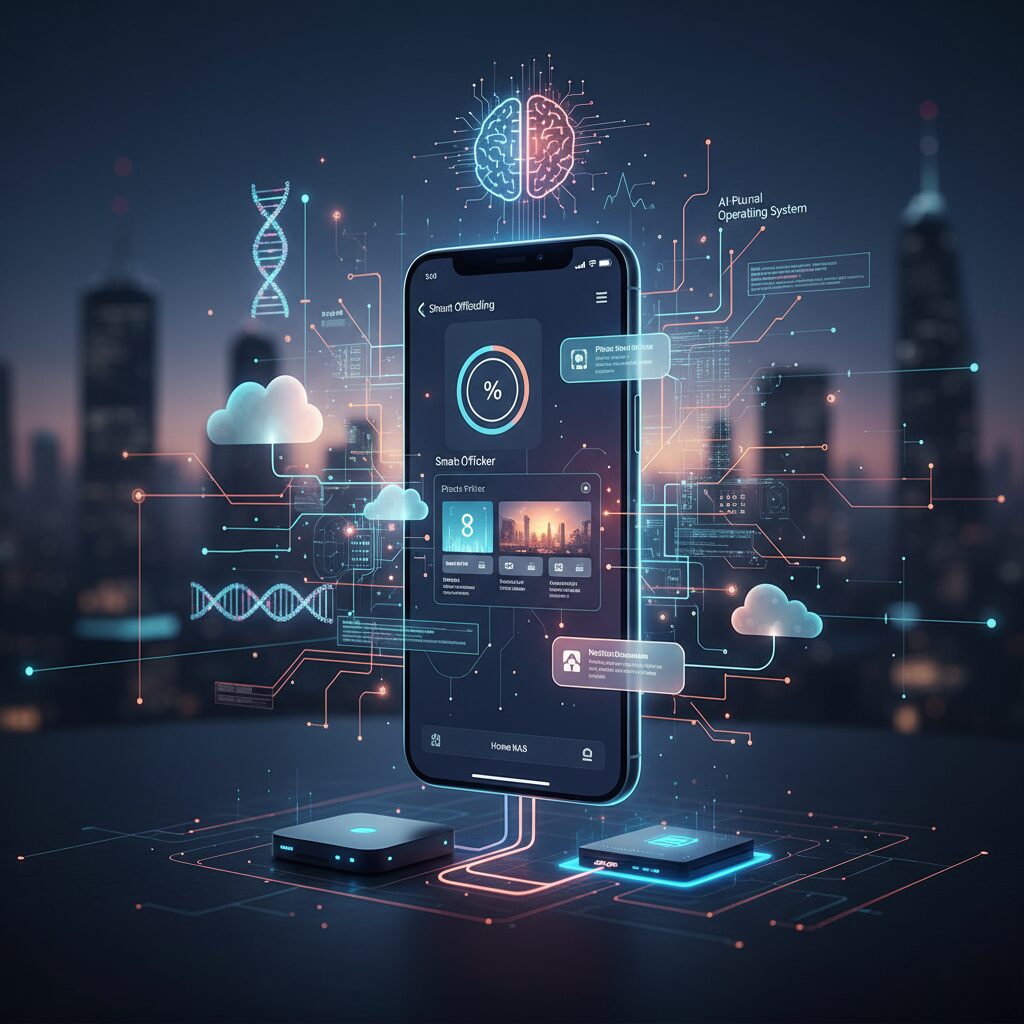
In 2026, the smartest way to save storage is no longer deleting files manually. It is letting AI decide what truly deserves to stay on your device. Notification Summaries, Smart Offloading, and Embedded Photo Pickers are practical OS-level features that quietly prevent gigabytes of unnecessary data from accumulating.
According to official Android feature documentation, Gemini-powered Notification Summaries analyze long message threads and extract only key points. Instead of keeping endless chat logs for quick reference, users can rely on structured summaries. This reduces the psychological need to archive everything, which indirectly limits the growth of text-heavy backups.
Apple Intelligence takes a similar approach by automatically prioritizing notifications based on context and importance. As multiple industry reports note, business users receive hundreds of notifications per day. AI-based sorting prevents redundant screenshots, forwarded messages, and duplicated attachments from becoming permanent storage residents.
Smart Offloading: AI as a Background Storage Manager
Android 16 introduces Smart Offloading through deeper Gemini integration and App Functions APIs. Instead of waiting for storage warnings, the system proactively identifies temporary files, duplicated media, and low-use assets inside apps.
These files are either deleted safely or moved to cloud tiers before the user even notices storage pressure. This shifts optimization from reactive cleanup to continuous background maintenance.
| Feature | What It Does | Storage Impact |
|---|---|---|
| Notification Summaries | Condenses long threads into key points | Reduces need to retain full logs |
| Smart Offloading | Removes or offloads unused app data | Prevents cache buildup |
| Embedded Photo Picker | Limits full library access by apps | Blocks redundant indexing files |
Industry storage analysts such as WWT emphasize that modern storage pressure comes from duplicated and transient data rather than core user files. Smart Offloading directly targets this invisible bloat.
Embedded Photo Pickers: Structural Waste Prevention
One of the most underrated upgrades is the Embedded Photo Picker. Traditionally, apps requested full photo library access, generating their own indexing caches and thumbnails. Each app effectively recreated partial copies of your media database.
The embedded system-level picker changes this model. Apps access only selected assets via a controlled interface. They no longer scan or mirror the entire gallery. This architectural shift eliminates structural duplication at the source.
For heavy social media users who install multiple editing and messaging apps, the difference can mean several gigabytes saved over time. Instead of cleaning storage repeatedly, the OS now prevents waste from being created in the first place.
In a 5G-saturated environment where high-resolution media grows exponentially, these practical AI features matter more than headline-grabbing compression breakthroughs. They operate quietly, continuously, and structurally, making them some of the most impactful storage-saving tools built directly into modern mobile operating systems.
App-Level Optimization: Managing Heavy Data from Messaging and Short-Video Platforms
For power users in Japan, the biggest storage drain in 2026 is no longer 4K camera footage but messaging and short-video platforms. LINE and TikTok continuously generate chat logs, media thumbnails, cached clips, and effect data that quietly accumulate in the background.
According to coverage by ITmedia Mobile, dissatisfaction with storage limits and cloud subscription costs remains persistent, even though awareness of backup importance exceeds 90 percent. This gap pushes users to rethink how app-level data should be handled before it reaches the cloud.
LINE is structurally complex. It stores text threads, compressed images, original media, voice messages, stickers, and cached previews. Many users assume deleting chats is the only solution, but that approach is both risky and inefficient.
Instead, a layered method is recommended in 2026. By combining LINE’s in-app “Delete Data” settings with PC-based archiving, users can externalize valuable media while removing expendable cache files.
| Data Type | Impact on Storage | Recommended Action |
|---|---|---|
| Cache Data | Can reach several GB | Delete regularly without affecting chat history |
| Photos/Videos | High long-term growth | Archive to PC/NAS before deletion |
| Voice Messages | Moderate but cumulative | Keep only essential records |
Specialized guides in 2026 emphasize that cache deletion alone can recover gigabytes instantly without erasing conversation history. This makes it the highest-ROI action for storage recovery.
TikTok presents a different challenge. Its algorithm preloads videos in the background to ensure seamless playback. As explained in detailed platform guides, cached videos, downloaded clips for offline viewing, and AR effect data all persist locally unless manually cleared.
The app now includes a dedicated “Free up space” section under Settings and Privacy, enabling selective clearing. Because TikTok’s storage growth is tied to viewing behavior, weekly maintenance prevents exponential buildup.
The key difference between LINE and TikTok optimization lies in data intent. LINE often contains irreplaceable personal archives. TikTok data is predominantly consumptive and temporary. Treating them identically leads to either unnecessary loss or unnecessary hoarding.
Advanced users increasingly integrate PC clients or AI-enabled NAS devices into this workflow. By exporting LINE media through desktop applications and synchronizing only curated folders to private storage, they reduce redundant cloud uploads and avoid subscription tier escalation.
In a 5G-saturated market where nearly all new devices are 5G-enabled, high-bandwidth usage accelerates content exchange and therefore data accumulation. Without app-level governance, OS-level AI optimization alone cannot fully control storage expansion.
Ultimately, managing heavy data from messaging and short-video platforms requires behavioral discipline supported by built-in tools. When transient cache is purged routinely and meaningful media is archived intentionally, backup size shrinks not by force, but by design.
From Public Cloud to Private AI NAS: The Strategic Shift Toward Hybrid Backup Architectures
For years, public cloud services such as iCloud and Google One have been the default destination for smartphone backups. However, as data volumes surge in the 5G era and subscription costs accumulate month after month, many power users are reconsidering that dependency. According to ITmedia Mobile, around 60% of cloud storage users are already on paid plans, yet dissatisfaction with pricing and capacity limits remains strong.
This tension is driving a strategic shift: from cloud-only backup models to hybrid architectures that combine public cloud with private AI-powered NAS.
Why Hybrid Is Becoming the Rational Choice
| Aspect | Public Cloud Only | Hybrid with AI NAS |
|---|---|---|
| Cost Structure | Recurring monthly fees | Upfront hardware + reduced subscription tier |
| Data Control | Provider-managed | User-controlled local primary copy |
| AI Processing | Often cloud-side | On-device / on-NAS AI filtering |
| Resilience | Dependent on provider policy | Distributed between local and cloud |
The hybrid approach does not reject the cloud. Instead, it redefines its role. Frequently accessed data, AI-processed media, and sensitive archives are first synchronized to a private NAS at home. Only selected, compressed, or deduplicated datasets are then pushed to the public cloud as a secondary layer.
At CES 2026, UGREEN introduced its NASync AI NAS lineup, positioning these devices not merely as storage boxes but as personal AI servers. Features such as AI Album and Smart File Organization automatically classify photos by faces, animals, scenes, and text—enabling natural-language search without sending raw data to external servers. This local intelligence changes the economics of backup.
Instead of uploading everything and paying to store redundancy, users can let the NAS decide what truly deserves long-term cloud retention.
Hardware evolution reinforces this shift. As WWT notes in its 2026 primary storage outlook, QLC SSDs are reaching capacities of 30TB, 60TB, and beyond, while NVMe architectures reduce latency and CPU overhead. Combined with Wi-Fi 7 and Thunderbolt 5 connectivity highlighted in recent tech digests, smartphone-to-NAS synchronization becomes nearly instantaneous, removing friction from local-first strategies.
Security and compliance also favor hybridization. Data privacy analysts such as Didomi and Schellman emphasize that 2026 marks deeper integration between AI governance and data protection frameworks. Keeping a primary encrypted copy on a private NAS simplifies consent management and limits exposure to third-party processing risks.
In practice, a modern workflow looks like this: the smartphone’s on-device AI filters low-value media, the AI NAS performs deduplication and advanced compression, and the public cloud stores only critical snapshots or disaster-recovery replicas. This layered design reduces recurring costs, lowers bandwidth usage, and mitigates single points of failure.
For gadget enthusiasts and tech-forward households, the move toward Private AI NAS represents more than storage optimization. It signals a structural rebalancing of power—where intelligence and ownership shift back to the edge, and the cloud becomes a strategic partner rather than the sole guardian of digital life.
QLC SSDs, NVMe, Thunderbolt 5, and Wi-Fi 7: The Infrastructure Powering Real-Time Backup
Real-time backup in 2026 is no longer limited by software intelligence alone. It is fundamentally enabled by breakthroughs in storage media and connectivity. QLC SSDs, NVMe protocols, Thunderbolt 5, and Wi-Fi 7 together form the infrastructure layer that makes continuous, invisible synchronization possible.
The shift from mechanical latency to flash-native architecture is what allows backups to happen in the background without disrupting daily smartphone use.
QLC SSDs: Capacity Without the Data Center Footprint
According to analysis from WWT and Infinidat, primary storage in 2026 is decisively moving away from HDD toward high-density QLC (Quad-Level Cell) flash. Enterprise-grade QLC drives are now shipping in 30TB, 60TB, and even 120TB capacities, dramatically increasing storage density per rack unit.
For personal AI NAS environments, this matters because higher density means fewer drives, lower power draw, and reduced cooling requirements. Compared with legacy HDD arrays, QLC-based systems offer significantly better power efficiency per terabyte, which directly impacts the long-term cost of always-on backup nodes.
NVMe and NVMe-oF: Eliminating Protocol Bottlenecks
The transition from SCSI-based stacks to NVMe (Non-Volatile Memory Express) reduces CPU overhead and unlocks parallelism optimized for flash memory. Industry reporting highlights that NVMe significantly lowers latency compared to traditional storage protocols, especially under mixed workloads.
When extended over fabric (NVMe-oF), this architecture allows remote storage to behave almost like a local drive. For smartphone backup workflows, this translates into near-instant metadata indexing and chunk-level deduplication, even when files are streamed over high-speed local networks.
Thunderbolt 5 and Wi-Fi 7: Bandwidth That Matches Flash Speed
Connectivity is the other half of the equation. Thunderbolt 5 dramatically increases available throughput compared to previous generations, allowing external NVMe enclosures or AI NAS units to ingest large 4K or 8K video libraries in minutes rather than hours. Tech infrastructure briefings in 2026 consistently point to Thunderbolt 5 as a turning point for creator-grade backup workflows.
Meanwhile, Wi-Fi 7 introduces wider channels and higher theoretical throughput than Wi-Fi 6/6E, with reduced latency under congestion. This is critical for always-on smartphone backup, where incremental photo uploads and neural-compressed media files must sync continuously without noticeable lag.
| Technology | Primary Benefit | Impact on Real-Time Backup |
|---|---|---|
| QLC SSD | High density, lower power per TB | Large local archives with reduced operating cost |
| NVMe / NVMe-oF | Low latency, parallel I/O | Faster indexing, deduplication, snapshot creation |
| Thunderbolt 5 | Ultra-high wired throughput | Rapid bulk transfer from smartphone or PC |
| Wi-Fi 7 | Higher wireless bandwidth, lower latency | Seamless background synchronization |
Industry outlooks from TrendForce and storage vendors emphasize that AI workloads are increasing infrastructure pressure year over year. Real-time backup is part of that load. Without flash-native protocols and next-generation connectivity, continuous protection would either drain batteries or overwhelm home networks.
In 2026, infrastructure is no longer the bottleneck—it is the enabler. Smartphones can capture higher-resolution media because storage backends and network fabrics are finally fast enough to absorb that data instantly. The result is a backup experience that feels less like a scheduled task and more like a permanent, invisible safety net.
Neural Image Compression vs. WebP, AVIF, and JPEG XL: What the Data Really Shows
When we compare neural image compression with WebP, AVIF, and JPEG XL, the discussion often becomes emotional. However, the real picture emerges only when we look at peer‑reviewed data and standardized benchmarks rather than marketing claims.
According to the TinyPNG technical guide on modern formats, WebP typically reduces file size by around 30% compared to legacy JPEG, while AVIF achieves roughly 40–50% savings thanks to its AV1 foundation. JPEG XL goes further, delivering about 60% reduction and supporting lossless JPEG recompression.
| Format | Estimated Size Reduction vs JPEG | Key Strength |
|---|---|---|
| WebP | ~30% | Broad compatibility |
| AVIF | 40–50% | High compression + HDR |
| JPEG XL | ~60% | Lossless JPEG transcoding |
| Neural Compression | 70–85% | Semantic optimization |
On paper, neural compression appears to dominate. Research presented at ICCV 2025 on Extreme Compression of Adaptive Neural Images reports reductions down to one‑eighth of original size in controlled settings. That translates to an efficiency improvement approaching 800% under specific conditions.
However, nuance matters. An analysis highlighted by researchers discussing large‑scale image evaluation shows that neural compression’s advantage shrinks as image resolution increases. At 32×32 pixels, neural methods outperformed WebP by nearly 29%, but at practical photo resolutions above 1000 pixels, the margin dropped to roughly 5–6%.
Neural compression is not universally superior; its edge depends heavily on resolution, content complexity, and bitrate constraints.
This happens because neural codecs allocate bits semantically. Faces, text, and textured regions are prioritized, while flat backgrounds are aggressively simplified. In high‑resolution photography, traditional codecs like AVIF and JPEG XL already exploit spatial redundancy efficiently, narrowing the gap.
Another overlooked factor is computational cost. Neural methods require model inference during encoding and often during decoding. In AI‑accelerated environments this may be acceptable, but on low‑power devices, AVIF or JPEG XL can offer a better performance‑to‑compression balance.
JPEG XL also offers a strategic advantage for large ecosystems: it can convert existing JPEG libraries losslessly into a more efficient container. For organizations managing petabytes of legacy assets, this interoperability can outweigh marginal gains from neural approaches.
The emerging best practice in 2026 is hybridization. Systems scan an image, apply neural compression to semantically important regions, and rely on AVIF or JPEG XL for homogeneous areas. This layered strategy captures most of the theoretical gains while controlling compute overhead.
In short, the data shows that neural image compression represents a breakthrough, especially at extreme bitrates and controlled scenarios. Yet for real‑world, high‑resolution photography at scale, AVIF and JPEG XL remain formidable competitors, delivering predictable efficiency with lower operational complexity.
The future is not a single winner, but intelligent orchestration between neural and conventional codecs.
Deduplication, Homomorphic Encryption, and Immutable Snapshots: Security Meets Efficiency
As backup volumes explode in the 5G and AI era, efficiency alone is no longer enough. Users demand both minimal storage consumption and uncompromising security. In 2026, the convergence of deduplication, homomorphic encryption, and immutable snapshots is redefining how smartphone data is protected without inflating costs.
The core challenge is simple but profound: how do you eliminate redundancy while preserving privacy? Traditional storage systems solved only half of this equation.
Deduplication: Eliminating Redundancy at Scale
Data deduplication works by storing a single instance of identical data blocks and replacing duplicates with references. According to Cohesity’s technical documentation, this block-level strategy can dramatically reduce backup footprints in environments where similar files are repeatedly generated.
In smartphone ecosystems, redundancy is common. Burst photos, forwarded media files, app reinstall packages, and repeated video exports often contain identical binary segments. AI-powered NAS systems in 2026 analyze data fingerprints before writing them to QLC SSD arrays, preventing unnecessary duplication.
However, classic deduplication assumes visibility into raw data. Once end-to-end encryption is applied with unique user keys, identical files appear mathematically different. This tension between privacy and efficiency has historically limited cross-user deduplication.
| Technique | Storage Efficiency | Privacy Impact |
|---|---|---|
| Traditional Deduplication | High (block-level savings) | Requires plaintext visibility |
| Client-side Encryption | Low (no cross-user dedupe) | Strong user isolation |
| Homomorphic Encryption | Moderate to High | Encrypted processing possible |
Homomorphic Encryption: Processing Without Decrypting
Homomorphic encryption enables computation on encrypted data without exposing its contents. As highlighted in 2026 data privacy analyses, this approach allows storage systems to perform operations such as duplicate detection while maintaining cryptographic protection.
In practice, systems apply cryptographic hashing combined with secure multi-party computation techniques so that duplicate segments can be identified mathematically rather than visually. No raw image, message, or document needs to be decrypted in a shared environment.
This architectural shift reconciles two previously conflicting goals: aggressive storage optimization and strict regulatory compliance. With GDPR-aligned consent requirements and expanding AI governance frameworks, encrypted processing is becoming essential rather than optional.
Immutable Snapshots: Ransomware-Resilient Backups
Efficiency and encryption are insufficient if backups themselves can be altered. Immutable snapshots address this vulnerability by creating write-once, tamper-resistant restore points. According to enterprise storage trend reports in 2026, immutable architectures are increasingly standard in modern backup systems.
When smartphone data synchronizes to AI-enabled NAS or cloud infrastructure, snapshot versions are locked for defined retention periods. Even if ransomware encrypts active files, the snapshot remains untouched. Restoration does not depend on negotiation or decryption keys from attackers.
This approach is particularly relevant as AI workloads and always-connected devices expand the attack surface. By combining deduplication at the block level, encrypted duplicate detection, and snapshot immutability, storage systems achieve three simultaneous outcomes: reduced capacity usage, preserved confidentiality, and guaranteed recoverability.
For gadget enthusiasts managing terabytes of 4K video, RAW photography, and AI-generated content, this triad is transformative. It means lower subscription tiers, faster restores over Wi-Fi 7 or Thunderbolt 5, and resilience against increasingly sophisticated threats.
Security and efficiency are no longer trade-offs. In modern backup architecture, they reinforce each other.
DNA Storage and DePIN: Are We Entering the Post-Cloud Era?
For more than a decade, “the cloud” has been the default answer to every storage problem. Yet in 2026, two radically different paradigms—DNA storage and DePIN (Decentralized Physical Infrastructure Networks)—are challenging that assumption and quietly redefining what a post-cloud era could look like.
Instead of asking how much cloud capacity we can rent, the conversation is shifting toward how permanently, how efficiently, and how autonomously we can preserve data.
DNA Storage: Archiving at Molecular Scale
DNA storage encodes digital information into sequences of A, T, C, and G. According to research highlighted in Nature and industry analyses in 2025, experimental systems have demonstrated storage densities capable of preserving 36 petabytes in an extremely small physical volume, with a theoretical upper bound of 455 exabytes per gram.
This density fundamentally exceeds magnetic tape and flash memory. More importantly, properly preserved DNA can remain stable for centuries or even millennia, eliminating the recurring migration cycles that plague traditional cold storage systems.
| Medium | Longevity | Density Potential |
|---|---|---|
| Magnetic Tape | Decades (with migration) | High |
| Flash (QLC SSD) | Years–Decades | Very High |
| DNA Storage | Centuries+ | Ultra-High (Theoretical 455 EB/g) |
For enterprises managing immutable archives—legal records, genomic databases, blockchain snapshots—DNA offers something the cloud cannot: near-zero ongoing energy consumption once written. In a world where AI workloads are pushing data center power demand to new extremes, as multiple infrastructure reports in 2026 indicate, that characteristic is not just technical—it is economic and environmental.
DePIN: From Centralized Cloud to Distributed Ownership
While DNA storage reimagines the medium, DePIN reimagines the infrastructure. Instead of hyperscale data centers owned by a few corporations, DePIN networks aggregate surplus storage and connectivity from individuals worldwide.
Industry forecasts in 2026 estimate the broader DePIN sector reaching multi-trillion-dollar scale, with projects onboarding millions of nodes. In these systems, smartphone backups or archival data are encrypted, fragmented, and distributed across geographically dispersed participants.
No single point of failure. No single provider lock-in. That architectural shift alone challenges the psychological dominance of the cloud.
For users, the implications are profound. A future backup workflow could look like this: frequently accessed data synchronized to a local AI NAS, long-term archives encoded into DNA-based vaults, and redundant encrypted shards distributed across a DePIN network. The “cloud” becomes just one layer among many—not the center of gravity.
Regulatory trends reinforce this direction. As global privacy frameworks tighten consent and transparency requirements, distributed and user-controlled storage architectures become strategically attractive. Data sovereignty is easier to defend when infrastructure itself is decentralized.
Of course, DNA storage is not yet consumer-ready, and DePIN models still face scalability and governance challenges. But together, they signal a structural transition: from renting space in someone else’s server farm to architecting a layered, resilient, and ownership-driven data future.
If the cloud defined the 2010s and early 2020s, then DNA and DePIN may define what comes next—a world where permanence and decentralization are no longer trade-offs, but design principles.
Energy Efficiency and “Tokens per Watt”: The Hidden Cost of AI-Driven Data Management
As AI-driven data management becomes standard in smartphones, NAS devices, and cloud platforms, a new metric is quietly reshaping infrastructure decisions: “tokens per watt.” This indicator measures how many AI tokens can be processed or generated per unit of electrical power. In practical terms, it connects your photo backup, compression, and indexing directly to energy consumption.
According to DDN, AI workloads are projected to grow by 110% within a year, yet 65% of organizations report struggling to achieve meaningful AI ROI. One major reason is power efficiency. The more intelligent your backup pipeline becomes, the more compute cycles—and electricity—it consumes.
This creates a hidden cost layer beneath seemingly “smart” storage optimization.
| Factor | Impact on Energy | Implication for Backup |
|---|---|---|
| Neural compression | High GPU usage | Smaller files, higher compute cost |
| Real-time AI indexing | Continuous processing | Faster search, constant power draw |
| Deduplication + encryption | Additional cryptographic load | Privacy with energy trade-offs |
In traditional storage systems, capacity and latency were the dominant metrics. In 2026, energy per inference is equally critical. Infinidat’s analysis of storage trends highlights how data centers are under pressure to curb power growth while AI accelerates. Every background classification of a photo, every semantic scan of a document, consumes measurable wattage.
For smartphone users, this may seem abstract. However, when Apple Intelligence filters thousands of images on-device or Android’s Gemini summarizes long chat histories, the device’s neural engine activates repeatedly. On-device AI reduces cloud transmission energy, but it shifts the load to local silicon.
The equation becomes more complex in cloud environments.
TrendForce notes that AI infrastructure is reshaping the global technology landscape in 2026, with GPU clusters becoming central assets. These clusters require not only processors but advanced cooling. DDN reports that optimized AI infrastructure can reduce cooling costs by up to 70%, directly improving tokens per watt efficiency.
Efficiency is no longer just about smaller files—it is about computational discipline.
Consider neural image compression. Research presented at ICCV 2025 demonstrates compression ratios of up to 70–85% compared to JPEG under certain conditions. Yet larger images reduce the relative advantage, meaning compute intensity does not always scale proportionally with savings. If a model consumes significant GPU time for marginal gains, tokens per watt drops.
This introduces a strategic trade-off for AI-driven backup systems:
Should data be aggressively compressed using neural models, or moderately optimized using formats like AVIF or JPEG XL that require less computational overhead?
The most advanced systems now adopt hybrid pipelines, reserving heavy AI models for semantically critical regions while applying lighter codecs elsewhere. This approach maximizes compression benefit while preserving tokens per watt efficiency.
Energy efficiency also intersects with privacy. Homomorphic encryption and secure multi-party computation enable deduplication without exposing raw data, but they introduce additional processing layers. According to emerging privacy trend analyses for 2026, compliance and AI governance requirements are increasing compute demand across the stack.
For power users investing in AI NAS devices, this means examining not just terabytes and transfer speeds, but silicon efficiency, cooling design, and workload orchestration. Thunderbolt 5 and Wi-Fi 7 accelerate data movement, yet faster throughput can amplify compute bursts if not carefully scheduled.
Ultimately, tokens per watt becomes the invisible KPI behind sustainable AI storage. The smarter your backup becomes, the more crucial it is that each watt produces maximum semantic value. In a world where AI manages everything from photo curation to distributed storage indexing, energy efficiency defines whether intelligent data management scales responsibly—or becomes an unsustainable luxury.
Designing a Four-Layer Backup Roadmap for 2026 and Beyond
Designing a four-layer backup roadmap for 2026 and beyond requires more than simply choosing a cloud plan. In a market where nearly 99.9% of newly shipped smartphones are 5G-ready and capable of generating massive 4K and AI-created content, backup must be architected as a structured, value-driven pipeline.
According to MM Research Institute, device shipments in Japan have rebounded strongly, accelerating replacement cycles. This means more data migration events, more duplication, and more risk unless backup is intentionally layered.
The core principle for 2026 is simple: filter early, compress intelligently, store strategically, and preserve immutably.
| Layer | Primary Role | Key Technologies |
|---|---|---|
| Layer 1 | On-device filtering | Apple Intelligence, Gemini |
| Layer 2 | App-level reduction | Cache controls, structured exports |
| Layer 3 | Private AI storage | AI NAS, QLC SSD, NVMe |
| Layer 4 | Long-term resilience | DePIN, Immutable snapshots |
Layer 1 begins at the moment of creation. Modern OS environments such as Android 16 with Gemini and Apple Intelligence evaluate image quality, duplicate shots, and contextual importance before data even reaches the cloud. By excluding blurred photos or redundant screenshots at capture time, you prevent exponential storage growth.
This is not cosmetic optimization. Research presented at ICCV 2025 on adaptive neural compression shows that early semantic filtering dramatically improves downstream compression efficiency.
Layer 2 targets high-volume applications. Messaging and short-video platforms accumulate gigabytes of cache and temporary media. Structured PC exports, selective deletion of cached assets, and limiting local downloads create predictable storage behavior instead of chaotic growth.
Layer 3 shifts control to a private AI NAS. Devices such as AI-enabled NAS systems introduced at CES 2026 integrate neural compression, deduplication, and automated categorization. With QLC SSD capacities scaling toward 30TB and beyond, and NVMe drastically reducing latency, home infrastructure now rivals small enterprise setups.
This layer reduces recurring cloud subscription pressure while maintaining performance. It also allows local AI processing, reducing dependence on external data centers whose AI workloads, according to DDN, are projected to grow over 100% year over year.
Layer 4 addresses permanence. Immutable snapshots defend against ransomware, while distributed infrastructure models such as DePIN eliminate single points of failure. For archival-grade data, emerging DNA storage research published in Nature demonstrates unprecedented density and durability, signaling where cold storage may evolve next.
What makes this roadmap future-proof is its adaptability. Compression formats can evolve from JPEG XL to neural hybrids. Storage media can migrate from SSD to post-silicon solutions. Yet the layered logic remains stable.
In 2026 and beyond, backup is no longer a destination. It is a staged decision framework that continuously evaluates data value, energy cost, privacy exposure, and long-term relevance.
When designed deliberately across four layers, your smartphone ecosystem transforms from reactive storage expansion into intelligent digital asset management.
参考文献
- MM Research Institute (MM総研):スマートフォン出荷台数が3年ぶりに3000万台規模に回復
- ITmedia Mobile:携帯調査リポート
- Android Authority:Android 16: Confirmed features, codename, leaks, release date, and everything else we know so far
- UGREEN:UGREEN Debuts New Smart Ecosystem at CES 2026, Led by AI NAS
- TinyPNG Blog:The Ultimate Guide to Image Compression in 2025
- CVF Open Access (ICCV 2025 Workshop):Extreme Compression of Adaptive Neural Images
- Infinidat:Storage Trends for 2026
- Binance Square / BlockchainReporter:Top 6 DePIN Projects Transforming Physical Infrastructure in 2026