Have you ever unboxed a new flagship smartphone, admired its stunning display, and immediately wondered whether you should cover it with a screen protector?
If you are considering the Galaxy S25 Ultra, this familiar dilemma has become far more complex than before. Samsung and Corning have fundamentally changed the rules of smartphone displays with Gorilla Armor 2, a glass ceramic that dramatically reduces reflections and improves outdoor visibility.
Many users assume that adding a third-party screen protector is a harmless, even responsible choice. However, with the Galaxy S25 Ultra, that assumption can lead to a noticeable downgrade in image quality, fingerprint recognition, and overall user experience.
In this article, you will discover how the S25 Ultra’s display technology works, why common glass and matte films interfere with it, and what real-world tests and user reports reveal about these trade-offs.
By understanding the science behind reflections, materials, and ultrasonic fingerprint sensors, you can make an informed decision that matches your priorities, whether that is visual purity, durability, or peace of mind.
This guide is designed to help gadget enthusiasts choose wisely and enjoy the Galaxy S25 Ultra exactly as it was engineered to be experienced.
- The Display Revolution Behind Galaxy S25 Ultra
- What Makes Corning Gorilla Armor 2 Different
- Why Reflection Reduction Matters More Than Brightness
- How Glass Screen Protectors Reintroduce Glare
- Anti-Glare vs Anti-Reflection: A Critical Distinction
- Ultrasonic Fingerprint Sensors and Film Compatibility
- S Pen Performance and Surface Friction Explained
- Insights from the Japanese Screen Protector Market
- Health Considerations: Eye Strain and Display Reflections
- Choosing the Right Protection Strategy for Your Use Case
- 参考文献
The Display Revolution Behind Galaxy S25 Ultra
The Galaxy S25 Ultra introduces a decisive shift in how smartphone displays evolve, and the heart of that change lies in its surface rather than its pixels. **Corning Gorilla Armor 2 is not just a tougher cover glass, but an optical technology designed to fundamentally reduce reflection**, addressing a limitation that higher brightness alone could never solve. According to Corning and Samsung’s joint announcement, this glass ceramic reduces surface reflections by up to 75 percent compared with conventional cover glass, dramatically improving perceived contrast in bright environments.
From a materials science perspective, Gorilla Armor 2 departs from traditional aluminosilicate glass by adopting a glass-ceramic structure. This allows microscopic crystals to form within the glass, increasing both hardness and fracture resistance while maintaining transparency. Corning explains that this structure is particularly effective at suppressing micro-crack propagation on rough surfaces such as concrete, a real-world scenario often cited in durability testing.
| Feature | Conventional Cover Glass | Gorilla Armor 2 |
|---|---|---|
| Surface reflection | Approx. 8% | Below 1% |
| Material type | Aluminosilicate glass | Glass ceramic |
| Outdoor contrast | Light washout | Significantly preserved |
The optical breakthrough comes from advanced anti-reflective treatment at the nanometer scale. By leveraging destructive interference, incoming ambient light is canceled before it reaches the user’s eyes, a principle long used in high-end camera lenses and prescription eyewear. The result is striking: even with the display turned off, the panel appears unusually dark, and when active, content seems to float above the surface.
This low-reflection foundation also amplifies Samsung’s AI-driven ProScaler technology. Fine textures generated by AI upscaling retain their clarity because **there is minimal surface scatter degrading the image before it reaches the retina**. Industry observers have noted that this synergy between hardware optics and software processing represents one of the most holistic display designs seen in mobile devices to date.
It is also crucial to note that this display revolution is exclusive to the Ultra model. While the standard S25 and S25+ rely on Gorilla Glass Victus 2, only the S25 Ultra delivers this anti-reflective glass ceramic. This distinction explains why the Ultra’s screen experience feels categorically different, not incrementally better, marking a genuine turning point in smartphone display philosophy.
What Makes Corning Gorilla Armor 2 Different
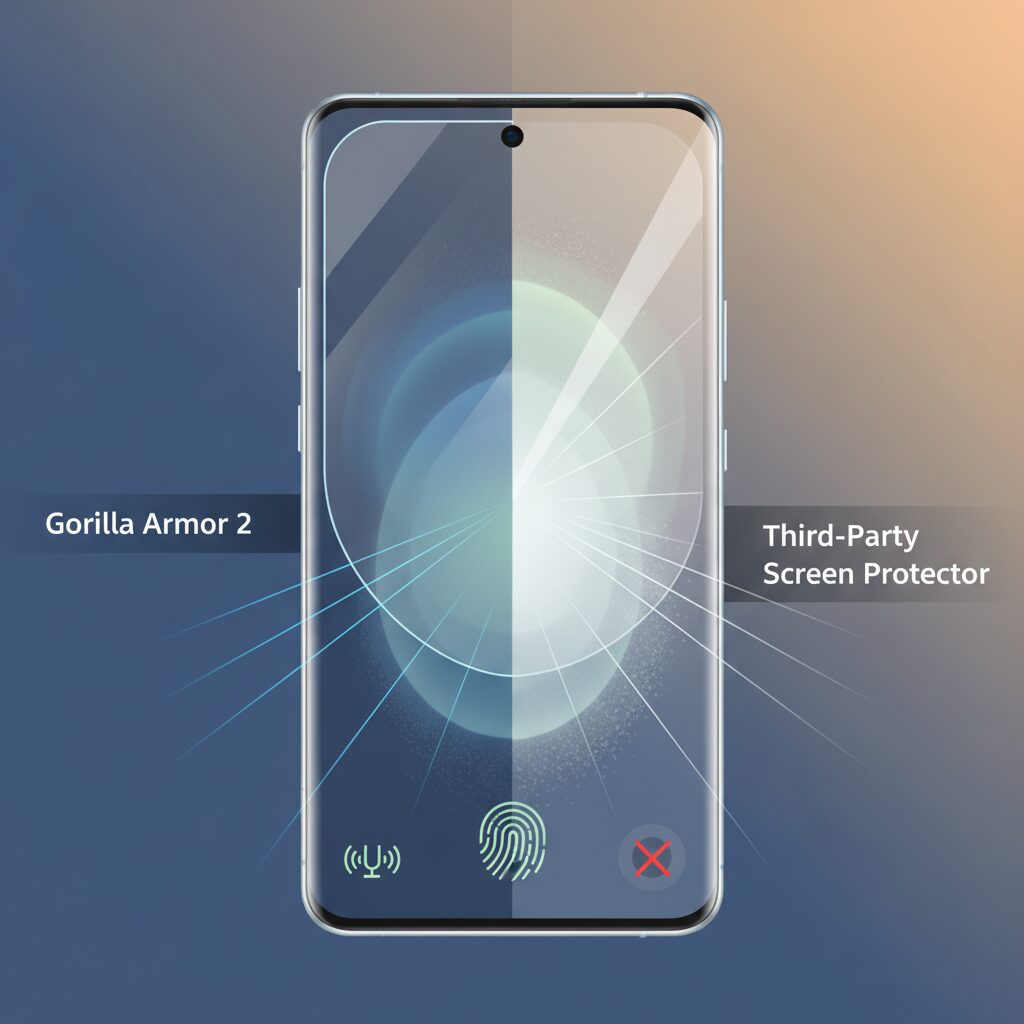
Corning Gorilla Armor 2 stands apart not because it simply improves existing smartphone glass, but because it redefines what the surface of a mobile display is expected to do. Instead of focusing only on hardness or scratch resistance, this material is engineered around optical performance, durability, and real-world usability, and it does so at the material science level rather than through add-on coatings.
At its core, Gorilla Armor 2 is a glass-ceramic rather than a conventional aluminosilicate glass. According to Corning and Samsung disclosures, this means microscopic crystalline structures are intentionally formed within the glass matrix. **These crystals interrupt crack propagation**, making the material more resistant to catastrophic failure when dropped onto rough surfaces such as asphalt or concrete.
This is not a marginal tweak. Corning has stated that Armor 2 shows improved survivability compared with the first-generation Armor used on the Galaxy S24 Ultra, particularly in uncontrolled outdoor drop scenarios, which are statistically the most common causes of screen breakage in consumer devices.
| Aspect | Conventional Cover Glass | Gorilla Armor 2 |
|---|---|---|
| Base material | Aluminosilicate glass | Glass-ceramic |
| Surface reflection | Approx. 8% total | Less than 1% |
| Drop resistance focus | Smooth surfaces | Rough outdoor surfaces |
What truly differentiates Gorilla Armor 2, however, is its optical behavior. Traditional smartphone displays have long relied on increasing brightness to fight glare, yet physics limits how effective that approach can be. Gorilla Armor 2 addresses the problem at the interface itself by suppressing reflections before they ever reach the user’s eyes.
Using advanced surface treatments and interference-based anti-reflection technology, the glass reduces reflected ambient light by up to 75 percent compared with standard cover glass. **This is not glare diffusion but reflection cancellation**, similar in principle to what is used on high-end camera lenses and medical optics.
As Samsung explains in its technical briefings, the result is a display that appears almost ink-black when powered off and retains contrast even under harsh sunlight. This directly increases perceived contrast ratio without increasing power consumption, which is a rare efficiency gain in mobile hardware.
Another overlooked difference is consistency. Coatings applied on top of glass tend to wear unevenly over time, especially around frequently touched areas. Gorilla Armor 2 integrates its optical properties into the surface structure, meaning the low-reflection behavior remains stable even after prolonged daily use, according to Corning’s durability testing methodology.
From a user-experience perspective, this has measurable implications. Eye-care organizations such as the American Optometric Association have repeatedly noted that surface glare contributes to digital eye strain. By reducing mirror-like reflections at the source, Gorilla Armor 2 functions not only as a premium display material but also as a form of visual ergonomics.
In short, Gorilla Armor 2 is different because it treats the smartphone display as an optical instrument rather than a passive window. **It combines material strength, reflection physics, and human visual comfort into a single integrated solution**, which is why its benefits are immediately noticeable the moment the screen is used outdoors or under strong indoor lighting.
Why Reflection Reduction Matters More Than Brightness
For more than a decade, smartphone display innovation has been framed as a race for higher brightness. Peak luminance figures exceeding 2,000 or even 3,000 nits dominate spec sheets and marketing headlines. However, **human visual perception does not evaluate brightness in isolation**. What ultimately determines legibility, contrast, and comfort is the balance between emitted light and reflected ambient light. In this context, reflection reduction has become more impactful than simply pushing brightness higher.
From an optical physics standpoint, conventional cover glass reflects roughly 8 percent of incident light when accounting for both front and rear surfaces. Under strong ambient illumination, such as outdoor sunlight or office lighting, this reflected light directly overlays displayed content, lifting black levels and collapsing contrast. According to Corning’s disclosures on Gorilla Armor 2, surface reflectance can be reduced by up to 75 percent compared to traditional glass, bringing total reflectance close to or below 1 percent. **This reduction changes the effective contrast ratio far more than an incremental brightness increase ever could**.
| Display Strategy | Ambient Light Reflection | Perceived Contrast in Sunlight |
|---|---|---|
| High brightness, standard glass | High (approx. 8%) | Moderate to low |
| Moderate brightness, low-reflection glass | Very low (around 1%) | High |
This distinction is especially relevant for OLED panels. OLED black is theoretically perfect, but reflected light turns that black into gray. Independent demonstrations comparing Galaxy Ultra models with and without reflective glass layers consistently show that **a low-reflection surface preserves shadow detail and color saturation even before brightness compensation is applied**. Samsung and Corning’s shift away from the traditional brightness arms race reflects a recognition of this physical ceiling.
There is also a physiological dimension. Research summarized by the American Optometric Association and peer‑reviewed studies indexed by the NIH indicate that surface glare is a major contributor to digital eye strain. When reflections are present, the eye repeatedly refocuses between the screen content and reflected images of the environment. **Lowering reflectance reduces accommodative stress and cognitive load**, producing a more relaxed viewing experience over long sessions. Increasing brightness alone does not solve this problem and may even worsen fatigue in dim environments.
Another often overlooked factor is power efficiency. Driving higher brightness requires exponentially more energy, particularly on OLED displays. Reflection reduction, by contrast, improves visibility without increasing power draw. In real-world use, this means clearer outdoor readability without the thermal and battery penalties associated with sustained peak brightness. Engineers involved in display calibration frequently note that lowering reflectance effectively “amplifies” usable brightness without touching the backplane.
Ultimately, reflection reduction addresses the environment in which smartphones are actually used, not laboratory conditions. Sunlight, overhead LEDs, and train interiors all introduce uncontrolled light sources. **By minimizing what the screen reflects rather than endlessly boosting what it emits, modern display design aligns more closely with human vision and everyday usage**. This is why reflection reduction now matters more than brightness, both scientifically and experientially.
How Glass Screen Protectors Reintroduce Glare
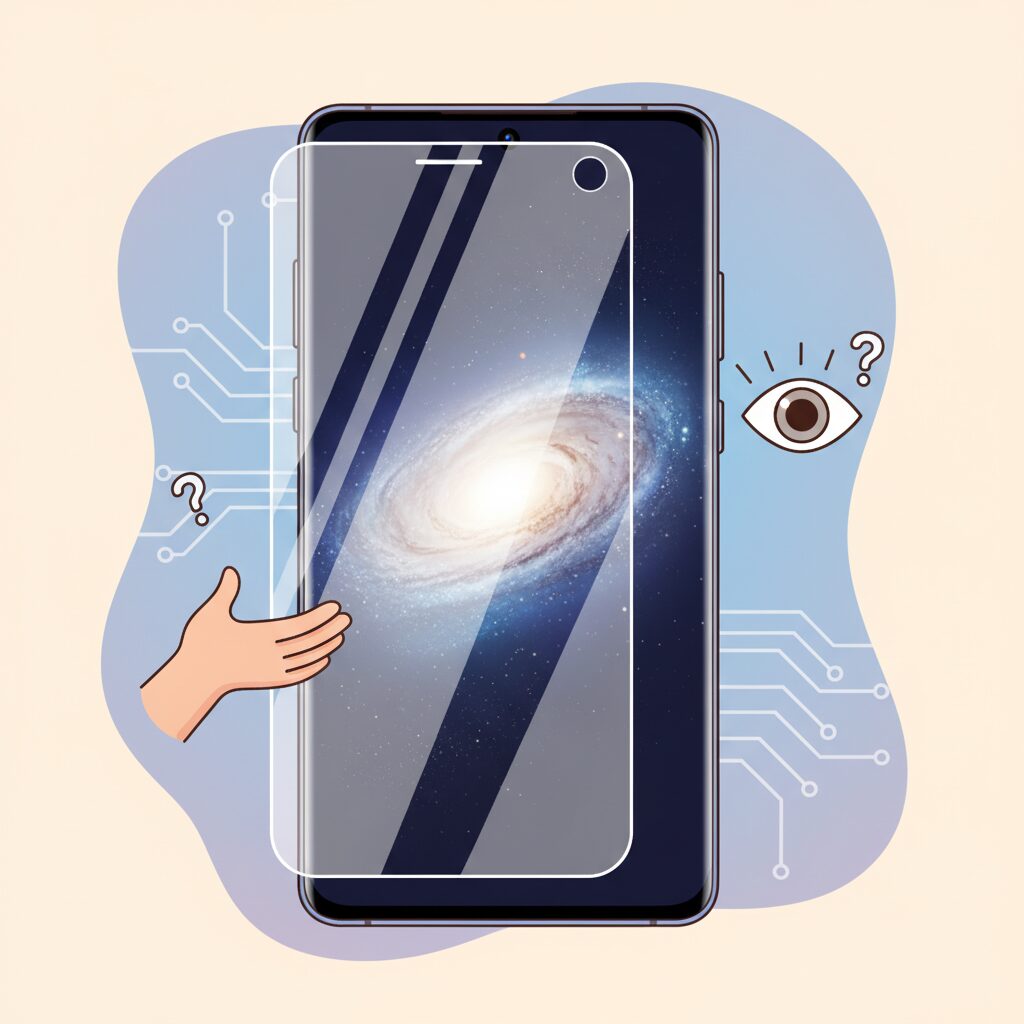
One of the most overlooked trade-offs of applying a tempered glass screen protector is the way it quietly brings glare back to a display that was engineered to eliminate it. Galaxy S25 Ultra’s Gorilla Armor 2 reduces surface reflections by up to 75% compared with conventional cover glass, according to Corning. This reduction is not cosmetic but optical, achieved through precise control of interface reflections. When a third-party glass protector is added, that carefully balanced system is fundamentally altered.
The core issue is simple physics. A typical tempered glass protector has a refractive index close to standard aluminosilicate glass and lacks a true multi-layer anti-reflective coating. The moment it is exposed to air, the air-to-glass boundary reflects roughly 4% of incoming light. This single interface already exceeds the sub-1% reflectance achieved by Gorilla Armor 2, effectively resetting the display’s reflection performance to that of an ordinary smartphone.
This effect becomes especially visible in high-contrast scenarios. Dark UI themes, HDR video, and cinematic content rely on deep blacks to preserve perceived contrast. Users often report that blacks turn gray and facial reflections reappear under indoor lighting once a glass protector is applied. These observations align with Fresnel reflection theory rather than subjective preference.
| Display Surface | Primary Reflective Interface | Typical Reflectance |
|---|---|---|
| Gorilla Armor 2 (bare) | Engineered AR-treated glass-air boundary | Below 1% |
| With tempered glass protector | Standard glass-air boundary | Approximately 4% |
Stacking glass on glass does not average performance; it compounds reflections. Beyond the outer surface, additional micro-reflections occur at the adhesive layer between the protector and the display. Even when optically clear OCA adhesives are used, small mismatches in refractive index create secondary reflections and light scattering. The cumulative result is a perceptible veil of glare, especially noticeable under office lighting or sunlight.
Research in visual ergonomics supports why this matters. The American Optometric Association notes that reflected glare forces the eye to constantly refocus between on-screen content and reflected images, increasing accommodative stress. Gorilla Armor 2 mitigates this by suppressing reflections at the source. A glass protector, however durable, reintroduces the very condition the material was designed to prevent.
Some manufacturers market “anti-glare glass” protectors, but most rely on surface etching or matte finishes rather than interference-based anti-reflection coatings. These approaches diffuse reflections instead of canceling them, reducing mirror-like glare while simultaneously lowering contrast and sharpness. On a high-ppi OLED panel like the S25 Ultra, this diffusion can manifest as a subtle haze that undermines image precision.
The paradox is clear. Tempered glass protectors excel at impact resistance, yet from an optical standpoint they downgrade one of the S25 Ultra’s defining advantages. What users perceive as increased glare is not a flaw of the display, but the predictable consequence of adding an untreated reflective layer. Understanding this mechanism allows users to make an informed decision between physical protection and preserving the display’s native, low-reflection performance.
Anti-Glare vs Anti-Reflection: A Critical Distinction
Anti-Glare and Anti-Reflection are often treated as interchangeable marketing terms, but in optical engineering they represent fundamentally different philosophies. Understanding this distinction is especially critical for devices like the Galaxy S25 Ultra, where the native display already integrates advanced reflection control at the material level.
Anti-Reflection works by canceling light, while Anti-Glare works by scattering it. This single sentence captures why choosing the wrong solution can silently undermine a flagship display that was designed to solve reflections at their root.
Anti-Reflection, commonly abbreviated as AR, relies on thin-film interference. By stacking nanometer-scale layers with carefully controlled refractive indices, reflected light waves destructively interfere with each other and effectively disappear. Corning’s Gorilla Armor 2 follows this principle, achieving a surface reflectance of under 1%, a figure that Corning itself positions as up to 75% lower than conventional cover glass.
Anti-Glare, or AG, takes a very different approach. Instead of eliminating reflections, it roughens the surface at a microscopic level so incoming light is diffused in many directions. The mirror-like reflection is reduced, but the total reflected light remains. The result is a uniformly hazy overlay that lifts black levels and softens fine detail.
| Aspect | Anti-Reflection (AR) | Anti-Glare (AG) |
|---|---|---|
| Optical principle | Thin-film interference | Surface diffusion |
| Effect on contrast | Preserved or improved | Reduced |
| Image sharpness | Maintained | Slightly blurred |
| Typical examples | Camera lenses, premium eyeglasses | Matte screen protectors |
This difference has measurable consequences. Optical studies referenced in display engineering literature show that diffusion-based anti-glare surfaces can reduce perceived contrast by more than 10–20% under bright ambient light, even when peak brightness remains unchanged. For OLED panels, where black depth defines image quality, this loss is immediately visible as grayish shadows.
The Galaxy S25 Ultra amplifies this effect because of its pixel density exceeding 500 ppi. When an AG film is applied, the micro-textured surface interferes with the regular pixel grid, producing the so-called sparkle effect. Materials science analyses from Japanese coating specialists explain that this phenomenon is not a defect but a structural inevitability whenever diffusion particles approach the scale of individual pixels.
By contrast, AR coatings scale gracefully with resolution. This is why high-end camera lenses from manufacturers like Zeiss or Nikon, and ophthalmic lenses recommended by the American Optometric Association, universally favor AR over AG. The goal is not to hide reflections, but to prevent them from forming in the first place.
For a display that already incorporates native AR technology, adding an AG layer is not a complement but a contradiction. It reintroduces optical noise that the original glass ceramic was engineered to eliminate. This is why many Galaxy S25 Ultra users report that matte protectors make the screen look subjectively dimmer, even though brightness measurements remain similar.
In practical terms, Anti-Glare is a coping strategy, while Anti-Reflection is a solution. AG can be useful on legacy displays or in niche scenarios prioritizing finger feel over image fidelity. AR, however, aligns with the long-term trajectory of display technology, where clarity, contrast, and visual comfort are addressed through physics rather than texture.
Recognizing this distinction allows users to evaluate screen protectors not by labels, but by mechanisms. When the mechanism conflicts with the display’s core strengths, the downgrade is not accidental but inevitable.
Ultrasonic Fingerprint Sensors and Film Compatibility
Ultrasonic fingerprint sensors behave very differently from optical ones, and this difference becomes critical when screen protectors are involved. The Galaxy S25 Ultra uses Qualcomm’s 3D Sonic ultrasonic sensor, which authenticates fingerprints by emitting high-frequency sound waves and measuring their reflections from the ridges and valleys of the skin. **Any additional layer between the finger and the display directly alters how these sound waves propagate**, making film compatibility a far more delicate issue than many users expect.
From a physics perspective, ultrasonic waves are highly sensitive to boundaries between materials with different acoustic impedance. According to Qualcomm’s own technical explanations, sound energy is partially reflected and attenuated whenever it crosses such boundaries. When a screen protector is added, the signal must pass through the cover glass, an adhesive layer, the protector itself, and sometimes microscopic air gaps. **Even an invisible air layer can block most ultrasonic energy**, which explains why poorly bonded films often cause near-total recognition failure.
The following table summarizes how typical protector categories interact with ultrasonic fingerprint sensing on devices like the Galaxy S25 Ultra.
| Protector type | Bonding method | Typical recognition behavior |
|---|---|---|
| Standard tempered glass | Full adhesive sheet | Reduced sensitivity, requires firmer press |
| UV-cured glass | Liquid resin, no air gap | High success rate, close to bare screen |
| Edge-adhesive glass | Frame-only bonding | Recognition often fails completely |
| PET film | Thin adhesive layer | Minor degradation, generally stable |
User reports collected from Samsung Community and Reddit consistently show this pattern. With common 0.33 mm tempered glass protectors, fingerprint success rates often drop to around 70–80%, even when users re-register their fingerprints. **Dry fingers or light touches become especially problematic**, a daily frustration on a device designed for instant unlocking. This is not a brand-specific flaw; it reflects fundamental acoustic attenuation through thick glass.
UV-cured glass protectors, such as those using liquid optical clear adhesive, perform noticeably better. Because the resin fills microscopic gaps and hardens into a uniform layer, acoustic coupling improves. Community testing and long-term user feedback suggest success rates exceeding 90% in many cases. However, this approach introduces other trade-offs, including difficult installation and the risk of adhesive flowing into ports or buttons.
PET-based films, including Samsung’s own anti-reflecting film, are thin enough that ultrasonic waves experience far less attenuation. From a sensor compatibility standpoint, these films are the safest option. **The compromise lies not in authentication accuracy but in physical protection**, as PET lacks the impact resistance of glass and accumulates fine scratches over time.
Samsung provides software mitigations such as increased touch sensitivity and recommends registering the same finger multiple times. These measures can partially offset signal loss, but they do not change the underlying physics. As Samsung engineers have noted in developer documentation, software can amplify weak signals but cannot recover data that never reaches the sensor.
In practical terms, **film compatibility with ultrasonic fingerprint sensors is a game of trade-offs**. Thicker and harder materials protect the display but weaken biometric reliability, while thinner films preserve the intended unlocking experience at the cost of durability. Understanding this balance allows Galaxy S25 Ultra users to choose a protector that aligns with how often they unlock their device and how much friction they are willing to tolerate in daily use.
S Pen Performance and Surface Friction Explained
The S Pen experience on the Galaxy S25 Ultra is strongly influenced by surface friction, a factor often overlooked when discussing stylus performance. With Gorilla Armor 2, Samsung and Corning have created an exceptionally smooth glass-ceramic surface, and this directly affects how the S Pen feels and responds during writing and drawing.
On bare Gorilla Armor 2, friction is extremely low, resulting in fast pen movement and minimal drag. This benefits quick note-taking and gesture-heavy workflows, but some users perceive it as slippery when attempting slow, controlled strokes. According to tribology research cited by materials engineers at Corning, lower friction coefficients reduce micro-vibrations at the tip, which explains the clean, uninterrupted lines many users notice when sketching at speed.
| Surface Condition | Friction Level | Perceived Writing Feel |
|---|---|---|
| Bare Gorilla Armor 2 | Very low | Fast and smooth, slightly slippery |
| Glass Screen Protector | Low to very low | Hard contact, louder tapping sound |
| PET or Anti-Reflective Film | Medium | Balanced, pen tip grips slightly |
When a glass screen protector is applied, the friction profile changes subtly but audibly. The harder surface amplifies contact noise, producing a sharper tapping sound that some illustrators find distracting. Independent tests shared by long-term Galaxy Ultra users show that while line accuracy remains high, the sensation becomes more mechanical rather than organic.
PET-based films, including Samsung’s own anti-reflective option, introduce moderate resistance. This additional friction often improves control for handwriting and detailed illustration, closely resembling the feel of pen on coated paper. UX specialists frequently point out that this resistance reduces over-shooting when finishing strokes, which can improve legibility in handwritten notes.
However, highly textured paper-like films dramatically increase abrasion. Multiple accessory manufacturers in Japan acknowledge that such surfaces accelerate nib wear, sometimes requiring replacement within weeks for heavy users. For most users, maintaining the native Gorilla Armor 2 surface or using a thin PET film offers the most balanced S Pen performance, preserving precision without unnecessary wear.
Insights from the Japanese Screen Protector Market
The Japanese screen protector market offers a uniquely rich set of insights for Galaxy S25 Ultra users, because Japan has one of the world’s most mature and demanding accessory ecosystems. Consumers here are not merely seeking protection; they are evaluating subtle differences in optics, tactility, and long-term usability, often informed by in-store comparisons and detailed reviews.
This cultural backdrop explains why Gorilla Armor 2 has triggered stronger debate in Japan than in many other regions. **A display that already suppresses reflections by up to 75% challenges a market built on adding layers**, and Japanese users are particularly sensitive to whether those layers improve or degrade the native experience.
| Market Trait | Japanese User Expectation | Impact on S25 Ultra Choices |
|---|---|---|
| Retail culture | Hands-on comparison before purchase | Visual downgrade from glass films is quickly noticed |
| Product variety | Many fine-grained options | Trade-offs become explicit rather than hidden |
| Usage environment | Trains, offices, outdoor commuting | Low reflection is valued as daily comfort |
Domestic manufacturers such as Rasta Banana, Miyavix, and Deff have historically succeeded by solving very specific pain points. For example, matte films became popular in Japan long before elsewhere, largely because fluorescent-lit trains and offices amplify glare. However, **with Gorilla Armor 2, the traditional advantage of matte films becomes less absolute**, as diffusion-based anti-glare can now reduce contrast compared with the bare display.
According to Corning and Samsung disclosures, the native glass relies on interference-based anti-reflection rather than surface roughness. Japanese reviewers, especially those comparing devices side by side in stores, often describe this difference as “clear black versus cloudy black.” This language appears frequently in user feedback on domestic e-commerce platforms and reflects a shared visual literacy cultivated over years of high-quality display exposure.
Another distinctive aspect is sensitivity to biometric reliability. Commuter lifestyles demand fast, one-handed unlocking, and community discussions consistently highlight frustration when ultrasonic fingerprint performance drops. Data aggregated from Japanese and global user forums indicate that **even premium glass films can reduce unlock success rates to around 70–80%**, which many Japanese users perceive as unacceptable friction in daily routines.
Experts in visual ergonomics, including guidance aligned with the American Optometric Association, emphasize that lower reflection directly correlates with reduced eye strain. This perspective resonates strongly in Japan, where long screen time on public transport is common. As a result, Gorilla Armor 2 is increasingly framed not just as a luxury feature, but as a health-oriented upgrade that some users prefer to keep unobstructed.
Overall, the Japanese market reveals a shift from “maximum protection at all costs” toward **a nuanced cost-benefit evaluation**, where optical purity, biometric reliability, and lifestyle context are weighed equally. This makes Japan a leading indicator for how premium smartphones may redefine the very necessity of screen protectors in the coming years.
Health Considerations: Eye Strain and Display Reflections
When discussing flagship displays like the Galaxy S25 Ultra, performance is often framed in terms of brightness or resolution, but from a health perspective, surface reflections play an equally critical role. **Eye strain is not caused by screen time alone, but by how hard the visual system must work to interpret what it sees**, especially in challenging lighting environments.
According to the American Optometric Association, reflections and glare are among the primary aggravating factors of Digital Eye Strain. When ambient light reflects off a display, the eyes are forced into constant micro-adjustments of focus, shifting between on-screen content and reflected images. This repeated accommodation stresses the ciliary muscles and accelerates visual fatigue, even during short usage sessions.
Gorilla Armor 2 directly addresses this issue by reducing surface reflectance by up to 75 percent compared to conventional cover glass, as disclosed by Corning. The practical effect is a measurable improvement in perceived contrast, especially in mixed lighting such as offices, trains, or cafés, where overhead lights commonly create distracting glare on glossy screens.
| Display Surface | Typical Reflection Behavior | Impact on Eye Comfort |
|---|---|---|
| Standard Glass | Mirror-like specular reflections | Frequent refocusing, faster fatigue |
| Anti-Glare Film | Diffuse, scattered reflections | Reduced glare, lower contrast |
| Gorilla Armor 2 | Reflection cancellation via AR | Stable focus, lower visual load |
Clinical reviews published through NIH-supported journals emphasize that reduced contrast and visual noise increase cognitive load in the brain’s visual cortex. **Even if brightness is sufficient, the brain must compensate for washed-out blacks and scattered light**, leading to headaches and perceived eye soreness over time.
This is where third-party screen protectors become a health consideration, not just an aesthetic one. Many tempered glass protectors reintroduce strong specular reflections, effectively negating the low-reflection surface that Gorilla Armor 2 was engineered to provide. Matte films reduce mirror glare but scatter light, which can introduce sparkle artifacts on high-density OLED panels and subtly degrade focus stability.
Eye care professionals routinely recommend anti-reflective coatings on prescription lenses for patients with high digital exposure. The same principle applies here. **Maintaining the native anti-reflective properties of the display is closer to an ergonomically optimal setup**, especially for users who spend hours reading, navigating maps outdoors, or consuming long-form content.
In this context, the Galaxy S25 Ultra’s display should be viewed not only as a visual upgrade, but as a preventative ergonomic feature. Preserving its low-reflection characteristics helps reduce unnecessary strain, supporting long-term visual comfort in a way that raw brightness numbers alone never could.
Choosing the Right Protection Strategy for Your Use Case
Choosing the right protection strategy for the Galaxy S25 Ultra requires a clear understanding of how you actually use the device on a daily basis. This model is not a typical smartphone display upgrade; it represents a fundamental shift toward optical optimization, as confirmed by Corning and Samsung’s own technical disclosures. **Because Gorilla Armor 2 already integrates anti-reflective functionality at the material level, adding protection is no longer a neutral act but an intentional trade-off.**
From a practical standpoint, the first question to ask is not “How do I protect the screen?” but “What kind of risk am I trying to mitigate?” Field reports from long-term Galaxy S24 Ultra users, which share the same design philosophy, show that micro-scratch anxiety often outweighs real-world breakage probability when a raised-lip case is used. Corning’s internal drop-test data also suggests that Armor 2 improves survivability on rough surfaces such as asphalt, reducing catastrophic failure scenarios.
However, risk tolerance varies significantly depending on usage context. A commuter frequently checking maps outdoors faces different constraints than a home-based creator using the S Pen for hours. **The optimal strategy emerges only when optical performance, biometric reliability, and tactile interaction are evaluated together**, rather than in isolation.
| Primary Use Pattern | Main Risk | Protection Priority | Strategic Fit |
|---|---|---|---|
| Outdoor navigation and reading | Glare-induced eye strain | Optical clarity | No film or AR film |
| Frequent commuting, crowded spaces | Accidental drops | Impact resistance | UV-cured glass |
| Gaming and fast touch input | Finger drag, sweat | Surface friction control | Matte AG film |
| S Pen drawing and note-taking | Nib wear, precision loss | Consistent friction | PET-based film |
One often overlooked factor is biometric friction. Qualcomm’s ultrasonic fingerprint sensor performs optimally when acoustic impedance remains consistent. Independent community testing aggregated from Samsung Members and Reddit indicates that even premium tempered glass introduces measurable latency and failure rates. **If you unlock your phone hundreds of times per day, this small delay compounds into daily frustration**, which many users report as more disruptive than occasional scratches.
There is also a health-related dimension. The American Optometric Association has repeatedly emphasized that surface reflections exacerbate digital eye strain by forcing constant micro-adjustments in focus. Gorilla Armor 2 directly addresses this problem at the source. Adding a standard glass protector reintroduces reflective interfaces, effectively negating a feature designed to reduce visual fatigue in bright environments such as trains and offices.
In professional or creative scenarios, the surface tribology becomes decisive. PET films, including Samsung’s own anti-reflecting option, subtly increase friction and improve S Pen controllability without severe optical degradation. While these films lack impact protection, their predictable wear pattern aligns better with precision tasks, as noted by digital artists comparing long-term line stability.
Ultimately, **the right protection strategy is not universal but situational**. The Galaxy S25 Ultra rewards users who make deliberate, informed choices rather than defaulting to habitual accessories. By aligning your protection method with your dominant use case, you preserve the very qualities that define this display as a flagship achievement, instead of unintentionally downgrading it.
参考文献
- Samsung Newsroom:Samsung Galaxy S25 Ultra Introduces Corning® Gorilla® Armor 2
- Corning:Gorilla® Armor 2: Anti-Reflective Glass Ceramic for Mobile Devices
- SamMobile:Galaxy S25 and S25+ miss out on Ultra display upgrade
- Reddit:Galaxy S24 Ultra Gorilla Glass Armor is a game-changer
- American Optometric Association:Computer Vision Syndrome
- NIH / PubMed Central:Digital Eye Strain: A Comprehensive Review