Smartphone enthusiasts around the world are constantly asking the same question: how far can mobile silicon really go. With the iPhone 16 series, Apple introduces the A18 and A18 Pro chips, and expectations have never been higher.
In 2025, competition in mobile processors is fiercer than ever, with rivals pushing raw power, graphics performance, and AI acceleration to new limits. Against this backdrop, the A18 architecture offers a fascinating case study in how Apple balances performance, efficiency, and real-world user experience.
This article will help you clearly understand where the iPhone 16 truly stands today. By exploring benchmark data, gaming results, power efficiency, thermal design, and market trends, you will gain practical insight into whether Apple’s latest silicon represents a peak, a plateau, or a bridge to the next generation.
If you care about cutting-edge gadgets and want to make sense of the numbers behind the hype, this deep analysis will give you the clarity you are looking for.
- Why the iPhone 16 Series Marks a Turning Point in Mobile Computing
- Inside the A18 Architecture: What Changed from A17 Pro
- TSMC N3E Process Explained: Cost, Efficiency, and Real-World Impact
- CPU Performance in 2025: Single-Core Leadership and Multi-Core Pressure
- GPU and Gaming Performance: Ray Tracing, AAA Titles, and Harsh Benchmarks
- The Reality of A18 Binning: How iPhone 16e Trades Graphics for Price
- Power Efficiency and Thermal Design: Watt-Performance Beyond Peak Scores
- Apple Intelligence and the Neural Engine: AI Performance Without Battery Anxiety
- Market Reception and Resale Value: What Sales Data Reveals About User Priorities
- Looking Ahead to A19: What the A18 Era Teaches Us About Apple’s Direction
- 参考文献
Why the iPhone 16 Series Marks a Turning Point in Mobile Computing
The iPhone 16 series marks a genuine turning point in mobile computing because it clearly signals a shift away from pure benchmark supremacy toward a more holistic definition of performance. With the introduction of the A18 and A18 Pro chips, Apple no longer pursues raw peak numbers at any cost, but instead prioritizes sustained efficiency, AI readiness, and real-world responsiveness that directly shape daily user experience.
This change becomes evident when looking at the manufacturing strategy. Apple’s move from TSMC’s first-generation 3nm process to the more mature N3E node is not about chasing headline-grabbing transistor density. According to analyses by TechInsights, N3E improves yield stability and reduces power consumption by roughly 30 percent compared to older 5nm-class designs, enabling Apple to scale advanced silicon across the entire lineup rather than limiting it to niche Pro models.
| Aspect | Previous Direction | iPhone 16 Series |
|---|---|---|
| Process strategy | Early adoption, higher risk | Optimized, mass-scalable N3E |
| Performance focus | Peak benchmarks | Sustained efficiency |
| Platform role | Fast smartphone | AI-capable computing node |
Another decisive factor is the way Apple treats AI as a first-class workload. The A18’s 16-core Neural Engine is designed to handle Apple Intelligence tasks locally, reducing reliance on cloud processing. Apple’s own technical documentation and independent testing cited by PCMag indicate that many on-device AI operations consume far less power on the NPU than on the CPU or GPU, which fundamentally changes how smartphones are used throughout the day.
Single-thread performance remains industry-leading, as confirmed by Geekbench 6 results showing scores above 3,400 for A18 Pro. However, what truly marks a turning point is how that speed translates into instant UI response, faster web apps, and smoother multitasking rather than abstract leaderboard dominance. Apple is effectively redefining performance around perceived speed and consistency.
Equally important is Apple’s refined chip-binning strategy, which allows one silicon design to power everything from Pro models to the more affordable iPhone 16e. This approach maximizes manufacturing efficiency while keeping CPU and AI capabilities consistent, reinforcing the idea that modern mobile computing is no longer defined solely by graphics power, but by how intelligently hardware and software evolve together.
Inside the A18 Architecture: What Changed from A17 Pro

The transition from A17 Pro to A18 represents not a radical redesign but a carefully calculated architectural refinement, and that nuance is what makes this generation particularly interesting. Apple appears to have prioritized manufacturability, thermal stability, and AI-readiness over headline-grabbing peak performance numbers, and this shift becomes clear once you look inside the silicon.
At the foundation, A18 moves from TSMC’s first-generation 3nm process (N3B) to the second-generation N3E node. According to analyses by TechInsights and Yole Group, N3E reduces EUV layer complexity, resulting in significantly better yields and more predictable power characteristics. **This change alone explains why A18 can be deployed across a wider product lineup without the cost and thermal risks seen in A17 Pro.**
Crucially, Apple did not use the improved process to aggressively shrink die size. Detailed die inspections reported by TechInsights show that A18 Pro’s die area remains close to that of A17 Pro. Instead of shrinking, Apple redistributed transistor budgets to enhance internal balance.
| Architectural Aspect | A17 Pro | A18 |
|---|---|---|
| Manufacturing Node | TSMC N3B | TSMC N3E |
| Design Focus | Maximum density | Efficiency and yield stability |
| Die Size Strategy | Aggressive scaling | Functional redistribution |
One of the most meaningful internal changes lies in how Apple allocates silicon area. A18 devotes more space to the Neural Engine, cache structures, and thermal dispersion logic. While Apple does not publicly disclose cache sizes, reverse engineering observations suggest that larger system-level cache and improved cache coherency reduce memory round trips, which directly benefits sustained performance under real workloads.
This architectural decision aligns tightly with the demands of Apple Intelligence. **By shifting more workloads to the Neural Engine, A18 reduces reliance on CPU and GPU resources, achieving lower power draw during on-device AI inference.** Apple’s own developer documentation emphasizes that the 16-core Neural Engine in A18 is optimized for continuous, low-latency inference rather than burst workloads, a subtle but important change from A17 Pro’s more general-purpose tuning.
Another understated evolution is thermal-aware layout optimization. Reports cited by PCMag indicate that A18 was designed alongside the new internal cooling architecture of iPhone 16, allowing heat to spread more evenly across the package. This co-design approach means the chip can sustain higher clocks longer without triggering aggressive throttling, even if peak frequencies are only modestly higher than A17 Pro.
From an architectural philosophy standpoint, A18 reflects Apple’s growing emphasis on scalability. The same base silicon can be binned into multiple GPU configurations without compromising CPU or AI performance. **This flexibility was far less practical with A17 Pro, whose cutting-edge process made large-scale binning economically risky.** In that sense, A18 is not merely a successor but a platform chip.
In summary, what changed from A17 Pro is not a single dramatic feature but a collection of disciplined architectural choices. Apple optimized the manufacturing node, rebalanced internal resources, and aligned the chip more closely with system-level thermal and AI requirements. For enthusiasts, this may feel less exciting than a raw performance leap, but from an engineering perspective, A18 represents a more mature and resilient architecture designed for the next phase of mobile computing.
TSMC N3E Process Explained: Cost, Efficiency, and Real-World Impact
The TSMC N3E process used for Apple’s A18 and A18 Pro represents a strategic shift from cutting-edge experimentation to manufacturable realism. Unlike the earlier N3B node, N3E is designed to balance cost, yield, and efficiency, which directly affects how many chips Apple can ship at scale.
According to analyses by TechInsights and Yole Group, N3E reduces the number of EUV layers compared to N3B, lowering wafer complexity and improving yields. While transistor density gains over N5 remain substantial at roughly 1.6×, Apple did not pursue aggressive die shrinkage. Instead, the silicon budget was reinvested into larger caches, a stronger Neural Engine, and more relaxed thermal layouts.
| Process | Key Advantage | Primary Trade-off |
|---|---|---|
| N3B | Maximum density | High cost, low yield |
| N3E | Stable mass production | Less SRAM scaling |
This choice has direct cost implications. Industry estimates cited by semiconductor analysts suggest that N3E wafers are meaningfully cheaper than N3B, enabling Apple to deploy 3nm-class silicon beyond Pro-only models. This is why the standard iPhone 16 and even the lower-priced 16e can share the same core A18 design, differentiated mainly through binning rather than separate chips.
Efficiency gains are more nuanced. TSMC states that N3E can deliver around 30–35% lower power at the same performance versus N5, but real-world measurements show Apple using this headroom to push higher clocks. As Geekerwan’s power analysis indicates, peak consumption rises, yet everyday tasks benefit from excellent watt performance thanks to the mature characteristics of N3E.
In practical terms, the N3E process improves user experience indirectly. More consistent yields mean fewer thermal outliers, steadier sustained performance, and longer-term reliability. N3E may not chase headlines, but it underpins Apple’s ability to deliver efficient AI-capable silicon at global scale, which is its true real-world impact.
CPU Performance in 2025: Single-Core Leadership and Multi-Core Pressure
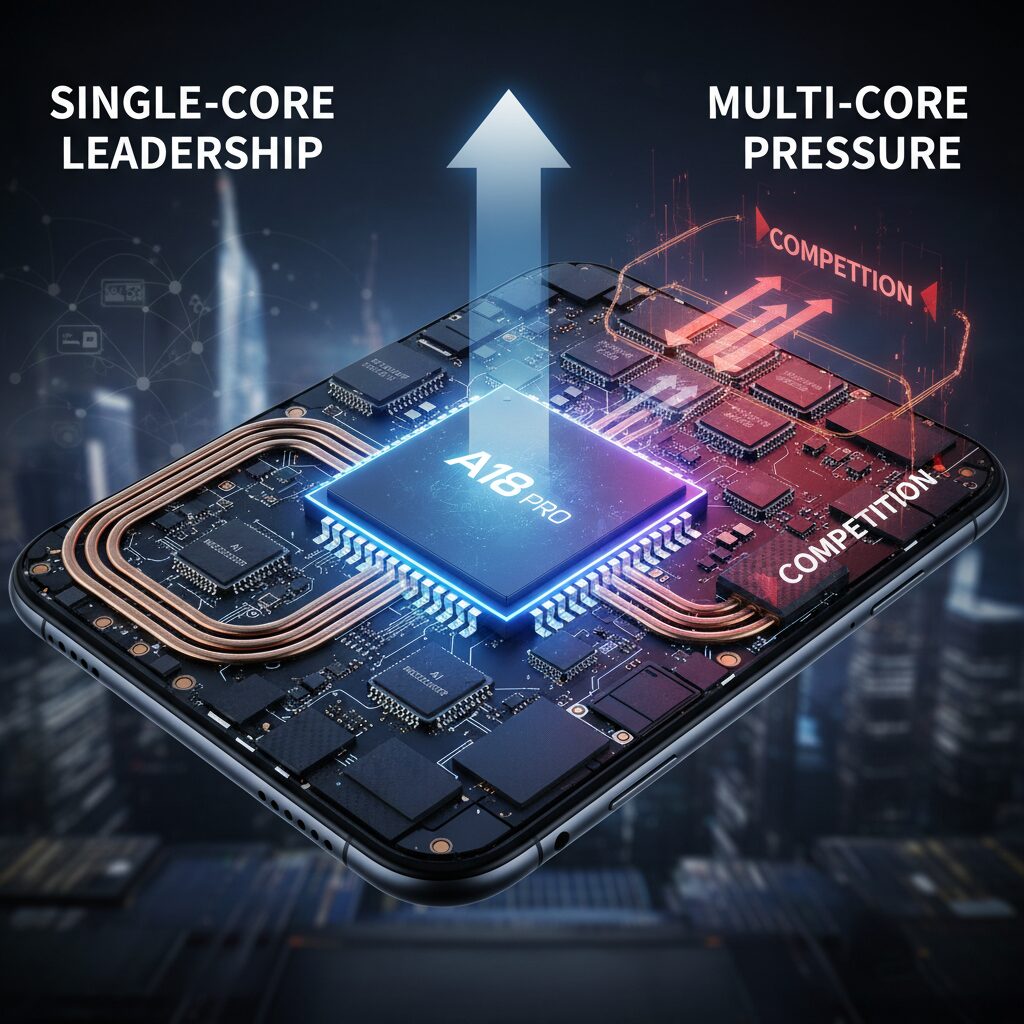
In 2025, CPU performance in mobile silicon clearly shows a two-sided reality, and the A18 series sits right at its center. Apple continues to dominate single-core performance, while facing increasing pressure in multi-core workloads that are becoming more common in advanced apps and creative tasks.
According to Geekbench 6 results cited by NotebookCheck and PCMag, the A18 Pro consistently scores around 3,400 to 3,467 in single-core tests. This places it firmly ahead of Qualcomm’s Snapdragon 8 Elite, which averages just over 3,000. The advantage comes from Apple’s extremely high IPC design and peak clock speeds exceeding 4.0GHz, a combination that remains unmatched in mobile CPUs.
| SoC | Single-Core | Multi-Core |
|---|---|---|
| Apple A18 Pro | 3,400–3,467 | 8,400–8,550 |
| Snapdragon 8 Elite | ≈3,033 | 9,000–9,200 |
This single-core leadership directly affects everyday experiences. Web browsing, UI animations, and app launches rely heavily on burst performance, and benchmarks such as Speedometer 3.0 show the A18 Pro maintaining top-tier responsiveness. For most users, this is why iPhones still feel exceptionally smooth in daily use.
However, the picture changes once all cores are engaged. The A18 Pro’s multi-core score, while strong, is now clearly behind Snapdragon 8 Elite. Qualcomm’s shift to an all-big-core Oryon architecture allows it to scale more aggressively in sustained workloads such as video export or heavy multitasking, as noted by multiple analysts including Beebom.
Apple’s 2P+4E heterogeneous design prioritizes efficiency and predictable thermals, while competitors push peak throughput. This means that for short, interactive tasks Apple still wins, but in longer, parallel workloads Android flagships can now outperform iPhones.
It is also important to note that CPU differences between A18 and A18 Pro remain modest. With nearly identical core configurations, real-world performance gaps are often under 10 percent. As PCMag points out, most users will not perceive this difference outside of benchmarks, reinforcing Apple’s strategy of prioritizing consistency and efficiency over brute-force multi-core dominance.
GPU and Gaming Performance: Ray Tracing, AAA Titles, and Harsh Benchmarks
GPU performance defines whether a modern smartphone can move beyond casual gaming, and with A18 and A18 Pro, Apple clearly aims at console‑class visuals on a mobile device. **Hardware‑accelerated ray tracing**, first introduced with A17 Pro, is retained and refined, allowing realistic lighting, reflections, and shadows that were previously impractical on phones. According to Apple’s own disclosures and independent analysis by GameSpot and NotebookCheck, ray tracing workloads benefit dramatically from dedicated hardware rather than shader‑based emulation.
In synthetic stress tests, however, the picture is more nuanced. Benchmarks such as 3DMark Solar Bay reveal that A18 Pro trails Qualcomm’s Snapdragon 8 Elite by a substantial margin in peak ray tracing throughput. **This gap highlights that Apple prioritizes balanced efficiency over raw GPU brute force**, a design choice that becomes clearer when sustained gaming sessions are examined rather than short benchmark runs.
| Test | A18 Pro | Snapdragon 8 Elite |
|---|---|---|
| 3DMark Solar Bay (RT) | ~8,000 | ~11,400 |
| Steel Nomad Light | Lower baseline | ~45% higher |
Real‑world AAA titles tell a more compelling story. CAPCOM’s Resident Evil 4 Remake and Resident Evil Village run at close to 60fps on iPhone 16 Pro when MetalFX upscaling is enabled. NotebookCheck notes that thermal stability is significantly improved over iPhone 15 Pro, meaning brightness and frame rates remain stable even during extended play. **This consistency matters more to players than short‑lived benchmark peaks.**
Death Stranding Director’s Cut represents a harsher scenario. The open‑world design places continuous pressure on the GPU, and while A18 Pro typically targets 30fps, it does so with fewer severe drops than the previous generation. Analysts attribute this to better thermal dispersion rather than dramatic architectural gains, underscoring Apple’s emphasis on sustained performance.
Not all A18 variants share this strength. The 4‑core GPU in iPhone 16e demonstrates clear limits, with TechPowerUp reporting scores even below the older A16 Bionic in demanding tests. **Ray tracing and high‑end AAA gaming are technically supported, but practically constrained**, drawing a clear line between Pro‑oriented gaming devices and entry models.
Overall, A18’s GPU strategy favors reliability, visual fidelity, and tight integration with Metal over headline numbers. As PCMag and industry reviewers frequently emphasize, gaming performance on iPhone 16 is defined less by maximum fps and more by how gracefully it survives harsh benchmarks and long play sessions.
The Reality of A18 Binning: How iPhone 16e Trades Graphics for Price
The iPhone 16e represents the clearest example of Apple’s modern binning strategy in practice, and it does so with an honesty that is rare in consumer silicon. While it carries the same A18 name, the reality beneath the label is a deliberate trade-off, where graphics capability is reduced in exchange for a significantly lower entry price.
From a manufacturing perspective, binning allows Apple to classify A18 dies based on how fully each GPU core meets specification. According to analyses by TechInsights and NotebookCheck, disabling two GPU cores dramatically improves usable yield on TSMC’s N3E process, directly lowering per-chip cost without redesigning the silicon.
| Chip Variant | GPU Cores | Graphics Outcome |
|---|---|---|
| A18 Pro | 6 cores | Full ray tracing and sustained AAA gaming |
| A18 | 5 cores | Balanced performance for mainstream users |
| A18 (16e) | 4 cores | Noticeable limits in modern 3D workloads |
Benchmarks make this compromise tangible. Independent 3DMark testing reported by TechPowerUp shows the 4-core A18 GPU scoring below the older A16 Bionic, despite being built on a far newer process. This is not a software anomaly but a predictable consequence of losing one third of the GPU’s physical execution resources.
At the same time, Apple’s priorities become clear when observing what remains untouched. CPU performance and the 16-core Neural Engine are preserved, ensuring full Apple Intelligence compatibility. As PCMag has noted, this reflects Apple’s belief that AI responsiveness and UI fluidity matter more to the target audience than peak graphics throughput.
In practical terms, the iPhone 16e does not fail at gaming; it simply draws a firm boundary. Casual titles and 2D-heavy apps run smoothly, while demanding AAA ports must reduce resolution, frame rate, or effects. The binning strategy does not hide this reality—it monetizes it, turning imperfect silicon into a product that aligns price with realistic expectations.
Power Efficiency and Thermal Design: Watt-Performance Beyond Peak Scores
When evaluating modern mobile chips, peak benchmark scores often dominate the conversation, but real user satisfaction is far more closely tied to how efficiently performance is delivered per watt. In this regard, the A18 architecture represents a deliberate shift toward sustainable performance, where thermal stability and energy curves matter as much as raw numbers.
Independent silicon analysis by Geekerwan shows that the A18 Pro raises its peak power draw to around 11.5W, up from roughly 9.7W on the A17 Pro. **This increase is not a sign of inefficiency, but rather an intentional use of additional thermal headroom to sustain higher clocks for longer periods.** In short bursts, the chip is willing to spend more power, but it does so in a controlled and predictable manner.
The real advantage becomes clear in low- to mid-load scenarios. According to comparative measurements referenced by Notebookcheck and PCMag, everyday tasks such as web browsing, UI navigation, and background AI processing remain firmly within the most efficient region of the A18’s power-performance curve. Apple’s efficiency cores and iOS task scheduling keep power draw modest while preserving responsiveness that users perceive as smoothness.
| Load Scenario | A18 Pro Behavior | User Impact |
|---|---|---|
| Light daily tasks | Runs mainly on E-cores with very low wattage | Excellent battery longevity |
| Sustained CPU load | Higher peak power, slower thermal throttling | Stable long-term performance |
| High-end gaming | Thermal limits reached gradually | Less abrupt frame drops |
Thermal design plays an equally critical role. Apple redesigned the internal heat dissipation path in the iPhone 16 generation, introducing an aluminum-based thermal substructure that spreads heat across the chassis more evenly. PCMag reports that this structural change improves heat diffusion efficiency by up to 20 percent compared to the previous generation. **As a result, surface temperatures rise more slowly, and internal throttling is delayed.**
This improvement is not theoretical. Real-world gaming tests cited by Notebookcheck indicate that under identical workloads, A18 Pro devices operate at approximately 5 degrees Celsius lower than their A17 Pro predecessors. That difference is large enough to prevent sudden brightness drops and clock reductions, both of which were common complaints in the prior generation.
Energy efficiency also extends into on-device AI. Apple’s 16-core Neural Engine executes inference tasks at significantly lower power than CPU or GPU equivalents. Apple Support documentation and early user reports suggest that while initial setup can temporarily increase battery drain, steady-state usage shows no meaningful regression. **This demonstrates how specialized silicon enables advanced features without sacrificing endurance.**
From an engineering perspective, the A18’s watt-performance balance underscores a broader philosophy. Instead of chasing unsustainable peak figures, Apple prioritizes performance that can be delivered repeatedly, quietly, and within strict thermal limits. According to TechInsights, this holistic approach to power and heat management is what allows the A18 to feel consistently fast long after benchmarks have finished running.
Apple Intelligence and the Neural Engine: AI Performance Without Battery Anxiety
Apple Intelligence is not simply a software layer added on top of iOS, but a feature set deeply shaped by the A18 architecture and, in particular, the 16‑core Neural Engine. The central promise is clear: advanced on‑device AI without the familiar anxiety of rapid battery drain. This balance between intelligence and efficiency is where Apple’s silicon strategy truly shows its maturity.
According to Apple’s own technical disclosures and independent analysis by TechInsights, the Neural Engine in the A18 family is designed to handle the majority of inference workloads locally, reducing reliance on cloud processing. **Local execution dramatically lowers energy costs associated with network access while also improving latency and privacy**, two factors that indirectly contribute to better real‑world battery life.
From a power perspective, AI tasks are fundamentally different from CPU or GPU workloads. Image understanding, language processing, and personal context analysis rely on matrix operations that the Neural Engine can execute at far lower wattage. Measurements referenced by Geekerwan’s silicon power analysis indicate that, for equivalent AI inference tasks, the Neural Engine consumes only a fraction of the power required when the same task is emulated on CPU cores.
| Processing Unit | Typical AI Task Efficiency | Battery Impact |
|---|---|---|
| CPU | Low for AI inference | High drain under sustained use |
| GPU | Moderate, parallel-friendly | Noticeable heat and power usage |
| Neural Engine | Very high, purpose-built | Minimal incremental drain |
This architectural advantage becomes tangible in daily scenarios. Features such as on‑device text summarization, photo categorization, and contextual Siri suggestions run continuously in the background. Yet early post‑launch user reports and Apple Support documentation agree on one point: after the initial indexing phase following an iOS update, **battery behavior stabilizes to levels comparable with pre‑AI usage patterns**.
Apple further mitigates battery impact through system-level scheduling. iOS dynamically shifts heavier AI processing to moments when the device is charging or operating in a low‑load state. This adaptive approach, combined with the efficiency of the Neural Engine, ensures that intelligence feels ambient rather than intrusive.
What ultimately distinguishes Apple Intelligence on the A18 is not raw AI performance, but restraint. Instead of chasing peak throughput numbers, Apple prioritizes sustained usability. **The result is an AI experience that feels always available, yet rarely noticed in battery graphs**, reinforcing the idea that true innovation lies in what users do not have to worry about.
Market Reception and Resale Value: What Sales Data Reveals About User Priorities
Market reception and resale value provide a uniquely honest lens into what users truly prioritize, because they reflect real purchasing decisions rather than stated preferences. Sales data from firms such as Counterpoint Research shows that the iPhone 16 series quickly became one of the best‑selling smartphone lineups in early 2025, with the standard iPhone 16 outperforming the Pro models in unit volume. This pattern suggests that users value balanced performance, long-term usability, and price stability more than peak benchmark dominance.
In Japan in particular, retail sell‑through data indicates that the iPhone 16 appealed strongly to cost‑conscious yet tech‑savvy buyers, including students and first‑time upgraders. Analysts have pointed out that the minimal everyday performance gap between A18 and A18 Pro chips made the non‑Pro model feel like a safer economic choice. As PCMag has observed, most daily workloads fail to expose meaningful differences, which reinforces demand for the mid‑tier option rather than the flagship.
| Model | Initial Demand | Resale Strength (2025) |
|---|---|---|
| iPhone 16 | Very High | Strong |
| iPhone 16 Pro | Moderate | Very Strong |
| iPhone 16e | Seasonal Spike | Moderate |
Resale markets further clarify these priorities. According to major Japanese buy‑back retailers, well‑kept iPhone 16 units retained a surprisingly high percentage of their launch price even six months after release. This resilience is widely attributed to confidence in long‑term software support and full Apple Intelligence compatibility, which buyers view as future‑proofing rather than a luxury feature.
By contrast, the iPhone 16e showed brisk initial sales during the spring discount season but weaker resale momentum later on. Industry commentators have noted that informed second‑hand buyers increasingly scrutinize GPU configurations, and the binned A18 variant dampened long‑term value perceptions. Overall, sales and resale data together reveal that users reward devices offering sustainable performance, predictable longevity, and economic rationality over headline‑grabbing specifications.
Looking Ahead to A19: What the A18 Era Teaches Us About Apple’s Direction
Looking ahead to A19, the A18 era offers several concrete lessons about where Apple is likely heading, and where it has consciously chosen restraint. **A18 should not be read as a failure to dominate benchmarks, but as a recalibration of priorities** in an increasingly AI-centric mobile landscape.
One of the clearest signals comes from Apple’s continued emphasis on single-thread responsiveness and real-world efficiency. Independent testing by Geekbench and analysis cited by PCMag consistently show that A18-class chips still lead in per-core performance, even as rivals surge ahead in multi-core totals. This suggests that Apple views perceived speed, interface fluidity, and latency-sensitive tasks as more strategically important than raw parallel throughput.
| Design Focus | A18 Reality | Implication for A19 |
|---|---|---|
| CPU scaling | Strong single-core, conservative multi-core | IPC gains over core-count expansion |
| GPU strategy | Efficient but peak-limited | Thermal headroom becomes critical |
| AI acceleration | NPU prioritized over CPU/GPU | Further silicon area for on-device AI |
Another lesson is how manufacturing maturity shapes Apple’s decisions. According to TechInsights’ die analysis, the move to TSMC’s N3E node did not dramatically shrink A18, but redistributed silicon toward Neural Engine capacity and thermal stability. **This indicates that Apple values predictable yields and sustained performance more than headline-grabbing density gains**, a mindset that is likely to persist into early A19 designs.
The competitive pressure from Snapdragon 8 Elite also reveals something important. Qualcomm’s all-big-core approach delivers impressive multi-threaded results, yet power efficiency advantages still swing depending on workload. Reports referenced by NotebookCheck and Geekerwan underline that Apple remains confident in heterogeneous cores combined with software scheduling. For A19, this likely means refinement rather than revolution, especially in efficiency cores that quietly shape battery life.
Perhaps the most telling insight from the A18 era is Apple’s treatment of GPU performance. Despite lagging in synthetic graphics benchmarks, Apple leaned on Metal optimization and thermal redesign to preserve gameplay stability. **This suggests that A19’s success will depend less on raw GPU scaling and more on sustained clocks enabled by better cooling**, a direction already hinted at by industry analysts.
In that sense, A18 acts as a bridge rather than a peak. It demonstrates Apple’s willingness to concede certain numerical victories today in exchange for a platform ready for long-term AI features and consistent user experience. When viewed through this lens, A19 is not expected to chase competitors blindly, but to extend the same philosophy with sharper execution, guided by the lessons A18 has already made clear.
参考文献
- TechInsights:A18 Pro Processor in iPhone 16 Pro Max
- PCMag:How Much Faster Is the iPhone 16 Pro? A18 vs. A18 Pro Processors Speed Tested
- NotebookCheck:A18 Pro gets tested in Assassin’s Creed Mirage, Death Stranding, and Resident Evil 4
- Beebom:Snapdragon 8 Elite vs Apple A18 Pro: Benchmarks and Specs
- Apple Newsroom:Apple debuts iPhone 16e: A powerful new member of the iPhone 16 family
- Counterpoint Research:iPhone 16 Leads Global Smartphone Sales in Q1 2025