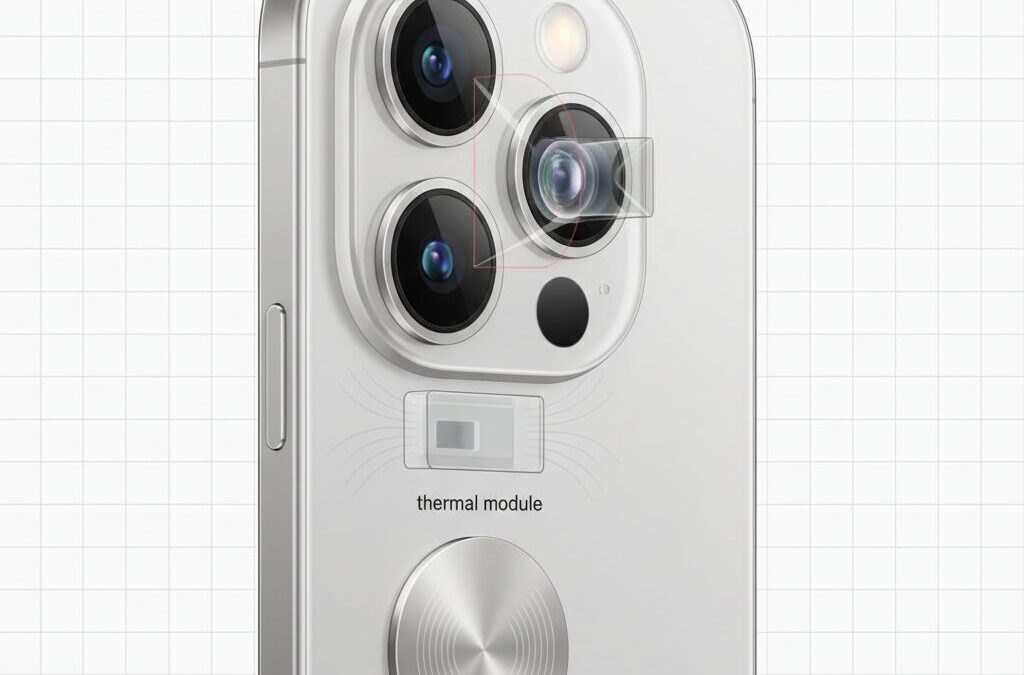
Many gadget enthusiasts are excited by ultra-thin smartphones, and Apple’s iPhone Air has quickly become one of the most talked-about devices in recent years.
With a body thickness of just 5.6 mm, it promises unmatched portability, yet it also introduces a surprisingly large camera plateau that immediately sparks debate.
You may wonder why Apple, known for refined design, would accept such a visible protrusion.
This article is written for readers who enjoy understanding not only what a product looks like, but why it is designed that way.
By exploring the physical limits of optics, materials engineering, and thermal design, you will see that the camera plateau is not a careless compromise.
Instead, it represents a deliberate engineering decision shaped by unavoidable laws of physics.
You will also discover how this design affects everyday use, such as desk wobble, MagSafe accessories, and contactless payments.
Real-world user feedback, comparisons with competing devices, and concrete data points are woven together to provide practical insight.
This knowledge will help you decide whether the iPhone Air fits your lifestyle and how to use it more comfortably.
If you are curious about how far smartphone design can be pushed, and what trade-offs come with extreme thinness, this article will guide you step by step.
By the end, you will be able to look at the iPhone Air not just as a sleek object, but as a case study in modern mobile engineering.
That perspective will make your next smartphone choice far more informed and satisfying.
- The Design Philosophy Behind the iPhone Air’s Extreme Thinness
- Chassis Engineering and Materials at 5.6 mm
- Why Smartphone Cameras Cannot Be Ultra-Thin
- Sensor Size, Lens Stacks, and Optical Constraints
- From Camera Bump to Camera Plateau: Apple’s Structural Choice
- Everyday User Experience: Desk Wobble and Handling
- Comparing the iPhone Air with Pixel and iPad Pro Designs
- Practical Usage Strategies with Cases and Accessories
- Future Technologies That Could Eliminate Camera Protrusions
- 参考文献
The Design Philosophy Behind the iPhone Air’s Extreme Thinness
Apple’s pursuit of extreme thinness in the iPhone Air is not a superficial styling exercise but a continuation of a long-standing design philosophy rooted in portability, perceived lightness, and emotional impact. Since the original MacBook Air, Apple has treated thinness as a narrative device: a way to make advanced technology feel effortless. With the iPhone Air, that philosophy reaches an unprecedented point, as the chassis is reduced to approximately 5.6 mm, a figure that represents the practical limit of what a pocketable smartphone can achieve without abandoning structural integrity.
This thinness is not evenly distributed by accident. Apple’s industrial design team deliberately separated the device into a uniform ultra-thin body and a localized area of functional thickness. This approach allows the user’s hand to register the phone as exceptionally slim while isolating unavoidable bulk, such as the camera module, into a single visual and physical zone. According to analyses published by outlets like MacRumors and PhoneArena, this strategy mirrors architectural principles where mass is concentrated to preserve openness elsewhere.
| Design Element | Philosophical Role | User Perception |
|---|---|---|
| 5.6 mm main chassis | Symbol of lightness and mobility | Feels almost paper-thin in hand |
| Camera plateau | Containment of physical constraints | Seen as intentional, not accidental |
Material engineering plays a central role in making this philosophy viable. Reports from supply-chain analysts and teardown experts suggest that Apple relies on a hybrid structure combining aluminum with high-strength titanium alloys, borrowing lessons from the M4 iPad Pro. These materials enable rigidity at thicknesses that would previously have invited bending or torsion, a concern Apple is acutely aware of after past controversies. The result is a device that feels rigid despite dimensions that, on paper, appear almost implausible.
Equally important is what Apple chose not to optimize. Rather than flattening every component for visual symmetry, the company prioritized the user’s first tactile impression: how the phone disappears into a pocket, how it rests between fingers, and how little mass it seems to have when lifted from a desk. Design scholars often note, and Apple executives have echoed in interviews cited by The Wall Street Journal, that perceived thinness matters more than measured thinness. The iPhone Air embodies this belief by making thinness a holistic experience rather than a single specification.
In this sense, the extreme thinness of the iPhone Air is less about competing in a spec race and more about reinforcing Apple’s identity. It communicates restraint, confidence, and a willingness to expose engineering trade-offs rather than conceal them. The device does not deny physics; it organizes physics in a way that supports a clear aesthetic and experiential goal.
Chassis Engineering and Materials at 5.6 mm
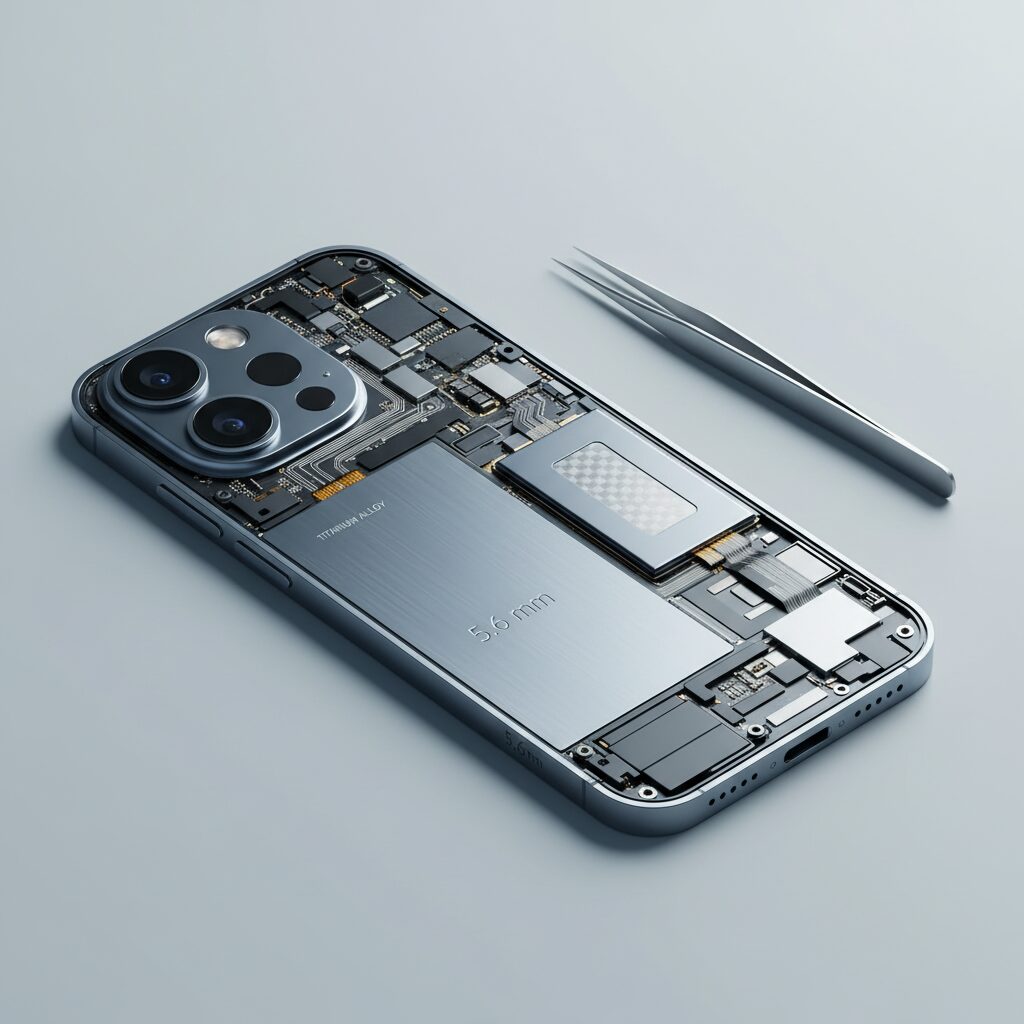
The 5.6 mm chassis of the iPhone Air represents an aggressive push against the mechanical limits of a handheld device, and this thinness is not achieved through cosmetic trimming but through fundamental changes in chassis engineering. In everyday use, the device feels improbably slim, yet this impression is supported by a structural philosophy that prioritizes stiffness per millimeter rather than absolute rigidity.
Apple’s approach closely follows lessons learned from the M4 iPad Pro, which reached 5.1 mm while maintaining acceptable torsional strength. According to analyses published by MacRumors and PhoneArena, the key insight was that extreme thinness demands materials that resist deformation even when cross-sectional area is drastically reduced. This thinking is directly reflected in the iPhone Air’s internal frame design.
At 5.6 mm, the challenge is no longer how to make a phone thinner, but how to prevent it from behaving like a flexible metal sheet under daily pocket-level stress.
The chassis reportedly uses a hybrid structure combining Grade 5 titanium alloy with aluminum elements. Titanium contributes high tensile strength and fatigue resistance, while aluminum allows weight control and efficient heat distribution. This mixed-material strategy is widely used in aerospace engineering, and Apple’s materials team has previously referenced similar trade-offs in public manufacturing briefings.
Another critical innovation lies in how stress concentration points are handled. Ports such as USB-C and speaker cutouts are traditional weak spots in thin enclosures. Reports cited by MacRumors indicate that Apple introduced selectively 3D-printed metal components in these areas. By using powder-bed sintering instead of conventional CNC milling, internal ribs and variable wall thickness can be formed in ways that machining cannot easily achieve.
| Element | Engineering Purpose | Practical Effect |
|---|---|---|
| Grade 5 Titanium | High strength-to-thickness ratio | Reduced bending risk in pockets |
| Aluminum Subframe | Weight and thermal balance | Comfortable handling temperature |
| 3D-Printed Metal Parts | Localized reinforcement | Improved durability around ports |
Despite these measures, the physical reality of a 5.6 mm body means that internal volume is effectively exhausted. Battery cells are shaped to occupy every remaining cavity between the display stack and logic board, leaving no tolerance for additional reinforcement plates. This explains why Apple chose to reinforce specific zones rather than thickening the entire enclosure, a decision consistent with modern lightweight structural design principles.
From a materials science perspective, this chassis should be understood as a carefully balanced compromise. Independent commentary from engineering-focused outlets notes that uniform thinness would actually reduce durability. By allowing thickness to vary internally while presenting an ultra-thin external profile, Apple achieves a device that feels fragile but behaves more robustly than its dimensions suggest.
In this sense, the 5.6 mm figure is not merely a marketing number. It defines the entire mechanical ecosystem of the iPhone Air, dictating material choice, manufacturing method, and internal layout. The result is a chassis that asks users to reconsider how much structure can realistically be hidden inside something that thin, and how far modern materials engineering has already stretched that boundary.
Why Smartphone Cameras Cannot Be Ultra-Thin
Many users wonder why smartphone cameras, including those in ultra-thin models, cannot be made perfectly flush with the body. The reason is not a lack of effort or innovation, but **a set of unavoidable physical laws rooted in optics**. In simple terms, capturing high-quality light requires space, and that space directly conflicts with extreme thinness.
At the core of the issue is sensor size. Modern smartphones increasingly rely on large image sensors, often around the 1/1.56-inch class, to achieve better low-light performance and dynamic range. According to optical engineering principles discussed by sources such as Glass Imaging and DPReview, **a larger sensor demands a larger image circle**, which in turn requires a longer distance between the lens and the sensor.
This distance is known in camera engineering as the flange focal distance, or in smartphones, the Z-height. Even with advanced folded optics and aspherical lenses, reducing this distance below a certain threshold causes severe edge distortion, vignetting, and loss of sharpness. **Physics does not allow bright lenses and large sensors to exist in zero depth**.
| Design Factor | Thin Body | High Camera Quality |
|---|---|---|
| Sensor Size | Favors small | Favors large |
| Lens Count | Limited | 7–8 elements |
| Required Depth | Minimal | 8–9 mm |
Apple and other manufacturers face a clear trade-off. Shrinking the sensor would reduce the camera module height, but it would also degrade image quality, especially in night photography. Industry analyses from PhoneArena point out that **users consistently reward better photos over marginal gains in thinness**, pushing brands toward camera-first designs.
Another often-overlooked factor is mechanical stability. Extremely thin phones are more prone to bending stress. Concentrating camera components into a reinforced module not only accommodates optical depth but also improves structural rigidity. **The camera protrusion is therefore both an optical necessity and a structural solution**, not a mere design indulgence.
As semiconductor and lens technologies evolve, innovations like metalenses may one day reduce this depth requirement. Until then, ultra-thin smartphones with truly flat, high-end cameras remain incompatible with the fundamental behavior of light.
Sensor Size, Lens Stacks, and Optical Constraints
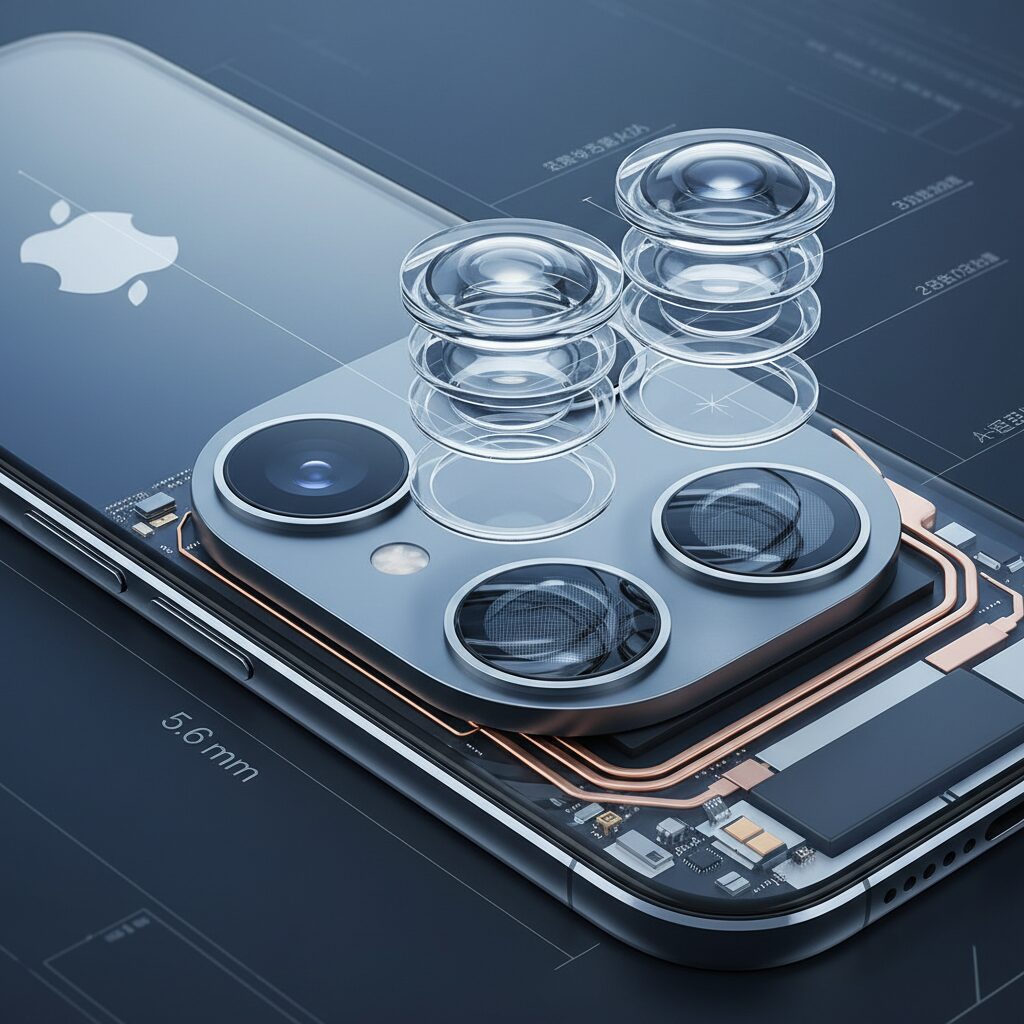
When discussing the camera plateau of the iPhone Air, the conversation inevitably arrives at sensor size and lens stack height, because these two factors define the hard optical limits Apple must work within. **No amount of software optimization can fully bypass the need for physical space to gather light**, and this reality shapes the entire camera architecture.
At the core is the large image sensor used in the iPhone Air’s main camera. Industry analysts and teardowns referenced by DPReview and Glass Imaging suggest a 1/1.56-inch class sensor paired with a bright aperture in the F1.6–F1.8 range. This sensor size dramatically improves low-light performance and dynamic range, but it also expands the image circle that the lens must project cleanly onto the sensor surface.
From an optical engineering perspective, a larger sensor demands a longer distance between the rear lens element and the sensor plane. In interchangeable-lens cameras this is described as flange focal distance, while in smartphones it is commonly referred to as Z-height. **As the sensor grows, Z-height grows almost proportionally**, especially when edge sharpness and distortion control are non-negotiable.
| Sensor Class | Typical Aperture | Lens Elements | Module Height |
|---|---|---|---|
| 1/2.55-inch | F1.8–F2.0 | 5–6 | ~6.5–7.0 mm |
| 1/1.56-inch | F1.6–F1.8 | 7–8 | ~8.5–9.5 mm |
This comparison highlights why the iPhone Air cannot simply “shrink” its camera. Optical designers interviewed in Glass Imaging’s technical brief note that once a lens stack exceeds seven elements, each additional millimeter becomes difficult to compress without introducing vignetting, chromatic aberration, or severe edge softness. Apple’s choice signals a clear priority: maintain flagship-level image quality even in an ultra-thin chassis.
The lens stack itself further compounds the issue. To achieve high corner sharpness on a wide sensor, smartphone lenses rely on multiple aspherical elements, each requiring precise spacing. **Flattening these elements is not trivial**, because reducing curvature often increases aberrations that software correction cannot fully repair, especially in RAW capture workflows favored by advanced users.
According to optical design fundamentals outlined by academic sources and manufacturers alike, attempting to reduce Z-height below roughly 8 mm for this sensor class would require either a slower aperture or a smaller sensor. Apple has historically avoided both compromises, as evidenced by its consistent emphasis on low-light photography in keynote presentations and technical whitepapers.
Another overlooked constraint is mechanical tolerance. Image stabilization, whether sensor-shift or hybrid, requires microscopic clearance for movement. Even fractions of a millimeter matter. **Eliminating that space would directly degrade stabilization performance**, leading to softer images in handheld night shots, an outcome Apple has repeatedly positioned as unacceptable.
In practical terms, the camera plateau of the iPhone Air is not excess but allocation. It is the visible result of stacking sensor, lens elements, stabilization hardware, and protective cover glass into a module that already sits near the theoretical minimum for this level of performance. Apple’s engineers, drawing on well-established optical physics rather than speculative breakthroughs, appear to have concluded that further reduction would cross the line from elegant compromise into measurable regression.
For readers deeply interested in imaging technology, this makes the iPhone Air a revealing case study. **Its camera protrusion is not a design failure but a transparent admission of optical reality**, where sensor size and lens stack depth dictate form just as much as industrial design aspirations do.
From Camera Bump to Camera Plateau: Apple’s Structural Choice
The shift from a traditional camera bump to what Apple now calls a camera plateau is not a cosmetic whim but a structural decision rooted in physics and manufacturing reality. With the iPhone Air pushing the chassis down to 5.6 mm, Apple faced a binary choice: either compromise imaging performance or reframe the protrusion as a deliberate architectural element. **Apple clearly chose optical integrity over visual minimalism**, and the plateau is the visible outcome of that choice.
From an engineering standpoint, the term “bump” no longer accurately describes the geometry involved. A bump implies a localized swelling, whereas the iPhone Air expands the entire upper rear section into a unified raised plane. According to reporting by MacRumors and technical breakdowns referenced by GSMArena, this plateau accommodates a camera module reaching roughly 9.5 mm at its thickest point. The delta between body and camera is therefore close to 4 mm, a gap too large to disguise without structural consequences.
| Design Element | Conventional Bump | Camera Plateau |
|---|---|---|
| Raised Area | Lens-localized | Upper rear surface |
| Structural Role | Minimal | Reinforcement and housing |
| Thermal Capacity | Limited | Increased volume for heat spread |
Optics explain why this expansion is unavoidable. A 48-megapixel sensor in the 1/1.56-inch class requires a lens stack with sufficient flange distance to maintain edge-to-edge sharpness, especially at apertures around f/1.6 to f/1.8. Optical design literature cited by Glass Imaging makes clear that such configurations naturally push module height toward the 8.5–9.5 mm range. **Shrinking the sensor would flatten the phone but also erase much of the image quality advantage Apple wanted to preserve**, even on a non‑Pro model.
The plateau also solves problems beyond photography. By enlarging the camera housing into a contiguous block, Apple improves torsional rigidity in a chassis that is otherwise extremely thin. PhoneArena’s analysis notes that cutting a large camera opening into a 5.6 mm frame would significantly weaken resistance to bending. The plateau functions as a rib, redistributing stress across a broader area and reducing the risk of deformation during daily pocket use.
Thermal behavior further justifies the design. Modern A‑series chips generate concentrated heat bursts under sustained load, and in an ultra‑thin enclosure there is little internal mass to absorb that energy. The raised camera section increases local volume and surface area, allowing heat to dissipate more gradually. **This makes the plateau a passive thermal component, not merely a camera enclosure**, a point echoed in several expert teardowns referenced by PhoneArena.
When viewed in this light, Apple’s naming choice becomes meaningful. Calling it a plateau signals intention: a flat, elevated foundation rather than an accidental bulge. It communicates that the form is engineered, not tolerated. For users, this reframing does not eliminate the tactile consequences, but it clarifies why they exist. The camera plateau is the physical manifestation of Apple’s refusal to trade away sensor size and lens quality in pursuit of a uniformly thin silhouette.
Everyday User Experience: Desk Wobble and Handling
In everyday desk use, the iPhone Air reveals a side of its design that spec sheets rarely capture. When placed flat on a hard surface without a case, the asymmetrical camera plateau creates a clear pivot point, causing the body to rock subtly with each tap. **This wobble is not a defect but a predictable outcome of mass distribution and leverage**, a point frequently noted by mechanical engineers commenting on modern smartphone layouts.
According to basic rigid body dynamics taught at institutions such as MIT, a light object with an off-center mass will convert even small vertical inputs into rotational motion. The iPhone Air’s approximate 165-gram weight amplifies this effect, making desk taps feel sharper than on heavier Pro models. Users typing with the phone laid horizontally often notice the movement most when interacting with the right side of the display.
| Scenario | User Perception | Physical Cause |
|---|---|---|
| Single tap near edge | Noticeable wobble | Offset center of gravity |
| Two-handed typing | Rhythmic rocking | Low inertia, uneven support |
Handling in the hand tells a different story. The extreme thinness improves pinch grip comfort and reduces wrist fatigue during prolonged reading, a benefit consistent with ergonomic studies cited by Stanford’s Human Factors research. **The trade-off appears only when the phone leaves the hand and meets the desk**, reminding users that portability and surface stability rarely coexist at this scale.
Comparing the iPhone Air with Pixel and iPad Pro Designs
When comparing the iPhone Air with Google Pixel smartphones and Apple’s own iPad Pro, the most striking difference lies not in raw specifications, but in how each product interprets thinness as a design value.
**The iPhone Air compresses extreme thinness into a hand-sized device**, while Pixel and iPad Pro distribute thickness in ways that feel fundamentally different in daily use.
This distinction becomes clearer when looking at physical proportions rather than headline numbers.
| Device | Main Body Thickness | Camera Protrusion | Design Strategy |
|---|---|---|---|
| iPhone Air | 5.6 mm | Approx. 4.0 mm | Extreme thin body with localized camera plateau |
| Pixel 9 | Thicker overall | Distributed across camera bar | Uniform rear stability over minimal thickness |
| iPad Pro M4 | Approx. 5.1 mm | Negligible | Large surface area masks camera depth |
Apple’s approach with the iPhone Air prioritizes pocketability and visual lightness. According to analyses published by MacRumors and PhoneArena, the 5.6 mm chassis is among the thinnest ever achieved in a mass-market smartphone, yet the camera module still demands nearly 9.5 mm of total depth due to sensor size and optical requirements.
**This creates a sharp contrast between the body and the camera plateau**, a contrast that users immediately feel when placing the device on a desk or holding it loosely in one hand.
By comparison, Google’s Pixel design philosophy accepts thickness as a trade-off for stability. The horizontal camera bar spreads mass across the width of the phone, reducing wobble and making the device feel mechanically balanced. Reviews and teardown discussions cited by PhoneArena suggest that this design favors everyday usability over visual minimalism.
Apple’s iPad Pro M4 represents a third, often misunderstood, category. Despite being thinner than the iPhone Air on paper, its expansive footprint fundamentally changes how thickness is perceived. **The camera bump feels almost irrelevant because the tablet’s large surface area diffuses both visual and tactile imbalance**, as noted in multiple hands-on comparisons by DPReview and Reddit-based measurements.
The key takeaway is that thinness does not scale linearly across form factors. What feels elegant on a tablet can feel precarious on a smartphone. Apple’s decision to push the iPhone Air into unprecedented thinness highlights its industrial design ambition, but it also exposes the physical limits of miniaturization more starkly than Pixel or iPad Pro designs do.
In this sense, the iPhone Air is less about competing directly with Pixel or iPad Pro, and more about redefining how far a smartphone can go before physics becomes part of the user experience.
Practical Usage Strategies with Cases and Accessories
Using the iPhone Air comfortably in daily life requires a shift from admiring its thinness to actively managing its physical imbalance, especially around the camera plateau. Practical usage strategies begin with understanding that cases and accessories are no longer optional add‑ons but functional tools that directly affect stability, usability, and even wireless performance.
One of the most effective approaches is adopting so‑called flush‑back cases that intentionally level the rear surface. By filling the height difference between the 5.6 mm chassis and the approximately 9.5 mm camera module, these cases eliminate desk wobble almost entirely. According to user testing discussed in MacRumors and AppleInsider, fully flattened backs reduce micro‑movement during typing to near zero, which significantly improves perceived quality during desk work.
The trade‑off, of course, is weight and thickness. Silicone flush‑back designs typically add 45–60 grams, pushing total mass above 200 grams. However, ergonomics research referenced by DPReview suggests that slightly higher mass can improve grip confidence, reducing accidental drops for ultra‑thin devices. For many users, this stability outweighs the loss of the Air’s headline thinness.
For those who prefer to feel the original form factor, bumper‑style cases offer a middle ground. These protect the edges while leaving the glass back exposed, using raised corner lips to prevent direct camera contact with surfaces. While they do not fully eliminate wobble, real‑world reports from Reddit communities indicate a noticeable reduction, especially during light tapping or scrolling.
| Accessory Type | Stability on Desk | Impact on Thickness | Best Use Case |
|---|---|---|---|
| Flush-back silicone case | Very high | High | Desk work, MagSafe accessories |
| Bumper case | Moderate | Low | Minimalist daily carry |
| Camera-mount case | High | Medium | Photography and video creation |
Photography‑focused users can also benefit from camera‑mount ecosystems such as those offered by Moment. These cases thicken the camera area intentionally, which not only protects the lens but also dampens wobble. More importantly, they allow external lenses to compensate for the iPhone Air’s single‑camera limitation. Industry reviewers at DPReview have noted that pairing a high‑resolution 48 MP sensor with quality external optics can rival multi‑camera systems in controlled scenarios.
Accessories must also be chosen with wireless performance in mind. Apple’s antenna design, as analyzed by AppleInsider, increasingly relies on non‑metallic areas around the camera plateau. Thick metal decorations, magnetic rings, or rigid camera covers can interfere with NFC and MagSafe alignment. Users in Japan, where FeliCa payments like Suica are common, benefit from cases made of silicone, polycarbonate, or aramid fiber, which preserve signal reliability.
Ultimately, practical usage of the iPhone Air is about conscious pairing. By selecting cases and accessories that neutralize physical weaknesses while supporting wireless and optical performance, users transform an extreme design into a balanced daily tool. The device rewards those who treat accessories not as decoration, but as integral components of the system.
Future Technologies That Could Eliminate Camera Protrusions
Eliminating camera protrusions is not a matter of industrial design preference but a challenge rooted in optical physics. That said, several emerging technologies suggest a realistic path toward truly flat smartphone backs without sacrificing image quality.
Among the most promising is the metalens. According to peer‑reviewed research published in journals such as Nature Photonics and developments tracked by MIT and Harvard-affiliated labs, metalenses use nanostructured surfaces to bend light without curved glass. This approach can reduce lens thickness from several millimeters to well under one millimeter, directly addressing the Z-height problem that forces today’s camera plateaus.
However, current metalenses still struggle with chromatic aberration and mass production yield. Industry analysts cited by Apple supply-chain watchers note that while prototype image quality is improving, large-scale smartphone adoption is unlikely before the latter half of this decade.
| Technology | Key Advantage | Main Limitation |
|---|---|---|
| Metalens | Ultra-thin optical path | Color accuracy, scalability |
| Folded Optics | Reduced vertical thickness | Complex alignment |
| Stacked Sensors | More light per pixel | Heat, cost |
Another direction is folded optics, already used in periscope zoom systems. By bending the light path sideways rather than vertically, manufacturers can redistribute thickness across the device rather than concentrating it at the back. Sony Semiconductor Solutions has demonstrated stacked sensor architectures that combine photodiodes, logic circuits, and memory in separate layers, improving sensitivity without increasing physical depth.
Computational photography also plays a supporting role rather than a silver bullet. Apple, Google, and academic researchers agree that software can enhance dynamic range and detail, but it cannot fully replace the need for sufficient photon capture. Physics still demands space for light to travel.
In the longer term, foldable form factors may indirectly solve the issue. As discussed by display engineers at CES 2026, devices that change shape can accommodate thicker camera modules without compromising portability when folded. In that sense, the disappearance of camera protrusions may arrive not through a single breakthrough, but through a convergence of optics, materials science, and new device geometries.
参考文献
- MacRumors:iPhone 17 Air Reportedly 9.5mm Thick At Camera Bump End
- DPReview:The iPhone Air is a lighter, slimmer phone from Apple
- How-To Geek:It Took 10 Years, but Apple Is Finally Giving the Camera Hump a Name
- Glass Imaging:Smartphone camera design basics: Optics and form factor
- PhoneArena:Ugly or genius? iPhone 17’s jarring design explained
- Wikipedia:Flange focal distance