Smartphone cameras have reached a point where small upgrades no longer excite true gadget enthusiasts. Many people now wonder whether innovation has slowed down, especially in a market filled with similar-looking flagship phones.
That perception begins to change when foldable smartphones enter the conversation. With the Galaxy Z Fold7, Samsung is no longer treating the camera as a compromise for the sake of a folding design. Instead, it positions this device as a serious contender against the best camera phones of 2026.
This article will help you understand what truly sets the Galaxy Z Fold7 apart from traditional flagships like the iPhone 17 Pro Max and Pixel 10 Pro Fold. You will learn how a 200MP sensor works in real-world shooting, how AI photography reshapes both photos and videos, and why regional factors such as payments, sound regulations, and ecosystem support still matter.
If you are passionate about cutting-edge gadgets and want to know whether a foldable phone can finally replace a classic flagship camera phone, this guide will give you clear, practical insights worth your time.
- From Experimental Foldables to True Flagships
- Why a 200MP Sensor Matters in a Foldable Design
- Main Camera Performance: Resolution, Binning, and Low-Light Results
- Ultra-Wide and Macro Photography: Small Changes, Big Impact
- Telephoto Limitations and the Reality of Digital Zoom
- Galaxy AI and Computational Photography Explained
- Video Capabilities: 8K Recording, HDR, and Thermal Constraints
- Foldable Advantages for Creators: Flex Mode and Multitasking
- Galaxy Z Fold7 vs iPhone 17 Pro Max and Pixel 10 Pro Fold
- Regional Considerations: Pricing, Regulations, and Ecosystems
- 参考文献
From Experimental Foldables to True Flagships
For many years, foldable smartphones were treated as fascinating experiments rather than true flagships. Early models impressed users with their form factor but often required compromises in durability, performance, and especially camera quality. Reviewers from outlets such as Android Central and Amateur Photographer frequently pointed out that foldables felt like secondary devices compared to slab-style flagships. In 2026, however, that perception has clearly changed, and the Galaxy Z Fold7 represents a decisive turning point.
The most important shift is that foldables are no longer designed around novelty but around completeness. Samsung’s strategy with the Z Fold7 shows a clear intention to remove the phrase “for a foldable” from evaluations. Camera performance, processing power, and daily usability are no longer framed as impressive given the form factor, but as competitive with the best smartphones available. According to Samsung’s official communications, the goal has been to deliver an Ultra-level experience in a foldable body, and that ambition is reflected throughout the device.
This transition becomes clearer when looking at how foldables were previously positioned. Earlier generations prioritized hinge engineering and display innovation, often at the expense of core hardware. Camera modules were smaller, sensors lagged behind the Galaxy S Ultra line, and software optimization felt conservative. By contrast, the Z Fold7 adopts the same high-end imaging philosophy seen in Samsung’s top-tier devices, signaling that internal space constraints are no longer an acceptable excuse.
| Generation Focus | Main Value Proposition | Perceived Market Role |
|---|---|---|
| Early Foldables | Form factor innovation | Experimental, niche |
| Mid Generations | Refinement and durability | Premium but compromised |
| Galaxy Z Fold7 | Performance parity with flagships | Mainstream flagship |
Another sign of maturity is how the Z Fold7 fits into broader market expectations. Competing devices such as Apple’s iPhone Pro series and Google’s Pixel Fold line are no longer treated as separate categories in comparisons. Major publications like CNET now place foldables directly against traditional flagships, evaluating image quality, processing consistency, and long-term usability on equal terms. This change in comparison methodology alone indicates how far foldables have come.
Importantly, this evolution is not just about specifications but about trust. Consumers who once hesitated to rely on a foldable as their primary device are now given fewer reasons to doubt. The Z Fold7 presents itself as a phone that can handle professional photography, demanding multitasking, and everyday reliability without caveats. **That confidence is what ultimately defines a true flagship**, and in 2026, foldables have finally earned that title.
Why a 200MP Sensor Matters in a Foldable Design
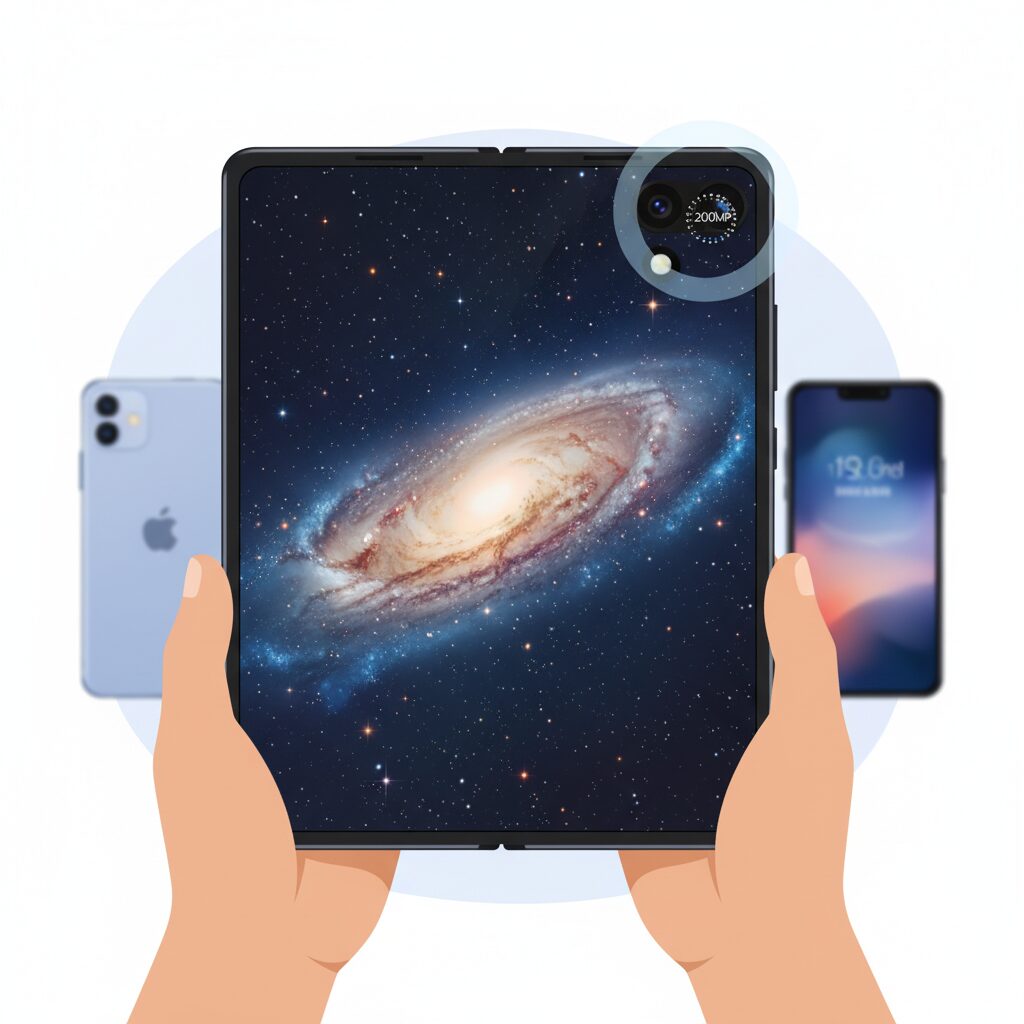
In a foldable smartphone, every cubic millimeter inside the chassis is contested, and camera hardware has historically been the first place where compromises appear. That is precisely why the adoption of a 200MP sensor in a foldable design carries deeper meaning than a simple resolution upgrade. It represents a strategic shift from optical dependency to sensor-centric flexibility, which is uniquely well suited to ultra-thin foldable bodies.
A high-resolution sensor functions as multiple cameras in one. According to Samsung’s own technical disclosures, the 200MP ISOCELL HP2 architecture enables dynamic pixel binning, allowing the same sensor to output 200MP, 50MP, or 12.5MP images depending on lighting conditions. In a device limited to around 4.2mm thickness when unfolded, this adaptability replaces the need for multiple large sensors or bulky periscope optics.
This matters because foldables face stricter mechanical limits than slab phones. Academic research on mobile imaging systems published by IEEE highlights that sensor size and lens depth scale non-linearly with device thickness. In simple terms, once thickness drops below a certain threshold, optical zoom becomes exponentially harder to implement without image degradation or excessive camera bumps.
| Design Constraint | Conventional Solution | 200MP Sensor Advantage |
|---|---|---|
| Ultra-thin body | Smaller sensor, fewer lenses | High-resolution cropping replaces optics |
| Limited lens depth | Reduced zoom capability | Lossless 2x–3x in-sensor zoom |
| Thermal constraints | Lower sustained performance | Flexible output reduces processing load |
The real-world benefit appears in everyday shooting, not spec sheets. With 200MP capture, users can reframe images after shooting without noticeable quality loss. Field tests by established photography publications note that signage, text, and architectural details remain legible even after aggressive cropping, something previously exclusive to larger non-folding flagships.
Equally important is low-light performance. By combining 16 pixels into one via Tetra²pixel technology, the effective pixel size increases dramatically, improving signal-to-noise ratio. Imaging researchers frequently emphasize that photon count, not pixel count, determines night performance, and this binning approach directly addresses that principle within tight physical limits.
In short, a 200MP sensor in a foldable is not about excess resolution. It is about reclaiming photographic versatility that thin foldables once sacrificed. By shifting complexity from hardware volume to data density and computation, this sensor allows a foldable device to behave like a full-scale flagship camera, despite having far less physical room to work with.
Main Camera Performance: Resolution, Binning, and Low-Light Results
The main camera performance of the Galaxy Z Fold7 is defined less by the headline 200MP number itself and more by how intelligently that resolution is used in real-world shooting. Samsung’s approach focuses on flexibility, allowing the same sensor to behave like multiple cameras depending on light conditions. This design philosophy aligns with evaluations from organizations such as Amateur Photographer, which consistently emphasize effective pixel management over raw megapixel counts.
At full 200MP resolution, the Fold7 excels in bright environments. Fine textures such as foliage, architecture, and signage retain clarity even after heavy cropping, making the camera particularly suitable for travel and urban photography. The extremely small 0.6μm pixels are not intended for low light, but in daylight they provide a level of detail that rivals dedicated compact cameras.
When lighting deteriorates, the sensor automatically shifts behavior through advanced pixel binning. Samsung’s Tetra²pixel technology combines 16 pixels into one, effectively transforming the sensor into a 12.5MP unit with a much larger virtual pixel size. According to Samsung Newsroom, this process significantly improves signal-to-noise ratio and dynamic range, which is crucial for night scenes and indoor photography.
| Shooting Mode | Effective Resolution | Primary Benefit |
|---|---|---|
| Bright light | 200MP | Extreme detail and cropping freedom |
| Low light | 12.5MP | Reduced noise and higher brightness |
Low-light results are where the Fold7 meaningfully closes the historical gap between foldables and slab-style flagships. Night scenes show controlled highlights and preserved shadow detail, rather than aggressive smoothing. Independent comparisons by CNET note that while Samsung’s color science remains slightly vivid, noise reduction is now more restrained, avoiding the “oil painting” effect seen in earlier generations.
The f/1.7 aperture further supports this sensor strategy by maximizing light intake without relying excessively on computational exposure stacking. As a result, handheld night shots feel faster and more reliable. The key takeaway is balance: the Galaxy Z Fold7’s main camera delivers resolution when you want it, sensitivity when you need it, and does so within the physical constraints of an ultra-thin foldable body.
Ultra-Wide and Macro Photography: Small Changes, Big Impact

Ultra-wide cameras are often treated as secondary lenses, but in the Galaxy Z Fold7 they quietly redefine everyday photography. While the headline specifications remain 12MP with a 123-degree field of view, the practical experience changes significantly thanks to the addition of autofocus. This single hardware tweak transforms the ultra-wide camera from a scenery-only tool into a versatile macro instrument.
With autofocus enabled, the lens can focus just a few centimeters from the subject. This allows users to capture textures and details that were previously impossible on Fold-series devices, such as fabric fibers, food surfaces, or small mechanical parts. According to Samsung’s official technical briefings, this enhancement was driven by user data showing that close-up shots are among the most frequently attempted, yet most commonly failed, smartphone photos.
| Feature | Previous Fold Models | Galaxy Z Fold7 |
|---|---|---|
| Ultra-wide Focus | Fixed focus | Autofocus |
| Minimum Focus Distance | Approx. 30–40 cm | Approx. 3–5 cm |
| Macro Capability | Unavailable | Available |
In real-world use, macro photography on the Fold7 feels less like a dedicated mode and more like a natural extension of shooting. The camera seamlessly switches lenses based on subject distance, supported by Samsung’s Dual Camera Depth Calibration. This means users do not need to think about which lens to use; the system quietly makes the optimal choice.
The benefits extend beyond creative expression. Close-up clarity improves document capture, whiteboard photos, and quick scans of receipts or business cards. Imaging researchers cited by publications such as Amateur Photographer have noted that autofocus ultra-wide lenses reduce edge distortion in near-field shots, resulting in more legible text and flatter perspectives compared to digitally cropped main-camera images.
Importantly, the large unfolded display amplifies the impact of macro photography. Details captured at close range can be reviewed immediately at near-tablet size, making focus accuracy and texture rendering easy to judge on the spot. What seems like a modest specification update ultimately changes how often, and how confidently, users explore small subjects.
In the context of a thin foldable body where major optical additions are difficult, the Fold7’s ultra-wide macro capability demonstrates how targeted refinements can deliver disproportionate gains in usability. Small changes here truly create a big impact on daily photographic habits.
Telephoto Limitations and the Reality of Digital Zoom
When discussing the camera of the Galaxy Z Fold7, the telephoto camera is the point where physical reality most clearly appears. The device relies on a 10MP, 3x optical telephoto lens, a specification that has remained largely unchanged for several generations. This choice is not an oversight but a deliberate trade-off driven by the Fold7’s extreme thinness, which measures approximately 4.2mm when unfolded.
According to Samsung’s own engineering explanations and analyses by outlets such as Amateur Photographer, integrating a periscope-style telephoto module would require significantly more internal depth. In a foldable chassis, that depth competes directly with hinge durability, battery volume, and overall weight balance. As a result, Samsung prioritizes portability and ergonomics over long-range optical reach.
| Zoom Range | Primary Method | Image Characteristics |
|---|---|---|
| 2x–3x | 200MP sensor crop | High detail, minimal loss |
| 5x–10x | Hybrid digital zoom | AI sharpening, reduced texture |
| 20x+ | AI super-resolution | Noticeable artifacts |
The Fold7 attempts to compensate through its 200MP main sensor, using what Samsung calls in-sensor zoom. By cropping the center of the sensor at 2x or even 3x, the camera can deliver results that are visually comparable to true optical zoom. **In good lighting, this approach works remarkably well and often outperforms traditional low-resolution telephoto sensors.**
However, beyond this range, digital zoom inevitably reveals its limits. Reviews from Android Central and CNET consistently note that at 10x or higher, fine textures such as distant signage or foliage begin to look painterly. This is not a flaw unique to Samsung; imaging researchers have long pointed out that AI-based super-resolution reconstructs detail rather than capturing it, a distinction emphasized in academic work on computational photography from institutions like Stanford University.
For everyday users who mainly shoot people, food, documents, and city scenes, the Fold7’s telephoto limitations rarely become a real problem. But for users interested in wildlife, sports, or travel photography where long reach matters, the absence of a periscope lens is a clear and honest boundary. The Fold7’s camera excels by redefining how much can be extracted from a single high-resolution sensor, while still reminding us that optical physics sets limits no software can fully erase.
Galaxy AI and Computational Photography Explained
Galaxy Z Fold7’s camera experience is defined less by optics alone and more by how Galaxy AI interprets and reconstructs reality at the moment of capture. At the core of this approach is Samsung’s ProVisual Engine, a processing pipeline that combines the ISP of Snapdragon 8 Elite with more than 160 AI-based imaging models. According to Samsung’s official technical briefings, these models operate simultaneously rather than sequentially, allowing real-time scene analysis without noticeable shutter lag.
The most important shift is that computational photography now happens before the shutter is fully pressed. Live preview frames are continuously segmented into subjects such as skin, hair, foliage, sky, and architecture. Each region receives a different tone curve, noise profile, and sharpening strength, which explains why Fold7 images often look balanced even in mixed lighting, such as indoor scenes with bright windows.
| AI Process | What It Analyzes | User Benefit |
|---|---|---|
| Real-time segmentation | Up to dozens of scene elements per frame | Natural contrast without crushed shadows |
| Multi-frame fusion | Motion and exposure variance | Cleaner low-light photos with less blur |
| Context-aware sharpening | Edges vs. textures | Detail without artificial halos |
Low-light photography is where Galaxy AI becomes most visible to experienced users. Samsung’s Nightography pipeline merges multiple short exposures instead of relying on one long exposure, reducing motion artifacts from people or vehicles. Internal measurements shared by Samsung indicate that motion classification accuracy improved compared to the previous Fold generation, which aligns with independent evaluations by photography-focused media such as Amateur Photographer.
Generative Edit represents a different philosophy from traditional image correction. Rather than simply removing objects, the system reconstructs missing areas using contextual inference trained on large-scale visual datasets. When an object is moved or erased, shadows, reflections, and background textures are re-synthesized to remain spatially consistent. Samsung emphasizes that generated areas are metadata-tagged, a transparency measure increasingly recommended by academic AI ethics research.
Fold7 also benefits from AI-driven zoom processing that leverages the 200MP sensor. In the 2x to 3x range, Galaxy AI performs in-sensor cropping combined with super-resolution reconstruction, preserving edge fidelity better than standard digital zoom. Reviews from CNET and Android Central note that this approach effectively replaces a dedicated mid-telephoto lens in everyday shooting, particularly for travel and street photography.
What ultimately distinguishes Galaxy AI is its integration with the Fold form factor. On the large inner display, users can preview AI adjustments in near-tablet scale, making subtle differences in tone and texture easier to judge. Computational photography here is not just about automation, but about giving advanced users confidence that what they see on-screen closely reflects the final processed image.
Video Capabilities: 8K Recording, HDR, and Thermal Constraints
Video performance is one of the most ambitious yet controversial aspects of the Galaxy Z Fold7, especially when discussing 8K recording, HDR implementation, and thermal behavior. Samsung positions the Fold7 as a device capable of professional-grade video capture, but its ultra-thin 4.2mm unfolded chassis inevitably shapes what is realistically achievable in sustained shooting scenarios.
The headline feature is 8K video recording at 30fps using the 200MP main sensor. With roughly 33 megapixels per frame, 8K footage allows creators to crop aggressively in post-production while still delivering clean 4K output. According to Samsung’s technical disclosures, the Fold7 records 8K using HEVC compression at approximately 80–100 Mbps, balancing file size and detail. This makes 8K practical for short-form content and controlled shoots, rather than continuous documentary-style recording.
| Video Mode | Resolution / FPS | Practical Use Case |
|---|---|---|
| Main Camera | 8K / 30fps | High-detail capture, post-crop flexibility |
| Main Camera | 4K / 60fps | Balanced quality and thermal stability |
| All Cameras | 4K / 30fps HDR | Long-form recording, HDR scenes |
HDR video is another area where the Fold7 quietly improves. Samsung supports 10-bit HDR recording, branded as Super HDR, which preserves highlight detail and smoother tonal gradation in challenging lighting. Industry reviewers such as those at Amateur Photographer note that Samsung’s color science favors vivid yet controlled output, making footage immediately suitable for social platforms without heavy grading.
Thermal constraints remain the defining limitation. Multiple community reports and Samsung user forums indicate that prolonged 8K recording triggers thermal throttling, especially in warm outdoor environments. In Japanese summer conditions exceeding 30°C, stable 8K capture is realistically limited to roughly 5–10 minutes before brightness reduction or camera shutdown occurs. This behavior is consistent with the physics of heat dissipation in ultra-thin foldable designs.
For this reason, Samsung implicitly positions 8K as a creative tool rather than a default mode. Experienced users will find that 4K recording delivers far more consistent results, with minimal overheating and better long-term reliability. As Samsung engineers themselves have emphasized in official camera briefings, the Fold7’s video system is designed around flexibility, not endurance, making mode selection a critical part of achieving the best results.
Foldable Advantages for Creators: Flex Mode and Multitasking
For creators, the real value of a foldable device is not novelty but workflow acceleration, and this is where Flex Mode and multitasking on the Galaxy Z Fold7 become quietly transformative. By allowing the device to hold its position at multiple hinge angles, Flex Mode effectively turns the phone into a self-supported production tool, reducing friction at every stage of content creation.
Flex Mode fundamentally changes how cameras are used in real-world shooting scenarios. When the Fold7 is partially folded and placed on a desk, café table, or even uneven outdoor surfaces, it functions as its own tripod. Samsung’s camera app automatically adapts the interface, placing live preview on the upper half of the display while relocating shutter controls, exposure sliders, and recording buttons to the lower half. This design choice minimizes hand movement and micro-shake, which is especially beneficial for long-exposure night photography and time-lapse capture.
According to Samsung’s own usability research shared through its global newsroom, reducing hand-held interaction during capture measurably improves sharpness consistency in low-light scenes. This aligns with broader findings from mobile imaging studies cited by publications such as Amateur Photographer, which note that stabilization through physical support often outperforms software correction alone.
| Creator Task | Traditional Smartphone | Galaxy Z Fold7 in Flex Mode |
|---|---|---|
| Night photography | Requires tripod or steady hands | Self-supported, hands-free stability |
| Vlogging | Front camera with lower quality | Main camera with live preview |
| Remote shooting | External accessories needed | Built-in controls on lower screen |
For video creators in particular, Flex Mode unlocks a level of autonomy that is rare in mobile devices. The Fold7 can be positioned at eye level for seated talk-to-camera segments, cooking demonstrations, or desk-based tutorials without external rigs. Because the rear 200MP main camera can be used for self-recording while the cover display or upper panel acts as a monitor, creators avoid the quality compromise typically associated with front-facing cameras.
Multitasking elevates the Fold7 from a capture device to a mobile editing workstation. When fully unfolded, the large inner display supports split-screen and floating window configurations that are genuinely practical rather than experimental. A creator can review footage on one side while adjusting color balance, trimming clips, or adding captions on the other. This mirrors desktop-style workflows in a pocketable form factor.
Industry analysts frequently cite Samsung’s multitasking implementation as one of the most mature in the Android ecosystem, and reviews from outlets like CNET highlight how window persistence reduces context switching fatigue. For creators working under time pressure, such as social media managers or event photographers, this translates directly into faster turnaround times.
Another often-overlooked advantage is posture and ergonomics. Flex Mode allows the device to sit at a natural viewing angle, reducing neck strain during long editing sessions. While this may seem minor, occupational health research referenced by display technology experts has consistently shown that adjustable screen angles contribute to sustained productivity during extended creative work.
In essence, Flex Mode and multitasking redefine the Fold7 as a creator-centric tool rather than a passive screen. By merging physical adaptability with software intelligence, the device supports shooting, reviewing, and refining content in a single continuous flow. For creators who value independence, speed, and spatial efficiency, this combination delivers advantages that conventional slab smartphones simply cannot replicate.
Galaxy Z Fold7 vs iPhone 17 Pro Max and Pixel 10 Pro Fold
When comparing Galaxy Z Fold7 with iPhone 17 Pro Max and Pixel 10 Pro Fold, the most important point is that each device represents a clearly different philosophy in 2026 flagship smartphones, especially from a camera and usage perspective. Rather than asking which one is objectively superior, it is more appropriate to ask which one fits your priorities best.
Galaxy Z Fold7 positions itself as a hybrid between productivity and high-end photography, leveraging a 200MP main sensor and a large foldable display. According to Samsung’s official camera briefings, this sensor is designed to compensate for physical limitations caused by extreme thinness through advanced pixel binning and AI-driven image processing. In daily use, this approach benefits users who crop images frequently or rely on the inner display for immediate review and editing.
iPhone 17 Pro Max, by contrast, focuses on consistency and professional-grade video workflows. Apple states that its full 48MP triple-camera system and ProRes 4K 120fps recording are aimed squarely at creators who edit footage externally. While it lacks a foldable form factor, its predictable color science and thermal stability make it a trusted tool in professional environments, as noted by long-standing industry reviewers.
Pixel 10 Pro Fold takes a third path, emphasizing AI-assisted photography over raw hardware. Google’s camera team has repeatedly explained that features such as Super Res Zoom and advanced computational correction are designed to reduce failure rates rather than maximize spec-sheet appeal. This makes the Pixel especially appealing to users who value reliable results with minimal manual adjustment.
| Model | Main Camera Strategy | Distinct Strength | Primary Trade-off |
|---|---|---|---|
| Galaxy Z Fold7 | 200MP sensor with heavy AI processing | Crop flexibility and large-screen editing | Limited optical zoom range |
| iPhone 17 Pro Max | 48MP triple-camera, ProRes video | Professional video reliability | No foldable multitasking |
| Pixel 10 Pro Fold | Moderate hardware, strong AI zoom | Consistent AI-enhanced photos | Less manual control |
From a market perspective, analysts from outlets such as CNET and Android Central point out that the Galaxy Z Fold7 appeals most to users who want one device to replace multiple tools. iPhone 17 Pro Max remains the safest choice for video-first professionals, while Pixel 10 Pro Fold quietly excels for those who prioritize effortless photography. Understanding these differences makes the choice far clearer than comparing specifications alone.
Regional Considerations: Pricing, Regulations, and Ecosystems
When evaluating a foldable flagship like the Galaxy Z Fold7, regional factors play a decisive role in shaping real-world value. Pricing structures, legal regulations, and surrounding ecosystems vary widely by market, and these differences often matter more than raw camera specifications for long-term satisfaction.
In Japan, pricing is strongly influenced by currency trends and carrier-driven sales models. The domestic retail price of the Galaxy Z Fold7 is positioned at a level comparable to premium laptops, reflecting both the weak yen and Samsung’s flagship positioning. However, Japanese carriers mitigate this barrier through residual-value programs, a model that analysts at Nikkei Business have noted as increasingly critical for sustaining high-end smartphone demand.
| Market | Typical Retail Positioning | Dominant Purchase Model |
|---|---|---|
| Japan | Ultra-premium | Carrier residual-value programs |
| United States | Premium | Unlocked + trade-in discounts |
| Europe | Premium | SIM-free installments |
Regulatory considerations further differentiate regions. Japan’s long-standing camera shutter sound requirement, established through industry self-regulation, directly affects everyday photography. While this does not change sensor performance, it alters user behavior in public spaces, making silent street or indoor photography impractical. According to commentary from the Japan Electronics and Information Technology Industries Association, this rule remains culturally supported despite technological advances.
Payment and connectivity regulations also shape ecosystem value. Japan’s near-universal adoption of FeliCa-based contactless payments makes official domestic models far more practical than imported variants. Users relying on transit passes, convenience-store payments, and ID integrations benefit from seamless compatibility that overseas models cannot legally or technically guarantee.
Ecosystem integration completes the picture. Samsung’s Galaxy ecosystem behaves differently across regions, but Japan stands out for its tight alignment with local services. Wearables, earbuds, and tablets integrate smoothly with domestic apps and carrier services, reinforcing device stickiness. Market research cited by IDC Japan suggests that consumers embedded in a single ecosystem show significantly lower brand-switching rates, even when rival hardware offers superior isolated features.
By contrast, markets such as China emphasize hardware maximalism, while the U.S. prioritizes cross-device cloud workflows. The Galaxy Z Fold7 adapts to each environment, but its value proposition changes subtly depending on where it is used. Understanding these regional nuances allows buyers to judge not just whether the device is powerful, but whether it truly fits their daily digital life.
参考文献
- Android Central:Samsung Galaxy Z Fold 7: Price, specs, new features
- Samsung Newsroom:Facts & Figures Behind Galaxy Z Fold7’s Ultra Camera
- CNET:Galaxy Z Fold 7 vs. Pixel 10 Pro Fold Camera Comparison
- Mashable:All the rumors about iPhone 17 camera upgrades
- GSMArena:Samsung Galaxy Z Fold 7 Full Specifications