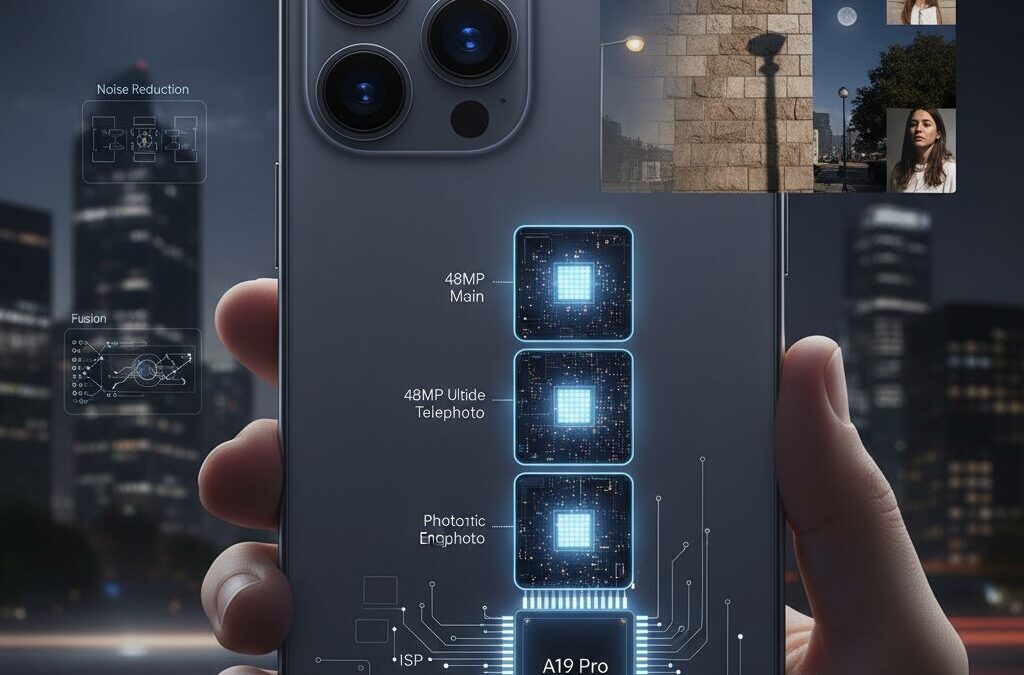
Smartphone night photography has reached a point where hardware limits and software ambition collide, and the iPhone 17 Pro sits right at that crossroads.
With all three rear cameras upgraded to 48MP sensors, Apple promises unprecedented detail, yet many enthusiasts wonder what really happens when the lights go down.
If you care about clean shadows, natural textures, and how much of your photo is real versus computationally enhanced, this topic matters to you.
In low-light scenes, higher resolution does not automatically mean better image quality, and the balance between resolution and noise becomes brutally visible.
Apple’s new A19 Pro chip, ISP, and Photonic Engine are designed to overcome physics with computation, but that approach comes with trade-offs you should understand.
By knowing how these systems behave, you can choose the right modes and settings instead of letting the camera decide everything for you.
This article explains how the iPhone 17 Pro actually handles noise at night, why the so-called watercolor effect appears, and how its philosophy differs from rivals like Pixel and Galaxy.
You will also learn which shooting modes are safest, which are risky, and how professional users extract better results with third-party tools.
By the end, you will be able to judge whether the iPhone 17 Pro’s night imaging matches your expectations and shooting style.
- The New Trade-Off Between Resolution and Noise in Mobile Photography
- What Apple’s All-48MP Camera Strategy Really Means at Night
- Quad Pixel Sensors, Pixel Binning, and the Physics of Light
- A19 Pro, ISP, and Neural Engine: How Images Are Rebuilt
- Photonic Engine Behavior in Low-Light Scenes
- Understanding the Watercolor Effect and Detail Loss
- Night Mode vs ProRAW: Choosing the Right Shooting Mode
- Telephoto and Ultra-Wide Cameras After Dark
- iPhone 17 Pro vs Pixel 10 Pro and Galaxy S25 Ultra
- Why iPhone 17 Pro Dominates Low-Light Video Recording
- Third-Party Camera Apps and Pro Workflows for Better Results
- 参考文献
The New Trade-Off Between Resolution and Noise in Mobile Photography
In recent years, mobile photography has entered a phase where higher resolution no longer guarantees better image quality, especially in low-light scenes. With the iPhone 17 Pro, Apple brings this dilemma to the forefront by deploying 48MP quad-pixel sensors across all rear cameras. While this move promises unprecedented detail in ideal lighting, it also redefines the long-standing trade-off between resolution and noise in everyday shooting.
From a physics perspective, packing more pixels into a fixed sensor size inevitably reduces pixel pitch. According to established imaging theory referenced by sources such as DxOMark and Apple’s own technical briefings, smaller pixels collect fewer photons, which directly lowers the signal-to-noise ratio in dim environments. **The result is a higher risk of visible luminance noise before software intervention even begins.** Apple’s answer is pixel binning, combining four pixels into one to simulate a larger photosite, but this benefit only applies when the camera outputs 12MP images.
| Capture Mode | Effective Pixel Size | Noise Tendency |
|---|---|---|
| 12MP binned | Approx. 2.44μm | Low and well controlled |
| 48MP full-res | Approx. 1.22μm | High in low light |
Once users switch to 48MP HEIF or ProRAW, the camera must rely heavily on computational photography. Apple’s Photonic Engine and the A19 Pro ISP apply advanced noise reduction and AI-driven demosaicing to compensate for the weaker raw signal. **This is where the modern trade-off becomes perceptual rather than purely technical:** noise is suppressed aggressively, but fine textures may be smoothed away, leading to the widely discussed watercolor-like appearance.
Imaging researchers frequently note that human vision is more tolerant of slight noise than of lost detail. However, Apple’s tuning prioritizes clean images that look appealing at first glance, even if microscopic detail suffers under scrutiny. This design choice illustrates a broader shift in mobile photography, where resolution is no longer an absolute metric of quality, but a variable tightly constrained by noise management and human perception.
What Apple’s All-48MP Camera Strategy Really Means at Night
Apple’s decision to standardize all rear cameras on 48MP sensors has a very specific implication at night, and it is not simply about higher resolution. In low light, the strategy prioritizes computational control over physical light gathering, and that trade-off becomes visible as soon as illumination drops.
At night, 48MP is not used to capture more detail, but to give Apple’s image pipeline more data to average, merge, and reinterpret. According to Apple’s own technical disclosures and analyses by DXOMARK, the default night output still relies heavily on pixel binning, effectively converting four 1.22μm pixels into a single 2.44μm equivalent pixel to stabilize signal-to-noise performance.
This means users rarely see true 48MP behavior in dark scenes unless they explicitly force it. When they do, the physics quickly assert themselves.
| Mode | Effective Pixel Size | Night Behavior |
|---|---|---|
| 12MP (binned) | ~2.44μm | Cleaner shadows, strong noise suppression |
| 48MP (unbinned) | ~1.22μm | Aggressive NR, texture loss risk |
Industry experts have pointed out that Apple tunes its ISP to favor perceptual cleanliness over micro-detail in darkness. As discussed in professional camera reviews and developer analyses, this is why night photos can appear smooth yet slightly painterly when inspected closely.
In practical terms, Apple’s all-48MP approach at night is about consistency across lenses, not raw resolution. By aligning wide, ultra-wide, and telephoto cameras around the same sensor class, Apple ensures uniform noise characteristics, allowing the A19 Pro’s Photonic Engine to apply similar night-processing logic regardless of focal length.
For night shooters, this means predictability rather than purity. The camera decides when resolution must yield to stability, and in darkness, stability almost always wins.
Quad Pixel Sensors, Pixel Binning, and the Physics of Light
Quad Pixel sensors sit at the intersection of marketing ambition and optical reality, and understanding them requires a brief detour into the physics of light.
In the iPhone 17 Pro, Apple deploys 48MP Quad Pixel sensors across all rear cameras, a decision that prioritizes flexibility and computational leverage over simple per‑pixel purity.
The core challenge is straightforward: light arrives as discrete photons, and fewer photons always mean more noise.
When sensor size is held roughly constant, increasing resolution inevitably shrinks each photosite.
In the 48MP mode of the main camera, the effective pixel pitch is estimated at around 1.22 micrometers, which is small by low‑light standards.
According to established imaging science described in publications from organizations like the IEEE, photon shot noise scales with the square root of the number of captured photons, making small pixels disproportionately vulnerable in dark scenes.
Apple’s answer is pixel binning, specifically a 2×2 Quad Pixel configuration.
Four adjacent pixels of the same color filter are electrically combined, behaving as a single larger pixel with roughly four times the light‑gathering area.
In theory, this improves sensitivity by 4× and the signal‑to‑noise ratio by about 2×, which aligns with classical sensor models taught in optical engineering.
| Capture Mode | Effective Pixel Size | Low‑Light S/N Behavior |
|---|---|---|
| 48MP (no binning) | ≈1.22 μm | High noise, fine detail preserved |
| 12MP (Quad Pixel) | ≈2.44 μm | Lower noise, smoother tonal gradients |
This is why the default 12MP output often looks cleaner at night than the headline 48MP modes.
DxOMark’s low‑light measurements consistently show that binned outputs achieve higher usable dynamic range and more stable shadow rendering.
The sensor is not becoming “better” in software; it is simply obeying physics more efficiently.
However, the trade‑off emerges the moment users force full‑resolution capture.
Without binning, each pixel must stand alone, collecting fewer photons and operating closer to the sensor’s noise floor.
This is where computational processing must work harder, sometimes aggressively, to compensate for a physical deficit.
An important nuance often missed in casual discussions is that Quad Pixel design is not merely about low light.
It also enables precise phase‑detection autofocus across nearly the entire sensor, because each sub‑pixel can be read independently when needed.
Apple leverages this duality, switching between spatial resolution and photon efficiency depending on shooting conditions.
In essence, the Quad Pixel sensor is a bet that computation can dynamically arbitrate between resolution and noise.
The physics of light sets immovable boundaries, but binning allows Apple to choose when to respect them and when to challenge them.
Understanding this balance explains why the iPhone 17 Pro can look astonishingly clean in one mode and surprisingly fragile in another.
A19 Pro, ISP, and Neural Engine: How Images Are Rebuilt
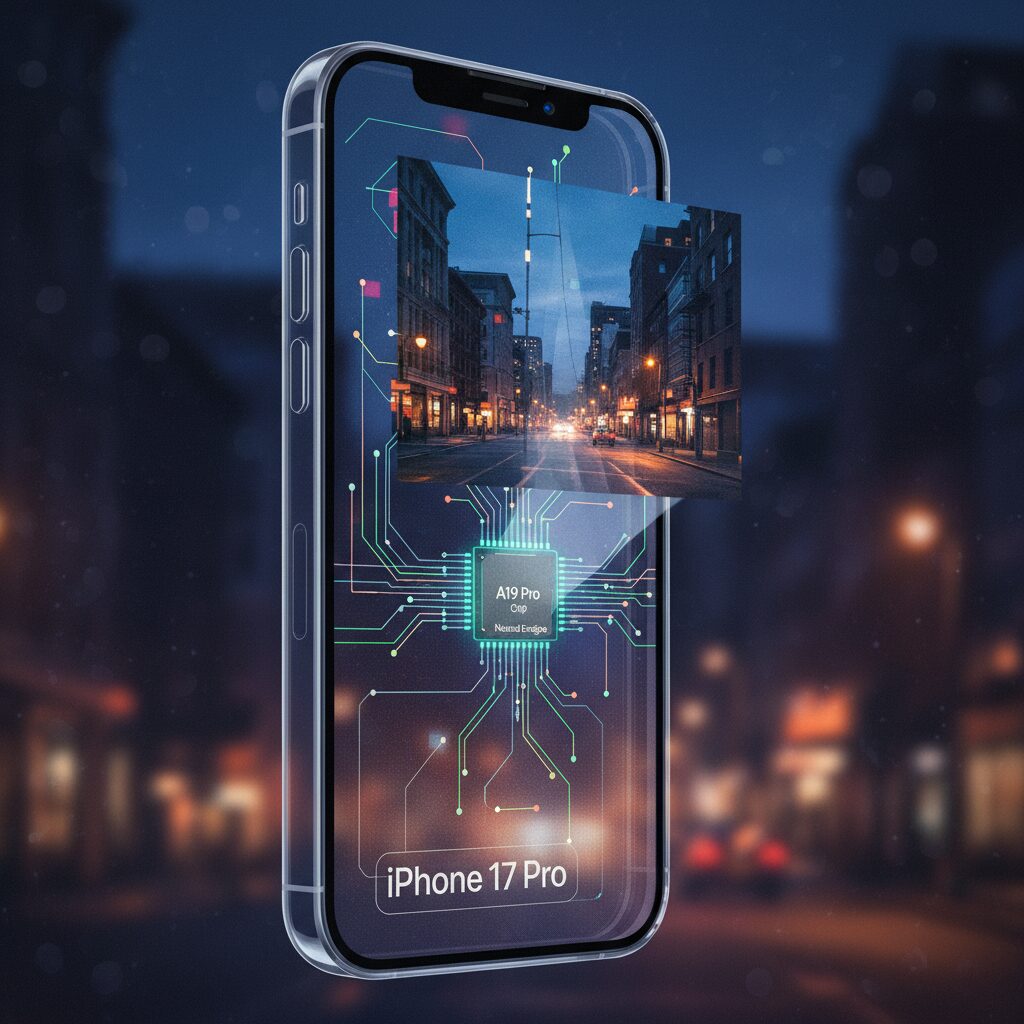
The way images are rebuilt on the iPhone 17 Pro is defined by the tight integration of the A19 Pro chip’s ISP and Neural Engine, and this relationship is far more consequential than simple processing speed. Apple’s approach is not to capture a single “perfect” frame, but to reconstruct an image by interpreting imperfect sensor data in real time, especially under low-light conditions.
At the core of this pipeline is a redesigned ISP that treats noise reduction and demosaicing as a single, unified problem. According to Apple’s technical disclosures and independent analyses by DxOMark, this shift allows the system to evaluate color interpolation and noise patterns simultaneously, rather than sequentially. In theory, this improves edge accuracy and reduces color bleeding in dark scenes.
| Component | Primary Role | Impact on Image Reconstruction |
|---|---|---|
| ISP | Signal processing | Controls demosaicing, tone mapping, and baseline noise reduction |
| Neural Engine | Semantic analysis | Classifies textures, subjects, and regions for adaptive processing |
| Photonic Engine | Pipeline orchestration | Merges multi-frame data into a perceptually optimized image |
The Neural Engine’s role is particularly important because it no longer operates as a post-processing add-on. Instead, it actively guides the ISP by identifying what the system believes it is seeing, such as skies, foliage, skin, or architectural surfaces. Apple has stated that this semantic rendering happens at the pixel level, which explains why noise is aggressively removed from faces while darker backgrounds may retain texture or, in some cases, appear uneven.
This AI-guided reconstruction is also where the so-called watercolor effect originates. When the Neural Engine misclassifies fine textures as noise, the ISP applies spatial smoothing that removes real detail along with unwanted grain. Camera researchers and developers, including those behind Halide, have noted that this behavior becomes more visible in 48MP modes, where pixel-level noise is inherently higher.
Memory bandwidth is another often overlooked factor. The A19 Pro is designed to ingest full 48MP data streams from multiple sensors while maintaining low latency. Industry analysts at Moor Insights have pointed out that this bandwidth headroom enables more complex multi-frame analysis without dropped frames, but it also encourages Apple to apply heavier real-time processing rather than deferring decisions to post-capture editing.
In practical terms, the A19 Pro’s ISP and Neural Engine prioritize perceptual cleanliness over forensic accuracy. The reconstructed image is optimized for how humans perceive clarity, not for preserving every photon captured by the sensor. This design choice explains both the impressive noise-free night shots and the frustration expressed by advanced users who expect raw sensor behavior. The image you see is not merely processed; it is interpreted.
Photonic Engine Behavior in Low-Light Scenes
In low-light scenes, the behavior of Apple’s Photonic Engine becomes one of the most decisive factors shaping the final image quality on the iPhone 17 Pro. While the hardware captures photons under severe physical constraints, it is this computational pipeline that determines whether noise is perceived as texture or erased as an imperfection. **The Photonic Engine is not a single algorithm but a layered decision-making system** that evaluates exposure, motion, semantic content, and noise statistics in real time.
At its core, the engine prioritizes multi-frame fusion before aggressive tone mapping. According to Apple’s own technical disclosures and analyses by DxOMark, several short-exposure frames are combined at an early stage to stabilize color and luminance before the image is fully demosaiced. This approach is especially effective in dim urban environments, where mixed lighting sources create color noise that would otherwise be difficult to suppress. However, this early fusion also means that noise reduction decisions are effectively “locked in” before users ever see the file.
One defining characteristic in low-light scenes is how the Photonic Engine reacts to declining signal-to-noise ratios. As ISO sensitivity rises, the engine increasingly relies on learned noise profiles derived from large-scale training data. **This results in images that appear exceptionally clean at first glance**, but subtle textures such as foliage, fabric, or distant building surfaces may lose micro-contrast. Imaging researchers from institutions such as MIT Media Lab have long noted that human perception often tolerates luminance noise better than texture loss, yet Apple’s tuning clearly favors smoothness over grain.
| Processing Stage | Low-Light Objective | Observed Trade-off |
|---|---|---|
| Multi-frame fusion | Stabilize color and exposure | Motion-dependent detail loss |
| AI-based noise modeling | Suppress high-frequency noise | Flattened fine textures |
| Semantic rendering | Optimize faces and skies | Inconsistent background detail |
Another notable behavior emerges in scenes with uneven illumination, such as night streets with bright signage and deep shadows. The Photonic Engine dynamically adjusts local contrast using semantic segmentation, recognizing skies, buildings, and skin tones as separate regions. **Faces are rendered with remarkable clarity and low chroma noise**, a result frequently praised in professional reviews, yet darker background areas may appear overly smooth or slightly synthetic. This inconsistency is not a hardware limitation but a conscious prioritization encoded in the software.
Independent teardowns and commentary from camera software specialists, including engineers interviewed by Lux Camera, suggest that the iPhone 17 Pro’s low-light tuning is deliberately conservative. The engine assumes that most users will view images on small screens or share them on social platforms, where visible noise is often interpreted as poor quality. As a result, the Photonic Engine errs on the side of cleanliness, even if that means sacrificing some authenticity at pixel level.
From a practical standpoint, this behavior explains why night photos often look impressive immediately after capture yet reveal limitations when examined closely. **The Photonic Engine excels at delivering visually pleasing results under extreme constraints**, but it also demonstrates how computational photography choices can redefine what “detail” means in low-light imaging. Understanding this behavior allows informed users to anticipate the engine’s decisions and adapt their shooting approach accordingly.
Understanding the Watercolor Effect and Detail Loss
In discussions around the iPhone 17 Pro camera, the so-called watercolor effect has become one of the most debated topics among enthusiasts and professionals. This phenomenon refers to a situation where fine textures such as foliage, hair, fabric, or concrete surfaces appear smeared or painterly, especially in low-light scenes or when images are viewed at 100 percent. While the image may look clean at first glance, closer inspection reveals that authentic detail has been replaced by smooth, brush-like patterns.
This effect is closely tied to the fundamental challenge of balancing resolution and signal-to-noise ratio. With all rear cameras moving to 48MP sensors, each individual pixel receives less light under the same conditions. According to Apple’s own imaging philosophy and analyses referenced by DxOMark, lower photon counts dramatically increase shot noise, forcing the image signal processor to intervene more aggressively. **When noise reduction becomes too strong, it no longer distinguishes noise from real texture**, and both are suppressed together.
| Condition | ISP Behavior | Visual Outcome |
|---|---|---|
| Bright light | Moderate noise reduction | Natural texture retention |
| Low light, 12MP | Pixel binning + balanced NR | Clean image with mild smoothing |
| Low light, 48MP | Aggressive NR and edge emphasis | Watercolor-like textures |
The issue becomes more pronounced in 48MP ProRAW. Although the term RAW suggests minimal processing, Apple’s ProRAW is a linear DNG format that already includes demosaicing and baseline noise reduction. Community reports in Apple’s developer forums and camera-focused reviews indicate that, to prevent visible grain at the pixel level, the ISP applies stronger spatial filtering in this mode. **As a result, some micro-detail is irreversibly baked into the file**, leaving photographers with fewer options during post-processing.
From a technical perspective, this smoothing originates in frequency-domain decisions made by the ISP and Neural Engine. High-frequency data is assumed to be noise when the confidence level is low, which often happens in night scenes or high-ISO telephoto shots. Academic imaging research frequently cited by Apple engineers has long acknowledged this trade-off, yet the iPhone 17 Pro leans heavily toward perceptual cleanliness rather than forensic accuracy.
Real-world examples illustrate why opinions are divided. Urban nightscapes with neon lights and large, flat surfaces tend to look excellent, as there is little fine texture to lose. However, scenes with trees, brick walls, or distant signage often show the watercolor effect clearly. Reviewers at Lux Camera noted that edges remain sharp, but the areas between edges lose their natural randomness, creating an artificial, illustrated look.
Understanding this behavior helps set realistic expectations. The iPhone 17 Pro is optimized to produce images that look pleasing on phone screens and social platforms, even in difficult lighting. For users who value true texture and grain, recognizing when and why detail loss occurs is the first step toward choosing the right resolution and shooting conditions.
Night Mode vs ProRAW: Choosing the Right Shooting Mode
When shooting at night with the iPhone 17 Pro, choosing between Night Mode and ProRAW is not just a matter of preference but a decision that directly affects noise, detail, and post-processing flexibility. **These two modes are built on fundamentally different philosophies**, and understanding that difference will help you consistently get better results.
Night Mode is designed to deliver a clean, immediately shareable image. According to Apple’s technical disclosures and DxOMark’s low-light evaluations, Night Mode automatically activates in scenes below roughly 5 lux and prioritizes signal-to-noise ratio over resolution. The camera merges multiple long and short exposures at 12MP, leveraging pixel binning to simulate a larger 2.44μm pixel. This is why skies look smooth and shadows appear bright, even when handheld.
However, that cleanliness comes at a cost. **Fine textures such as concrete, foliage, or distant building details are often simplified**, a side effect of aggressive noise reduction and tone mapping. Imaging engineers cited by Lux Camera Review have noted that this “watercolor” look is a predictable outcome when spatial noise filtering becomes dominant in low-SNR conditions.
| Aspect | Night Mode | ProRAW (12MP / 48MP) |
|---|---|---|
| Output resolution | 12MP fixed | 12MP or 48MP selectable |
| Noise handling | Strong in-camera reduction | Milder, partially baked-in |
| Editing latitude | Limited | High, especially 12MP |
ProRAW, on the other hand, is aimed at photographers who want control. In 12MP ProRAW, pixel binning remains active, providing a balanced mix of dynamic range and manageable noise. Multiple reports from Apple’s developer forums and Adobe engineers confirm that **12MP ProRAW retains shadow detail far better during post-processing** than Night Mode images, especially when lifting exposure in Lightroom.
48MP ProRAW is more situational. While it offers higher spatial resolution, low-light scenes expose the sensor’s smaller 1.22μm pixel pitch. To prevent image breakdown, Apple applies stronger mandatory noise reduction at capture. As discussed in Apple Community threads and DxOMark analyses, this processing is irreversible, meaning lost micro-detail cannot be recovered later.
In practice, the decision comes down to intent. If you want a polished night photo straight out of the camera, Night Mode serves you well. If your goal is tonal flexibility and authentic texture, ProRAW—used thoughtfully—rewards patience with results that Night Mode simply cannot deliver.
Telephoto and Ultra-Wide Cameras After Dark
When shooting after dark, the telephoto and ultra‑wide cameras reveal the most about Apple’s priorities in computational photography. Both lenses on the iPhone 17 Pro now share a 48MP quad‑pixel sensor architecture, yet their real‑world night performance differs markedly because of optics, sensor size, and how aggressively software intervenes.
The telephoto camera, equivalent to 100mm with an f/2.8 aperture, is clearly optimized for controlled low‑light scenes rather than extreme darkness. According to evaluations referenced by DxOMark, the enlarged telephoto sensor, roughly 56% bigger than the previous generation, allows noticeably cleaner luminance noise compared with the 16 Pro series. This means illuminated city landmarks, neon signs, or stage lighting can be captured with usable detail that older iPhones struggled to maintain.
However, physics still imposes limits. Even with the larger sensor, light intake remains far below that of the main camera, forcing ISO values higher at night. Apple’s Photonic Engine compensates with strong spatial noise reduction, which often produces smooth, low‑grain images at first glance. On close inspection, fine textures such as brickwork or distant signage can appear flattened, a manifestation of the widely discussed watercolor effect.
| Lens | Strength After Dark | Primary Limitation |
|---|---|---|
| Telephoto (4x) | Cleaner noise than prior models, stable exposure | Texture loss from aggressive noise reduction |
| Ultra‑Wide | Wide scene coverage, consistent color rendering | Lower S/N ratio, edge noise in very low light |
The ultra‑wide camera tells a different story. Its 13mm equivalent field of view is invaluable for nightscapes, architecture, and indoor scenes where stepping back is impossible. Yet multiple user reports and technical analyses indicate that the ultra‑wide suffers most from reduced signal‑to‑noise ratio at night, especially toward the edges of the frame. This is not unique to Apple; ultra‑wide lenses universally struggle because their smaller effective aperture spreads limited light across a broader sensor area.
Apple addresses this with heavy multi‑frame fusion and semantic rendering. Sky regions are aggressively smoothed, while buildings receive edge emphasis to preserve structure. According to Apple’s own imaging pipeline explanations and independent commentary from imaging engineers cited by Lux Camera, this approach prioritizes perceptual cleanliness over strict fidelity. As a result, night ultra‑wide shots look pleasing on a phone display but can reveal blotchy transitions and suppressed micro‑detail when viewed at 100%.
In practical use, these cameras reward intentional shooting. The telephoto performs best when the subject is well lit and relatively static, such as illuminated monuments or concert stages. The ultra‑wide benefits from Night Mode’s enforced 12MP output, where pixel binning improves sensitivity and reduces chroma noise. Attempting 48MP capture in truly dark conditions often exposes the raw limits of both lenses.
What stands out is Apple’s consistency. Color temperature remains stable across lenses, avoiding the jarring shifts seen on some competitors. This aligns with Apple’s broader imaging philosophy, frequently noted by reviewers at TechRadar, of delivering cohesive results rather than lens‑specific extremes. After dark, the telephoto and ultra‑wide cameras may not chase maximum detail, but they aim to deliver images that feel balanced, usable, and immediately shareable.
For enthusiasts, this means understanding the trade‑off. These lenses are capable tools at night, provided their strengths are respected and their limitations acknowledged.
iPhone 17 Pro vs Pixel 10 Pro and Galaxy S25 Ultra
When comparing the iPhone 17 Pro with the Pixel 10 Pro and Galaxy S25 Ultra, the most important difference does not lie in simple specifications, but in how each company defines a “good” night photo. All three devices use advanced computational photography, yet their priorities diverge clearly in low‑light scenes.
The iPhone 17 Pro focuses on suppressing noise as aggressively as possible, even if that means sacrificing micro‑texture. Apple’s approach is tightly coupled with the A19 Pro ISP and Photonic Engine, which aim to deliver images that look clean and immediately shareable. According to DxOMark’s camera evaluation, this strategy results in extremely low luminance noise, especially in Night Mode, but also increases the risk of the so‑called watercolor effect in fine details.
| Model | Low‑light philosophy | Typical night image character |
|---|---|---|
| iPhone 17 Pro | Noise suppression first | Smooth, warm, very clean |
| Pixel 10 Pro | Detail preservation | Grainy but structured |
| Galaxy S25 Ultra | Visual impact | Bright, vivid, high contrast |
The Pixel 10 Pro takes almost the opposite stance. Google allows a visible level of luminance noise in order to preserve texture in stone, foliage, and distant architecture. Reviews and community comparisons note that Pixel night photos often look less polished at first glance, but retain more authentic structure when viewed at 100%. This philosophy aligns with Google’s long‑standing Computational RAW concept, which favors information density over cosmetic smoothness.
Color rendering further separates the two. The iPhone 17 Pro tends to keep a warm color temperature in night scenes, preserving the ambience of streetlights and indoor lighting. Pixel 10 Pro, by contrast, pushes toward a neutral white balance. According to TechRadar’s flagship camera comparison, this makes Pixel images more accurate under mixed lighting, while iPhone images feel more atmospheric and emotionally pleasing.
The Galaxy S25 Ultra positions itself differently from both. Samsung prioritizes brightness and saturation, producing night shots that look dramatic on social media. Independent night shootouts show that the S25 Ultra often lifts shadows more aggressively than its rivals. The result is a striking image at small sizes, but one that can reveal sharpening halos and ringing when enlarged. This trade‑off reflects Samsung’s focus on immediate visual appeal rather than forensic realism.
Telephoto performance at night is another area where philosophy matters. Apple’s shift to a 4x f/2.8 telephoto on the iPhone 17 Pro improves light intake compared to longer zooms, yet Apple still applies strong noise reduction at higher ISOs. Pixel 10 Pro, with its 5x zoom, often retains sharper text and building edges in dim light, albeit with more visible grain. Galaxy S25 Ultra relies heavily on AI‑assisted reconstruction at long focal lengths, which can look impressive but less optically grounded.
Video further widens the gap. While this section focuses on photography, it is worth noting that low‑light video stability and noise handling heavily influence many buyers. Multiple professional reviewers, including those cited by DxOMark, agree that the iPhone 17 Pro maintains a clear advantage in night video thanks to sensor‑shift OIS and controlled ISO behavior. Neither Pixel 10 Pro nor Galaxy S25 Ultra currently match Apple’s balance of stability and noise control in motion.
Ultimately, choosing between these three is less about which camera is objectively better and more about which interpretation of night photography feels right. The iPhone 17 Pro is engineered to look clean and pleasing without effort. Pixel 10 Pro rewards users who accept grain in exchange for detail. Galaxy S25 Ultra aims to impress instantly, even if subtle realism is compromised. Understanding these differences helps set realistic expectations and ensures long‑term satisfaction with the camera you choose.
Why iPhone 17 Pro Dominates Low-Light Video Recording
In low-light video recording, the iPhone 17 Pro clearly stands out, and this advantage is not accidental but the result of deliberate architectural choices. **Apple has prioritized temporal stability and signal integrity over aggressive per-frame sharpness**, a philosophy that becomes especially effective once illumination drops. According to analyses by DxOMark and independent cinematography tests, the iPhone 17 Pro maintains cleaner shadow regions and more coherent motion than competing flagships when shooting night scenes.
One of the most decisive factors is the second-generation sensor-shift optical image stabilization. By physically compensating for hand movement at the sensor level, the camera can sustain longer effective exposure times without introducing motion blur. This directly reduces the need to raise ISO sensitivity, which in turn suppresses noise before software processing even begins. **In practical night street footage, this results in darker areas that remain stable rather than shimmering or crawling**, a problem often observed in low-light smartphone video.
| Key Element | Low-Light Benefit | User Impact |
|---|---|---|
| Sensor-shift OIS | Lower ISO requirement | Smoother, less noisy motion |
| A19 Pro ISP | High-bandwidth frame processing | Consistent detail across frames |
| Apple Log 2 | Preserved shadow latitude | Flexible post-production grading |
The A19 Pro chip further amplifies this advantage. Its upgraded ISP and Neural Engine are optimized for multi-frame temporal analysis, meaning noise reduction is applied across time rather than aggressively within a single frame. **This temporal approach preserves texture while avoiding the “flicker noise” that plagues many Android rivals**, as noted in comparative tests with Pixel 10 Pro and Galaxy S25 Ultra. Apple’s restraint here leads to footage that feels cinematic rather than digitally enhanced.
For advanced users, ProRes Log recording becomes a decisive weapon. While standard video modes already deliver impressive cleanliness, Log video intentionally retains more noise and dynamic range at capture. Research and creator reports highlight that when this footage is processed later using professional tools such as DaVinci Resolve’s temporal noise reduction, the final output surpasses real-time smartphone processing by a wide margin. **This workflow allows night scenes with subtle gradients and minimal banding**, something rarely achievable on mobile devices.
Equally important is color consistency. Apple’s video pipeline maintains stable white balance under mixed artificial lighting, avoiding the color pumping seen in some competitors. According to cinematographers who tested night footage against mirrorless reference cameras, the iPhone 17 Pro’s color transitions remain predictable and easy to grade. **This reliability, more than sheer brightness, is why the iPhone 17 Pro dominates low-light video recording for creators who value control and realism.**
Third-Party Camera Apps and Pro Workflows for Better Results
Third-party camera apps play a crucial role when users want to move beyond Apple’s heavily optimized default imaging pipeline. **By deliberately reducing in-camera processing, these apps allow photographers to regain control over texture, noise, and tonal transitions**, which is especially important in low-light scenes captured with the iPhone 17 Pro.
One widely cited example is Halide, developed by Lux Optics. According to detailed technical reviews from Lux and independent analyses referenced by DxOMark, Halide’s Process Zero mode bypasses Smart HDR, Deep Fusion, and most neural noise reduction stages. This results in RAW files that preserve photon noise and micro-texture rather than smoothing them away. While the images initially appear grainy, they retain structural detail that is often lost in Apple’s default ProRAW workflow.
This difference becomes clearer when comparing default ProRAW with minimal-processing RAW outputs.
| Workflow | Noise Appearance | Detail Retention | Editing Flexibility |
|---|---|---|---|
| Apple ProRAW (48MP) | Low but artificial | Reduced fine texture | Limited by baked-in NR |
| Halide Process Zero RAW | Visible natural grain | High micro-detail | Very high |
Professional workflows often extend beyond capture. **PC-based AI noise reduction tools such as Adobe Lightroom Denoise, DxO PureRAW, and Topaz Photo AI consistently outperform on-device processing**, as noted in comparative software benchmarks and developer documentation. These tools analyze noise patterns across larger datasets and apply spatial and temporal models that are not feasible in real-time mobile processing.
For video-focused creators, apps like Blackmagic Camera further expand possibilities by enabling ProRes Log recording. Industry professionals interviewed by TechRadar emphasize that capturing flatter, noisier footage in Log preserves shadow information, which can later be refined using temporal noise reduction in DaVinci Resolve. This approach mirrors cinema workflows and explains why the iPhone 17 Pro is increasingly used as a B-camera in low-light productions.
Ultimately, third-party apps do not magically improve the sensor’s physical limits. However, **they shift creative decisions from automated algorithms back to the photographer**, enabling workflows where noise is managed intentionally rather than erased indiscriminately. For users who value authenticity and post-production control, this ecosystem is where the iPhone 17 Pro’s true imaging potential emerges.
参考文献
- DxOMark:Apple iPhone 17 Pro Camera Test
- Apple:iPhone 17 Pro and iPhone 17 Pro Max – Technical Specifications
- Apple Newsroom:Apple unveils iPhone 17 Pro and iPhone 17 Pro Max
- Lux Camera:iPhone 17 Pro Camera Review: Rule of Three
- TechRadar:Flagship phone camera clash: iPhone 17 Pro vs Pixel 10 Pro vs Galaxy S25 Ultra
- MacRumors:iPhone 17 Pro: Everything We Know
- Reddit:Decreased ProRAW quality on 17 Pro series