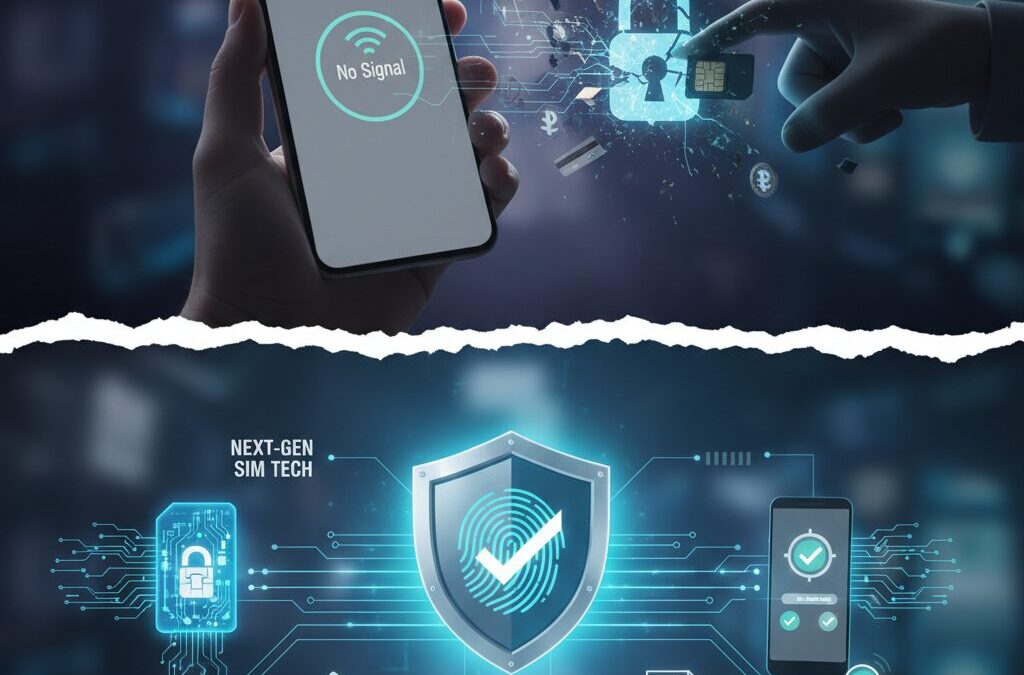
Have you ever lost signal suddenly and assumed it was just a network glitch?
In 2026, that moment of confusion can be the difference between safety and total digital compromise. SIM swap fraud has evolved into one of the most destructive cyberattacks, capable of draining bank accounts, hijacking crypto wallets, and permanently stealing online identities within minutes.
This article explains how 2026 has become a historic turning point for mobile and financial security. You will learn how new regulations, carrier-level technology, and passwordless authentication are finally closing long‑standing attack paths. By understanding these changes, gadget enthusiasts and tech‑savvy users can better protect their digital lives and make smarter choices about devices, networks, and authentication methods going forward.
- What SIM Swap Fraud Really Is and Why It Became So Dangerous
- Why 2026 Marks a Global Turning Point for Mobile Identity Security
- How New SIM Regulations Are Shutting Down Old Attack Techniques
- The Human Factor: Social Engineering and AI-Powered Impersonation
- How Mobile Carriers Are Reinforcing SIM and eSIM Infrastructure
- From Physical SIM to eSIM and iSIM: Security Gains and New Risks
- Why Financial Institutions Are Abandoning SMS Authentication
- Passkeys Explained: Phishing-Resistant Login for the Post-SMS Era
- AI as Both Weapon and Shield in Modern Identity Protection
- Practical SIM Swap Defense Strategies for Individual Users
- 参考文献
What SIM Swap Fraud Really Is and Why It Became So Dangerous
SIM Swap Fraud is a form of identity takeover in which an attacker impersonates a legitimate mobile subscriber and convinces a carrier to reissue a SIM card or provision an eSIM under the attacker’s control. Once this process succeeds, the victim’s smartphone suddenly loses network connectivity, while calls and SMS messages tied to the phone number are silently redirected to the attacker. According to analyses published by security researchers and incident-response firms, this single moment effectively hands over control of the victim’s digital life.
What makes this fraud especially insidious is that it does not rely on malware or advanced hacking of devices. Instead, it exploits the phone number itself as a trusted identity anchor. **Many online services still treat possession of a phone number as proof of identity**, using SMS-based one-time passwords for login, password resets, and transaction approvals. When attackers hijack the number, they inherit that trust instantly.
| Stage | What the attacker gains | What the victim experiences |
|---|---|---|
| SIM reissue | Control of calls and SMS | Phone shows “No Service” |
| Account recovery | SMS codes for resets | Unexpected reset alerts |
| Asset access | Banking and crypto entry | Locked out of accounts |
Security reports frequently emphasize that the danger lies in speed. With modern eSIM provisioning, attackers no longer need physical access or postal delivery. Research summarized by global incident-response teams shows that **the entire chain from SIM takeover to financial loss can complete in under five minutes**. During that window, victims often assume the outage is a temporary carrier issue and reboot their device, unaware that authentication messages are being intercepted elsewhere.
Another reason SIM Swap Fraud became so dangerous is its reliance on human systems rather than technical flaws. Studies cited by telecommunications regulators and security vendors indicate that the vast majority of cases stem from social engineering. Attackers use leaked personal data, rehearsed narratives, or even AI-generated voice impersonation to pressure customer support staff into bypassing safeguards. From the attacker’s perspective, persuading a human operator is often easier than breaking encryption.
The financial impact explains why organized crime has embraced this technique. Law-enforcement briefings and industry analyses describe SIM swap crews operating with clear role separation: data collectors harvest personal information, social engineers handle carrier interactions, and money-movement specialists drain accounts within minutes. Losses reported in recent years frequently reach millions of dollars per operation, particularly when cryptocurrency wallets are involved.
Finally, the broader digital ecosystem amplified the risk. For years, SMS-based authentication was promoted as a convenient second factor, even by major platforms. Academic researchers and standards bodies have since warned that SMS was never designed as a secure identity protocol. As long as phone numbers remained portable and reissuable with imperfect verification, SIM Swap Fraud was not an anomaly but an inevitable outcome of that design choice.
Understanding what SIM Swap Fraud really is, therefore, means recognizing it as a structural weakness in how identity, telecommunications, and online services intersected. Its danger did not suddenly appear overnight; it accumulated quietly, until criminals learned how to turn a simple customer-support request into total digital takeover.
Why 2026 Marks a Global Turning Point for Mobile Identity Security
In 2026, mobile identity security reaches a decisive global inflection point, because the weaknesses of phone-number–based trust finally become impossible to ignore at a societal scale. For years, SIM swap fraud has been treated as a niche telecom issue, but by the mid-2020s it is directly linked to mass financial theft, account takeovers, and erosion of digital trust. According to international security research and law enforcement briefings, the majority of high-impact account breaches still originate from the hijacking of a mobile number, not from sophisticated malware.
What makes 2026 different is the convergence of law, technology, and user behavior. Governments, starting with Japan in April 2026, no longer accept visual or document-image verification as sufficient for mobile identity. Instead, they mandate cryptographic verification using IC chips and digital signatures. This shift mirrors recommendations long advocated by institutions such as NIST and the FIDO Alliance, which have warned that possession of a phone number is not proof of identity.
| Before 2026 | From 2026 onward | Security implication |
|---|---|---|
| SMS-based OTP | Device-bound cryptographic auth | SIM swap attacks lose leverage |
| Visual ID checks | IC chip verification | Forgery and deepfakes neutralized |
| Human judgment 중심 | Protocol-enforced checks | Social engineering impact reduced |
At the same time, financial institutions worldwide accelerate their move away from SMS authentication. By 2026, large banks and brokerages treat passkeys and hardware-backed credentials as the default, not an optional upgrade. Security researchers emphasize that this transition directly breaks the economic incentive behind SIM swap fraud, because stealing a number no longer grants access to assets.
Another global factor is the rise of eSIM and iSIM. These technologies make mobile connectivity more flexible, but they also force the industry to define identity at the silicon and protocol level rather than at the carrier help desk. Standards bodies like GSMA respond with stricter mutual authentication rules, acknowledging that convenience without cryptographic assurance is no longer acceptable.
As a result, 2026 is remembered not just as a year of new regulations, but as the moment when the world collectively abandons the illusion that a phone number equals a person. Mobile identity finally becomes something that is mathematically provable, device-bound, and globally interoperable, and this change quietly reshapes how digital society protects trust.
How New SIM Regulations Are Shutting Down Old Attack Techniques
New SIM regulations introduced for 2026 are not just incremental improvements but structural changes that directly invalidate many of the classic SIM swap attack techniques used over the past decadeです。What makes this shift significant is that it targets the attacker’s preferred entry points rather than merely adding friction at later stages of fraudです。
For years, criminals relied on weaknesses in remote identity verification, especially visual checks of ID photos and selfiesです。According to Japan’s Ministry of Internal Affairs and Communications, these methods were never designed to withstand AI‑assisted forgery and voice impersonation, which became widely accessible after 2023です。その結果、制度そのものが攻撃の起点になっていました。
| Old attack technique | Why it worked before | Status after 2026 rules |
|---|---|---|
| Photo ID + selfie eKYC | Human visual checks were easy to fool | Effectively blocked by IC chip verification |
| Call center impersonation | Operators could override checks | Overridden by mandatory cryptographic proof |
| Fake physical ID at shops | Surface inspection only | Rejected without valid chip signatures |
The core of the reform is the mandatory use of IC chip–based identity data for SIM reissuance and number recoveryです。By requiring cryptographic verification from My Number cards or driver’s licenses, attackers lose the ability to rely on deepfake faces or stolen personal data aloneです。Digital signatures stored in chips cannot be recreated with consumer‑grade tools, which fundamentally changes the cost structure of crimeです。
Experts at the Digital Agency of Japan have noted that this is a classic example of “asymmetric defense”です。Defenders invest once in infrastructure, while attackers must now compromise hardware‑level trust anchors, a leap that is unrealistic for most criminal groupsです。その結果、従来型の大量攻撃は成立しなくなっています。
Another quietly powerful effect is procedural rigidityです。Under the new rules, even store staff must use certified IC readers, removing discretionary judgment that attackers previously exploited through social engineeringです。This directly addresses findings cited by cybersecurity researchers, including analyses referenced by Trend Micro, showing that human shortcuts accounted for the majority of SIM swap successesです。
In practical terms, old playbooks built around urgency, emotional manipulation, and forged documents are becoming obsoleteです。Attackers are being pushed toward far more complex supply‑chain or insider threats, which are harder to scale and easier to detect at a national levelです。That is how regulation, when paired with cryptography, quietly shuts the door on an entire class of attacksです。
The Human Factor: Social Engineering and AI-Powered Impersonation
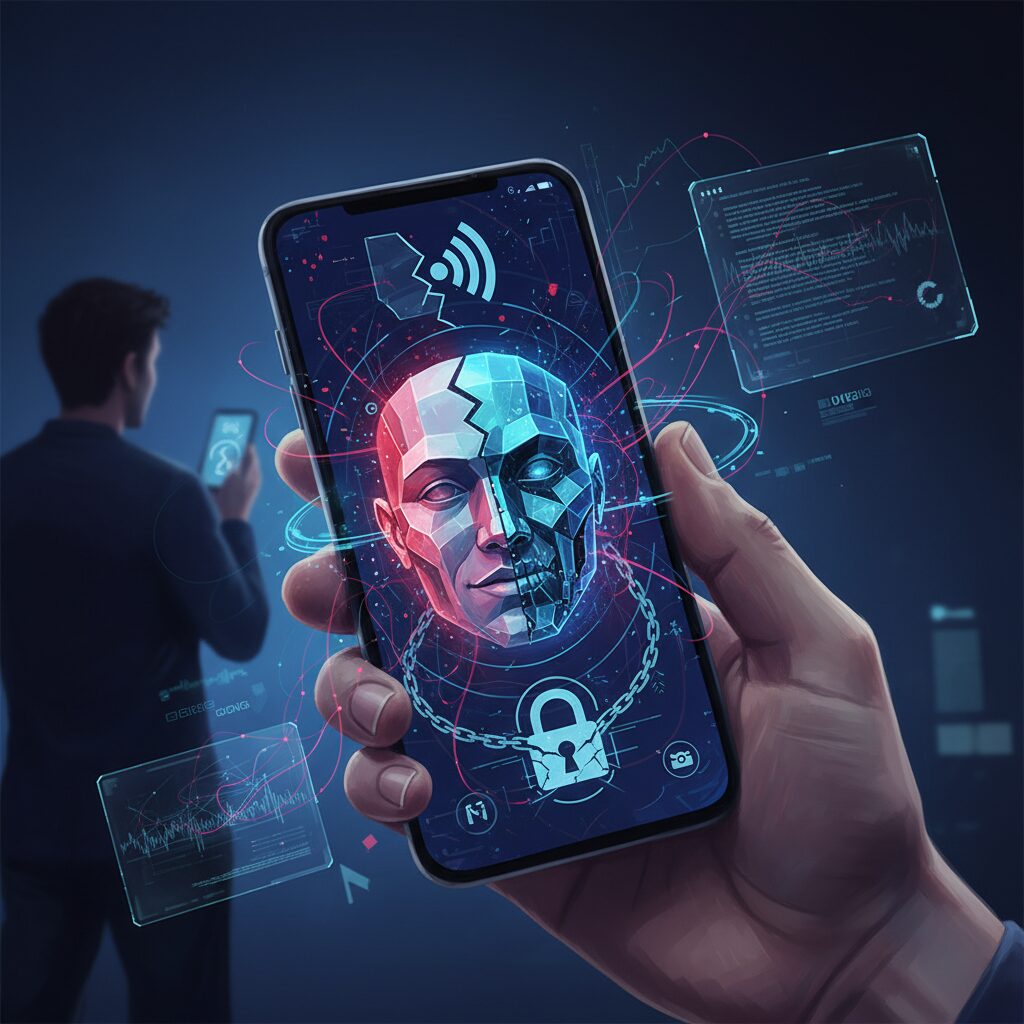
The most advanced security stack can still fail if the human element is compromised, and this is where modern SIM swap attacks increasingly focus their energy. In 2026, attackers no longer rely on technical exploits alone. Instead, they systematically exploit trust, urgency, and empathy, which remain deeply human traits. **According to law enforcement briefings and telecom incident reviews, the overwhelming majority of SIM swap cases originate from social engineering rather than software vulnerabilities.**
What has changed most dramatically is the role of AI in impersonation. Voice synthesis systems can now reproduce a person’s tone, pacing, and emotional cues from only a few seconds of recorded audio. Security researchers cited by Google’s Mandiant unit have warned that call center fraud has entered an era where “voice is no longer proof.” Operators faced with a caller who sounds distressed, authentic, and well-informed are placed under intense psychological pressure to resolve the issue quickly.
This pressure is not accidental. Attackers deliberately construct scenarios involving lost phones, travel emergencies, or imminent financial harm. These narratives are optimized by generative AI, trained on thousands of past fraud transcripts, to trigger compliance. **The attack succeeds not because staff are careless, but because they are human.** Average handling time metrics and customer satisfaction targets unintentionally amplify this risk.
| Human Weakness Exploited | AI-Enhanced Technique | Operational Impact |
|---|---|---|
| Empathy | Emotionally adaptive voice cloning | Verification steps shortened |
| Urgency bias | Real-time scenario generation | Exception handling invoked |
| Authority trust | Impersonation of corporate roles | Escalation paths abused |
Academic studies on human-in-the-loop security consistently show that **automation pushes attackers toward people, not systems**. Telecom fraud is now structured as an industrial process: data collectors feed personal details into AI agents, which then conduct repeated, low-cost calls until one succeeds. The marginal cost of failure is near zero, while a single success can unlock complete digital identities.
Experts from national cybersecurity agencies emphasize that awareness alone is insufficient. Training must be paired with structural safeguards that remove discretion at critical moments. From a user perspective, this reality reframes SIM swap risk as a social problem augmented by AI, not merely a technical flaw. Understanding this shift is essential for anyone who assumes that technology alone can compensate for human trust.
How Mobile Carriers Are Reinforcing SIM and eSIM Infrastructure
Mobile carriers in Japan are reinforcing SIM and eSIM infrastructure in 2026 with a clear priority on eliminating the structural weaknesses that enabled SIM swap fraud. This reinforcement does not focus only on user-facing procedures, but instead extends deep into provisioning systems, identity verification pipelines, and real-time risk controls that operate before a SIM profile is ever activated.
One of the most significant shifts is the carrier-wide move toward IC chip–based identity verification as a mandatory prerequisite for SIM reissue and eSIM provisioning. According to guidance published by the Ministry of Internal Affairs and Communications, visual inspection of ID documents is no longer considered sufficient, even in physical retail stores. **By binding SIM lifecycle operations directly to cryptographically verifiable identity data, carriers are closing the primary social-engineering entry point used in past attacks.**
At the infrastructure layer, carriers have redesigned their eSIM provisioning workflows to slow down and compartmentalize risk. Remote provisioning once optimized for speed is now governed by staged authorization, device binding, and contextual checks that evaluate whether a request aligns with the subscriber’s historical behavior.
| Infrastructure Layer | Pre-2025 Model | 2026 Reinforced Model |
|---|---|---|
| SIM Reissue Trigger | Customer request with basic KYC | IC chip verification with legal identity binding |
| eSIM Provisioning | Immediate remote download | Tokenized, time-limited provisioning |
| Device Association | Weak or optional | Hardware-level EID binding |
Major carriers such as NTT Docomo and KDDI are also reinforcing backend monitoring systems that correlate SIM events with network-level signals. For example, if a SIM reissue request originates from a location or time pattern inconsistent with the subscriber’s usage history, the request is automatically escalated or suspended. SoftBank has publicly discussed the adoption of UEBA-style analytics, a method long recommended by security researchers for detecting account takeover attempts at scale.
Another critical improvement lies in eSIM profile governance. Rather than treating an eSIM as a portable digital asset, carriers are increasingly treating it as a controlled credential. **Profiles are now issued with single-use provisioning tokens, strict expiration windows, and multi-channel user notifications**, ensuring that silent takeovers become far more difficult. Research summarized by GSMA working groups has repeatedly shown that reducing unattended provisioning time is one of the most effective ways to mitigate SIM swap damage.
Retail infrastructure is evolving in parallel. Carrier shops are being equipped with standardized IC readers connected directly to central identity verification services. This removes local discretion from staff and prevents attackers from exploiting human judgment under pressure. Experts in telecom fraud prevention have noted that most successful SIM swaps historically relied on procedural shortcuts rather than technical exploits.
Importantly, these measures do not exist in isolation. Carriers are aligning their infrastructure changes with financial institutions and platform providers that are abandoning SMS-based trust models. This alignment reduces the downstream value of a hijacked phone number, further discouraging attacks. As telecommunications analysts have pointed out, **a secure SIM is no longer just a connectivity issue, but a foundational element of national digital identity protection.**
For gadget enthusiasts and advanced users, the key takeaway is that 2026 marks a transition from reactive fraud handling to preventive infrastructure design. SIM and eSIM systems are no longer optimized solely for convenience, but for resilience under adversarial conditions, a change that fundamentally reshapes how mobile identity is protected.
From Physical SIM to eSIM and iSIM: Security Gains and New Risks
The shift from physical SIM cards to eSIM and further to iSIM fundamentally changes the security model of mobile identity, and in 2026 this transition is no longer theoretical but operational reality. Physical SIMs made attacks tangible and visible, because theft or duplication required physical access. eSIM and iSIM remove that surface entirely, which is a major security gain, but they also concentrate trust into software, provisioning servers, and supply chains.
From a defensive standpoint, eSIM dramatically reduces classic SIM swap vectors. According to GSMA technical documentation and recent academic surveys, remote provisioning relies on certificate-based mutual authentication between the carrier backend and the embedded UICC. This makes simple social engineering far less effective than in the era of plastic cards, because the attacker cannot just “reissue” a SIM without cryptographic authorization.
| SIM Type | Main Security Gain | Primary New Risk |
|---|---|---|
| Physical SIM | Isolated, offline credential | Theft, cloning, visual forgery |
| eSIM | Cryptographic provisioning | Backend and account takeover |
| iSIM | Hardware-level integration | Manufacturing supply chain |
However, security does not disappear; it relocates. With eSIM, the most sensitive point becomes the subscription management infrastructure. Research published via ResearchGate in 2025 highlights that while on-device security improved, attackers increasingly target carrier portals, identity verification workflows, and recovery processes. In other words, the SIM itself is safer, but the surrounding ecosystem becomes the battlefield.
iSIM pushes this logic even further by embedding SIM functionality directly into the SoC. This eliminates removable hardware entirely and significantly raises the bar for physical tampering. Semiconductor vendors emphasize power efficiency and space savings, but security researchers focus on a different issue: trust during manufacturing. If provisioning keys are injected at the factory, a single compromised production line can affect millions of devices before they ever reach users.
Industry analysts note that this risk is not hypothetical. Discussions within GSMA working groups and NIST-aligned supply chain security research repeatedly stress the need for a silicon-level root of trust and audited factory networks. The threat model shifts from “stolen phone” to “compromised fabrication environment,” which is rarer but far more impactful.
Another subtle risk emerges around speed. eSIM enables near-instant profile transfers, which improves user experience but compresses the attack timeline. Multiple incident analyses show that once identity checks fail, the window from takeover to financial loss can be measured in minutes. Faster technology magnifies both safety and damage.
In summary, moving from physical SIM to eSIM and iSIM in 2026 delivers real, measurable security gains at the cryptographic and hardware levels. At the same time, it demands a more mature understanding of systemic risk, where backend identity controls, factory security, and recovery procedures matter as much as the chip itself.
Why Financial Institutions Are Abandoning SMS Authentication
For decades, SMS-based one-time passwords were treated as a convenient compromise between security and usability in financial services. However, by 2026, that compromise has clearly collapsed, and financial institutions are abandoning SMS authentication not as a trend, but as a necessity driven by structural risk.
The most decisive factor is the industrialization of SIM swap fraud. According to analyses referenced by cybersecurity vendors and law enforcement agencies, the vast majority of account takeovers that bypass multi-factor authentication no longer rely on malware, but on hijacking the phone number itself. Once control of a number is lost, every SMS-based control collapses instantly, regardless of how strong the backend systems may be.
From the perspective of banks and brokerages, SMS is no longer a second factor but a single point of failure. This realization fundamentally changed internal risk models. A phone number is issued and governed by a telecom operator, not the financial institution, and customer support processes at carriers inevitably involve human judgment. As long as human-driven identity recovery exists, SMS cannot meet modern threat assumptions.
| Authentication Aspect | SMS-Based OTP | Device-Bound Authentication |
|---|---|---|
| Control Authority | Telecom carrier | Financial institution |
| Resistance to SIM Swap | None | High |
| Phishing Resilience | Low | Designed to be resistant |
Regulatory pressure also accelerated this shift. Supervisory authorities increasingly view SMS OTP as insufficient for protecting high-value transactions. In Japan, the surge in SIM swap–assisted financial fraud reported by the National Police Agency forced institutions to justify why they still relied on a channel known to be actively exploited. Internally, many compliance teams reached the same conclusion: continuing SMS authentication exposes institutions to reputational and legal risk that cannot be insured away.
Another decisive reason is the economics of incident response. When an SMS-based breach occurs, financial institutions must compensate victims, investigate cross-border money laundering routes, and temporarily suspend services. These downstream costs far exceed the investment required to deploy stronger authentication. As security researchers frequently point out, SMS shifts operational risk from attackers to defenders, because attackers act once while defenders must clean up repeatedly.
User behavior further undermined the viability of SMS. Studies cited by security vendors show that customers routinely reuse phone numbers across banking, crypto exchanges, and social platforms. This creates a cascading failure effect: one successful SIM swap opens multiple financial doors within minutes. From a systemic risk standpoint, financial institutions recognized that SMS authentication actively amplifies blast radius rather than containing it.
Finally, the maturation of alternatives removed the last practical justification for SMS. Standards-based authentication tied to secure hardware and biometrics became widely available and stable by 2026. As organizations like FIDO Alliance and major platform providers demonstrated, it is now possible to deliver stronger security while reducing login friction. Once a safer method is also easier, continuing to use SMS becomes indefensible.
In this context, financial institutions are not abandoning SMS because it is old, but because it contradicts modern threat intelligence, regulatory expectations, and cost realities. SMS authentication was designed for a world where phone numbers were trusted identifiers. That world no longer exists.
Passkeys Explained: Phishing-Resistant Login for the Post-SMS Era
As SMS-based one-time passwords crumble under the weight of SIM swap fraud, passkeys have emerged as the most practical answer for the post-SMS era. Passkeys are built on the FIDO2 and WebAuthn standards, and their defining feature is simple yet profound: the secret never leaves the user’s device. There is no shared password, no code traveling over telecom networks, and nothing for attackers to intercept.
According to the FIDO Alliance and research referenced by major platform vendors such as Apple and Google, passkeys are inherently resistant to phishing because they are cryptographically bound to the legitimate domain. Even if a user is tricked into visiting a fake website, the authentication simply fails. This property directly neutralizes the most common kill chain that follows SIM swaps.
| Authentication Method | Exposure to SIM Swap | Phishing Resistance |
|---|---|---|
| SMS OTP | High | Low |
| Authenticator App | Medium | Medium |
| Passkeys | None | Very High |
In real-world deployments, financial institutions that defaulted to passkeys in 2026 reported a sharp reduction in account takeover attempts linked to phone number compromise. Security teams emphasize that stealing a number is no longer enough; attackers would need the physical device and successful biometric authentication, a hurdle that drastically raises cost and risk.
For users, the experience is equally transformative. Logging in with Face ID, fingerprint, or Windows Hello feels instant, yet the security model is stronger than any complex password policy. With improved cross-device synchronization through trusted cloud recovery flows, passkeys finally resolve the long-standing tension between usability and security, marking a clean break from the fragile SMS era.
AI as Both Weapon and Shield in Modern Identity Protection
In 2026, artificial intelligence has become both the most dangerous weapon for attackers and the most reliable shield for defenders in identity protection. This duality is especially visible in SIM swap–driven account takeovers, where AI dramatically compresses the time between reconnaissance and financial loss.
According to Google Cloud’s Mandiant cybersecurity outlook, AI is no longer an experimental tool for threat actors but a baseline capability. Generative models now automate social engineering at a scale and precision that was impossible only a few years ago, fundamentally changing the economics of identity crime.
On the offensive side, AI enables hyper-personalized phishing, smishing, and vishing. By training models on leaked datasets and public social media traces, attackers generate messages and voice calls that match a victim’s writing style, vocabulary, and even emotional patterns.
Security researchers have noted that a few seconds of recorded audio are now sufficient to synthesize a convincing voice clone. In SIM swap scenarios, this allows AI agents to repeatedly call carrier support lines, impersonating victims with near-perfect accuracy and exploiting human-centered processes.
| Aspect | AI as Weapon | AI as Shield |
|---|---|---|
| Authentication Abuse | Voice cloning and adaptive scripts deceive human operators | Behavioral biometrics detect non-human interaction patterns |
| Attack Speed | Automated retries reduce takeover time to minutes | Real-time anomaly detection blocks actions before completion |
| Scalability | One model targets thousands of identities simultaneously | Models learn population-level norms and spot outliers instantly |
Defenders respond by embedding AI deeper into identity infrastructure. Telecom operators and financial platforms increasingly rely on user and entity behavior analytics, where models learn how a legitimate user taps, scrolls, speaks, and moves across networks.
Even when credentials or one-time codes are compromised, deviations in micro-behaviors trigger step-up authentication or session termination. This reflects a broader industry shift away from static identity toward continuously verified identity.
Mandiant analysts emphasize that AI-driven defense is most effective when it anticipates intent rather than reacts to breaches. Predictive models correlate signals such as unusual SIM reissuance requests, atypical access times, and sudden changes in device context.
However, this arms race introduces new risks. Experts warn that poisoned or synthetic training data can degrade defensive models, a concern amplified by the so-called 2026 AI data scarcity problem discussed by NTT and other research bodies.
The critical insight for 2026 is that AI alone is neither good nor evil. Identity protection succeeds when AI is paired with hardware-bound credentials, strong legal frameworks, and human processes redesigned to assume that deception is the default state.
In this environment, AI does not replace trust but continuously tests it. For users and providers alike, understanding AI as both adversary and ally is now a prerequisite for surviving modern identity threats.
Practical SIM Swap Defense Strategies for Individual Users
For individual users, effective SIM swap defense in 2026 is no longer about installing a single app or memorizing emergency steps. It is about redesigning your personal security posture so that your phone number is treated as an untrusted identifier rather than a proof of identity. **This mindset shift alone dramatically reduces real-world risk**, according to guidance echoed by NIST and major financial regulators.
One of the most practical steps is proactively locking down carrier-side controls before an incident occurs. Japanese carriers now expose granular settings that allow users to restrict remote SIM reissuance or require in-person IC chip verification. Users who enable these options are statistically less likely to experience successful SIM takeover attempts, as carrier fraud teams report that most attacks still rely on urgency and procedural shortcuts.
| Defense Layer | User Action | Risk Reduction Effect |
|---|---|---|
| Carrier Controls | Disable online SIM reissue and port-out by default | Blocks social engineering entry points |
| Authentication | Replace SMS OTP with passkeys or authenticator apps | Neutralizes number hijacking |
| Device Security | Enable SIM PIN and OS-level biometric locks | Prevents physical misuse |
Equally important is removing SMS from critical authentication flows. By 2026, major banks and cloud providers have publicly acknowledged that SMS-based verification is vulnerable to SIM swap abuse. **Passkeys based on FIDO2 standards bind authentication to your physical device and biometrics**, making stolen phone numbers irrelevant. Research cited by Google’s security teams shows that phishing-resistant credentials reduce account takeover attempts by more than 90 percent.
Finally, users are encouraged to rehearse a rapid response scenario. Experts from Japan’s National Police Agency emphasize that immediate carrier suspension and financial account freezes within the first ten minutes can be the difference between inconvenience and irreversible loss. Preparing these steps in advance is a quiet but powerful form of personal cyber resilience.
参考文献
- Keepnet Labs:SIM Swap Fraud 2025: Stats, Legal Risks & 360° Defenses
- Specops Software:SIM-swap fraud: Scam prevention guide
- Ministry of Internal Affairs and Communications (Japan):Review of Identity Verification Methods Under the Mobile Phone Improper Use Prevention Act
- ResearchGate:Security of eSIM Technology: Latest Trends and Innovations in 2025
- IoT Business News:eSIM + iSIM in 2026: Real Deployment Challenges That Vendors Don’t Advertise
- SMBC Nikko Securities:Introduction of Passkey Authentication for Account Login