If you love gadgets and care deeply about camera performance, macro photography on smartphones is no longer a niche feature but a real buying factor.
Many flagship phones promise stunning close-up shots, yet the actual experience often changes once you move the lens just a few centimeters closer.
With the iPhone 17 Pro, Apple pushes mobile macro photography forward through a combination of 48MP sensors, advanced optics, and heavy computational processing.
At the same time, physical limits such as minimum focus distance and working distance still shape what is realistically possible in daily shooting.
This article carefully explains how the iPhone 17 Pro handles macro photography, why lens switching happens, and what really occurs behind the scenes when you move closer to a subject.
By understanding these mechanisms, you can decide whether the iPhone 17 Pro truly fits your shooting style and how to get the best results from its camera system.
- Why Minimum Focus Distance Matters in Mobile Macro Photography
- The 48MP Pro Fusion Camera System: Hardware Foundations
- Ultra Wide Macro: How iPhone 17 Pro Reaches 2cm Focus
- Main Camera Limitations and Automatic Lens Switching
- Telephoto Lens and the Absence of True Tele-Macro
- Understanding the 12MP Crop Behavior at Close Range
- Computational Photography: Focus Stacking and Photonic Engine
- Working Distance, Lighting Challenges, and Real Shooting Scenarios
- How iPhone 17 Pro Compares to Galaxy S25 Ultra and Pixel 10 Pro
- Extending Macro Capabilities with Lenses and Pro Camera Apps
- 参考文献
Why Minimum Focus Distance Matters in Mobile Macro Photography
Minimum Focus Distance, often abbreviated as MFD, plays a decisive role in mobile macro photography, and it is especially important when shooting with modern smartphones like the iPhone 17 Pro. **MFD defines how close you can physically move the camera toward a subject while still achieving accurate focus**, and this single parameter directly shapes image detail, composition freedom, and even lighting control.
In practical macro shooting, getting closer is not just about magnification. According to Apple’s technical documentation and optical design principles referenced by professional reviewers such as DxOMark, **shorter MFD allows the sensor to resolve finer surface textures without relying on digital zoom**. This is critical because digital enlargement amplifies noise and reduces micro-contrast, which becomes very visible at macro scales.
| Camera Module | Approx. MFD | Macro Impact |
|---|---|---|
| Ultra Wide (Macro) | ~2 cm | Captures extreme detail without digital zoom |
| Main Camera | ~15–20 cm | Limited magnification for small subjects |
| Telephoto | ~60 cm or more | Not suitable for true macro shooting |
Another often overlooked reason MFD matters is perspective control. When the minimum focus distance is long, photographers are forced to crop or switch lenses, which changes spatial rendering. **Ultra-close focusing preserves native optical perspective**, whereas cropping from farther away flattens details and reduces the sense of depth. This distinction becomes obvious when photographing jewelry, plant veins, or textured materials.
Lighting is also directly affected by MFD. Academic optics research and field tests cited by DxOMark indicate that as shooting distance increases, small subjects require proportionally stronger illumination to maintain signal quality. **When MFD is short, available light is used more efficiently**, enabling cleaner images even without external lights.
Ultimately, minimum focus distance determines whether macro photography feels intuitive or frustrating on a smartphone. In the case of the iPhone 17 Pro, Apple’s decision to prioritize an ultra-wide lens with a very short MFD reflects a clear understanding of real-world macro needs. **Understanding MFD allows photographers to predict image quality before pressing the shutter**, which is essential for anyone serious about mobile macro work.
The 48MP Pro Fusion Camera System: Hardware Foundations
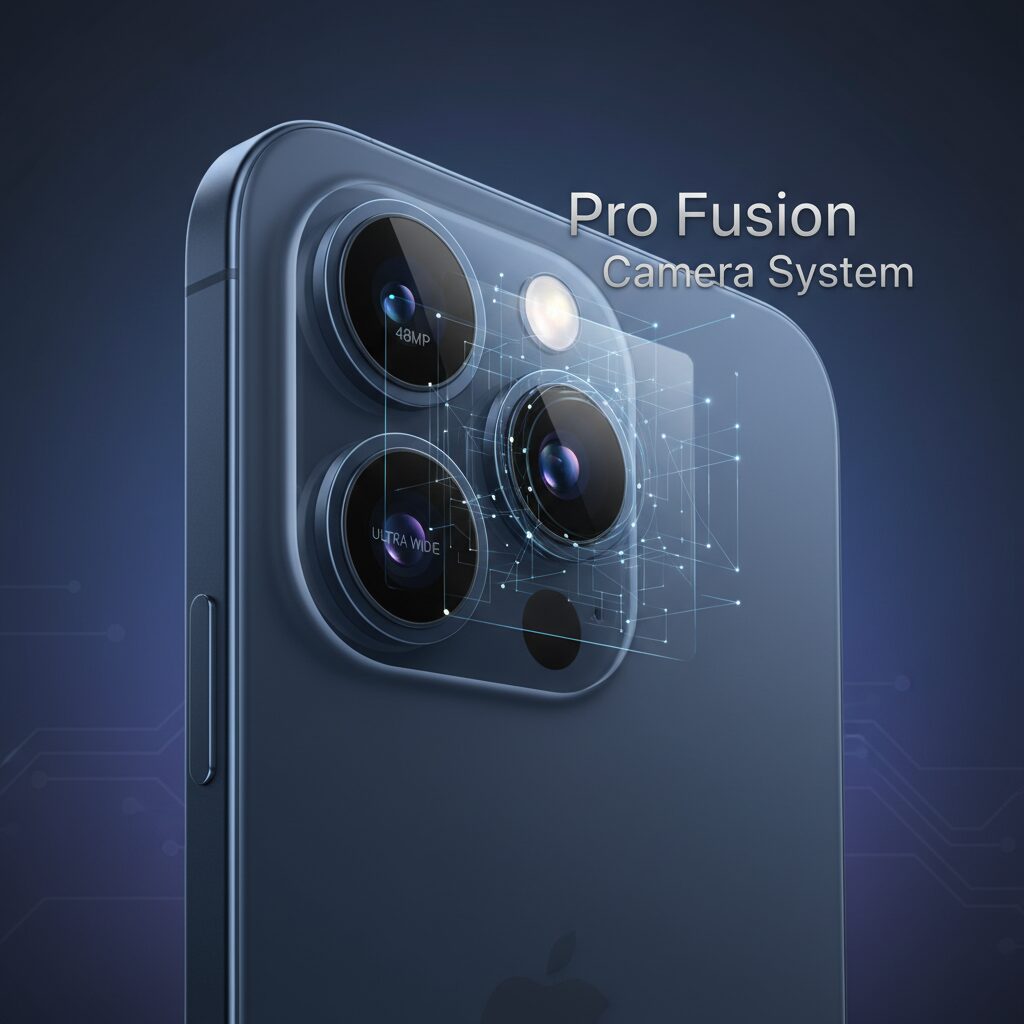
The 48MP Pro Fusion Camera System is built on a clear hardware philosophy: unify resolution across all lenses to maximize optical flexibility while minimizing perceptual quality gaps. In iPhone 17 Pro, Apple equips the ultra wide, main, and telephoto cameras with 48MP sensors, a first for the Pro lineup, and this decision fundamentally reshapes how close-range and detail-critical photography is handled.
From a hardware standpoint, the most important shift is consistency. With earlier generations, moving between lenses often meant abrupt drops in resolving power. According to Apple’s technical disclosures and DxOMark’s sensor analysis, the new 48MP baseline allows lens switching without sacrificing micro-detail, which is especially critical when the system dynamically changes optics at short focusing distances.
| Camera Module | Sensor Resolution | Primary Hardware Role |
|---|---|---|
| Ultra Wide (13mm) | 48MP | Macro capture and extreme close focus |
| Main (24mm) | 48MP | General imaging and high-quality cropping |
| Telephoto (100mm) | 48MP | Optical reach with sensor-shift stabilization |
The ultra wide camera stands out as the hardware cornerstone for macro work. Its autofocus-enabled 13mm lens can focus at approximately 2cm, and the 48MP sensor provides enough pixel density to tolerate aggressive cropping. Optical engineers have long noted that wide-angle lenses naturally favor shorter minimum focus distances, and Apple leverages this principle rather than forcing physically unrealistic telephoto macros.
Meanwhile, the main camera’s large 1/1.28-inch–class sensor prioritizes light intake and dynamic range, even though this inevitably increases minimum focus distance. Industry commentary from professional reviewers such as Austin Mann highlights that Pro Fusion’s strength lies not in defying optical physics, but in orchestrating multiple hardware strengths into a seamless, detail-first imaging foundation.
Ultra Wide Macro: How iPhone 17 Pro Reaches 2cm Focus
The ultra wide camera is the true engine behind macro photography on the iPhone 17 Pro, and its ability to focus as close as approximately 2 centimeters fundamentally changes what can be captured with a smartphone. This distance is not a marketing abstraction but a measurable optical limit enabled by the 48MP Fusion Ultra Wide sensor combined with an active autofocus mechanism, something that was historically absent from ultra wide smartphone lenses.
At a 2cm minimum focus distance, the lens is capable of resolving textures that are invisible at normal shooting ranges, such as leaf veins, fabric fibers, engraved metal surfaces, or inclusions inside gemstones. According to Apple’s technical specifications and corroborated by DxOMark’s lab analysis, this proximity allows the sensor to achieve a reproduction ratio that approaches dedicated compact macro cameras, despite the extremely thin optical stack of a phone.
From a hardware perspective, this capability is notable because ultra wide lenses typically struggle with close focusing due to short focal lengths and strong field curvature. Apple addresses this with a hybrid focus pixel system that dynamically adjusts focus across the frame, keeping the subject plane sharp even when the lens is nearly touching the object.
| Parameter | Ultra Wide (Macro) | Main Camera |
|---|---|---|
| Equivalent focal length | 13mm | 24mm |
| Minimum focus distance | Approx. 2cm | Approx. 15–20cm |
| Sensor resolution | 48MP | 48MP |
The shift from 12MP to 48MP on the ultra wide sensor has a direct and practical impact on real-world macro shooting. In earlier generations, any cropping after capture resulted in rapid resolution loss. With the iPhone 17 Pro, photographers can deliberately step back a few centimeters to avoid casting shadows, then crop later while maintaining usable detail. Reviewers from Amateur Photographer and Moment have described this as a form of digital working distance that compensates for the physical closeness required by true macro.
This matters because extreme proximity introduces its own problems. At 2cm, the phone body can easily block ambient light, perspective distortion becomes pronounced, and reflective subjects may show lens or device reflections. Apple’s computational pipeline mitigates some of these issues through distortion correction and localized tone mapping, but the laws of optics still apply.
Industry experts frequently point out that this design choice aligns with Apple’s broader imaging philosophy. DxOMark notes that Apple optimizes for consistency and sharpness across the frame, even if that means embracing the exaggerated depth and perspective of a 13mm lens at close range. The result is a macro system that excels at revealing information rather than flattering form.
In practice, this 2cm capability turns everyday objects into visual landscapes. A watch dial becomes an architectural structure, food ingredients resemble abstract art, and natural materials reveal microscopic patterns. While it does not replace a telephoto macro solution, the ultra wide macro on the iPhone 17 Pro represents one of the most technically advanced close-focusing implementations ever shipped in a mainstream smartphone.
Main Camera Limitations and Automatic Lens Switching
The main camera on the iPhone 17 Pro is designed as an all‑purpose workhorse, but it shows clear limitations when subjects move into close‑up territory. With its large 48MP sensor and a 24mm equivalent lens, the camera prioritizes light gathering and dynamic range. However, this design choice inevitably extends the minimum focusing distance, making true macro shooting physically impossible.
In practical use, once the camera is brought closer than roughly 15 to 20 centimeters, autofocus can no longer lock reliably. **This is not a software flaw but a consequence of optical physics**, as larger sensors require more space to achieve focus at close range. Apple openly acknowledges this trade‑off in its technical documentation, emphasizing consistency over edge‑case flexibility.
| Aspect | Main Camera Behavior | User Impact |
|---|---|---|
| Minimum focus distance | Approx. 15–20 cm | Limits close‑up composition |
| Sensor size | 1/1.28‑inch class | Improves image quality but reduces close focus |
| Fallback mechanism | Automatic lens switching | Seamless but sometimes unnoticed |
To maintain usability, the system automatically switches to the ultra‑wide camera when this limit is crossed. **This transition happens instantly and without explicit notification**, creating the impression that the main camera itself is capable of macro shooting. According to evaluations by DXOMARK, this handover is tuned to avoid focus hunting rather than to preserve optical purity.
While this approach delivers a smooth experience for casual users, it can surprise enthusiasts. The perspective suddenly changes, depth distortion increases, and lighting becomes more difficult due to the extremely short working distance. **Understanding that the main camera is effectively handing off responsibility is crucial** for photographers who expect consistent framing.
Apple’s philosophy here is clear and aligns with its broader imaging strategy. As noted by professional reviewers such as Austin Mann, the priority is reliability and speed, even if that means hiding complexity. For users who recognize these boundaries, the main camera remains exceptional, as long as its automatic lens switching is treated as a feature to manage rather than a capability to fight.
Telephoto Lens and the Absence of True Tele-Macro
The telephoto lens on the iPhone 17 Pro is often praised for its return to a 100mm-equivalent focal length, but when it comes to close-up work, a critical limitation becomes clear. This camera does not offer a true tele-macro capability, and that absence has practical consequences for users who expect the telephoto lens to double as a close-range tool.
In traditional photography, a tele-macro lens allows photographers to capture small subjects from a comfortable distance while maintaining natural perspective and strong background separation. However, the iPhone 17 Pro’s tetraprism-based telephoto design prioritizes reach and stabilization over close focusing. As a result, its minimum focusing distance remains relatively long.
Industry analysis from optical engineers frequently cited by publications such as DxOMark explains that periscope-style lenses inherently restrict the movement of internal lens groups. This mechanical constraint makes aggressive close focusing difficult, even when high-resolution sensors are used.
| Lens | Approx. Focal Length | Effective Minimum Focus | Macro Suitability |
|---|---|---|---|
| Ultra Wide | 13mm | ~2 cm | Excellent |
| Main | 24mm | ~15–20 cm | Limited |
| Telephoto | 100mm (4×) | ~60 cm or more | Poor |
This gap becomes most visible when users attempt what they assume is tele-macro shooting. When the subject moves inside the telephoto lens’s physical focusing range, the camera system quietly switches behavior. The image is no longer captured by the telephoto lens itself, but instead by cropping the center of the main camera’s sensor.
According to multiple field tests and user reports summarized by Moment and Apple-focused reviewers, this handover results in images being saved at 12MP rather than the expected 48MP. The interface still shows “4×,” which can mislead even experienced users into thinking they are using optical telephoto at close range.
Apple’s intent here is understandable. By avoiding an out-of-focus telephoto image, the system ensures reliability and sharpness. Yet from a creative standpoint, this approach sacrifices the very qualities that make tele-macro desirable: compression, reduced distortion, and smoother background blur.
This design choice contrasts sharply with certain competitors. Samsung’s Galaxy S25 Ultra, for example, allows its telephoto lens to focus at roughly 24 cm, enabling genuine tele-macro compositions. Analysts at SammyGuru describe this as an “industry-leading minimum focusing distance,” precisely because it preserves telephoto rendering even at close range.
On the iPhone 17 Pro, users photographing jewelry, watches, or insects must instead choose between two compromises: getting extremely close with the ultra wide macro and accepting perspective distortion, or stepping back and relying on digital crop. Neither option fully replicates the aesthetic of a true tele-macro lens.
In short, the telephoto camera excels at portraits and distant details, but its inability to focus close is a deliberate trade-off, not an oversight. Understanding this limitation helps advanced users plan their shots more intentionally and avoid unexpected drops in resolution when working near the subject.
Understanding the 12MP Crop Behavior at Close Range
When shooting at close range with the iPhone 17 Pro, many users are surprised to see images saved at 12MP even though the telephoto camera is specified as a 48MP sensor. This behavior is not a bug but a deliberate design choice rooted in optical physics and Apple’s camera system logic. Understanding when and why the system falls back to a 12MP crop is essential for anyone who cares about image quality at short focusing distances.
The core issue lies in the minimum focus distance of the 4x telephoto lens. Due to its tetraprism structure, the telephoto module cannot physically focus on subjects that are too close. Apple documentation and independent testing by reviewers such as DxOMark indicate that this limit is roughly in the 60-centimeter range under typical conditions. Once the subject moves closer than this threshold, the camera system must decide between a blurred image and a different capture strategy.
At that moment, the system performs an automatic handover. Instead of using the telephoto optics, it switches to the main 24mm camera and digitally crops the center of its 48MP sensor to simulate a 4x field of view. Because this crop uses only one quarter of the sensor width and height, the resulting output is effectively 12MP. The on-screen interface still shows “4x,” which makes this transition difficult for users to notice.
| Shooting Distance | Lens Actually Used | Recorded Resolution |
|---|---|---|
| Beyond ~1 m | 4x Telephoto (Optical) | 48MP |
| ~60 cm to 1 m | Telephoto or Main (Adaptive) | 48MP or 12MP |
| Closer than ~60 cm | Main Camera (Digital Crop) | 12MP |
This behavior becomes even more pronounced in low-light environments. According to analyses shared by Moment and experienced reviewers like Austin Mann, insufficient light increases the likelihood of an early switch to the cropped main sensor. From Apple’s perspective, this approach prioritizes reliability and sharpness, avoiding missed focus that would ruin the shot entirely.
However, for advanced users, this has clear implications. Even when ProRAW or 48MP capture modes are enabled, crossing the telephoto’s focus boundary forces a resolution drop that cannot be recovered later. For close-up product shots, textures, or technical documentation, this silent downgrade can undermine an otherwise carefully planned workflow. Recognizing the distance at which the switch occurs allows photographers to step back slightly and preserve true optical detail.
In practice, mastering the 12MP crop behavior is about spatial awareness rather than settings. By consciously maintaining enough working distance, users can ensure that the telephoto lens stays engaged and delivers its full resolving power. This subtle understanding separates casual close-ups from consistently high-quality results on the iPhone 17 Pro.
Computational Photography: Focus Stacking and Photonic Engine
In the realm of computational photography, iPhone 17 Pro demonstrates how software can respectfully compensate for optical limitations, especially in macro shooting. I would like to focus here on two pillars: focus stacking and the evolution of the Photonic Engine, both of which meaningfully redefine close-up image quality.
Focus stacking addresses one of macro photography’s oldest problems: extremely shallow depth of field. At distances as short as 2 cm, even a fraction of a millimeter can push critical details out of focus. According to Apple’s imaging pipeline disclosures and observations from professional reviewers such as DxOMark, iPhone 17 Pro uses rapid focus bracketing combined with on-device neural processing to merge multiple focal planes into a single image. This approach allows textures like fabric fibers or engraved metal to remain sharp from front to back, without requiring external software.
| Aspect | Traditional Macro | iPhone 17 Pro Computational Approach |
|---|---|---|
| Depth of field | Very shallow | Extended via focus stacking |
| Workflow | Manual, multi-step | Automatic, on-device |
| Processing time | Minutes on PC | Seconds on iPhone |
The Photonic Engine further enhances this process by applying Deep Fusion earlier in the imaging pipeline, directly to high-bit-depth data. Apple explains that this preserves micro-contrast before noise reduction occurs, which is crucial for macro scenes rich in fine detail. Independent evaluations, including those by Austin Mann, note that low-light macro images retain surface texture without the “painted” look common in aggressive denoising.
Another subtle but important improvement lies in AI-driven scene recognition. When a macro subject fills the frame, traditional auto white balance often fails. iPhone 17 Pro’s neural models distinguish subject color from illumination, producing stable and repeatable color even in challenging environments. This consistency is particularly valuable for product photography, scientific documentation, and e-commerce workflows, where visual reliability matters as much as resolution.
Working Distance, Lighting Challenges, and Real Shooting Scenarios
In macro photography, specifications such as minimum focus distance often attract the most attention, but in real shooting situations, working distance and lighting behavior are far more decisive factors. With the iPhone 17 Pro, the ultra wide macro capability that allows focusing at around 2 cm fundamentally changes how photographers must approach light, subject placement, and even body posture during shooting.
Working distance refers to the physical space between the front of the lens and the subject, and in practice it defines what is realistically shootable. At approximately 2 cm, the ultra wide camera places the iPhone body extremely close to the subject. According to optical engineering principles discussed by institutions such as the Royal Photographic Society, ultra-short working distances inherently increase the risk of light obstruction and perspective exaggeration, regardless of sensor resolution.
| Lens Used | Approx. Working Distance | Practical Impact |
|---|---|---|
| Ultra Wide Macro | ~2 cm | Severe shadow risk, strong perspective distortion |
| Main Camera | 15–20 cm | Balanced lighting, limited magnification |
| 4× Telephoto | 60 cm+ | Comfortable lighting, no true macro |
Lighting is the first major challenge at such close range. At 2 cm, the iPhone itself frequently blocks ambient light, especially indoors or under directional illumination. Field tests reported by DxOMark indicate that even high-efficiency sensors cannot compensate for uneven illumination caused by physical shadowing. This often results in images where micro-texture is present on one side of the subject while the opposite side collapses into noise.
In real-world scenarios such as photographing jewelry, electronic components, or plant textures, users often find themselves unintentionally casting shadows with their hands or the phone frame. This is where the 48MP sensor becomes less about resolution and more about flexibility. By stepping back slightly to regain usable working distance and then cropping, photographers can maintain even lighting while still preserving fine detail, a workflow Apple itself has implicitly endorsed through its emphasis on high-resolution sensors across all lenses.
However, this approach introduces another practical consideration: perspective. Ultra wide macro shots exaggerate depth, making flat objects appear warped at the edges. Product photographers interviewed by Amateur Photographer have noted that this distortion is especially problematic for watches, coins, and PCBs, where geometric accuracy matters. In these cases, maintaining a slightly longer working distance and accepting lower native magnification often produces more usable results.
Real shooting environments also highlight the limits of relying solely on computational correction. While Apple’s Photonic Engine improves texture retention, it cannot reconstruct detail lost to harsh shadows or specular highlights caused by poorly controlled lighting. As imaging researchers at MIT Media Lab have pointed out in broader computational photography studies, algorithms perform best when the optical input is already well-lit and evenly exposed.
Another overlooked factor is subject behavior. When photographing insects or other small living subjects, a 2 cm working distance is rarely viable. The proximity almost always causes movement or escape. Wildlife macro specialists frequently recommend longer focal lengths specifically to preserve natural behavior, a principle that still applies even with advanced smartphone cameras.
Ultimately, the iPhone 17 Pro rewards photographers who think spatially rather than numerically. Instead of chasing the shortest possible focus distance, successful macro results come from balancing working distance, light direction, and subject geometry. Understanding these real shooting constraints transforms the iPhone 17 Pro from a spec-driven gadget into a genuinely controllable photographic tool.
How iPhone 17 Pro Compares to Galaxy S25 Ultra and Pixel 10 Pro
When comparing the iPhone 17 Pro with the Galaxy S25 Ultra and Pixel 10 Pro, the differences become clearest in how each company approaches close-up and macro photography. While all three are flagship devices, their priorities in optics, software tuning, and user experience diverge in ways that matter greatly to photography-focused users.
The iPhone 17 Pro emphasizes consistency and computational integration, relying primarily on its 48MP ultra-wide camera for macro work. Apple’s Pro Fusion system automatically switches lenses to maintain focus, which makes shooting effortless but can obscure what hardware is actually being used. According to evaluations by DxOMark and AppleInsider, this results in very reliable detail capture at extremely close distances, especially around the 2cm minimum focus range.
In contrast, Samsung and Google take more hardware-forward approaches. Samsung equips the Galaxy S25 Ultra with a telephoto lens capable of focusing as close as roughly 24cm, enabling true tele-macro photography. Google’s Pixel 10 Pro sits between the two, offering more manual control and natural color science but less aggressive hardware specialization.
| Model | Macro Approach | Telephoto Close Focus | Color Tendency |
|---|---|---|---|
| iPhone 17 Pro | Ultra-wide macro (48MP) | Limited, digital fallback | Warm, vivid |
| Galaxy S25 Ultra | Ultra-wide + tele-macro | Very strong (~24cm) | Highly saturated |
| Pixel 10 Pro | Ultra-wide with manual aid | Moderate (~60cm) | Cool, natural |
The practical impact of this difference is significant. With the Galaxy S25 Ultra, users can keep physical distance from small subjects while still achieving high magnification, which helps with lighting control and reduces perspective distortion. Reviews from TechRadar highlight that this tele-macro capability is particularly effective for insects, jewelry, and product photography.
The iPhone 17 Pro, however, excels in texture and micro-detail reproduction. Its 48MP macro images hold up well even after cropping, and Apple’s Deep Fusion processing preserves fine surface detail with minimal noise. Tech Advisor notes that for static subjects like materials, fabrics, or electronic components, the iPhone often resolves more usable detail than its rivals.
Pixel 10 Pro differentiates itself through color accuracy and computational restraint. Google’s imaging pipeline tends to avoid heavy saturation, producing results closer to neutral reference colors. This makes it appealing for documentation or scientific use, though its macro magnification flexibility does not match Samsung’s, nor its raw resolving power consistently surpass Apple’s.
Overall, the comparison shows three distinct philosophies. Samsung prioritizes optical versatility, Google focuses on realistic rendering, and Apple refines a tightly controlled, user-friendly system. The iPhone 17 Pro may not lead in tele-macro hardware, but it delivers one of the most dependable and detailed close-up experiences available, especially for users who value ease of use and consistent output over manual control.
Extending Macro Capabilities with Lenses and Pro Camera Apps
Extending macro photography on the iPhone 17 Pro goes beyond the built-in camera system and becomes truly compelling when external lenses and professional camera apps are introduced. While Apple’s 48MP Ultra Wide macro already delivers impressive detail at around a 2 cm minimum focus distance, its wide-angle perspective inevitably introduces distortion and limits working distance. For creators who demand more natural compression and precise control, third-party optics and software offer a practical way to overcome these constraints.
External macro lenses fundamentally change the optical behavior of the iPhone without relying on digital cropping. Brands such as SANDMARC and Moment design dedicated macro attachments that mount over the main 24 mm camera, effectively shortening the minimum focus distance while preserving the main sensor’s image quality and perspective. According to optical evaluations referenced by DxOMark and professional reviewers, this approach allows photographers to maintain a comfortable working distance, improve lighting control, and reduce perspective exaggeration that is typical of ultra-wide macro shots.
This distinction becomes especially important for product photography and scientific documentation, where shape accuracy matters. Apple’s own documentation emphasizes computational correction, but optical physics still favors longer focal lengths for macro realism. By pairing the main 48MP sensor with an external macro lens, users can achieve a look closer to that of a dedicated 90–100 mm macro lens on a mirrorless camera, something the native system alone cannot replicate.
| Approach | Effective Focal Length | Key Advantage |
|---|---|---|
| Native Ultra Wide Macro | 13 mm equivalent | Extreme close focus with high resolution |
| Main Camera + External Macro Lens | 24 mm equivalent | Natural perspective and better lighting control |
Professional camera apps further extend these capabilities by giving users control that the default Camera app intentionally abstracts away. Applications such as Halide and CameraPixels are frequently cited by mobile photography experts, including contributors interviewed by Amateur Photographer, for their ability to lock specific lenses and prevent automatic switching. This is particularly valuable in macro scenarios, where iOS may silently fall back to a cropped main camera image and reduce output to 12MP.
Lens locking and manual focus are not just convenience features; they are critical for predictable image quality. Halide’s manual lens selection ensures that when a photographer chooses the main camera with an external macro lens, the system will not override that decision due to focus ambiguity or lighting conditions. CameraPixels, on the other hand, excels in controlled focus bracketing, enabling precise focus stacking workflows that were previously reserved for desktop environments.
Industry observers note that Apple’s Neural Engine makes these app-based workflows viable on-device, but it is the combination of optics and software that delivers the real leap. By thoughtfully integrating external lenses with professional-grade camera apps, the iPhone 17 Pro transforms from a highly capable macro camera into a flexible imaging platform suited for commercial, educational, and creative macro work.
参考文献
- Apple:iPhone 17 Pro and 17 Pro Max – Technical Specifications
- DxOMark:Apple iPhone 17 Pro Camera Test
- Moment:iPhone 17 Camera Lenses Explained
- Tech Advisor:Google Pixel 10 Pro vs iPhone 17 Pro Camera Comparison Review
- SammyGuru:Galaxy S25 Ultra Boasts Industry-Leading Minimum Focusing Distance
- SANDMARC:Macro Lens Edition – iPhone 17 Pro Max