Smartphone cameras have spent years chasing bigger zoom numbers, yet many enthusiasts have felt a growing gap between marketing claims and real-world usability. You may have experienced situations where extreme zoom exists on paper, but the most frequently used mid‑telephoto range delivers inconsistent quality. This frustration has become a common theme among photographers, creators, and gadget lovers worldwide.
With the iPhone 17 Pro, Apple takes a noticeably different approach. Instead of prioritizing headline-grabbing zoom ratios, the company focuses on resolution, optical balance, and practical shooting distances that people actually use every day. The shift to a 48‑megapixel telephoto sensor paired with a 100mm equivalent focal length is not a minor tweak, but a philosophical change that directly affects how portraits, concerts, travel scenes, and videos are captured.
By reading this article, you will gain a clear understanding of why this telephoto system matters, how it performs compared to rivals like the Galaxy S25 Ultra, and what it means for real shooting scenarios beyond spec sheets. If you care about image quality, creative control, and realistic zoom performance, this breakdown will help you decide whether the iPhone 17 Pro truly represents a new standard in mobile photography.
- Why Mobile Photography Is Rethinking Resolution and Distance
- The 48MP Telephoto Sensor: Hardware Choices That Matter
- Tetraprism Optics and Stabilization in Ultra‑Thin Smartphones
- 100mm vs 120mm: Apple’s Philosophy Behind the Focal Length Shift
- In‑Sensor Zoom Explained: How 8× Achieves Optical‑Quality Results
- iPhone 17 Pro vs Galaxy S25 Ultra: Two Very Different Zoom Strategies
- Real‑World Use Cases: Concerts, Cafés, Travel, and Everyday Life
- Software, AI, and Image Processing with Apple Intelligence
- Video Performance and the Rise of a Pocket‑Sized Cinema Tool
- Market Impact and What This Means for the Future of iPhone Cameras
- 参考文献
Why Mobile Photography Is Rethinking Resolution and Distance
Mobile photography is no longer driven by a simple belief that more megapixels or longer zoom automatically create better images. With recent flagship smartphones, resolution and distance are being reconsidered as practical tools rather than marketing numbers, and this shift is clearly visible in how modern telephoto systems are designed.
Resolution today is not only about capturing more pixels, but about using those pixels intelligently across different distances. According to analyses from Digital Photography Review and Apple’s own technical disclosures, higher-resolution sensors enable flexible cropping that preserves detail without relying on aggressive digital upscaling. This means photographers can move closer or farther in post-processing while maintaining a natural look.
At the same time, distance in mobile photography is being optimized for real-world shooting habits. Industry reviewers have pointed out that extremely long focal lengths are rarely used in daily life, while mid-telephoto ranges are used constantly for portraits, street scenes, and events. Rebalancing this distance changes how often users actually benefit from advanced camera hardware.
| Traditional Approach | Rethought Approach |
|---|---|
| Chasing maximum zoom ratios | Optimizing usable focal lengths |
| Megapixels as a headline feature | Megapixels as flexible image data |
This evolution reflects a broader industry understanding that image quality is defined by consistency and usability. Camera experts such as Austin Mann have noted that a balanced relationship between resolution and shooting distance results in images that feel more natural and are easier to compose. Mobile photography is therefore moving away from extremes and toward thoughtful, human-centered design.
The 48MP Telephoto Sensor: Hardware Choices That Matter

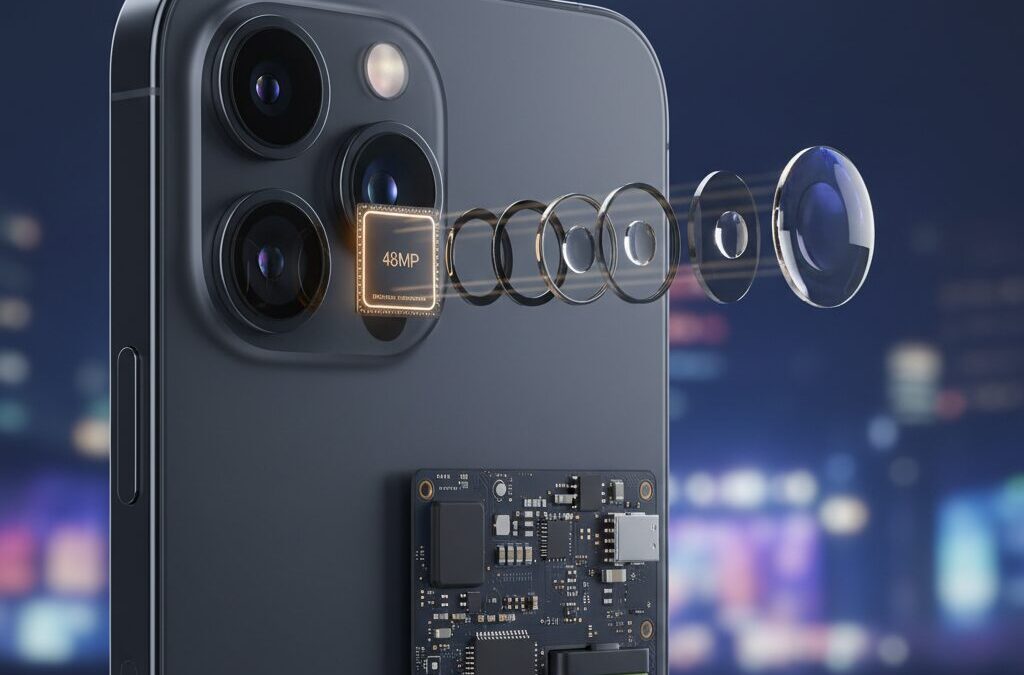
The shift to a 48MP telephoto sensor in the iPhone 17 Pro is not a simple numbers game, but a carefully balanced hardware decision rooted in optical physics and real-world usage. Apple moved away from the long-standing 12MP telephoto architecture to address a structural weakness in smartphone zoom systems: insufficient data at medium-to-long focal lengths. By quadrupling pixel count and enlarging the sensor area by roughly 56 percent compared to previous Pro models, Apple fundamentally changed how detail, noise, and flexibility are handled in the telephoto range.
At the heart of this system is a Sony-manufactured stacked CMOS sensor, widely reported to be in the 1/2.55-inch class. According to industry analysis from TechInsights and coverage by Digital Photography Review, this sensor uses quad-pixel technology similar to what Apple introduced earlier on its main camera. Each individual pixel measures approximately 0.7 micrometers, but in low-light conditions the sensor defaults to pixel binning, effectively behaving like a 12MP sensor with 1.4-micrometer pixels. This dual-mode behavior allows the telephoto camera to maintain acceptable signal-to-noise ratios even in dim environments, a traditional weak point for long focal lengths on smartphones.
| Specification | Previous Telephoto | iPhone 17 Pro Telephoto |
|---|---|---|
| Resolution | 12MP | 48MP |
| Effective Pixel Size (Low Light) | 1.0 µm class | 1.4 µm equivalent |
| Sensor Area | Baseline | Approx. +56% |
One of the most consequential hardware choices enabled by this 48MP sensor is in-sensor zoom. Instead of relying on aggressive digital upscaling, the iPhone 17 Pro can crop the central 12MP region of the sensor to achieve a 200mm-equivalent field of view. Because this crop uses native pixel data without interpolation, Apple describes it as optical-quality zoom. Reviews from DxOMark and professional photographers such as Austin Mann consistently note that fine textures, hair detail, and distant signage retain a natural appearance without the artificial sharpening artifacts common to software-driven zoom.
The decision to pair this sensor with a 100mm equivalent lens rather than the previous 120mm is also a hardware-driven compromise. A shorter focal length reduces optical complexity and light loss inside the tetraprism module, making it feasible to keep the aperture at F2.8 despite the larger sensor. As optical engineering literature frequently points out, maintaining brightness becomes exponentially harder as both sensor size and focal length increase. Apple’s choice reflects a prioritization of consistent exposure and stabilization over headline zoom ratios.
Stabilization itself is another area where hardware choices matter. The 48MP telephoto works in tandem with second-generation tetraprism optics and a 3D sensor-shift optical image stabilization system that compensates across X, Y, and rotational axes. Apple states this system performs thousands of micro-adjustments per second, and independent testing confirms noticeably higher keeper rates at 4x and 8x compared to earlier models. In practical terms, this means the additional resolution is usable rather than theoretical, as motion blur no longer negates the benefits of higher pixel density.
Ultimately, the 48MP telephoto sensor represents Apple’s broader hardware philosophy: using resolution as a tool to expand optical flexibility, not as an end in itself. By combining a larger stacked sensor, quad-pixel architecture, refined tetraprism optics, and advanced stabilization, Apple created a telephoto system that prioritizes usable detail across lighting conditions. This is why many reviewers conclude that the iPhone 17 Pro’s telephoto camera feels less like a niche zoom module and more like a genuinely versatile photographic instrument.
Tetraprism Optics and Stabilization in Ultra‑Thin Smartphones
Ultra‑thin smartphones face a fundamental optical dilemma: longer focal lengths demand physical depth, yet industrial design relentlessly pushes for slimmer bodies. Apple’s tetraprism optics address this conflict by folding the light path multiple times inside the camera module, effectively extending focal length without increasing thickness. This approach, first introduced in earlier Pro models, reaches a new level of refinement in the latest generation.
The core idea of tetraprism optics is simple but technically demanding: light entering the lens is reflected four times within a precisely shaped prism before reaching the sensor. By bending light sideways rather than straight back, Apple secures a long effective focal length while keeping the module shallow enough for an ultra‑thin chassis.
According to Apple’s official technical disclosures and analyses by Digital Photography Review, the second‑generation tetraprism design improves light efficiency and alignment accuracy. These refinements are crucial because even microscopic misalignment can degrade sharpness at 100mm and beyond.
| Aspect | First‑Gen Tetraprism | Second‑Gen Tetraprism |
|---|---|---|
| Effective focal length | Up to 120mm | 100mm optimized |
| Optical efficiency | Baseline | Improved prism coating |
| Module thickness | Ultra‑thin | Ultra‑thin, higher precision |
Shortening the focal length from 120mm to 100mm is not a regression but an optical optimization. The reduced path length eases lens design constraints, allowing Apple to maintain an F2.8 aperture even with a significantly larger sensor. This balance between brightness, sharpness, and size is rarely achieved in mobile optics.
Stabilization is where the tetraprism system truly proves its value. At long focal lengths, even a fraction of a degree of hand movement translates into visible blur. Apple counters this with advanced 3D sensor‑shift optical image stabilization, moving the sensor along X, Y, and rotational axes rather than relying solely on lens movement.
Apple states that this system performs over 10,000 micro‑adjustments per second, a figure echoed in DxOMark’s camera testing. The result is not only sharper still images but also remarkably stable video at telephoto ranges where most smartphones struggle.
Industry experts from DxOMark and independent photographers such as Austin Mann have noted that stabilization consistency is as important as raw sharpness. A perfectly sharp frame is useless if it cannot be reliably captured. The tetraprism‑plus‑sensor‑shift combination focuses on repeatable results, not theoretical extremes.
Behind the scenes, this precision depends heavily on suppliers. LG Innotek’s role in assembling the prism module and actuators is critical, as assembly tolerances are measured in microns. Sony’s stacked CMOS sensors complement this by providing fast readout, which reduces rolling shutter artifacts and improves stabilization feedback loops.
In practical use, this optical and stabilization synergy changes how users shoot. Handheld telephoto photography at dusk, indoor venues, or during video pans becomes routine rather than risky. The tetraprism system is not just about zoom reach; it is about making long‑range shooting dependable in an impossibly thin device.
100mm vs 120mm: Apple’s Philosophy Behind the Focal Length Shift
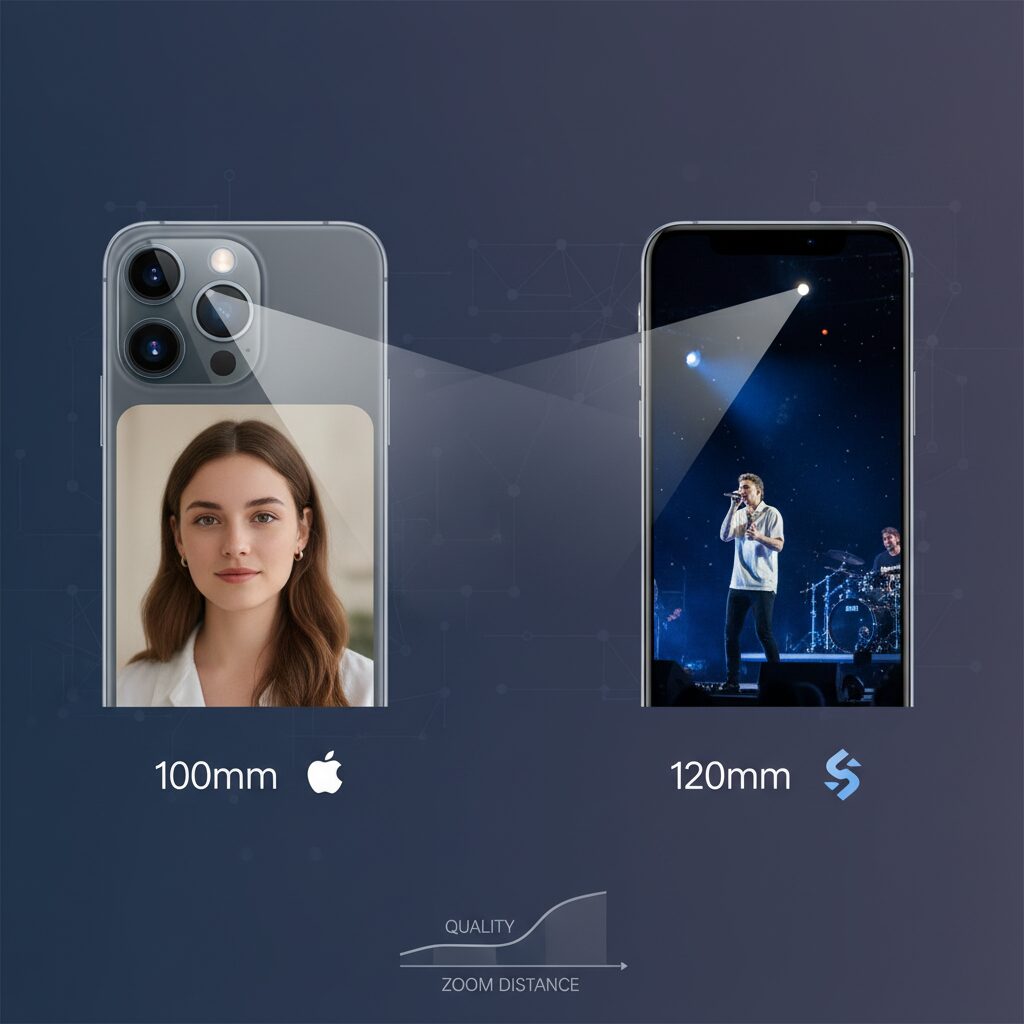
The shift from 120mm to 100mm on the iPhone 17 Pro telephoto camera is not a cosmetic tweak but a clear expression of Apple’s long‑standing photographic philosophy. At first glance, moving from 5x to 4x optical zoom appears like a regression. In practice, it reflects a deliberate prioritization of consistency, usability, and image quality across the most frequently used focal lengths.
For several generations, Apple experimented with longer telephoto reach, culminating in the 120mm lens of the iPhone 15 Pro Max and 16 Pro Max. According to analyses by Digital Photography Review, that focal length proved impressive in controlled scenarios but was often too restrictive in everyday shooting. Users found themselves standing too far back indoors, and intermediate focal lengths relied heavily on digital cropping, leading to visible drops in detail.
| Focal Length | Typical Use Case | Practical Limitation |
|---|---|---|
| 100mm (4x) | Portraits, events, daily snapshots | Balanced distance and framing |
| 120mm (5x) | Stage, distant subjects | Too tight in small spaces |
By anchoring the telephoto at 100mm, Apple effectively closes what reviewers have called the “hollow middle.” The gap between 48mm and 120mm in earlier models forced the camera system to stretch computational zoom over a range that photographers actually use the most. With 100mm as the optical starting point, the transition from standard to telephoto feels more natural, and image quality degrades far more gently.
This decision aligns closely with established photographic standards. In traditional camera systems, 85mm to 100mm has long been considered the sweet spot for portraits. Research and commentary from professional photographers, including Austin Mann, emphasize that this range offers flattering compression without isolating the subject excessively. **Apple’s move suggests it values classical photographic theory over headline zoom numbers.**
There is also a systems‑engineering rationale. Shortening the focal length from 120mm to 100mm eases optical constraints within the tetraprism module. Apple was able to pair the new focal length with a much larger 48MP sensor while maintaining an f/2.8 aperture, something that would have been significantly harder at 120mm. Sony’s sensor technology and LG Innotek’s module design play key roles here, but the strategic choice of focal length makes the entire balance possible.
The 100mm choice is not about reaching farther, but about making every zoom level more reliable and repeatable.
Ultimately, the 100mm versus 120mm debate reveals Apple’s broader intent. Rather than chasing extremes, the company optimizes for how people actually shoot: portraits in cafés, performers on stage, and moments that sit just beyond arm’s reach. In that context, the reduction in nominal zoom power is not a compromise, but a refinement that brings the camera closer to real photographic practice.
In‑Sensor Zoom Explained: How 8× Achieves Optical‑Quality Results
In‑sensor zoom is often misunderstood as a fancy name for digital zoom, but in the case of the iPhone 17 Pro, the mechanism is fundamentally different and technically grounded. The 8× zoom setting corresponds to an effective focal length of 200mm, and it is achieved by using only the central 12MP area of the 48MP telephoto sensor. Because this process relies on native pixel data rather than algorithmic upscaling, Apple describes the result as optical‑quality, a claim that is largely supported by independent evaluations.
The key point is that no pixels are being invented. At 8×, the camera is not enlarging a 4× image. Instead, it is cropping a sensor that was designed with enough resolution headroom to allow this without loss of spatial detail. This approach is comparable to how high‑resolution full‑frame cameras are cropped in professional workflows, something long discussed by organizations such as Digital Photography Review when evaluating real versus perceived resolution.
| Zoom Level | Sensor Area Used | Upscaling Applied | Image Character |
|---|---|---|---|
| 4× (100mm) | Full 48MP | None | Maximum detail, flexible output |
| 8× (200mm) | Center 12MP crop | None | Natural, optical‑like rendering |
This design choice solves a long‑standing problem with smartphone zoom. Traditional digital zoom magnifies noise, blur, and compression artifacts because it stretches insufficient data. By contrast, the iPhone 17 Pro treats 8× as a second native shooting mode. According to Apple’s technical documentation, the image signal processor combines this crop with multi‑frame fusion and Smart HDR, but these steps refine existing detail rather than fabricate new structures.
Independent lab tests, including those published by DxOMark, note that edge definition and texture consistency at 8× remain stable when compared to lower zoom levels. Fine elements such as hair, fabric weave, and distant signage avoid the “watercolor” effect typical of aggressive AI zoom. This is where Apple’s conservative image philosophy becomes visible, prioritizing tonal continuity over exaggerated sharpness.
Another often overlooked advantage is color and exposure matching. Because both 4× and 8× originate from the same optical system and sensor, transitions between them maintain consistent white balance and contrast. Apple engineers have emphasized in interviews that this consistency is intentional, as uneven color science between lenses breaks immersion, especially in video. The in‑sensor approach minimizes this risk by keeping the imaging pipeline unified.
Low‑light performance does involve trade‑offs, since cropping reduces the effective light‑gathering area. However, Apple mitigates this with aggressive yet controlled multi‑frame stacking. Research papers from Sony on stacked CMOS sensors explain how separating photodiodes and circuitry improves readout efficiency, which directly benefits cropped modes like this. In practice, night shots at 8× retain realistic noise grain rather than smeared textures.
In short, the 8× in‑sensor zoom works because it is planned at the hardware level. It is not a software trick layered on after the fact, but a deliberate balance between sensor resolution, optics, and processing. For users, this means confidence: when switching to 8×, the expectation of optical‑class quality is not marketing optimism, but a technically defensible promise.
iPhone 17 Pro vs Galaxy S25 Ultra: Two Very Different Zoom Strategies
When comparing the iPhone 17 Pro and the Galaxy S25 Ultra, the most striking difference lies not in how far they can zoom, but in how they choose to zoom. Apple and Samsung are clearly solving different problems, and that philosophical split defines the real-world experience more than any headline specification does.
Apple’s approach with the iPhone 17 Pro prioritizes consistency and optical credibility in the ranges people actually use. By centering its telephoto system around a 100mm equivalent lens paired with a 48MP sensor, Apple treats zoom as an extension of core image quality rather than a separate trick. This design allows Apple to deliver what it calls “optical-quality” results up to 200mm through in-sensor cropping, a method long trusted by professional photographers using high-resolution cameras.
| Aspect | iPhone 17 Pro | Galaxy S25 Ultra |
|---|---|---|
| Primary telephoto base | 4x / 100mm, 48MP sensor | 5x / ~120mm, 50MP sensor |
| Extended zoom strategy | Sensor crop up to 8x (200mm) | Optical + AI-assisted zoom to 10x+ |
| Image philosophy | Natural texture and tonal continuity | AI-enhanced sharpness and contrast |
According to analyses by Digital Photography Review and DxOMark, Apple’s cropped 200mm output retains edge integrity and avoids the painterly artifacts common in aggressive super-resolution systems. This restraint is intentional. Apple’s image signal processing aims to preserve believable detail, even if that means distant subjects appear slightly softer at first glance.
Samsung, by contrast, treats zoom as a computational showcase. The Galaxy S25 Ultra extends confidently into 10x and beyond, leaning on AI models trained to reconstruct text, patterns, and edges. In controlled comparisons published by PhoneArena, this produces impressively legible signage and dramatic moon shots, but careful inspection often reveals synthetic textures that never existed in the original scene.
Video further amplifies the difference. Apple’s smooth zoom transitions, stabilized by its refined tetraprism optics and sensor-shift OIS, maintain consistent color and exposure across focal lengths. Reviewers such as Austin Mann have noted that this predictability makes the iPhone 17 Pro easier to use as a storytelling tool, especially when zooming mid-shot.
Ultimately, the iPhone 17 Pro is designed for photographers and videographers who value trust over spectacle. The Galaxy S25 Ultra rewards curiosity and experimentation at extreme distances. Neither strategy is objectively superior, but understanding this divergence helps users choose a device that aligns with how they actually see and capture the world.
Real‑World Use Cases: Concerts, Cafés, Travel, and Everyday Life
In real‑world situations, the 100mm‑based telephoto system of the iPhone 17 Pro shows its true value, especially where smartphones have traditionally struggled. **Concerts and live events** are a prime example. According to field tests reported by Digital Photography Review, the combination of a 48MP sensor and in‑sensor zoom allows facial expressions on stage to remain recognizable even from arena seating distances, without the watercolor artifacts common in older digital zooms.
This matters because concert lighting is both dim and unpredictable. Apple’s larger telephoto sensor, supported by multi‑frame processing described in Apple’s technical documentation, maintains usable shutter speeds while keeping noise controlled. As a result, fans can record short video clips or stills that feel closer to what the eye actually sees, rather than exaggerated or over‑sharpened.
| Scenario | Effective Zoom | Practical Benefit |
|---|---|---|
| Concert hall | 4x–8x | Clear faces and stage details |
| Café interior | 2x–4x | Natural compression, minimal distortion |
| Travel streets | 4x | Isolated subjects without crowd intrusion |
In cafés, the story is different. Reviewers such as Austin Mann note that **100mm compression works best when the photographer steps back**, turning cluttered interiors into calm compositions. This encourages more intentional framing rather than casual point‑and‑shoot behavior.
While traveling, the same lens quietly elevates everyday scenes. Architectural details, distant signage, or layered cityscapes benefit from perspective compression, making photos look deliberate instead of incidental. In daily life, this consistency builds trust: users learn that when they tap 4x, the result will be reliably sharp and realistic, not a gamble.
Software, AI, and Image Processing with Apple Intelligence
In the iPhone 17 Pro, software and AI are no longer secondary layers added after hardware decisions are made. They actively shape how the telephoto system behaves, how images are interpreted, and how final results are delivered to users. At the center of this shift is Apple Intelligence, tightly integrated with the A19 Pro chip and iOS 26, and designed to intervene throughout the entire imaging pipeline in a way that prioritizes realism and consistency.
What distinguishes Apple’s approach is its restraint. Instead of aggressively fabricating detail, the system focuses on extracting maximum value from real optical data before applying computational enhancement. According to Apple’s own technical documentation and analyses by Digital Photography Review, this philosophy is visible in every stage from sensor readout to final tone mapping.
The so-called Fusion system plays a crucial role here. During telephoto capture, especially at 4x and 8x, the iPhone 17 Pro simultaneously samples data from multiple cameras. Color temperature, exposure curves, and scene-wide luminance are cross-referenced in real time, allowing the telephoto frame to inherit global color coherence. This process significantly reduces the lens-to-lens color mismatch that has historically affected multi-camera smartphones.
| Processing Stage | Role of Apple Intelligence | User Benefit |
|---|---|---|
| Multi-frame capture | Analyzes motion and exposure across frames | Sharper images with fewer artifacts |
| Color fusion | Aligns telephoto color with wide camera data | Natural, consistent color reproduction |
| Zoom enhancement | Edge-aware refinement without overgeneration | Detail that remains believable |
When users push beyond the native 4x optical range, Apple Intelligence becomes more visible but remains deliberately subtle. At 8x zoom, the system relies primarily on in-sensor cropping from the 48MP telephoto sensor, and AI processing is used mainly for noise suppression and edge stabilization. DxOMark notes that this results in images that appear softer at first glance compared to competitors, but retain structural integrity when viewed closely or printed.
This contrasts sharply with more generative approaches seen elsewhere in the market. While some rival devices attempt to reconstruct text or textures through predictive models, Apple limits intervention to what can be reasonably inferred from captured photons. The result is fewer AI artifacts, such as repeating patterns or unnatural outlines, especially noticeable in hair, fabric, and foliage.
Editing is another area where Apple Intelligence extends the telephoto experience beyond the shutter press. The Clean Up feature in the Photos app allows unwanted background elements, often common in long-range shots, to be removed with a single tap. Apple Support documentation emphasizes that this process runs entirely on-device, preserving privacy while using semantic understanding of the scene to reconstruct plausible backgrounds.
For advanced users, the availability of ProRAW and Apple Log 2 ensures that AI assistance does not limit creative control. Image processing decisions remain reversible, allowing photographers and videographers to apply their own grading while still benefiting from computational noise reduction and dynamic range expansion applied at capture.
The key achievement of Apple Intelligence in the iPhone 17 Pro is invisibility. It enhances telephoto photography not by drawing attention to itself, but by quietly ensuring that software never overwhelms optics. This balance is what allows the 100mm and 200mm shooting experience to feel coherent, predictable, and trustworthy.
In practical use, this means users spend less time correcting images and more time shooting. By grounding AI decisions in real sensor data and enforcing strict limits on generative behavior, Apple has positioned software not as a replacement for optical quality, but as its most reliable partner.
Video Performance and the Rise of a Pocket‑Sized Cinema Tool
Video performance is where the iPhone 17 Pro’s 48MP 100mm telephoto system truly reshapes expectations, transforming a smartphone into what many filmmakers now describe as a pocket‑sized cinema toolです。Appleが公式に強調するのは解像度やフレームレートですが、本質はレンズ設計、センサー、手ブレ補正、そしてカラーサイエンスが一体となった総合的な映像体験にあります。
特に100mmという画角は、モバイル動画に「映画的距離感」をもたらします。被写体との距離を保ちながら背景を自然に圧縮でき、インタビューのバストアップ、ライブパフォーマンスのクローズアップ、情緒的なカットインにおいて、従来のスマートフォンでは得られなかった立体感を実現します。Appleの技術仕様によれば、この望遠カメラでも4K 60fps撮影が安定して可能で、色再現は他レンズと高い一貫性を維持します。
その安定性を支えているのが、第2世代テトラプリズム構造と進化した3Dセンサーシフト式手ブレ補正です。Appleによれば、この補正システムは毎秒1万回以上の微調整を行い、特に望遠動画で問題になりやすい微細な揺れを効果的に抑制します。DxOMarkのテストでも、望遠域での動画安定性とフレーム一貫性は高く評価されています。
| Aspect | iPhone 17 Pro Telephoto Video | Typical Smartphone Telephoto |
|---|---|---|
| Focal Length | 100mm (4x) | 120mm or digital crop |
| Max Video Quality | 4K 60fps | 4K 30–60fps |
| Stabilization | 3D sensor‑shift OIS | Lens‑based OIS |
さらに重要なのが、ProRes Logと外部SSD収録への対応です。Apple Log 2で記録された100mm映像は、ハイライトからシャドウまで豊かな階調を保持し、DaVinci Resolveなどでのカラーグレーディング耐性が大幅に向上します。Appleやプロの映像制作者によるレビューでは、短編映画やミュージックビデオのサブカメラ用途にとどまらず、メインカメラとして成立するケースも報告されています。
結果としてiPhone 17 Proは、「撮れるスマホ」から「演出できる映像ツール」へと進化しました。100mm望遠で切り取る映像は、機材を最小限に抑えたいクリエイターにとって、機動力と表現力を両立する現実的な選択肢になりつつあります。
Market Impact and What This Means for the Future of iPhone Cameras
The introduction of a 48MP telephoto system at 100mm has had a tangible impact on the smartphone camera market, and it is already influencing how competitors and consumers think about zoom photography. **Apple’s decision to prioritize usable focal lengths and sensor quality over headline zoom numbers has shifted the conversation from “how far” to “how well.”** According to Digital Photography Review, early evaluations of the iPhone 17 Pro emphasize consistency and reliability across zoom ranges rather than extreme reach, and this framing has resonated strongly with enthusiast users.
From a market perspective, this change challenges the long-standing dominance of high-magnification marketing led by Android flagships. Devices such as Samsung’s Galaxy S25 Ultra still advertise 10x and beyond, but comparative tests discussed by DxOMark and PhoneArena suggest that many users rarely exploit those extremes in daily shooting. Instead, they value predictable image quality in the 3x to 8x range, where portraits, events, and travel photography actually occur.
| Market Trend | Before iPhone 17 Pro | After iPhone 17 Pro |
|---|---|---|
| Zoom marketing | Emphasis on maximum倍率 | Emphasis on practical focal lengths |
| Sensor strategy | Small sensors, long optics | Larger sensors with in-sensor zoom |
| User expectation | Occasional novelty shots | Daily-use telephoto reliability |
This shift also affects purchasing behavior. Market commentary from MacStories notes that users increasingly justify the higher price of Pro models by comparing them to dedicated compact cameras rather than to standard smartphones. **The 48MP telephoto effectively replaces the role once filled by entry-level mirrorless cameras for casual creators**, especially in regions like Japan where portability and everyday usability are highly valued.
Looking ahead, the implications for future iPhone cameras are significant. Supply-chain analysis reported by TechInsights indicates that continued investment in larger stacked sensors is more likely than a return to longer fixed focal lengths. This suggests that future models may expand the in-sensor zoom concept further, potentially offering multiple “optical-quality” steps from a single module.
For the broader industry, Apple’s approach sends a clear signal. **The next phase of smartphone camera competition is likely to focus on image integrity, color consistency, and real-world shooting distances**, rather than extreme specifications. If competitors follow this direction, users can expect fewer gimmicks and more dependable results, marking a maturation point for mobile photography as a whole.
参考文献
- Apple Newsroom:Apple unveils iPhone 17 Pro and iPhone 17 Pro Max
- DPReview:iPhone 17 Pro cameras: What’s new, what’s unchanged
- MacRumors:iPhone 17 Pro: Everything We Know
- TechRadar:The iPhone 17 Pro could get a 48MP telephoto camera, which is way more exciting than it sounds
- PhoneArena:iPhone 17 Pro Max vs Galaxy S25 Ultra camera comparison
- DxOMark:Apple iPhone 17 Pro Camera Test