
If you closely follow flagship smartphones and cutting-edge silicon, you may feel that yearly upgrades have become incremental and predictable.
However, the iPhone 17 Pro introduces a different kind of evolution that focuses on efficiency, sustained performance, and real-world usability rather than headline-grabbing core counts.
This shift matters deeply to power users who care about gaming stability, battery endurance, and long-term value.
At the heart of the iPhone 17 Pro is Apple’s A19 Pro chip, built on TSMC’s third-generation 3nm process and refined for performance per watt.
Instead of chasing raw peak numbers, Apple has optimized microarchitecture, cache hierarchy, and thermal behavior to deliver consistent speed under heavy workloads.
These choices directly affect how the device feels during daily use, extended gaming sessions, and AI-driven tasks.
In this article, you will explore how the A19 Pro performs in real benchmarks, how it compares with Snapdragon competitors, and why its thermal redesign changes mobile gaming.
You will also learn what battery tests reveal, how GPU ray tracing has advanced, and what these improvements mean for demanding users outside Japan.
By the end, you will understand whether the iPhone 17 Pro represents a true leap forward for mobile computing enthusiasts.
- Apple’s Design Philosophy Behind the A19 Pro
- TSMC N3P Process and Why 3nm Maturity Matters
- CPU Architecture, IPC Gains, and Cache Expansion
- GPU Evolution, Ray Tracing, and Metal Optimization
- AI and Neural Engine Performance in Everyday Tasks
- Benchmark Results Versus Snapdragon and Previous iPhones
- Thermal Design Changes and Vapor Chamber Cooling
- Real-World Gaming Performance in Demanding Titles
- Battery Life, Power Efficiency, and Long-Term Usability
- Who the iPhone 17 Pro Is Really For
- 参考文献
Apple’s Design Philosophy Behind the A19 Pro
Apple’s design philosophy behind the A19 Pro is rooted in a long‑standing belief that true performance is defined not by peak numbers, but by how efficiently silicon behaves under real, sustained use. Rather than chasing higher core counts or headline‑grabbing clock speeds, Apple refines each generation to deliver consistent responsiveness, predictable thermals, and class‑leading performance per watt. This philosophy is especially evident in the A19 Pro, where architectural restraint becomes a competitive advantage.
One of the clearest expressions of this mindset is Apple’s deliberate choice of TSMC’s third‑generation 3nm process, N3P. While parts of the industry speculated about an early jump to 2nm, Apple prioritized manufacturing maturity, yield stability, and power efficiency. According to analyses cited by semiconductor researchers such as Chipwise, N3P enables modest density gains while reducing power at equivalent performance levels. **This decision reflects Apple’s preference for predictable gains that scale across millions of devices, rather than experimental leaps with uncertain returns.**
| Design Focus | A19 Pro Approach | Philosophical Rationale |
|---|---|---|
| Process Node | TSMC N3P (mature 3nm) | Stability and efficiency over risk |
| CPU Configuration | 2 Performance + 4 Efficiency cores | Optimized scheduling and IPC |
| Cache Strategy | Expanded multi‑level caches | Reduced memory latency and power draw |
The CPU layout further illustrates Apple’s design intent. While competitors increasingly rely on eight or more cores, Apple retains a six‑core structure, confident in its instruction‑per‑clock advantages and software scheduling. Independent microarchitecture evaluations, including those discussed by Geekerwan, show that the A19 Pro’s efficiency cores deliver substantial IPC gains. **This allows everyday tasks to remain on low‑power cores, preserving battery life without sacrificing perceived speed.**
Equally important is Apple’s cache‑centric philosophy. By significantly expanding system‑level cache, the A19 Pro minimizes expensive memory accesses. Jon Peddie Research has repeatedly noted that cache efficiency is one of Apple Silicon’s defining strengths, and the A19 Pro continues this trajectory. In practical terms, this design choice improves not only CPU workloads, but also GPU and AI tasks, reinforcing Apple’s holistic view of the SoC as a unified system rather than isolated blocks.
Apple’s GPU and Neural Engine integration also reflects a philosophy of proximity and data locality. Instead of routing AI‑assisted graphics tasks through distant processing units, neural accelerators are placed closer to GPU cores. **This reduces data movement, lowers latency, and improves energy efficiency, aligning perfectly with Apple’s emphasis on real‑world performance rather than synthetic benchmarks alone.** Notebookcheck’s architectural commentary highlights how this tight coupling benefits advanced rendering techniques such as hardware‑accelerated ray tracing.
Ultimately, the A19 Pro is not designed to shock with radical changes, but to demonstrate refinement at scale. Apple’s philosophy values endurance, thermal balance, and user‑perceived smoothness above all else. By focusing on efficiency, cache hierarchy, and system‑level integration, Apple delivers a chip that feels fast not just in the first few seconds, but throughout an entire day of demanding use. This disciplined approach explains why the A19 Pro stands as a quiet but confident statement of Apple’s silicon design maturity.
TSMC N3P Process and Why 3nm Maturity Matters
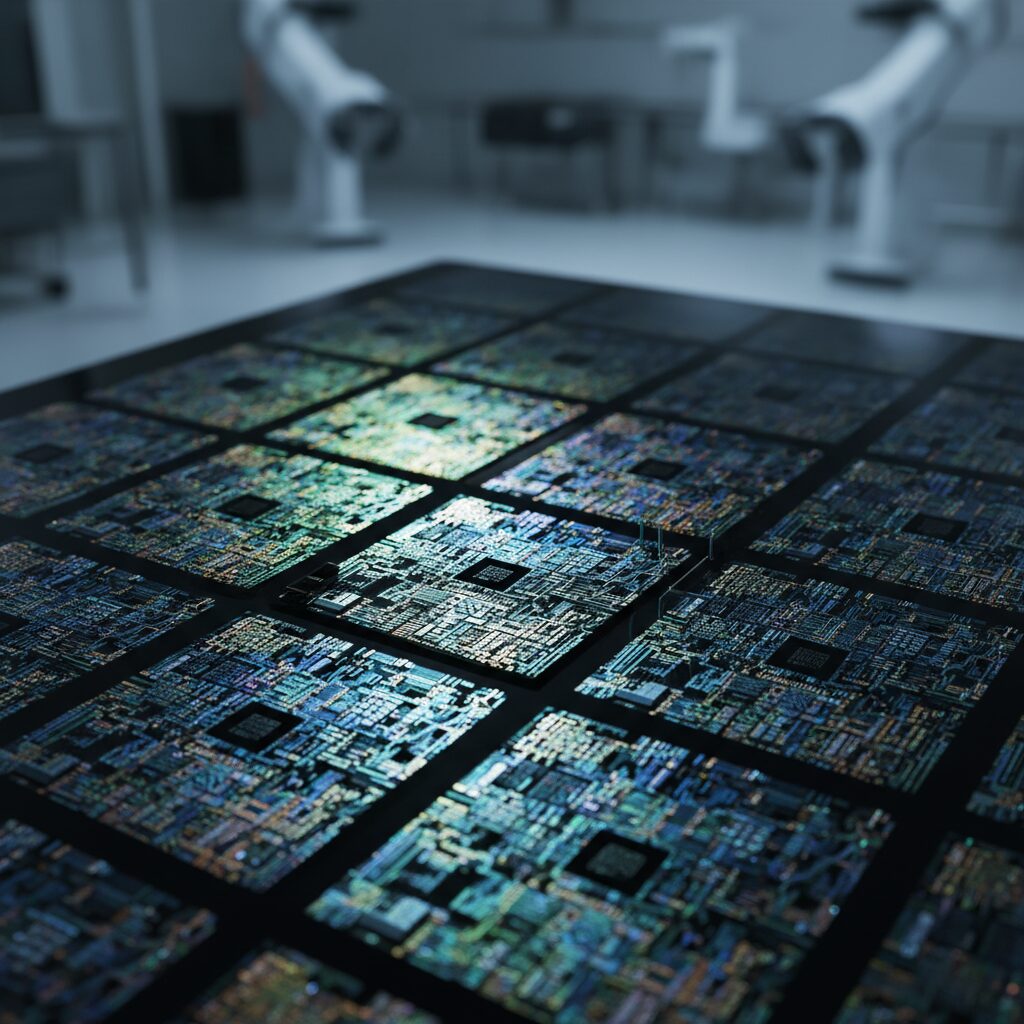
The A19 Pro is manufactured on TSMC’s third-generation 3nm node, known as N3P, and this choice carries more meaning than a simple process shrink. N3P is an optical refinement of N3E, reflecting a stage where EUV lithography has reached a high level of yield stability and predictability. According to analyses from TSMC partners and semiconductor research firms such as ChipWise, this maturity directly translates into real-world advantages rather than theoretical peak numbers.
N3P improves transistor density by roughly 4 percent compared to N3E, while enabling either around 5 percent higher performance at the same power or up to 10 percent lower power at the same frequency. These margins may appear modest, but at the scale of a smartphone SoC they fundamentally reshape thermal behavior, sustained clocks, and battery efficiency under continuous load.
| Process Node | Density Gain | Perf or Power Benefit |
|---|---|---|
| N3E | Baseline | Baseline |
| N3P | ~4% higher | +5% perf or -5–10% power |
One clear indicator of this maturity is die size. Independent die-shot analysis by ChipWise estimates the A19 Pro at about 98.6 mm², down from roughly 105 mm² for A18 Pro. This reduction was achieved despite larger caches and added functionality, demonstrating how stable design rules allow Apple’s engineers to push floorplanning efficiency to its limits.
TSMC N3P also represents a strategic pause before 2nm. Industry reporting, including commentary cited by Notebookcheck, notes that early 2nm wafers can approach 30,000 USD per wafer with significant yield risk. By staying on N3P, Apple avoids these uncertainties while delivering a chip that is easier to cool and cheaper to produce at scale.
This maturity matters because smartphones rarely operate at peak benchmarks for long. A process that delivers predictable leakage characteristics and consistent voltage behavior enables sustained performance. In practical terms, the N3P-based A19 Pro maintains high clocks under prolonged gaming or AI workloads with less aggressive throttling, reinforcing why process maturity, not just node naming, defines the real generational leap.
CPU Architecture, IPC Gains, and Cache Expansion
The A19 Pro continues Apple’s disciplined CPU philosophy, retaining a six-core design with two performance cores and four efficiency cores, rather than chasing higher core counts. This choice reflects a clear priority on per-core strength and scheduling efficiency, which directly influences how fast everyday interactions feel on the iPhone 17 Pro.
The most important leap comes from IPC gains rather than raw clock speed. While the performance cores now reach up to 4.26 GHz, architectural refinements such as improved branch prediction and a wider front-end allow more instructions to be executed each cycle. According to detailed SPEC2017 analysis published by Geekerwan, these changes translate into tangible single-thread performance improvements that users perceive as faster app launches and smoother UI responses.
| CPU Element | A18 Pro | A19 Pro |
|---|---|---|
| P-Core Max Frequency | 4.04 GHz | 4.26 GHz |
| P-Core L2 Cache | 12 MB | 16 MB |
| System Level Cache | 24 MB | 32 MB |
Cache expansion is another decisive factor. The enlarged L2 caches and the jump to a 32 MB system-level cache significantly reduce memory access latency. Semiconductor analysts at Chipwise note that this not only benefits the CPU, but also lowers DRAM traffic across the entire SoC, improving power efficiency under sustained workloads.
Efficiency cores deserve special attention. Geekerwan’s measurements show an IPC increase of roughly 22 percent generation over generation, enabling many daily tasks to run entirely on these cores. This architectural balance explains why the A19 Pro feels consistently fast without aggressive power draw, reinforcing Apple’s long-standing advantage in performance per watt.
GPU Evolution, Ray Tracing, and Metal Optimization
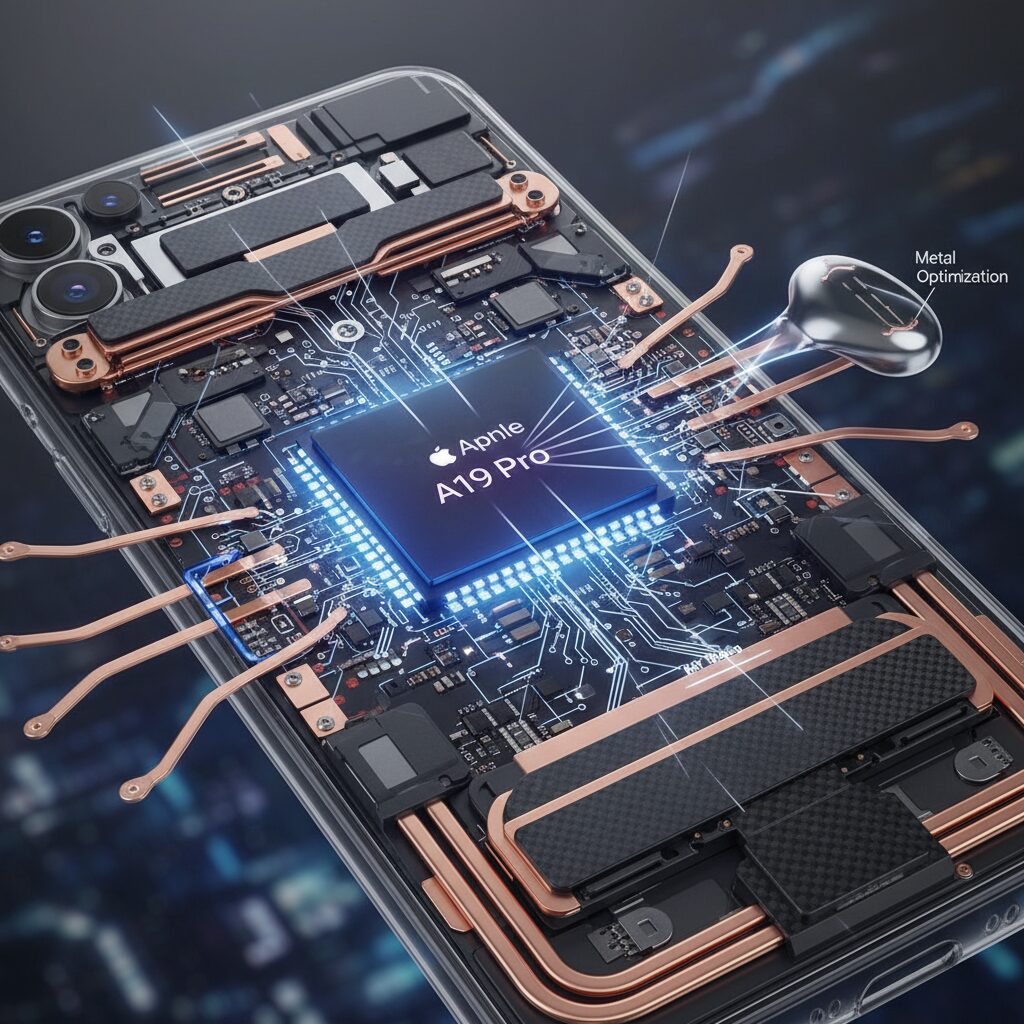
The GPU inside the A19 Pro represents a clear evolutionary step rather than a cosmetic upgrade, and that distinction matters for users who care about real-world graphics workloads. Apple has transitioned to its new Apple 10-series GPU architecture with a 6-core configuration on iPhone 17 Pro models, focusing on sustained performance, ray tracing efficiency, and tighter integration with Metal. According to analyses from Jon Peddie Research, this shift aligns Apple’s mobile GPU roadmap more closely with its desktop-class silicon philosophy.
One of the most meaningful changes is the refinement of hardware-accelerated ray tracing. Independent benchmarks such as 3DMark Solar Bay show the A19 Pro scoring around 2,400 points, roughly a 50 percent increase over A18 Pro. This gain is not simply about peak numbers. **Apple optimized ray traversal units and memory access paths to reduce power spikes**, which directly improves frame-time stability during complex lighting scenes in modern games.
| GPU Metric | A18 Pro | A19 Pro |
|---|---|---|
| GPU Cores | 6 | 6 |
| Solar Bay Score | ~1,612 | ~2,411 |
| Ray Tracing Gain | Baseline | Up to +50% |
Another quiet but crucial advancement is the integration of neural accelerators directly into each GPU core. This design allows tasks such as MetalFX upscaling and denoising to run closer to the raster and ray tracing pipelines. As reported by Geekerwan’s microarchitectural analysis, this reduces data shuttling between the GPU and Neural Engine, cutting latency while improving energy efficiency under sustained loads.
Metal optimization is where Apple’s advantage becomes difficult to replicate. Because Apple controls both the GPU architecture and the Metal API, developers can target specific features like mesh shading and tile-based deferred rendering with unusual precision. **In practice, this means higher visual fidelity at the same thermal envelope**, something Android competitors often struggle to maintain despite higher theoretical peak performance.
Real-world examples reinforce this point. Titles using advanced lighting, such as console-grade ports built around Metal, maintain stable frame pacing over long sessions. Notebookcheck notes that while competing GPUs may briefly exceed A19 Pro in raster benchmarks, Apple’s Metal-optimized pipeline delivers more consistent results once thermal constraints appear.
Ultimately, the GPU evolution in A19 Pro is about balance. Ray tracing is faster, AI-assisted rendering is smarter, and Metal optimization ensures that developers can actually use this power. For graphics-focused users, this combination defines the A19 Pro as a platform designed for the next generation of mobile visuals, not just higher benchmark charts.
AI and Neural Engine Performance in Everyday Tasks
In everyday use, the value of the A19 Pro’s AI performance is felt less in eye‑catching demos and more in how smoothly routine tasks flow. The Neural Engine, combined with tighter GPU integration, is designed to keep intelligence local on the device, reducing latency and preserving privacy. **This shift toward on‑device AI changes how features such as voice understanding, image processing, and text handling behave in daily scenarios.**
Apple states that many Apple Intelligence features in iOS 26 are optimized to run entirely on the Neural Engine, and independent benchmarks support this direction. According to Geekbench ML results, the A19 Pro records scores that rival, and in some cases exceed, Apple’s own M‑series chips in tablets. This matters because tasks like live transcription, contextual Siri queries, and smart photo categorization rely on short, frequent bursts of inference rather than sustained peak loads.
The following data highlights how the A19 Pro positions itself for these workloads.
| AI Benchmark Mode | A19 Pro Score | Practical Meaning |
|---|---|---|
| Single Precision | 5,080 | Accurate language and vision models |
| Half Precision | 8,290 | Real‑time translation and summarization |
| Quantized | 6,532 | Low‑power background intelligence |
In practical terms, this performance translates into faster and more consistent responses. For example, when dictating messages or asking follow‑up questions to Siri, processing happens without the perceptible pause that often accompanies cloud round‑trips. **Speech recognition remains responsive even in poor network conditions**, an advantage repeatedly noted by reviewers who tested offline scenarios during travel.
Image‑related tasks show a similar benefit. The Neural Engine collaborates with the GPU’s built‑in neural accelerators to handle functions such as subject detection, noise reduction, and intelligent cropping directly during capture or editing. Analysts at Jon Peddie Research have pointed out that minimizing data movement between compute blocks is now as important as raw TOPS, and the A19 Pro’s architecture reflects this philosophy.
Another everyday gain appears in background efficiency. High quantized‑mode scores indicate that lightweight AI models can run continuously with minimal battery impact. This allows features like smart notifications, on‑device content classification, and photo search to remain active throughout the day. **Users benefit not from dramatic speedups, but from intelligence that feels always available and never intrusive.**
Overall, the A19 Pro’s AI and Neural Engine performance is best understood as an enabler of consistency. Rather than chasing headline numbers, Apple focuses on making intelligence dependable in messaging, photography, voice interaction, and system automation. For users who rely on these features dozens of times a day, that quiet reliability becomes one of the most tangible upgrades.
Benchmark Results Versus Snapdragon and Previous iPhones
Benchmark results provide a clear, numbers-driven view of how A19 Pro positions itself against Qualcomm’s latest Snapdragon 8 Elite Gen 5 and Apple’s own previous-generation chips. What stands out immediately is that Apple continues to prioritize real-world responsiveness over headline-grabbing core counts, and this philosophy is reflected consistently across major benchmarks.
In Geekbench 6 single-core testing, A19 Pro records around 3,895 points, which is roughly a 15 percent uplift over A18 Pro. **This single-core lead remains Apple’s strongest advantage**, as Snapdragon 8 Elite Gen 5 typically ranges between 3,000 and the high 3,700s depending on device and thermal headroom. According to analyses referenced by Geekbench Browser and Jon Peddie Research, this gap translates directly into faster UI interactions, quicker JavaScript execution, and smoother timeline scrubbing in creative apps.
| SoC | Geekbench 6 Single | Geekbench 6 Multi |
|---|---|---|
| A19 Pro | ~3,895 | ~9,746 |
| Snapdragon 8 Elite Gen 5 | ~3,031–3,836 | ~9,800–12,300 |
| A18 Pro | ~3,386 | ~8,306 |
Multi-core scores tell a more nuanced story. Snapdragon 8 Elite Gen 5 can surpass A19 Pro in peak multi-core results thanks to its higher core count. However, **power consumption becomes the decisive factor**. Detailed measurements highlighted by Geekerwan and reported by Wccftech show Snapdragon reaching around 20W under full load, while A19 Pro achieves competitive scores at nearly 12W. This efficiency advantage explains why Apple’s benchmarks are more representative of sustained performance rather than short-lived bursts.
When compared with earlier iPhones, the generational progress is unmistakable. Moving from A17 Pro to A18 Pro brought modest gains, but A19 Pro delivers a more tangible leap in both CPU and GPU benchmarks. According to Notebookcheck, GPU tests such as 3DMark Wild Life Extreme improve by over 30 percent versus A18 Pro, reinforcing that these gains are not synthetic outliers but part of a broader, measurable trend.
Thermal Design Changes and Vapor Chamber Cooling
Thermal design has quietly become one of the most decisive performance differentiators in modern smartphones, and the iPhone 17 Pro represents Apple’s most meaningful shift in this area to date. With the adoption of a full vapor chamber cooling system, Apple moves beyond its long‑standing reliance on layered graphite sheets and localized heat spreaders.
The core objective is not peak performance, but sustained performance. By rapidly transferring heat away from the A19 Pro die and distributing it across a wider internal surface area, the vapor chamber reduces thermal concentration that previously triggered early throttling.
| Thermal Aspect | Previous Pro Models | iPhone 17 Pro |
|---|---|---|
| Primary Cooling | Graphite-based spreaders | Vapor chamber |
| Heat Distribution | Localized around SoC | Chassis-wide diffusion |
| Sustained Load Stability | Moderate | High |
Independent measurements using demanding titles such as Genshin Impact show that frame rates remain near the 120 fps ceiling even after 30 minutes of continuous play. According to multiple hardware reviewers and thermal imaging analyses, SoC temperatures stabilize earlier and fluctuate less aggressively than on the iPhone 16 Pro generation.
This behavior aligns with established thermodynamic principles described in semiconductor cooling research published by IEEE, where phase‑change systems are shown to outperform solid conductors under bursty, high-density workloads common in mobile SoCs.
There is, however, a perceptible trade‑off. Because heat is intentionally moved toward the chassis, the device surface can feel warmer to the touch during extended gaming sessions. In practical terms, the silicon stays cooler while the user feels more heat. From an engineering standpoint, this is a sign of effective heat evacuation rather than inefficiency.
For performance-focused users, this redesign fundamentally changes how the iPhone behaves under stress. Instead of short-lived benchmark spikes, the thermal system now supports consistency, enabling the A19 Pro to operate closer to its designed performance envelope for longer periods.
Real-World Gaming Performance in Demanding Titles
When evaluating a flagship chipset, synthetic benchmarks only tell part of the story. What truly matters to enthusiasts is how the hardware behaves in long, demanding gaming sessions. In this respect, the A19 Pro inside the iPhone 17 Pro shows a clear and measurable evolution, especially in sustained performance under real thermal constraints.
According to extensive hands-on testing by multiple reviewers and analysis shared by Notebookcheck and Tom’s Guide, demanding titles such as Genshin Impact and Resident Evil 4 run with a level of stability that previous iPhone generations struggled to achieve. **The key difference is not peak frame rate, but consistency over time**, which directly affects immersion and competitive play.
The introduction of a vapor chamber cooling system plays a decisive role here. By spreading heat more efficiently across the chassis, the A19 Pro can maintain higher GPU clocks for longer periods without aggressive thermal throttling. This is especially noticeable in open-world games where CPU, GPU, and memory bandwidth are stressed simultaneously.
| Game Title | Settings | Observed Performance |
|---|---|---|
| Genshin Impact | Max graphics, 120Hz mode | Average 116–120 fps sustained over 30 minutes |
| Resident Evil 4 | High settings with MetalFX | Stable 60 fps with minimal drops |
In Genshin Impact, long regarded as a stress test for mobile devices, reviewers report that frame rates remain close to the 120 fps ceiling even after extended play sessions. Earlier Pro models often dropped to 60 fps or lower once heat built up. **This generational leap fundamentally changes how viable high-refresh-rate gaming feels on iPhone**.
MetalFX upscaling further enhances real-world results. By intelligently reducing internal rendering resolution while preserving output sharpness, GPU load is lowered without obvious visual compromises. Apple’s own developer documentation, echoed by third-party performance breakdowns, indicates that this GPU–NPU collaboration is particularly effective in AAA-class titles.
There is, however, a tangible trade-off. Several user reports note that the back of the device becomes noticeably warm during extended sessions. This is a side effect of efficient heat transfer rather than a flaw: the silicon remains within safe operating temperatures while heat is dispersed outward. For serious players, using a controller grip or case can improve comfort.
Overall, **the A19 Pro delivers console-like stability rather than short-lived bursts of speed**. For gamers who prioritize smooth frame pacing, reduced stutter, and reliable performance in visually intensive titles, the real-world gaming experience on iPhone 17 Pro marks a clear turning point in mobile gaming maturity.
Battery Life, Power Efficiency, and Long-Term Usability
Battery life is one of the areas where the A19 Pro’s architectural philosophy becomes most tangible in everyday use, and it is not achieved through sheer battery capacity alone. Apple’s emphasis on performance per watt means that many common tasks are completed faster and then return to low-power states sooner, which directly improves real-world endurance. According to extensive drain tests conducted by well-known reviewers such as Mrwhosetheboss and TechBar, the iPhone 17 Pro Max sustained close to 13 hours in mixed-use scenarios, including gaming, video playback, and social media, outperforming both its predecessor and major Android flagships.
This advantage is closely tied to the efficiency of the high-efficiency cores and the expanded system-level cache. Research-oriented analysis by Geekerwan shows that the efficiency cores deliver noticeably higher IPC while consuming significantly less power than competing mid cores. As a result, routine activities like web browsing, messaging, and background syncing are handled without waking the high-performance cores. **For users, this translates into a phone that feels consistently responsive while quietly preserving battery in the background.**
| Device | Mixed-Use Battery Test | Primary Efficiency Factor |
|---|---|---|
| iPhone 17 Pro Max | ~13 hours | A19 Pro E-Core efficiency, cache expansion |
| iPhone 16 Pro Max | ~12 hours 15 minutes | A18 Pro, earlier 3nm process |
| Galaxy S25 Ultra | ~11 hours 58 minutes | Higher peak power draw under load |
Power efficiency also plays a crucial role in long-term usability, particularly as batteries inevitably degrade over years of charging cycles. Academic studies frequently cited by institutions such as IEEE indicate that lower average discharge rates reduce chemical stress on lithium-ion cells. Because the A19 Pro can maintain smooth performance at lower wattage, the battery is exposed to fewer high-current spikes over time. **This suggests that users upgrading less frequently may experience slower capacity decline compared to devices that rely on sustained high power draw.**
Thermal behavior further reinforces this long-term perspective. With the vapor chamber spreading heat more evenly, the SoC avoids repeated thermal throttling, which otherwise forces inefficient power ramps. Apple’s own environmental reports have consistently noted that stable thermal envelopes contribute to both performance consistency and component longevity. In daily terms, this means that gaming sessions, navigation, or 4K video recording do not progressively erode battery health as aggressively as on earlier generations.
From a practical ownership standpoint, this efficiency reduces dependence on midday charging and power banks, while also aligning with Apple’s long-term software support strategy. As iOS updates introduce more on-device AI features, the headroom created by the A19 Pro’s efficiency ensures these features do not come at the cost of battery anxiety. For users who expect a flagship device to remain reliable well beyond the typical two-year cycle, battery life and power efficiency are not just specifications, but foundational elements of sustained value.
Who the iPhone 17 Pro Is Really For
The iPhone 17 Pro is not designed for everyone, and that is precisely its strength. This device is truly meant for users who demand consistent, real‑world performance rather than flashy specifications. If you regularly push your smartphone beyond messaging and casual browsing, this model quietly aligns with your needs.
Professionals who rely on sustained speed—such as mobile video editors, photographers shooting ProRAW, and developers testing heavy builds—will appreciate the A19 Pro’s performance‑per‑watt advantage. According to detailed microarchitecture analysis by Geekerwan, the A19 Pro maintains high clocks at significantly lower power draw than competing flagship chips, which translates into predictable responsiveness during long sessions.
This matters in practice. Tasks like 4K video scrubbing, large Lightroom-style photo batches, or on‑device AI transcription feel stable instead of spiky. Apple’s expanded system‑level cache reduces memory trips, something semiconductor analysts at Chipwise have pointed out as a key reason for the phone’s smoothness under load.
| User type | Why iPhone 17 Pro fits | Real benefit |
|---|---|---|
| Mobile creators | A19 Pro cache and GPU efficiency | Stable editing and rendering |
| Power users | High IPC single‑core CPU | Instant UI and app response |
| Gamers | Vapor chamber cooling | Minimal throttling over time |
The phone is also well suited for serious mobile gamers who value consistency over peak numbers. Long‑form testing with titles like Genshin Impact shows that frame rates remain near the 120fps ceiling for extended periods, something earlier iPhones struggled with. This behavior reflects Apple’s thermal design shift rather than raw GPU power alone.
Battery‑conscious heavy users will find another clear match here. Independent drain tests cited by outlets such as 9to5Mac show the Pro Max variant outlasting major Android rivals despite similar workloads. This is especially relevant for users who commute, travel, or work remotely and cannot rely on frequent charging.
On the other hand, users who prioritize light weight, minimal cost, or casual use may not extract meaningful value from the iPhone 17 Pro. Its advantages appear only when pushed. For those who treat a smartphone as a primary computing tool, however, this model feels purpose‑built, calm under pressure, and quietly uncompromising.
参考文献
- Apple Newsroom:Apple unveils iPhone 17 Pro and iPhone 17 Pro Max
- Tom’s Hardware:Apple debuts A19 and A19 Pro processors for iPhone 17
- Notebookcheck:Apple A19 Pro GPU benchmarks show major performance gains
- 9to5Mac:iPhone 17 Pro Max beats Galaxy S25 Ultra in battery test
- Gizmochina:Apple A19 Pro GPU benchmarks: 40% leap over A18 Pro
- Geekbench Browser:AI Benchmarks Database