
Have you ever felt frustrated when your smartphone mishears a critical word during a meeting or interview? In 2026, that frustration is rapidly disappearing thanks to a new generation of on‑device AI, dedicated NPUs, and deeply integrated operating systems.
Today’s flagship chips such as Snapdragon 8 Elite Gen 5 and Google Tensor G5 dramatically boost AI inference performance while reducing power consumption, enabling real‑time transcription, summarization, and even live translation directly on your device. This shift from cloud‑dependent processing to on‑device intelligence significantly improves privacy, latency, and reliability.
In this article, you will discover how hardware architecture, OS‑level features, specialized apps like Notta, and even external microphones work together to maximize transcription accuracy. By understanding and optimizing each layer, you can turn your smartphone into a near‑perfect intelligent recording assistant for business, research, law enforcement, and global communication.
- The 2026 Paradigm Shift: From Cloud Transcription to Fully On‑Device AI
- AI Chip Wars: Snapdragon 8 Elite Gen 5 vs. Google Tensor G5 and the Rise of Dedicated NPUs
- Agentic AI and Personalized Learning: How Smartphones Adapt to Your Voice and Context
- iOS 19 and Apple Intelligence: System‑Level Transcription, Summaries, and Call Recording
- Android 16/17 and Pixel Innovations: Live Caption, Voice Translate, and Tone‑Aware Input
- Benchmarking Accuracy: Why Apps Like Notta Reach 98.86% and What That Really Means
- Japanese Optimization and High‑Speed Processing: The Case of Rimo Voice
- Hardware Still Matters: Directional Microphones, Wireless Systems, and SNR Optimization
- Acoustic Engineering for Everyday Users: Room Treatment, Placement, and Vibration Control
- Training Your AI: Custom Dictionaries, Context Injection, and Filler Word Management
- Real‑World Impact: Law Enforcement, Global Conferences, and Creative Audio Workflows
- Energy Limits, AI Hallucinations, and the Human‑in‑the‑Loop Imperative
- 参考文献
The 2026 Paradigm Shift: From Cloud Transcription to Fully On‑Device AI
In 2026, smartphone transcription no longer depends on distant cloud servers. It runs directly on the device in your hand. What used to require a stable internet connection and remote GPUs is now executed by dedicated NPUs inside flagship chips such as Snapdragon 8 Elite Gen 5 and Google Tensor G5.
This transition marks a structural shift in architecture, not just an incremental upgrade. According to Qualcomm, its latest platform improves AI inference performance by 37% over the previous generation while reducing designed power consumption by 39%. That efficiency gain makes continuous, high‑accuracy transcription feasible entirely on‑device.
The difference between cloud‑based and fully on‑device transcription can be understood across three practical dimensions.
| Dimension | Cloud Transcription (Past Standard) | On‑Device AI (2026 Standard) |
|---|---|---|
| Latency | Network‑dependent, variable delay | Near real‑time, hardware‑level processing |
| Privacy | Audio uploaded to remote servers | Audio processed locally |
| Reliability | Requires stable connection | Works offline |
Latency is the most immediately visible improvement. With inference handled by integrated NPUs, transcription begins almost instantly. In practical terms, this means live captions during calls, real‑time multilingual translation, and automatic summarization that appears seconds after speech ends.
Google’s Tensor G5, designed in collaboration with DeepMind, natively runs Gemini Nano on‑device. Features such as real‑time call translation and voicemail transcription operate without routing full audio streams to external servers. The experience feels continuous rather than transactional.
Privacy is the second pillar of this shift. By keeping raw voice data local, smartphones dramatically reduce exposure risks. As regulatory scrutiny around data sovereignty increases globally, on‑device AI aligns with stricter compliance expectations while maintaining usability.
Apple’s integration of transcription directly into system apps such as Voice Memos further demonstrates this architectural philosophy. Recording, transcription, summarization, and key‑point extraction occur as a unified pipeline inside the OS layer, not as a cloud add‑on.
This evolution also changes how AI behaves. Qualcomm describes its new architecture as “Agentic AI,” meaning the system learns user patterns and adapts settings proactively. Instead of merely converting speech to text, the device anticipates formatting preferences, vocabulary tendencies, and contextual needs.
Importantly, this shift does not eliminate the cloud entirely. Rather, it redefines its role. Heavy model training and large‑scale updates may still occur remotely, but day‑to‑day inference—the moment that matters to users—happens locally.
From a marketing and product‑strategy perspective, this is a competitive moat. Devices are no longer differentiated only by camera megapixels or display brightness. AI inference performance per watt has become a core buying criterion.
The 2026 paradigm shift, therefore, is not simply about better transcription accuracy. It is about architectural sovereignty: speed without dependency, intelligence without exposure, and personalization without latency. Smartphones have moved from being gateways to cloud AI to becoming autonomous AI endpoints.
AI Chip Wars: Snapdragon 8 Elite Gen 5 vs. Google Tensor G5 and the Rise of Dedicated NPUs
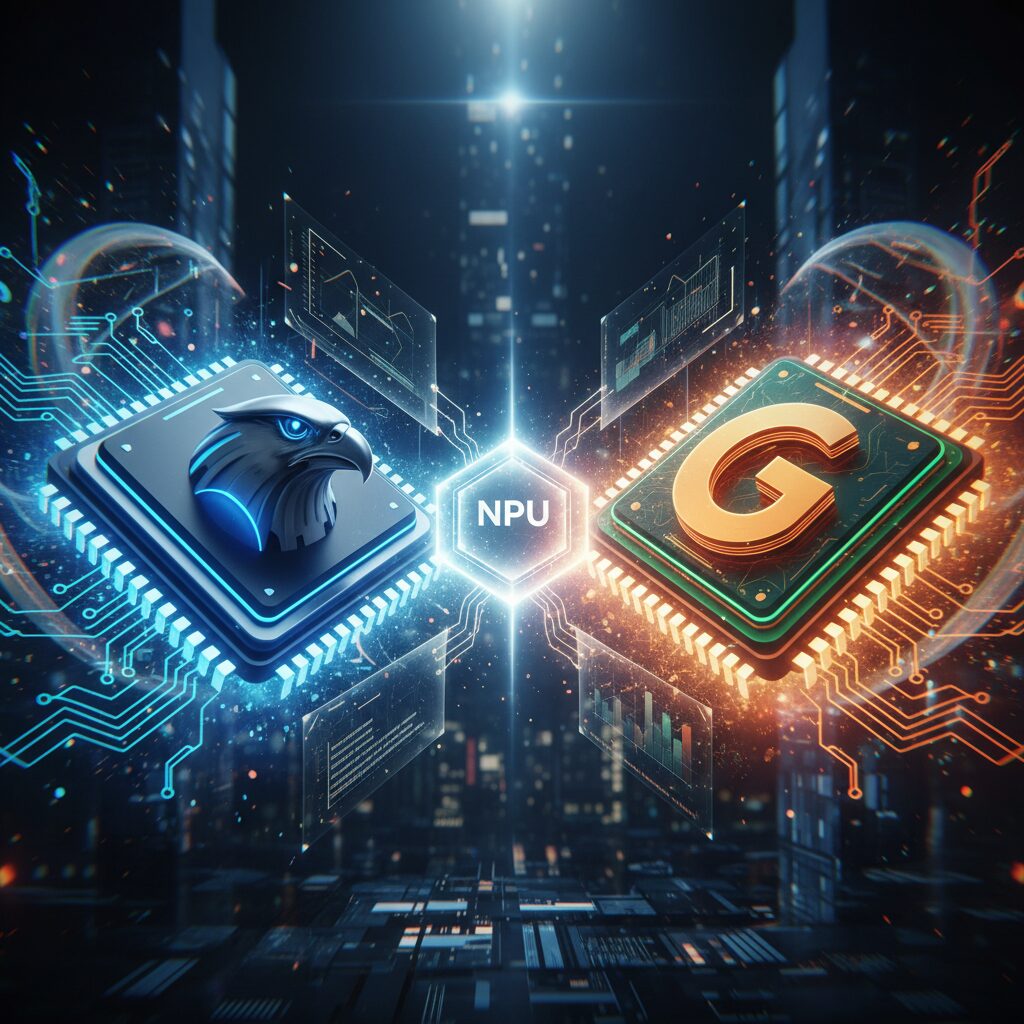
In 2026, the competition between Snapdragon 8 Elite Gen 5 and Google Tensor G5 is no longer just about CPU or GPU benchmarks. It is fundamentally an AI chip war, where the true battleground is the dedicated NPU and its ability to execute large-scale on-device inference with extreme efficiency.
The rise of dedicated NPUs has transformed smartphones into real-time AI engines, especially for transcription, translation, and contextual understanding. As cloud dependence declines, silicon-level AI acceleration has become the decisive factor.
| Chip | AI Architecture Focus | Key AI Advancement (2026) |
|---|---|---|
| Snapdragon 8 Elite Gen 5 | Agentic AI + Hexagon NPU | 37% faster AI inference, 39% power reduction |
| Google Tensor G5 | DeepMind co-designed + Gemini Nano | Native on-device translation & contextual AI |
Qualcomm’s Snapdragon 8 Elite Gen 5 represents a major leap in dedicated AI processing. According to coverage of Qualcomm’s 2026 platform announcement, the updated Hexagon NPU delivers a 37% improvement in AI inference performance compared to the previous generation. This is not a minor tuning upgrade; it directly affects how quickly on-device large language models process live audio streams.
Equally important is the reported 39% reduction in energy consumption by design. In real-world transcription scenarios such as multi-hour meetings or lectures, sustained AI workloads traditionally led to thermal throttling and gradual accuracy degradation. Improved power efficiency means stable inference over long sessions, which directly contributes to consistent transcription precision.
The architectural shift toward “Agentic AI” is another defining trait. Rather than passively executing commands, the chip architecture is designed to learn user behavior patterns and optimize tasks dynamically. In transcription workflows, this enables adaptive noise handling, contextual correction, and smarter post-processing without manual intervention.
On the other side of the battlefield, Google’s Tensor G5 takes a vertically integrated approach. Co-designed with DeepMind, it is the first foundation optimized to run Gemini Nano natively on-device. This tight coupling between silicon and model architecture allows Google to fine-tune performance not just at the hardware level, but at the model inference pipeline level.
One clear demonstration is real-time voice translation on Pixel 10 devices. Reports describing the “Voice Translate” feature explain how phone conversations can be translated live while preserving tone and speech characteristics. This requires parallel processing of speech recognition, semantic understanding, translation, and speech synthesis — all executed locally. Such multi-stage pipelines are only possible because the NPU is no longer a secondary accelerator but a central computational core.
The strategic difference between the two chips becomes clear when we examine their optimization philosophy. Snapdragon emphasizes cross-application AI orchestration and high raw inference gains. Tensor G5 focuses on deep integration with Google’s AI stack, especially Gemini Nano, enabling tightly controlled real-time experiences.
From a system design perspective, dedicated NPUs now handle:
High-throughput speech-to-text decoding
LLM-based contextual correction and summarization
Simultaneous translation and tone-preserving synthesis
Previously, these tasks would have required server-side GPUs. In 2026, they run in your pocket.
This transition also addresses privacy concerns. Because advanced inference happens entirely on-device, sensitive voice data no longer needs to be transmitted to external servers. In professional environments such as legal interviews or internal corporate meetings, hardware-level AI acceleration enables both higher accuracy and stronger data sovereignty.
However, this AI arms race is not without constraints. As highlighted in broader discussions about AI scaling and energy limits in 2026, performance growth is increasingly tied to power efficiency. NPUs must deliver more TOPS per watt, not simply higher raw compute. Both Qualcomm and Google appear to recognize that sustainable AI performance is as critical as peak throughput.
Ultimately, the Snapdragon 8 Elite Gen 5 and Tensor G5 symbolize a structural shift in mobile computing. The smartphone is no longer a thin client relying on the cloud; it is an autonomous AI system powered by a specialized neural engine. The rise of dedicated NPUs marks the beginning of silicon-defined intelligence, where transcription accuracy, contextual awareness, and real-time reasoning are determined at the chip level.
For users who care deeply about cutting-edge AI performance, understanding this chip war is essential. The future of on-device intelligence will not be decided by clock speed alone, but by how intelligently these NPUs are designed to think alongside us.
Agentic AI and Personalized Learning: How Smartphones Adapt to Your Voice and Context
By 2026, smartphones no longer wait passively for your commands. They observe, learn, and proactively assist. This shift toward Agentic AI is redefining personalized learning on mobile devices, especially in how they adapt to your voice, behavior, and real-world context.
Qualcomm’s Snapdragon 8 Elite Gen 5, for example, integrates an Agentic AI architecture that improves on-device AI inference performance by 37% over the previous generation while reducing energy consumption by 39% by design. This combination enables continuous learning from user interactions without compromising battery life, making real-time personalization practical at scale.
Agentic AI does not simply transcribe your voice. It studies how you speak, when you speak, and why you speak—then adjusts system behavior accordingly.
Unlike earlier assistants that reacted to isolated prompts, Agentic AI systems analyze speech patterns, habitual phrasing, correction history, and frequently used terminology. Over time, your smartphone builds a dynamic linguistic profile. If you often dictate technical terms, project names, or multilingual phrases, the system prioritizes those in prediction and correction pipelines.
Google’s Tensor G5, co-designed with DeepMind, takes this further by tightly integrating Gemini Nano on-device. In features such as real-time Voice Translate, the phone preserves vocal tone while translating conversations live. This demonstrates contextual adaptation beyond text—capturing emotional cadence and conversational intent.
| Capability | Traditional AI | Agentic AI (2026) |
|---|---|---|
| Learning Style | Command-based | Behavior-driven continuous learning |
| Context Awareness | Session-limited | Cross-app, long-term adaptation |
| Voice Handling | Literal transcription | Tone, intent, and correction modeling |
Personalized learning also operates at the OS level. Apple Intelligence in iOS 19 integrates transcription, summarization, and key-point extraction into a unified workflow. The system recognizes recurring meeting structures or frequently contacted individuals and adjusts summaries accordingly. Over time, it anticipates whether you prefer concise bullet-style summaries or detailed narrative reports.
Context awareness extends beyond language. If you regularly record lectures in quiet classrooms, the device optimizes microphone gain and noise filtering differently than when you capture field interviews. Because advanced inference now runs on-device, these adjustments occur instantly and privately, without cloud dependency.
According to coverage of Pixel 10’s AI features, the ability to suggest next actions—such as adding calendar events from voicemail transcriptions—illustrates the evolution from recognition to reasoning. The phone interprets not just what was said, but what should happen next.
This progression signals a deeper transformation. Your smartphone becomes a continuously learning collaborator, refining its understanding of your vocabulary, professional domain, and communication style. The more you use voice input, the more precise and anticipatory the system becomes.
In practical terms, this means fewer corrections, more accurate domain-specific transcription, smarter summaries, and context-aware automation. Personalized learning in 2026 is not an optional feature layered on top of voice recognition. It is the foundation of how modern smartphones understand—and increasingly anticipate—your intent.
iOS 19 and Apple Intelligence: System‑Level Transcription, Summaries, and Call Recording
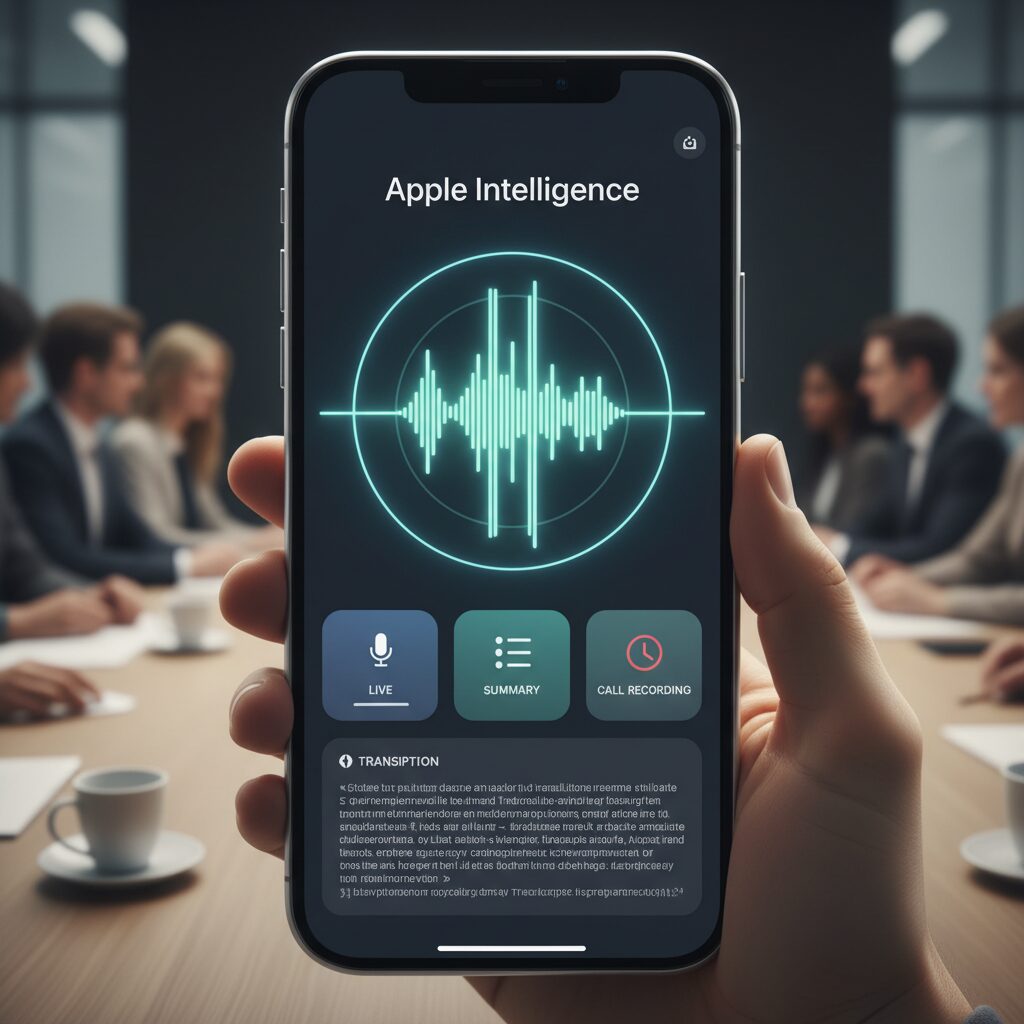
With iOS 19, Apple has moved transcription from a convenient feature to a deeply integrated system capability. Apple Intelligence now operates at the OS level, enabling automatic transcription, structured summaries, and compliant call recording without relying on third‑party apps.
This shift reflects the broader 2026 trend toward on‑device AI processing. As noted in multiple 2026 industry analyses, including coverage of Apple Intelligence’s expansion in Japan, advanced language models now run locally, reducing latency while strengthening privacy protections.
The result is a workflow that feels instantaneous and native rather than layered on top.
| Function | Where It Works | Output |
|---|---|---|
| Automatic Transcription | Voice Memos, Call Recording | Speaker‑separated text |
| AI Summaries | Recorded audio files | Concise key points |
| Call Recording | Phone app (with notification) | Audio + transcript + summary |
In the Voice Memos app, transcription is generated immediately after recording. Users simply access the menu to display text, and the system produces a clean transcript within seconds. iOS 19 enhances this by chaining transcription, summarization, and key‑point extraction into a single automated flow.
This is not just speech‑to‑text conversion. The model performs post‑processing using large language model techniques, correcting contextual errors and restructuring fragmented spoken language into readable prose. According to recent guides on Apple Intelligence features, summaries are generated directly inside the Notes environment, eliminating copy‑paste friction.
For professionals handling interviews or strategy sessions, this dramatically reduces turnaround time.
Call recording represents an even more significant evolution. When recording begins, the system notifies the other party, ensuring transparency. After the call ends, iOS 19 automatically creates a transcript with speaker separation and a structured summary stored alongside the audio.
This system‑level integration distinguishes Apple’s approach. Instead of treating recording as a raw audio archive, the OS transforms conversations into searchable knowledge assets.
For legal, journalistic, or executive use cases, that searchable layer is often more valuable than the recording itself.
Privacy remains central to Apple’s positioning. By performing transcription and summarization on‑device, Apple Intelligence minimizes the need to send sensitive voice data to external servers. In 2026, where AI scalability is increasingly constrained by energy and infrastructure concerns, efficient on‑device inference is also a strategic advantage.
The low‑latency response means users can review transcripts immediately after a meeting or call, even without a stable network connection.
This reliability changes how voice capture is used in daily workflows.
In practical terms, iOS 19 turns the iPhone into a real‑time documentation assistant. Meetings become structured notes. Phone calls become indexed archives. Spoken ideas become summarized briefs ready for action.
The key innovation is not transcription accuracy alone, but the seamless fusion of recording, understanding, and summarizing at the system level.
For gadget enthusiasts and productivity‑focused users, this marks one of the most meaningful OS‑level upgrades in Apple’s recent history.
Android 16/17 and Pixel Innovations: Live Caption, Voice Translate, and Tone‑Aware Input
On Android 16 and 17, voice is no longer an input method but a system-level intelligence layer. Especially on Pixel devices powered by Tensor G5, speech recognition, translation, and tone control operate directly on-device, combining low latency with stronger privacy. This shift from cloud dependency to on-device AI fundamentally changes how we interact with our phones in real time.
Reports covering the Pixel 10 series note that Google DeepMind collaborated on Tensor G5 to optimize Gemini Nano for speech and language tasks. As a result, features such as Live Caption and Voice Translate are processed locally, reducing delay while maintaining contextual accuracy. This architectural decision also minimizes the need to stream sensitive voice data externally.
Core Innovations in Android 16/17
| Feature | What It Does | On‑Device AI Role |
|---|---|---|
| Live Caption | Real-time transcription of media and conversations | Instant speech-to-text with contextual correction |
| Voice Translate | Real-time bidirectional call translation | Parallel recognition and translation pipeline |
| Tone‑Aware Input | Voice-driven text editing and tone adjustment | LLM-based rewriting with style control |
Live Caption has evolved from a simple accessibility tool into a universal audio layer. It can transcribe videos, voice messages, and even spontaneous in-person dialogue. Because processing runs locally on advanced NPUs, latency is low enough that captions appear almost simultaneously with speech, which is critical in fast-paced discussions or noisy environments.
Accuracy improvements are closely tied to hardware. With dedicated AI acceleration, the system performs contextual post-processing rather than raw phonetic decoding alone. This means misheard syllables are corrected based on sentence meaning, similar to the LLM-backed correction pipelines now common in high-end transcription tools.
Voice Translate represents an even more dramatic leap. According to analyses of Pixel 10’s AI features, calls can be translated in real time while preserving the speaker’s vocal tone in synthesized output. This is not merely word substitution but tone-aware semantic transfer, allowing conversations to feel more natural across language barriers.
The technical breakthrough lies in parallel processing. Speech recognition and translation occur simultaneously instead of sequentially, significantly reducing delay. Combined with on-device execution, this architecture makes international communication practical in everyday scenarios such as booking services abroad or handling global business calls.
Equally transformative is tone‑aware input in Gboard. Users can dictate a message and then issue spoken commands to adjust its style—professional, casual, concise—without touching the screen. This merges speech recognition with generative language modeling, turning voice into both drafting and editing control.
For productivity-focused users, this matters more than it first appears. Instead of typing, revising, and reformatting, you can speak your thoughts, then refine them through additional voice prompts. The system interprets intent, applies stylistic constraints, and outputs a revised version aligned with your desired tone.
The convergence of Live Caption, Voice Translate, and tone-aware editing signals a broader UI evolution: voice becomes the primary interface layer. Rather than navigating menus, users increasingly express goals verbally, and the OS interprets both content and emotional nuance.
Privacy also improves as a result of on-device AI. Since transcription and translation are executed locally on chips like Tensor G5, sensitive conversations—whether business negotiations or personal calls—are less exposed to external processing. This design reflects a wider industry move toward edge AI, where performance and confidentiality advance together.
In Android 16 and 17, these innovations are not isolated features but interconnected capabilities. Live Caption feeds contextual understanding, Voice Translate extends communication globally, and tone-aware input reshapes composition workflows. Together, they redefine what a smartphone keyboard, microphone, and screen are capable of delivering in 2026.
Benchmarking Accuracy: Why Apps Like Notta Reach 98.86% and What That Really Means
When an app like Notta claims an accuracy rate of 98.86% or higher, it immediately captures the attention of serious gadget users and professionals. However, to truly evaluate that number, you need to understand how speech recognition accuracy is benchmarked and what it means in real-world scenarios.
In most cases, accuracy is measured using Word Error Rate (WER), a standard metric widely referenced in academic research and industry evaluations. WER calculates substitutions, deletions, and insertions compared to a human-generated reference transcript. An accuracy of 98.86% roughly implies a WER of around 1.14%, meaning just over one word in 100 is incorrect under test conditions.
98.86% accuracy does not mean perfection. It means that under controlled conditions, the system performs with extremely low word-level error compared to a verified transcript.
To understand the significance of this figure, it helps to break down what “controlled conditions” typically involve.
| Factor | Optimized Benchmark Setting | Real-World Risk |
|---|---|---|
| Audio Quality | High S/N ratio, minimal noise | Café noise, echo, overlap |
| Speakers | Clear articulation, limited overlap | Interruptions, dialect variation |
| Vocabulary | General domain language | Industry jargon, proper nouns |
According to industry comparisons published in 2026 app rankings, Notta maintains its 98.86%+ performance by combining advanced AI models with post-processing layers such as filler-word removal and contextual correction. This multi-stage pipeline is critical. Raw acoustic decoding alone rarely achieves such high scores without language-model refinement.
Another key factor is multilingual optimization. Notta supports 104 languages and provides real-time translation in 41 languages, as noted in recent product documentation. Maintaining near-99% accuracy across languages requires language-specific tuning, pronunciation modeling, and continuous dataset updates. Accuracy in English business meetings may differ slightly from accuracy in tonal or morphologically complex languages.
It is also important to interpret 98.86% from a productivity perspective. In a 10,000-word transcript, a 1.14% error rate would statistically translate to about 114 word-level errors. In many business contexts, especially when combined with searchable timestamps and tagging features, this level of imperfection is operationally acceptable because manual correction becomes dramatically faster than full transcription from scratch.
Moreover, benchmarking typically evaluates clean recordings. When paired with high-performance on-device AI chips such as Snapdragon 8 Elite Gen 5 or Google Tensor G5, inference latency drops and contextual correction improves, which indirectly stabilizes accuracy during long sessions. However, environmental variables still influence outcomes more than the headline number suggests.
Ultimately, 98.86% should be read as a signal of technological maturity rather than absolute infallibility. It indicates that the combination of acoustic modeling, large language model post-processing, and optimized hardware has reached a stage where transcription errors are the exception, not the norm. For power users, the real value lies not just in the percentage itself, but in how that high baseline accuracy transforms editing time, workflow speed, and decision-making efficiency.
Japanese Optimization and High‑Speed Processing: The Case of Rimo Voice
Rimo Voice stands out in 2026 as a transcription engine engineered specifically for Japanese, where linguistic nuance directly affects accuracy and speed. Japanese presents structural challenges such as omitted subjects, flexible word order, and a high density of homophones. General-purpose multilingual models often struggle with these characteristics, but Rimo Voice is optimized to process them natively.
The core strength of Rimo Voice lies in its Japanese-first acoustic and language modeling. According to comparative reviews in 2026 app rankings, it consistently ranks among the top tools for domestic business use, particularly in meetings and interviews conducted entirely in Japanese. Rather than maximizing language coverage, it concentrates computational resources on deep contextual prediction within one language.
| Feature | Rimo Voice | General Multilingual Apps |
|---|---|---|
| Primary Optimization | Japanese-specific | Multi-language balance |
| Processing Speed (1h audio) | Approx. 5 minutes | Varies widely |
| Homophone Handling | Context-prioritized | Model-dependent |
One of its most remarkable advantages is processing speed. Reviews of leading transcription apps in 2026 report that one hour of audio can be converted into text in roughly five minutes. This throughput dramatically changes workflow design. Instead of waiting for batch processing overnight, journalists and corporate teams can iterate transcripts during the same meeting cycle.
Speed alone would be meaningless without stability. Rimo Voice maintains high responsiveness even with long-form recordings, which is critical in board meetings or academic lectures. Because Japanese conversations frequently rely on implicit context, rapid post-processing using language models helps reconstruct omitted subjects and clarify sentence endings in real time.
Another defining capability is audio-linked editing. When users select a segment of text, the corresponding audio plays instantly. This reduces cognitive load during correction. Rather than scrubbing manually through a waveform, editors validate AI output with pinpoint precision. In practice, this shortens verification time and supports a human-in-the-loop workflow, which remains essential for legal or public-facing documentation.
Japanese optimization also extends to sentence-final expressions and polite forms. Business Japanese relies heavily on subtle endings such as “〜でございます” or “〜と存じます,” which can shift tone and intent. By prioritizing domestic linguistic patterns, Rimo Voice better preserves these distinctions, minimizing semantic drift.
For organizations operating exclusively in Japan, this specialization becomes a strategic advantage. Instead of paying for multilingual breadth they rarely use, teams gain accelerated turnaround, culturally aligned transcription, and smoother revision cycles. In a market where on-device AI and energy-efficient processing define 2026 standards, Rimo Voice demonstrates that focused optimization can outperform broad generalization when linguistic complexity demands precision.
Hardware Still Matters: Directional Microphones, Wireless Systems, and SNR Optimization
Even in 2026, when on-device AI can correct mispronunciations and restore context, hardware still defines the ceiling of transcription accuracy. No neural engine can recover detail that was never captured. The true bottleneck is often not the model, but the microphone and signal path feeding it.
Signal-to-noise ratio (SNR) remains the single most critical physical metric. If the voice signal is weak and background noise dominates, even the most advanced LLM-based post-processing will struggle. Improving SNR at the recording stage reduces the burden on AI correction and directly increases word recognition stability.
Directional Microphones: Controlling What the AI Hears
Built-in smartphone microphones are typically close to omnidirectional. They capture everything—voices, HVAC hum, keyboard clicks, and reverberation. In controlled tests summarized by product comparison platforms such as MyBest in 2026, directional microphones consistently delivered clearer vocal isolation in meeting environments.
Models like the Shure MV88+ or Panasonic WX-4100B are designed to prioritize sound from a specific axis. By physically rejecting off-axis noise, they increase effective SNR before any software enhancement occurs. This mechanical filtering is fundamentally different from digital noise reduction, which attempts reconstruction after contamination.
| Microphone Type | Pickup Pattern | Best Use Case |
|---|---|---|
| Built-in Smartphone | Near-omnidirectional | Casual notes, short memos |
| Shotgun / Directional | Cardioid / Supercardioid | Meetings, interviews |
| Lavalier (Clip-on) | Close-proximity capture | Lectures, presentations |
In reverberant rooms with glass or concrete surfaces, directional microphones reduce reflected sound energy reaching the capsule. This lowers temporal smearing, which improves phoneme boundary detection in ASR engines.
Wireless Systems: Mobility Without Compromising Clarity
When speakers move, distance becomes the enemy of clarity. According to 2026 wireless microphone rankings, systems such as RODE Wireless GO II maintain stable digital transmission up to approximately 200 meters under optimal conditions. The key advantage is proximity: a lavalier mic clipped near the mouth preserves vocal energy regardless of room size.
Reducing mouth-to-microphone distance from 1 meter to 20 centimeters dramatically increases direct sound pressure while background noise remains relatively constant. This physical principle alone can outperform many layers of algorithmic enhancement.
Modern 2.4GHz and 800MHz wireless systems also provide stable signal locking and selectable channels, minimizing interference. For long lectures or corporate events, this stability prevents dropouts that would otherwise create gaps in transcripts.
SNR Optimization in Practice
Improving SNR does not always require expensive gear. Simple placement strategies matter. Elevating the smartphone on a stand reduces table-borne vibration. Positioning the microphone away from air vents avoids low-frequency rumble that can confuse voice activity detection.
Acoustic treatment also plays a measurable role. Soft furnishings such as curtains or carpets absorb mid-to-high frequency reflections, improving clarity before audio reaches the ADC stage. AI can suppress steady-state noise, but it cannot fully reconstruct speech masked by overlapping reflections.
For gadget enthusiasts pursuing near-perfect transcription, the equation is clear: pair a high-performance on-device AI chipset with a directional or close-proximity wireless microphone, and actively manage recording distance and room acoustics. When SNR is optimized at the source, modern ASR systems operate at their true potential.
In an era of agentic AI and real-time translation, the smartest upgrade may not be another app—but a better microphone.
Acoustic Engineering for Everyday Users: Room Treatment, Placement, and Vibration Control
Even in 2026, when on-device AI powered by chips like Snapdragon 8 Elite Gen 5 and Google Tensor G5 can compensate for noise and distortion, the physical acoustic environment still determines the ceiling of transcription accuracy. No algorithm can fully recover speech that is masked by reverberation or low-frequency vibration. If you want near-perfect results, you must first optimize the room, placement, and mechanical isolation.
Clean input remains the single most controllable variable for everyday users. The good news is that you do not need a professional studio. With a few evidence-based adjustments, you can dramatically increase signal-to-noise ratio and reduce recognition errors before the AI even begins processing.
Room Treatment: Controlling Reflections Before AI Has to
Hard, reflective surfaces such as glass, concrete, and bare walls create reverberation. Reverberation smears consonants—the very sounds speech recognition models rely on for word discrimination. Research in architectural acoustics consistently shows that reducing reflective surfaces improves speech intelligibility, especially in small rooms.
In practical terms, this means introducing soft, absorptive materials. Carpets, thick curtains, upholstered furniture, and even bookshelves diffuse and absorb mid-to-high frequencies. You do not need full acoustic panels; a living room with fabric surfaces will outperform a minimalist conference room with glass walls.
| Environment Type | Reflection Level | Expected Impact on Transcription |
|---|---|---|
| Glass-walled meeting room | High | More word boundary errors |
| Carpeted room with curtains | Moderate | Improved consonant clarity |
| Room with added soft furnishings | Low | Higher overall recognition stability |
If you frequently record meetings, consider portable solutions: foldable acoustic screens or even positioning participants away from reflective walls. Small environmental tweaks often yield disproportionate gains in transcription accuracy.
Microphone Placement: Distance and Direction Matter
Smartphone built-in microphones are typically wide pickup designs, optimized for general use rather than focused speech capture. As highlighted in 2026 microphone rankings by MyBest, directional microphones such as the Shure MV88+ or Panasonic WX-4100B significantly reduce ambient pickup compared to omnidirectional capture.
The principle is simple: the closer the microphone is to the primary speaker, the higher the direct-to-reverberant ratio. Even reducing distance from 1 meter to 30 centimeters can materially increase clarity. For interviews, a lavalier system like RODE Wireless GO II allows consistent proximity without restricting movement.
Prioritize proximity over volume. Increasing speaking volume does not fix room reflections, but reducing distance directly improves the signal quality fed into the AI model.
Central vs. Priority Placement in Meetings
In multi-person discussions, users often place the smartphone at the geometric center of the table. While equal distance seems fair, it may not be optimal. If one or two participants dominate the discussion, positioning the device closer to them reduces misrecognition of key statements.
When using apps with speaker separation capabilities, such as tools supporting multi-speaker identification, maintaining consistent relative positioning helps the model distinguish voices more reliably. Sudden changes in speaker distance can increase diarization errors.
Vibration Control: The Overlooked Accuracy Killer
Low-frequency vibrations are rarely discussed, yet they degrade speech capture in subtle ways. When a smartphone is placed directly on a hard table, it mechanically couples with the surface. Keyboard taps, pen drops, air conditioning hum, and even foot movement transmit structure-borne noise into the microphone housing.
This type of noise is particularly problematic because AI-based noise reduction systems are optimized for airborne noise, not mechanical vibration. As a result, transcription engines may misinterpret these low-frequency disturbances as speech artifacts.
Simple mechanical isolation techniques are highly effective:
Placing the device on a folded towel or soft pad.
Using a small tripod or dedicated smartphone stand.
Avoiding direct contact with shared conference tables during active typing.
Mechanical decoupling can reduce non-speech interference without any software adjustment. It is one of the highest return-on-effort optimizations available to everyday users.
Managing Background Noise Strategically
While 2026 AI models can suppress steady-state noise, such as air conditioning, they struggle more with unpredictable transient sounds. Closing windows, silencing notifications, and temporarily pausing nearby devices reduce acoustic complexity before it reaches the model.
If recording in public spaces, choose seating positions with physical barriers behind the speaker. A wall or soft partition behind the talker reduces competing sound sources entering from the rear hemisphere of the microphone’s pickup pattern.
In 2026, transcription engines are remarkably powerful, but they are still physics-bound systems. By shaping your recording environment—softening reflections, minimizing distance, isolating vibration, and positioning strategically—you transform an ordinary smartphone into a high-precision capture device. For gadget enthusiasts who demand the highest accuracy, acoustic engineering is no longer optional; it is the final performance multiplier.
Training Your AI: Custom Dictionaries, Context Injection, and Filler Word Management
Even with cutting-edge on-device AI in 2026, transcription accuracy does not peak automatically. The real breakthrough comes when you deliberately train your AI with custom dictionaries, structured context injection, and intelligent filler word management. These three layers transform a generic speech model into a domain-optimized assistant.
Out-of-the-box AI understands language. Trained AI understands your language. That distinction determines whether your transcript is merely readable or truly reliable in professional environments.
Custom Dictionaries: Controlling Terminology Precision
Modern transcription tools such as Notta allow pre-registering industry-specific vocabulary, project names, and proper nouns. This feature is not cosmetic. According to market evaluations in 2026, tools like Notta achieve over 98.86% recognition accuracy, but performance significantly improves in specialized fields when terminology is predefined.
Large language models are statistically strong in general conversation but weaker with rare entity names. By registering terms such as product codes, executive names, or technical acronyms in advance, you reduce phonetic ambiguity before decoding even begins.
| Without Custom Dictionary | With Custom Dictionary |
|---|---|
| Phonetically similar substitutions | Correct domain-specific terms |
| Manual post-editing required | Minimal correction workload |
| Contextually vague output | Professionally usable transcript |
Some platforms also leverage historical transcripts to prioritize recurring terminology. Notta’s update logs describe contextual learning features that reference past meeting data, enabling organization-specific language adaptation. This reduces semantic drift across recurring projects.
Context Injection: Guiding the Model Before It Listens
Context injection refers to supplying metadata before recording begins. This may include meeting titles, participant roles, industry category, or expected subject matter.
Because modern engines use LLM-based post-processing, early context narrows probability space. If the AI knows the session concerns semiconductor design rather than marketing strategy, homophones are resolved differently.
Context reduces hallucination-like corrections and improves semantic coherence. Instead of retroactively “fixing” unclear speech, the system interprets it within a defined thematic boundary.
Research trends highlighted by the Bank for International Settlements emphasize human oversight in AI outputs. Context injection acts as a preventive control mechanism, lowering the risk of unintended reinterpretation in sensitive domains such as finance or law.
Filler Word Management: Clean Output Without Losing Meaning
Advanced transcription engines in 2026 apply automatic filler removal, often called disfluency filtering. Notta and similar tools allow adjusting the level of removal for words like “um,” “uh,” or repetitive fragments.
This setting should align with purpose. Legal documentation may require verbatim accuracy. Business summaries benefit from clarity. Creative interviews may preserve natural rhythm.
| Use Case | Recommended Filler Setting |
|---|---|
| Board meeting minutes | High removal |
| Legal testimony | Minimal removal |
| Podcast transcript | Moderate removal |
Because punctuation and filler handling are applied during LLM post-processing, these parameters also influence sentence segmentation. Tools like MyEdit explicitly allow punctuation toggling, which further shapes readability.
Ultimately, training your AI is not about rewriting the model itself. It is about configuring probability boundaries. By combining structured vocabulary control, proactive context definition, and calibrated disfluency management, you shift the system from reactive transcription to precision-guided interpretation.
In 2026, the highest transcription accuracy belongs not to the most powerful device, but to the most intentionally configured one.
Real‑World Impact: Law Enforcement, Global Conferences, and Creative Audio Workflows
In 2026, smartphone transcription has moved far beyond convenience. It now functions as mission‑critical infrastructure in law enforcement, global diplomacy, and creative production.
What makes this possible is not only higher word accuracy, but the combination of on‑device AI processing, real‑time translation, and context‑aware summarization working together.
The real‑world impact is measured in solved cases, smoother negotiations, and entirely new forms of artistic output.
Law Enforcement: From Cold Cases to Actionable Intelligence
U.S. police departments have begun leveraging AI transcription to analyze massive volumes of recorded calls and interrogation audio. According to reports covering recent AI deployments in policing, investigators can now process prison call archives and multilingual evidence in hours rather than weeks.
This shift is not merely about speed. Modern systems extract entities, flag recurring names, and surface contextual links across conversations, transforming raw audio into searchable intelligence.
For cold cases, where overlooked fragments can be decisive, searchable and multilingual transcripts dramatically expand investigative reach.
| Aspect | Before AI Transcription | 2026 Workflow |
|---|---|---|
| Audio review time | Manual, weeks or months | Automated, hours |
| Language barriers | Translator required | Real‑time multilingual processing |
| Evidence search | Linear listening | Keyword & entity search |
At the same time, experts emphasize human verification. As institutions such as the Bank for International Settlements have warned in other AI contexts, automated outputs must be reviewed to prevent overreliance on probabilistic systems.
Global Conferences: Real‑Time Multilingual Dialogue
International conferences in 2026 increasingly rely on smartphone‑based real‑time translation and transcription. Devices powered by chips like Tensor G5 process speech on‑device, converting it into text and translated audio with minimal delay.
Features such as Pixel’s Voice Translate and Notta’s one‑language real‑time translation pipeline allow speech recognition and translation to run in parallel. This architectural shift reduces latency and preserves conversational rhythm.
Participants no longer wait for interpretation; dialogue flows almost as if everyone shared the same native language.
Because tone and speech patterns are retained in synthesized output, nuance survives translation. For negotiators and executives, this preservation of intent can influence trust and clarity in high‑stakes settings.
Creative Audio Workflows: From Voice to Music and Story
In creative industries, transcription has become a generative tool rather than a passive recorder. Google’s latest recorder capabilities demonstrate how spoken input can evolve into structured notes, summaries, and even music‑related outputs.
By analyzing pitch, rhythm, and vocal texture alongside linguistic content, AI systems can reinterpret voice recordings as compositional elements. Songwriters capture melodic ideas verbally; podcasters auto‑generate structured show notes; filmmakers convert interviews into editable scripts instantly.
The boundary between documentation and creation is dissolving.
For creators, this means less friction between inspiration and execution. A spontaneous spoken idea can move from raw audio to searchable transcript, summarized concept, and production draft within minutes—all on a handheld device.
Across enforcement agencies, diplomatic halls, and recording studios, the pattern is consistent: transcription in 2026 is no longer a background utility. It is an active collaborator, amplifying human capability while still requiring human judgment at the final stage.
Energy Limits, AI Hallucinations, and the Human‑in‑the‑Loop Imperative
As on‑device AI models grow more capable in 2026, three constraints define their real-world limits: energy, hallucination risk, and the necessity of human oversight. Performance headlines often highlight faster NPUs and smarter language models, yet the true bottleneck is increasingly power efficiency, not raw compute.
At the hardware level, chips such as Snapdragon 8 Elite Gen 5 emphasize reduced energy consumption alongside higher AI throughput, with Qualcomm disclosing up to 39% lower power draw by design compared to the previous generation. This matters because long transcription sessions—multi‑hour meetings, lectures, or investigations—stress thermal envelopes and battery capacity simultaneously.
| Constraint | Technical Impact | User Consequence |
|---|---|---|
| Battery drain | Continuous NPU inference load | Session interruption or throttling |
| Thermal limits | Clock speed reduction | Latency spikes, reduced accuracy |
| Model size | Memory and energy scaling | Trade-off between depth and endurance |
Even Elon Musk noted at the 2026 Davos discussions that AI scaling is increasingly constrained by energy availability rather than chip supply. On smartphones, this macro trend translates into micro trade‑offs: larger on‑device language models improve contextual correction, but they also consume more power per token processed.
Energy, however, is only half the story. As transcription systems integrate large language models for summarization and contextual correction, the risk of hallucination becomes structurally embedded. The Bank for International Settlements has warned that AI systems in high‑stakes environments can introduce systemic risk when outputs are trusted without verification. In transcription, hallucination does not always mean wild fabrication. It can appear as subtle semantic drift—clean grammar that slightly alters intent.
This is particularly critical in legal, financial, and law‑enforcement contexts, where one altered clause can change interpretation. AI‑generated summaries may omit hedging language or emotional nuance. While post‑processing LLMs correct disfluencies and infer punctuation, they may also over‑normalize speech patterns that carry evidentiary weight.
Therefore, the Human‑in‑the‑Loop (HITL) model remains indispensable in 2026. Advanced tools such as Notta and Rimo Voice provide synchronized audio‑text editing precisely to support this workflow. Humans verify, correct, and validate; AI accelerates and structures. The optimal configuration is collaborative, not autonomous.
In practice, this means disabling overly aggressive auto‑summaries in sensitive scenarios, retaining raw transcripts for audit trails, and implementing review checkpoints before distribution. Energy‑efficient hardware enables longer sessions. Smarter AI reduces manual workload. But only human judgment safeguards factual integrity.
The future of smartphone transcription is not defined by maximum intelligence alone. It is defined by balanced intelligence—efficient, bounded, and accountable.
参考文献
- Mashdigi:Qualcomm Unveils the New Snapdragon 8 Elite Gen 5 Mobile Computing Platform
- Jobirun:Pixel 10 AI Features Explained: Google Tensor and 9 New AI Functions
- Good Apps:Best Transcription Apps Ranking 2026
- MyNavi News:How to Quickly Use Dictation on iPhone
- Digitalization Window:How to Use iPhone Text Recognition (OCR) [2026 Edition]
- MyBest:Recommended Directional Microphones Ranking (January 2026)