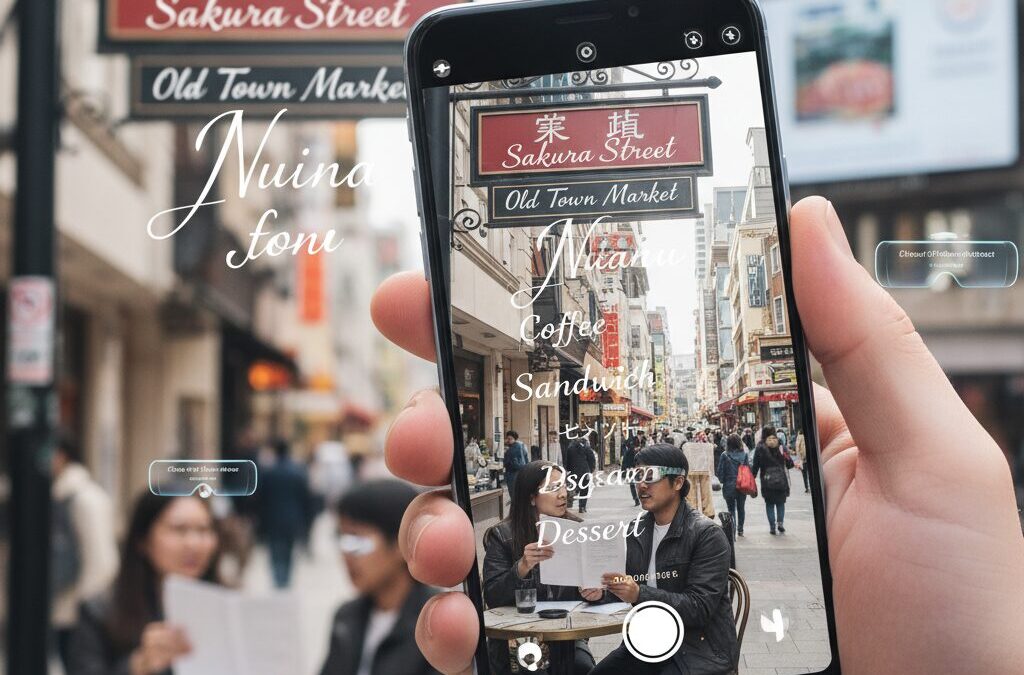
In 2026, the idea of “not understanding the language” is rapidly becoming outdated. With smartphone translation cameras powered by multimodal AI, you can simply point your device at a menu, contract, medical label, or street sign and see the world rewritten in your own language in real time. What used to require separate apps, manual input, and cloud processing now happens seamlessly at the OS level.
This transformation is driven by the fusion of large language models, vision-function layers, and on-device edge computing. Google Translate now supports 249 languages, while platforms like DeepL and Papago compete on contextual accuracy and domain expertise. At the same time, Android 17 and the latest iOS ecosystem integrate live translation across cameras, audio, wearables, and desktop modes.
In this article, you will discover how these technologies actually work, which apps lead in different scenarios, how the translation industry is being reshaped, and what privacy, regulatory, and ethical challenges still remain. If you are passionate about cutting-edge gadgets and global communication, this is your definitive guide to translation cameras in 2026.
- 2026 as the Turning Point: From Text Conversion to Ambient Multilingual Intelligence
- OS-Level Integration: How iOS Live Translation and Wearables Redefine the Camera Experience
- Android 17 and Task Continuity: Seamless Translation Across Devices and Desktop Mode
- Google Translate at 249 Languages: Scale, Speed, and Offline Reliability
- DeepL’s Contextual Precision: From Camera Capture to AI Writing Assistant
- Papago and Regional Optimization: Why It Excels in Asian Travel Scenarios
- Inside the Tech: Vision Function Layers and the Rise of Multimodal LLMs
- LLaViT and Visual-Text Alignment: Expanding LLMs into True Vision Transformers
- Real-World Use Cases: Tourism, Business Contracts, and Hybrid AI Workflows
- Healthcare and Public Services: Translation Cameras as Critical Infrastructure
- Market Impact: 12% Growth in Language Tech and the Shift from Translators to Strategists
- Regulation, Bias, and Hallucination: Navigating EU AI Law and Trust Challenges
- Edge AI and Privacy: Why On-Device Translation Is Becoming the Default
- Expert Predictions: Autonomous AI Agents and the Future of Ambient Translation
- 参考文献
2026 as the Turning Point: From Text Conversion to Ambient Multilingual Intelligence
2026 marks a decisive shift in how we experience translation. What used to be a simple act of converting text through OCR has evolved into something far more pervasive and intelligent. According to industry commentary cited by POEditor and DeepL, the focus has moved from static text conversion to dynamic multilingual content generation powered by large language models.
In practical terms, this means your smartphone no longer just “reads and replaces” words. It interprets scenes, voices, and intent simultaneously. Translation in 2026 functions as ambient multilingual intelligence rather than a standalone feature.
The change is visible at the operating system level. Apple’s iOS 26 integrates Live Translation across messaging, calls, and camera input, while Android 16 and the anticipated Android 17 emphasize AI-powered summarization and task continuity. Translation now persists across apps, devices, and contexts instead of being confined to a single screen.
| Phase | Core Capability | User Experience |
|---|---|---|
| Pre-2024 | OCR + Text Replacement | Manual capture and isolated output |
| 2025 | LLM-based Contextual Translation | More natural phrasing and tone control |
| 2026 | Multimodal + OS-level Integration | Real-time, cross-device, ambient support |
This evolution is backed by measurable industry transformation. Slator reports that while traditional language services declined by 2% in 2025, language technology providers grew by 12%, and AI-driven multimodal language services expanded by 18%. The economic signal is clear: intelligence embedded in workflows is replacing isolated translation tasks.
Research published on arXiv in late 2025 further explains why this leap became possible. Studies on Vision Function Layers in multimodal LLMs demonstrate that models now process images hierarchically—recognizing text, counting objects, and grounding relationships before generating language. Translation accuracy improves because understanding now precedes wording.
Edge computing accelerates this shift. As highlighted by industry forecasts from Omniscien Technologies, organizations are moving from cloud-first to control-first strategies. On-device AI enables low-latency translation without sending sensitive visual data to external servers. Ambient intelligence therefore becomes not only faster, but more private.
The result is subtle yet transformative. You no longer “use a translation app.” Instead, multilingual comprehension quietly accompanies your actions—while reading a menu, reviewing a contract, or navigating a transit hub. According to DeepL’s 2026 outlook, AI agents are beginning to anticipate intent rather than wait for explicit commands.
2026 is not merely about better translation quality. It represents the moment when multilingual capability dissolves into the background of daily life. The turning point lies in translation becoming an always-on cognitive layer integrated with vision, sound, and context.
OS-Level Integration: How iOS Live Translation and Wearables Redefine the Camera Experience
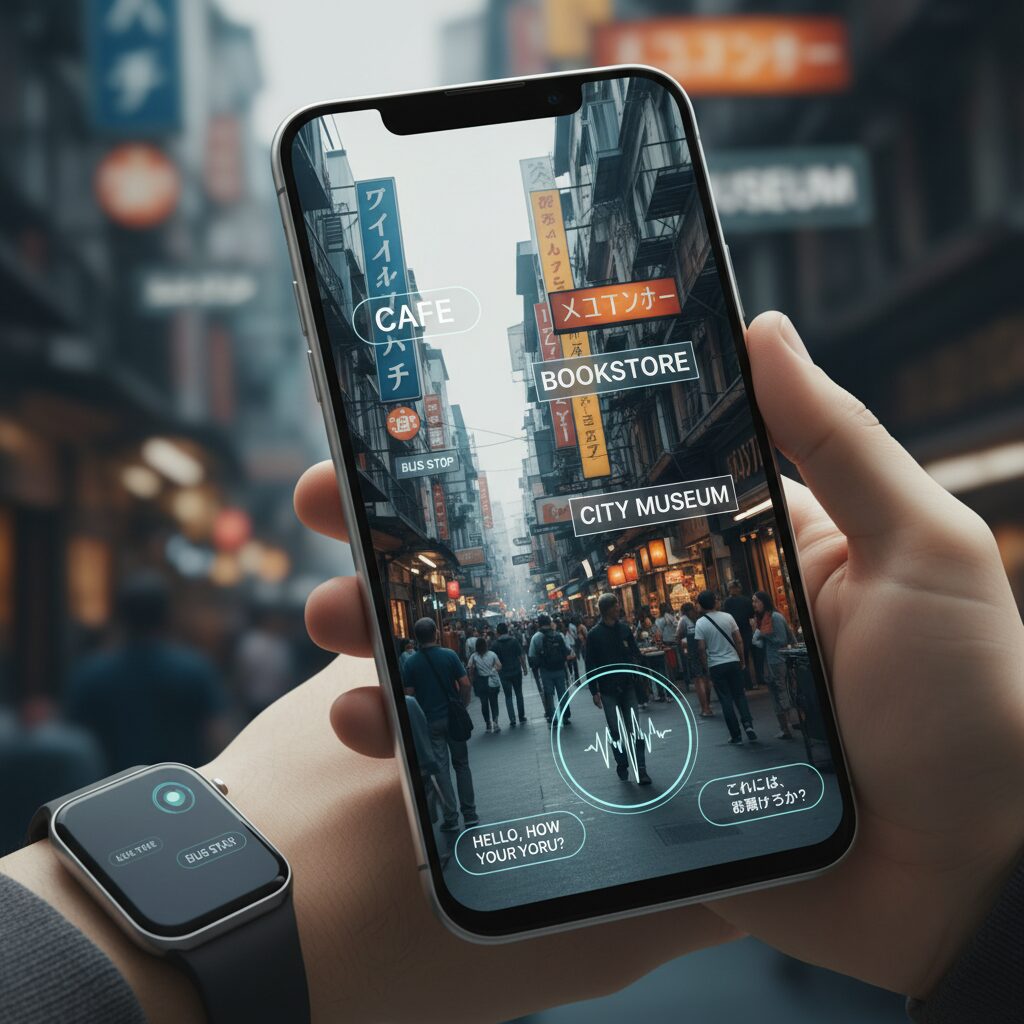
In 2026, camera translation is no longer an app you launch. It is an operating system capability that quietly orchestrates sensors, AI models, and wearables in the background. The shift to OS-level integration has transformed translation from a feature into an ambient layer of intelligence.
Apple’s iOS 26 exemplifies this transition. Live Translation is embedded across Messages, calls, music lyrics, and crucially, the Camera. When you point your iPhone at a sign or document, Apple Intelligence detects text and overlays translated content instantly, without switching contexts. According to coverage of iOS 26’s rollout, multilingual support including Japanese was strengthened from day one, signaling that translation is treated as core infrastructure rather than an add-on.
The real breakthrough, however, emerges when wearables enter the loop. With updated AirPods firmware in 2026, spoken language captured by the iPhone’s microphone is translated in real time and delivered directly into your ears. Your reply can then be played aloud through the iPhone speaker in the other person’s language. This creates a bidirectional, multimodal channel: eyes on the document, ears on the translation, voice in negotiation.
| Layer | Device | Role in Experience |
|---|---|---|
| Visual | iPhone Camera | Real-time AR text overlay and context detection |
| Audio Input | iPhone Mic | Speech capture for live translation |
| Audio Output | AirPods | Private, low-latency translated playback |
| Computation | On-device AI + LLM integration | Context-aware processing and response generation |
This layered architecture reduces friction dramatically. You no longer break eye contact to check a screen or pass a device back and forth. In business settings, this means reviewing a foreign-language contract through the camera while simultaneously conducting a translated conversation. In retail or medical environments, staff can maintain natural posture and attention, which directly improves trust and efficiency.
Google’s Android 16 and the anticipated Android 17 approach the same goal from a different angle: continuity. AI-powered notification summaries introduced in Android 16 reduce cognitive overload, while Android 17 emphasizes task continuity across devices. A menu translated on your phone can later reappear on a tablet or desktop environment for editing or sharing. The camera becomes the entry point of a cross-device workflow, not the endpoint.
Interface innovation also matters. Android 17’s redesigned camera UI and “action corners” allow instant saving, sharing, or searching of translated content. Instead of treating translation as static output, the OS frames it as actionable data. That subtle shift changes user behavior: translation feeds directly into productivity, research, and publishing flows.
What makes all of this viable is tighter integration between on-device AI engines and external large language models. Reports indicate that platforms increasingly allow selective use of proprietary intelligence engines alongside third-party LLMs. This hybrid model balances privacy, speed, and reasoning depth. On-device processing handles sensitive or low-latency tasks, while cloud-connected models provide advanced contextual refinement when needed.
Industry analysts have noted that 2026 marks the move from experimental AI features to intelligent automation embedded at the system level. In this environment, the camera is no longer a passive sensor. It is a trigger for a coordinated ecosystem spanning silicon, software, and wearables. OS-level integration turns translation into an always-available cognitive extension, redefining what a smartphone camera fundamentally represents.
Android 17 and Task Continuity: Seamless Translation Across Devices and Desktop Mode
Android 17 elevates translation from a single-device feature to a cross-device workflow. According to reporting by Android Authority and ZDNet, the upcoming release places Task Continuity at the center of the user experience, allowing activities started on a smartphone to move seamlessly to tablets, Chromebooks, and desktop environments.
For users who rely on camera translation in travel or business, this shift is profound. A menu captured on the street or a technical document scanned on-site no longer remains trapped inside a mobile session. It becomes a persistent, editable task across the Android ecosystem.
How Task Continuity Enhances Translation Workflows
| Scenario | On Smartphone | On Tablet / Desktop Mode |
|---|---|---|
| Restaurant research | Translate menu via camera | Review saved items, compare reviews in multi-window |
| Business document scan | Capture and auto-translate contract | Edit, annotate, and export in desktop layout |
| Tourist signage | Real-time AR translation | Compile trip notes with synced screenshots |
This continuity is tightly integrated with Android 17’s refreshed camera interface. The introduction of “Action Corners,” as previewed in early feature reports, allows users to instantly save, search, or share translated results while still in camera view. The translation output becomes actionable data rather than a static overlay.
Desktop Mode in Android 17 further amplifies this capability. When connected to an external display, the smartphone transforms into a multi-window workstation complete with taskbar and customizable keyboard shortcuts. A translated document captured minutes earlier can be opened side-by-side with notes, web references, or messaging apps.
This design aligns with broader industry trends. Slator reports that 60–80% of translation workflows already incorporate machine translation followed by human post-editing. Android 17 effectively supports this hybrid model by letting users scan via camera on mobile and refine the output in a desktop-grade interface without friction.
From a technical perspective, the benefits are reinforced by advances in multimodal AI and edge computing. Research on Vision Function Layers shows that optimized visual-text layers can deliver up to 98% performance using only 20% of the original dataset. This efficiency makes on-device processing more viable, reducing latency during cross-device handoff.
The result is a translation experience that feels continuous, not episodic. You begin understanding content in the physical world and finish shaping it into digital knowledge on a larger screen. For power users invested in the Android ecosystem, Android 17 turns camera translation into a scalable productivity pipeline rather than a convenience feature.
As mobile computing converges with desktop-grade workflows, translation is no longer confined to the moment of capture. It becomes part of an interconnected task graph that follows you across devices, preserving context, edits, and intent every step of the way.
Google Translate at 249 Languages: Scale, Speed, and Offline Reliability
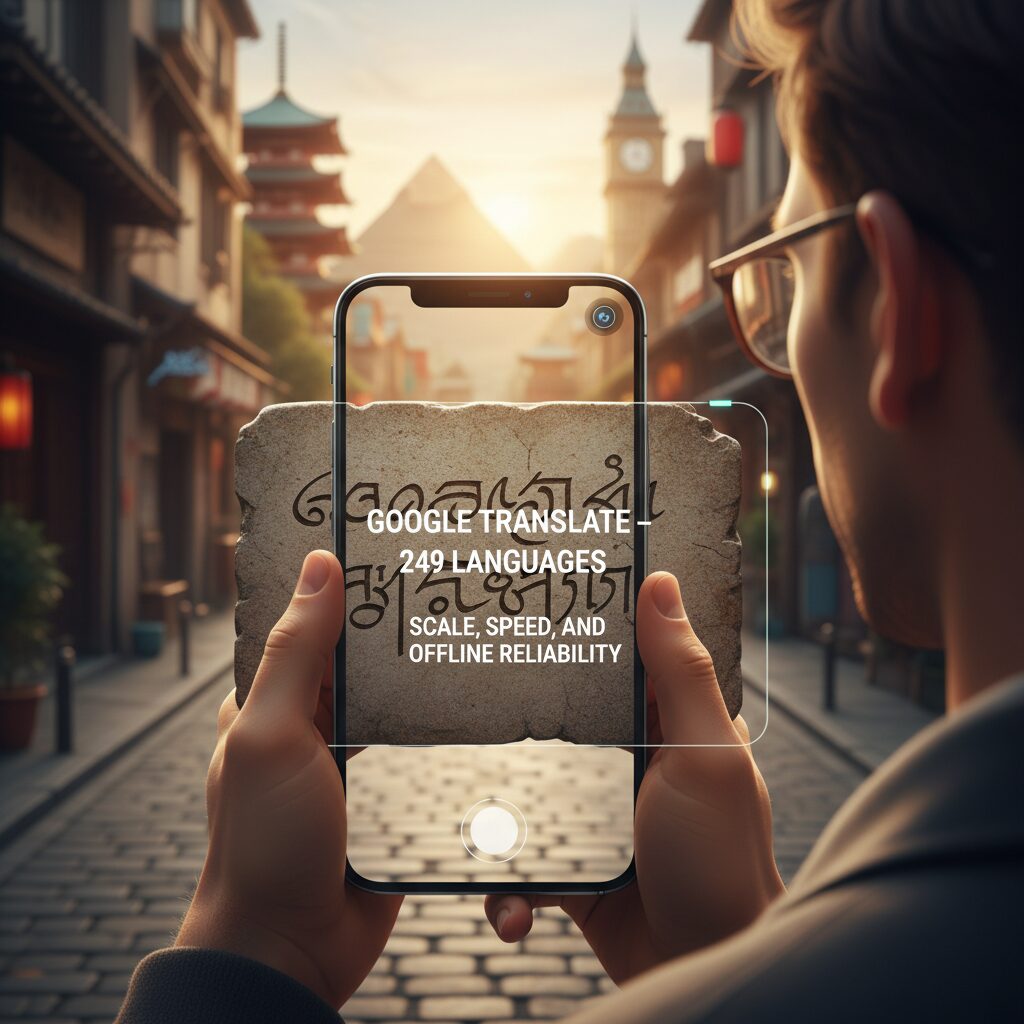
As of January 20, 2026, Google Translate supports 249 languages, making it the most extensive consumer translation infrastructure available today. This scale is not merely a headline number. It fundamentally changes how users approach multilingual environments, especially when using the camera translation feature in daily life and business settings.
According to app market analyses in early 2026, no other mainstream translation app matches this breadth. For travelers, researchers, and global teams dealing with less commonly supported languages, this coverage dramatically reduces the risk of linguistic dead ends.
Speed is the second pillar of its dominance. In camera mode, Google Translate leverages Google Lens to detect text in real time and overlay translated content directly onto the live view. The experience feels instantaneous, especially for static content such as signs, menus, and printed documents.
What distinguishes this system is not only optical character recognition, but contextual awareness. Lens identifies objects alongside text, allowing the app to connect translated words with relevant background information. This “perceptual translation” model reduces ambiguity when users encounter unfamiliar cultural references.
Independent comparisons of major apps in 2026 highlight how Google balances scale and responsiveness.
| Feature | Google Translate (2026) | Typical Competitors |
|---|---|---|
| Supported Languages | 249 | Typically 20–100+ |
| Camera Translation | Real-time AR overlay via Lens | Real-time or snapshot-based |
| Offline Support | Downloadable language packs | Available but often limited |
Offline reliability is the third critical advantage. Users can download language packs in advance, enabling camera translation without an internet connection. This is essential in airports with unstable Wi-Fi, underground transport systems, rural regions, or high-security corporate environments where cloud access is restricted.
Industry commentary in 2026 increasingly emphasizes edge processing and data control. In this context, Google Translate’s offline mode aligns with the broader “control-first” shift described in language technology forecasts. By reducing dependence on cloud transmission, it enhances both responsiveness and privacy in practical scenarios.
While some users have noted minor limitations in continuous voice recording during live conversations, these issues are far less relevant in static camera-based reading tasks. For scanning documents, decoding signage, or interpreting packaging abroad, the app remains remarkably stable.
Ultimately, Google Translate’s competitive edge lies in the combination of unmatched language coverage, high-speed AR rendering, and dependable offline functionality. In 2026, that trio transforms it from a convenient app into a foundational infrastructure for cross-border mobility and real-world comprehension.
DeepL’s Contextual Precision: From Camera Capture to AI Writing Assistant
DeepL’s strength in 2026 lies not only in translation accuracy but in how seamlessly it connects camera capture to high-level writing refinement. When you point your smartphone at a contract, research paper, or product specification, DeepL does more than extract text through OCR. It interprets tone, domain context, and structural nuance, then feeds that understanding directly into its AI writing assistant layer.
This shift from “translate and display” to “understand and rewrite” defines DeepL’s contextual precision. According to industry analyses such as Slator’s 2025 report, machine translation is now embedded in 60–80% of professional workflows, with human experts focusing on post-editing. DeepL positions itself precisely at this junction, where raw translation becomes strategically refined communication.
| Stage | Function | Value for Users |
|---|---|---|
| Camera Capture | Text detection and semantic parsing | Accurate extraction of complex layouts |
| Contextual Translation | Neural + LLM-based inference | Natural, domain-aware output |
| AI Writing Assistant | Tone adjustment, rewriting, summarization | Publication-ready multilingual text |
What makes this pipeline remarkable is the contextual continuity. Research on multimodal large language models, including findings on Vision Function Layers, shows that separating visual recognition layers from deeper reasoning layers dramatically improves efficiency while preserving up to 98% of performance with reduced data. DeepL’s camera workflow benefits from this architectural evolution, ensuring that visual input is not treated as isolated characters but as meaning embedded in structure.
In practical terms, imagine scanning a densely written legal clause. Instead of outputting a literal translation, DeepL can instantly suggest a more formal register, simplify convoluted phrasing, or generate a concise executive summary. The translation becomes a draft, and the writing assistant becomes the strategist.
This is particularly valuable in cross-border business communication. AI translation trends highlighted by POEditor in 2026 emphasize the move from static text conversion to dynamic multilingual content generation. DeepL embodies this trend by allowing users to modify tone—formal, neutral, persuasive—without leaving the captured document context.
Another critical factor is data control. As industry predictions from Omniscien indicate, enterprises are shifting from cloud-first to control-first strategies. DeepL’s integration into secure environments enables sensitive camera-captured documents to be processed under stricter governance, supporting compliance-conscious sectors such as finance and law.
Ultimately, DeepL’s contextual precision is not about speed alone. It is about preserving intent across languages while empowering users to reshape that intent intelligently. From a photographed paragraph to a polished multilingual deliverable, the experience feels less like using a translation tool and more like collaborating with a highly trained bilingual editor embedded in your device.
Papago and Regional Optimization: Why It Excels in Asian Travel Scenarios
When traveling across Asia, translation accuracy is not just about converting words. It is about understanding cultural nuance, honorifics, and context that shift meaning dramatically between Japanese, Korean, and Chinese. Papago, developed by NAVER, has positioned itself as a regionally optimized engine that focuses intensely on these linguistic ecosystems.
While some global platforms emphasize sheer language coverage, Papago concentrates on depth within key Asian languages. This specialization has made it particularly effective for travelers navigating menus, transportation systems, and conversational exchanges in East Asia.
Papago’s competitive edge lies in its focused optimization of Japanese, Korean, Chinese, and English language pairs, combined with robust offline functionality tailored for travel scenarios.
According to comparative app analyses updated in January 2026, Papago continues to be recognized for its smooth camera translation interface and high naturalness in these four core languages. For travelers moving between Seoul, Tokyo, Taipei, and Shanghai, this regional tuning translates into fewer awkward phrasing errors and more context-aware outputs.
| Feature | Papago Strength | Travel Impact |
|---|---|---|
| Core Language Focus | Japanese, Korean, Chinese, English | Higher contextual accuracy in East Asia |
| Offline Mode | Strong support for major Asian pairs | Usable in subways, rural areas, roaming-off mode |
| Conversation Integration | Phrase suggestions linked to camera results | Faster real-world response |
One standout capability is its integration between camera translation and practical conversation support. After scanning a restaurant menu, Papago can suggest relevant travel phrases through its global conversation features. This reduces cognitive load in high-pressure environments such as ordering food or asking about allergens.
In densely built Asian cities, connectivity can fluctuate underground or inside concrete-heavy buildings. Here, Papago’s offline translation support becomes critical. Industry trend analyses in 2026 emphasize the growing importance of on-device processing and edge AI for privacy and latency reasons. Papago’s travel-oriented offline packages align closely with this shift toward edge-first design principles.
Another regional advantage is handling honorifics and politeness gradients. Languages like Korean and Japanese encode social hierarchy directly into verb endings and vocabulary. A translation engine that ignores these layers risks producing socially awkward results. Papago’s optimization within these ecosystems helps maintain appropriate tone, which is essential in service interactions.
In practical travel scenarios, this manifests clearly. When reading train station signage in Japan or safety notices in Korea, clarity and brevity matter. Papago’s real-time text replacement through its camera mode prioritizes legibility and natural phrasing rather than literal translation, improving immediate comprehension.
For travelers whose itineraries concentrate on East Asia, Papago’s region-first design philosophy often delivers a more culturally aligned experience than globally generalized systems. Its strength is not maximum language count, but maximum refinement within its target region.
As multilingual AI continues evolving through multimodal models and edge computing, regionally specialized engines demonstrate that localization at the model-training level still matters. In Asian travel scenarios where nuance shapes experience, Papago’s optimization strategy proves strategically sound and practically effective.
Inside the Tech: Vision Function Layers and the Rise of Multimodal LLMs
The dramatic leap in camera translation accuracy in 2026 is not accidental. It is rooted in architectural breakthroughs inside multimodal large language models (MLLMs), where vision and language are no longer loosely connected modules but deeply integrated reasoning layers.
According to a late-2025 arXiv study on Vision Function Layers (VFL), researchers identified that specific internal layers within MLLMs consistently specialize in distinct visual tasks. This discovery reshapes how translation cameras are engineered at the model level.
| Layer Depth | Primary Function | Relevance to Camera Translation |
|---|---|---|
| Early Layers | OCR-like text extraction | Character recognition from signs and documents |
| Middle Layers | Object counting and detection | Identifying menus, labels, diagrams |
| Deep Layers | Grounding and relational reasoning | Context-aware translation and disambiguation |
Researchers demonstrated that by selectively strengthening these Vision Function Layers, developers could retain up to 98% of full-dataset performance while training on only 20% of the original data. This efficiency breakthrough directly enables on-device, edge-based multimodal translation without sacrificing accuracy.
Another pivotal shift comes from LLaViT, introduced in research rethinking visual processing in multimodal LLMs. Traditional pipelines converted images into textual descriptions before passing them to a language model, creating information bottlenecks. LLaViT instead allows bidirectional attention over visual tokens, effectively transforming the LLM into an extended vision transformer.
This architectural change means complex inputs such as handwritten notes, dense infographics, or mixed-layout documents can be interpreted with reasoning power rather than surface-level OCR. The model does not merely “read” pixels; it reasons over spatial and semantic relationships.
A 2026 PRISMA-guided survey on LLM-enabled visualization interaction further emphasizes visio-verbal synergy. Modern systems increasingly integrate user gestures, gaze cues, and spatial signals into interpretation loops. When a user points at a specific dish on a menu, the model anchors translation to that object, not just nearby text.
However, limitations remain. The same survey notes that spatial breadth and temporal sequencing are still challenging for current architectures. Long visual narratives or dynamic scene understanding can degrade reasoning consistency, especially under resource constraints on edge devices.
Even so, the rise of multimodal LLMs marks a paradigm shift. Translation cameras are no longer OCR tools connected to dictionaries. They are cognitive engines where vision and language co-evolve inside unified transformer stacks. For gadget enthusiasts watching the silicon and model wars unfold, this internal layering may be the most important innovation powering the seamless multilingual experiences of 2026.
LLaViT and Visual-Text Alignment: Expanding LLMs into True Vision Transformers
LLaViT represents a structural shift in how multimodal systems handle visual-text alignment. Instead of treating images as auxiliary inputs converted into text descriptions, it redefines the large language model itself as an extended vision transformer. This architectural rethink directly addresses one of the biggest bottlenecks in camera translation: modality mismatch.
Earlier frameworks such as LLaVA relied on a pipeline where visual features were first encoded and then projected into textual tokens before entering the LLM. According to recent arXiv research on rethinking visual information processing in multimodal LLMs, this projection step often caused information compression and semantic gaps. Fine details in charts, handwritten annotations, or spatial layouts were partially lost before reasoning even began.
LLaViT eliminates this fragile handoff by enabling bidirectional attention over visual tokens. In practical terms, the language model no longer passively receives “translated” vision features. It actively attends to them as first-class citizens in the transformer stack.
| Aspect | Conventional MLLM | LLaViT Approach |
|---|---|---|
| Visual Processing | External encoder + projection | LLM extended as vision transformer |
| Token Interaction | Mostly unidirectional | Bidirectional cross-attention |
| Information Loss | Higher risk during projection | Reduced via modality-specific layers |
The key innovation lies in modality-specific projection layers that are trained to preserve spatial and structural cues. This matters enormously for real-world translation cameras. When a smartphone interprets a subway map or a medical label, meaning is embedded not only in words but in layout, grouping, and proximity. With LLaViT-style alignment, the system reasons over structure and semantics simultaneously.
Research highlights that enabling LLMs to function directly as visual encoders improves grounding performance in complex scenes. That means the model does not merely read text inside an image; it understands relationships between objects and annotations. For example, a dosage instruction positioned next to a warning icon is processed as a unified semantic unit rather than isolated fragments.
This internal unification expands what camera translation can achieve. Instead of overlaying literal substitutions, systems can generate context-aware rewrites that respect spatial hierarchy. A financial graph photographed during a meeting can be interpreted with trend explanations. A restaurant menu image can trigger reasoning about ingredient clusters rather than isolated dish names.
Importantly, this evolution does not claim perfect spatial intelligence. Surveys on LLM-enabled visual interaction note that models still struggle with precise temporal ordering and complex geometric reasoning. However, by collapsing the boundary between language and vision within the same transformer backbone, LLaViT significantly narrows the gap.
For gadget enthusiasts and AI-focused professionals, this signals a deeper transition: smartphones are no longer running separate OCR engines and language models in sequence. They are deploying unified multimodal transformers where vision and language co-evolve in a single attention space. That architectural convergence is what turns advanced camera translation from a feature into a foundation for true ambient visual intelligence.
Real-World Use Cases: Tourism, Business Contracts, and Hybrid AI Workflows
In 2026, smartphone translation cameras are no longer experimental tools. They are embedded into daily operations across tourism, cross-border business, and hybrid AI-driven workflows. What makes this shift remarkable is not only higher accuracy, but the seamless fusion of multimodal AI and edge computing into real-world decision-making.
The value now lies in context-aware, real-time execution. Translation happens at the exact moment action is required, whether ordering food, reviewing a contract, or coordinating global teams.
Tourism: From Survival Tool to Augmented Travel Companion
For international travelers, camera translation has evolved into an augmented reality guide layered directly onto the physical world. Restaurant menus, transportation signage, museum descriptions, and safety instructions are translated live, often with contextual enhancement.
Google Translate, updated in January 2026 with support for 249 languages, continues to provide unmatched linguistic coverage. Papago remains particularly strong in Japanese–Korean–Chinese–English travel scenarios, especially with offline packs downloaded in advance. This matters in rural or underground environments where connectivity is unstable.
| Tourism Scenario | AI Capability in 2026 | User Impact |
|---|---|---|
| Restaurant menus | AR overlay + ingredient context | Safer food choices, allergy awareness |
| Train stations | Live updates + task continuity | Reduced navigation stress |
| Museums | Visual-text grounding | Deeper cultural understanding |
Research on Vision Function Layers in multimodal LLMs shows that modern systems process OCR, object grounding, and relational context in structured layers. This enables translation engines to distinguish between a dish name and an allergy warning rather than treating both as isolated strings of text.
The result is not just comprehension, but situational awareness.
Business Contracts: Human–AI Co-Authoring
In cross-border business, camera translation now initiates structured workflows. Executives scan contracts, technical manuals, or regulatory notices, generating instant drafts through engines such as DeepL, which continues to be recognized for natural, domain-sensitive output.
According to Slator’s 2025 industry analysis, 60–80% of translation tasks now involve machine translation followed by human post-editing. In 2026, this hybrid model has matured into strategic collaboration. AI produces the first structured interpretation, while legal and compliance teams validate terminology, jurisdictional nuance, and liability language.
AI handles speed and structural consistency; humans safeguard intent, risk, and accountability.
Domain-specific routing, identified as a major 2026 trend by machine translation analysts, automatically directs legal text to specialized engines. Reports indicate error rates can drop by an average of 38% compared with general-purpose systems when domain optimization is applied.
Edge processing further enhances security. Sensitive contracts can be translated on-device without cloud transmission, aligning with the growing “control-first” enterprise strategy emphasized by language technology providers.
Hybrid AI Workflows: From Capture to Execution
The most transformative use case emerges in hybrid AI workflows. Translation cameras no longer end with interpretation; they trigger multi-step task continuity across devices.
On Android 17, translated materials captured on-site can be continued later in desktop mode for restructuring, annotation, and collaboration. On iOS 26, integration with live translation ecosystems allows voice negotiation through AirPods while reviewing translated visual documents simultaneously.
Academic surveys on LLM-enabled visualization emphasize visio-verbal interaction, where visual and textual reasoning reinforce each other. In practical terms, this means teams can scan a foreign-language chart, ask follow-up questions to an AI agent, generate summaries, and export structured insights into project management tools without retyping a single sentence.
Translation becomes the entry point into automated knowledge workflows. It captures, interprets, routes, summarizes, and contextualizes information across environments.
Across tourism, legal contracts, and distributed collaboration, smartphone translation cameras in 2026 function less as dictionaries and more as operational intelligence layers. They reduce friction at the moment decisions are made, while still requiring informed human oversight where stakes are high.
Healthcare and Public Services: Translation Cameras as Critical Infrastructure
In healthcare and public services, translation cameras have rapidly evolved from convenient tools into mission-critical infrastructure. When language barriers directly affect patient safety, legal rights, or access to welfare, accuracy and latency are no longer matters of comfort but of responsibility.
According to industry analysis by Slator, while traditional language services declined by 2% in 2025, language technology grew by 12%, reflecting institutional adoption rather than casual use. Hospitals, municipal offices, and emergency responders are now embedding AI translation into their operational workflows, not treating it as an optional add-on.
Google’s official Android updates have highlighted research such as MedGemma 1.5, a model designed to interpret medical imagery and contextual information. When a patient scans a prescription label or discharge document, the system does more than replace text—it explains dosage, warnings, and side effects in medically coherent language.
This multimodal capability is grounded in recent findings on Vision Function Layers published on arXiv, which show that visual recognition and contextual grounding occur in structured layers. By selectively optimizing these layers, developers achieve high accuracy even with reduced datasets, improving reliability in sensitive environments.
| Sector | Primary Use | Risk Mitigated |
|---|---|---|
| Hospitals | Medication & consent form translation | Misunderstanding of treatment |
| Local Government | Application & policy explanation | Administrative exclusion |
| Emergency Services | On-site instruction & signage | Delayed response |
Privacy is equally central. As Omniscien and other AI analysts note, the shift from “cloud-first” to “control-first” architectures has accelerated. In public institutions handling sensitive personal data, on-device edge translation minimizes exposure by keeping images and text local to the device.
Regulatory pressure reinforces this design choice. Under tightening EU AI governance frameworks referenced in multiple 2026 policy discussions, transparency and accountability in AI outputs are mandatory, particularly when errors could cause harm. Translation systems deployed in public settings must therefore log outputs, flag uncertainty, and allow human override.
Crucially, institutions are not eliminating human expertise. Reports indicate that 90–98% of organizations using AI translation still apply some level of human post-editing. In hospitals, bilingual staff or certified interpreters supervise high-stakes outputs, creating a hybrid safety net.
As migration and tourism increase linguistic diversity in urban centers, translation cameras are becoming as fundamental as digital ID systems or electronic health records. They do not merely translate words—they sustain equitable access to care, justice, and civic participation in an increasingly multilingual society.
Market Impact: 12% Growth in Language Tech and the Shift from Translators to Strategists
The language industry is undergoing a structural transformation. According to Slator’s 2025 market analysis, traditional language service revenues declined by 2%, while language technology providers achieved a remarkable 12% growth during the same period. When multimodal AI, voice, and video translation are included, the broader AI-driven language market expanded by 18% year over year.
| Segment | 2025–2026 Trend | Primary Driver |
|---|---|---|
| Traditional Translation Services | -2% | Automation and cost pressure |
| Language Technology Providers | +12% | Enterprise AI infrastructure investment |
| AI-Driven Multimodal Market | +18% | Voice, video, and data-centric expansion |
This divergence signals more than cyclical change. Value is shifting from manual translation output to scalable AI-powered systems. Enterprises are allocating budgets toward translation engines, API integrations, edge AI deployments, and multilingual data pipelines rather than per-word human translation contracts.
At the same time, the role of human professionals is not disappearing. It is evolving. Industry reports indicate that 90–98% of organizations using AI translation still implement some level of human post-editing. However, the emphasis has moved upstream. Professionals are increasingly responsible for governance, optimization, and brand alignment rather than sentence-level conversion.
The translator is becoming a strategist. This shift manifests in three measurable ways across enterprise environments.
First, localization strategy now determines competitive advantage. As AI generates multilingual content at scale, companies require experts who can ensure cultural nuance, regulatory compliance, and tonal consistency across markets. This strategic oversight protects brand equity in ways automation alone cannot.
Second, prompt engineering and workflow design have become core competencies. Specialists define terminology constraints, domain rules, and output parameters that guide large language models. Instead of translating text directly, they architect the conditions under which translation occurs.
Third, high-quality training data has become a strategic asset. As highlighted in AI translation trend analyses for 2026, organizations investing in curated domain-specific corpora achieve significantly lower error rates than those relying solely on generic engines. Data stewardship now influences translation performance as much as linguistic skill once did.
The financial implications are substantial. The AI voice translation market alone is projected to reach 5.73 billion USD by 2028, driven by real-time communication demand in global business and remote collaboration environments. Capital is flowing toward platforms that integrate multimodal understanding, edge processing, and enterprise security.
For professionals in the language field, this transition represents both disruption and opportunity. Routine linguistic tasks are increasingly automated, yet demand is growing for expertise in AI governance, risk mitigation, and multilingual content strategy. The economic center of gravity has moved from production to orchestration.
In practical terms, companies that embrace this shift are not asking, “How many words can we translate?” They are asking, “How do we design multilingual systems that scale securely and intelligently?” The 12% growth in language technology is therefore not just a statistic. It reflects a fundamental redefinition of where value is created in the global communication ecosystem.
Regulation, Bias, and Hallucination: Navigating EU AI Law and Trust Challenges
As translation cameras become embedded into daily life, regulation and trust have moved from abstract debates to immediate design constraints. In 2026, the European Union’s AI regulatory framework places strong emphasis on transparency, safety, and accountability, and translation AI systems are not exempt from these expectations. For gadget enthusiasts and power users, this means that performance is no longer the only benchmark—compliance and explainability are becoming competitive differentiators.
According to industry analyses referenced by POEditor and Slator, AI translation has shifted from experimental deployment to mission-critical infrastructure. When a camera translation feature is used in medical, legal, or administrative contexts, the risk profile changes dramatically. Under emerging EU requirements, providers must clarify whether users are interacting with AI-generated content and implement mechanisms to reduce foreseeable harm.
Hallucination, bias, and opacity are no longer tolerable side effects—they are regulatory risks with legal and reputational consequences.
Hallucination remains one of the most discussed failure modes. If a translation camera misinterprets dosage instructions on a medicine package or alters the meaning of a contractual clause, the downstream damage can be tangible. As noted in recent discussions on AI misuse risks in 2026, responsibility attribution is becoming a central issue: is the liability borne by the model provider, the platform integrator, or the enterprise deploying the tool?
To mitigate this, companies are adopting layered safeguards such as confidence scoring, domain-specific routing, and human-in-the-loop validation. Slator reports that 90–98% of organizations using AI-generated translation still apply some level of post-editing, reflecting an industry-wide acknowledgment that full automation without oversight is not yet viable.
| Risk Area | Typical Scenario | Mitigation Strategy |
|---|---|---|
| Hallucination | Incorrect medical or legal translation | Domain engines + human review |
| Bias | Stereotyped gender or cultural phrasing | Bias evaluation and dataset curation |
| Opacity | No disclosure of AI-generated output | Clear labeling and provenance tracking |
Bias presents a subtler but equally serious challenge. Research trends highlighted around ACL 2025 indicate that large language models can reproduce patterns embedded in their training data. In translation cameras, this may surface as gendered assumptions in professional titles or culturally skewed interpretations. Under stricter EU expectations, systematic bias testing and mitigation are becoming standard components of deployment pipelines rather than optional ethical add-ons.
Another pillar of trust is provenance. European regulatory discussions increasingly stress traceability—being able to identify when content has been AI-generated or modified. Techniques such as digital watermarking and metadata tagging are being explored to signal machine involvement without degrading user experience. For consumers, this translates into clearer disclosures inside apps; for enterprises, it requires auditable logging architectures.
Ultimately, trust in translation cameras will not be secured by model size alone. It will be built through transparent governance, measurable risk controls, and realistic communication about limitations. In a regulatory climate shaped by the EU’s assertive stance, the most successful AI translation platforms will be those that treat compliance not as a constraint, but as a core feature of their product design.
Edge AI and Privacy: Why On-Device Translation Is Becoming the Default
As camera translation becomes deeply embedded into smartphones, a new priority is clearly emerging: privacy by design.
In 2026, on-device processing is no longer a niche feature for security-conscious users. It is rapidly becoming the default architecture for serious translation workflows.
The shift toward Edge AI is being driven by two forces: regulatory pressure and user expectation.
According to industry analysis from Omniscien Technologies, enterprises have moved from a “cloud-first” to a “control-first” mindset since 2025. Sensitive documents, medical forms, and legal contracts can no longer be casually uploaded to external servers for processing.
This shift is reinforced by tightening global regulations, particularly in Europe, where transparency and data provenance requirements under evolving AI governance frameworks are becoming stricter.
For translation cameras that routinely scan passports, prescriptions, and contracts, the implications are enormous.
| Processing Model | Data Flow | Primary Risk | Latency |
|---|---|---|---|
| Cloud-Based Translation | Image sent to remote server | Data exposure during transfer/storage | Network-dependent |
| On-Device (Edge) Translation | Processed locally on smartphone | Device-level security only | Near-instant |
From a user perspective, the difference feels subtle. From a security standpoint, it is transformative.
When translation occurs entirely on the device, scanned images never leave the smartphone. No cloud storage, no third-party server logs, no cross-border data transfer.
This architectural change dramatically reduces the attack surface.
Latency is another decisive factor. Real-time AR overlays depend on millisecond-level responsiveness. Even minor network delays can break immersion during live menu reading or medical consultations.
Edge AI eliminates round-trip communication delays, enabling stable translation in subways, airplanes, or rural regions with weak connectivity.
For global travelers and field professionals, offline reliability is not a luxury. It is mission-critical.
Market signals confirm this trajectory. Slator reports that while traditional language services declined by 2% in 2025, language technology infrastructure grew by 12%.
A significant portion of that investment is flowing into model optimization—shrinking multimodal LLMs so they can run efficiently on mobile chipsets without constant cloud dependence.
Chip manufacturers are now integrating dedicated AI accelerators specifically optimized for vision-language workloads.
Privacy expectations are also evolving culturally. Users increasingly assume that scanning a private document with their phone should not mean transmitting it to unknown servers.
In high-security environments—government offices, hospitals, corporate R&D labs—cloud-based translation may even be restricted entirely.
On-device translation becomes the only viable option.
Technical breakthroughs such as Vision Function Layer optimization have made this shift feasible. Research published on arXiv demonstrates that selectively enhancing specific multimodal layers can achieve up to 98% of full-model performance using only a fraction of training data.
This efficiency gain enables compact yet powerful models to operate locally without sacrificing meaningful accuracy.
The result is a new equilibrium between intelligence and discretion.
Looking ahead, the competitive differentiator for translation platforms will not be language count alone. It will be how securely and seamlessly they process sensitive visual information.
In 2026, the smartest translation system is not the one that knows the most languages. It is the one that protects them.
And increasingly, that protection begins—and ends—on your device.
Expert Predictions: Autonomous AI Agents and the Future of Ambient Translation
By 2026, experts increasingly agree that autonomous AI agents will redefine how translation operates in daily life and business. According to DeepL’s public commentary, this is the year AI shifts from being a reactive tool to becoming an intent-aware agent that anticipates user needs. Instead of waiting for a command, translation systems begin to monitor context, detect linguistic friction, and intervene proactively.
This marks the transition from on-demand translation to ambient translation. Ambient systems do not require users to open an app or frame a sentence. Through integration with smartphone cameras, microphones, wearables, and AR interfaces, AI continuously interprets multilingual signals in the background while respecting privacy constraints.
Industry forecasts highlight how rapidly this shift is unfolding.
| Prediction Area | 2026–2028 Outlook | Implication |
|---|---|---|
| Autonomous AI Adoption | 69% of business leaders expect operational transformation | Translation embedded in workflows |
| AI Voice Translation Market | Projected $5.73B by 2028 | Growth of real-time ambient dialogue |
| Language Tech Sector | 12–18% annual growth | Investment in multimodal infrastructure |
Slator’s market analysis shows traditional translation shrinking while language technology expands at double-digit rates. This economic rebalancing supports a future where translation is not a separate service but an invisible infrastructure layer.
Researchers also predict that multimodal large language models will become increasingly autonomous in perception. Studies such as the Vision Function Layer research on arXiv demonstrate that models can selectively strengthen contextual and grounding layers while reducing computational load. This efficiency enables on-device agents capable of persistent environmental monitoring without constant cloud dependence.
Edge-native autonomous agents are widely viewed as the cornerstone of ambient translation. Analysts from Omniscien emphasize that privacy, latency, and control requirements will push AI processing closer to the device. In practice, this means future smartphones and smart glasses will continuously translate visual signage, spoken conversation, and even gestural cues in real time.
However, experts caution against over-optimism. ACL 2025 discussions highlighted persistent disparities between high-resource and low-resource languages. Without deliberate dataset expansion and bias mitigation, ambient translation risks reinforcing digital divides rather than eliminating them.
Another major prediction concerns agentic orchestration. Instead of one monolithic translator, autonomous systems will route tasks dynamically. A medical label detected by a camera may trigger a domain-specific medical engine, while a legal document may invoke a compliance-aware model. This layered autonomy reduces hallucination risk and improves reliability in high-stakes contexts.
Looking ahead, specialists foresee translation becoming perceptual rather than transactional. Smart glasses may overlay multilingual subtitles seamlessly, while earbuds interpret tone and emotional nuance. Users will no longer “request” translation; they will experience environments that are linguistically adaptive.
The future of ambient translation is not about faster word substitution. It is about AI agents that understand context, manage domain expertise, preserve privacy through edge computation, and act proactively on behalf of users. If current adoption curves and infrastructure investments continue, multilingual interaction will increasingly feel native, continuous, and invisible.
参考文献
- DeepL:DeepL Press Release
- POEditor Blog:6 AI Translation Trends to Watch in 2026
- Android Authority:Android 17: Leaked Features, Codename, Release Date, and Everything Else We Know So Far
- Google Blog:Stay Organized and Express Yourself with Android 16’s New Updates
- arXiv:Vision Function Layer in Multimodal LLMs
- arXiv:Rethinking Visual Information Processing in Multimodal LLMs
- Slator:Five Ways AI Reshaped the Translation Industry in 2025
- Omniscien Technologies:AI and Language Processing Predictions for 2025