
If you are passionate about gadgets, you have probably noticed that modern smartphones are starting to look and feel very similar.
Features that once defined flagship models, such as high-refresh-rate OLED displays and advanced computational photography, are now common even in mid-range devices.
In this crowded market, choosing a phone that truly delivers value has become surprisingly difficult.
The Google Pixel 9a stands out by taking a different approach from traditional spec-focused competition.
Instead of chasing raw hardware numbers, Google focuses on AI-driven user experience, camera intelligence, and long-term software value.
This strategy has helped the Pixel “a” series gain strong momentum, especially in markets where consumers are highly price-sensitive yet tech-savvy.
In this article, you will discover how the Pixel 9a balances camera hardware and computational photography, why on-device AI matters more than ever, and how real-world pricing strategies can dramatically change its perceived value.
By the end, you will clearly understand who the Pixel 9a is designed for and whether it fits your personal usage style.
If you are looking for a smarter way to evaluate mid-range smartphones in 2026, this guide will help you make a confident decision.
- The Commoditization of Smartphones and the Role of the Pixel a Series
- Camera Hardware Design: Smaller Sensors, Smarter Trade-Offs
- Wide, Ultra-Wide, and Front Cameras: Practical Choices for Everyday Shooting
- Computational Photography and the Power of Tensor G4
- Super Res Zoom: AI Solving the Missing Telephoto Problem
- On-Device AI with Gemini Nano and Why Privacy Matters
- Thermal Performance and Charging Efficiency in Daily Use
- Real-World Pricing Strategies and the Economics of Value
- How Pixel 9a Compares with iPhone SE and Galaxy A Series
- 参考文献
The Commoditization of Smartphones and the Role of the Pixel a Series
The global smartphone market has entered a phase where technological differentiation is increasingly difficult to perceive, and this commoditization is reshaping how value is defined. Features that once justified premium pricing, such as OLED displays with high refresh rates, advanced computational photography, and on-device AI processing, are now expected even in mid-range devices. According to industry analyses frequently cited by organizations such as IDC and academic research on mature consumer electronics markets, commoditization typically shifts competition away from raw specifications toward experience, trust, and ecosystem integration.
In this context, Google’s Pixel a series has positioned itself not as a “cheaper Pixel,” but as a reference point for what a modern Android smartphone should deliver at a reasonable cost. The Pixel a line benefits from Google’s vertical integration of hardware, software, and AI, allowing it to offer capabilities that feel disproportionately advanced for its price segment. This approach mirrors patterns observed in other mature tech categories, where platform owners stabilize user expectations by setting a clear baseline rather than chasing excess.
| Market Phase | User Expectations | Role of Pixel a Series |
|---|---|---|
| Early innovation | Novel hardware features | Not yet established |
| Commoditization | Balanced performance and reliability | Android reference model |
Especially in markets like Japan, where consumers are highly sensitive to usability and long-term software support, the Pixel a series functions as a stabilizing force. Analysts from major tech publications have noted that Pixel devices are often used internally by developers as a benchmark for Android behavior. This reinforces the idea that, amid commoditization, the Pixel a series derives its value from setting standards rather than exceeding them.
As smartphones become less about surprise and more about consistency, the Pixel a series illustrates how strategic restraint, combined with AI-driven user experience, can remain compelling even when hardware advantages alone no longer suffice.
Camera Hardware Design: Smaller Sensors, Smarter Trade-Offs
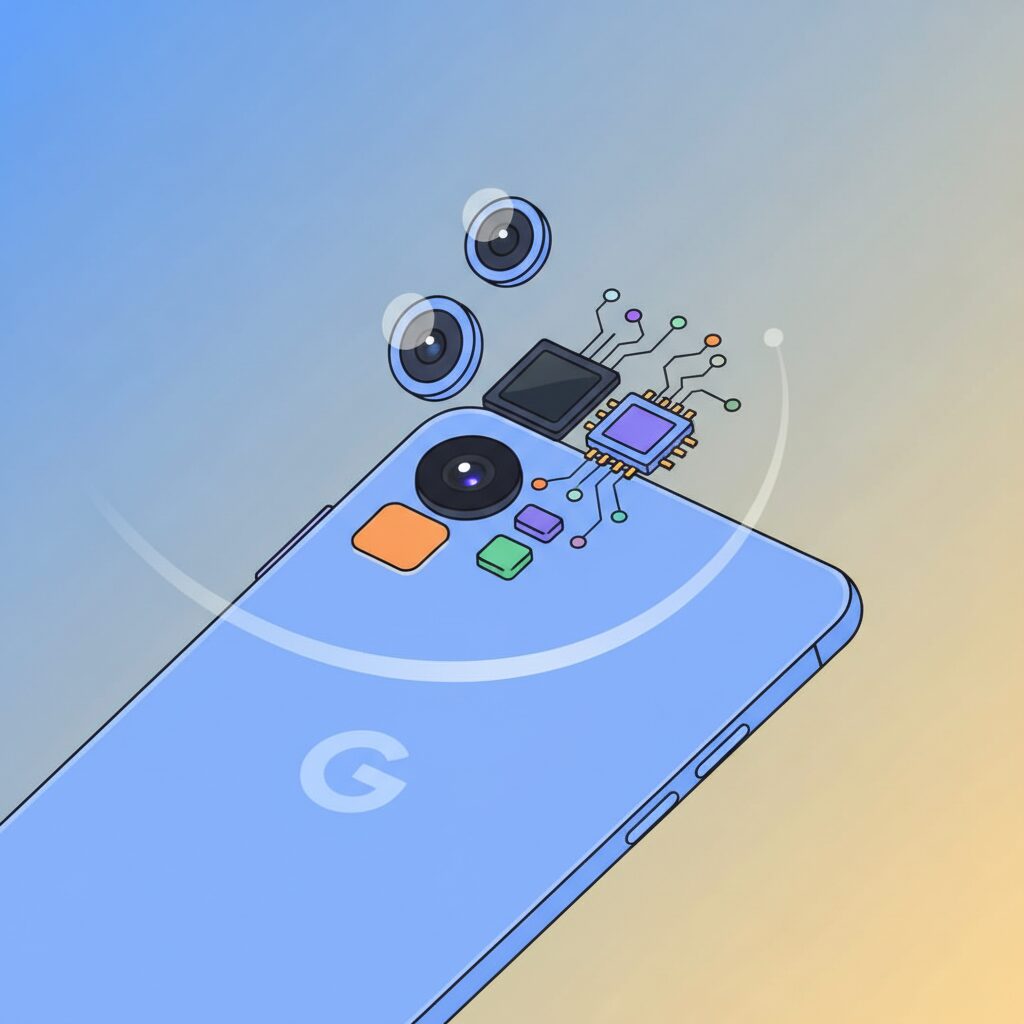
The camera hardware design of the Pixel 9a reflects a clear philosophical shift: instead of chasing larger sensors at all costs, Google prioritizes balance, usability, and system-level optimization. This approach may appear conservative on paper, but it is grounded in a deep understanding of how camera modules affect real-world device design.
The most debated change is the move from a 1/1.73-inch sensor on the Pixel 8a to a smaller 1/2-inch sensor on the Pixel 9a. In traditional camera engineering, this would normally imply reduced light-gathering capability and potentially weaker low-light performance. However, Google deliberately accepts this physical compromise to unlock other advantages.
One immediate benefit is industrial design. Larger sensors require thicker lens stacks to maintain proper focal distance, which directly contributes to camera bumps. By slightly reducing sensor size, Google achieves a nearly flush rear design, eliminating the pronounced camera visor seen in earlier Pixel generations. This results in better pocketability and improved stability when the phone is placed on a flat surface.
| Model | Main Sensor Size | Aperture | Design Impact |
|---|---|---|---|
| Pixel 8a | 1/1.73-inch | ƒ/1.89 | Noticeable camera bump |
| Pixel 9a | 1/2-inch | ƒ/1.7 | Almost flush rear panel |
To compensate for the reduced sensor area, Google pairs the new sensor with a brighter ƒ/1.7 lens. According to optical engineering principles outlined by organizations such as IEEE, aperture size can offset sensor limitations by increasing photon intake per exposure. In practice, this means the Pixel 9a can maintain competitive noise control without aggressively raising ISO sensitivity.
This is not a downgrade, but a recalibration of priorities. Google is effectively betting that smarter optical choices, combined with its well-established image processing pipeline, matter more than raw silicon size alone. Reviews from photography-focused outlets like PetaPixel have noted that daylight dynamic range remains consistent with the previous generation, despite the smaller sensor.
The same philosophy extends to the supporting cameras. The 13MP ultra-wide sensor uses a modest 1/3.1-inch format, yet its optical characteristics are tuned for distortion correction rather than sheer resolution. This allows software to work with cleaner edge data, reducing the aggressive warping often seen in ultra-wide shots.
In hardware terms, the Pixel 9a demonstrates a mature understanding of trade-offs. Instead of escalating component costs and physical bulk, Google refines the relationship between sensor size, lens brightness, and device ergonomics. For users, this translates into a camera system that feels thoughtfully integrated rather than technically excessive.
Wide, Ultra-Wide, and Front Cameras: Practical Choices for Everyday Shooting
When choosing a smartphone camera for daily use, the balance between wide, ultra-wide, and front cameras often matters more than headline specifications. The Pixel 9a takes a notably practical approach here, prioritizing consistency and usability over experimental hardware. This philosophy aligns closely with Google’s long-standing emphasis on computational photography, which institutions such as MIT Technology Review have repeatedly highlighted as a defining strength of the Pixel lineup.
The main wide camera serves as the backbone of everyday shooting. With a 48MP sensor paired with a bright ƒ/1.7 aperture, it is tuned to handle routine scenarios such as street snapshots, food photography, and casual portraits without demanding manual adjustments. **In real-world terms, this means stable exposure and reliable color even in mixed lighting**, a situation common in cafés or indoor shopping spaces. Reviewers at PetaPixel have noted that Pixel cameras tend to favor natural color science over exaggerated saturation, which helps images age better and reduces the need for post-editing.
| Camera | Resolution | Aperture | Practical Strength |
|---|---|---|---|
| Wide | 48MP | ƒ/1.7 | Low-light stability and natural color |
| Ultra-wide | 13MP | ƒ/2.2 | Wide scenes with controlled distortion |
| Front | 13MP | ƒ/2.2 | Group selfies and social video |
The ultra-wide camera extends this practicality. With a 120-degree field of view, it is particularly effective for landscapes, architecture, and tight indoor spaces. While ultra-wide lenses are often criticized for edge distortion, Google’s software correction minimizes unnatural stretching. According to analyses published by Android Headlines, this sensor size is generous for a mid-range device, allowing cleaner results than typical secondary cameras when shooting during daytime travel or family outings.
The front camera deserves special attention in an era dominated by social media and video communication. Its 96.1-degree ultra-wide angle allows multiple people to fit comfortably into the frame without awkward arm positioning. **This directly improves usability for video calls, vlogs, and short-form content**, a trend widely discussed by marketing analysts at firms like Deloitte when examining Gen Z smartphone behavior. The emphasis here is not cinematic depth but framing flexibility, which proves far more valuable for everyday users.
Taken together, the wide, ultra-wide, and front cameras on the Pixel 9a form a cohesive system rather than isolated features. Each lens is optimized for common shooting habits, ensuring predictable results across different perspectives. This consistency is ultimately what makes the Pixel 9a feel dependable as an everyday camera, even without chasing extreme hardware specifications.
Computational Photography and the Power of Tensor G4

Computational photography is where the Pixel 9a truly differentiates itself, and at the center of this experience is the Tensor G4 processor. Rather than relying on large sensors or complex lens systems, Google continues its long-standing philosophy of overcoming physical limitations through advanced software and on-device AI. **This approach allows the Pixel 9a to deliver image quality that often feels disproportionate to its midrange hardware class**, especially in everyday shooting scenarios.
The Tensor G4 acts as the control tower for the entire imaging pipeline. From the moment light hits the sensor, multiple frames are captured, analyzed, and merged in real time. According to evaluations shared by imaging-focused outlets such as PetaPixel, Google’s multi-frame HDR processing remains among the most consistent in the industry, particularly in challenging high-contrast scenes. Highlights are preserved without flattening shadows, producing images that look natural rather than overly processed.
One of the clearest examples of Tensor G4’s impact is Super Res Zoom. Despite the absence of a dedicated telephoto lens, the Pixel 9a can reach up to 8x zoom by combining micro hand movements with AI-based super‑resolution reconstruction. This technique, which Google has refined over several generations, extracts sub-pixel color data from multiple frames and reassembles it into a sharper final image. **In the 2x to 3x range, results frequently approach what entry-level optical zoom lenses deliver**, a claim supported by comparative camera tests from Android-focused reviewers.
| Zoom Method | Hardware Requirement | Image Characteristics |
|---|---|---|
| Optical Telephoto | Dedicated lens module | Consistent sharpness, higher cost |
| Super Res Zoom | Main sensor + Tensor G4 | High detail at 2x–3x, compact design |
Tensor G4 also enables more subtle forms of image intelligence. Skin tone rendering, edge separation in portrait shots, and night photography all benefit from models trained on vast photographic datasets. Google has previously disclosed, through its AI research blog, that these models are optimized to run efficiently on-device, reducing latency and ensuring predictable results even without a network connection. This matters in real-world use, where responsiveness often defines whether a feature feels magical or frustrating.
Another important dimension is privacy and speed. By executing key imaging tasks locally, the Pixel 9a avoids round trips to the cloud for most photo enhancements. **For users, this translates into near-instant previews and edits, as well as confidence that personal photos remain on the device.** In a market where AI features are increasingly common, Tensor G4’s tight integration with computational photography shows how performance is not just about raw power, but about intelligent allocation of it.
Super Res Zoom: AI Solving the Missing Telephoto Problem
The absence of a dedicated telephoto lens on the Pixel 9a initially sounds like a clear limitation, especially for users accustomed to optical zoom as a marker of camera quality.
However, Google approaches this problem from a fundamentally different angle, using AI to compensate for missing hardware rather than competing in lens count.
Super Res Zoom is the clearest expression of this philosophy, and it is designed to solve a very specific, real-world problem.
Traditional digital zoom works by cropping the center of an image and upscaling it, which inevitably destroys fine detail.
Super Res Zoom instead relies on multi-frame computational photography, capturing several frames in rapid succession.
Each frame is slightly different due to natural hand movement, and that difference is the key to the technology.
Google’s imaging team has publicly explained that this micro hand shake creates sub-pixel variations between frames.
The Tensor G4 processor analyzes these variations and merges color and luminance data at a sub-pixel level.
This process allows the AI to infer edges, textures, and contrast that would otherwise be lost.
| Zoom Method | Image Data Source | Detail Preservation |
|---|---|---|
| Conventional Digital Zoom | Single cropped frame | Low |
| Super Res Zoom | Multiple offset frames | Medium to High |
According to camera evaluations published by imaging-focused outlets such as PetaPixel, this approach delivers optical-quality results at 1x.
More importantly, it maintains convincing sharpness up to around 2x and 3x zoom.
In everyday photography, this range covers portraits, street details, and casual subject isolation.
This is where Super Res Zoom becomes more than a technical trick and turns into a usability feature.
Most users rarely exceed 3x zoom in daily life, even when their phones technically support 5x or 10x optics.
Google’s strategy is to optimize the range people actually use, rather than chasing extreme specifications.
From a cost and design perspective, the implications are significant.
Eliminating a telephoto module reduces internal complexity, saves space, and lowers manufacturing cost.
The result is a flatter camera housing and a cleaner industrial design without sacrificing perceived versatility.
There is also a performance advantage that is easy to overlook.
Because Super Res Zoom operates primarily on the main sensor, it benefits from the larger pixel area and brighter aperture.
This means zoomed images in low light often look cleaner than those from small telephoto sensors on budget devices.
Academic research in computational photography, including work frequently cited by IEEE imaging conferences, supports this approach.
Multi-frame super-resolution has been shown to outperform single-frame optical zoom under constrained sensor sizes.
Pixel phones are among the few consumer devices that deploy this research at scale.
Of course, Super Res Zoom does not fully replace a true optical telephoto at long distances.
At the maximum 8x setting, artifacts and reduced micro-contrast become visible.
Yet Google appears comfortable with this trade-off, prioritizing realistic use cases over spec-sheet dominance.
In the context of a midrange smartphone, this decision feels deliberate rather than compromised.
Super Res Zoom reframes the idea of zoom from hardware dependency to software intelligence.
For users who value consistency and reliability over extreme reach, it effectively solves the missing telephoto problem.
On-Device AI with Gemini Nano and Why Privacy Matters
On-device AI has quietly become one of the most meaningful differentiators in modern smartphones, and Gemini Nano on the Pixel 9a represents a clear statement of intent from Google. Rather than relying exclusively on cloud-based intelligence, Gemini Nano is designed to run directly on the device, optimized for the Tensor G4 architecture. This approach is not about chasing raw benchmark scores, but about redefining how everyday AI features interact with personal data.
At a technical level, Gemini Nano is a compact multimodal model capable of understanding text, audio, and contextual signals without sending raw inputs to external servers. According to Google’s own AI engineering disclosures, this local processing dramatically reduces both latency and exposure of sensitive data. **For users, the practical impact is that AI feels instant and private at the same time**, even in environments with poor connectivity such as underground trains or crowded urban areas.
Privacy is where on-device AI moves from convenience to necessity. Features like voice memo summarization, contextual suggestions based on notifications, or photo content analysis often involve highly personal information. When these processes are handled locally, recordings and images remain stored within the device’s secure enclave. Researchers at institutions such as MIT and Stanford have repeatedly pointed out that minimizing data transmission is one of the most effective ways to reduce the risk surface of consumer AI systems.
| Aspect | On-Device AI (Gemini Nano) | Cloud-Based AI |
|---|---|---|
| Data Handling | Processed locally on the device | Uploaded to external servers |
| Response Time | Near-instant, no network dependency | Variable, depends on connectivity |
| Privacy Risk | Lower exposure by design | Higher exposure during transmission |
What makes this especially notable on the Pixel 9a is the democratization of such capabilities. Until recently, robust on-device AI was largely reserved for flagship models with abundant memory and thermal headroom. By enabling Gemini Nano on a mid-range device, Google is signaling that privacy-preserving AI should be a baseline expectation, not a luxury add-on. This aligns with broader regulatory and cultural trends, particularly in markets where users are increasingly cautious about how their data is handled.
There is also an energy-efficiency dimension that often goes unnoticed. Processing data locally avoids constant radio usage for uploads and downloads, which can reduce battery drain during frequent AI interactions. Google engineers have noted that lightweight local models, when paired with dedicated AI accelerators in Tensor chips, can be more power-efficient than repeated cloud calls for short tasks. **The result is an AI experience that feels both responsive and sustainable for daily use**.
Ultimately, Gemini Nano on the Pixel 9a illustrates a philosophical shift. AI is no longer positioned as an omniscient service living somewhere in the cloud, but as a personal assistant residing in your pocket, bound by the physical and ethical limits of your device. In an era where trust is becoming as important as performance, on-device AI is not just a technical choice—it is a statement about who controls intelligence, and where personal data truly belongs.
Thermal Performance and Charging Efficiency in Daily Use
In daily use, thermal behavior and charging efficiency directly affect how comfortable a smartphone feels, and Pixel 9a is no exceptionです。The Tensor G4 continues Google’s long-running challenge with heat management, especially under combined workloads such as charging while using navigation or the cameraです。Long-term user reports and community discussions indicate that during fast charging, surface temperatures can approach around 40°C in warm environmentsです。This level is not dangerous, but it is high enough to trigger thermal control measures that subtly change the user experienceです。
Heat is most noticeable not during idle charging, but when multiple stress factors overlapです。For example, charging outdoors in summer while running Google Maps and background AI processes tends to raise internal temperatures faster than charging indoors at restです。According to battery research widely cited by institutions such as IEEE, lithium-ion batteries degrade more quickly when repeatedly charged at elevated temperatures, which explains why Google prioritizes thermal protection over raw charging speedです。
| Usage Scenario | Thermal Tendency | User Impact |
|---|---|---|
| Fast charging only | Moderate heat rise | Charging speed may taper near high battery levels |
| Charging + navigation | High heat buildup | Noticeable warmth, possible throttling |
| Charging + camera use | High heat spikes | Temporary slowdown or frame drops |
To mitigate these risks, Google relies heavily on Adaptive Chargingです。This software-driven system learns the user’s daily routine and intentionally slows charging overnight, reaching 100% just before wake-up timeです。While this approach is praised by battery experts for extending long-term health, it can feel restrictive when users need a quick top-up before leaving homeです。In those moments, the phone may feel conservative compared with rivals that allow sustained high-wattage charging at the cost of higher heatです。
The trade-off between charging speed and thermal stability defines the Pixel 9a experienceです。Rather than pushing aggressive wattage, Google chooses consistency and longevity, even if that means longer charging sessionsです。In Japan’s hot and humid summers, this philosophy becomes more apparent, as the device may reduce charging speed or performance to stay within safe limitsです。
In practical terms, users who charge in cool indoor environments and avoid heavy tasks during charging will rarely notice issuesです。一方で、 power users who rely on the phone as a navigation hub or camera while plugged in should expect warmth and occasional throttlingです。This behavior reflects Google’s cautious thermal strategy, prioritizing battery health and safety over headline charging numbersです。
Real-World Pricing Strategies and the Economics of Value
Real-world pricing is where the Pixel 9a’s value proposition truly becomes visible, and it is also where many readers risk misunderstanding its economics if they only look at the list price.
The Pixel 9a is not priced to win on sticker value alone, but to dominate through purchase pathways. According to analysis by Nikkei and ITmedia on Japan’s smartphone market structure, carrier-led subsidy models have become the primary battlefield for midrange devices, and Google has aligned the Pixel 9a precisely with this reality.
| Purchase Route | Upfront Cost | Two-Year Effective Cost |
|---|---|---|
| Google Store (SIM-free) | Approx. ¥80,000 | ¥80,000 minus resale |
| Carrier program with return | Minimal or zero | ¥0–¥1,000 range |
This gap illustrates a core economic principle discussed by Harvard Business School professors studying value-based pricing: perceived value often outweighs absolute ownership. In the carrier model, the Pixel 9a behaves less like a product and more like a low-cost, high-utility service bundled with connectivity.
For users willing to return the device after 24 months, the opportunity cost is extraordinarily low. Industry commentary from The Wall Street Journal has highlighted this as a form of strategic price discrimination, where manufacturers trade residual value for rapid ecosystem adoption.
Conversely, buyers who insist on outright ownership face a more conventional equation. At full price, the Pixel 9a competes directly with aggressively specced Chinese rivals and discounted former flagships, diluting its numerical advantage. This is not a flaw, but a deliberate segmentation strategy that rewards behavioral flexibility rather than brand loyalty.
In economic terms, the Pixel 9a delivers its highest surplus not to collectors or long-term hoarders, but to rational consumers who optimize total cost of use. That distinction defines its real-world pricing power.
How Pixel 9a Compares with iPhone SE and Galaxy A Series
When positioning the Pixel 9a against the iPhone SE and Samsung’s Galaxy A series, the differences become clearer when viewed through everyday usability rather than raw specifications.
All three target price‑sensitive yet quality‑focused users, but their priorities diverge in meaningful ways.
The Pixel 9a stands out by emphasizing AI‑driven experiences and camera intelligence over traditional hardware advantages.
| Model | Core Strength | Main Trade‑off |
|---|---|---|
| Pixel 9a | Computational photography, on‑device AI | Limited storage expansion |
| iPhone SE | Processing power, long‑term value | Single camera, older design |
| Galaxy A Series | Display quality, expandability | Camera consistency |
Compared with the iPhone SE, the Pixel 9a offers a fundamentally different photography philosophy.
While the SE relies on a single high‑quality lens and Apple’s image processing, Pixel 9a adds an ultra‑wide camera and Google’s well‑regarded Night Sight and portrait segmentation.
According to long‑running camera analyses by outlets such as PetaPixel, Pixel devices consistently deliver more reliable results in mixed lighting, even with smaller sensors.
Performance tells a different story.
The iPhone SE’s A‑series chip clearly surpasses Tensor G4 in raw CPU and GPU benchmarks, which benefits gaming and video editing.
However, Pixel 9a shifts the value discussion by prioritizing real‑time AI features like Super Res Zoom and on‑device Gemini Nano processing.
Against the Galaxy A series, particularly models like the A55, the contrast is more about balance.
Samsung emphasizes premium build quality, vibrant OLED displays, and practical features such as microSD card support.
These points matter for users who store large volumes of media locally or value hardware durability.
Camera behavior, however, remains a decisive factor.
Independent comparison tests on YouTube and by imaging specialists suggest Galaxy A models perform well in video stabilization, but Pixel 9a produces more consistent still photos.
This consistency reduces the need for manual adjustments, appealing to users who simply want dependable results.
Another subtle difference lies in long‑term software experience.
Google positions Pixel as the reference Android device, delivering faster OS updates and tighter integration with AI features.
For users interested in how smartphones are evolving toward AI‑first tools, Pixel 9a feels more future‑oriented than its rivals.
Ultimately, Pixel 9a does not attempt to win every category.
Instead, it competes by redefining value around intelligence, photography reliability, and everyday convenience.
This approach makes its comparison with iPhone SE and Galaxy A less about specs, and more about how people actually use their phones.
参考文献
- Google Store:Explore Pixel 9a Phone Specifications
- PhoneArena:Google Pixel 9a Full Specifications
- PetaPixel:Google Pixel 9a Review: $499 Phone Delivers Value But Lacks ‘Wow’ Factor
- Android Headlines:Google Pixel 9a Camera Specs
- MakeUseOf:6 Cool Tricks That Only Pixel Phones Can Do
- Impress Watch:Why the Pixel 9a Is Offered at an Extremely Low Effective Price in Japan