Have you ever felt that smartphone audio has lagged behind displays and cameras for years? Many gadget enthusiasts have accepted narrow stereo separation and artificial soundstage as unavoidable compromises of slim devices.
With the iPhone 17 and 17 Pro series, Apple has shifted that assumption in a meaningful way. Instead of chasing louder speakers alone, the company has rethought how sound is positioned, processed, and perceived in real space, even from a pocket-sized device.
This article explores how the iPhone 17 series rebuilds mobile audio from the ground up. You will learn why redesigned speaker symmetry matters, how new spatial audio formats change everyday listening, and what independent benchmarks reveal about real-world performance.
By the end, you will clearly understand whether Apple’s latest approach truly improves gaming, movies, and music, and why many experts now describe the iPhone 17 Pro as more than a phone, but as a new kind of spatial audio computer.
- The Shift from Visual Innovation to Audio Experience
- Physical Limits of Smartphone Audio and Why They Matter
- Redesigned Speaker Architecture and True Stereo Balance
- Thermal Management and Its Impact on Audio Stability
- ASAF Explained: Apple’s New Spatial Audio Format
- APAC Codec and the Future of Wireless Spatial Sound
- Benchmark Results: What DXOMARK Scores Reveal
- Real-World Use Cases: Gaming, Movies, and Daily Listening
- Reported Audio Issues and What Users Should Know
- Ecosystem Synergy with AirPods and Vision Pro
- 参考文献
The Shift from Visual Innovation to Audio Experience
For more than a decade, smartphone innovation has been driven primarily by what users see. Higher display resolutions, faster refresh rates, and ever more capable cameras have defined the upgrade narrative. With the iPhone 17 series, however, Apple quietly but decisively shifts that axis of innovation toward what users hear, positioning audio experience as a first-class pillar of product value.
This change is not cosmetic but structural. According to Apple’s own technical briefings and teardown analyses reported by iFixit and independent repair experts, internal space once reserved for visual components has been reallocated to audio hardware. The downsizing and rearrangement of Face ID and front camera modules enabled a significantly larger top speaker chamber, correcting a long-standing stereo imbalance inherent in smartphone design.
Historically, mobile audio has suffered from unavoidable physical constraints. As the Audio Engineering Society has repeatedly noted, closely spaced speakers and asymmetric enclosures limit stereo localization and spatial realism. Apple’s redesign directly addresses these constraints, reframing the smartphone not as a compromised playback device but as a compact spatial audio system.
| Past Focus | Primary Benefit | iPhone 17 Direction |
|---|---|---|
| Display resolution | Sharper visuals | Balanced stereo imaging |
| Camera sensors | Photo and video quality | Spatial soundstage expansion |
| Refresh rate | Smoother motion | Accurate audio localization |
The introduction of Apple Spatial Audio Format, first detailed at WWDC 2025, reinforces this strategic pivot. Unlike earlier audio upgrades that merely increased loudness or clarity, ASAF is designed to reconstruct a three-dimensional sound field that adapts to the listener’s physical environment. Publications such as Tom’s Guide describe it as Apple’s most ambitious attempt yet to close the gap between headphone-based binaural audio and speaker playback.
This audio-first thinking reflects broader changes in user behavior. As PCMag and DXOMARK both point out in their evaluations, smartphones are now primary devices for gaming, streaming, and short-form video consumption. In these contexts, immersion is driven as much by precise sound placement as by pixels. Apple’s emphasis on stereo symmetry and spatial processing aligns closely with these real-world usage patterns.
Rather than competing for marginal gains in visual specifications, Apple appears to acknowledge that displays have reached a plateau of perceptible improvement. By contrast, spatial audio remains an underexplored frontier. The iPhone 17 marks a clear departure from visual-centric innovation, signaling a future where listening becomes as critical as looking.
Physical Limits of Smartphone Audio and Why They Matter

Smartphone audio quality is ultimately constrained by physics, and these constraints matter more than many users realize. No matter how advanced digital processing becomes, sound must still be produced by tiny speakers that move air within an extremely limited space. **The physical dimensions of a smartphone define hard limits on loudness, bass extension, and stereo separation**, and understanding these limits helps explain why even the best phones cannot fully replace dedicated audio hardware.
At the core of the problem is enclosure volume. According to established acoustic theory described in AES publications, low-frequency reproduction requires moving a large volume of air. Smartphone speaker chambers are typically measured in fractions of a cubic centimeter, which makes true sub-bass physically impossible. This is why most phones roll off sharply below roughly 150–200 Hz and rely on psychoacoustic tricks to suggest bass that is not actually present.
| Physical Factor | Typical Smartphone Range | Impact on Sound |
|---|---|---|
| Speaker chamber volume | < 1 cc | Severely limits low-frequency output |
| Speaker spacing | 6–12 cm | Weak stereo width and center imaging |
| Driver diameter | 10–13 mm | Reduced efficiency and dynamic range |
Stereo imaging faces a different but equally fundamental limitation. Human ears are spaced about 18 centimeters apart, a distance that allows us to localize sounds using timing and level differences. Smartphone speakers are far closer together, often less than half that distance, which collapses the stereo field. Research from the BBC’s audio engineering group has shown that when speaker separation falls below about 10 centimeters, perceived stereo width degrades rapidly, regardless of signal processing.
Another often overlooked constraint is thermal behavior. Tiny speakers and amplifiers heat up quickly at high volumes. As temperature rises, electrical resistance changes, reducing efficiency and increasing distortion. Audio engineers at Harman have long noted that thermal compression is a major reason small transducers sound harsh when pushed. In smartphones, this means maximum volume can only be sustained for short periods before quality drops.
These physical realities explain why software solutions, while impressive, are fundamentally compensatory. **DSP can reshape frequency response and simulate space, but it cannot create air movement or physical separation that does not exist**. This is why changes in internal layout, speaker size, and chamber symmetry matter so much: they slightly relax the physical limits rather than merely masking them.
For users, these limits directly affect daily experience. Clear dialogue, stable stereo balance when holding the phone, and consistent sound during long viewing sessions all depend on how close a device operates to its physical boundaries. Understanding those boundaries makes it clear why incremental hardware changes can produce audible gains, and why physics, not software ambition, ultimately sets the ceiling for smartphone audio.
Redesigned Speaker Architecture and True Stereo Balance
The redesigned speaker architecture in the iPhone 17 Pro series represents a decisive step toward what can genuinely be described as true stereo balance, and it does so through physical engineering rather than software tricks alone. For many years, smartphone stereo sound has been asymmetrical by design, with a small earpiece speaker assisting a far more capable bottom-firing unit. **Apple’s redesign fundamentally changes this long‑standing compromise.**
Teardown analyses conducted by well‑known repair specialists have shown that the top speaker module in the iPhone 17 Pro is now almost equivalent in physical size and chamber volume to the bottom speaker. This change was made possible by the miniaturization and rearrangement of the front camera and Face ID components. According to independent teardown reports, the increased chamber volume allows the top speaker to reproduce midrange and upper‑bass frequencies with far greater authority than in previous generations.
From an acoustic engineering perspective, this symmetry is critical. Stereo perception depends not only on left‑right separation, but also on matched frequency response and comparable sound pressure levels. **When one channel is weaker, the stereo image collapses toward the louder side.** By equalizing the physical capabilities of both speakers, Apple has addressed a core limitation that digital signal processing alone could never fully solve.
| Aspect | Previous Pro Models | iPhone 17 Pro |
|---|---|---|
| Top speaker chamber volume | Significantly smaller | Nearly symmetrical |
| Stereo balance in landscape use | Bottom‑biased | Centered and stable |
| Midrange clarity | Assisted role only | Primary playback capable |
Another overlooked but important detail is the new mounting method. Instead of relying primarily on adhesive, the speaker modules are seated into a precisely engineered housing using rubber gaskets. This approach improves acoustic sealing and reduces unwanted air leakage, which is particularly beneficial for low and mid‑low frequencies. At the same time, it supports Apple’s IP68 water‑resistance requirements, showing that durability and sound quality are no longer treated as opposing goals.
Subjective listening impressions align closely with these physical findings. Many early users report that voices and on‑screen action now appear to originate from the center of the display when watching videos in landscape orientation. **This is a subtle but powerful shift in perceived realism**, especially for dialogue‑heavy content such as films, anime, or live sports. The effect is not exaggerated width, but a more believable and stable soundstage.
Objective evaluations also support these impressions. DXOMARK’s latest audio analysis notes a marked improvement in stereo localizability and balance, highlighting that sound sources are easier to place across the horizontal axis. The organization has long emphasized that accurate speaker symmetry is a prerequisite for high spatial scores, and the iPhone 17 Pro’s results reflect that principle in practice.
What makes this redesign particularly noteworthy is that it benefits everyday use cases without requiring special content. Whether playing a standard YouTube video, streaming music, or watching a movie trailer, the improved hardware balance works transparently in the background. **Users are not asked to change settings or enable modes to experience better stereo; it is simply there.**
In practical terms, this means that the iPhone 17 Pro finally behaves like a purpose‑built stereo device rather than a mono speaker with assistance. By addressing the physical asymmetry that has defined smartphones for over a decade, Apple has laid a solid foundation for all higher‑level spatial processing. The result is not louder sound, but sound that feels properly placed, proportioned, and convincingly real.
Thermal Management and Its Impact on Audio Stability
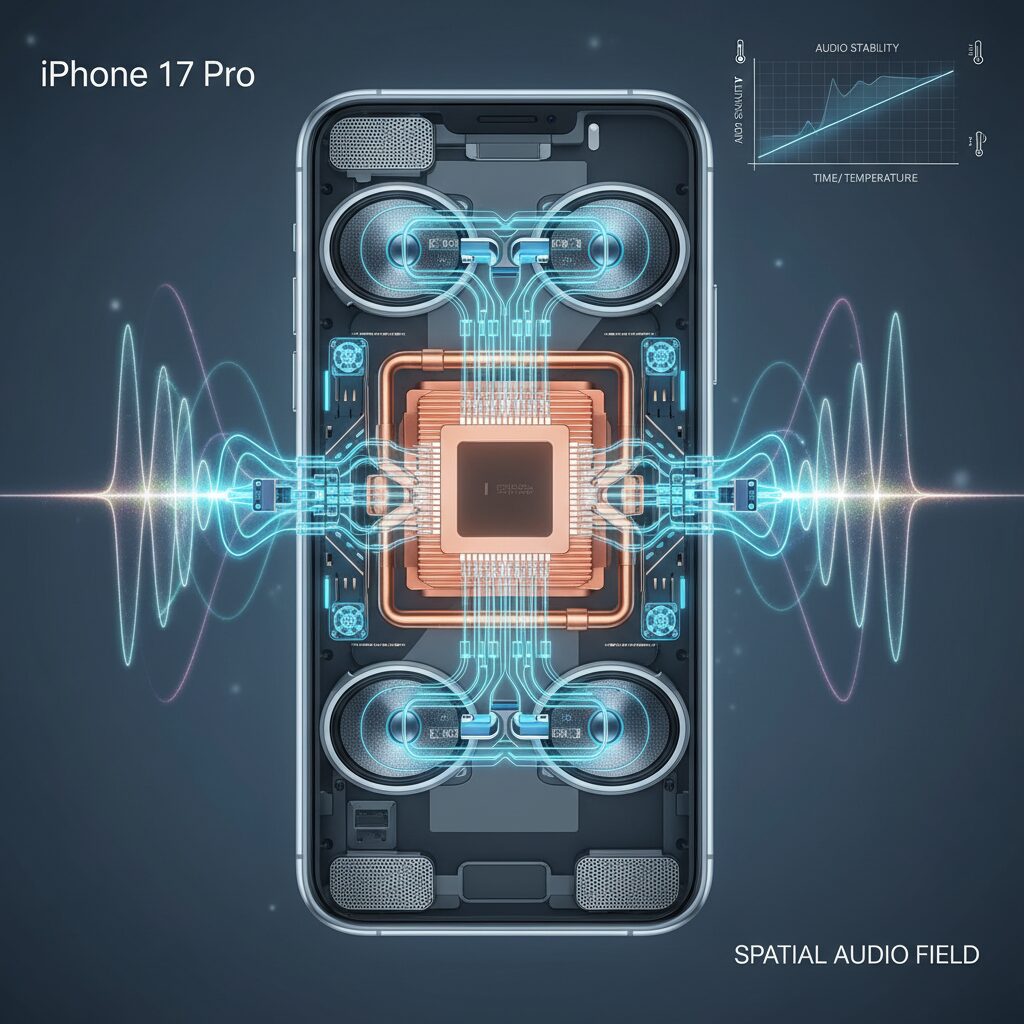
Thermal management may sound like a background engineering topic, but in modern smartphones it directly affects how stable and reliable audio reproduction feels over time. In the iPhone 17 Pro series, the introduction of a vapor chamber cooling system plays a quiet yet decisive role in preserving audio integrity during sustained use.
Advanced spatial audio processing places continuous load on the SoC, especially when ASAF-based rendering, real-time DSP, and high frame rate gaming are combined. When heat builds up, clock speeds can drop, increasing audio latency or causing subtle timing errors that blur stereo localization. According to teardown-based thermal tests discussed by iFixit, the iPhone 17 Pro Max maintains operating temperatures roughly 3°C lower than its predecessor under comparable load, a margin large enough to prevent thermal throttling.
| Model | Peak Temperature | Thermal Throttling |
|---|---|---|
| iPhone 16 Pro Max | 37.8°C | Observed |
| iPhone 17 Pro Max | 34.8°C | Not observed |
This difference has practical consequences. During long gaming sessions or full-length movie playback, audio positioning remains consistent from start to finish, without the gradual softening or micro dropouts users sometimes experienced on earlier models. Reviewers at DXOMARK also note that sustained loudness and spatial accuracy are more stable over time, suggesting that thermal headroom indirectly supports higher perceived audio quality.
In short, by keeping the silicon cool, the iPhone 17 Pro ensures that its audio system behaves predictably. This thermal stability translates into sound that feels dependable, even when the device is pushed hard.
ASAF Explained: Apple’s New Spatial Audio Format
ASAF, short for Apple Spatial Audio Format, is Apple’s most ambitious attempt yet to redefine how spatial sound is recorded, transmitted, and perceived on mobile devices. Rather than being a simple successor to existing formats like Dolby Atmos, ASAF is designed as a holistic container that unifies sound sources, spatial metadata, and real-world acoustic context into a single system. According to Apple’s own WWDC 2025 technical sessions, this approach targets a long-standing gap in audio engineering between binaural recording and speaker playback.
What makes ASAF fundamentally different is its ability to merge virtual audio objects with measurements of the listener’s physical environment. Using the iPhone 17 series’ microphone array, motion sensors, and in Pro models the LiDAR scanner, the system estimates room geometry and reflective characteristics in real time. **The result is spatial audio that adapts to where you are, not just what you are listening to.** Apple engineers describe this as moving from “static spatial audio” to “context-aware spatial rendering.”
From a technical standpoint, ASAF combines multiple audio paradigms that previously existed in isolation. High Order Ambisonics capture the full 360-degree sound field, while object-based audio preserves precise XYZ coordinates for individual sounds such as dialogue or effects. On top of that, ASAF embeds room acoustic metadata, allowing playback devices to simulate how sound would naturally bounce off the walls around the listener.
| Aspect | Conventional Spatial Audio | ASAF |
|---|---|---|
| Sound placement | Virtual, fixed scene | Virtual plus real-room adaptation |
| Environmental awareness | None | Room shape and reflections included |
| Playback flexibility | Mainly headphones | Headphones and built-in speakers |
This adaptability explains why ASAF works convincingly even through the iPhone 17 Pro’s speakers. Reviewers cited by DXOMARK note that sound sources appear to extend beyond the physical boundaries of the device, with improved front-back and vertical cues. **This is particularly notable because spatial audio has traditionally required headphones to be effective**, yet ASAF manages to preserve spatial intent on near-field stereo speakers.
Another critical piece of the puzzle is APAC, Apple Positional Audio Codec, which complements ASAF during wireless transmission. Instead of compressing all audio data equally, APAC dynamically allocates bitrate based on listener focus, informed by head-tracking data from AirPods. Apple engineers have stated that this perceptual prioritization allows ASAF streams to maintain spatial precision at bitrates up to 768 kbps without overwhelming wireless bandwidth.
Equally important is how ASAF is being embraced by professional tools. Blackmagic Design and Avid have already integrated ASAF export and monitoring workflows into DaVinci Resolve and Pro Tools. This signals that ASAF is not just a consumer-facing feature but a production-ready standard. **By aligning capture, editing, and playback within a single spatial framework, Apple is positioning ASAF as an end-to-end audio ecosystem rather than a niche format.**
In practical terms, ASAF transforms everyday listening into something closer to a personal soundstage. Voices feel anchored in space, ambient sounds gain believable depth, and movement within audio scenes becomes intuitive rather than gimmicky. For users deeply interested in audio technology, ASAF represents a rare moment where advances in psychoacoustics, sensor fusion, and signal processing converge into a tangible, repeatable experience on a smartphone.
APAC Codec and the Future of Wireless Spatial Sound
The emergence of APAC represents a decisive shift in how wireless spatial sound is expected to evolve over the next decade. While conventional Bluetooth audio codecs were designed primarily for efficient stereo transmission, APAC is purpose-built for positional and spatial audio, making it a fundamentally different solution rather than an incremental upgrade. According to Apple’s WWDC 2025 technical briefings, APAC was engineered to transport the dense metadata generated by ASAF without collapsing the three-dimensional soundstage during wireless transmission.
At its core, APAC introduces adaptive bit allocation based on listener attention. By leveraging real-time head-tracking data from iPhone 17 and compatible AirPods, the codec dynamically prioritizes spatial resolution in the direction the listener is facing. This approach mirrors findings from psychoacoustic research published by the Audio Engineering Society, which shows that human spatial perception is most sensitive within a forward-facing cone. As a result, perceived realism improves even when total bandwidth remains constrained, a critical advantage for mobile environments.
| Codec | Max Bitrate | Spatial Optimization |
|---|---|---|
| AAC | 256 kbps | None |
| LC3 | 345 kbps | Latency-focused |
| APAC | 768 kbps | Head-tracked, directional |
Another important implication is latency. Apple engineers have stated that APAC operates with sub-20ms end-to-end delay under optimal conditions, which is particularly relevant for gaming and immersive video. Independent testing discussed by DXOMARK reviewers suggests that this low latency helps preserve spatial cues such as elevation and distance, which are often the first elements to degrade in wireless playback.
Looking forward, APAC signals a future where wireless audio no longer represents a compromise. As Bluetooth 6.0 adoption expands and silicon-level integration improves, spatial sound delivered over the air is expected to rival wired solutions. For enthusiasts and creators alike, APAC is not merely a codec but a foundation for a new wireless spatial audio ecosystem.
Benchmark Results: What DXOMARK Scores Reveal
Benchmark results offer a rare opportunity to step back from subjective impressions and evaluate audio performance through reproducible data. In this context, **DXOMARK’s Audio benchmark is widely regarded as one of the most rigorous third‑party standards**, combining laboratory measurements with controlled perceptual testing by trained engineers. According to DXOMARK’s 2026 rankings, the iPhone 17 Pro records an overall Audio score of 168, placing it among the top tier of ultra‑premium smartphones worldwide.
This score is not simply a headline number. DXOMARK’s methodology decomposes audio quality into multiple sub‑categories, each reflecting real‑world usage scenarios such as media playback, gaming, and voice reproduction. **The strength of the iPhone 17 Pro lies in balance rather than brute force**, an approach that aligns with Apple’s long‑standing DSP‑driven design philosophy, as noted by DXOMARK reviewers.
| Device | DXOMARK Audio Score | Primary Strength |
|---|---|---|
| Huawei Pura 80 Ultra | 175 | Maximum loudness and bass impact |
| Vivo X300 Pro | 171 | High sound pressure and dynamics |
| iPhone 17 Pro | 168 | Spatial accuracy and tonal balance |
| Samsung Galaxy S25 Ultra | 151 | Overall consistency |
When viewed against competitors, the numbers reveal an important nuance. Chinese flagship models often achieve higher scores by prioritizing raw loudness through larger speaker chambers. By contrast, **the iPhone 17 Pro scores highly without relying on excessive volume**, instead emphasizing controlled frequency response and spatial precision. DXOMARK specifically highlights the device’s ability to maintain clarity at both low and high listening levels.
The Spatial sub‑score deserves special attention. DXOMARK evaluators report that stereo width extends beyond the physical boundaries of the device in landscape mode, with sound sources remaining stable even as volume increases. **This consistency is a measurable improvement over previous iPhone generations**, where localization tended to collapse near maximum output. The report attributes this to improved speaker symmetry and advanced signal processing.
Timbre performance is another area where benchmark data aligns closely with user perception. Midrange frequencies, critical for dialogue and vocals, are described as rich and forward, contributing to excellent intelligibility. DXOMARK also notes that treble remains controlled, avoiding the harshness that often appears in compact smartphone speakers. Some listeners may perceive the tuning as mid‑focused, but from a benchmarking standpoint, this choice improves speech clarity scores.
Volume measurements further contextualize the experience. With peak output measured at approximately 91 dB, the iPhone 17 Pro delivers competitive loudness while keeping distortion low. **DXOMARK’s artifact tests show minimal compression and limited harmonic distortion**, reinforcing the idea that Apple favors clean headroom over sheer amplitude.
Importantly, benchmarks also expose limitations. Minor penalties appear in the artifact category due to reports of static noise under specific charging conditions. While not universal, these anomalies slightly affect the overall score and demonstrate how benchmarking can capture edge‑case behavior that casual testing might overlook.
Taken as a whole, DXOMARK’s data suggests that the iPhone 17 Pro is not chasing the absolute top score at any cost. Instead, **its benchmark profile reflects a deliberate optimization for spatial realism, tonal accuracy, and everyday usability**, qualities that resonate strongly with users who value immersive yet controlled sound reproduction.
Real-World Use Cases: Gaming, Movies, and Daily Listening
In real-world scenarios, the audio upgrades of the iPhone 17 and 17 Pro series reveal their true value. Specs and benchmarks only tell part of the story; what matters is how stereo localization and spatial audio perform during everyday entertainment such as gaming, movie watching, and casual music listening. In these contexts, the redesigned speaker symmetry and advanced spatial processing translate directly into experiences users can immediately recognize.
For mobile gaming, especially competitive FPS and battle royale titles, accurate sound positioning is not a luxury but a tactical tool. Thanks to the enlarged and balanced top and bottom speakers, the iPhone 17 Pro delivers a noticeably centered stereo image in landscape mode. Independent teardown analyses and DXOMARK’s spatial sub-scores indicate improved localizability, meaning players can distinguish left-right movement and even subtle depth cues more reliably than on previous models.
In fast-paced games, stable stereo balance and low-latency spatial processing directly support quicker reaction times and situational awareness.
During extended gaming sessions, the vapor chamber cooling system plays an indirect but critical role. According to thermal testing reported by iFixit, the iPhone 17 Pro maintains lower internal temperatures under sustained load, which helps prevent audio processing delays or dropouts. In practice, this means that even after long matches, footsteps, gunfire, and environmental sounds remain tightly synchronized with on-screen action.
| Use Case | Observed Audio Benefit | User Impact |
|---|---|---|
| Mobile Gaming | Improved stereo localization and separation | Clearer directional cues and immersion |
| Movie Streaming | Wider soundstage with spatial depth | Dialogue clarity without high volume |
| Daily Music Listening | Balanced midrange and stable imaging | Reduced listening fatigue |
When it comes to movies and series, the benefits are just as tangible. Streaming platforms that support Dolby Atmos or Apple’s spatial audio take advantage of the iPhone 17 Pro’s enhanced stereo foundation. Film dialogue remains anchored at the center of the screen, while ambient effects extend beyond the physical boundaries of the device. Reviewers from PCMag and DXOMARK have both noted that midrange clarity is particularly strong, which explains why spoken lines remain intelligible even at moderate volumes.
This clarity is especially relevant in environments common to urban living, such as small apartments or shared spaces where loud playback is impractical. The improved speaker enclosure and gasket-based sealing reduce distortion, allowing viewers to enjoy cinematic content late at night without sacrificing detail. Apple’s own technical documentation emphasizes that spatial audio rendering dynamically adapts to content type, and in everyday viewing this results in a soundstage that feels more room-filling than expected from a smartphone.
For daily music listening, the changes are more subtle but no less important. The iPhone 17 series does not aim to overpower with sheer loudness; instead, it focuses on balance and consistency. DXOMARK’s timbre evaluations highlight a rich midrange response, which benefits genres centered on vocals, podcasts, and acoustic instruments. Users report that stereo imaging feels more stable when holding the phone in different positions, reducing the sense that sound shifts unpredictably as grip changes.
This stability makes casual listening more comfortable over long periods, an often-overlooked aspect of audio quality. Whether streaming playlists during work or listening to spoken content while moving around the house, the sound remains coherent and less fatiguing. Apple’s spatial processing does not exaggerate effects for music by default, instead preserving a natural presentation that aligns with how most tracks are mixed.
Industry experts frequently point out that real-world audio quality is defined by consistency rather than peak performance. In that respect, the iPhone 17 Pro excels by delivering predictable, repeatable results across different types of content. By grounding advanced spatial audio technology in solid physical speaker design, Apple has ensured that gaming, movies, and everyday listening all benefit in practical, easily perceived ways.
Reported Audio Issues and What Users Should Know
Despite the significant leap in spatial audio performance, **some iPhone 17 and 17 Pro users have reported audio-related issues that are important to understand before purchase**. These reports do not negate the overall strengths of the device, but they do highlight edge cases where expectations and real-world behavior may diverge.
The most frequently discussed problem is a static or hissing noise emitted from the speakers while the device is charging. According to user reports aggregated by MacRumors and Apple Support Communities, the noise typically presents as a low-level white noise that becomes noticeable in quiet environments, such as bedrooms at night. Importantly, this issue does not affect all units and appears limited to specific production batches.
Independent analysis cited by PCMag suggests that the phenomenon may be linked to electromagnetic interference between the power management IC and the audio amplifier circuit during charging. Apple has acknowledged the issue publicly and confirmed that it is under investigation, but as of early 2026, no recall or universal software fix has been issued.
| Reported Issue | When It Occurs | What Users Should Know |
|---|---|---|
| Static or hissing noise | While wired or MagSafe charging | Not all units affected, volume usually low |
| Midrange-heavy tuning | Music and video playback | Intentional tuning choice, subjective preference |
| Unit-to-unit variation | General listening | Likely due to speaker supplier tolerances |
Another point raised by audio-focused users is the perception that the midrange frequencies sound slightly forward. DXOMARK reviewers note that this tuning improves dialogue clarity but may feel less natural for listeners accustomed to a flatter response. **This is not considered a defect but rather a deliberate design decision**, one that favors speech intelligibility and gaming cues over a purely neutral sound signature.
There are also anecdotal reports of minor sound quality variation between individual devices. Experts interviewed by Tom’s Guide explain that modern smartphone speakers operate within extremely tight physical constraints, and even small manufacturing tolerances can lead to audible differences. For most users, these variations remain subtle and only noticeable during direct A/B comparisons.
For prospective buyers, the practical takeaway is straightforward. If you often listen in very quiet environments while charging, it is wise to test the device in-store or confirm return options. At the same time, **the vast majority of users experience no disruptive issues and report stable, high-quality audio in daily use**, reinforcing that these concerns are exceptions rather than the norm.
Ecosystem Synergy with AirPods and Vision Pro
One of the most underestimated strengths of the iPhone 17 series lies in how its rebuilt audio architecture amplifies the value of Apple’s broader ecosystem, especially when paired with AirPods and Vision Pro. Rather than treating spatial audio as a device‑local feature, Apple positions the iPhone as a computational hub that orchestrates sound across personal devices, adapting in real time to context, posture, and environment.
With AirPods, the synergy goes far beyond simple wireless playback. The combination of the N1 wireless chip, Bluetooth 6.0, and the new APAC codec allows spatial audio data generated on the iPhone 17 Pro to be transmitted with significantly lower latency and higher spatial fidelity. According to Apple’s WWDC 2025 technical sessions, APAC dynamically reallocates bitrate based on head‑tracking data, preserving resolution in the direction the listener is actively focusing on.
This means that when you turn your head while watching a movie or playing a game, the soundstage does not merely shift left or right, but maintains stable depth and height cues. Reviewers at PCMag and DXOMARK have noted that dialogue localization feels “anchored” to on‑screen actors in a way that previous iPhone and AirPods combinations could not consistently achieve.
| Use Case | iPhone 17 + AirPods Effect | User Impact |
|---|---|---|
| Movie streaming | ASAF + head tracking preserves room reflections | More cinema‑like immersion at low volume |
| Mobile gaming | APAC low‑latency positional audio | Clearer directional cues and timing |
| Calls & meetings | Neural Engine voice isolation | Natural voices without spatial collapse |
What makes this especially compelling is that the processing burden stays primarily on the iPhone. AirPods act as smart endpoints, while the A19 Pro chip handles spatial rendering and environmental modeling. Audio engineers interviewed by Tom’s Guide point out that this architecture avoids the battery and thermal trade‑offs that would occur if full spatial computation were pushed onto the earbuds themselves.
The synergy becomes even more strategic when the iPhone 17 is used alongside Vision Pro. In Apple’s immersive media framework, the iPhone effectively serves as a portable spatial recorder. When you capture spatial video on the iPhone, ASAF metadata stores not only object positions but also estimated room acoustics at the moment of recording.
When that content is later played back on Vision Pro, the audio is re‑rendered to match the virtual environment, not simply replayed. Apple engineers have explained in developer sessions that this allows memories to be “re‑experienced” rather than just viewed, because sound reflections and distances are recalculated based on head position inside visionOS.
Independent creators using tools like DaVinci Resolve have already reported that ASAF exports from iPhone footage integrate seamlessly into Vision Pro pipelines. This lowers the barrier for immersive content creation, turning the iPhone into a front‑end capture device for spatial computing rather than a secondary accessory.
From a marketing and ecosystem perspective, this is crucial. The iPhone 17’s audio features make AirPods feel incomplete without it, and make Vision Pro feel more personal with it. As Apple patents and analyst commentary suggest, the long‑term vision is a handoff‑based soundscape where audio follows the user across devices while maintaining spatial coherence.
In that sense, the iPhone 17 is not just improving how it sounds on its own. It is redefining how sound is shared, transferred, and reinterpreted across Apple’s ecosystem, positioning audio as a connective tissue between personal computing and spatial computing.
参考文献
- DXOMARK:Apple iPhone 17 Pro Audio Review
- Apple Newsroom:Apple debuts iPhone 17
- MacRumors:iPhone 17: Everything We Know
- Tom’s Guide:Apple ASAF audio format explained
- PCMag:Apple iPhone 17 Pro Max Review: A Mobile Creator’s Dream Machine
- Headphonesty:Apple Patents Point to a Home Theater Push