For decades, the QWERTY keyboard has been the unquestioned gateway to the digital world. Yet in the mid-2020s, that dominance is quietly fading as AI-powered voice input reaches a level of accuracy and speed that finally rivals — and in some cases surpasses — typing.
Thanks to deep learning, Transformer architectures, and large language models, modern speech recognition systems no longer just convert sound into text. They understand context, correct intent, and even reshape spoken words into structured emails, clean code, or publish-ready drafts.
In this article, you will explore benchmark data comparing Whisper, ReazonSpeech, Google, and IBM models, discover platform-specific optimization strategies for macOS and Windows, and learn how voice-to-code workflows and RSI prevention are reshaping digital work. If you care about gadgets, AI, and next-generation productivity, this guide will show you why the post-keyboard era has already begun.
- Why Voice Input Is Reaching an Interface Singularity
- From HMM to End-to-End AI: The Technical Evolution of Speech Recognition
- LLM-Integrated ASR: From Speech-to-Text to Voice-to-Generation
- OpenAI Whisper in 2026: Benchmarks, Strengths, and Hallucination Risks
- ReazonSpeech and the Rise of High-Performance Japanese ASR Models
- IBM Granite and the Changing Cloud Speech API Landscape
- Best Voice Input Setup for macOS: Local AI, Turbo Models, and Context Awareness
- Windows 11 Voice Typing: Built-In AI That Finally Competes
- Dedicated AI Recorders vs Traditional Hardware: PLAUD NOTE and Sony Compared
- Voice-to-Code Workflows: How Developers Are Programming by Speaking
- RSI Prevention and Ergonomics: Medical Evidence Behind Hands-Free Computing
- Digital Twins and Multimodal AI: The Future Beyond Text Input
- 参考文献
Why Voice Input Is Reaching an Interface Singularity
We are now witnessing what can only be described as an interface singularity in human–computer interaction.
For decades, the QWERTY keyboard has defined the speed limit of digital thought. Today, advances in automatic speech recognition powered by deep learning are dissolving that constraint.
Voice input is no longer an assistive workaround. It is becoming a primary cognitive interface.
The structural shift behind this moment is technological, not cosmetic. Earlier systems built on Hidden Markov Models separated acoustic modeling, pronunciation dictionaries, and language modeling into fragile pipelines. Errors accumulated, unknown words broke the system, and users had to speak in unnatural fragments.
Modern end-to-end architectures, enabled by recurrent networks and later Transformer-based models, replaced this fragmentation with unified neural systems. According to research trends reflected in large-scale open models such as OpenAI’s Whisper, trained on 680,000 hours of multilingual data, robustness to noise, accents, and hesitation improved dramatically.
The machine stopped merely decoding sounds and began modeling language.
| Generation | Core Architecture | Limitation | Capability Shift |
|---|---|---|---|
| Pre-2010 | HMM + GMM Pipeline | Error accumulation | Fragmented recognition |
| Mid-2010s | End-to-End (CTC/Attention) | Data dependency | Context awareness |
| 2024– | ASR + LLM Integration | Compute cost | Intent-level generation |
The decisive leap occurred when ASR systems began integrating with large language models. Applications such as Superwhisper demonstrate how spoken input can be reformatted automatically depending on on-screen context, converting casual speech into structured email prose or properly formatted programming code.
This represents a transition from speech-to-text to what can be described as voice-to-generation.
The system no longer transcribes what you say. It interprets what you mean.
Benchmark comparisons reinforce this inflection point. On Japanese datasets such as CommonVoice 8, Whisper Large variants have achieved single-digit word error rates, while Japan’s ReazonSpeech v2 models report character error rates around 8% on JSUT benchmarks, according to findings presented by the Association for Natural Language Processing.
Meanwhile, IBM’s Granite Speech models have topped Hugging Face’s open ASR leaderboard, signaling that enterprise-grade accuracy is entering open ecosystems.
Accuracy once considered unattainable in real-world environments is now routine.
When recognition accuracy approaches conversational reliability and latency drops to near real time, the keyboard stops being the default interface.
Singularities are defined not by gradual improvement but by irreversibility. The keyboard optimized for mechanical constraints of typewriters. Voice input optimizes for biology.
Humans speak significantly faster than they type, and modern neural models can keep pace with spontaneous speech, filler words included. Contemporary systems even filter hesitations automatically, reducing the cognitive friction that once discouraged adoption.
What changes is not only speed, but cognitive flow.
As latency decreases and contextual reasoning increases, voice becomes a command layer rather than a transcription tool. In coding environments, developers can describe intent in natural language and allow AI-assisted editors to generate structured output. In writing workflows, fragmented thoughts can be shaped into coherent drafts instantly.
The interface shifts from mechanical input to semantic orchestration.
This is why voice input is reaching an interface singularity: it collapses the gap between thought, language, and digital execution.
From HMM to End-to-End AI: The Technical Evolution of Speech Recognition
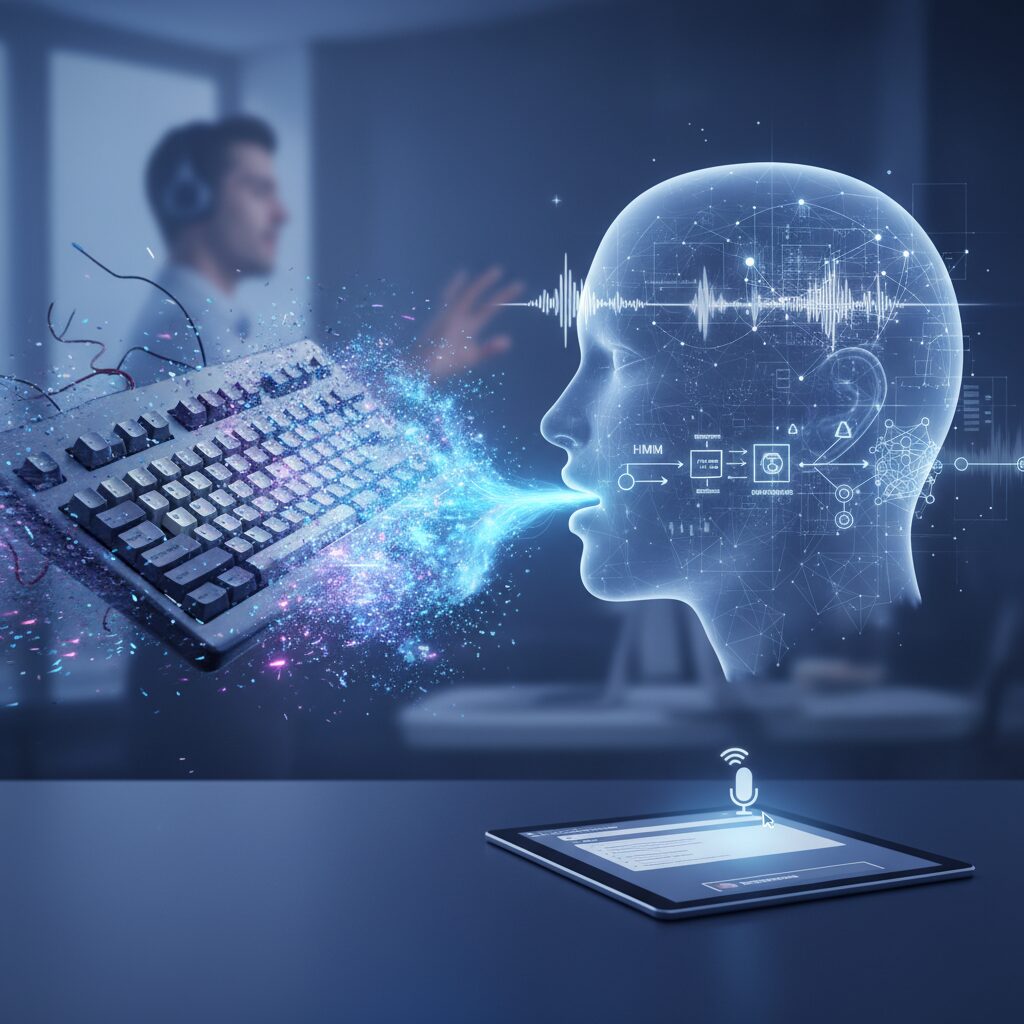
Until the early 2010s, automatic speech recognition relied on a carefully engineered statistical pipeline. Hidden Markov Models (HMMs) estimated temporal state transitions, while Gaussian Mixture Models (GMMs) modeled acoustic feature distributions such as MFCCs. This modular design separated sound, pronunciation, and language into distinct components.
In practice, three blocks worked in sequence: an acoustic model mapping waveforms to phonemes, a pronunciation lexicon converting phoneme sequences into words, and an N-gram language model ranking word sequences by probability. This architecture was elegant for its time, but structurally fragile.
Errors accumulated at every boundary. A misclassified phoneme could not be fully corrected downstream, and out-of-vocabulary words were nearly impossible to handle. For languages like Japanese, where word boundaries are ambiguous, dependence on morphological analysis further amplified error propagation.
| Era | Core Technology | Structural Limitation |
|---|---|---|
| Pre-2010s | HMM + GMM + N-gram | Pipeline error accumulation, weak context modeling |
| Mid-2010s | RNN/LSTM + CTC | Improved sequence learning, still partially modular |
| Late-2010s onward | Attention & End-to-End models | Unified optimization, strong contextual inference |
The deep learning wave fundamentally changed this landscape. Recurrent neural networks, especially LSTMs, enabled models to retain longer temporal dependencies. Connectionist Temporal Classification (CTC) allowed alignment between audio and text without frame-level labeling, eliminating the need for hand-crafted alignment rules.
The real paradigm shift came with attention-based encoder–decoder architectures. End-to-End models directly mapped raw audio features to text using a single neural network trained on paired data. According to widely cited research in the ASR community, this unified optimization significantly reduced cascading errors and improved robustness in noisy environments.
Instead of stitching together probabilities from isolated modules, the model learned the entire transformation jointly. Homophones could now be resolved using sentence-level context, not just local N-gram statistics. Domain adaptation also became dramatically simpler: fine-tuning on task-specific audio-text pairs was often sufficient.
By the early 2020s, Transformer-based architectures pushed this further. Self-attention mechanisms captured global dependencies across long utterances, improving both accuracy and fluency. OpenAI’s Whisper, trained on 680,000 hours of multilingual supervised data, demonstrated how scale and architectural simplicity could outperform highly engineered legacy systems.
The most recent phase extends beyond transcription. Integration with large language models (LLMs) shifts ASR from speech-to-text toward speech-to-intent systems. In this configuration, recognition output is no longer the final product but an intermediate representation refined by generative models.
The system does not merely decode sound; it interprets intention. Disfluencies, incomplete sentences, and informal phrasing can be normalized or reformatted automatically. This evolution marks a conceptual leap: from probabilistic decoding of phonemes to context-aware generation guided by semantic understanding.
In less than two decades, speech recognition has moved from modular statistical engineering to unified neural architectures and now to cognitively augmented systems. The technical evolution is not incremental but structural, redefining what it means to “recognize” speech in the first place.
LLM-Integrated ASR: From Speech-to-Text to Voice-to-Generation
The integration of large language models into automatic speech recognition marks a structural shift from simple transcription to real-time generation. Traditional ASR systems aimed to minimize word error rate. LLM-integrated systems aim to understand intent. This difference transforms voice from an input method into a creative interface.
According to OpenAI’s published overview of Whisper, the model already embeds language modeling capabilities trained on 680,000 hours of multilingual data. When this transcription backbone is combined with a separate generative LLM layer, the system no longer stops at converting speech into text. It interprets, reformats, summarizes, and rewrites on the fly.
A practical example can be observed in applications such as Superwhisper, which implements “Intelligent Modes.” When a code editor is active, spoken instructions are formatted as executable code. When an email client is open, casual speech is automatically rewritten into business tone. The acoustic signal is therefore routed through contextual understanding before final output appears.
| Stage | Traditional ASR | LLM-Integrated ASR |
|---|---|---|
| Primary Goal | Accurate transcription | Intent-aware generation |
| Error Handling | User manual correction | Contextual auto-correction |
| Output Form | Literal text | Structured or reformatted content |
This architecture typically follows a two-layer flow. First, a high-accuracy ASR engine such as Whisper Large V3 or ReazonSpeech produces a transcript. Second, a generative LLM refines that transcript using task-specific prompts. Research from Hugging Face leaderboards and IBM’s Granite Speech announcement shows that state-of-the-art ASR models now reach sufficiently low error rates to make downstream reasoning reliable. Without this accuracy threshold, generation would amplify mistakes.
One of the most significant advances is contextual inference. If the ASR misrecognizes “useState” as “U.S. state,” a coding-aware LLM operating inside an AI editor can infer the correct token based on file context. Instead of treating recognition errors as terminal failures, the system treats them as probabilistic signals. This layered reasoning dramatically reduces perceived friction.
Another transformation lies in filler absorption. Older systems required careful dictation. Modern pipelines tolerate hesitations, fragmented sentences, and mid-course corrections. The generative layer reorganizes fragmented speech into coherent paragraphs. As cognitive science research on speech production suggests, spontaneous speech is structurally different from written prose. LLM mediation bridges that gap in real time.
The user’s role shifts from “dictator of text” to “director of outcomes.” Rather than spelling punctuation or structuring sentences, users articulate goals: “Summarize this in three bullet-style sentences,” or “Rewrite in a formal tone.” The model interprets speech as instruction, not merely content.
This evolution also redefines latency expectations. Real-time transcription once meant displaying words quickly. In Voice-to-Generation systems, responsiveness includes reasoning speed. Turbo variants such as Whisper Large V3 Turbo reduce inference delay, enabling generative post-processing without noticeable interruption. The experience feels conversational rather than mechanical.
Importantly, this shift introduces new responsibility. Because LLMs can rephrase and expand content, users must remain aware of potential overcorrection or unintended elaboration. The system optimizes fluency, but fluency is not identical to factual accuracy. High-precision ASR combined with carefully constrained prompts becomes essential for professional workflows.
LLM-integrated ASR therefore represents more than an incremental improvement. It collapses the boundary between recognition and creation. Speech is no longer converted into text and then edited. It is transformed directly into output aligned with context, intent, and task. In this model, voice functions not as a keyboard substitute, but as a high-level command interface for generation itself.
OpenAI Whisper in 2026: Benchmarks, Strengths, and Hallucination Risks
By 2026, OpenAI Whisper remains a reference point in automatic speech recognition. Trained on 680,000 hours of weakly supervised multilingual audio, it established a new baseline for robustness against noise, accents, and spontaneous speech. According to OpenAI’s original technical report, this large-scale, web-derived dataset is the core reason Whisper generalizes so well across domains.
On public benchmarks such as Common Voice 8, results compiled on Hugging Face show that whisper-large-v3 achieves consistently lower word error rates than earlier Whisper versions, particularly in multilingual settings including Japanese. While exact scores vary by dataset and preprocessing, the trend is clear: iterative refinement has reduced both WER and CER compared to v2.
| Model | Training Scale | Notable Strength |
|---|---|---|
| Whisper Large v2 | 680k hours | Strong multilingual robustness |
| Whisper Large v3 | 680k hours (refined) | Improved WER, better punctuation |
| Whisper Large v3 Turbo | Optimized inference | Faster real-time performance |
The introduction of Large v3 Turbo is particularly important for practitioners. In real-world applications such as Superwhisper, the Turbo variant maintains near-Large-level accuracy while significantly improving inference speed, enabling practical real-time dictation on consumer hardware.
Whisper’s strengths go beyond raw accuracy. Because it was trained with weak supervision on noisy web data, it performs well in imperfect conditions: background chatter, compressed audio, or informal speech. Independent comparisons, including analyses contrasting Whisper with Google Cloud Speech-to-Text, have reported lower WER for Whisper in several open test scenarios.
However, Whisper is not immune to hallucination. Researchers and developers have observed a recurring failure mode: during silence or low-confidence segments, the model may generate repeated phrases or plausible but nonexistent text. This behavior stems from its autoregressive decoding process, which predicts the next token even when acoustic evidence is weak.
In production systems, mitigation strategies are essential. Voice Activity Detection (VAD) is commonly used to remove silence before transcription. Confidence thresholds, temperature tuning, and segment-level filtering further reduce spurious outputs. When properly configured, these safeguards dramatically lower hallucination frequency without sacrificing speed.
Another nuance in 2026 is task framing. Whisper performs differently depending on whether it is used in pure transcription mode or translation mode. Benchmark communities note that explicitly setting the language, rather than relying on automatic detection, can reduce initial latency and misclassification in short utterances.
In sum, Whisper in 2026 is best understood as a high-capacity, highly general ASR backbone: state-of-the-art in robustness, competitive in benchmark accuracy, but dependent on careful decoding control to manage hallucination risks. For advanced users, the model’s power is undeniable—but so is the need for disciplined implementation.
ReazonSpeech and the Rise of High-Performance Japanese ASR Models
ReazonSpeech has emerged as the most serious domestic challenger to global ASR giants, redefining what high-performance Japanese speech recognition looks like.
Developed by Reazon Holdings, the project is built on one of the largest Japanese speech corpora ever assembled, reportedly ranging from 19,000 to 35,000 hours of audio, including television broadcast recordings. According to research presented at the Annual Meeting of the Association for Natural Language Processing, this scale is unprecedented in the Japanese ASR domain.
This sheer volume of Japanese-native data is the foundation of its competitive edge.
Scale and Architectural Strategy
| Model | Training Focus | Key Architecture | Notable Strength |
|---|---|---|---|
| ReazonSpeech v2.1 | Japanese-specialized corpus | Zipformer | High speed with compact size |
| Fast Conformer variant | Japanese ASR optimization | Fast Conformer (NeMo) | Multi-fold inference acceleration |
In benchmark evaluations such as JSUT Basic 5000, ReazonSpeech v2 models have achieved character error rates around 8.23%, placing them on par with or slightly outperforming Whisper Large v2 in Japanese settings. This is particularly significant because Japanese ASR must handle kanji conversion, homophones, and ambiguous word boundaries simultaneously.
Unlike multilingual models that distribute capacity across dozens of languages, ReazonSpeech concentrates model capacity on Japanese phonetics, prosody, and vocabulary. As a result, it demonstrates strong recognition of proper nouns, contemporary expressions, and broadcast-style spontaneous speech.
Speed as a Strategic Weapon
Accuracy alone does not define next-generation ASR. Inference speed increasingly determines usability.
ReazonSpeech v2.1 adopts the Zipformer architecture with approximately 159 million parameters, achieving a balance between compact size and high recognition performance. Reports from NVIDIA NeMo discussions indicate that Fast Conformer-based implementations can deliver several times to over ten times faster inference compared with Whisper Large under certain configurations.
This performance profile opens the door to real-time, low-latency Japanese transcription without requiring massive GPU resources.
ONNX and the On-Device Frontier
Another strategic differentiator is ONNX format support. By providing models in Open Neural Network Exchange format, ReazonSpeech enables deployment on CPU-centric laptops and even smartphones.
For privacy-conscious users or enterprise environments where audio data cannot leave the device, this capability is transformative. Offline transcription with competitive accuracy is no longer theoretical; it becomes operational.
This aligns with the broader industry shift toward edge AI, where computation happens locally to reduce latency and data exposure risks.
ReazonSpeech represents more than a domestic alternative. It signals a structural shift toward language-specialized, high-speed, on-device Japanese ASR optimized for real-world workflows.
The rise of ReazonSpeech illustrates an important macro trend in ASR evolution: specialization can rival scale. While global models leverage multilingual breadth, focused investment in a single linguistic ecosystem can yield superior performance under local constraints.
For Japanese gadget enthusiasts and productivity-driven professionals, this means the choice of ASR engine is no longer binary between accuracy and speed. ReazonSpeech demonstrates that, with the right corpus and architecture, it is possible to achieve both.
IBM Granite and the Changing Cloud Speech API Landscape
The cloud speech API market is entering a new phase, and IBM Granite Speech is at the center of that shift. For years, Google Cloud Speech-to-Text, Amazon Transcribe, and similar services defined the enterprise standard. Now, according to IBM Research, Granite Speech 3.3 8B has reached the top tier of the Hugging Face Open ASR leaderboard, outperforming well-known open models on Word Error Rate benchmarks.
This is not just a model update. It signals a structural change in how cloud-based speech recognition is evaluated and adopted.
Historically, cloud APIs competed on three pillars: accuracy, scalability, and ecosystem integration. Google leveraged its search-scale infrastructure, Amazon integrated deeply with AWS analytics pipelines, and IBM focused on enterprise-grade reliability and compliance. What Granite changes is the balance between proprietary cloud lock-in and open, benchmark-driven competition.
| Provider | Positioning | Key Strength |
|---|---|---|
| Google Cloud | Ecosystem-integrated API | Streaming stability and global infra |
| Amazon Transcribe | AWS-native service | Analytics and workflow integration |
| IBM Granite Speech | Enterprise + open leaderboard focus | Top-tier WER performance |
What makes Granite particularly notable is its transparency in public benchmarking. The Hugging Face leaderboard has become a de facto neutral arena for ASR comparison. When an enterprise-backed model ranks at the top in that environment, it reduces the traditional skepticism toward vendor-reported metrics.
This also reflects a broader cloud API transformation. In the early 2010s, cloud speech services were black boxes: you sent audio, you received text, and performance claims were difficult to independently verify. Today, open leaderboards and shared evaluation datasets create measurable accountability. Enterprise buyers now compare WER and latency figures alongside pricing tiers and compliance certifications.
The implication for advanced users is strategic freedom. If IBM can deliver state-of-the-art recognition while maintaining enterprise compliance standards, procurement decisions shift from “Which cloud is safest?” to “Which model performs best under my workload?”
Another important dimension is hybrid deployment. IBM has positioned Granite within a broader AI portfolio that supports enterprise integration patterns. This aligns with a growing demand for flexible deployment—cloud, on-premises, or controlled environments—particularly in finance, healthcare, and government sectors where data residency requirements are strict.
Meanwhile, Google and Amazon continue to emphasize streaming reliability, multilingual scaling, and seamless integration with productivity platforms and analytics services. For developers building real-time transcription dashboards or call-center intelligence systems, API maturity and SDK tooling remain critical factors beyond raw WER.
The competitive landscape is therefore no longer a simple accuracy race. It is a multidimensional optimization problem balancing benchmark performance, compliance readiness, ecosystem depth, and deployment flexibility.
IBM Granite’s rise on open ASR rankings suggests that enterprise vendors can compete head-to-head with research-driven open models. For gadget enthusiasts and technical decision-makers, this means the cloud speech API layer is becoming more transparent, more performance-driven, and ultimately more replaceable than ever before.
In practical terms, the era of unquestioned cloud dominance is over. We are entering a stage where measurable performance, not brand inertia, defines the speech recognition stack.
Best Voice Input Setup for macOS: Local AI, Turbo Models, and Context Awareness
On macOS, the optimal voice input environment is built on three pillars: local AI processing, Turbo-class models, and context-aware post-processing. When these elements are aligned, voice input stops feeling like dictation and starts functioning as a real-time cognitive extension.
The key is minimizing latency while maximizing semantic accuracy. Even a one-second delay between speech and on-screen text disrupts thought flow. Local execution of ASR models eliminates network round trips and stabilizes performance regardless of Wi-Fi conditions.
Superwhisper is currently the most integrated solution for this approach on Mac. It runs OpenAI’s Whisper models directly on Apple Silicon, enabling private, offline transcription with near real-time feedback.
| Configuration | Processing Location | Practical Impact |
|---|---|---|
| Cloud API | External server | Network latency, data transmission required |
| Local Whisper Large | On-device (Mac) | High accuracy, heavier compute load |
| Whisper Large V3 Turbo | On-device (optimized) | Balanced speed and accuracy for daily input |
The introduction of Whisper Large V3 Turbo significantly changed usability. According to benchmark discussions on Hugging Face and developer analyses, V3 variants reduced error rates compared to earlier Large versions while improving inference speed. In practice, Turbo models maintain high Japanese accuracy while feeling responsive enough for live drafting.
On Apple Silicon Macs, especially M-series chips with Neural Engine acceleration, this balance becomes practical. The system can transcribe continuously without thermal throttling in typical writing sessions.
Equally important is fixing the language setting to Japanese rather than relying on auto-detection. Short utterances such as “yes” or technical terms can trigger misclassification in auto mode, introducing unnecessary delay and instability.
However, raw transcription is only half the story. Context awareness transforms voice input from speech-to-text into intent-to-output.
Modern macOS tools can detect the active application and adjust formatting accordingly. When dictating inside a code editor, spoken instructions are structured as code blocks. In a mail client, casual speech can be normalized into business prose.
This mirrors the broader ASR–LLM integration trend described in recent AI research: recognition handles acoustic decoding, while language models repair structure, punctuation, and style. IBM’s Granite Speech and other leaderboard-topping systems highlight how tightly coupled language modeling improves downstream usability, not just word error rate.
On macOS, this means you should think in terms of “mode design.” Prepare separate presets for:
Technical writing mode with strict punctuation and formal tone.
Coding mode optimized for structured output.
Brainstorm mode that tolerates filler words and prioritizes speed.
By predefining these behavioral contexts, you reduce cognitive switching costs. The system adapts to you instead of forcing you to adapt to it.
When local AI ensures privacy, Turbo models ensure speed, and contextual intelligence ensures semantic correctness, macOS becomes a voice-native productivity platform. At that point, the keyboard is no longer the default input device—it becomes a precision editing tool used only when necessary.
Windows 11 Voice Typing: Built-In AI That Finally Competes
Windows 11 has quietly transformed voice typing from a niche accessibility feature into a genuinely competitive AI input system. By pressing Win + H, users can activate a cloud-powered dictation engine that leverages Microsoft’s Azure speech recognition stack, bringing enterprise-grade ASR directly into the operating system.
What makes this evolution remarkable is not just accuracy, but integration. Voice typing now works consistently across browsers, document editors, chat apps, and even code environments without additional installation. For gadget enthusiasts who value frictionless workflows, this OS-level embedding changes everything.
Core Capabilities in Windows 11 Voice Typing
| Feature | Description | Practical Impact |
|---|---|---|
| Automatic punctuation | AI inserts commas and periods based on context | Reduces manual correction time |
| Voice commands | Commands like “delete that” or “stop listening” | Hands-free editing workflow |
| Multilingual support | Supports multiple languages including Japanese and English | Flexible for global users |
| Cloud processing | Powered by Microsoft’s Azure speech services | Continuous accuracy improvements |
The automatic punctuation feature deserves particular attention. According to Microsoft Support documentation, users can enable “automatic punctuation” in settings, allowing the system to infer sentence boundaries. In practice, this means you can speak naturally instead of dictating “period” or “comma” every few seconds. The cognitive load drops significantly, especially during long-form writing.
Voice commands are another major leap. Instead of reaching for a keyboard to fix errors, you can say “delete that,” “select previous word,” or “stop dictation.” This brings Windows closer to the hands-free paradigm that older dedicated speech recognition systems once promised but rarely delivered smoothly.
Earlier generations of Windows Speech Recognition required deliberate phrasing and rigid command structures. Windows 11’s implementation feels far more tolerant of natural speech patterns. While Microsoft does not publish detailed WER benchmarks for the built-in tool, Azure’s speech services are widely used in enterprise environments, and independent comparisons such as those reported by Gladia show that cloud-based systems continue to close the gap with leading open models.
There are still constraints. Because processing relies on cloud connectivity, offline use is limited compared to fully local models. Privacy-sensitive users should also be aware that audio data is transmitted to Microsoft’s servers for processing. For many consumers, however, the trade-off results in consistently strong real-time transcription.
Perhaps the most compelling aspect is accessibility democratization. Unlike third-party tools that require subscriptions or GPU resources, Windows 11 voice typing is available out of the box. No setup friction, no additional cost, no technical tuning. This lowers the barrier for experimentation and makes AI-powered dictation a default capability rather than an enthusiast add-on.
For power users willing to master command phrases and enable automatic punctuation, Windows 11 voice typing is no longer a fallback option. It is a credible, built-in AI interface that finally stands shoulder to shoulder with dedicated speech tools.
Dedicated AI Recorders vs Traditional Hardware: PLAUD NOTE and Sony Compared
When comparing a dedicated AI recorder like PLAUD NOTE with a traditional hardware recorder such as the Sony ICD-TX660, the difference is not simply “with AI or without AI.” It reflects two fundamentally different design philosophies: cloud-native intelligence versus hardware-first reliability.
Both devices capture audio, but what happens after you press record defines their value in a productivity workflow.
| Aspect | PLAUD NOTE | Sony ICD-TX660 |
|---|---|---|
| Core Concept | AI-integrated recorder | Ultra-compact digital voice recorder |
| Processing | Cloud-based (Whisper + GPT via API) | On-device recording only |
| Output | Transcript + automatic summary | Audio file (manual transcription required) |
| Cost Structure | Hardware + subscription | One-time hardware purchase |
PLAUD NOTE is designed for the post-keyboard era. With a physical switch, you can instantly record calls or in-person meetings, then upload audio to the cloud where OpenAI’s Whisper handles transcription and GPT-based models generate summaries. Reviews highlight its seamless integration with ChatGPT-style workflows and MagSafe attachment for iPhone convenience.
The device is not merely a recorder; it is an input terminal for large language models. That distinction matters. Instead of listening back to one hour of audio, you receive structured text and condensed insights within minutes.
However, this intelligence comes at a price. Subscription fees are required for AI processing, and the workflow depends on internet connectivity. For privacy-sensitive environments, sending recordings to external servers may be a concern, even if encrypted.
In contrast, the Sony ICD-TX660 embodies refinement through hardware excellence. Weighing approximately 30 grams, with a slim design that fits discreetly into a shirt pocket, it prioritizes portability and dependable microphone performance. Owner reviews frequently praise its battery life and consistent recording quality.
It does one thing—and does it exceptionally well: capture clean audio.
There is no built-in AI, no automatic transcription, and no cloud dependency. Yet this simplicity is its strength. In unstable network environments, long conferences, or legally sensitive interviews, a self-contained recorder eliminates variables. You can later process the audio with Whisper or ReazonSpeech locally, building a hybrid workflow that combines Sony’s hardware reliability with modern ASR engines.
According to recent developments in open ASR benchmarking, models like Whisper Large V3 have reached word error rates low enough to make post-recording transcription highly practical. This shifts the role of traditional recorders: they become high-fidelity data acquisition tools feeding powerful AI systems later.
If your priority is instant meeting summaries and automated knowledge extraction, PLAUD aligns with that workflow. If your priority is dependable capture under any condition, with maximum control over when and how AI is applied, Sony remains compelling.
Ultimately, the comparison is not about which device is “better.” It is about where you want intelligence to reside: embedded in the workflow from the moment of capture, or applied deliberately after pristine audio has been secured.
Voice-to-Code Workflows: How Developers Are Programming by Speaking
Voice-to-code workflows are no longer experimental. By combining high-accuracy ASR models such as Whisper Large V3 Turbo with AI-native editors like Cursor or Windsurf, developers are beginning to program by expressing intent aloud rather than typing syntax manually. This shift changes not only input speed but also how code is conceptualized.
According to comparative ASR benchmarks published on Hugging Face and analyses by IBM Research, modern speech recognition models now achieve single-digit word error rates under controlled conditions. At this level of accuracy, the bottleneck in coding is no longer recognition quality but workflow design. The question is not “Can it hear me?” but “How should I speak to maximize code generation fidelity?”
From Syntax Dictation to Intent Declaration
Early attempts at voice coding required developers to dictate punctuation and symbols explicitly: “open bracket,” “curly brace,” “semicolon.” This approach replicated keyboard behavior and proved cognitively exhausting. The modern workflow replaces syntax dictation with structured intent declaration.
Instead of saying:
“const user equals await fetch open parenthesis URL close parenthesis semicolon”
Developers now say:
“Create an async function that fetches user data from this endpoint and handles errors with try-catch.”
The editor’s embedded LLM interprets context, generates syntactically correct code, and adapts to the open file. Even if ASR misrecognizes a token, the language model often reconstructs the correct intent from surrounding code.
| Layer | Role in Workflow | Error Recovery |
|---|---|---|
| ASR (e.g., Whisper) | Converts speech to text | Handles fillers, minor noise |
| LLM in Editor | Interprets developer intent | Corrects semantic inconsistencies |
| IDE Context Engine | Reads current file & project | Aligns output with codebase |
This layered architecture means voice errors are often absorbed upstream before reaching production code. The collaboration between probabilistic transcription and contextual reasoning is the real breakthrough.
Real-World Developer Flow
In practice, developers activate voice input with a shortcut and describe modifications in natural language. For example, while editing a React component, one might say: “Add a loading state using useState, display a spinner during fetch, and show a toast on error.”
If “useState” is transcribed incorrectly, the AI editor—aware that the file imports React—corrects it during code generation. This interplay demonstrates how ASR hallucination risks, documented in analyses comparing Whisper and other systems, are mitigated by downstream reasoning layers.
Speed gains are especially visible during refactoring and boilerplate creation. Large structural changes, which would require repetitive typing, can be expressed in a single spoken instruction. Developers remain focused on architecture rather than keystrokes.
The core productivity leap comes from shifting cognitive load from symbol production to architectural thinking.
There are, however, constraints. Precise debugging, character-level edits, or writing dense regular expressions may still favor keyboard input. Many advanced users therefore adopt a hybrid rhythm: voice for generation and restructuring, keyboard for surgical refinement.
As ASR models continue to improve in robustness and latency—particularly with optimized variants like Turbo models—the friction of speaking to code diminishes further. Voice-to-code is not about replacing typing entirely. It is about elevating programming into a higher abstraction layer, where speech becomes a command interface for software design rather than a substitute for key presses.
RSI Prevention and Ergonomics: Medical Evidence Behind Hands-Free Computing
Repetitive Strain Injury (RSI) is not a theoretical risk for heavy gadget users. It is a medically documented occupational disorder affecting the hands, wrists, forearms, shoulders, and neck due to repetitive micro-movements and sustained static posture. For developers, writers, and data workers who spend hours on keyboards, this cumulative load becomes a structural problem rather than a temporary discomfort.
According to research on keyboard-based RSI published in ergonomics and occupational health journals, prolonged typing is strongly associated with upper limb disorders, especially when combined with poor posture and limited rest intervals. The mechanism is simple: tendons and surrounding sheaths are subjected to repeated friction without adequate recovery time.
Hands-free computing through modern speech recognition directly removes the primary mechanical trigger: repetitive finger and wrist motion. This is not a marginal improvement but a fundamental shift in load distribution.
| Risk Factor | Keyboard-Centric Work | Voice-Centric Work |
|---|---|---|
| Finger repetition | Thousands of keystrokes/hour | Near zero |
| Wrist extension | Sustained, often static | Minimal |
| Shoulder tension | Elevated with mouse use | Reduced when posture optimized |
| Error correction load | Manual retyping | Increasingly voice-command based |
Early 2000s research questioned whether voice recognition could truly solve RSI because low accuracy forced users to return to the keyboard for constant corrections. A study titled Is Voice Recognition the Solution to Keyboard-Based RSI? concluded that benefits were limited when recognition errors were frequent.
That limitation is materially different in 2025. With Whisper-class systems achieving single-digit word error rates in many environments, correction frequency has dropped significantly. Microsoft’s implementation of voice commands in Windows 11 further allows deletion, punctuation, and formatting without touching input devices.
AbilityNet, a UK-based digital accessibility organization, recommends early adoption of speech recognition when RSI symptoms first appear. They warn that switching the mouse to the non-dominant hand may simply transfer strain rather than eliminate it. From a biomechanical standpoint, eliminating repetition is safer than redistributing it.
However, medical ergonomics does not suggest absolute replacement. The Guardian’s technology desk has highlighted hybrid workflows as the most sustainable model. Use voice during high-volume drafting, then switch to short, precise keyboard sessions for refinement. This alternation reduces continuous load on any single muscle group.
Posture remains critical. Voice input does not automatically guarantee ergonomic safety. Users should maintain neutral neck alignment, avoid craning toward the screen, and consider standing desks to prevent static spinal loading. “Ergonomics of the Voice,” a guide from Computer Talk, emphasizes that vocal ergonomics also matters; excessive vocal strain can become a separate occupational issue.
The evidence therefore supports a nuanced conclusion. Modern hands-free computing is not merely a productivity hack. It is a medically defensible intervention that reduces one of the most well-documented risk factors in digital labor: repetitive fine motor strain. For high-intensity computer users, that shift can mean the difference between sustainable long-term output and chronic injury.
Digital Twins and Multimodal AI: The Future Beyond Text Input
As voice input evolves beyond simple speech-to-text, the next frontier lies in the convergence of digital twins and multimodal AI. This shift moves us from “transcription” to context-aware, identity-aware interaction, where systems no longer just capture words but model the person and environment behind them.
According to NTT’s announcement on its tsuzumi large language model, researchers have developed dialogue technologies capable of efficiently reproducing an individual’s speaking style and personal traits. By learning from a user’s speech and text history, a system can generate outputs that mirror that individual’s phrasing patterns and reasoning structures. This is the foundation of a practical digital twin.
A digital twin in this context is not a static voice clone, but a dynamic cognitive model trained on personal linguistic behavior.
When integrated with advanced ASR and LLM pipelines, such a twin transforms voice input into predictive collaboration. Instead of dictating every sentence, users may provide fragments—keywords, incomplete clauses, or high-level intent—while the system reconstructs full arguments consistent with their established style.
The functional distinction becomes clearer when comparing conventional voice interfaces with digital-twin-augmented systems.
| Aspect | Conventional Voice AI | Digital Twin + Multimodal AI |
|---|---|---|
| Input Processing | Speech → Text conversion | Speech → Intent + Personal Context |
| Output Style | Generic language model tone | User-specific phrasing and logic |
| Interaction Scope | Single modality (audio) | Audio + Vision + Environment data |
The multimodal dimension amplifies this transformation. Models such as GPT-4o and Google’s Gemini 2.0 demonstrate real-time processing of audio and visual inputs simultaneously. In practical terms, this means a user can speak while sharing a camera feed, and the system interprets both modalities in parallel.
Imagine repairing a device while pointing a camera at the circuit board and saying, “Replace this capacitor with the higher-voltage one.” A multimodal system identifies the referenced component visually, parses the spoken instruction, and generates a structured maintenance log. Voice becomes spatially grounded rather than purely symbolic.
For gadget enthusiasts and technical professionals, this convergence unlocks workflows previously constrained by keyboards and screens. Voice input evolves into a coordination layer across physical and digital environments, bridging coding, documentation, and field operations.
The long-term implication is profound. When a system understands not only what you say, but how you typically reason, what you are looking at, and what task context surrounds you, interaction shifts from command-based control to collaborative augmentation. The interface fades, and what remains is a synchronized cognitive loop between human and machine.
参考文献
- Hugging Face:Japanese ASR Leaderboard
- Gladia:OpenAI Whisper vs Google Speech-to-Text vs Amazon Transcribe: The ASR Rundown
- Reazon Research Blog:ReazonSpeech v2.1: Setting a New Standard in Japanese ASR
- IBM Research:IBM Granite model tops Hugging Face speech recognition leaderboard
- Microsoft Support:Use voice typing to talk instead of type on your PC
- AbilityNet:RSI in the Workplace inc Work Related Upper Limb Disorder and Computing
- The Guardian:Can speech recognition software help prevent RSI?
- NTT Group:NTT develops personalized dialogue technology for digital twins using large language models